NM_002067.5:c.506_507delinsTT (p.Thr169Ile) in GNA11 is absent from all queried population databases (gnomAD v2.1, v4.1, gnomAD-Canada), meeting PM2_Supporting.1 The variant is not a null variant (nonsense, frameshift, or canonical splice site) and does not qualify for PVS1 per ClinGen SVI PVS1 recommendations (PMC6185798); it is an in-frame delins producing a single missense substitution.2 No additional pathogenic or benign criteria are met. Computational evidence (SpliceAI max delta = 0.02) does not support PP3 or BP4, and no functional, segregation, or case-level data are available. The variant is classified as a Variant of Uncertain Significance (VUS) under generic ACMG/AMP 2015 rules; PM2_Supporting alone is insufficient to reach Likely Pathogenic or Likely Benign.3
Final classification
VUS
PM2
GNA11
c.506_507delinsTT
p.Thr169Ile
This variant
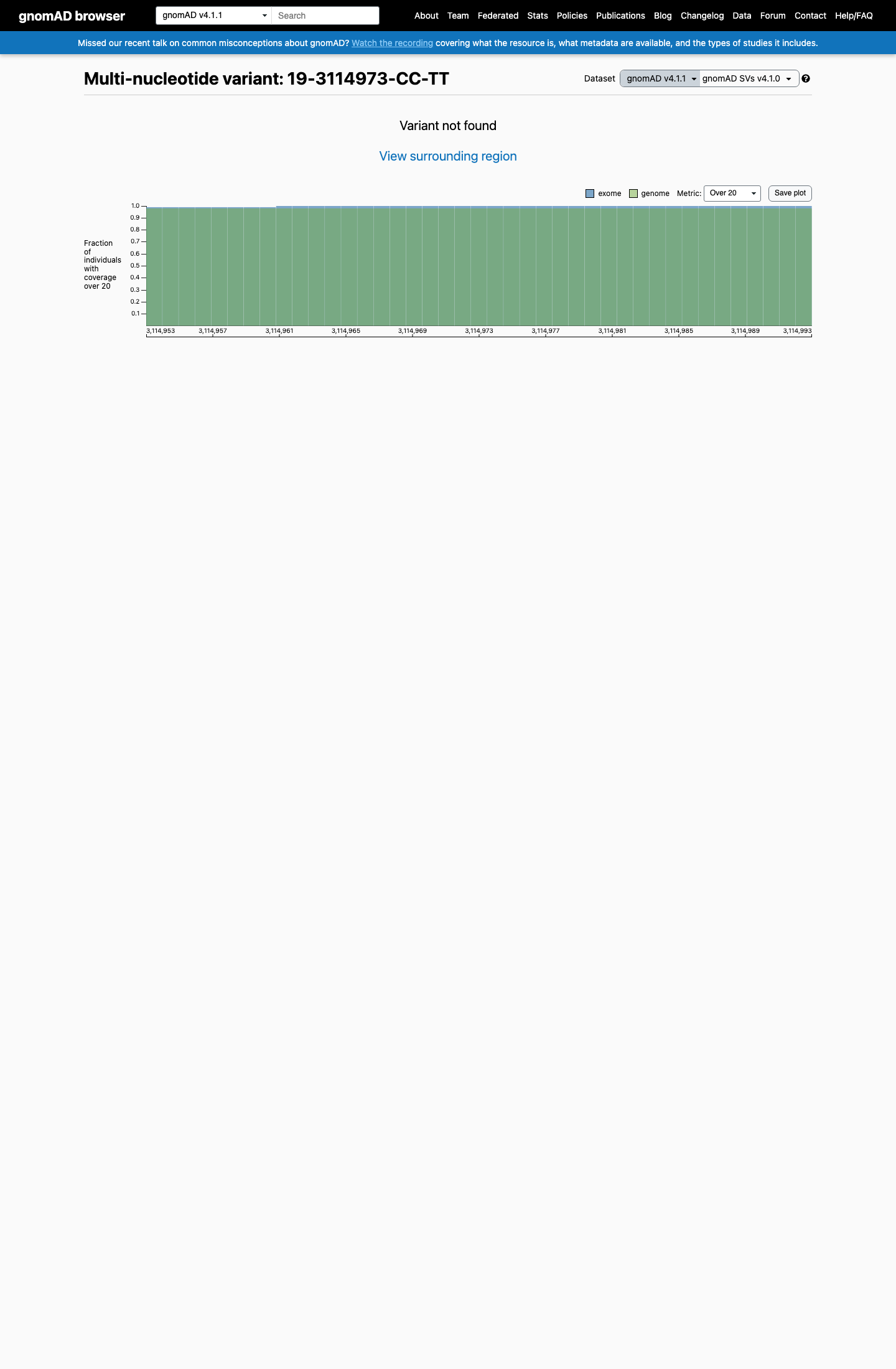
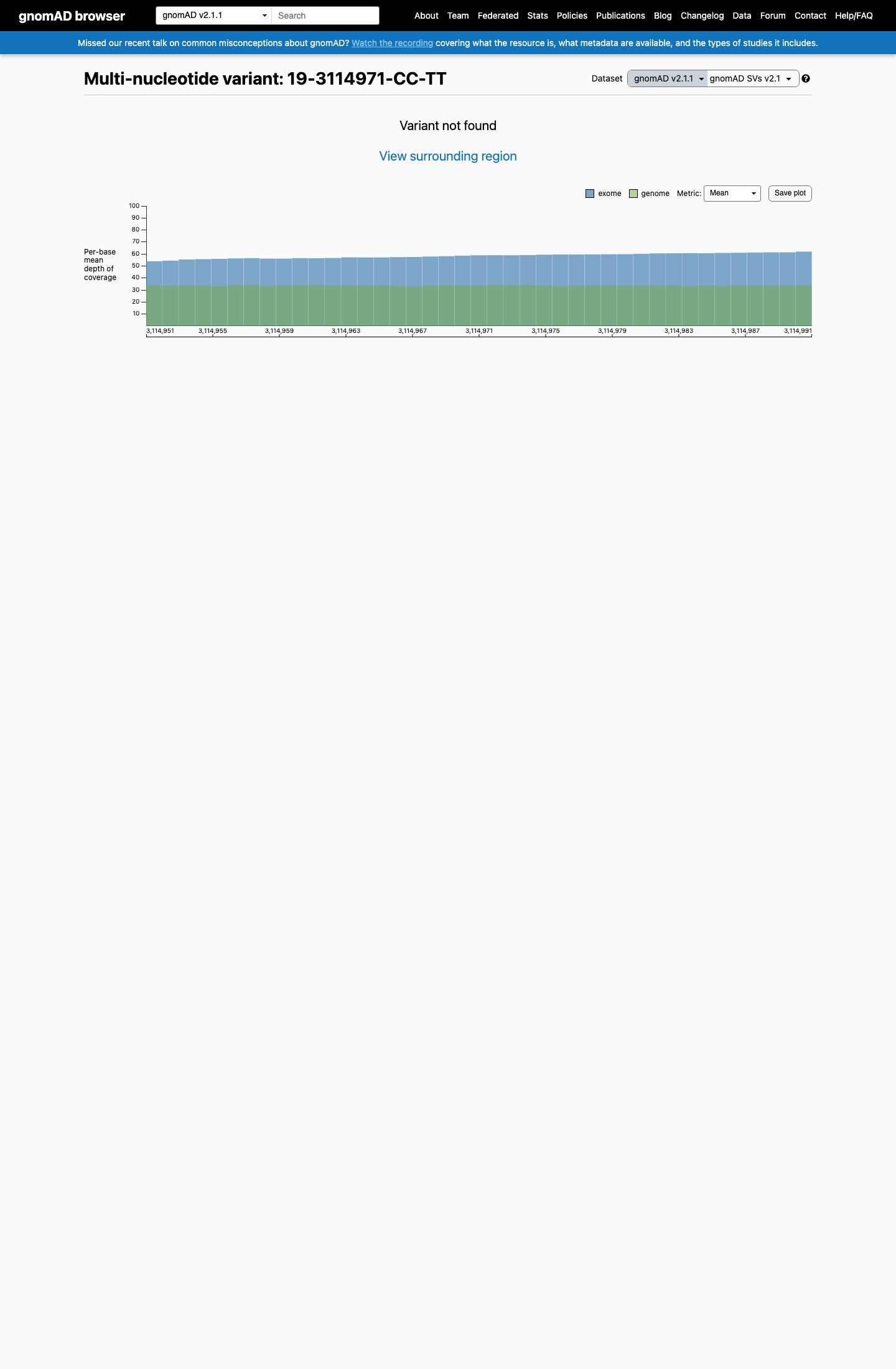
NM_002067.5:c.506_507delinsTT (p.Thr169Ile) in GNA11 is absent from all queried population databases (gnomAD v2.1, v4.1, gnomAD-Canada), meeting PM2_Supporting.
gene-specific framework lacked a usable explicit final combination framework, so generic ACMG/AMP 2015 final-combination rules were applied as fallback; applied criteria: PM2 supporting; combination = 1 supporting, which maps to VUS.
Classification rationale
PM2
VUS
GNA11 c.506_507delinsTT
PM2
→
VUS
2
pvs1_generic_framework ↗pvs1_variant_assessment
3
spliceai ↗generic_acmg_combination_rules
LYFE Sciences is an AI system, and it can make mistakes. Criteria
may be applied incorrectly, sources may be misread, and a confident-looking
classification can still be wrong. Double-check every criterion and
its underlying evidence before relying on any call.
Gene diagram
· NM_002067.5 · variants mapped to exon structure
GNA11
NM_002067.5
Fetching transcript structure from UCSC…
Applied criteria · 1 applied · 20 assessed
MetEvidence satisfies this criterion.
Not metEvaluated against available evidence; threshold not reached.
Not assessedApplies in principle, but no evidence was found to evaluate it.
N/ADoesn't apply to this variant type.
Applied · 1
Strength
Supporting
Moderate
Strong
Very strong
PM2
supporting
Pathogenic
NM_002067.5:c.506_507delinsTT is absent from gnomAD v2.1, v4.1, and gnomAD-Canada population databases (allele frequency = 0), meeting the PM2 threshold for absence from population controls (<0.1%).
Absent from gnomAD v2.1 (exomes).Absent from gnomAD v4.1 (exomes).Absent from gnomAD-Canada v1.0 (genomes).
Assessed · not applied
· 6 not met · 14 not assessed
Pathogenic
PS2
No de novo data are available for NM_002067.5:c.506_507delinsTT.
PS3
No well-established in vitro or in vivo functional studies have been identified for NM_002067.5:c.506_507delinsTT (p.Thr169Ile).
PS4
No case-control data comparing variant prevalence in affected versus unaffected individuals are available.
PM1
p.Thr169Ile is not located in a statistically significant mutational hotspot.
PM6
No de novo data are available for this variant.
PP1
No segregation data are available for NM_002067.5:c.506_507delinsTT.
PP2
HCI prior score is not available for GNA11; cannot assess whether GNA11 has a low rate of benign missense variation.
PP3
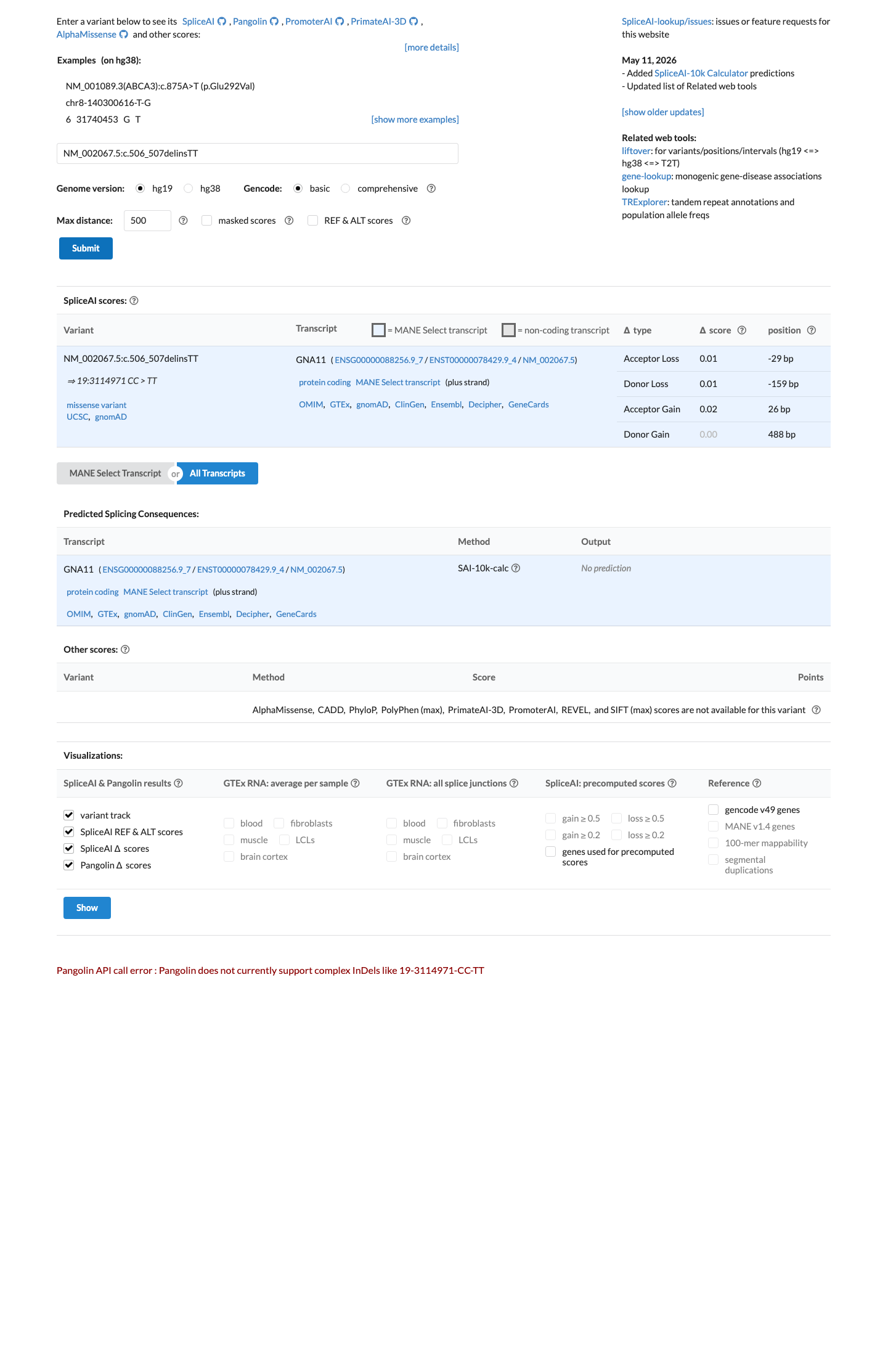
SpliceAI predicts no significant splice impact (max delta score = 0.02).
PP4
No patient phenotype or family history data are available to assess specificity for GNA11-associated disease.
PP5
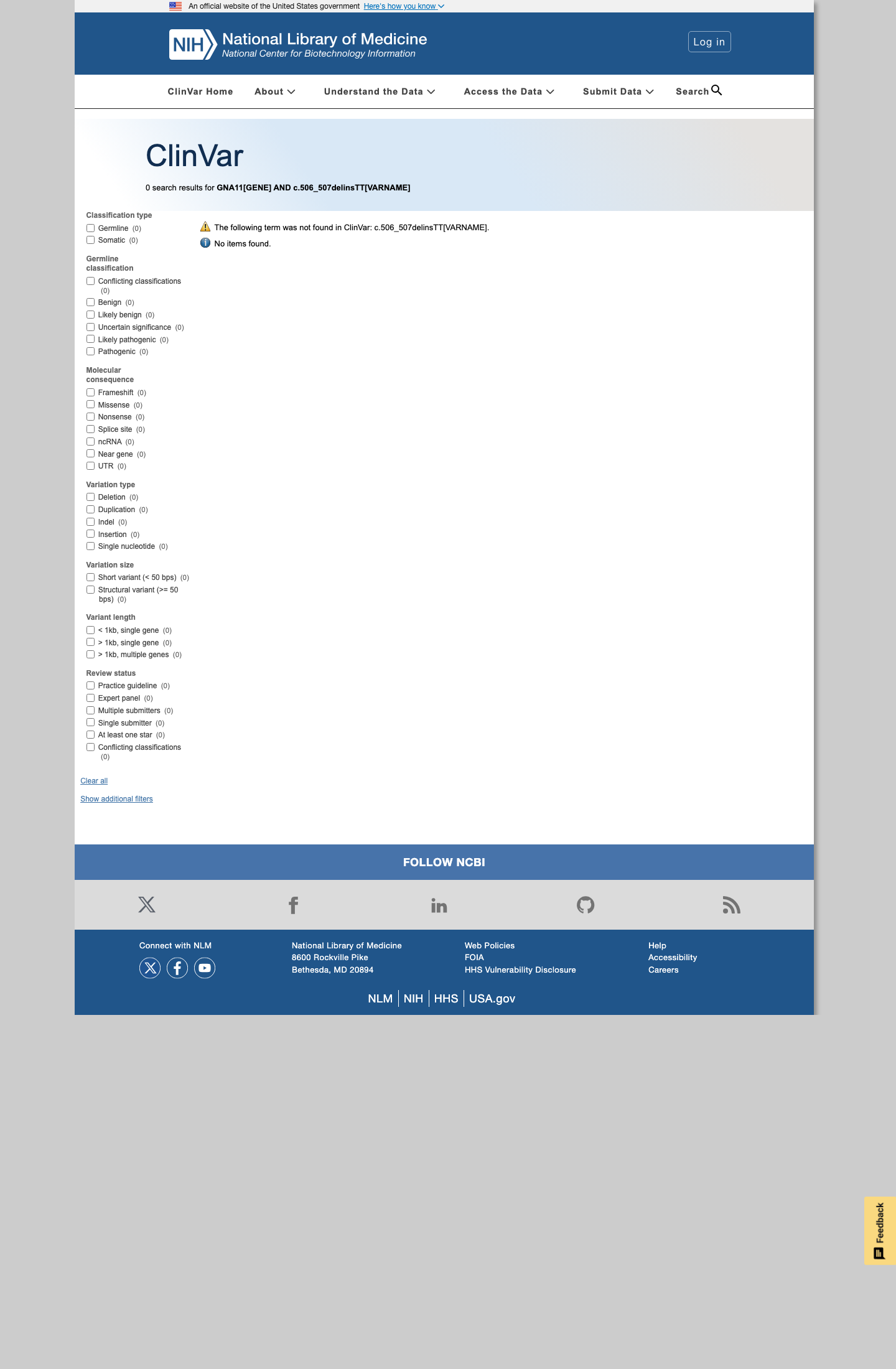
NM_002067.5:c.506_507delinsTT is absent from ClinVar.
Benign
BA1
The variant is absent from gnomAD v2.1, v4.1, and gnomAD-Canada (allele frequency = 0).
BS1
The variant is absent from gnomAD v2.1, v4.1, and gnomAD-Canada (allele frequency = 0).
BS2
No data are available regarding observation of this variant in a homozygous state or in trans with a pathogenic variant in healthy adults.
BS3
No well-established in vitro or in vivo functional studies have been identified that demonstrate no deleterious effect for NM_002067.5:c.506_507delinsTT.
BS4
No segregation data are available.
BP1
GNA11-associated disease is primarily driven by missense gain-of-function variants (e.g., Q209L, Q209P, R183C) in uveal melanoma and vascular malformations, not by truncating variants.
BP2
No data are available regarding observation of this variant in trans with a known pathogenic GNA11 variant.
BP4
SpliceAI predicts no significant splice impact (max delta score = 0.02).
BP5
No data are available regarding observation of this variant in a case where an alternative molecular basis for disease has been identified.
BP6
NM_002067.5:c.506_507delinsTT is absent from ClinVar.
N/A · 7
PVS1 · PS1 · PM3 · PM4 · PM5 · BP3 · BP7
Research & evidence
Population frequency
gnomAD v4.1
gnomAD v2.1
v4.1
Absent from gnomAD v4.1.
v2.1
Absent from gnomAD v2.1.
🇨🇦 CA
Absent from gnomAD-Canada v1.0.
Allele frequency by ancestry
three datasets · side by side
gnomAD v4.1
Absent
· 0 / ?
0 hom
0 hom
Not observed in any ancestry group.
gnomAD v2.1
Absent
· 0 / ?
0 hom
0 hom
Not observed in any ancestry group.
gnomAD Canada 🇨🇦
Absent
· 0 / ?
0 hom
0 hom
Not observed in any ancestry group.
In silico
SpliceAI predicts no significant splice impact for this variant (max delta score = 0.02).

Functional
Unknown Oncogenic Effect
OncoKB did not identify variant-specific reviewed functional evidence for this variant; gene-level curated context is available for reviewer follow-up. GNA11, a G protein subunit, is recurrently mutated in uveal melanoma.

COSMIC

Cancer hotspots
Somatic evidence
Not in COSMIC / hotspots
COSMIC
This variant does not lie in a statistically significant hotspot. This variant has not previously been reported in somatic cancers (COSMIC).
Hotspots
This variant does not lie in a statistically significant hotspot.
Sources & reference links