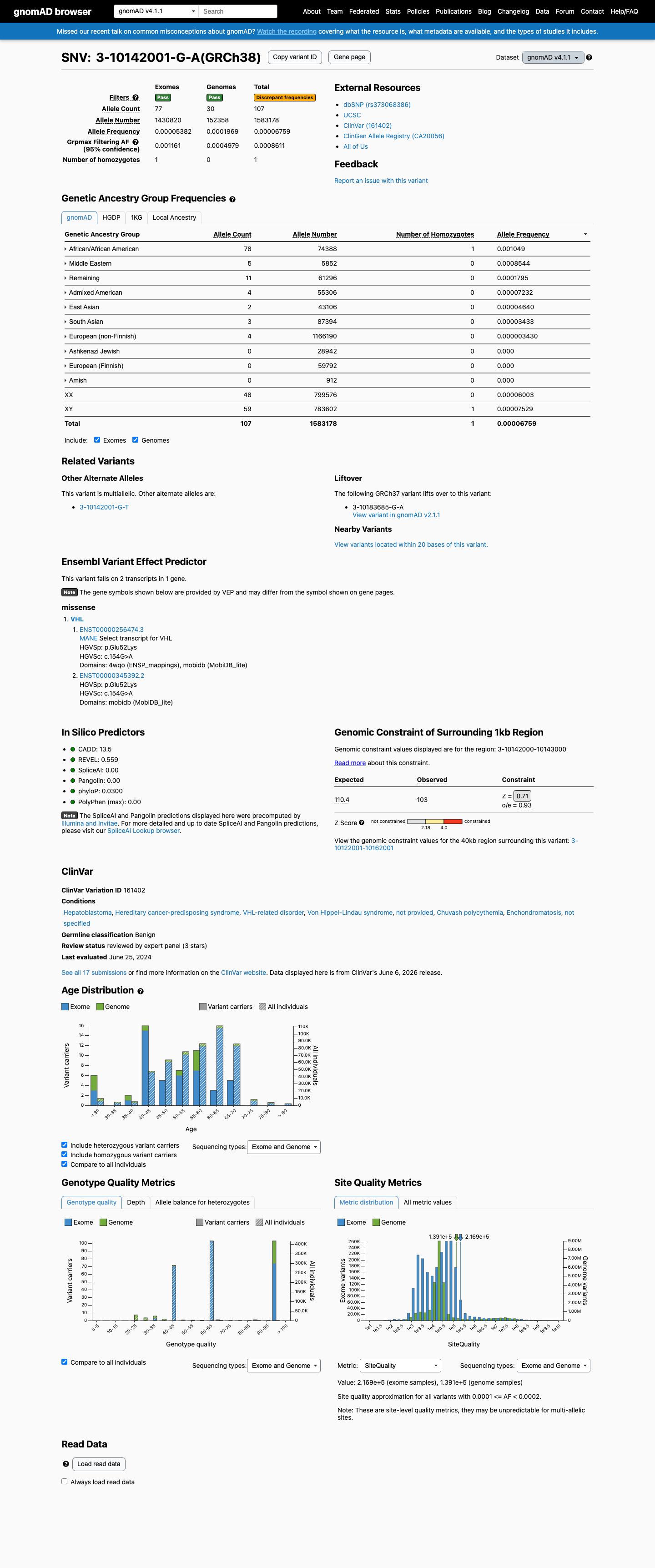
NM_000551.3:c.154G>A (p.Glu52Lys) has a GroupMax filtering allele frequency of 0.08611% (0.0008611) in gnomAD v4.1, which exceeds the VHL VCEP BA1 stand-alone benign threshold of 0.0156% (0.000156).1 The variant is observed in 107 of 1,583,178 alleles in gnomAD v4.1, including 1 homozygote, with highest frequency in the African/African American population (78/74,388 alleles, 0.1049%).2 BA1 as stand-alone benign is independently sufficient to classify the variant as Benign regardless of other evidence criteria.3 BS1 is also met at strong benign level: gnomAD v4 GroupMax FAF 0.0008611 exceeds the VCEP BS1 threshold of 0.0000156.4 BP4 is met at supporting benign level: SpliceAI predicts no splicing impact (max delta = 0.00).5 The variant was observed in 1-2 VHL families (Olschwang 1998, Gallou 2004) but this does not meet PS4 thresholds and is outweighed by population frequency data.6 ClinVar expert panel (ClinGen VHL VCEP) classifies this variant as Benign (VCV000161402).7 REVEL score of 0.559 does not meet the VHL VCEP PP3 threshold of ≥0.664. BayesDel score of -0.059 is consistent with a benign prediction.8 The variant alters codon 52, which is upstream of the second VHL initiation codon (Met54); only pVHL30 is affected while pVHL19 remains intact. This N-terminal region is outside recognized VHL critical functional domains.9
VHL
Final classification
Benign
BA1BS1BP4BP6
VHL
c.154G>A
p.Glu52Lys
This variant
NM_000551.3:c.154G>A (p.Glu52Lys) has a GroupMax filtering allele frequency of 0.08611% (0.0008611) in gnomAD v4.1, which exceeds the VHL VCEP BA1 stand-alone benign threshold of 0.0156% (0.000156).
ClinGen VHL Expert Panel Specifications to the ACMG/AMP Variant Interpretation Guidelines for VHL Version 1.1.0 v1.1.0 criteria-combination framework: matched Rule17 (1 Benign.Stand Alone) with applied criteria: BA1 stand-alone benign, BS1 strong benign, BP4 supporting benign, BP6 supporting benign; maps to Benign.
Classification rationale
BA1BS1BP4BP6
Benign
VHL c.154G>A
BA1 + BS1 + BP4 + BP6
→
Benign
Gene diagram
· NM_000551.3 · variants mapped to exon structure
VHL
NM_000551.3
Fetching transcript structure from UCSC…
Applied criteria · 4 applied · 15 assessed
MetEvidence satisfies this criterion.
Not metEvaluated against available evidence; threshold not reached.
Not assessedApplies in principle, but no evidence was found to evaluate it.
N/ADoesn't apply to this variant type.
Applied · 4
Strength
Supporting
Moderate
Strong
Very strong
✓
BA1
stand-alone
Benign
VHL VCEP BA1 threshold: GroupMax FAF ≥ 0.000156 (0.0156%) in gnomAD v4. This variant has gnomAD v4 GroupMax FAF = 0.0008611 (0.08611%) in the African/African American population (78/74,388 alleles, 1 homozygote). This is approximately 5.5-fold above the BA1 cutoff. The variant is also observed in gnomAD v2.1 with grpmax FAF 0.00037662 in the same population group. BA1 is met as stand-alone benign evidence, independently sufficient to classify this variant as benign regardless of other criteria.
gnomAD v4 GrpMax FAF 0.0008611 (0.08611%) ≥ BA1 cutoff 0.000156 (0.0156%).gnomAD v2.1 GrpMax FAF 0.00037662.Highest in African/African American: 78/74
✓
BS1
strong
Benign
VHL VCEP BS1 threshold: GroupMax FAF ≥ 0.0000156 (0.00156%) in gnomAD v4. This variant has gnomAD v4 GroupMax FAF = 0.0008611 (0.08611%), which is approximately 55-fold above the BS1 cutoff. BS1 is met as strong benign evidence. Note: BA1 (stand-alone) subsumes BS1; both are independently met.
gnomAD v4 GrpMax FAF 0.0008611 (0.08611%) ≥ BS1 cutoff 0.0000156 (0.00156%).
✓
BP4
supporting
Benign
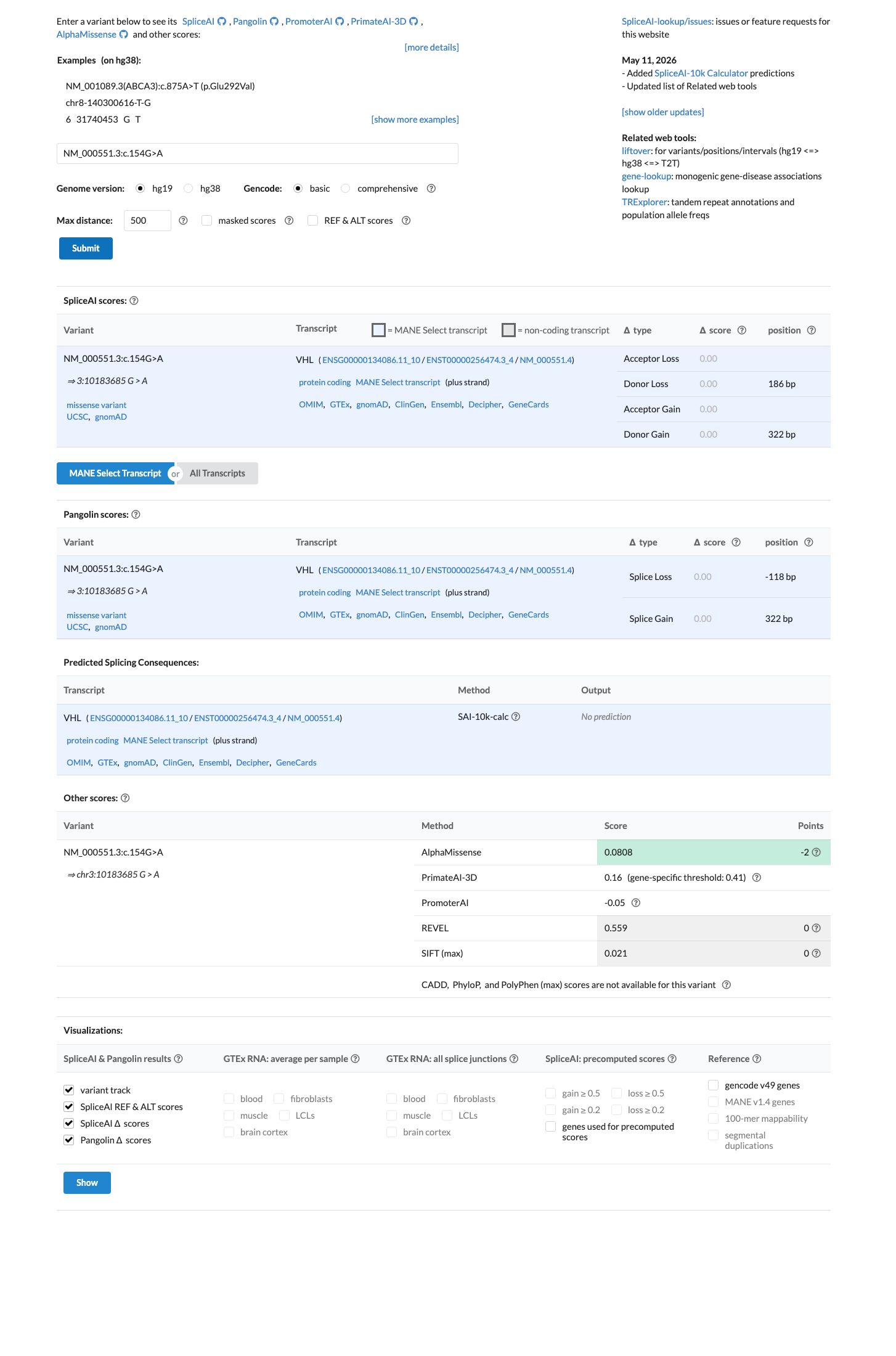
VHL VCEP BP4: missense predictors should not be used for BP4, but BP4 can be applied to assess lack of splicing impact with SpliceAI ≤ 0.1 and VarSeak Class 1 or 2. This variant has SpliceAI max delta = 0.00, indicating no predicted splice impact. Per VCEP instructions, the SpliceAI score alone can be applied if VarSeak is unable to accept the variant type. The variant is a coding missense with no predicted effect on splicing.
SpliceAI max delta score = 0.00 (no predicted splicing impact).
Assessed · not applied
· 15 not met · 0 not assessed
Pathogenic
PS1
PS1 requires a different nucleotide change at the same codon previously classified as pathogenic by the VHL VCEP.
PS2
No de novo occurrence with confirmed maternity and paternity was identified for this variant in the reviewed literature or ClinVar submissions.
PS3
No validated in vitro or in vivo functional assay demonstrating a damaging effect of E52K on VHL protein function (HIF1/2a degradation, VBC complex stability, or ECM/fibronectin binding).
PS4
The variant has been reported in a small number of VHL probands: one type 1 VHL patient in Olschwang et al.
PM1
Codon 52 resides in the pVHL N-terminal acidic repeat region (AA 1-53), upstream of the second initiation codon (Met54).
PM2
VHL VCEP PM2_Supporting requires GroupMax FAF ≤ 0.00000156 (0.000156%) in gnomAD v4.
PM5
PM5 requires a different missense change at the same residue previously classified as pathogenic by the VHL VCEP.
PM6
No assumed de novo occurrence without maternity/paternity confirmation was identified for this variant in the reviewed literature or ClinVar submissions.
PP1
No co-segregation data meeting VHL VCEP thresholds was identified.
PP3
VHL VCEP PP3 for missense variants requires REVEL score ≥ 0.664.
Benign
BS2
VHL VCEP BS2 requires at least 3 individuals ≥65 years old, unaffected, harboring this variant.
BS3
No validated functional assay demonstrating benign effect (WT-like function) of E52K on HIF1/2a degradation, VBC complex stability, or ECM/fibronectin binding.
BS4
No lack-of-segregation data available.
BP2
BP2_Strong would apply if the variant were observed in the homozygous state in an individual without VHL disease or congenital polycythemia.
BP5
BP5 requires two or more co-occurrences with pathogenic variants in a different gene that fully explain the patient's phenotype, with specific phenotype non-overlap criteria.
N/A · 7
PVS1 · PP2 · PP4 · PP5 · BP1 · BP3 · BP7
Research & evidence
Population frequency · supports benign
gnomAD v4.1
gnomAD v2.1
v4.1
This variant is present in gnomAD v4.1 (AF= 6.75856e-05; MAF= 0.00676%, 107/1583178 alleles, homozygotes = 1) and has highest observed frequency in the African/African American population (AF= 0.00104856; MAF= 0.10486%, 78/74388 alleles, homozygotes = 1); grpmax FAF= 0.0008611.
v2.1
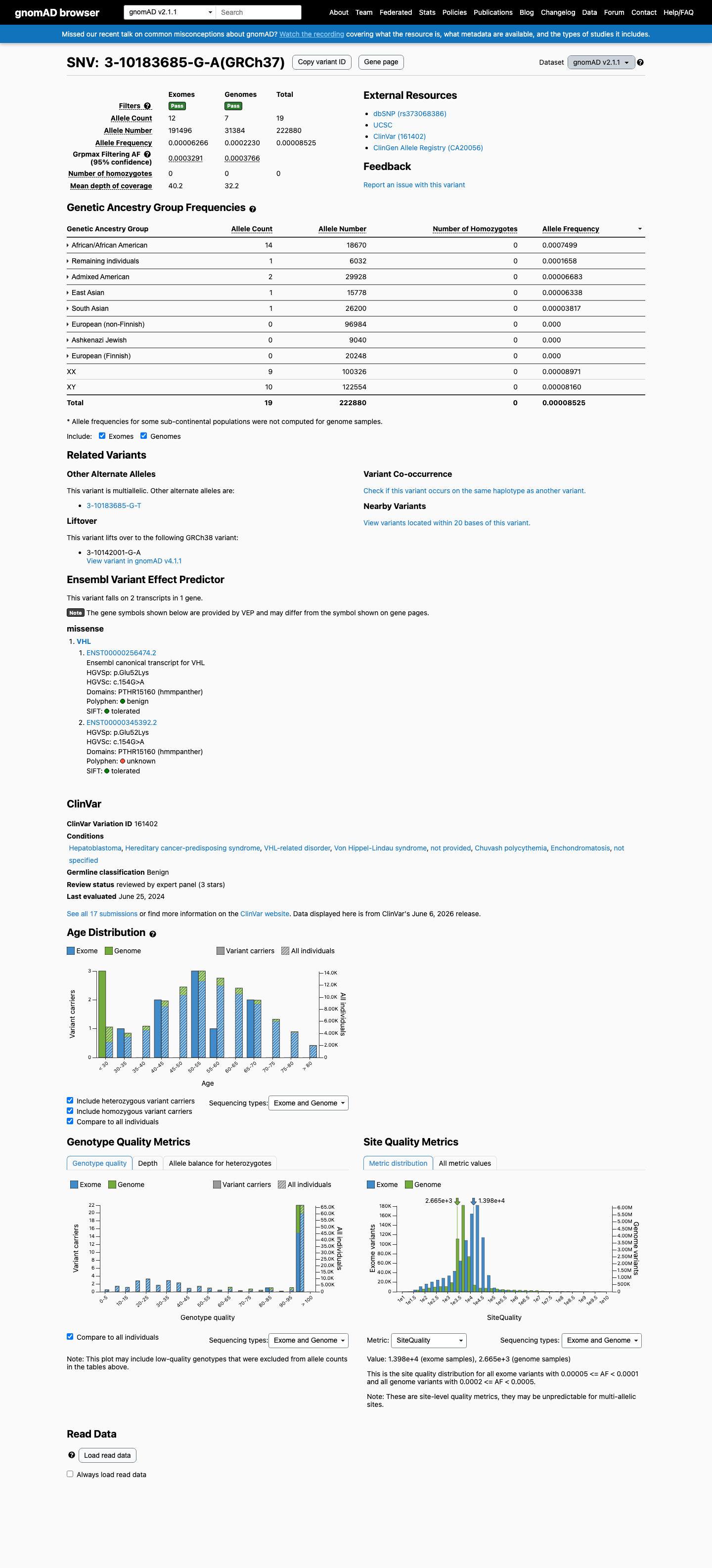
This variant is present in gnomAD v2.1 (AF= 8.52477e-05; MAF= 0.00852%, 19/222880 alleles, homozygotes = 0) and has highest observed frequency in the African/African American population (AF= 0.000749866; MAF= 0.07499%, 14/18670 alleles, homozygotes = 0); grpmax FAF= 0.00037662.
🇨🇦 CA
This variant is present in gnomAD-Canada v1.0 (AF= 0.00016284876777765715, 3/18422 alleles, homozygotes = 0).
Allele frequency by ancestry
three datasets · side by side
gnomAD v4.1
0.0068%
· 107 / 1,583,178
1 hom · FAF 0.086%
1 hom · FAF 0.086%
African/African American 78 / 74,388 |
0.1% 1 hom |
Middle Eastern 5 / 5,852 |
0.085% |
Remaining individuals 11 / 61,296 |
0.018% |
Admixed American 4 / 55,306 |
0.0072% |
East Asian 2 / 43,106 |
0.0046% |
South Asian 3 / 87,394 |
0.0034% |
European (non-Finnish) 4 / 1,166,190 |
0.00034% |
+ 3 not observed (European (Finnish), Amish, Ashkenazi Jewish)
gnomAD v2.1
0.0085%
· 19 / 222,880
0 hom · FAF 0.038%
0 hom · FAF 0.038%
African/African American 14 / 18,670 |
0.075% |
Remaining individuals 1 / 6,032 |
0.017% |
Admixed American 2 / 29,928 |
0.0067% |
East Asian 1 / 15,778 |
0.0063% |
South Asian 1 / 26,200 |
0.0038% |
+ 3 not observed (Ashkenazi Jewish, European (Finnish), European (non-Finnish))
gnomAD Canada 🇨🇦
0.016%
· 3 / 18,422
0 hom · FAF 0.035%
0 hom · FAF 0.035%
indel · split
African/African American 2 / 1,020 |
0.2% |
Latino/Admixed American 1 / 838 |
0.12% |
+ 7 not observed (Ashkenazi Jewish, East Asian, European (Finnish), Middle Eastern, European (non-Finnish), Remaining individuals, South Asian)

ClinVar
This variant has been reported in ClinVar as Uncertain significance (6 clinical laboratories) and as Likely benign (4 clinical laboratories) and as Benign (2 clinical laboratories) and as Benign by ClinGen VHL Variant Curation Expert Panel, ClinGen (expert panel). (ClinVarID = 161402)
In silico
SpliceAI predicts no significant splice impact for this variant (max delta score = 0.00). REVEL score = 0.559. BayesDel score = -0.0592421.
Functional
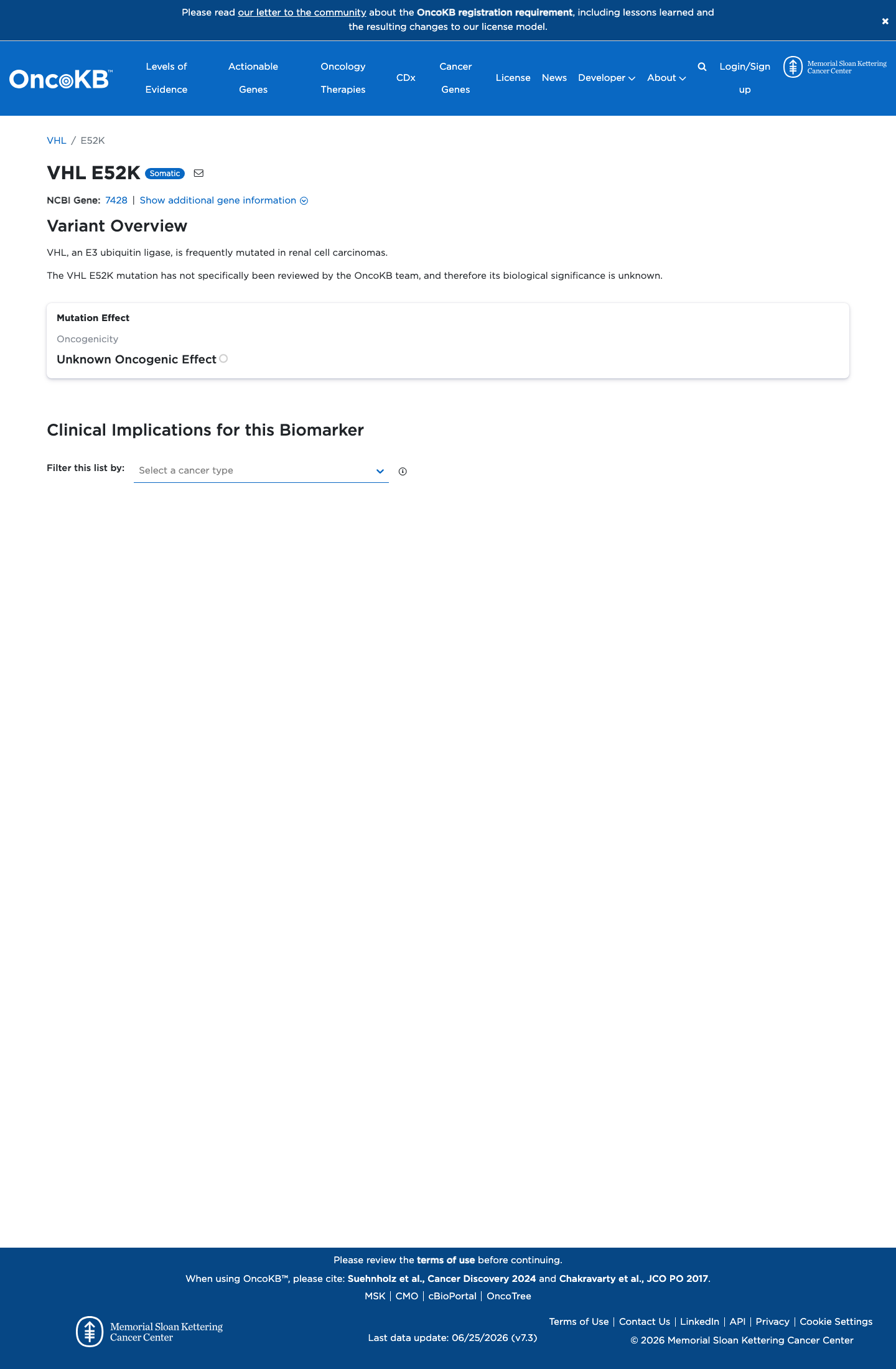
Unknown Oncogenic Effect
OncoKB did not identify variant-specific reviewed functional evidence for this variant; gene-level curated context is available for reviewer follow-up. VHL, an E3 ubiquitin ligase, is frequently mutated in renal cell carcinomas.
COSMIC

Cancer hotspots
Somatic evidence
Not in COSMIC / hotspots
COSMIC
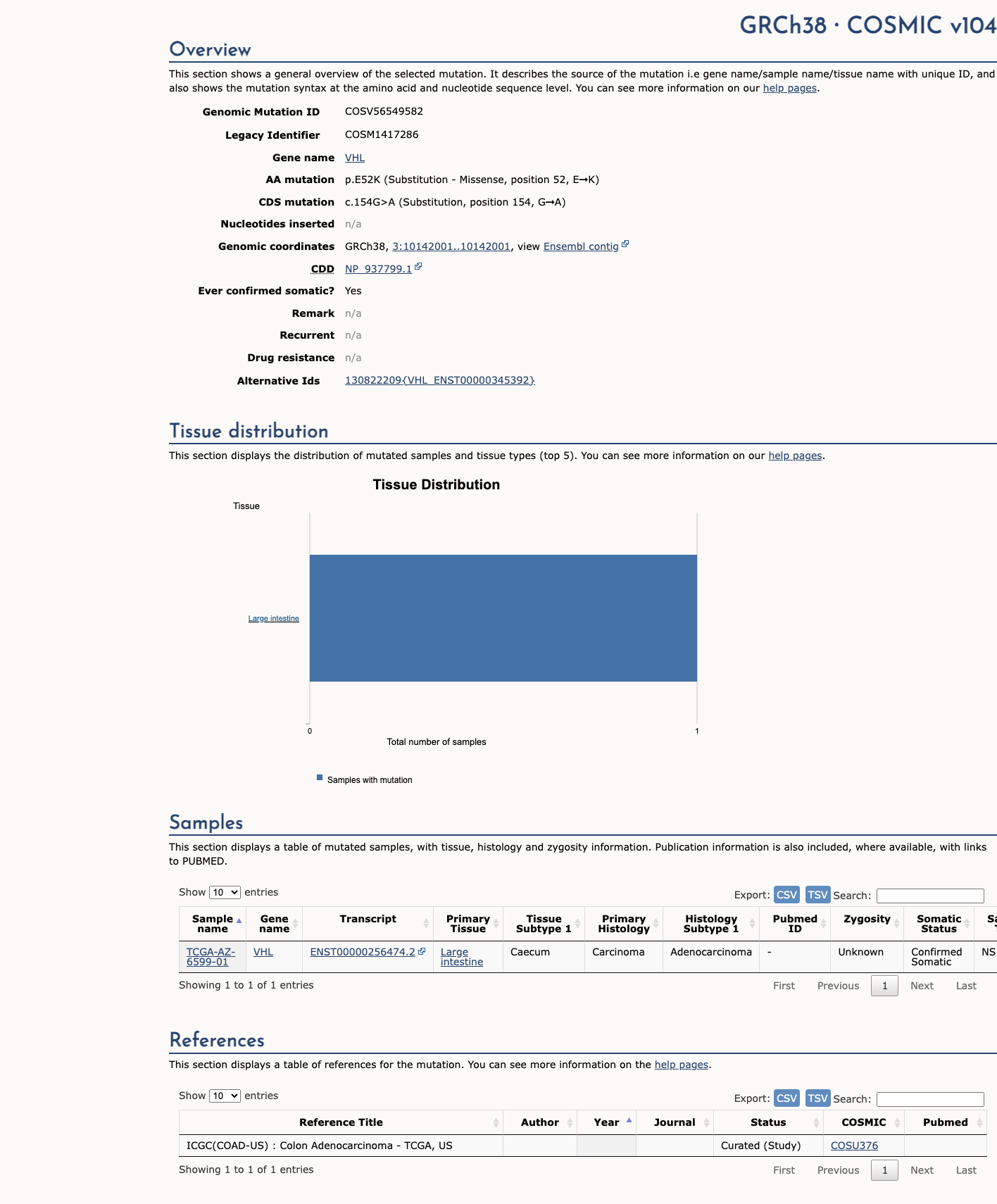
This variant does not lie in a statistically significant hotspot. This variant has previously been reported in somatic cancers (COSMIC; COSV56549582, n = 1 times).
Hotspots
This variant does not lie in a statistically significant hotspot.
Sources & reference links
9Sources
Triaged references · 10 PMIDs not cited in assessment
25741868 ↗
Standards and guidelines for the interpretation of sequence variants: a joint consensus recommendation of the American College of Medical Genetics and Genomics and the Association for Molecular Pathology.
CLINVAR
9829912 ↗
Germline mutation profile of the VHL gene in von Hippel-Lindau disease and in sporadic hemangioblastoma.
CLINVAR
10612827 ↗
UMD (Universal mutation database): a generic software to build and analyze locus-specific databases.
CLINVAR
12202531 ↗
Retinal hemangioblastoma in von Hippel-Lindau disease: a clinical and molecular study.
CLINVAR
28492532 ↗
Sherloc: a comprehensive refinement of the ACMG-AMP variant classification criteria.
CLINVAR