NM_003925.3:c.1177T>G (p.Phe393Val) in MBD4 is a rare missense variant absent from gnomAD v2.1 and observed as a single heterozygous allele in gnomAD v4.1 (1/1,613,932; AF=0.000062%), meeting PM2 at supporting level.1 Multiple in silico predictors consistently indicate a benign effect: REVEL score 0.174 (tolerated), BayesDel score −0.216 (benign), and SpliceAI max delta 0.00 (no splicing impact), meeting BP4 at supporting benign level.2 MBD4-associated disease is driven primarily by loss-of-function (truncating) variants. This missense variant occurs in a gene for which the predominant pathogenic mechanism is truncation, meeting BP1 at supporting benign level.3 Two clinically validated in silico prediction algorithms (BayesDel, REVEL) plus a splicing predictor (SpliceAI) all return results inconsistent with pathogenicity, further supporting BP4.4
MBD4
Final classification
Likely Benign
PM2BP1BP4
MBD4
c.1177T>G
p.Phe393Val
This variant
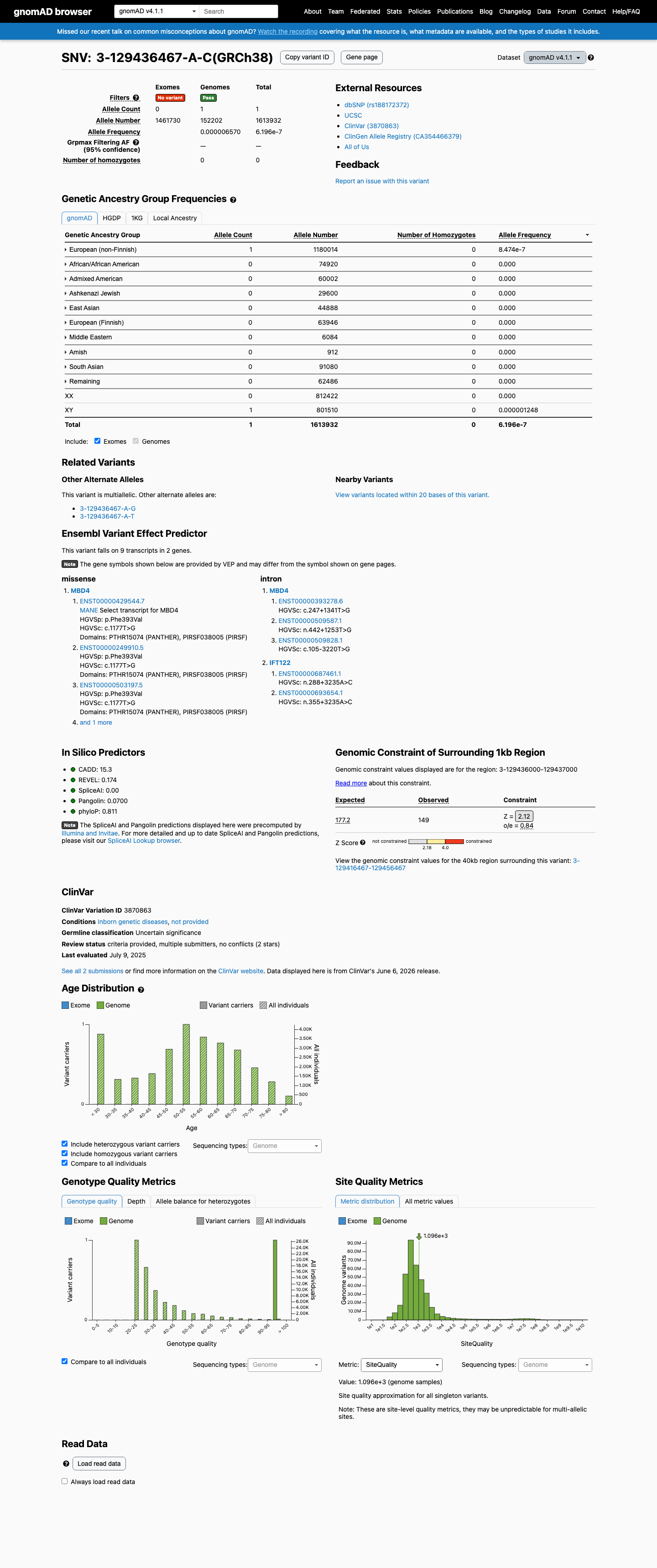
NM_003925.3:c.1177T>G (p.Phe393Val) in MBD4 is a rare missense variant absent from gnomAD v2.1 and observed as a single heterozygous allele in gnomAD v4.1 (1/1,613,932; AF=0.000062%), meeting PM2 at supporting level.
gene-specific framework lacked a usable explicit final combination framework, so generic ACMG/AMP 2015 final-combination rules were applied as fallback; applied criteria: PM2 supporting, BP1 supporting benign, BP4 supporting benign; combination = 1 supporting + 2 supporting benign, which maps to Likely Benign.
Classification rationale
PM2
BP1BP4
Likely Benign
MBD4 c.1177T>G
PM2 + BP1 + BP4
→
Likely Benign
Gene diagram
· NM_003925.3 · variants mapped to exon structure
MBD4
NM_003925.3
Fetching transcript structure from UCSC…
Applied criteria · 3 applied · 18 assessed
MetEvidence satisfies this criterion.
Not metEvaluated against available evidence; threshold not reached.
Not assessedApplies in principle, but no evidence was found to evaluate it.
N/ADoesn't apply to this variant type.
Applied · 3
Strength
Supporting
Moderate
Strong
Very strong
✓
PM2
supporting
Pathogenic
This variant is absent from gnomAD v2.1 and present at an extremely low allele frequency in gnomAD v4.1 (1/1,613,932 alleles; 0.000062%), well below the 0.1% PM2 threshold. It is also absent from gnomAD-Canada v1.0.
Absent from gnomAD v2.1 (exomes).gnomAD v4.1: 1 allele in 1613
✓
BP1
supporting
Benign
MBD4-associated disease is primarily caused by loss-of-function (truncating) variants, as supported by published germline cases (e.g., c.217C>T/p.Gln73*). This missense variant occurs in a gene where the predominant pathogenic mechanism is truncation, satisfying BP1.
MBD4 LOF mechanism supported by literature (nonsense variant c.217C>T/p.Gln73* reported in colorectal oligopolyposis).Multi-tumor predisposition syndrome linked to germline MBD4 deficiency via truncating variants.
✓
BP4
supporting
Benign
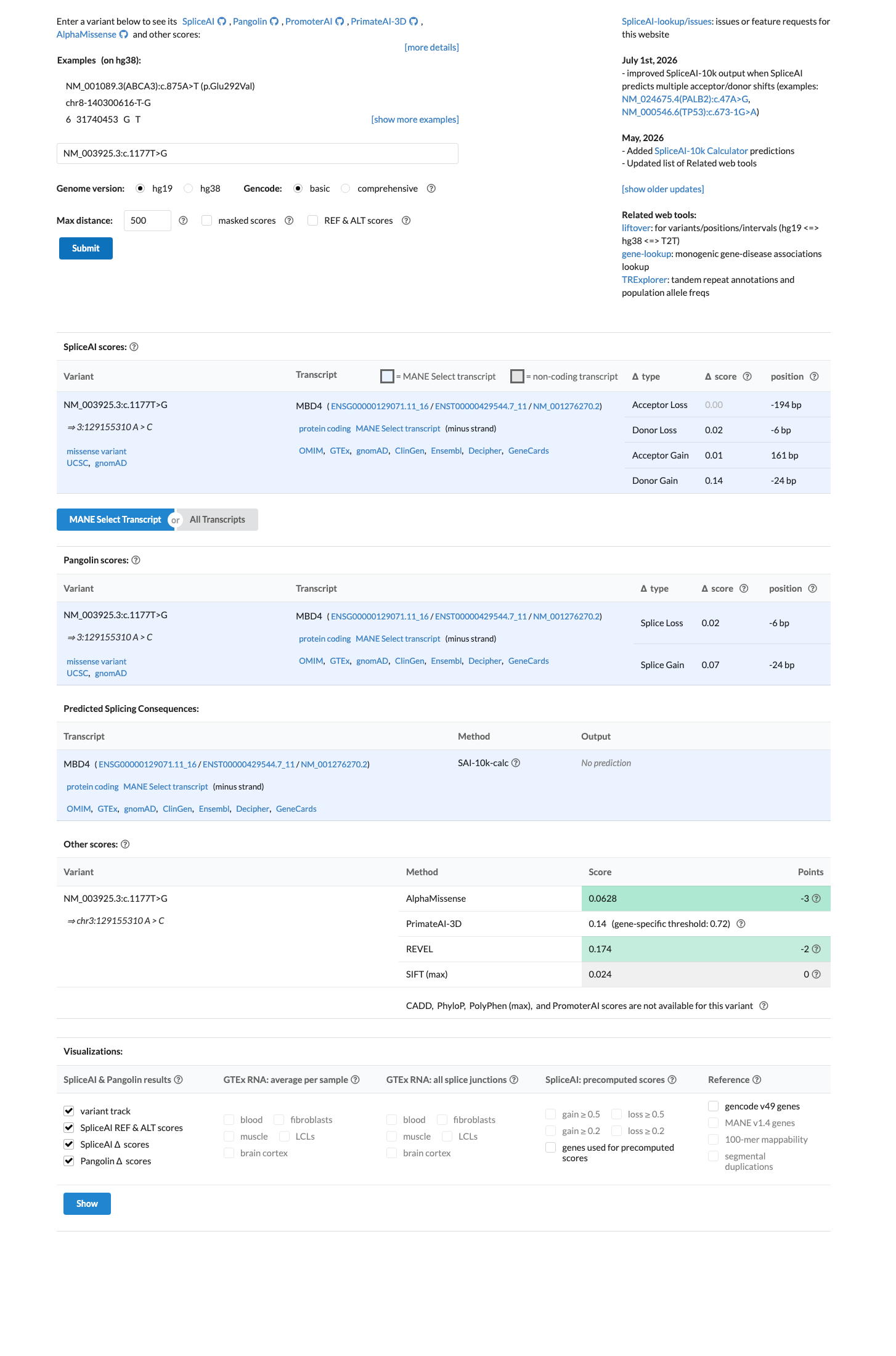
Multiple lines of computational evidence predict no deleterious impact: REVEL score 0.174 (tolerated, below the 0.5 damaging threshold), BayesDel score −0.216 (predicted benign), and SpliceAI max delta score 0.00 (no predicted splicing impact). This satisfies BP4 (supporting benign) with multiple concordant benign predictions.
REVEL: 0.174 (tolerated).BayesDel: −0.216 (benign).SpliceAI: max delta 0.00.
Assessed · not applied
· 18 not met · 0 not assessed
Pathogenic
PS2
No confirmed de novo occurrence data are available for this variant.
PS3
No well-established in vitro or in vivo functional studies supportive of a damaging effect have been identified for this variant.
PS4
The prevalence of this variant in affected individuals has not been shown to be significantly increased compared to controls.
PM1
This variant does not lie in a statistically significant mutational hotspot and is not located in a well-established critical functional domain where benign variation is absent.
PM6
No confirmed de novo occurrence has been reported for this variant, with or without parental confirmation.
PP1
No segregation data are available for this variant in affected families.
PP2
MBD4-associated disease is primarily driven by loss-of-function (truncating) variants; there is insufficient evidence that missense variants are a common disease mechanism or that the gene has a low rate of benign missense variation, as required for PP2.
PP3
Multiple lines of computational evidence suggest no deleterious impact: REVEL score 0.174 (below the 0.5 damaging threshold), BayesDel score −0.216 (benign range), and SpliceAI max delta 0.00 (no predicted splicing impact).
PP4
No patient-specific phenotype or detailed clinical information is available to assess whether this variant segregates with a disease presentation specific for MBD4.
PP5
No reputable source (expert panel or clinical laboratory with strong internal validation) has classified this variant as pathogenic.
Benign
BA1
Allele frequency in gnomAD v4.1 is 6.20×10⁻⁷ (0.000062%), well below the 1% BA1 stand-alone benign threshold.
BS1
Allele frequency in gnomAD v4.1 is 6.20×10⁻⁷ (0.000062%), well below the 0.3% BS1 threshold for a variant being too common to cause a highly penetrant disorder.
BS2
The single heterozygous observation in gnomAD v4.1 is insufficient to meet BS2 (observed in a healthy adult with full penetrance expected at an early age) without specific clinical confirmation that the individual was unaffected at an advanced age, especially given the variable penetrance of MBD4-associated cancer predisposition.
BS3
No well-established in vitro or in vivo functional studies demonstrating no deleterious effect have been identified for this variant.
BS4
No evidence of non-segregation with disease has been reported for this variant in affected families.
BP2
No evidence of this variant occurring in trans with a known pathogenic MBD4 variant has been reported; there is no observation in an autosomal recessive context.
BP5
No case has been identified in which this variant was found in a patient with an alternative molecular basis for disease that would explain the phenotype independently.
BP6
No reputable source has classified this variant as benign.
N/A · 4
PVS1 · PS1 · PM5 · BP7
Research & evidence
Population frequency · supports benign
gnomAD v4.1
gnomAD v2.1
v4.1
This variant is present in gnomAD v4.1 (AF= 6.19605e-07; MAF= 0.00006%, 1/1613932 alleles, homozygotes = 0) and has highest observed frequency in the European (non-Finnish) population (AF= 8.47448e-07; MAF= 0.00008%, 1/1180014 alleles, homozygotes = 0).
v2.1
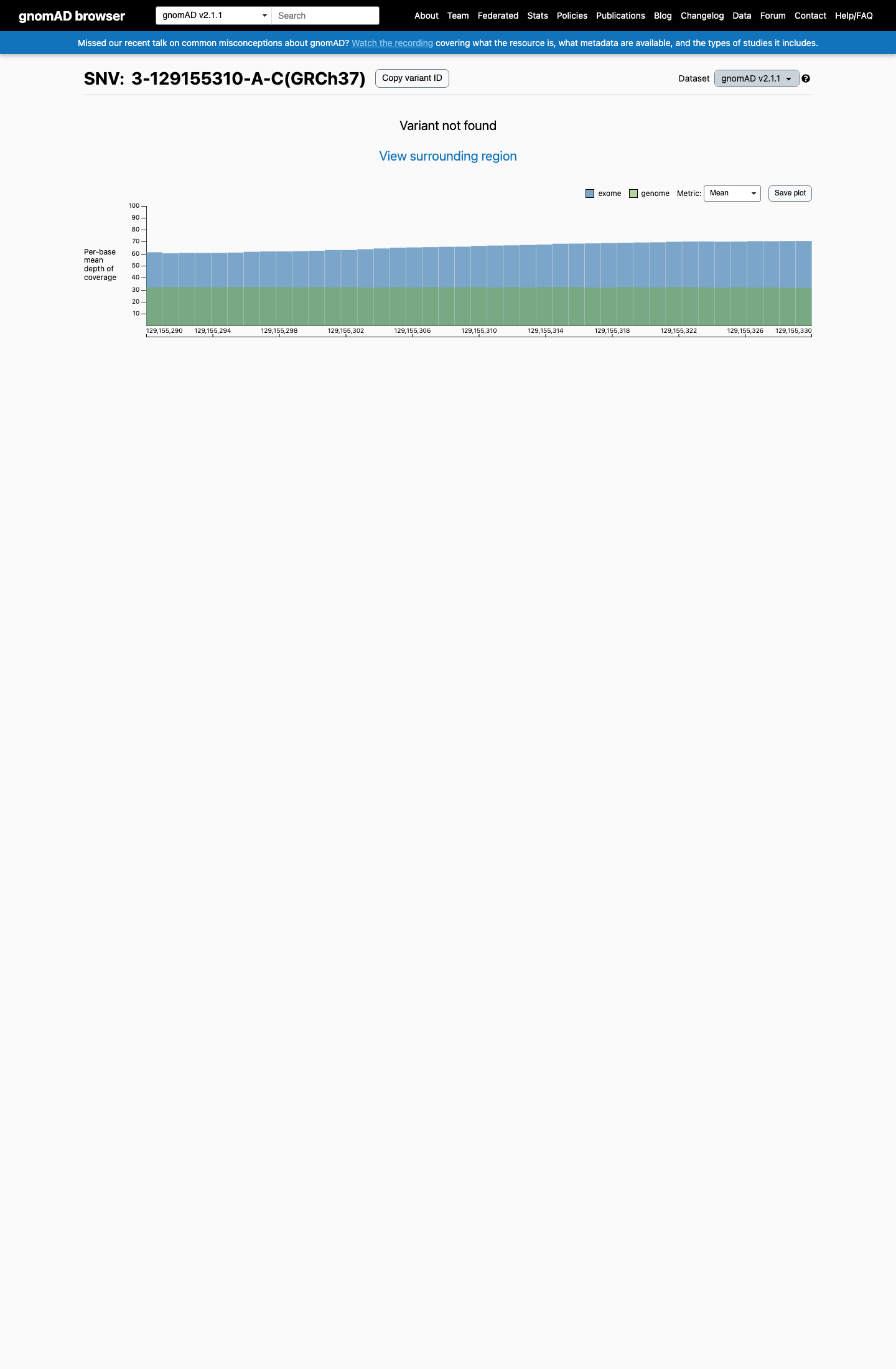
Absent from gnomAD v2.1.
🇨🇦 CA
Absent from gnomAD-Canada v1.0.
Allele frequency by ancestry
three datasets · side by side
gnomAD v4.1
6.2e-05%
· 1 / 1,613,932
0 hom
0 hom
European (non-Finnish) 1 / 1,180,014 |
8.5e-05% |
+ 9 not observed (Remaining individuals, Admixed American, European (Finnish), Amish, East Asian, Middle Eastern, South Asian, Ashkenazi Jewish, African/African American)
gnomAD v2.1
Absent
· 0 / ?
0 hom
0 hom
Not observed in any ancestry group.
gnomAD Canada 🇨🇦
Absent
· 0 / ?
0 hom
0 hom
Not observed in any ancestry group.
ClinVar
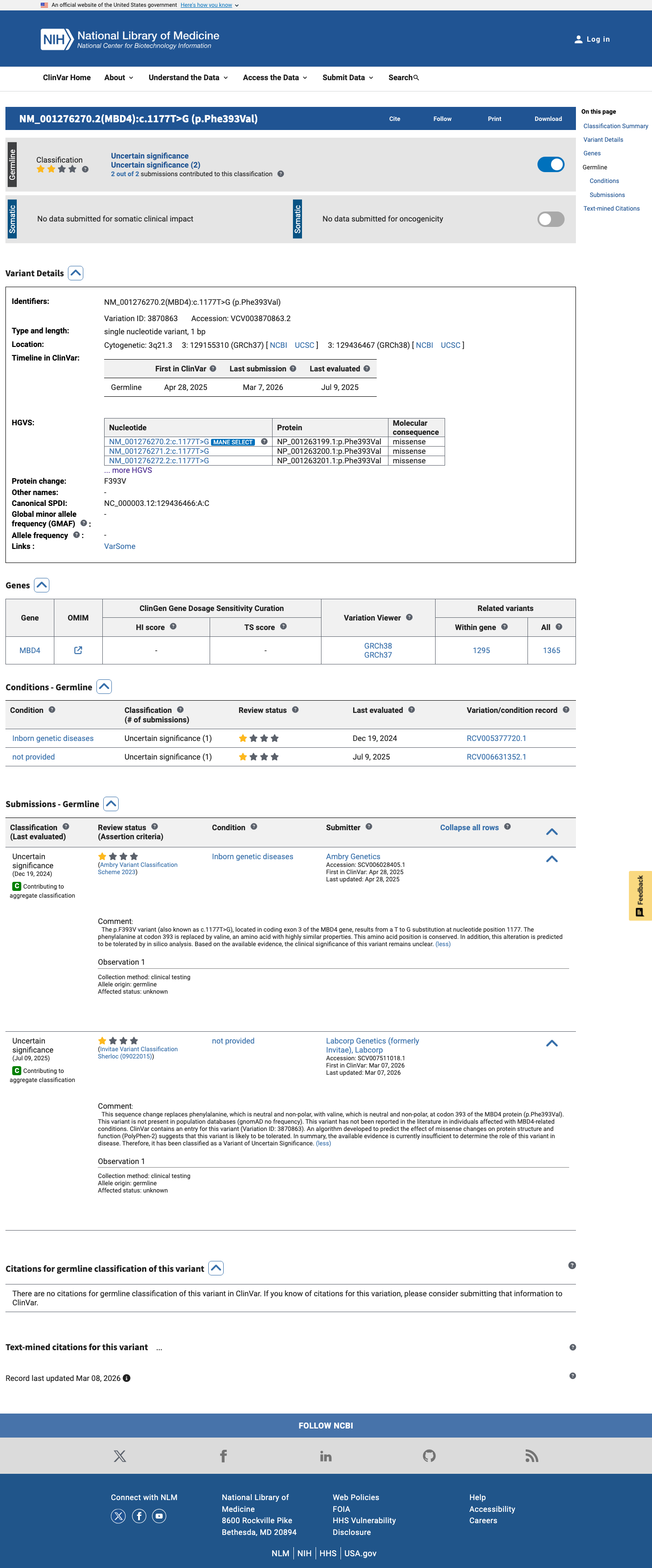
This variant has been reported in ClinVar as Uncertain significance (2 clinical laboratories). (ClinVarID = 3870863)
In silico
SpliceAI predicts no significant splice impact for this variant (max delta score = 0.00). REVEL score = 0.174. BayesDel score = -0.216133.

Functional
Unknown Oncogenic Effect
OncoKB did not identify variant-specific reviewed functional evidence for this variant; gene-level curated context is available for reviewer follow-up. MBD4, a DNA glycosylase, is infrequently altered in cancer.

COSMIC

Cancer hotspots
Somatic evidence
Not in COSMIC / hotspots
COSMIC
This variant does not lie in a statistically significant hotspot. This variant has not previously been reported in somatic cancers (COSMIC).
Hotspots
This variant does not lie in a statistically significant hotspot.
Sources & reference links
Triaged references · 5 PMIDs not cited in assessment
23652378 ↗
A framework to start the debate on neonatal screening policies in the EU: an Expert Opinion Document.
CLINVAR
25730230 ↗
Expanded carrier screening in reproductive medicine-points to consider: a joint statement of the American College of Medical Genetics and Genomics, American College of Obstetricians and Gynecologists, National Society of Genetic Counselors, Perinatal Quality Foundation, and Society for Maternal-Fetal Medicine.
CLINVAR
24394680 ↗
Parental permission for pilot newborn screening research: guidelines from the NBSTRN.
CLINVAR
31022120 ↗
ACOG Committee Opinion No. 778 Summary: Newborn Screening and the Role of the Obstetrician-Gynecologist.
CLINVAR