NM_000551.3:c.445G>T (p.Ala149Ser) co-segregates with VHL disease across >7 meioses in two independent multigenerational families with VHL type 2A (PMID:9435426) and type 2B (PMID:23673869) phenotypes, meeting PP1_Strong per VHL VCEP v1.1.0.1 The variant has been observed in multiple probands with Danish Criteria-meeting VHL phenotypes across two independent families, including pheochromocytoma, renal cell carcinoma, retinal angiomas, spinal hemangioblastoma, and pancreatic neuroendocrine tumors, meeting PS4_Moderate per VHL VCEP.2 NM_000551.3:c.445G>T is absent from gnomAD v2.1, v4.1, and gnomAD-Canada, meeting PM2_Supporting per VHL VCEP (threshold: absent or <=0.00000156 GroupMax FAF).3 REVEL in silico score of 0.896 exceeds the VHL VCEP PP3 threshold of >=0.664, supporting a deleterious effect of the p.Ala149Ser substitution.4 Applying VHL VCEP v1.1.0 combination rules: PP1_Strong (1 strong) + PS4_Moderate (1 moderate) + PM2_Supporting + PP3 (>=2 supporting) satisfies Rule 12 (1 Strong + >=2 Supporting), resulting in a classification of Likely Pathogenic.5
Final classification
Likely Pathogenic
PS4PM2PP1PP3
VHL
c.445G>T
p.Ala149Ser
This variant
NM_000551.3:c.445G>T (p.Ala149Ser) co-segregates with VHL disease across >7 meioses in two independent multigenerational families with VHL type 2A (PMID:9435426) and type 2B (PMID:23673869) phenotypes, meeting PP1_Strong per VHL VCEP v1.1.0.
ClinGen VHL Expert Panel Specifications to the ACMG/AMP Variant Interpretation Guidelines for VHL Version 1.1.0 v1.1.0 criteria-combination framework: matched Rule11 (1 Pathogenic.Strong + 1 Pathogenic.Moderate) with applied criteria: PS4 moderate, PM2 supporting, PP1 strong, PP3 supporting; maps to Likely Pathogenic.
Classification rationale
PS4PM2PP1PP3
Likely Pathogenic
VHL c.445G>T
PS4 + PM2 + PP1 + PP3
→
Likely Pathogenic
4
revel
5
vcep_vhl_functional_assay_svi_documentation
LYFE Sciences is an AI system, and it can make mistakes. Criteria
may be applied incorrectly, sources may be misread, and a confident-looking
classification can still be wrong. Double-check every criterion and
its underlying evidence before relying on any call.
Gene diagram
· NM_000551.3 · variants mapped to exon structure
VHL
NM_000551.3
Fetching transcript structure from UCSC…
Applied criteria · 4 applied · 14 assessed
MetEvidence satisfies this criterion.
Not metEvaluated against available evidence; threshold not reached.
Not assessedApplies in principle, but no evidence was found to evaluate it.
N/ADoesn't apply to this variant type.
Applied · 4
Strength
Supporting
Moderate
Strong
Very strong
PS4
moderate
review
Pathogenic
NM_000551.3:c.445G>T (p.Ala149S) has been observed in multiple probands with VHL-defining phenotypes across two independent families. PMID:9435426 (Atuk 1998) reports 7 affected individuals with confirmed mutation in a 4-generation American kindred with pheochromocytoma and retinal angiomas (VHL type 2A). PMID:23673869 (Mete 2014) reports 10 affected patients in a 3-generation Turkish family with pheochromocytoma, renal cell carcinoma, retinal angiomas, spinal hemangioblastoma, and pancreatic neuroendocrine tumors (VHL type 2B). Phenotypes in both families meet Danish Criteria for VHL. Estimated at 2-4 proband-equivalent points per VHL VCEP scoring, consistent with PS4_Moderate.
7 affected individuals with confirmed A149S in American VHL type 2A kindred (PMID:9435426)10 affected patients with confirmed A149S in Turkish VHL type 2B family (PMID:23673869)ClinVar classification as Pathogenic by 5 clinical laboratories (Variation ID 127829)
PM2
supporting
Pathogenic
NM_000551.3:c.445G>T is absent from gnomAD v2.1, v4.1, and gnomAD-Canada v1.0. Per VHL VCEP v1.1.0, PM2_Supporting is applied for variants absent from gnomAD or with GroupMax FAF <= 0.00000156 (0.000156%). Complete absence from large population databases supports pathogenicity.
Absent from gnomAD v2.1 (exomes)Absent from gnomAD v4.1 (exomes)Absent from gnomAD-Canada v1.0 (genomes)
PP1
strong
Pathogenic
NM_000551.3:c.445G>T (p.Ala149S) co-segregates with VHL disease across >7 meioses in two independent multigenerational families. PMID:9435426 (Atuk 1998): mutation confirmed in 7 affected members across 4 generations of an American kindred, with complete genotype-phenotype concordance. PMID:23673869 (Mete 2014): mutation detected in all 10 symptomatic patients and 7 asymptomatic carriers across 3 generations of a Turkish family. Combined meioses exceed 7 across >=2 families, meeting VHL VCEP threshold for PP1_Strong.
Mutation confirmed in 7 affected members across 4 generations of American VHL type 2A kindred (PMID:9435426)Mutation detected in all 10 affected and 7 asymptomatic carriers across 3 generations of Turkish VHL type 2B family (PMID:23673869)Complete genotype-phenotype concordance in both families
PP3
supporting
Pathogenic
REVEL score for NM_000551.3:c.445G>T is 0.896, which exceeds the VHL VCEP threshold of >=0.664 for PP3 application. This in silico prediction supports a deleterious effect of the p.Ala149Ser substitution on VHL protein function. SpliceAI delta score is 0.14, indicating no significant splicing impact, so the REVEL score is interpreted in the context of a missense effect.
REVEL score: 0.896 (VCEP threshold >=0.664)SpliceAI max delta: 0.14 (no significant splice effect)
Assessed · not applied
· 14 not met · 0 not assessed
Pathogenic
PS1
PS1 requires a different nucleotide change at the same amino acid position (Ala149) that has been classified as pathogenic by the VHL VCEP.
PS2
No de novo occurrence of NM_000551.3:c.445G>T with confirmed or assumed parentage was identified in the reviewed literature.
PS3
No variant-specific functional studies of p.Ala149Ser (NM_000551.3:c.445G>T) were identified in the available full-text literature.
PM1
The variant is located at codon 149 within the Beta domain (nuclear export region, AA 114-155), which is a key functional domain, and within the TRiC chaperonin binding Box 2 (AA 148-155).
PM5
PM5 requires a different pathogenic missense variant at the same amino acid residue (Ala149) classified by the VHL VCEP.
PM6
No de novo occurrence of NM_000551.3:c.445G>T was identified in the reviewed literature.
Benign
BA1
NM_000551.3:c.445G>T is absent from gnomAD v2.1 and v4.1.
BS1
NM_000551.3:c.445G>T is absent from gnomAD v2.1 and v4.1.
BS2
No evidence was identified of >=3 individuals aged >=65 years harboring NM_000551.3:c.445G>T who are unaffected with full or partial phenotyping for VHL-related cancers.
BS3
No benign functional evidence was identified for NM_000551.3:c.445G>T (p.Ala149Ser).
BS4
No evidence of lack of segregation in affected family members was identified.
BP2
No evidence was identified of NM_000551.3:c.445G>T observed in trans with a known pathogenic VHL variant, in a homozygous state in an unaffected individual, or in cis with multiple pathogenic VHL variants.
BP4
Per VHL VCEP v1.1.0, missense predictors are not to be used for BP4 assignment due to poor classification accuracy for benign VHL variants.
BP5
No evidence was identified of NM_000551.3:c.445G>T co-occurring with a pathogenic variant in a different gene that fully explains the patient's phenotype.
N/A · 7
PVS1 · PP2 · PP4 · PP5 · BP1 · BP6 · BP7
Research & evidence
Population frequency · supports pathogenic
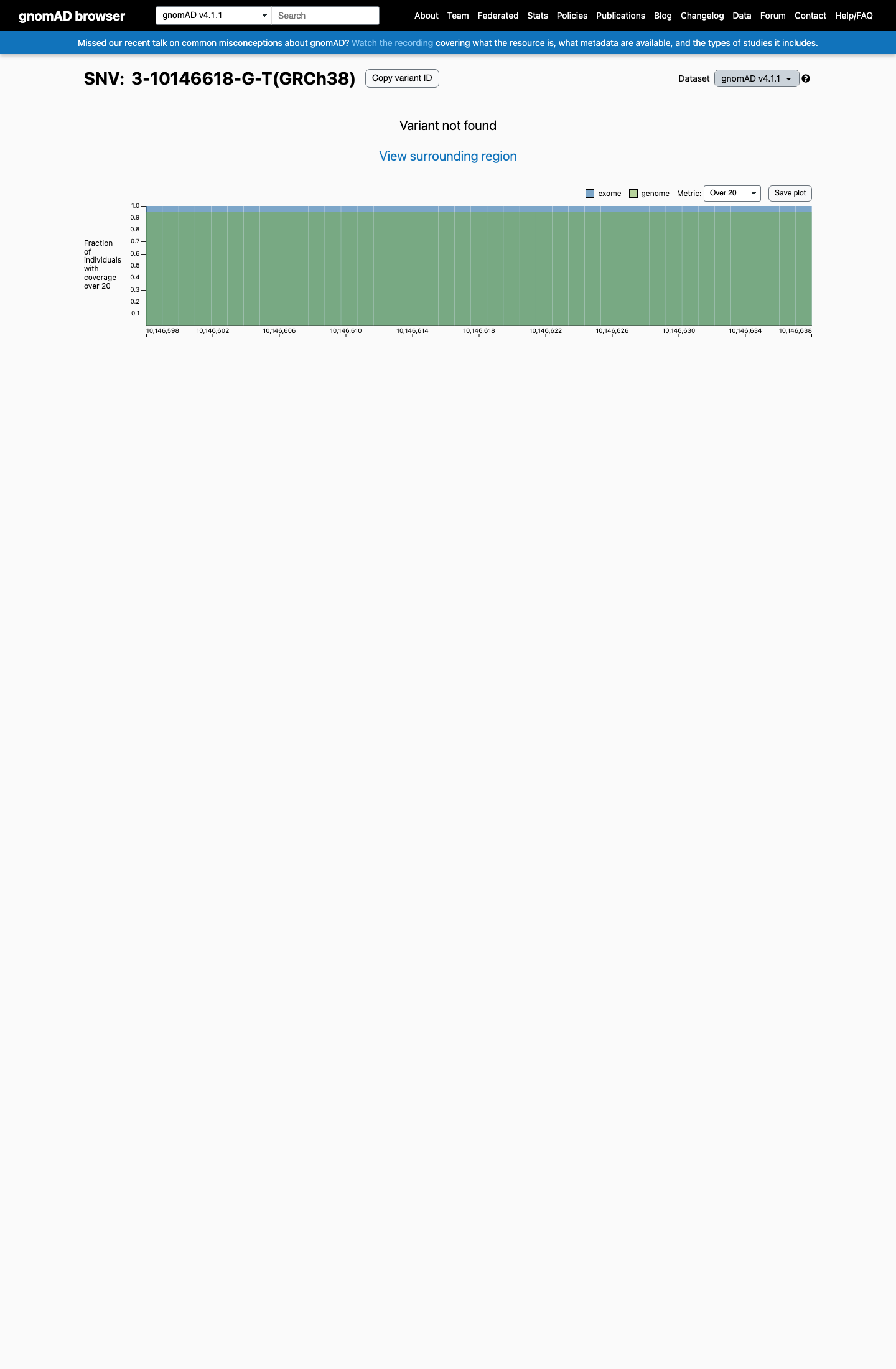
gnomAD v4.1
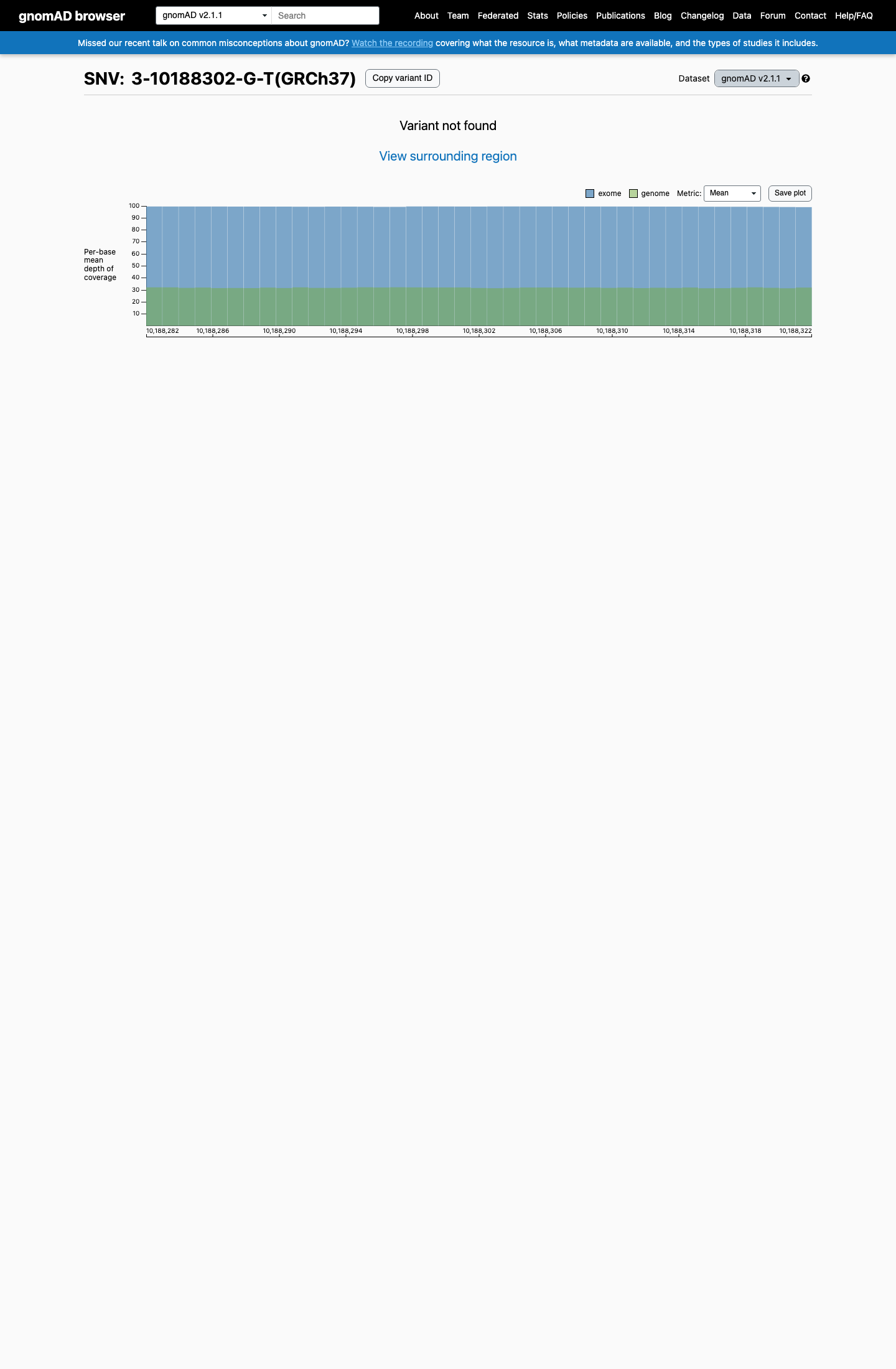
gnomAD v2.1
v4.1
Absent from gnomAD v4.1.
v2.1
Absent from gnomAD v2.1.
🇨🇦 CA
Absent from gnomAD-Canada v1.0.
Allele frequency by ancestry
three datasets · side by side
gnomAD v4.1
Absent
· 0 / ?
0 hom
0 hom
Not observed in any ancestry group.
gnomAD v2.1
Absent
· 0 / ?
0 hom
0 hom
Not observed in any ancestry group.
gnomAD Canada 🇨🇦
Absent
· 0 / ?
0 hom
0 hom
Not observed in any ancestry group.
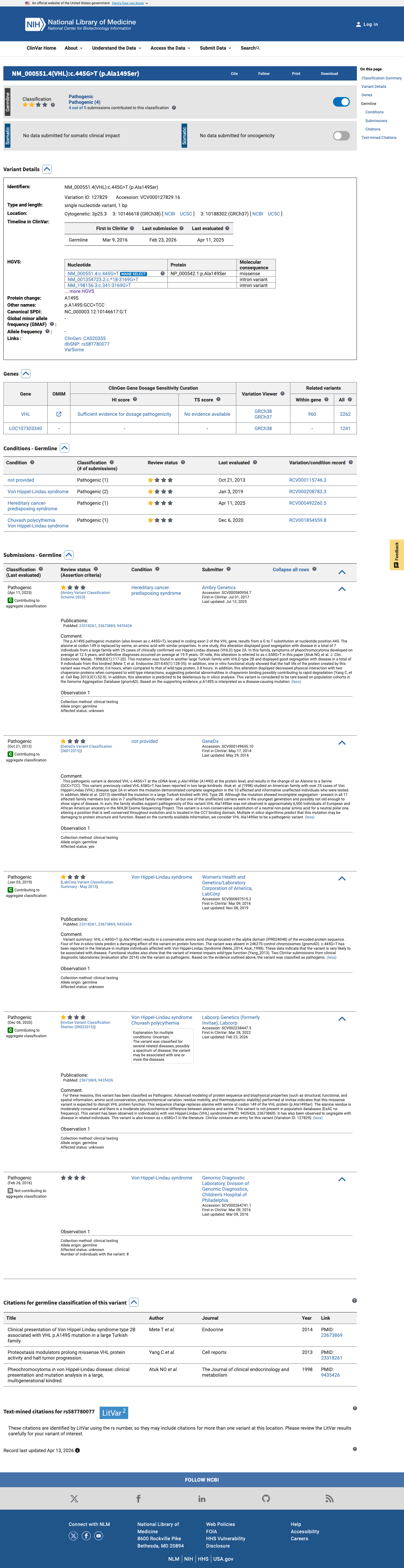
ClinVar
This variant has been reported in ClinVar as Pathogenic (5 clinical laboratories). (ClinVarID = 127829)
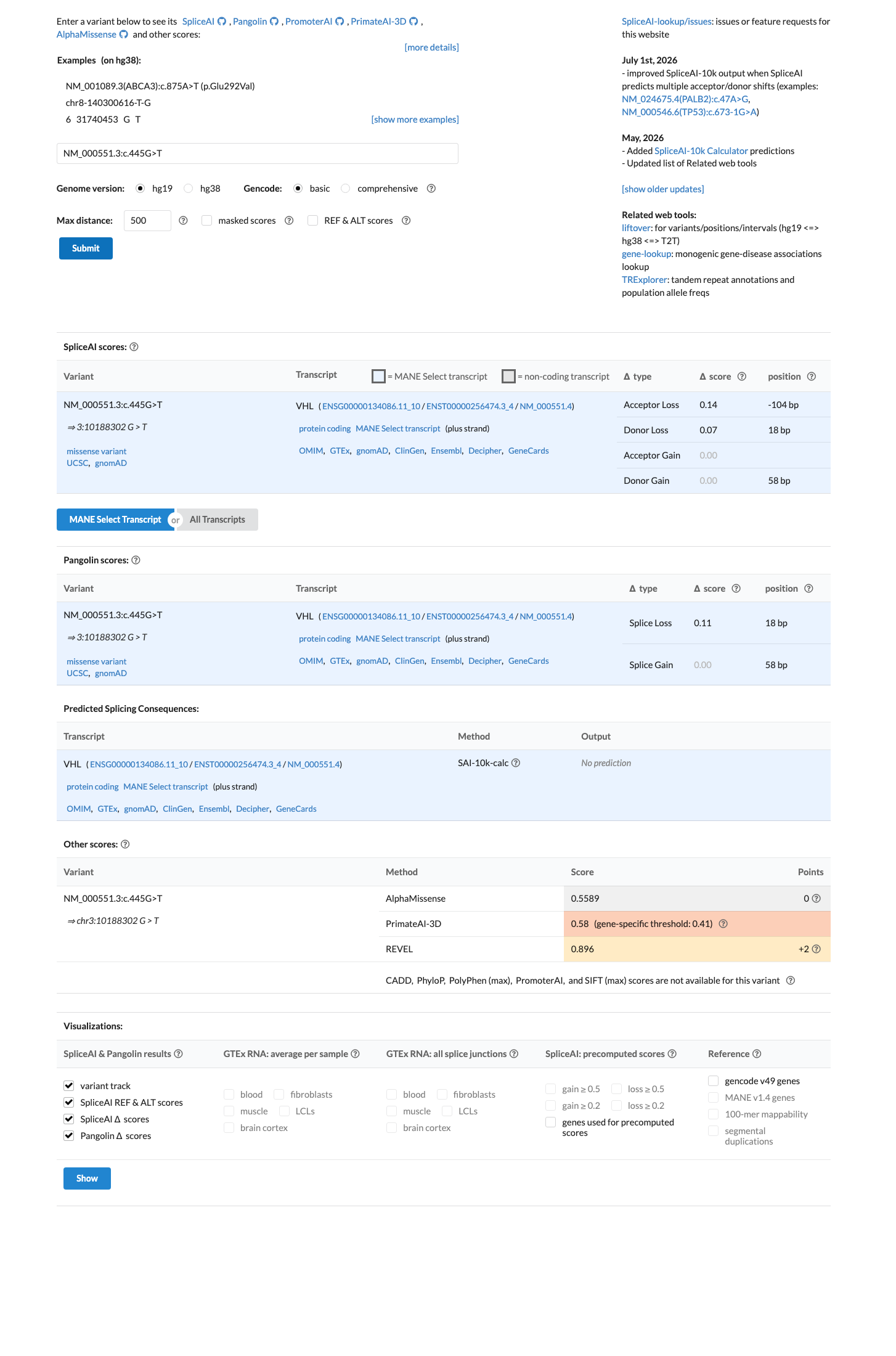
In silico
SpliceAI predicts no significant splice impact for this variant (max delta score = 0.14). REVEL score = 0.896. BayesDel score = 0.509578.
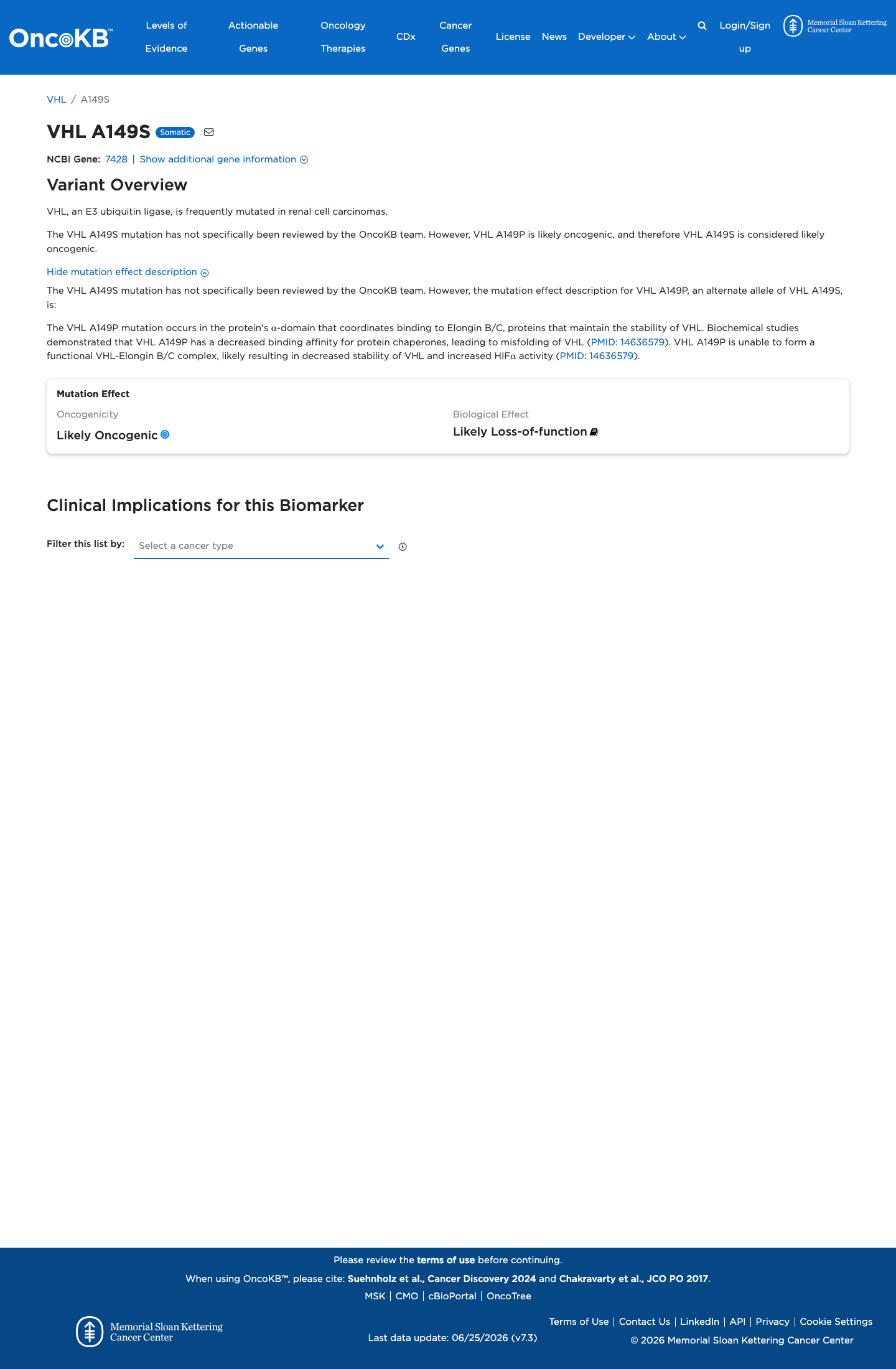
Functional
Likely Oncogenic
OncoKB did not identify variant-specific reviewed functional evidence for this variant; gene-level curated context is available for reviewer follow-up. VHL, an E3 ubiquitin ligase, is frequently mutated in renal cell carcinomas.

COSMIC

Cancer hotspots
Somatic evidence
Not in COSMIC / hotspots
COSMIC
This variant does not lie in a statistically significant hotspot. This variant has not previously been reported in somatic cancers (COSMIC).
Hotspots
This variant does not lie in a statistically significant hotspot.
Literature · how each cited paper was used
2papers cited
Each card is an audit: what was searched, what was found, whether it names the variant, which criteria it fed, and why. 6 further PMIDs triaged but not cited — see Sources & references.
Clinical presentation of Von Hippel Lindau syndrome type 2B associated with VHL p.A149S mutation in a large Turkish family.
Searched
c.445G>Tp.A149SA149S445G
Found
Heterozygous c.445G>T (p.Ala149S) mutation was identified in all 10 symptomatic patients and 7 asymptomatic family members (aged 2-50 years) in a 3-generation Turkish family with VHL syndrome type 2B. Manifestations included pheochromocytoma (9/10), renal cell carcinoma (4/10), retinal angioma (1/10), spinal hemangioblastoma (1/10), and pancreatic neuroendocrine tumors (3/10). One asymptomatic 15-year-old carrier later developed bilateral pheochromocytoma during follow-up.
Variant
✓ Names this variant — characterised directly
Applied to
→PS4
met
→PP1
met
Why
Variant confirmed as disease-causing in a VHL type 2B family; segregation data support PP1_Strong across multiple meioses and proband counts contribute to PS4_Moderate.
The analyzes showed heterozygous transversion from guanine to thymine at base position 445 of the coding region (c.445G > T), causing p.A149S mutation
Location Abstract; Results (DNA sequence analysis); Table 2; Figure 2 · Context PCR amplification and Sanger sequencing of VHL gene from peripheral blood; 49 family members screened · full text
Pheochromocytoma in von Hippel-Lindau disease: clinical presentation and mutation analysis in a large, multigenerational kindred.
Searched
c.445G>Tp.Ala149SerA149Snucleotide 658
Found
G to T transversion at nucleotide 658 (NM_000551.3:c.445G>T), resulting in p.Ala149Ser, was identified as the causative mutation in a large 4-generation American kindred with VHL type 2A. Twenty-five affected members were followed; 17 developed pheochromocytoma (mean age at diagnosis 19.9 years), 18 had retinal angiomas. The mutation was confirmed in 7 affected members and 4 asymptomatic children under age 10, demonstrating complete segregation with disease.
Variant
✓ Names this variant — characterised directly
Applied to
→PS4
met
→PP1
met
Why
Variant confirmed as disease-causing in a VHL type 2A kindred; segregation data support PP1_Strong and proband counts contribute to PS4_Moderate.
this mutation is a G to T change at nucleotide 658 that results in the substitution of a serine for an alanine residue at position 149 of the polypeptide chain
Location Abstract; Results (DNA sequence analysis); Table 3 · Context DNA sequence analysis from peripheral blood leukocytes; pedigree analysis of 4-generation kindred · full text
Sources & reference links
9Sources
Triaged references · 6 PMIDs not cited in assessment
14636579 ↗
Tumorigenic mutations in VHL disrupt folding in vivo by interfering with chaperonin binding.
ONCOKB
23318261 ↗
Proteostasis modulators prolong missense VHL protein activity and halt tumor progression.
CLINVAR
15604628 ↗
Genetic cancer risk assessment and counseling: recommendations of the national society of genetic counselors.
CLINVAR
25356965 ↗
ACMG policy statement: updated recommendations regarding analysis and reporting of secondary findings in clinical genome-scale sequencing.
CLINVAR