NM_002524.5:c.35G>A (p.Gly12Asp) is located in the P-loop domain (AA 10-17), a critical GTP-binding domain defined by the ClinGen RASopathy VCEP as a well-established functional domain without benign variation.1 p.Gly12Asp is the same amino acid change as well-established pathogenic variants across NRAS and other RAS paralogs. G12D is a canonical oncogenic substitution reported as Pathogenic in ClinVar by 11 clinical laboratories and observed in 1,303 somatic cancer samples in COSMIC.2 Multiple VCEP-approved functional assays demonstrate that NRAS G12D is a gain-of-function variant. N-RasG12D exhibits increased GTP-bound Ras (RAS Activation Assay), constitutive MEK and ERK phosphorylation (MEK/ERK Activation Assays), and transforming activity in focus formation assays.3 At codon 12, multiple different missense changes (G12V, G12C, G12S, G12A) have been established as pathogenic, satisfying PM5 at Moderate strength per the VCEP rule requiring at least one [likely] pathogenic residue change at the same codon.4 REVEL score of 0.783 meets the VCEP PP3 threshold (≥0.7), indicating multiple lines of computational evidence support a deleterious effect. SpliceAI predicts no splice impact (max delta = 0.00).5 This variant is present in gnomAD at extremely low frequency (v2.1: 0.0008%, 2/251,484 alleles; v4.1: 0.00105%, 17/1,613,956 alleles), with no homozygotes observed. The variant is absent from gnomAD-Canada. These frequencies are well below the VCEP BS1 (≥0.025%) and BA1 (≥0.05%) thresholds.6
Final classification
VUS
PS1PS3PM1PM5PP3
NRAS
c.35G>A
p.Gly12Asp
This variant
NM_002524.5:c.35G>A (p.Gly12Asp) is located in the P-loop domain (AA 10-17), a critical GTP-binding domain defined by the ClinGen RASopathy VCEP as a well-established functional domain without benign variation.
ClinGen RASopathy Expert Panel Specifications to the ACMG/AMP Variant Interpretation Guidelines for NRAS Version 2.3.0 v2.3.0 criteria-combination framework was evaluated deterministically with applied criteria: PS1 strong, PS3 moderate, PM1 moderate, PM5 moderate, PP3 supporting; no rule matched the adjudicated criteria.
Classification rationale
PS1PS3PM1PM5PP3
VUS
NRAS c.35G>A
PS1 + PS3 + PM1 + PM5 + PP3
→
VUS
LYFE Sciences is an AI system, and it can make mistakes. Criteria
may be applied incorrectly, sources may be misread, and a confident-looking
classification can still be wrong. Double-check every criterion and
its underlying evidence before relying on any call.
Gene diagram
· NM_002524.5 · variants mapped to exon structure
NRAS
NM_002524.5
Fetching transcript structure from UCSC…
Applied criteria · 5 applied · 14 assessed
MetEvidence satisfies this criterion.
Not metEvaluated against available evidence; threshold not reached.
Not assessedApplies in principle, but no evidence was found to evaluate it.
N/ADoesn't apply to this variant type.
Applied · 5
Strength
Supporting
Moderate
Strong
Very strong
PS1
strong
Pathogenic
p.Gly12Asp (G12D) is the same amino acid change as a previously established pathogenic variant regardless of nucleotide change. G12D is a well-characterized oncogenic substitution in NRAS, KRAS, and HRAS, observed in thousands of somatic cancers (COSMIC n=1303) and reported as Pathogenic in ClinVar by 11 clinical laboratories. The VCEP explicitly authorizes PS1 at Strong for analogous pathogenic residue positions across HRAS, KRAS, MRAS, NRAS, RIT1, and RRAS2.
G12D is a canonical oncogenic substitution in NRAS with established pathogenicity across RAS paralogsClinVar: Pathogenic (11 labs)Likely Pathogenic (3 labs)
PS3
moderate
Pathogenic
Well-established in vitro and in vivo functional studies demonstrate a gain-of-function effect for NRAS G12D. The VCEP-approved RAS Activation Assay, MEK Activation Assay, and ERK Activation Assay are all applicable to NRAS. N-RasG12D shows increased GTP-bound Ras (RAF-RBD pulldown), constitutive MEK and ERK phosphorylation in multiple cell types, and transforming activity in focus formation assays. Mouse models with endogenous NrasG12D expression develop myeloproliferative neoplasms. G12D is validated as a pathogenic/likely pathogenic control in VCEP-approved ERK Activation Assay for HRAS, supporting functional analogy across RAS paralogs. At least two different approved assay types (RAS Activation and MEK/ERK Activation) demonstrate damaging effect.
PMID:19075190: N-RasG12D used as positive controlelevated Ras-GTPincreased phospho-MEK and phospho-ERK
PM1
moderate
Pathogenic
Gly12 is located within the P-loop domain (amino acids 10-17), a critical and well-established functional domain defined in the VCEP supplementary table. The P-loop is essential for GTP binding and RAS protein function. This domain has no benign variation and is a known mutational hotspot.
Gly12 resides in P-loop (AA 10-17)a VCEP-approved critical functional domainStatistically significant hotspot per hotspot analysis
PM5
moderate
Pathogenic
At codon 12 of NRAS, multiple different missense changes have been established as pathogenic: G12V, G12C, G12S, and G12A are all recognized oncogenic substitutions. The VCEP PM5 Moderate rule is satisfied when ≥1 [likely] pathogenic residue change exists at the same codon. G12D represents a novel residue change at a codon with established pathogenic variants.
Codon 12 in NRAS has multiple established pathogenic variants: G12VG12CG12S
PP3
supporting
Pathogenic
REVEL score is 0.783, which meets the VCEP threshold of ≥0.7 for PP3_Supporting for missense variants. SpliceAI predicts no splice impact (max delta = 0.00), consistent with the variant's primary effect being at the protein level. The REVEL score indicates multiple lines of computational evidence support a deleterious effect.
REVEL score: 0.783 (meets VCEP PP3 threshold ≥0.7)SpliceAI max delta: 0.00 (no splice impact)
Assessed · not applied
· 6 not met · 8 not assessed
Pathogenic
PS2
No de novo occurrence data with confirmed maternity and paternity is available in the evidence packet for this specific variant.
PS4
The VCEP PS4 requires point-based scoring using probands with RASopathy phenotypes.
PM2
The VCEP PM2 rule states the variant must be absent from controls in gnomAD.
PM6
No assumed de novo events are documented in the evidence packet for this variant.
PP1
No co-segregation data in affected family members is available.
Benign
BA1
The VCEP BA1 threshold is gnomAD filtering allele frequency ≥0.05%.
BS1
The VCEP BS1 threshold is gnomAD filtering allele frequency ≥0.025%.
BS2
No data on healthy adult individuals carrying this variant with full penetrance expected at an early age are available.
BS4
No lack of segregation data in affected family members is available.
BP1
The VCEP BP1 rule applies only to truncating variants (nonsense, frameshift, canonical splice site, initiation codon, entire gene or multi-exon deletion) in genes without established LOF correlation to disease.
BP2
No data on an alternative molecular cause of a RASopathy in the same gene or on co-occurrence with a different causative variant are available.
BP4
The VCEP BP4 threshold for missense variants is REVEL ≤0.3.
BP5
No data on an alternative molecular cause of disease in a different gene are available.
BP7
BP7 applies only to synonymous (silent) variants.
N/A · 6
PVS1 · PP2 · PP4 · PP5 · BS3 · BP6
Research & evidence
Population frequency
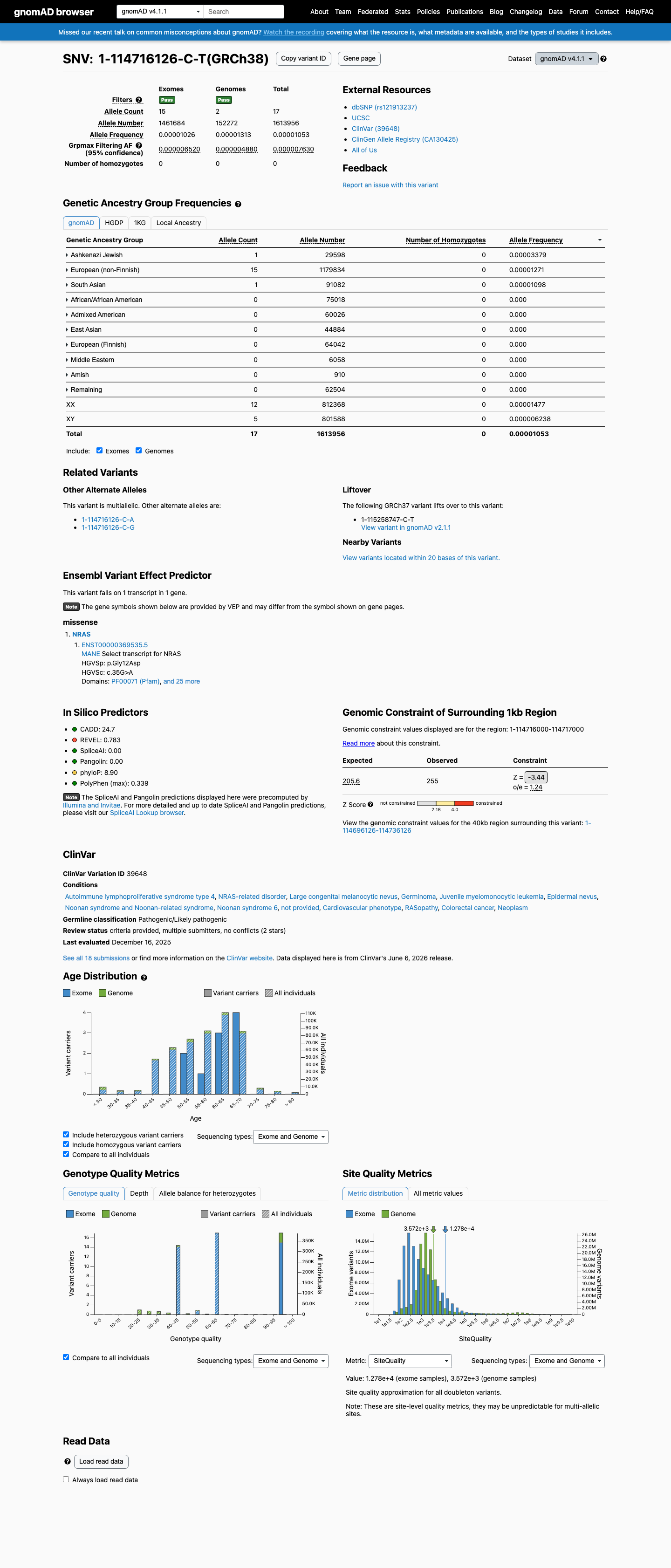
gnomAD v4.1
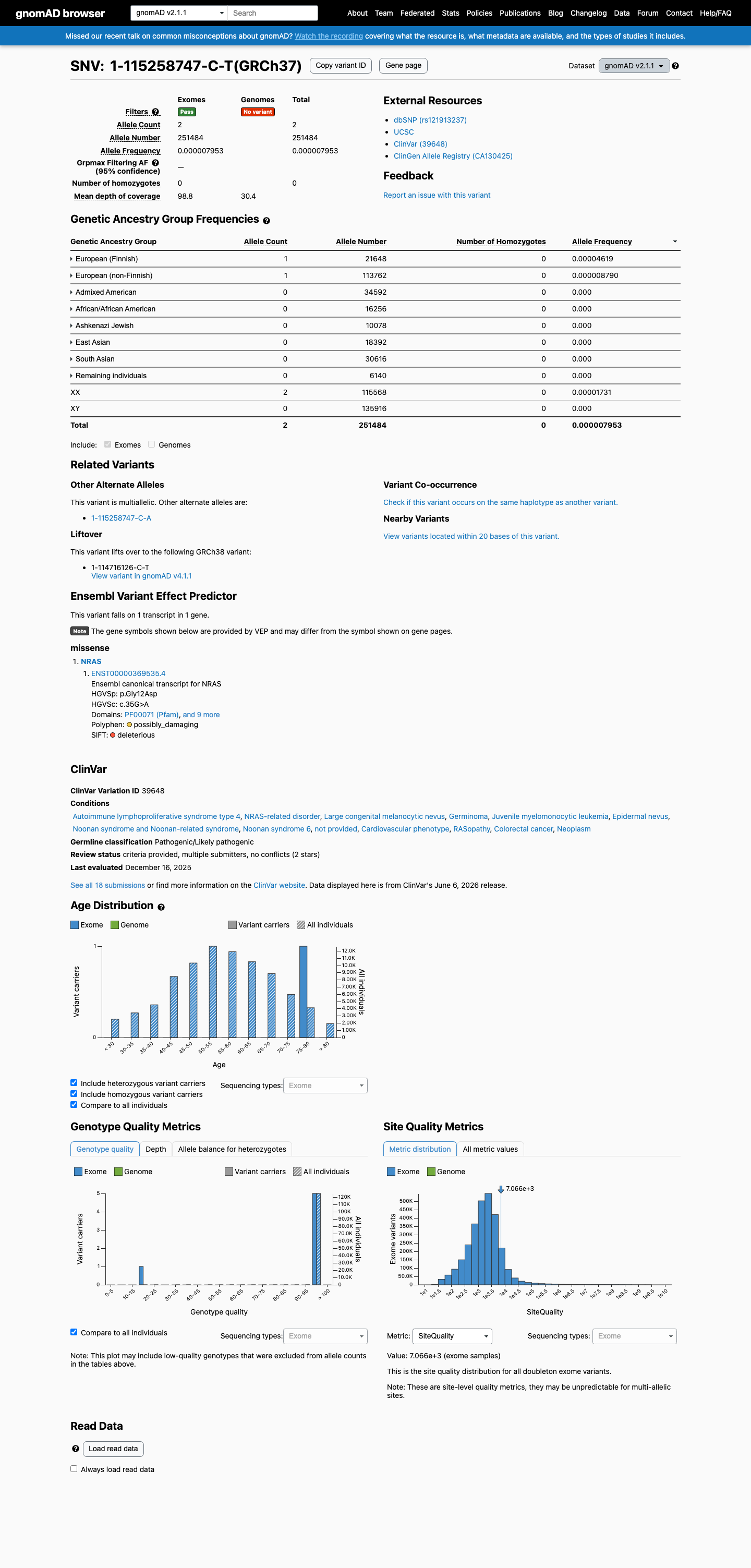
gnomAD v2.1
v4.1
This variant is present in gnomAD v4.1 (AF= 1.05331e-05; MAF= 0.00105%, 17/1613956 alleles, homozygotes = 0) and has highest observed frequency in the Ashkenazi Jewish population (AF= 3.37861e-05; MAF= 0.00338%, 1/29598 alleles, homozygotes = 0); grpmax FAF= 7.63e-06.
v2.1
This variant is present in gnomAD v2.1 (AF= 7.95279e-06; MAF= 0.00080%, 2/251484 alleles, homozygotes = 0) and has highest observed frequency in the European (Finnish) population (AF= 4.61936e-05; MAF= 0.00462%, 1/21648 alleles, homozygotes = 0).
🇨🇦 CA
Absent from gnomAD-Canada v1.0.
Allele frequency by ancestry
three datasets · side by side
gnomAD v4.1
0.0011%
· 17 / 1,613,956
0 hom · FAF 0.00076%
0 hom · FAF 0.00076%
Ashkenazi Jewish 1 / 29,598 |
0.0034% |
European (non-Finnish) 15 / 1,179,834 |
0.0013% |
South Asian 1 / 91,082 |
0.0011% |
+ 7 not observed (Remaining individuals, Admixed American, European (Finnish), Amish, East Asian, Middle Eastern, African/African American)
gnomAD v2.1
0.0008%
· 2 / 251,484
0 hom
0 hom
European (Finnish) 1 / 21,648 |
0.0046% |
European (non-Finnish) 1 / 113,762 |
0.00088% |
+ 6 not observed (African/African American, Admixed American, Ashkenazi Jewish, East Asian, Remaining individuals, South Asian)
gnomAD Canada 🇨🇦
Absent
· 0 / ?
0 hom
0 hom
Not observed in any ancestry group.

ClinVar
This variant has been reported in ClinVar as Pathogenic (11 clinical laboratories) and as Likely pathogenic (3 clinical laboratories). (ClinVarID = 39648)
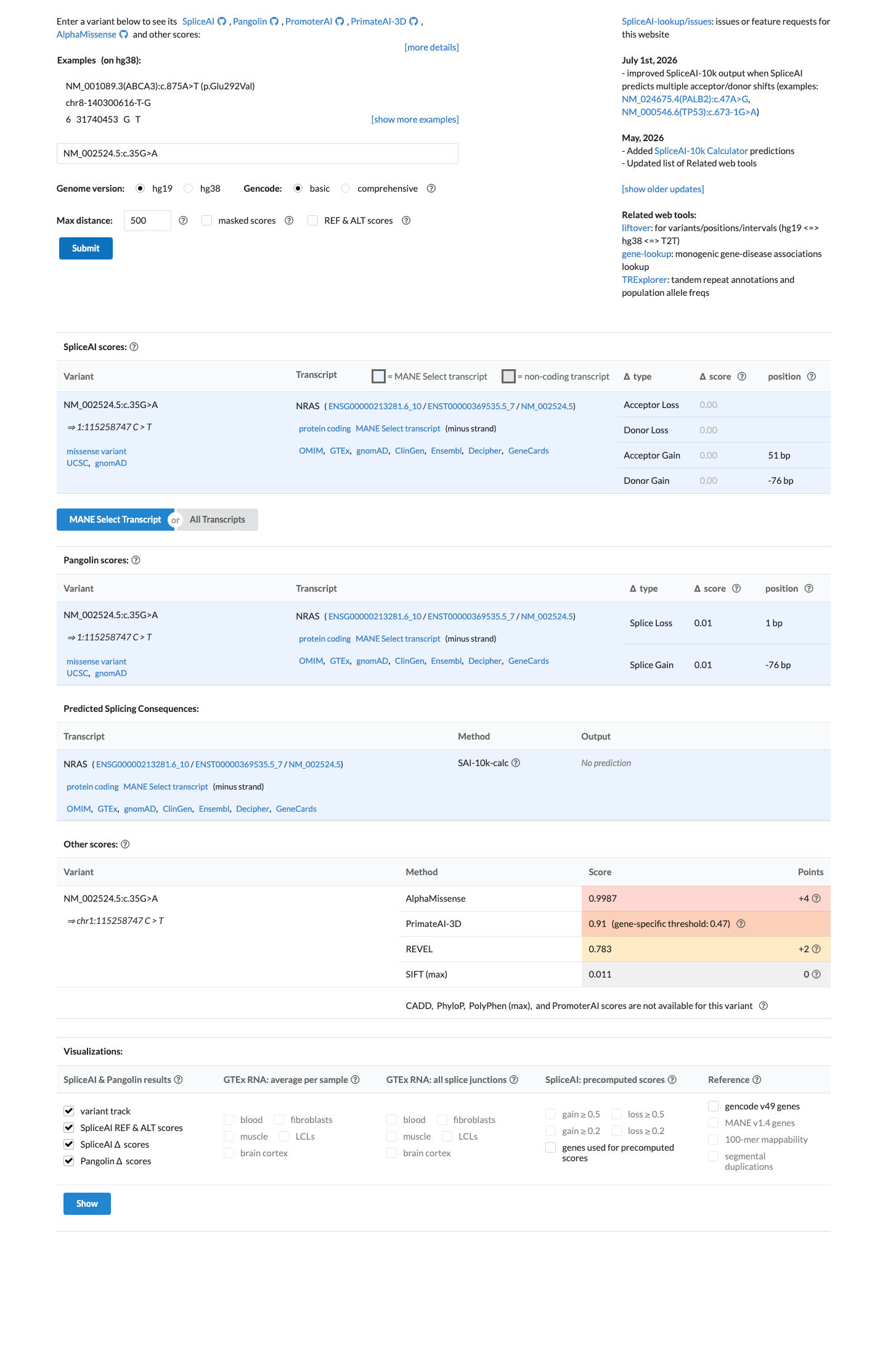
In silico
SpliceAI predicts no significant splice impact for this variant (max delta score = 0.00). REVEL score = 0.783. BayesDel score = 0.328551.
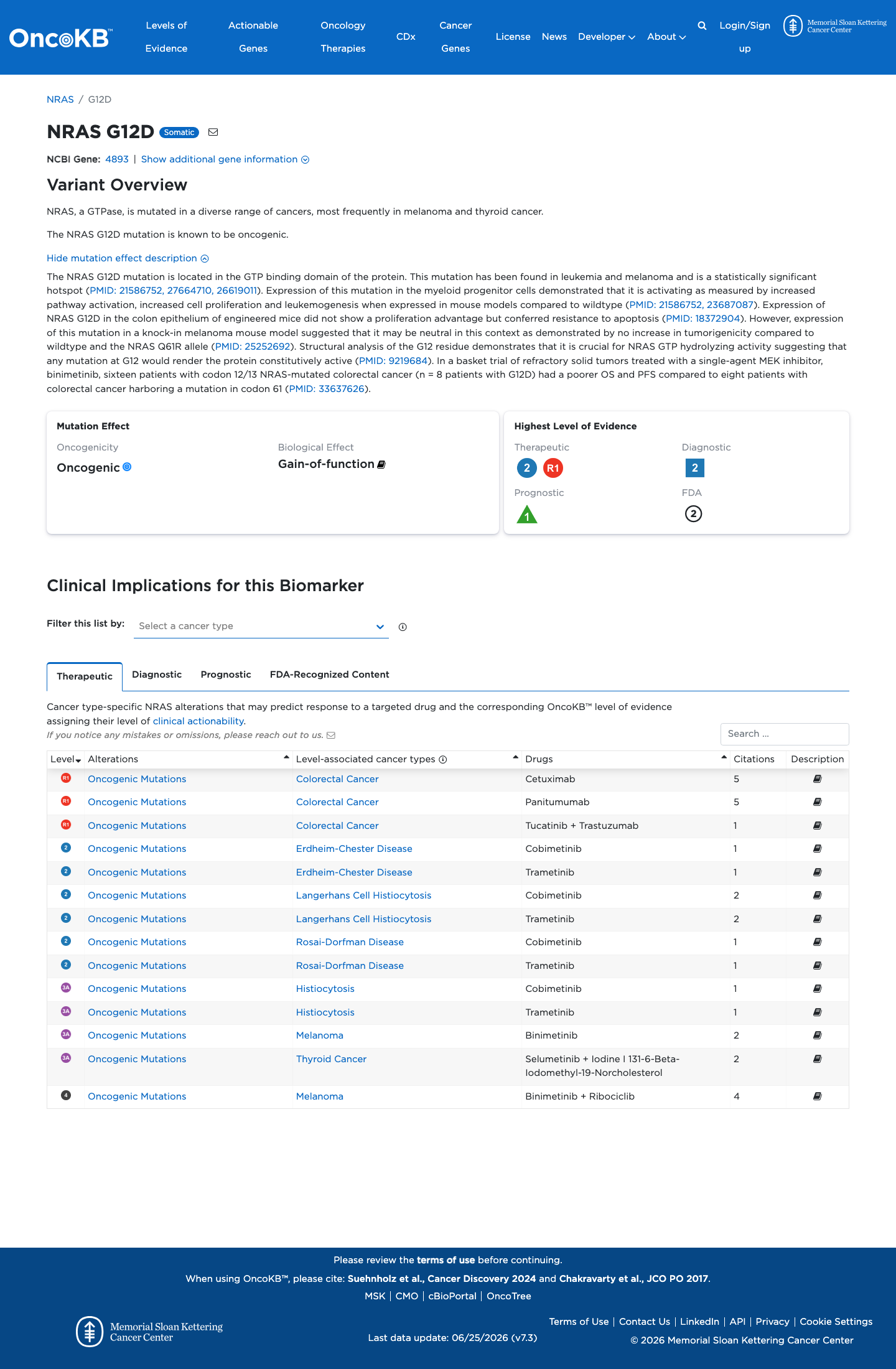
Functional
Oncogenic
OncoKB identified variant-specific curated literature and context relevant to functional review; biological-effect context: Gain-of-function; curated oncogenicity label: Oncogenic.
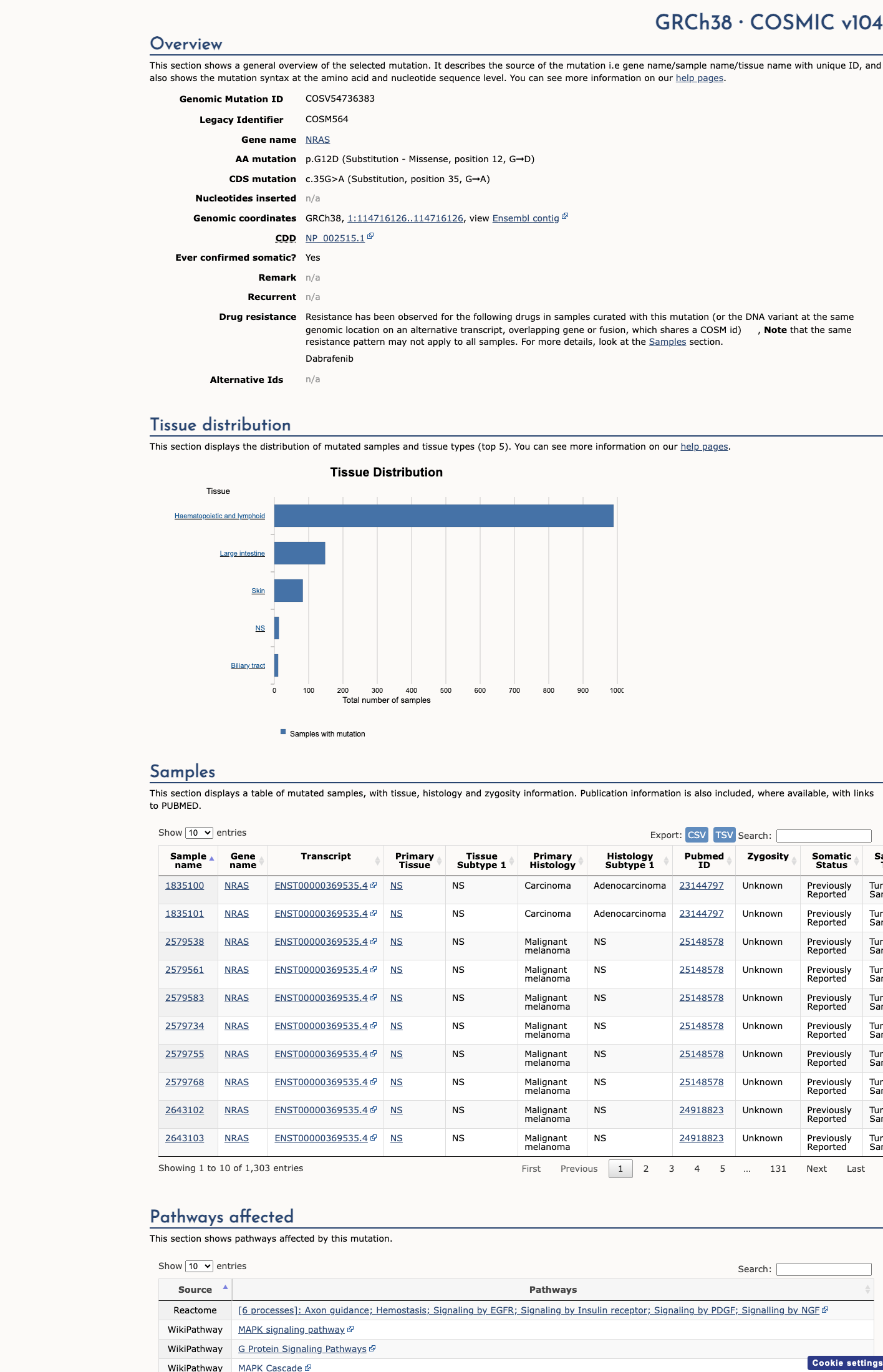
COSMIC

Cancer hotspots
Somatic evidence
Hotspot
COSMIC
This variant lies in a statistically significant hotspot. This variant has previously been reported in somatic cancers (COSMIC; COSV54736383, n = 1303 times).
Hotspots
This variant lies in a statistically significant hotspot.
Literature · how each cited paper was used
4papers cited
Each card is an audit: what was searched, what was found, whether it names the variant, which criteria it fed, and why. 3 further PMIDs triaged but not cited — see Sources & references.
Differential effects of oncogenic K-Ras and N-Ras on proliferation, differentiation and tumor progression in the colon.
Searched
c.35G>AG12DN-RasG12DNrasG12D
Found
N-RasG12D expression in murine colonic epithelium did not alter basal growth properties but conferred resistance to DSS-induced apoptosis. In the context of Apc-mutant tumors, N-RasG12D did not promote tumor progression, contrasting with K-RasG12D which drove hyperplasia and loss of differentiation.
Variant
✓ Names this variant — characterised directly
Applied to
→PS3
met
Why
Demonstrates N-RasG12D confers functional effects (apoptosis resistance) in vivo. Supports PS3 assessment.
N-RasG12D did not alter the growth properties of the epithelium, but was able to confer resistance to apoptosis.
Location Results; Figures 1-3 · Context Fabpl-Cre;NrasLSL-G12D/+ mouse model, colonic epithelium, in vivo · full text
High-throughput sequencing screen reveals novel, transforming RAS mutations in myeloid leukemia patients.
Searched
c.35G>AG12DN-RasG12DGly12Asp
Found
N-RasG12D was used as a positive control in RAS functional characterization. It exhibited elevated Ras-GTP levels (RAF-RBD pulldown), increased phospho-MEK and phospho-ERK, and transforming activity in A31 focus formation assays, serving as the most active mutant in the study's hierarchy.
Variant
✓ Names this variant — characterised directly
Applied to
→PS3
met
Why
Provides direct biochemical and functional evidence for N-RasG12D gain-of-function. Supports PS3 assessment at Moderate strength via RAS Activation and MEK/ERK Activation assays.
the G12D substitution in both N-Ras and K-Ras induces higher levels of the GTP-bound state of the enzyme
Location Results; Figure 1A-B, Figure 2A · Context HEK293T/17 cells, RAF-RBD pulldown, MEK/ERK immunoblotting, A31 focus formation assay · full text
Nras(G12D/+) promotes leukemogenesis by aberrantly regulating hematopoietic stem cell functions.
Searched
c.35G>AG12DNrasG12DG12D/+
Found
Endogenous NrasG12D/+ expression in hematopoietic stem cells induced moderate hyperproliferation, increased self-renewal, and myeloid differentiation bias. ERK1/2 was constitutively hyperactivated in NrasG12D/+ HSCs, and MEK inhibition with AZD6244 attenuated the aberrant HSC phenotypes.
Variant
✓ Names this variant — characterised directly
Applied to
→PS3
met
Why
Demonstrates NrasG12D gain-of-function in hematopoietic stem cells with mechanistic pathway data. Supports PS3 assessment.
ERK1/2 is constitutively hyperactivated in NrasG12D/+ HSCs and downregulation of the MEK/ERK signaling attenuates NrasG12D/+ HSC phenotypes.
Location Results; Figures 1-2 · Context Mx1-Cre; NrasG12D/+ mouse model, hematopoietic stem cells, phospho-flow cytometry, MEK inhibitor AZD6244 · full text
Mutation-specific RAS oncogenicity explains NRAS codon 61 selection in melanoma.
Searched
c.35G>AG12DNrasG12DNRAS G12D
Found
Comparison of NrasG12D and NrasQ61R in melanoma models showed that physiologic NrasG12D expression did not efficiently promote melanoma in vivo, in contrast to NrasQ61R and KrasG12D. NrasG12D showed enhanced nucleotide binding but decreased GTPase activity compared to wild-type, with similar engagement of PI3K and RAF effector pathways as NrasQ61R.
Variant
✓ Names this variant — characterised directly
Applied to
→PS3
met
Why
Shows context-dependent NrasG12D gain-of-function with biochemical characterization. Acknowledged in PS3 assessment but note that NrasG12D is less transforming than NrasQ61R in melanocytes.
NrasG12D did not efficiently promote melanoma in vivo, whereas NrasQ61R expression efficiently promoted melanoma
Location Results; Figures 1-2, Table 2 · Context Tyr-CRE-ERT2; p16L/L; LSL-NrasG12D mouse model, in vitro nucleotide binding and effector engagement assays · full text
Sources & reference links
9Sources
Triaged references · 3 PMIDs not cited in assessment
21586752 ↗
Endogenous oncogenic Nras mutation initiates hematopoietic malignancies in a dose- and cell type-dependent manner.
ONCOKB