PM1 (moderate): The c.515G>A (p.Arg172Lys) variant affects a well-established mutational hotspot at residue R172 in the IDH2 active site, confirmed by Cancer Hotspots and recurrently observed in COSMIC (n=467).1 PM2 (supporting): This variant is extremely rare in population databases, absent from gnomAD v2.1 and gnomAD-Canada, with a single heterozygous observation in gnomAD v4.1 (AF = 6.19e-7; 1/1,614,246 alleles), well below the 0.1% threshold.2 PS3 (supporting): Multiple independent functional studies across AML, glioma, and cholangiocarcinoma models confirm that IDH2 R172K confers a neomorphic gain-of-function producing the oncometabolite 2-hydroxyglutarate. Enasidenib, a selective IDH2-mutant inhibitor, produces clinical responses in R172K-mutated AML, confirming oncogenic dependency. However, all functional evidence derives from somatic cancer models, limiting strength to supporting in a germline context.3 PP3 (supporting): REVEL score of 0.733 predicts a deleterious effect on protein function. BayesDel (0.432) does not independently support pathogenicity, but the REVEL prediction provides computational support.4 Summary: One moderate criterion (PM1) and three supporting criteria (PM2, PS3, PP3) are met. No benign criteria are met. Under generic ACMG/AMP 2015 combination rules (PMID:25741868), this combination does not reach the threshold for Likely Pathogenic (requires 2 moderate OR 1 moderate + 2 supporting). The total evidence of PM1 + PM2 + PS3_supporting + PP3 falls short of a Likely Pathogenic classification. This variant is classified as a Variant of Uncertain Significance (VUS).5 CAUTION: All pathogenic evidence derives from somatic cancer contexts. IDH2 R172K is a well-established somatic oncogenic driver mutation. Its role in germline disease, if any, is not well characterized. The germline disease context identified for IDH2 (MDS/MPN overlap syndromes, PMID:33275756) does not specifically implicate this variant. Clinicians should interpret this germline VUS classification with the understanding that this variant is oncogenic in somatic tissues.6
Final classification
VUS
PS3PM1PM2PP3
IDH2
c.515G>A
p.Arg172Lys
This variant
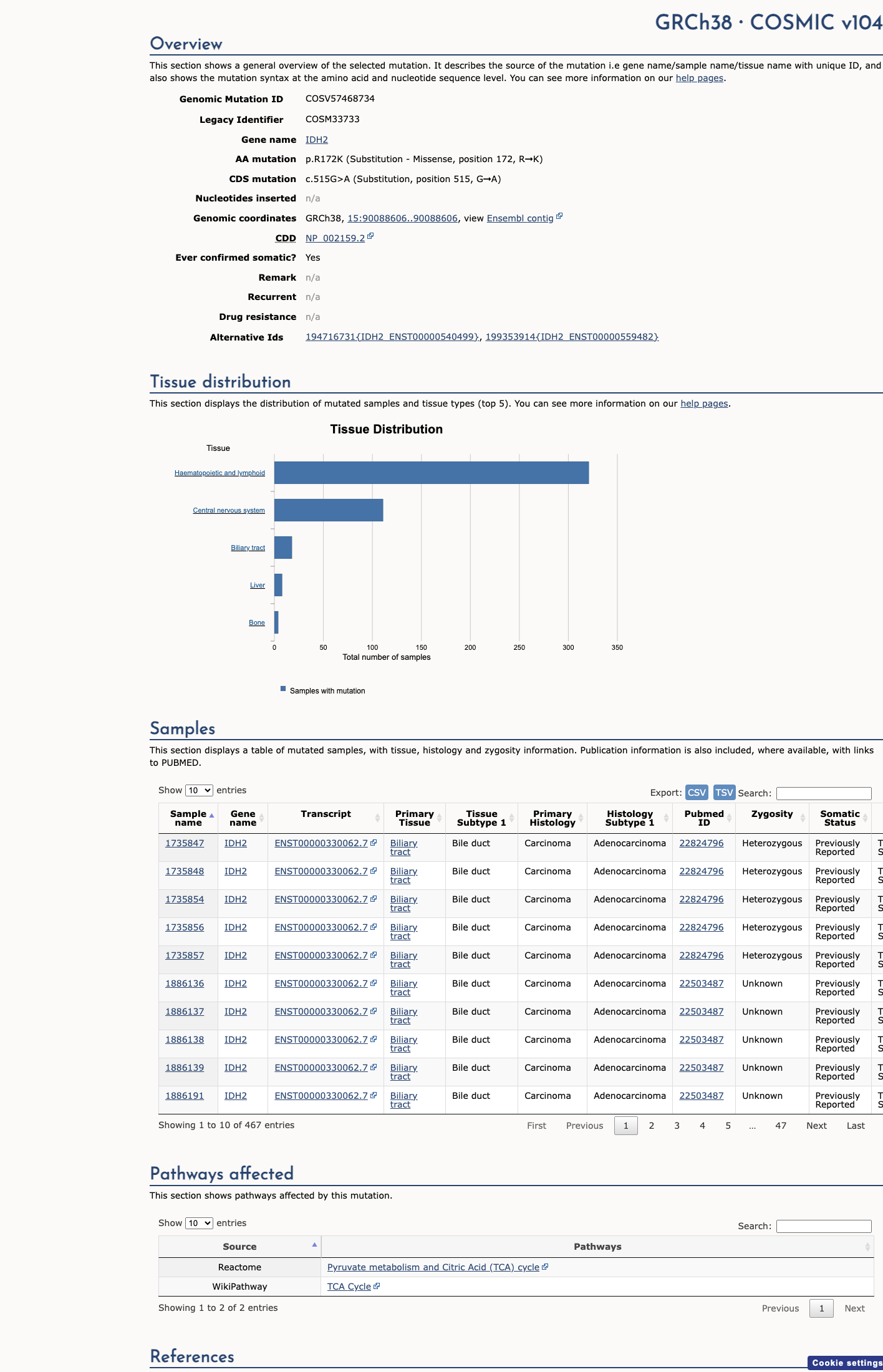
PM1 (moderate): The c.515G>A (p.Arg172Lys) variant affects a well-established mutational hotspot at residue R172 in the IDH2 active site, confirmed by Cancer Hotspots and recurrently observed in COSMIC (n=467).
gene-specific framework lacked a usable explicit final combination framework, so generic ACMG/AMP 2015 final-combination rules were applied as fallback; applied criteria: PS3 supporting, PM1 moderate, PM2 supporting, PP3 supporting; combination = 1 moderate + 3 supporting, which maps to VUS.
Classification rationale
PS3PM1PM2PP3
VUS
IDH2 c.515G>A
PS3 + PM1 + PM2 + PP3
→
VUS
4
revelbayesdel
5
generic_acmg_combination_rules
LYFE Sciences is an AI system, and it can make mistakes. Criteria
may be applied incorrectly, sources may be misread, and a confident-looking
classification can still be wrong. Double-check every criterion and
its underlying evidence before relying on any call.
Gene diagram
· NM_002168.3 · variants mapped to exon structure
IDH2
NM_002168.3
Fetching transcript structure from UCSC…
Applied criteria · 4 applied · 17 assessed
MetEvidence satisfies this criterion.
Not metEvaluated against available evidence; threshold not reached.
Not assessedApplies in principle, but no evidence was found to evaluate it.
N/ADoesn't apply to this variant type.
Applied · 4
Strength
Supporting
Moderate
Strong
Very strong
PS3
supporting
review
Pathogenic
Multiple independent functional studies demonstrate that IDH2 R172K produces a neomorphic gain-of-function enzymatic activity, converting α-ketoglutarate to the oncometabolite 2-hydroxyglutarate (2HG). This well-established functional effect has been confirmed across AML (Ward 2010, Paschka 2010), glioma (Jin 2011), and cholangiocarcinoma models (Saha 2014). Enasidenib, a selective IDH2-R172K inhibitor, produces clinical responses in R172K-mutated AML (Stein 2017). However, all functional evidence derives from somatic cancer models and was not designed to assess germline pathogenicity per ACMG/AMP standards, limiting strength assignment to supporting.
PMID:20171147: Neomorphic 2HG production confirmed by IDH2 R172K mutant enzyme assays.PMID:21326614: 2HG production confirmeddominant negative function excluded for IDH2 R172 mutations including R172K.
PM1
moderate
Pathogenic
This variant affects residue R172, located in the active site of IDH2 and a well-established mutational hotspot across multiple cancer types. Cancer Hotspots confirms this residue is statistically significant. COSMIC reports this exact variant 467 times. The R172 residue is the IDH2 analog of the IDH1 R132 hotspot and is one of only two recurrently mutated residues in IDH2 (R140 and R172), both in the enzymatic active site.
Cancer Hotspots: Residue R172 is a statistically significant hotspot (not a formal source_registry key).COSMIC COSV57468734: 467 somatic observations of this exact variant.Residue R172 is in the IDH2 active site
PM2
supporting
Pathogenic
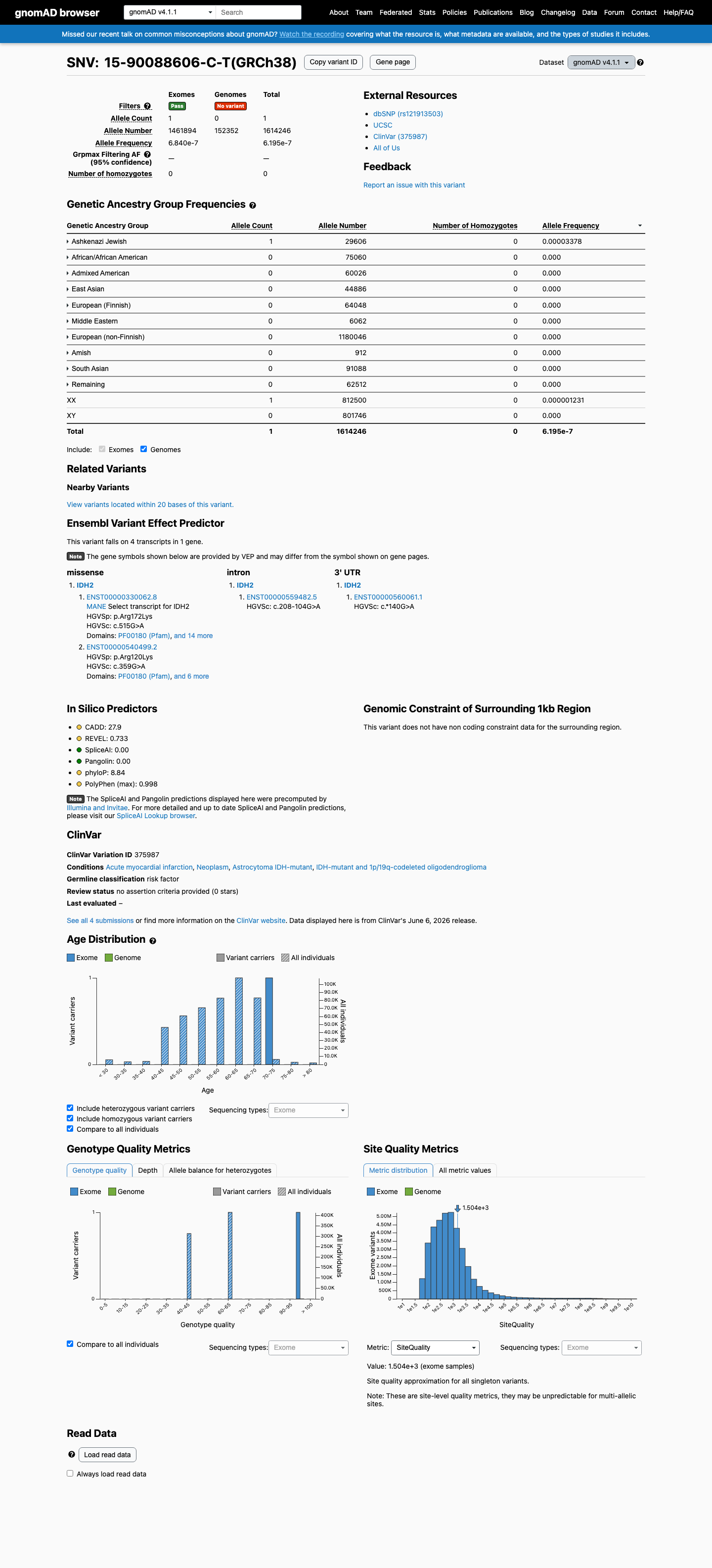
This variant is absent from gnomAD v2.1 and present in gnomAD v4.1 at extremely low frequency (AF = 6.19e-7; 1/1,614,246 alleles, 0 homozygotes). The highest subpopulation frequency is in Ashkenazi Jewish (AF = 3.38e-5; 1/29,606 alleles). These frequencies are well below the 0.1% PM2 threshold for non-VCEP assessment. The variant is also absent from gnomAD-Canada v1.0.
gnomAD v2.1: Absent.gnomAD v4.1: AF = 6.19e-7 (1/1614
PP3
supporting
Pathogenic
REVEL score of 0.733 predicts a deleterious effect on protein function. SpliceAI predicts no significant splice impact (max delta = 0.03), which is neither supportive nor contradictory for a missense variant. BayesDel score of 0.432 falls below the typical pathogenicity threshold (0.5) and does not support a deleterious prediction. Multiple lines of in silico evidence provide partial support for a deleterious effect.
REVEL: 0.733 (above 0.5 thresholdsupports deleterious).BayesDel: 0.432 (below 0.5 threshold
Assessed · not applied
· 16 not met · 1 not assessed
Pathogenic
PS1
No alternative nucleotide change at codon 172 (AGA) producing the same p.Arg172Lys substitution has been established as pathogenic.
PS2
No de novo occurrence data available for this variant.
PS4
No case-control data demonstrating statistically significant enrichment of this variant in affected individuals versus controls in a germline context.
PM6
No de novo observation data available for this variant, with or without confirmed parentage.
PP1
No co-segregation data available for this variant.
PP2
HCI prior not available for IDH2 (gene_not_supported).
PP4
No specific phenotype or family history data are available for this variant in a germline context.
PP5
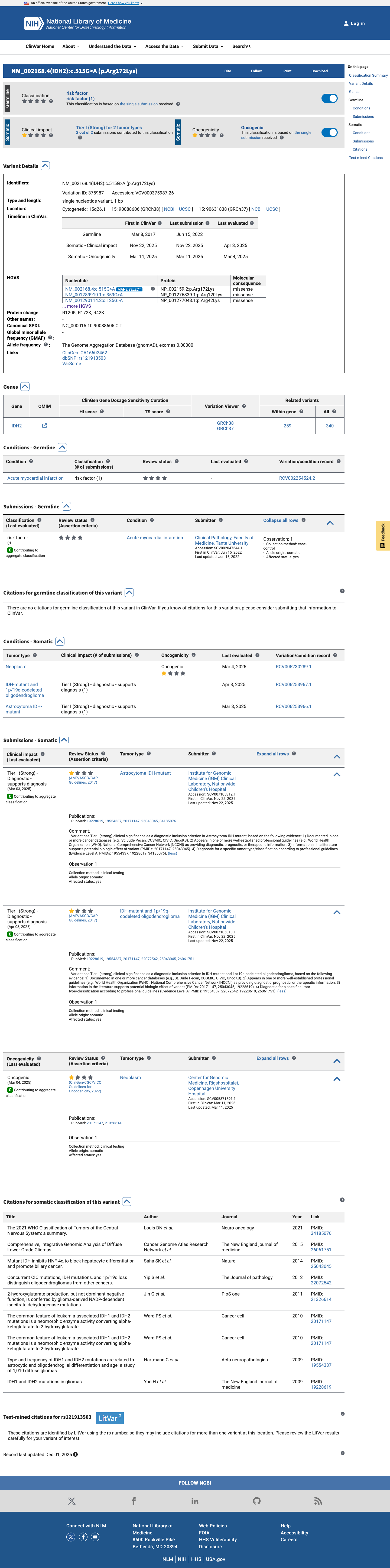
ClinVar lists this variant as 'risk factor' from a single submitter with no assertion criteria provided (trust_tier=weak_noisy).
Benign
BA1
The overall allele frequency is 6.19e-7 (0.00006%), far below the 1% BA1 threshold.
BS1
The overall allele frequency is 6.19e-7 (0.00006%), far below the 0.3% BS1 threshold for non-VCEP assessment.
BS2
No data demonstrating observation of this variant in healthy adult controls at a frequency consistent with benign variation.
BS3
Well-established functional studies demonstrate that IDH2 R172K has a neomorphic gain-of-function effect (2-hydroxyglutarate production) rather than a benign or neutral effect on protein function.
BS4
No non-segregation data available.
BP2
No data on observation of this variant in trans with a known pathogenic variant.
BP4
REVEL score of 0.733 predicts a deleterious effect, not a benign one.
BP5
No alternative molecular basis for disease has been identified in individuals harboring this variant.
BP6
This variant has not been reported as benign or likely benign by any reputable source.
N/A · 4
PVS1 · PM5 · BP1 · BP7
Research & evidence
Population frequency
gnomAD v4.1
gnomAD v2.1
v4.1
This variant is present in gnomAD v4.1 (AF= 6.19484e-07; MAF= 0.00006%, 1/1614246 alleles, homozygotes = 0) and has highest observed frequency in the Ashkenazi Jewish population (AF= 3.37769e-05; MAF= 0.00338%, 1/29606 alleles, homozygotes = 0).
v2.1
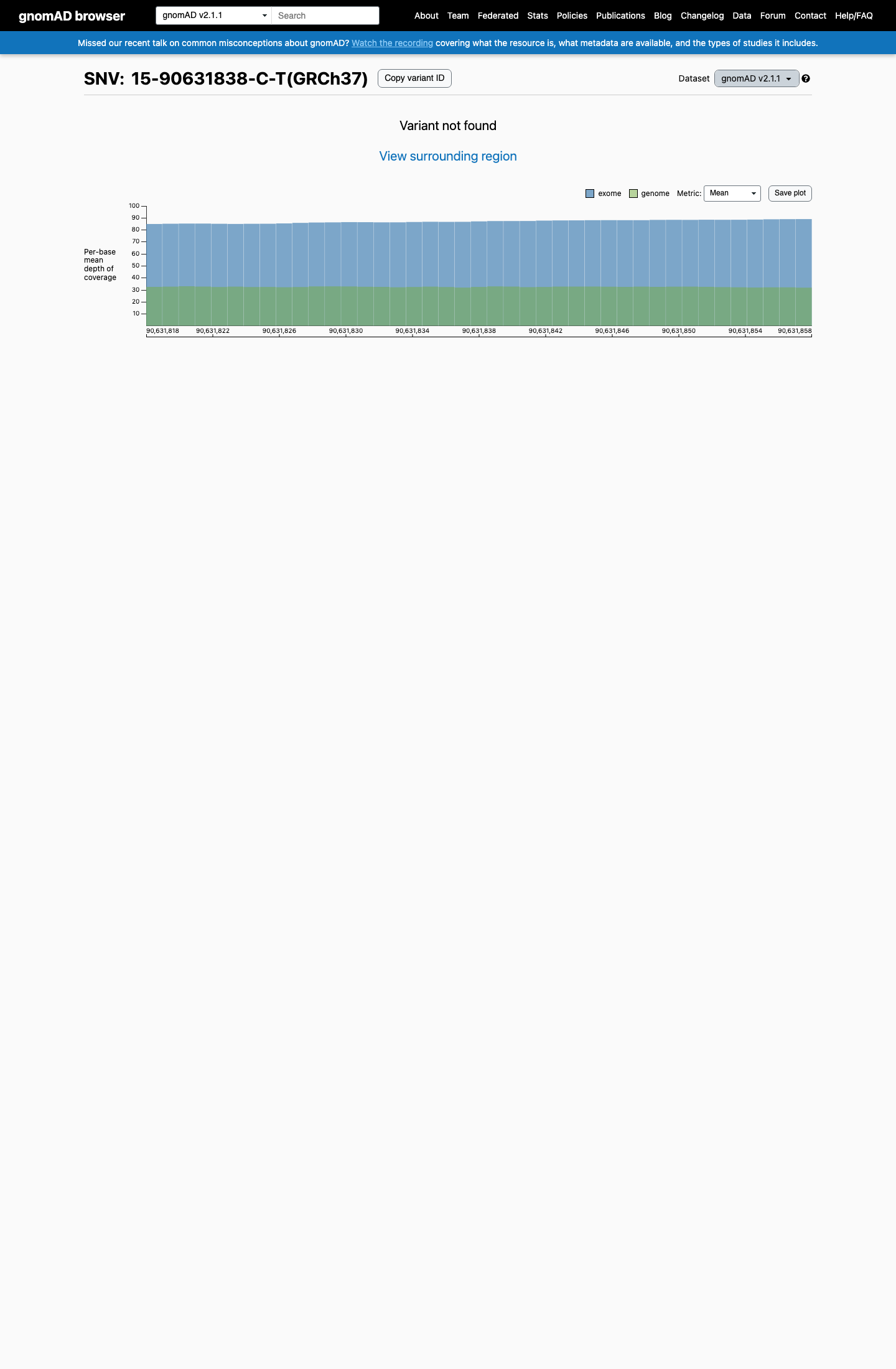
Absent from gnomAD v2.1.
🇨🇦 CA
Absent from gnomAD-Canada v1.0.
Allele frequency by ancestry
three datasets · side by side
gnomAD v4.1
6.2e-05%
· 1 / 1,614,246
0 hom
0 hom
Ashkenazi Jewish 1 / 29,606 |
0.0034% |
+ 9 not observed (Remaining individuals, Admixed American, European (Finnish), Amish, East Asian, Middle Eastern, South Asian, African/African American, European (non-Finnish))
gnomAD v2.1
Absent
· 0 / ?
0 hom
0 hom
Not observed in any ancestry group.
gnomAD Canada 🇨🇦
Absent
· 0 / ?
0 hom
0 hom
Not observed in any ancestry group.
ClinVar
This variant has been reported in ClinVar but submission details could not be extracted. (ClinVarID = 375987)

In silico
SpliceAI predicts no significant splice impact for this variant (max delta score = 0.03). REVEL score = 0.733. BayesDel score = 0.431707.
Functional
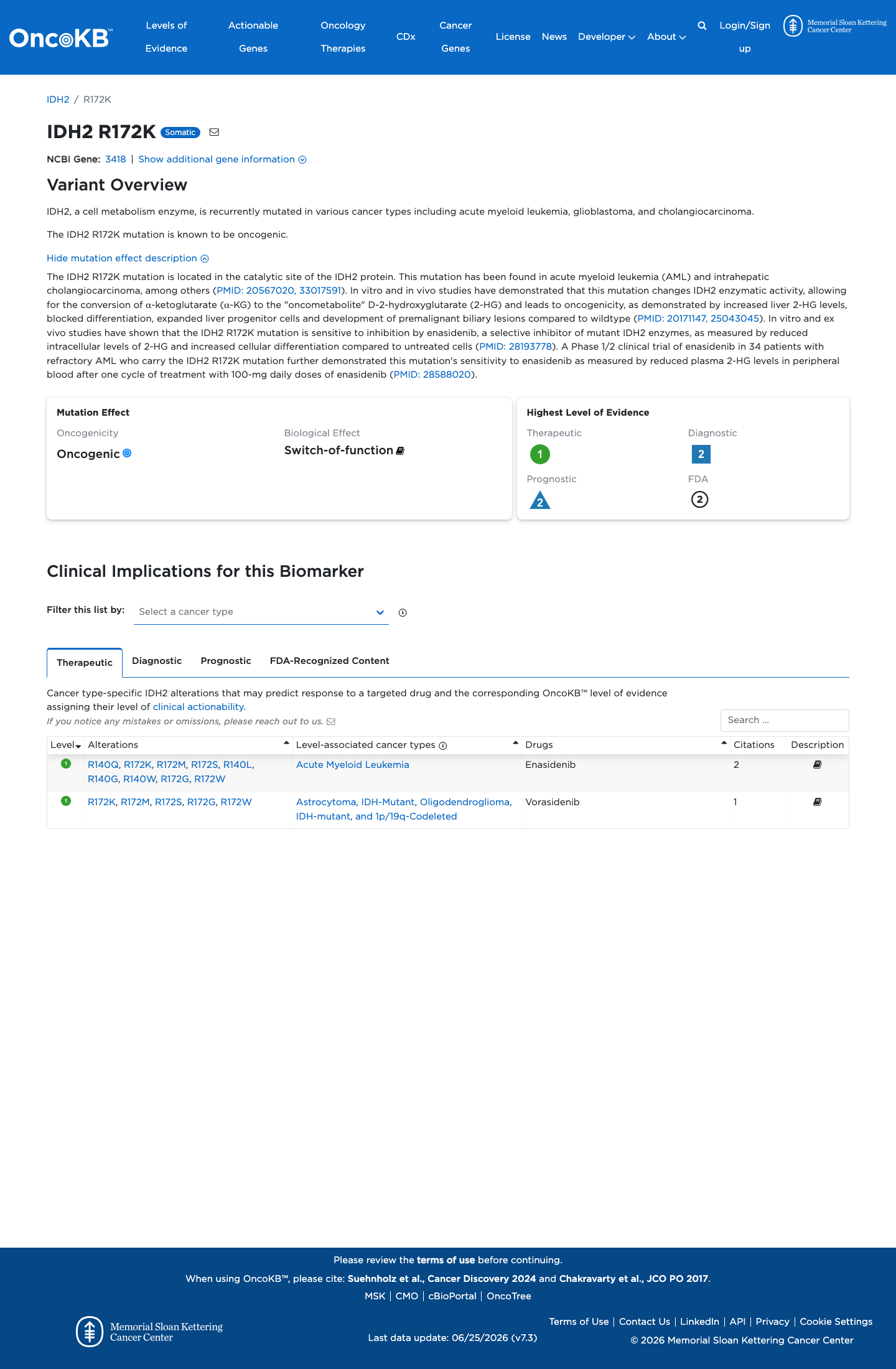
Oncogenic
OncoKB identified variant-specific curated literature and context relevant to functional review; curated oncogenicity label: Oncogenic.
COSMIC

Cancer hotspots
Somatic evidence
Hotspot
COSMIC
This variant lies in a statistically significant hotspot. This variant has previously been reported in somatic cancers (COSMIC; COSV57468734, n = 467 times).
Hotspots
This variant lies in a statistically significant hotspot.
Literature · how each cited paper was used
5papers cited
Each card is an audit: what was searched, what was found, whether it names the variant, which criteria it fed, and why. 2 further PMIDs triaged but not cited — see Sources & references.
The common feature of leukemia-associated IDH1 and IDH2 mutations is a neomorphic enzyme activity converting alpha-ketoglutarate to 2-hydroxyglutarate.
Searched
c.515G>Ac.G515Ap.Arg172Lysp.R172KR172K
Found
IDH2 R172K confirmed to have neomorphic enzyme activity converting α-ketoglutarate to the oncometabolite 2-hydroxyglutarate. Tumor 2HG was elevated in AML patients harboring IDH2 R172 mutations. All reported IDH1 and IDH2 mutations were heterozygous with retention of one wild-type allele, arguing against simple loss of function.
Variant
✓ Names this variant — characterised directly
Applied to
→PS3
met
→PM1
met
Why
Variant-specific neomorphic functional effect confirmed; referenced in PS3 and PM1 assessments.
The IDH2 mutations which have been identified in gliomas occur at the analogous residue to IDH1 R132, IDH2 R172.
Location Introduction, paragraph 1; Results, paragraphs 2-4; Figure 1-2 · Context Enzymatic assays for α-KG to 2HG conversion using recombinant IDH2 R172K mutant protein; 2HG measurement in AML patient samples · full text
IDH1 and IDH2 mutations are frequent genetic alterations in acute myeloid leukemia and confer adverse prognosis in cytogenetically normal acute myeloid leukemia with NPM1 mutation without FLT3 internal tandem duplication.
Searched
c.515G>Ac.G515Ap.Arg172Lysp.R172KR172K
Found
IDH2 c.G515A (c.515G>A, p.R172K) was identified in 22 of 805 AML patients (2.7%). IDH2 R172K mutations were mutually exclusive with FLT3-ITD and associated with adverse prognosis in CN-AML with mutated NPM1 without FLT3-ITD (5-year OS 41% vs 65%).
Variant
✓ Names this variant — characterised directly
Applied to
→PS3
met
→PM1
met
Why
Variant-specific prevalence and prognostic data in AML confirmed; referenced in PS3 and PM1 assessments.
All IDH2 mutations were missense mutations, either c.G419A or c.G515A, predicted to cause amino acid changes p.R140Q (n=48) and p.R172K (n=22), respectively.
Location Table 1; Results, paragraphs 1-2; Survival Analysis section · Context DHPLC and direct sequencing of exon 4 of IDH1/IDH2 in 805 AML patients enrolled on AMLSG treatment trials; survival analysis with median 6.3-year follow-up · full text
2-hydroxyglutarate production, but not dominant negative function, is conferred by glioma-derived NADP-dependent isocitrate dehydrogenase mutations.
Searched
c.515G>Ac.G515Ap.Arg172Lysp.R172KR172K
Found
IDH2 R172K, along with R172M and R172G, produces 2-hydroxyglutarate in glioma models. The study excluded a dominant negative mechanism, confirming that the shared gain-of-function (2HG production), not dominant negative inhibition, is the oncogenic mechanism of IDH2 R172 mutations.
Variant
✓ Names this variant — characterised directly
Applied to
→PS3
met
Why
Variant-specific functional data confirming neomorphic 2HG production and excluding dominant negative mechanism; referenced in PS3 assessment.
R172K, R172M, and R172G are the IDH2 substitutions observed in gliomas.
Location Introduction, paragraph 1 · Context NADP+-dependent IDH enzyme activity assays; 2HG production quantification; WT:mutant heterodimer studies · full text
Mutant IDH inhibits HNF-4α to block hepatocyte differentiation and promote biliary cancer.
Searched
c.515G>Ap.Arg172Lysp.R172KR172K
Found
IDH2-R172K expressed in mouse hepatoblasts produced increased 2HG and blocked hepatocyte differentiation, with IDH2-R172K causing the most pronounced effects among IDH mutants tested. Treatment with a mutant IDH inhibitor attenuated 2HG production and restored differentiation.
Variant
✓ Names this variant — characterised directly
Applied to
→PS3
met
Why
Variant-specific functional effect on differentiation confirmed in IHCC model; referenced in PS3 assessment.
HBs expressing mutant IDH1 (R132C, R132H) or IDH2 (R140Q, R172K) produced increased 2HG, but exhibited morphology and proliferation rates indistinguishable from vector and IDH wild type (WT) controls.
Location Results, paragraph 1; Extended Data Figure 1 · Context Mouse hepatoblast differentiation assay; 2HG quantification; IDH mutant inhibitor (ML309) treatment · full text
Enasidenib in mutant IDH2 relapsed or refractory acute myeloid leukemia.
Searched
c.515G>Ap.Arg172Lysp.R172KR172K
Found
Enasidenib, a first-in-class selective inhibitor of mutant IDH2, demonstrated clinical efficacy in IDH2-R172K-mutated relapsed/refractory AML. At 100 mg daily, enasidenib reduced plasma 2-HG by a median of 28% and maximum of 94% in patients with IDH2-R172K mutations. Overall response rate was 53.3% for IDH2-R172 patients.
Variant
✓ Names this variant — characterised directly
Applied to
→PS3
met
Why
Clinical confirmation of IDH2-R172K as an oncogenic driver targetable by enasidenib; referenced in PS3 assessment.
enasidenib 100 mg daily reduced plasma 2-HG levels from baseline by a median and maximum of 93% and 99%, respectively, in patients with IDH2-R140Q mutations and by 28% and 94% in patients with IDH2-R172K mutations
Location Results, Pharmacokinetics/Pharmacodynamics subsection; Efficacy subsection · Context Phase 1/2 clinical trial (NCT01915498); 239 patients with mutant-IDH2 advanced myeloid malignancies; dose-escalation and expansion cohorts · full text
Sources & reference links
Triaged references · 2 PMIDs not cited in assessment
28193778 ↗
AG-221, a First-in-Class Therapy Targeting Acute Myeloid Leukemia Harboring Oncogenic IDH2 Mutations.
ONCOKB