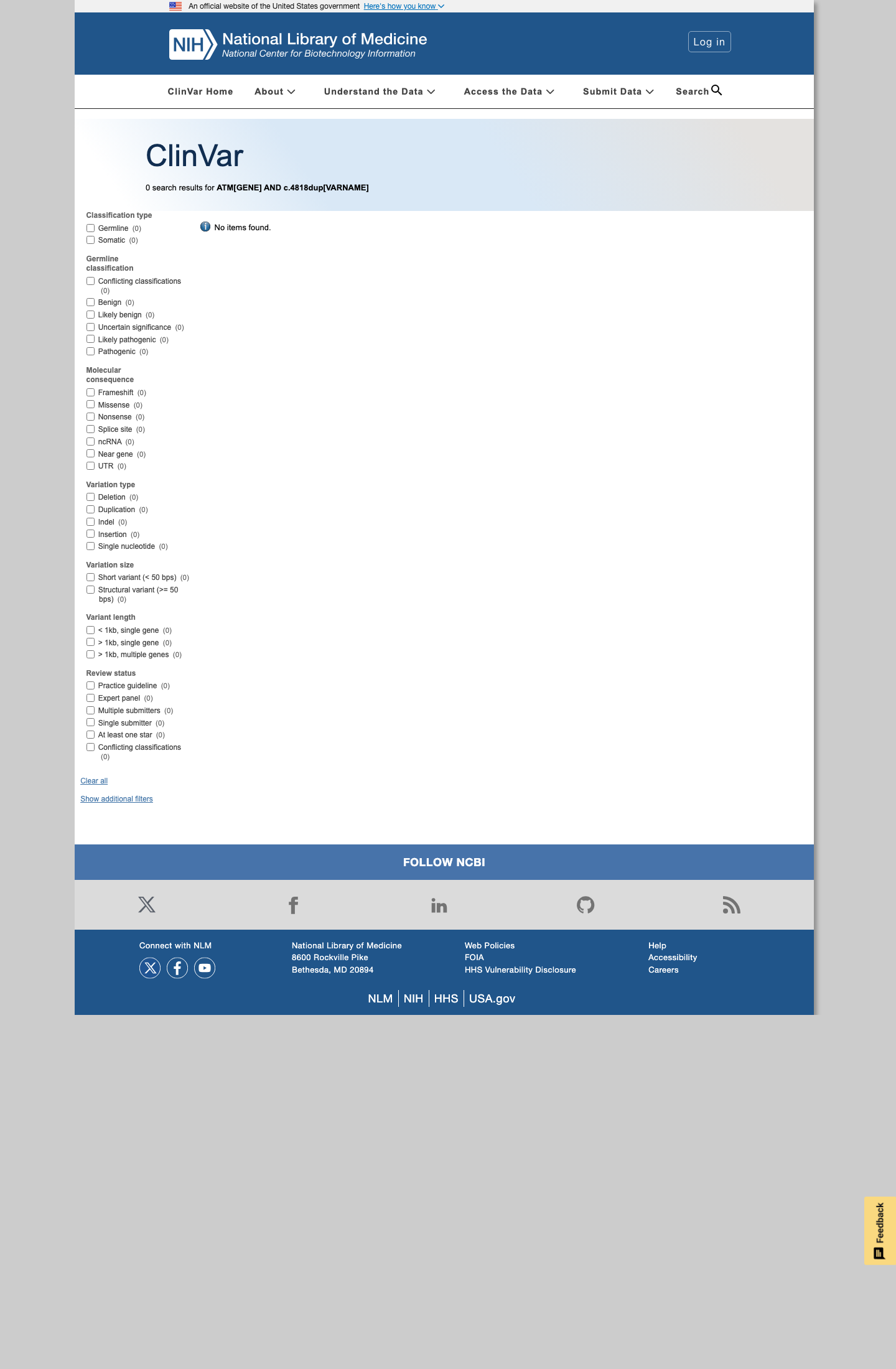
NM_000051.3:c.4818dupT (p.Pro1607SerfsTer6) is a frameshift duplication in exon 32 of ATM predicted to cause nonsense-mediated decay and complete loss of ATM protein function (PVS1_VeryStrong).1 The variant is absent from gnomAD v4.1 population database (0/1,614,094 alleles), meeting the ATM VCEP PM2_Supporting threshold of ≤0.001% allele frequency.2 The premature termination codon at p.Pro1607SerfsTer6 lies upstream of p.Arg3047, satisfying the ATM VCEP PM5_Supporting rule for frameshifting variants with PTCs upstream of this C-terminal boundary.3 No variant-specific functional studies, case-control data, co-segregation data, or co-occurrence data were identified for this variant in the literature screened (PMID:27413114, PMID:30348496, PMID:30553448). The variant is not present in ClinVar and has not been reported in COSMIC or in statistically significant mutational hotspots.4
Final classification
Pathogenic
PVS1PM2PM5
ATM
c.4818dup
p.Pro1607SerfsTer6
This variant
NM_000051.3:c.4818dupT (p.Pro1607SerfsTer6) is a frameshift duplication in exon 32 of ATM predicted to cause nonsense-mediated decay and complete loss of ATM protein function (PVS1_VeryStrong).
Richards et.al., 2015 - Combining rules v1.5.0 criteria-combination framework: matched Rule4 (1 Pathogenic.Very Strong + Pathogenic.Supporting >=2) with applied criteria: PVS1 very strong, PM2 supporting, PM5 supporting; maps to Pathogenic.
Classification rationale
PVS1PM2PM5
Pathogenic
ATM c.4818dup
PVS1 + PM2 + PM5
→
Pathogenic
LYFE Sciences is an AI system, and it can make mistakes. Criteria
may be applied incorrectly, sources may be misread, and a confident-looking
classification can still be wrong. Double-check every criterion and
its underlying evidence before relying on any call.
Gene diagram
· NM_000051.3 · variants mapped to exon structure
ATM
NM_000051.3
Fetching transcript structure from UCSC…
Applied criteria · 3 applied · 7 assessed
MetEvidence satisfies this criterion.
Not metEvaluated against available evidence; threshold not reached.
Not assessedApplies in principle, but no evidence was found to evaluate it.
N/ADoesn't apply to this variant type.
Applied · 3
Strength
Supporting
Moderate
Strong
Very strong
PVS1
very strong
Pathogenic
Frameshift variant NM_000051.3:c.4818dup (p.Pro1607SerfsTer6) creates a premature termination codon at residue 1612 in ATM, a gene where loss of function is an established mechanism for ataxia-telangiectasia and hereditary breast/ovarian/pancreatic cancer. The PTC is NMD-competent and lies well upstream of the C-terminal boundary (p.Arg3047) specified by the ATM VCEP v1.5.0 PVS1 decision tree. PVS1_VeryStrong applied per ClinGen HBOP VCEP specifications.
NM_000051.3:c.4818dup is a frameshift duplication in exon 32 of 63 coding exonsPredicted protein consequence: NP_000042.3:p.(Pro1607SerfsTer6)PTC at codon 1612 of 3056
PM2
supporting
Pathogenic
NM_000051.3:c.4818dupT is absent from gnomAD v4.1 (0 alleles, AF=0), satisfying the ATM VCEP PM2_Supporting threshold of ≤0.001% population frequency.
gnomAD v4.1: 0 allelesallele frequency = 0gnomAD v2.1: absent
PM5
supporting
Pathogenic
This frameshift variant creates a premature termination codon at p.Pro1607SerfsTer6 (PTC at codon 1612), which lies upstream of p.Arg3047, satisfying the ATM VCEP v1.5.0 PM5_Supporting rule for frameshifting/truncating variants with PTCs upstream of p.Arg3047.
Predicted protein: NP_000042.3:p.(Pro1607SerfsTer6)PTC at codon 1612p.Arg3047 is the VCEP-specified C-terminal cutoff for PM5 application
Assessed · not applied
· 2 not met · 5 not assessed
Pathogenic
PS3
No variant-specific functional studies were identified for NM_000051.3:c.4818dupT.
PS4
No case-control study data are available for NM_000051.3:c.4818dupT.
PP1
No co-segregation data are available for NM_000051.3:c.4818dupT.
Benign
BA1
NM_000051.3:c.4818dupT is absent from gnomAD v4.1 (0 alleles).
BS1
NM_000051.3:c.4818dupT is absent from gnomAD v4.1 (0 alleles).
BS3
No variant-specific functional rescue data are available for NM_000051.3:c.4818dupT.
BP2
No co-occurrence data in trans with a known pathogenic ATM variant are available for NM_000051.3:c.4818dupT.
N/A · 17
PS1 · PS2 · PM1 · PM4 · PM6 · PP2 · PP3 · PP4 · PP5 · BS2 · BS4 · BP1 · BP3 · BP4 · BP5 · BP6 · BP7
Research & evidence
Population frequency · supports pathogenic
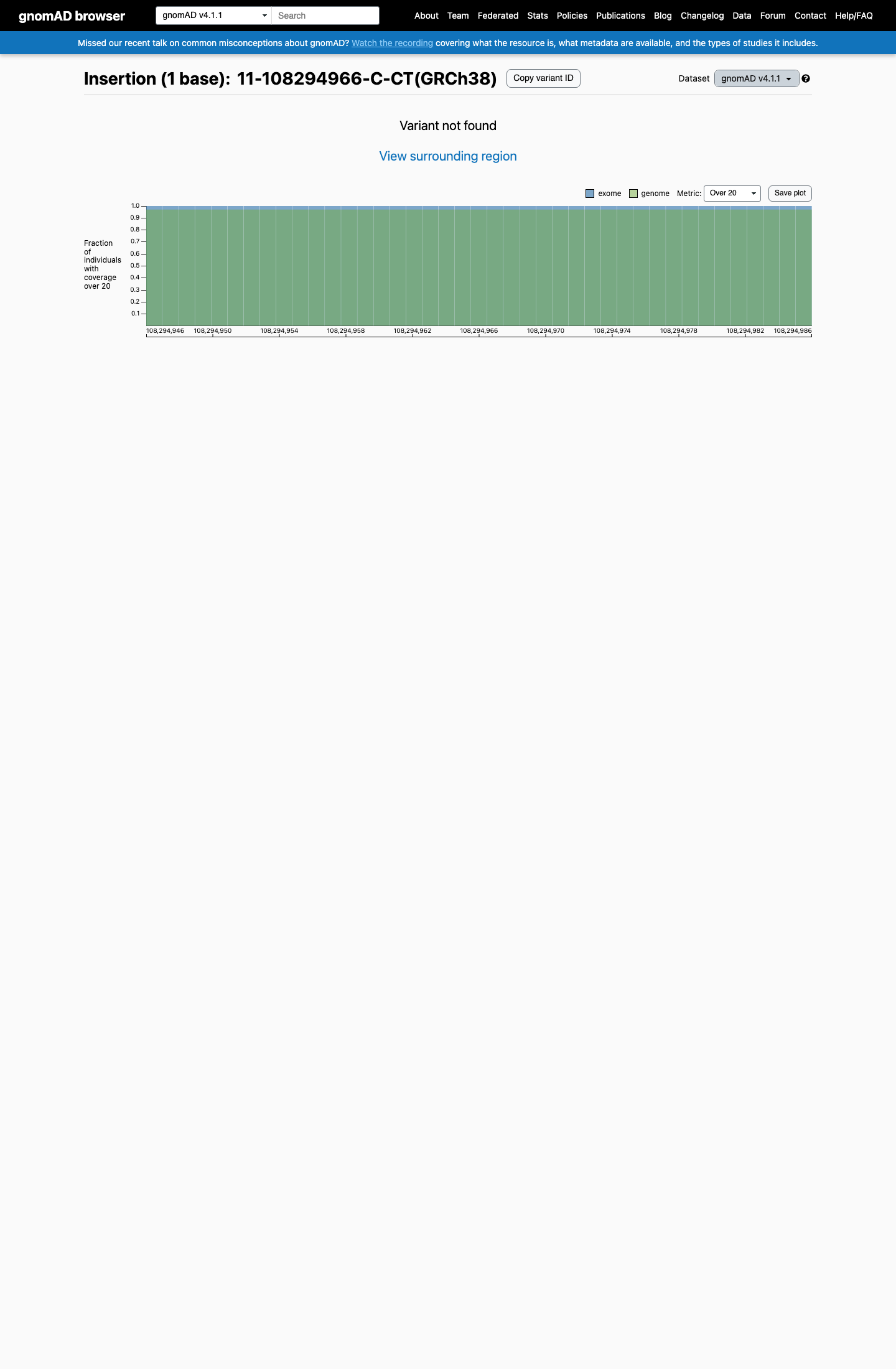
gnomAD v4.1
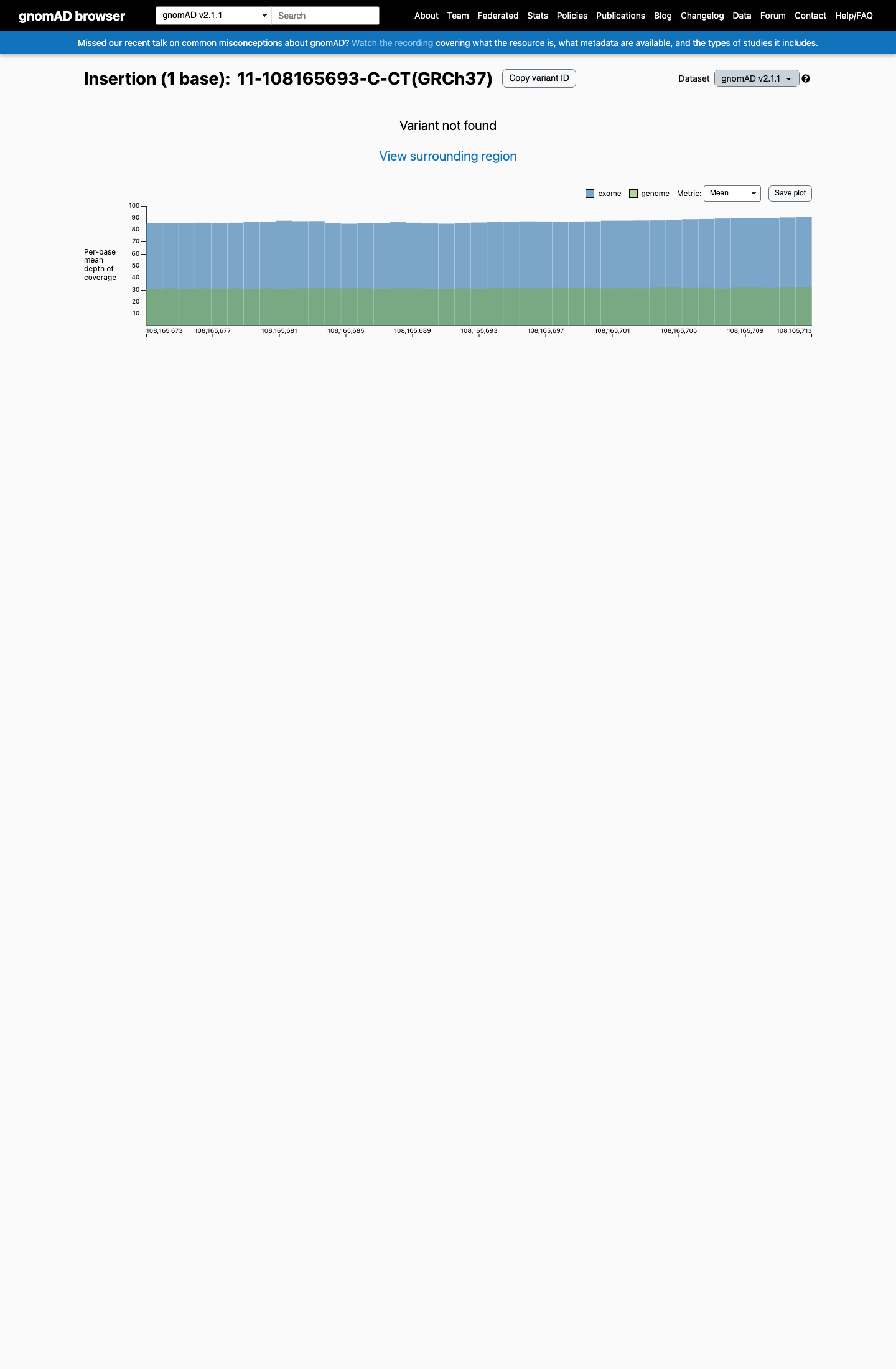
gnomAD v2.1
v4.1
Absent from gnomAD v4.1.
v2.1
Absent from gnomAD v2.1.
🇨🇦 CA
Absent from gnomAD-Canada v1.0.
Allele frequency by ancestry
three datasets · side by side
gnomAD v4.1
Absent
· 0 / ?
0 hom
0 hom
Not observed in any ancestry group.
gnomAD v2.1
Absent
· 0 / ?
0 hom
0 hom
Not observed in any ancestry group.
gnomAD Canada 🇨🇦
Absent
· 0 / ?
0 hom
0 hom
Not observed in any ancestry group.
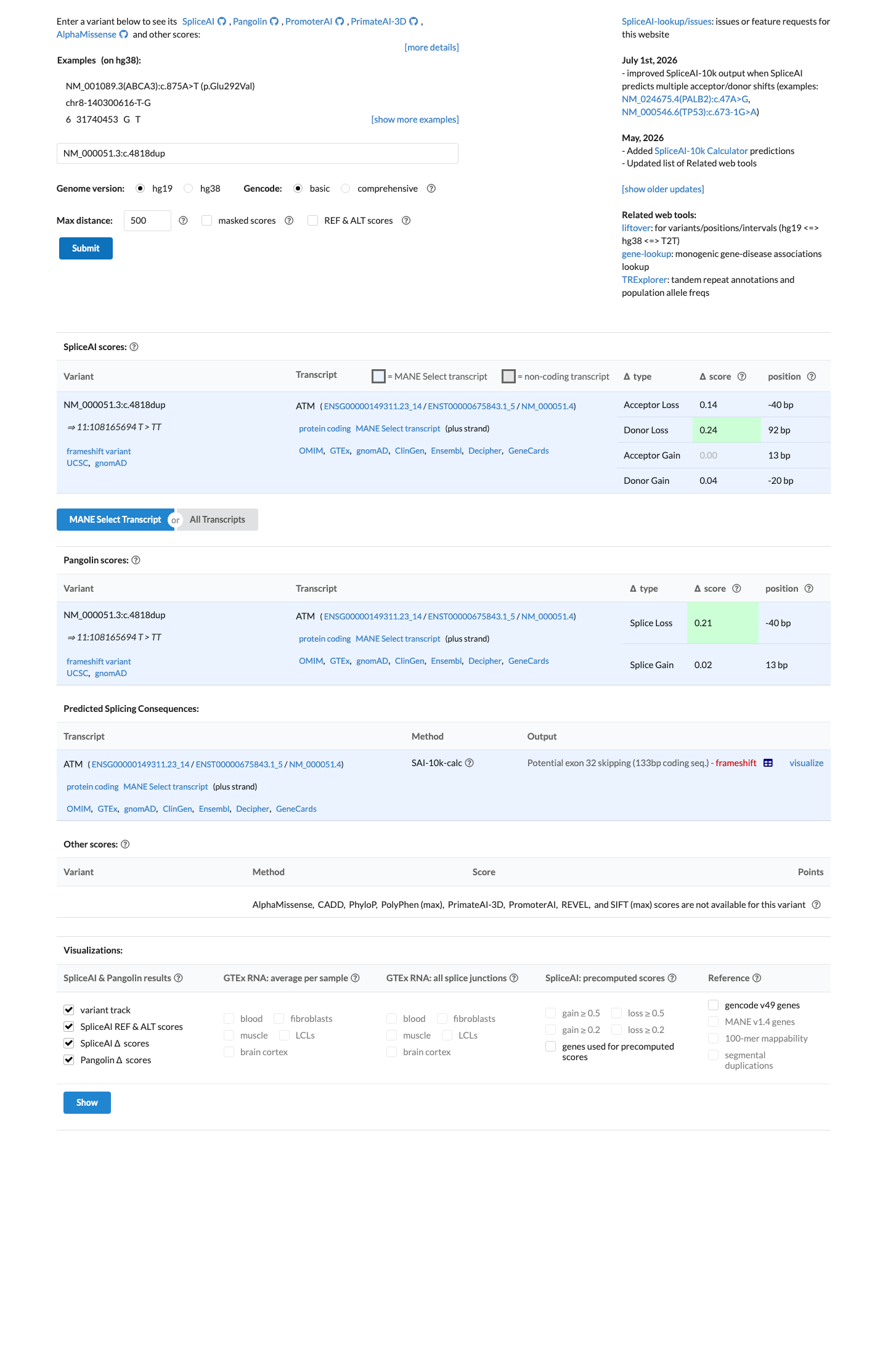
In silico
SpliceAI predicts possible splice impact for this variant (max delta score = 0.24).
Functional
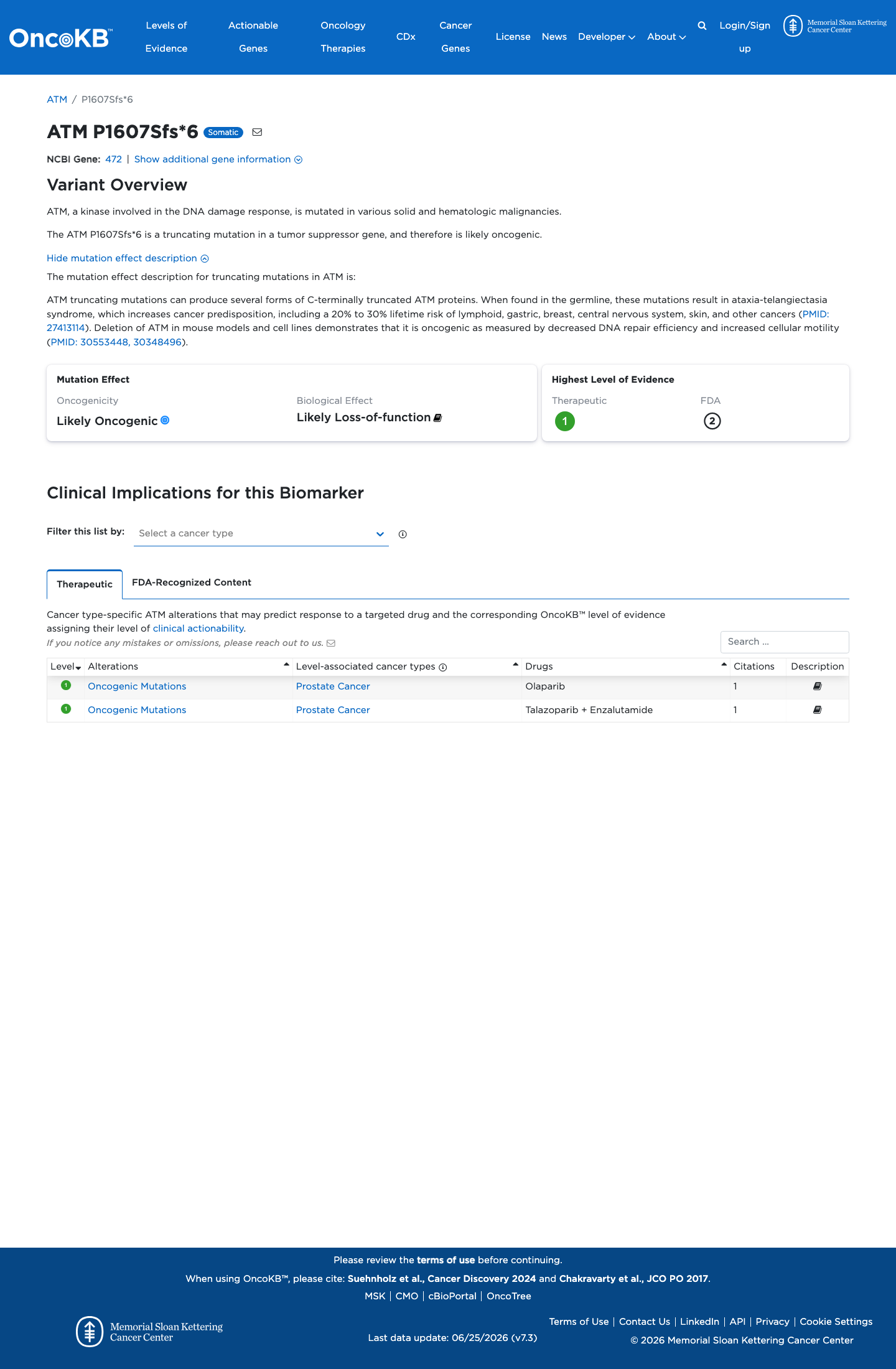
Likely Oncogenic
OncoKB identified variant-specific curated literature and context relevant to functional review; biological-effect context: Likely Loss-of-function; curated oncogenicity label: Likely Oncogenic.

COSMIC

Cancer hotspots
Somatic evidence
Not in COSMIC / hotspots
COSMIC
This variant does not lie in a statistically significant hotspot. This variant has not previously been reported in somatic cancers (COSMIC).
Hotspots
This variant does not lie in a statistically significant hotspot.
Sources & reference links
9Sources
Triaged references · 3 PMIDs not cited in assessment
30348496 ↗
Inactive Atm abrogates DSB repair in mouse cerebellum more than does Atm loss, without causing a neurological phenotype.
ONCOKB
30553448 ↗
Loss of ATM positively regulates Rac1 activity and cellular migration through oxidative stress.
ONCOKB