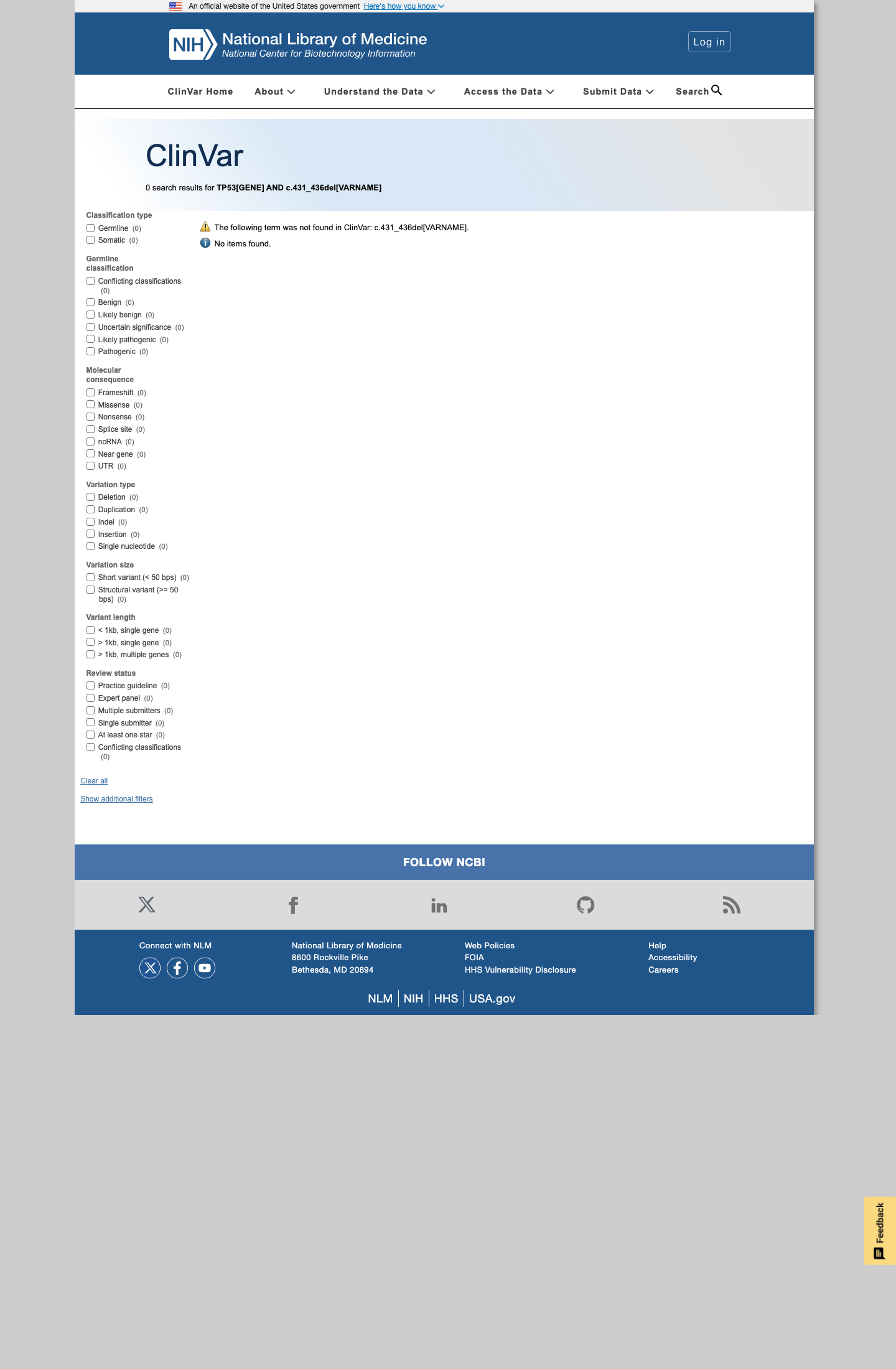
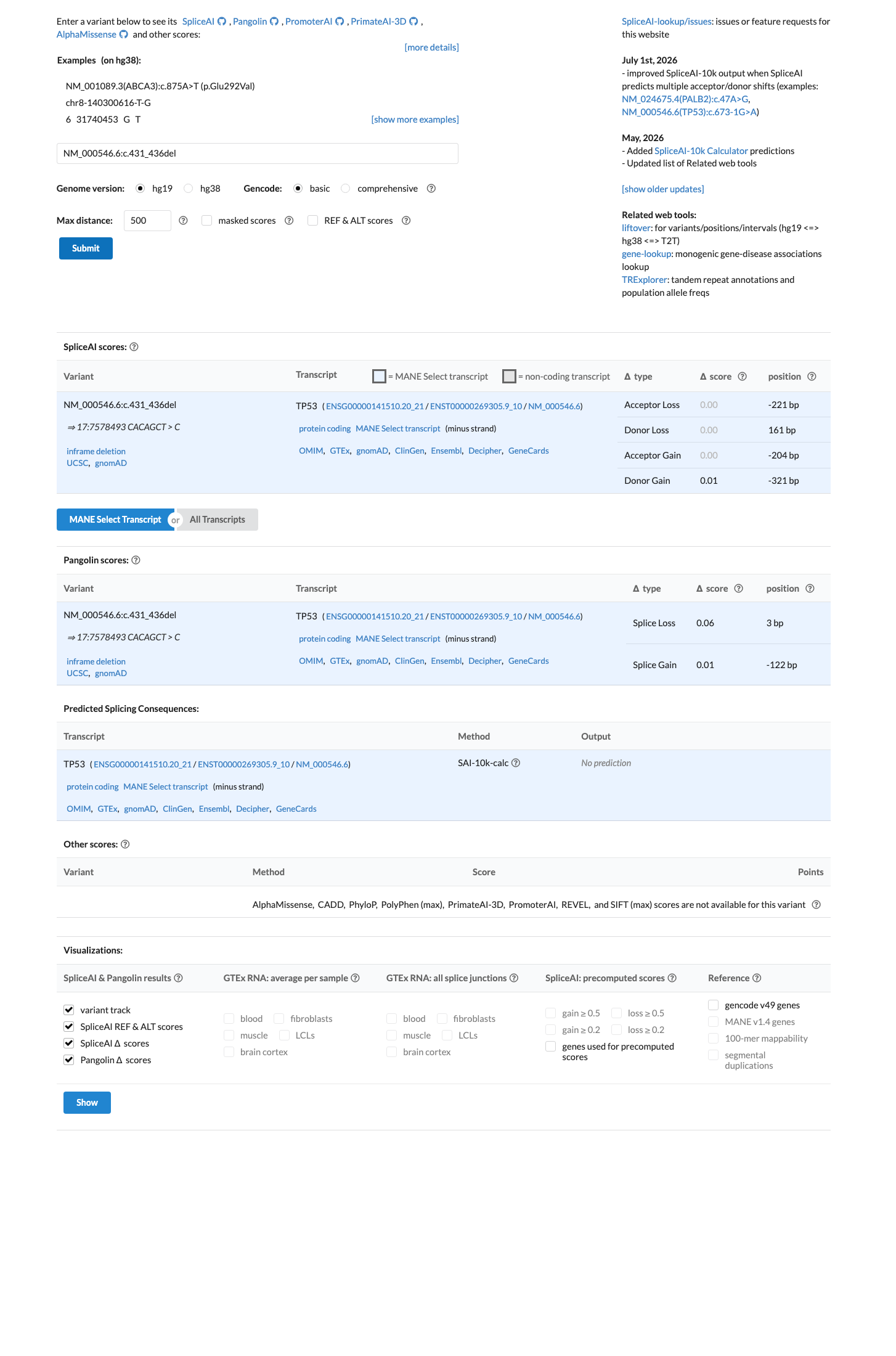
NM_000546.6:c.431_436del (p.Gln144_Trp146delinsArg) is a 6-bp in-frame deletion in exon 5 of TP53, removing two amino acids (Q144 and W146) in the DNA-binding core domain L2 loop region and inserting arginine. This variant is absent from gnomAD v2.1, v4.1, and gnomAD-Canada, consistent with PM2_Supporting (allele frequency < 0.003%).1 The variant has not been reported in ClinVar and has not been observed in COSMIC.2 SpliceAI predicts no splicing impact (max delta score = 0.00).3 The variant is not covered by the VCEP PVS1 framework (in-frame deletion, not a null variant), nor by VCEP PP3/BP4 in silico rules (multi-amino-acid deletion, not a missense or single-AA deletion).4 No variant-specific functional assay data from eligible studies (Kato, Kotler, Giacomelli, Funk, Kawaguchi) are available; the VCEP Functional worksheet does not contain this variant. OncoKB infers a Likely Loss-of-function but this is a somatic curation and not a direct germline functional assay.5 No proband data, segregation data, de novo observations, or cancer-phenotype data were available for this variant. Only one criterion met: PM2_Supporting. All other applicable criteria are either not met, not assessed due to absent data, or not applicable per VCEP specifications.
TP53
Final classification
VUS
PM2
TP53
c.431_436del
p.Gln144_Trp146delinsArg
This variant
NM_000546.6:c.431_436del (p.Gln144_Trp146delinsArg) is a 6-bp in-frame deletion in exon 5 of TP53, removing two amino acids (Q144 and W146) in the DNA-binding core domain L2 loop region and inserting arginine.
Tavtigian et.al., 2020 - Bayesian adaptation of Richards et.al., 2015 v2.4.0 point-based framework: PM2 supporting (+1) = 1 points, which maps to VUS.
Classification rationale
PM2
VUS
TP53 c.431_436del
PM2
→
VUS
4
vcep_pvs1_flowchartvcep_pp3_bp4_codes
5
vcep_functional_worksheetoncokb ↗
Gene diagram
· NM_000546.6 · variants mapped to exon structure
TP53
NM_000546.6
Fetching transcript structure from UCSC…
Applied criteria · 1 applied · 13 assessed
MetEvidence satisfies this criterion.
Not metEvaluated against available evidence; threshold not reached.
Not assessedApplies in principle, but no evidence was found to evaluate it.
N/ADoesn't apply to this variant type.
Applied · 1
Strength
Supporting
Moderate
Strong
Very strong
✓
PM2
supporting
Pathogenic
NM_000546.6:c.431_436del is absent from gnomAD v2.1, gnomAD v4.1, and gnomAD-Canada v1.0. This satisfies the VCEP PM2_Supporting rule requiring an allele frequency below 0.00003 (0.003%).
Absent from gnomAD v2.1 (exomes)Absent from gnomAD v4.1 (exomes)Absent from gnomAD-Canada v1.0 (genomes)
Assessed · not applied
· 5 not met · 8 not assessed
Pathogenic
PS1
VCEP PS1 requires a same-residue missense variant previously classified as pathogenic or likely pathogenic by TP53 VCEP specifications.
PS2
No de novo observation data available for this variant.
PS3
This 2-amino-acid in-frame deletion (p.Gln144_Trp146delinsArg) is not listed in the VCEP Functional worksheet (Supplementary Table S3), which covers single amino acid substitutions and single amino acid deletions.
PS4
No proband data available.
PP1
No cosegregation data available.
PP3
This variant is a 2-amino-acid in-frame deletion, which is not covered by the VCEP PP3 rules.
PP4
VCEP PP4 requires observation of the variant with a variant allele fraction (VAF) of 5-35%.
Benign
BA1
VCEP BA1 requires a filtering allele frequency ≥ 0.001 (0.1%) in a gnomAD continental subpopulation.
BS1
VCEP BS1 requires a filtering allele frequency ≥ 0.0003 (0.03%) but < 0.001 in a gnomAD continental subpopulation.
BS2
VCEP BS2 requires observation of the variant in unrelated females who have reached at least 60 years of age without cancer.
BS3
This 2-amino-acid in-frame deletion is not listed in the VCEP Functional worksheet.
BS4
VCEP BS4 requires lack of segregation in affected family members with LFS-associated cancers.
BP4
This is a 2-amino-acid in-frame deletion, which is not covered by the VCEP BP4 rules.
N/A · 13
PVS1 · PM1 · PM4 · PM5 · PM6 · PP2 · PP5 · BP1 · BP2 · BP3 · BP5 · BP6 · BP7
Research & evidence
Population frequency
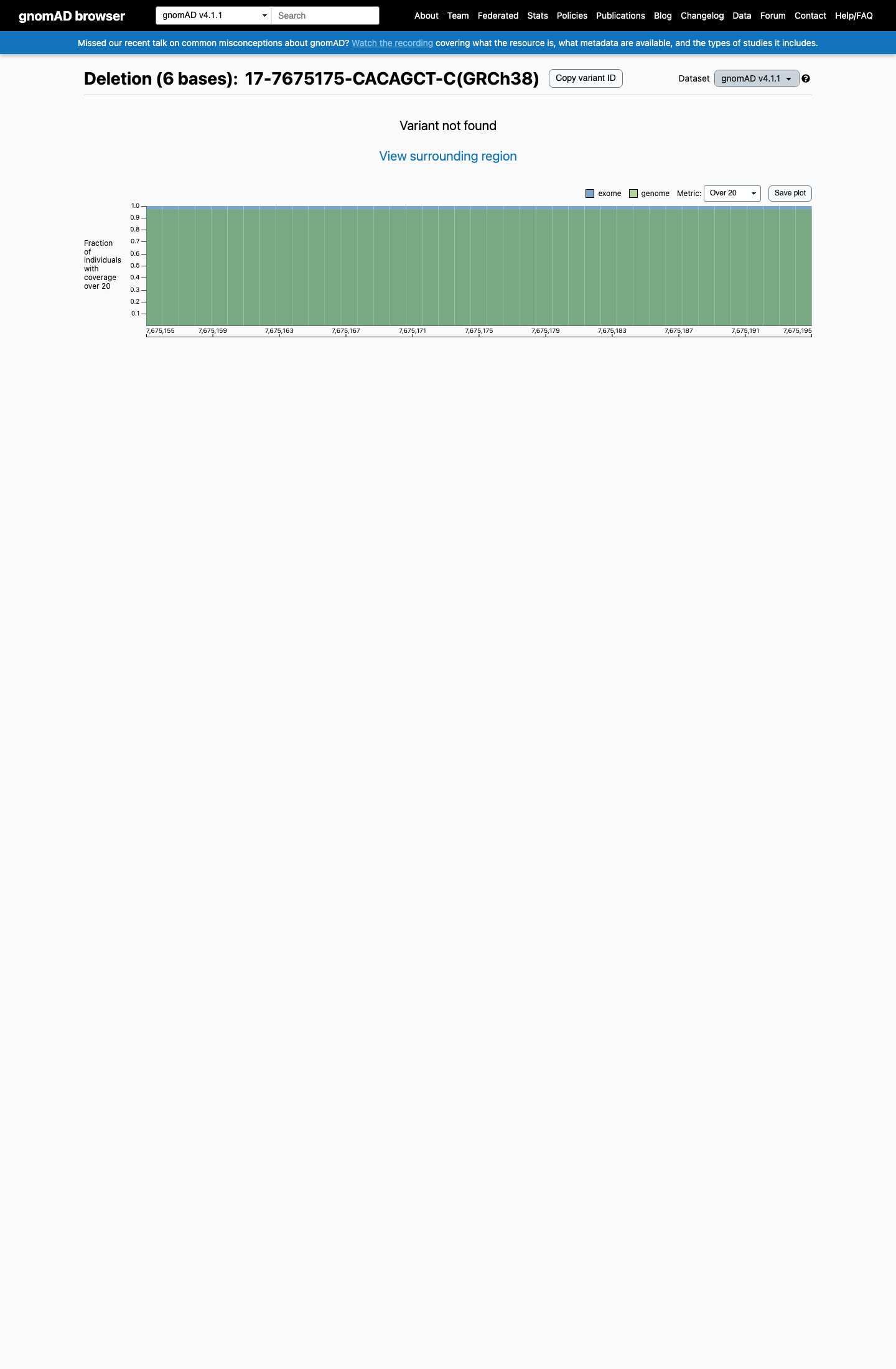
gnomAD v4.1
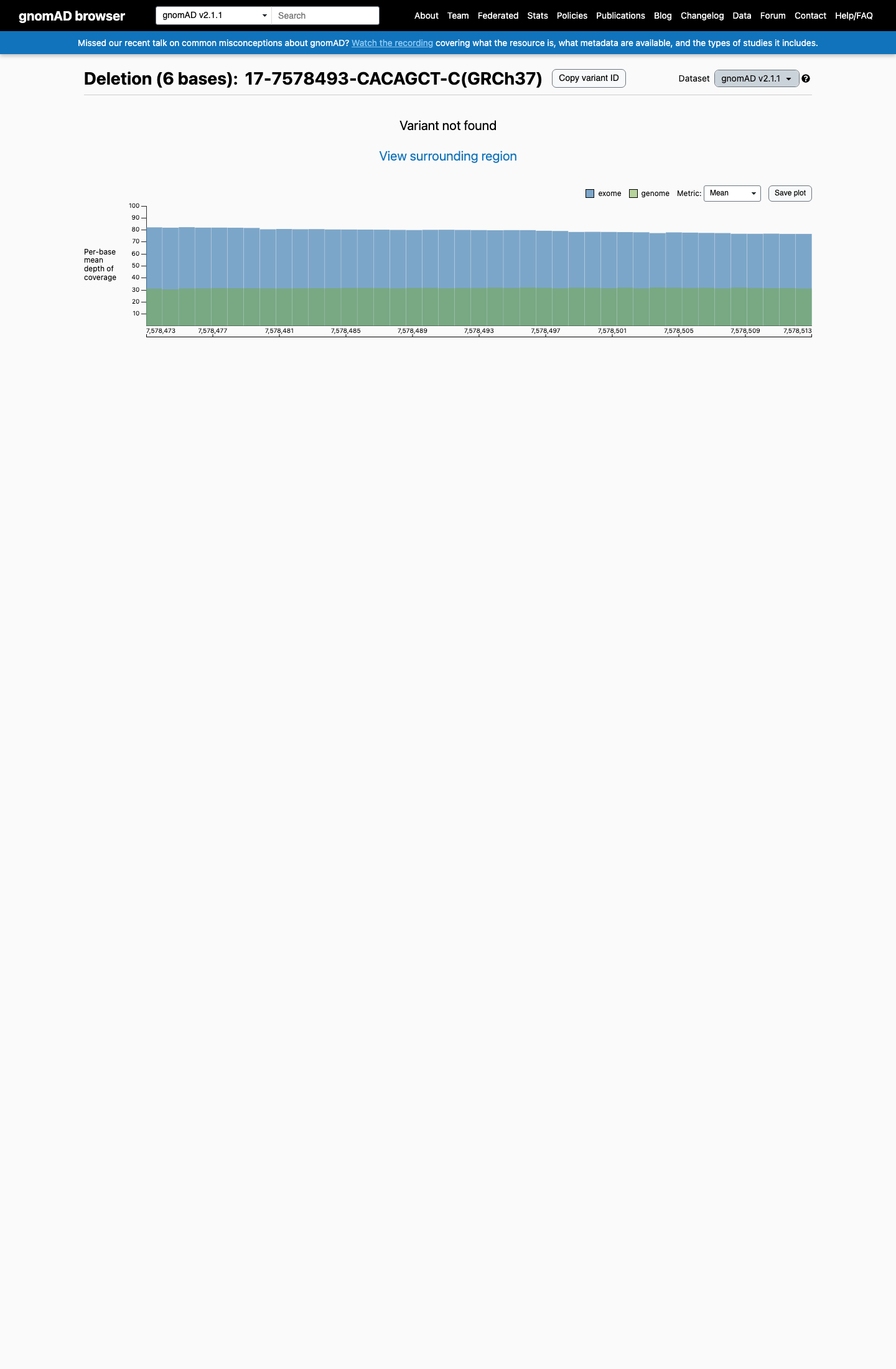
gnomAD v2.1
v4.1
Absent from gnomAD v4.1.
v2.1
Absent from gnomAD v2.1.
🇨🇦 CA
Absent from gnomAD-Canada v1.0.
Allele frequency by ancestry
three datasets · side by side
gnomAD v4.1
Absent
· 0 / ?
0 hom
0 hom
Not observed in any ancestry group.
gnomAD v2.1
Absent
· 0 / ?
0 hom
0 hom
Not observed in any ancestry group.
gnomAD Canada 🇨🇦
Absent
· 0 / ?
0 hom
0 hom
Not observed in any ancestry group.
In silico
SpliceAI predicts no significant splice impact for this variant (max delta score = 0.00).
Functional
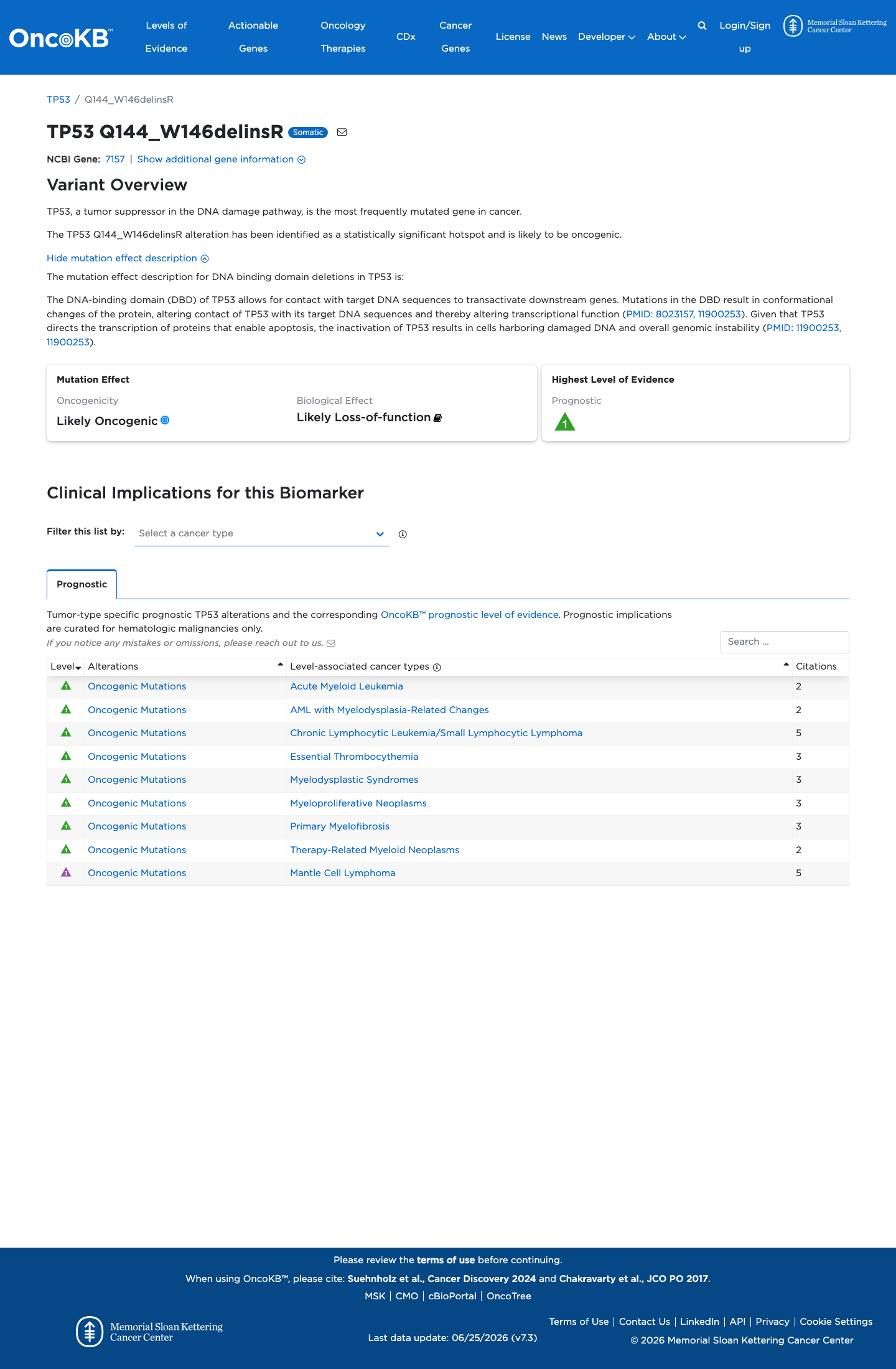
Likely Oncogenic
OncoKB identified variant-specific curated literature and context relevant to functional review; biological-effect context: Likely Loss-of-function; curated oncogenicity label: Likely Oncogenic.

COSMIC

Cancer hotspots
Somatic evidence
Hotspot
COSMIC
This variant lies in a statistically significant hotspot. This variant has not previously been reported in somatic cancers (COSMIC).
Hotspots
This variant lies in a statistically significant hotspot.
Sources & reference links
9Sources
Triaged references · 2 PMIDs not cited in assessment
8023157 ↗
Crystal structure of a p53 tumor suppressor-DNA complex: understanding tumorigenic mutations.
ONCOKB