Analysis in progress
Initialising…
0%
complete
This report is still being assembled — sections appear as each stage finishes. It isn't final yet.
SF3B1
Final classification
Likely Pathogenic
SF3B1 c.2359del · p.Ile787LeufsTer3
SF3B1

PVS1 (very_strong): NM_012433.2:c.2359del is a frameshift deletion predicted to cause premature termination (p.Ile787LeufsTer3) in SF3B1, a gene in which germline loss of function is an established disease mechanism for neurodevelopmental disorders (PMC6185798; PMID:41577671).

Gene
SF3B1
Transcript
NM_012433.2
HGVS · transcript:coding
NM_012433.2:c.2359del
Consequence
N/A
GRCh38
chr2:197401752 AT>A
GRCh37
chr2:198266476 AT>A
Basis gene-specific framework lacked a usable explicit final combination framework, so generic ACMG/AMP 2015 final-combination rules were applied as fallback; applied criteria: PVS1 very strong, PM2 moderate; combination = 1 very strong + 1 moderate, which maps to Likely Pathogenic.
gene-specific framework lacked a usable explicit final combination framework, so generic ACMG/AMP 2015 final-combination rules were applied as fallback; applied criteria: PVS1 very strong, PM2 moderate; combination = 1 very strong + 1 moderate, which maps to Likely Pathogenic.
Classification rationale
PVS1PM2 Likely Pathogenic
SF3B1 c.2359del

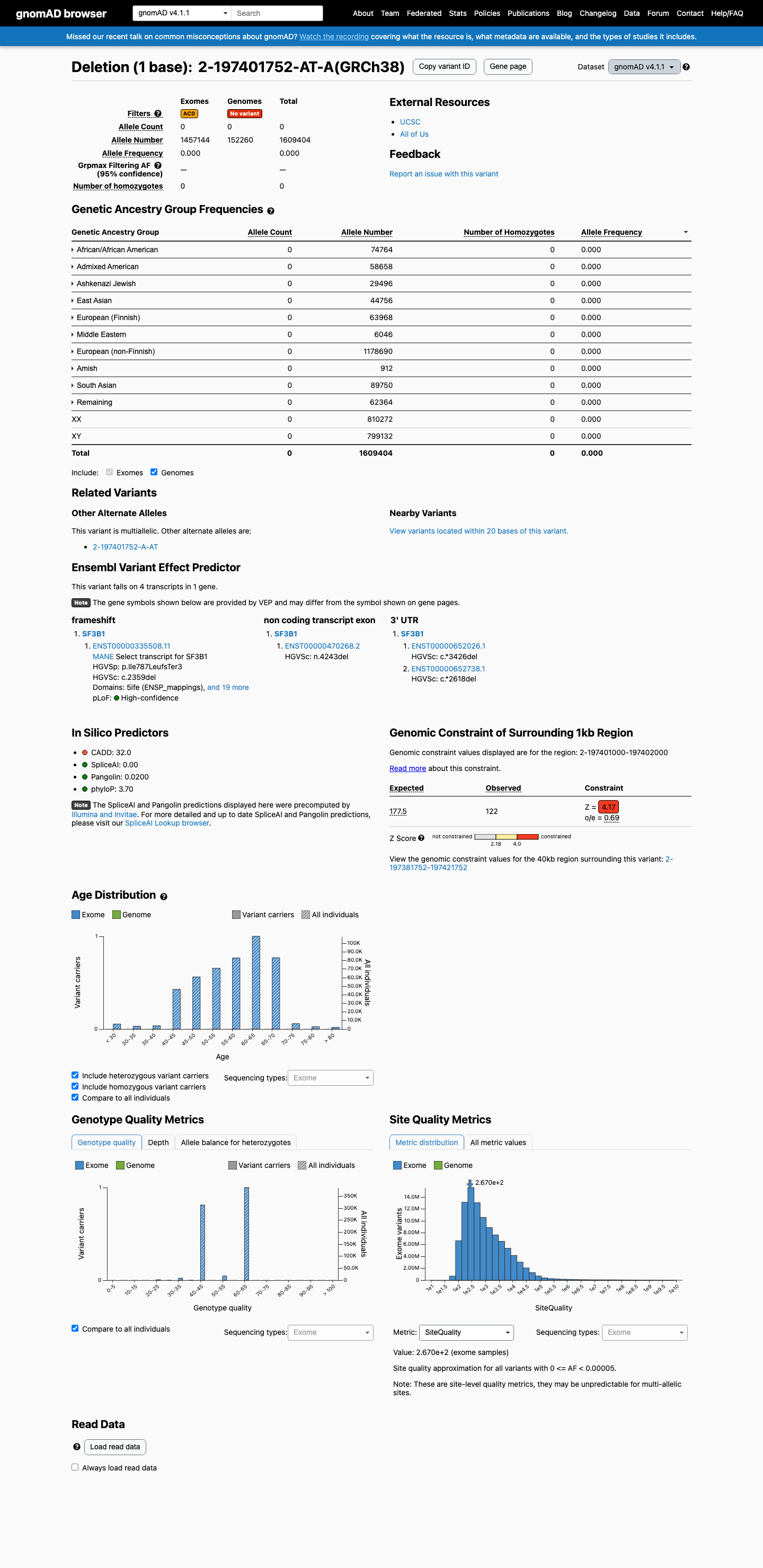
PVS1 (very_strong): NM_012433.2:c.2359del is a frameshift deletion predicted to cause premature termination (p.Ile787LeufsTer3) in SF3B1, a gene in which germline loss of function is an established disease mechanism for neurodevelopmental disorders (PMC6185798; PMID:41577671).1 PM2 (moderate): This variant is absent from large population databases including gnomAD v2.1 and v4.1 (0/1,609,404 alleles), consistent with rarity in the general population.2 Classification of Likely Pathogenic is assigned based on 1 very strong criterion (PVS1) and 1 moderate criterion (PM2) under the generic ACMG/AMP 2015 combination rules (PMID:25741868).3

PVS1 + PM2 Likely Pathogenic
1 pvs1_generic_framework ↗pvs1_variant_assessment
3 generic_acmg_combination_rules
Gene diagram · NM_012433.2 · variants mapped to exon structure
SF3B1 NM_012433.2
Fetching transcript structure from UCSC…
Applied criteria · 2 applied · 5 assessed
Applied · 2
Strength Supporting Moderate Strong Very strong
PVS1 very strong Pathogenic
NM_012433.2:c.2359del is a frameshift deletion predicted to cause premature termination at codon 789 (p.Ile787LeufsTer3), with the premature termination codon located well upstream of the normal terminus (residue 1305) in a gene where loss of function is an established disease mechanism for germline neurodevelopmental disorders.
Frameshift variant predicted to produce truncated protein p.I787Lfs*3 with NMD-competent premature termination codonSF3B1 germline loss-of-function mechanism supported by literature (PMID:41577671 reports 9 individuals with predicted LoF variants in neurodevelopmental disorder cohort)Variant located at c.2359
PM2 moderate Pathogenic
This variant is absent from large population databases including gnomAD v2.1 and v4.1 (0/1,609,404 alleles), supporting rarity in the general population.
Absent from gnomAD v2.1 (exomes)Absent from gnomAD v4.1 (0/1609
Assessed · not applied
Pathogenic
PM1 This variant does not lie in a statistically significant mutational hotspot and is not located in a critical functional domain identified as a hotspot for pathogenic variation.
PP3 Multiple lines of computational evidence do not independently support a deleterious effect beyond what is already captured by PVS1.
Benign
BA1 The allele frequency in population databases is 0.00%, which does not exceed the 1% threshold for BA1.
BS1 The allele frequency in population databases is 0.00%, which does not exceed the 0.3% threshold for BS1.
BP4 Multiple lines of computational evidence do not suggest no impact.
N/A · 21 PS1 · PS2 · PS3 · PS4 · PM3 · PM4 · PM5 · PM6 · PP1 · PP2 · PP4 · PP5 · BS2 · BS3 · BS4 · BP1 · BP2 · BP3 · BP5 · BP6 · BP7
Research & evidence
Population frequency · supports pathogenic
gnomAD v4.1 screenshot
gnomAD v4.1
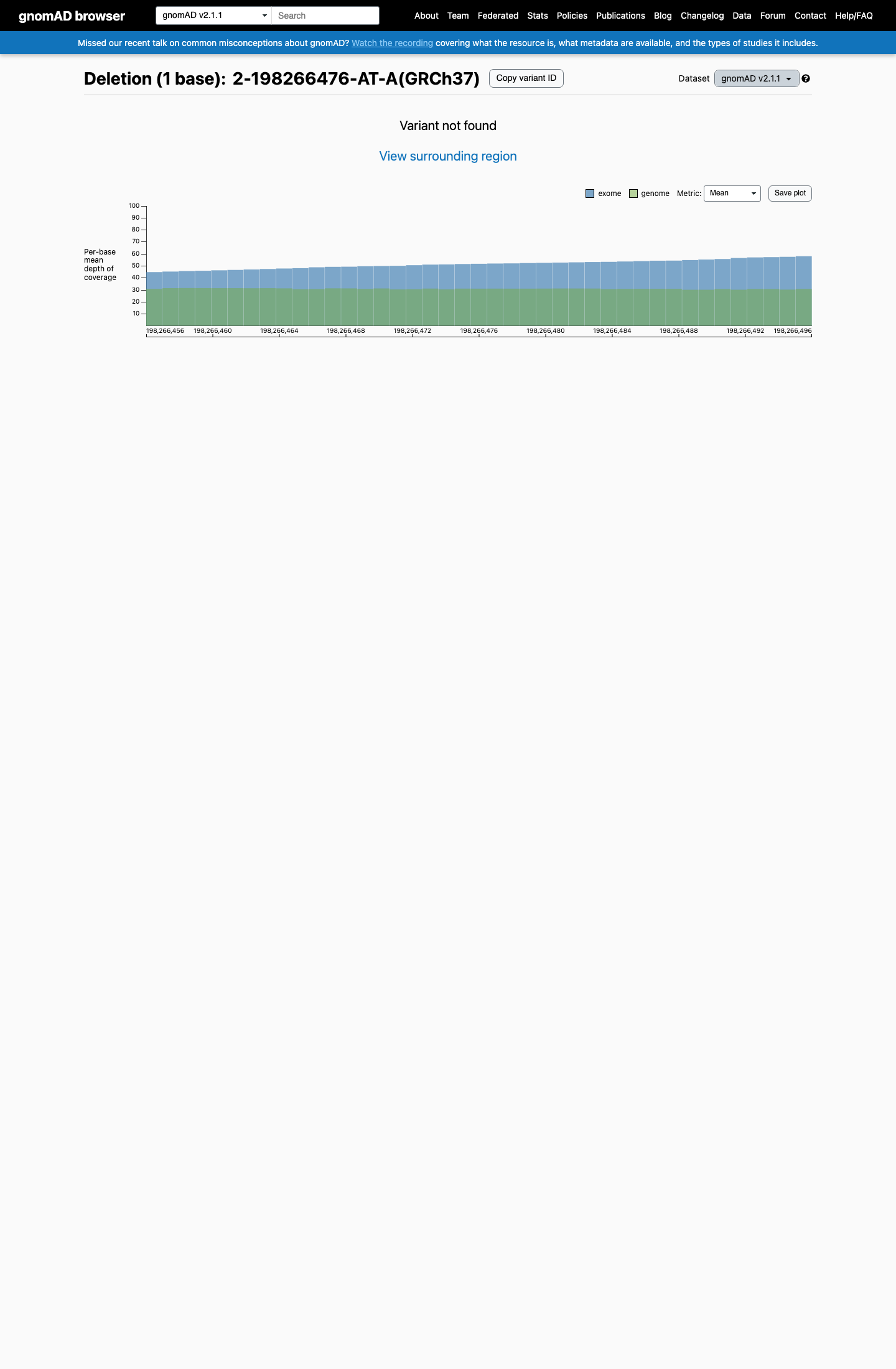
gnomAD v2.1 screenshot
gnomAD v2.1
v4.1
This variant is present in gnomAD v4.1 (AF= 0; MAF= 0.00000%, 0/1609404 alleles, homozygotes = 0) and has highest observed frequency in the African/African American population (AF= 0; MAF= 0.00000%, 0/74764 alleles, homozygotes = 0).
v2.1
Absent from gnomAD v2.1.
🇨🇦 CA
Absent from gnomAD-Canada v1.0.
Allele frequency by ancestry
three datasets · side by side
gnomAD v4.1
Absent · 0 / 1,609,404
0 hom
Not observed in any ancestry group.
+ 10 not observed (Remaining individuals, Admixed American, European (Finnish), Amish, East Asian, Middle Eastern, South Asian, Ashkenazi Jewish, African/African American, European (non-Finnish))
gnomAD v2.1
Absent · 0 / ?
0 hom
Not observed in any ancestry group.
gnomAD Canada 🇨🇦
Absent · 0 / ?
0 hom
Not observed in any ancestry group.
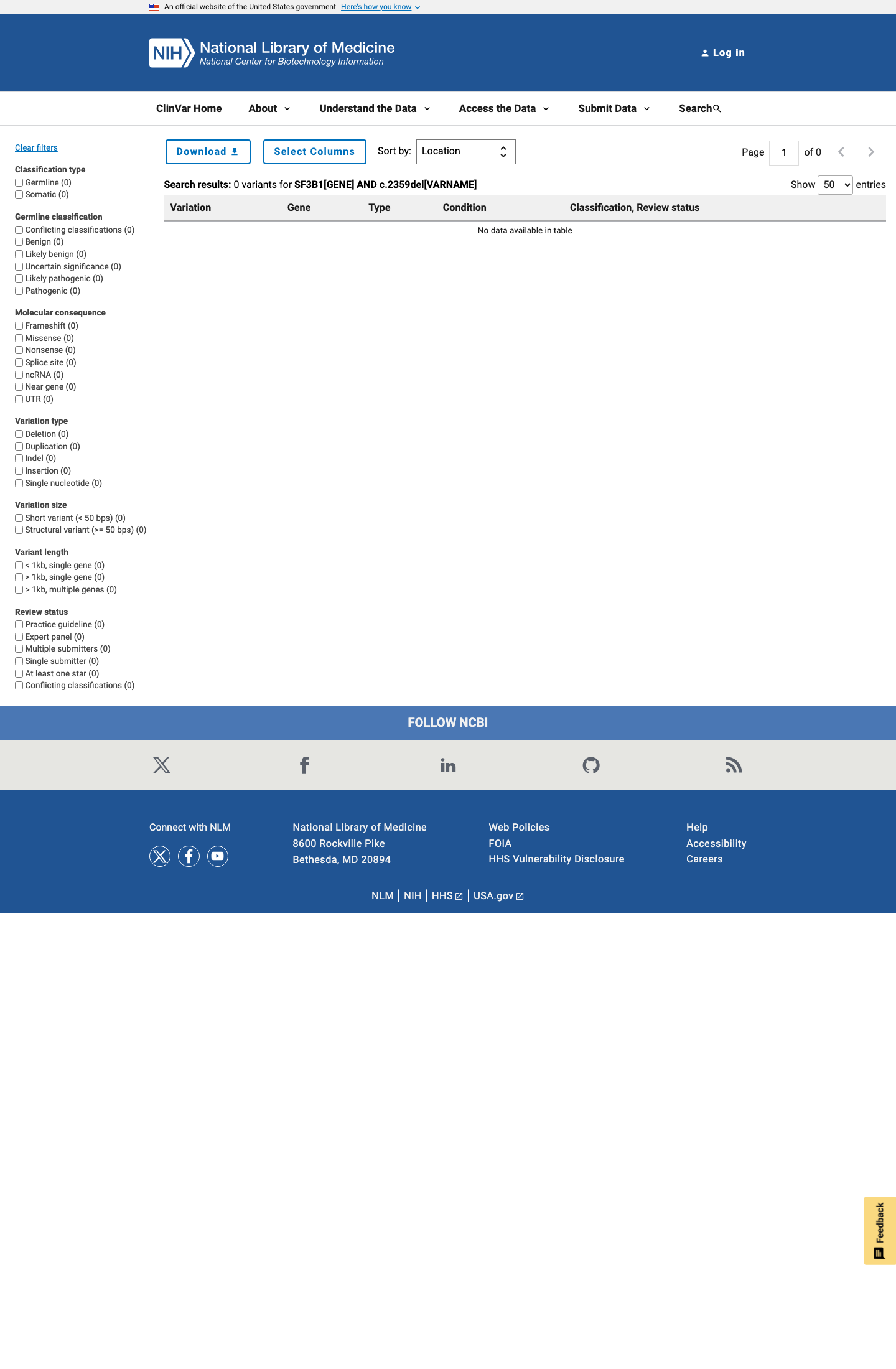
ClinVar screenshot
ClinVar
This variant is absent from ClinVar.
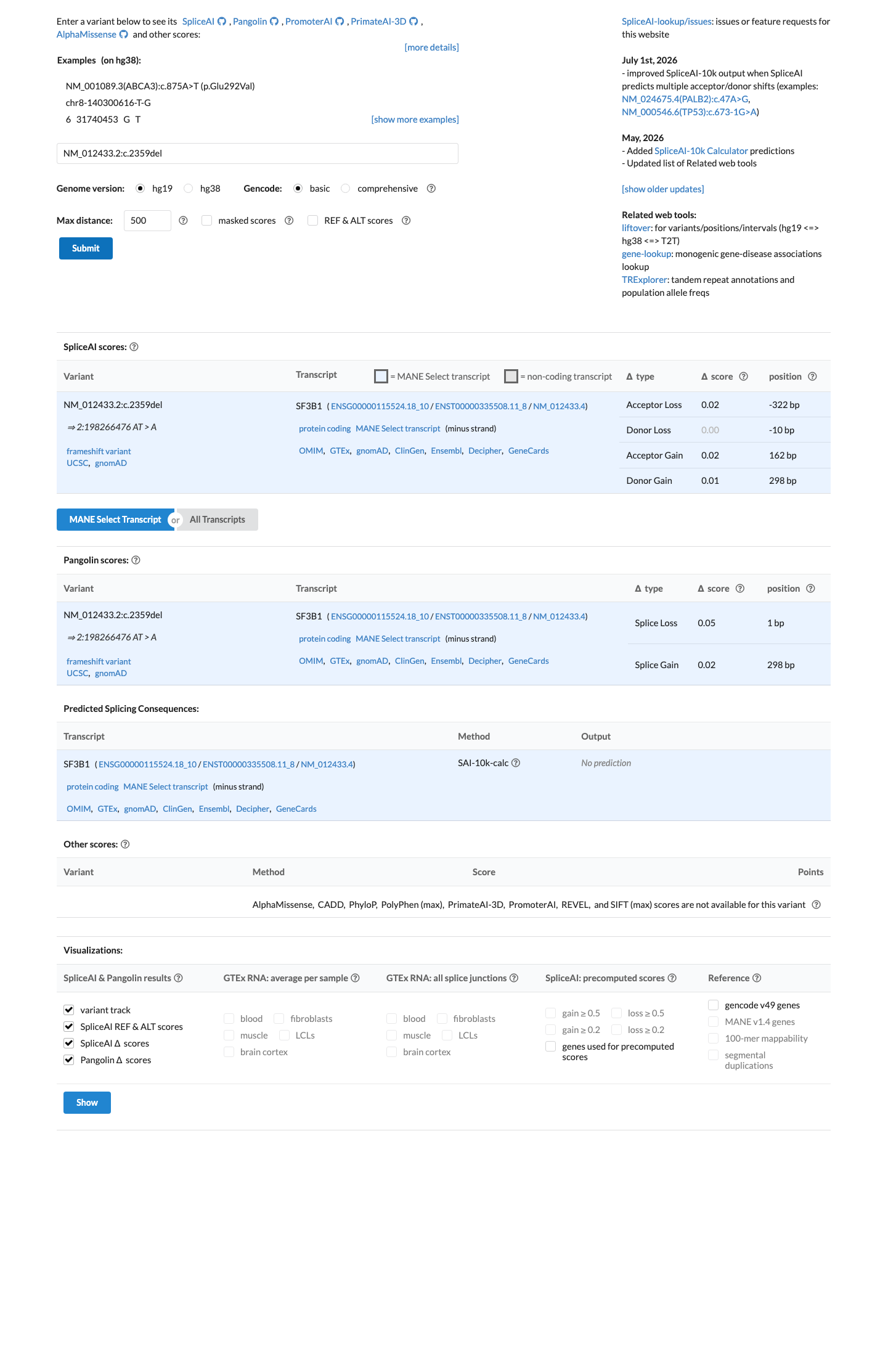
SpliceAI screenshot
In silico
SpliceAI predicts no significant splice impact for this variant (max delta score = 0.02).
Functional / OncoKB screenshot
Functional Unknown Oncogenic Effect
OncoKB identified curated literature and non-variant-specific oncogenicity context for review; listed oncogenicity label: Unknown Oncogenic Effect.
OncoKB ↗
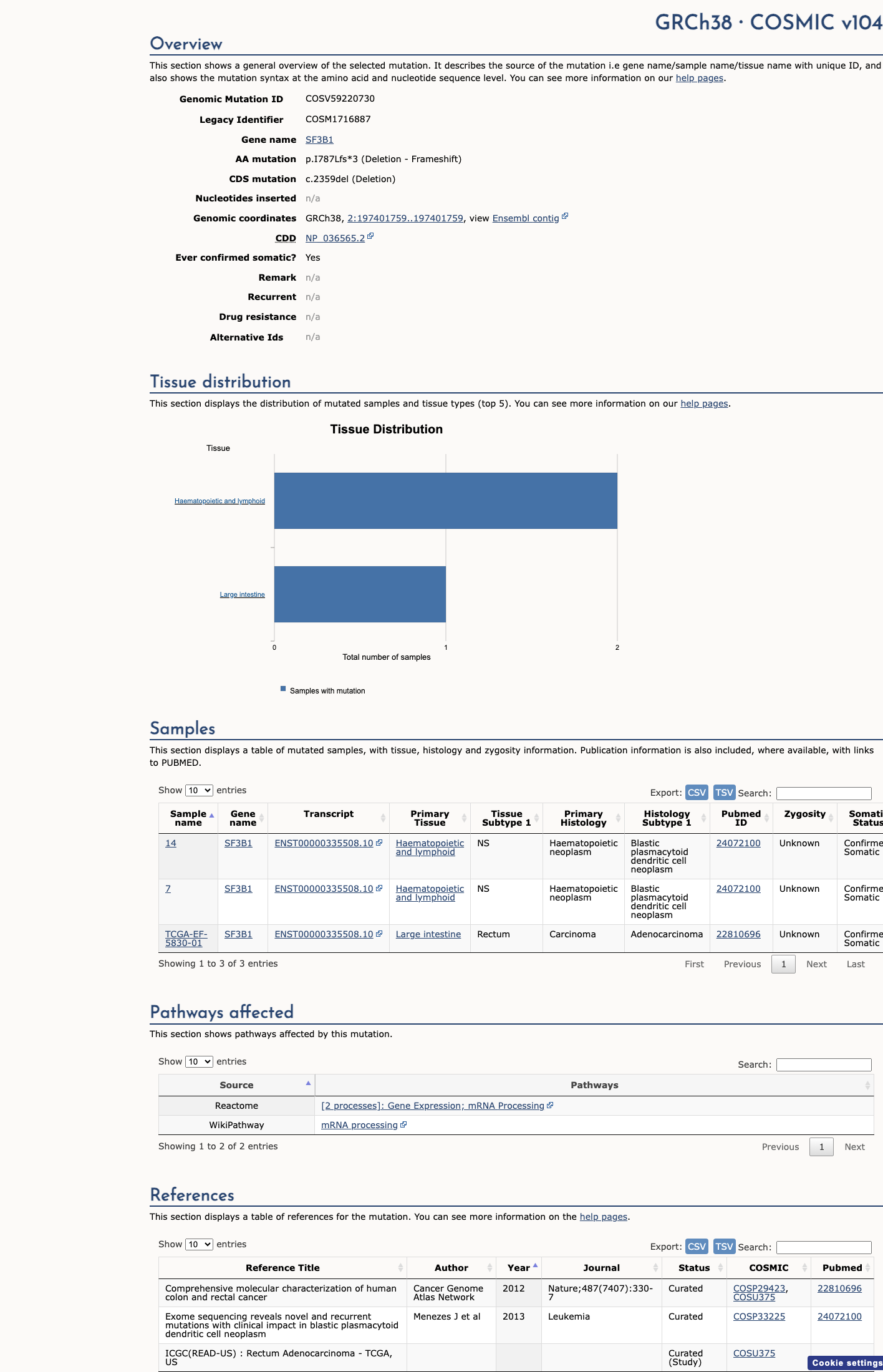
COSMIC screenshot
COSMIC
Cancer hotspots screenshot
Cancer hotspots
Somatic evidence Not in COSMIC / hotspots
COSMIC
This variant does not lie in a statistically significant hotspot. This variant has previously been reported in somatic cancers (COSMIC; COSV59220730, n = 3 times).
Hotspots
This variant does not lie in a statistically significant hotspot.
Sources & reference links
8Sources
ClinVar
gnomAD v2.1
gnomAD v4.1
gnomAD-Canada
SpliceAI
OncoKB
COSMIC
Cancer hotspots