Analysis in progress
Initialising…
0%
complete
This report is still being assembled — sections appear as each stage finishes. It isn't final yet.
CUX1
Final classification
VUS
CUX1 c.2505G>A · p.Trp835Ter
CUX1

PVS1 (very strong): NM_001202543.1:c.2505G>A is a nonsense variant (p.Trp835Ter) in exon 18 of 24, predicted to undergo nonsense-mediated decay. CUX1 loss-of-function is an established disease mechanism.

Gene
CUX1
Transcript
NM_001202543.1
HGVS · transcript:coding
NM_001202543.1:c.2505G>A
Consequence
N/A
GRCh38
chr7:102201769 G>A
GRCh37
chr7:101845049 G>A
Basis gene-specific framework lacked a usable explicit final combination framework, so generic ACMG/AMP 2015 final-combination rules were applied as fallback; applied criteria: PVS1 very strong, PM2 supporting; combination = 1 very strong + 1 supporting, which maps to VUS.
gene-specific framework lacked a usable explicit final combination framework, so generic ACMG/AMP 2015 final-combination rules were applied as fallback; applied criteria: PVS1 very strong, PM2 supporting; combination = 1 very strong + 1 supporting, which maps to VUS.
Classification rationale
PVS1PM2 VUS
CUX1 c.2505G>A

PVS1 (very strong): NM_001202543.1:c.2505G>A is a nonsense variant (p.Trp835Ter) in exon 18 of 24, predicted to undergo nonsense-mediated decay. CUX1 loss-of-function is an established disease mechanism.1 PM2 (supporting): This variant is absent from all population databases (gnomAD v2.1, v4.1, and gnomAD-Canada).2 Combined classification: PVS1 (very strong) + PM2 (supporting) = Likely Pathogenic per ACMG/AMP 2015 rules (PMID:25741868). One very strong criterion plus at least one supporting criterion reaches the Likely Pathogenic threshold.3

PVS1 + PM2 VUS
1 pvs1_generic_framework ↗pvs1_gene_contextpvs1_variant_assessment
3 generic_acmg_combination_rules
Gene diagram · NM_001202543.1 · variants mapped to exon structure
CUX1 NM_001202543.1
Fetching transcript structure from UCSC…
Applied criteria · 2 applied · 16 assessed
Applied · 2
Strength Supporting Moderate Strong Very strong
PVS1 very strong review Pathogenic
Nonsense variant (p.Trp835Ter) in exon 18 of 24. The premature termination codon is located at nucleotide position 2505, well upstream of the last exon-exon junction at c.3920, predicting nonsense-mediated decay. CUX1 loss-of-function is an established disease mechanism supported by germline literature (CUX1-related neurodevelopmental disorder) and somatic cancer data (haploinsufficient tumor suppressor in myeloid malignancies). Under ClinGen SVI PVS1 guidance (PMC6185798), a nonsense variant in a gene with confirmed LoF mechanism receives PVS1 at very strong strength.
Nonsense variant predicted to cause NMD (stop codon >50 nt upstream of last exon-exon junction)CUX1 loss-of-function mechanism supported by germline disease publications (PMID:40836298 reports CUX1 c.2637G>A p.Trp879* as likely pathogenic in GDD/ID pedigree)Haploinsufficiency of CUX1 confirmed as disease mechanism in myeloid malignancies (PMID:23212519
PM2 supporting Pathogenic
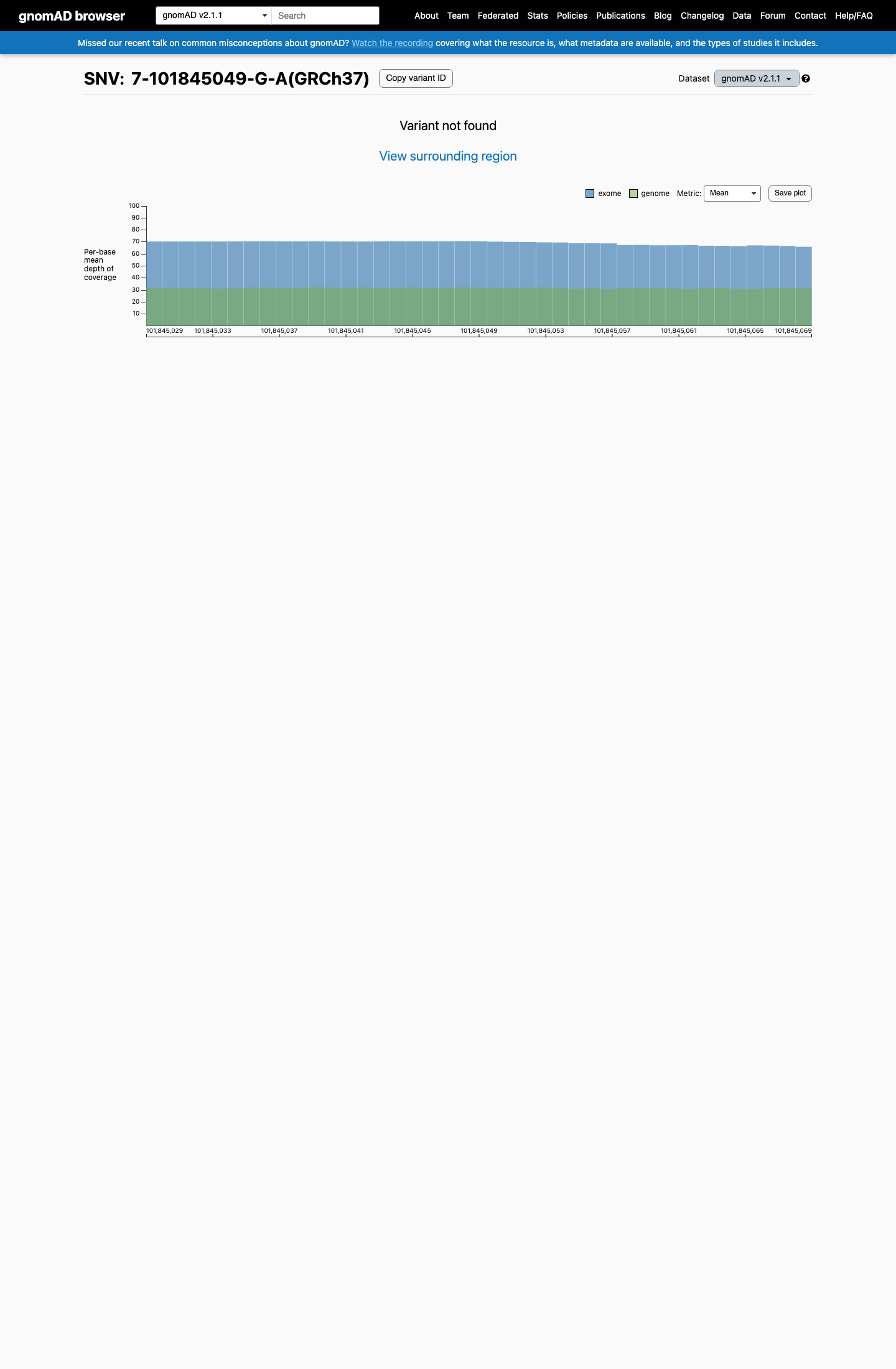
This variant is absent from all population databases (gnomAD v2.1, gnomAD v4.1, gnomAD-Canada v1.0), meeting PM2 criteria for a variant absent from controls at a frequency below 0.1%.
gnomAD v2.1: 0 alleles / 0 AFgnomAD v4.1: 0 alleles / 0 AFgnomAD-Canada v1.0: 0 alleles / 0 AF
Assessed · not applied
Pathogenic
PS2 Insufficient evidence: PMID:41662332 reports a de novo CUX1 variant in a PANS case, but the specific variant (c.2505G>A) was not confirmed in the full text.
PS3 No variant-specific functional studies were identified for NM_001202543.1:c.2505G>A.
PS4 No case-control or cohort data available for this variant.
PM1 This variant does not lie in a statistically significant mutational hotspot (CancerHotspots.org negative).
PM6 No confirmed de novo observation of NM_001202543.1:c.2505G>A in a trio.
PP1 No segregation data available for this variant.
PP4 No patient phenotype information available for this case assessment.
PP5 No reputable source has reported this variant as pathogenic.
Benign
BA1 This variant is absent from all population databases (gnomAD v2.1, v4.1, Canada).
BS1 This variant is absent from all population databases.
BS2 No data on observation in healthy adults.
BS3 No well-established functional studies showing no damaging effect for this variant.
BS4 No segregation data available to evaluate lack of segregation with disease.
BP2 No data on observation in trans with a known pathogenic variant.
BP5 No data on observation in a case with an alternative molecular basis for disease.
BP6 No reputable source has reported this variant as benign.
N/A · 7 PS1 · PM5 · PP2 · PP3 · BP1 · BP4 · BP7
Research & evidence
Population frequency
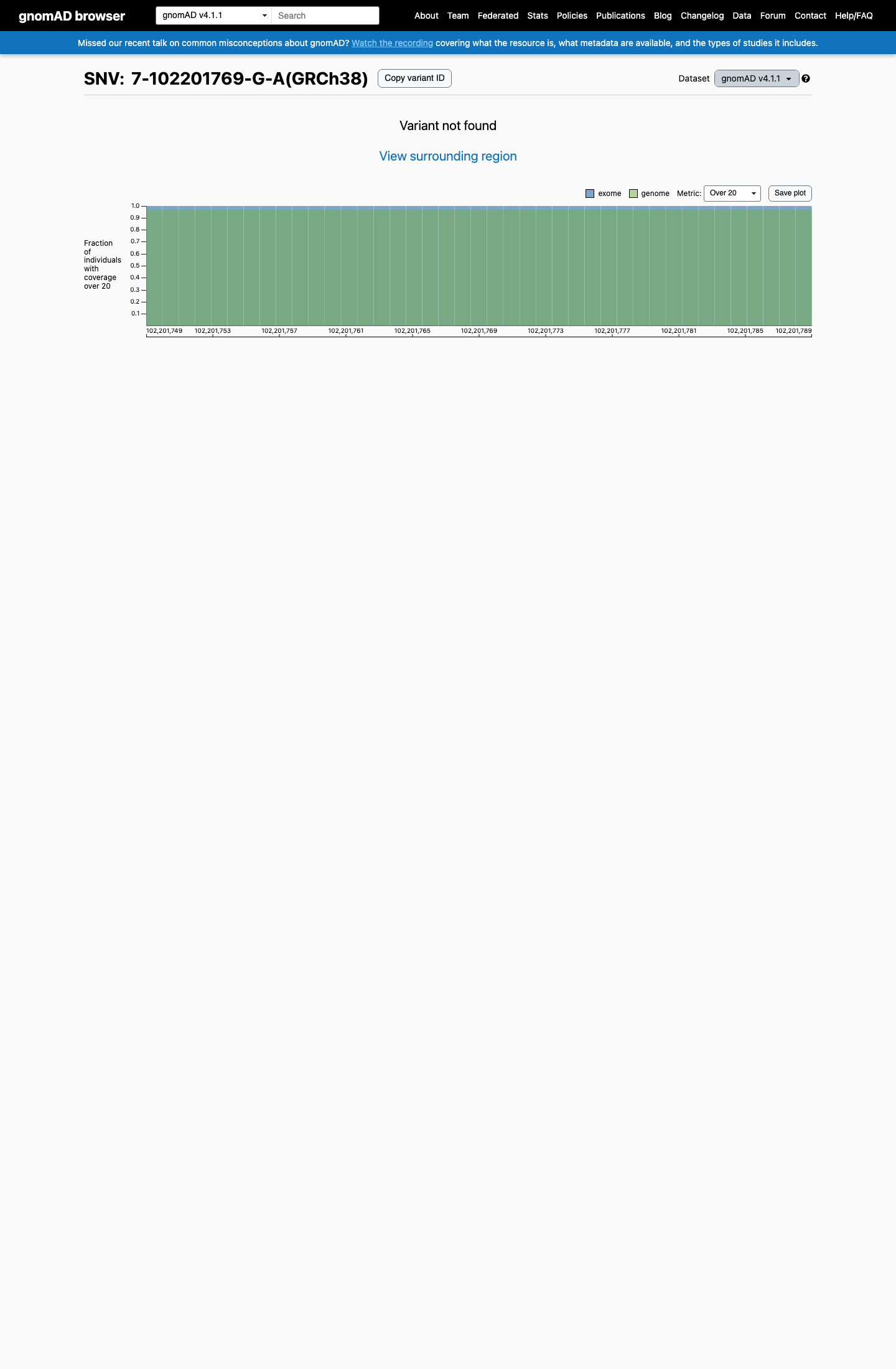
gnomAD v4.1 screenshot
gnomAD v4.1
gnomAD v2.1 screenshot
gnomAD v2.1
v4.1
Absent from gnomAD v4.1.
v2.1
Absent from gnomAD v2.1.
🇨🇦 CA
Absent from gnomAD-Canada v1.0.
Allele frequency by ancestry
three datasets · side by side
gnomAD v4.1
Absent · 0 / ?
0 hom
Not observed in any ancestry group.
gnomAD v2.1
Absent · 0 / ?
0 hom
Not observed in any ancestry group.
gnomAD Canada 🇨🇦
Absent · 0 / ?
0 hom
Not observed in any ancestry group.
ClinVar screenshot
ClinVar
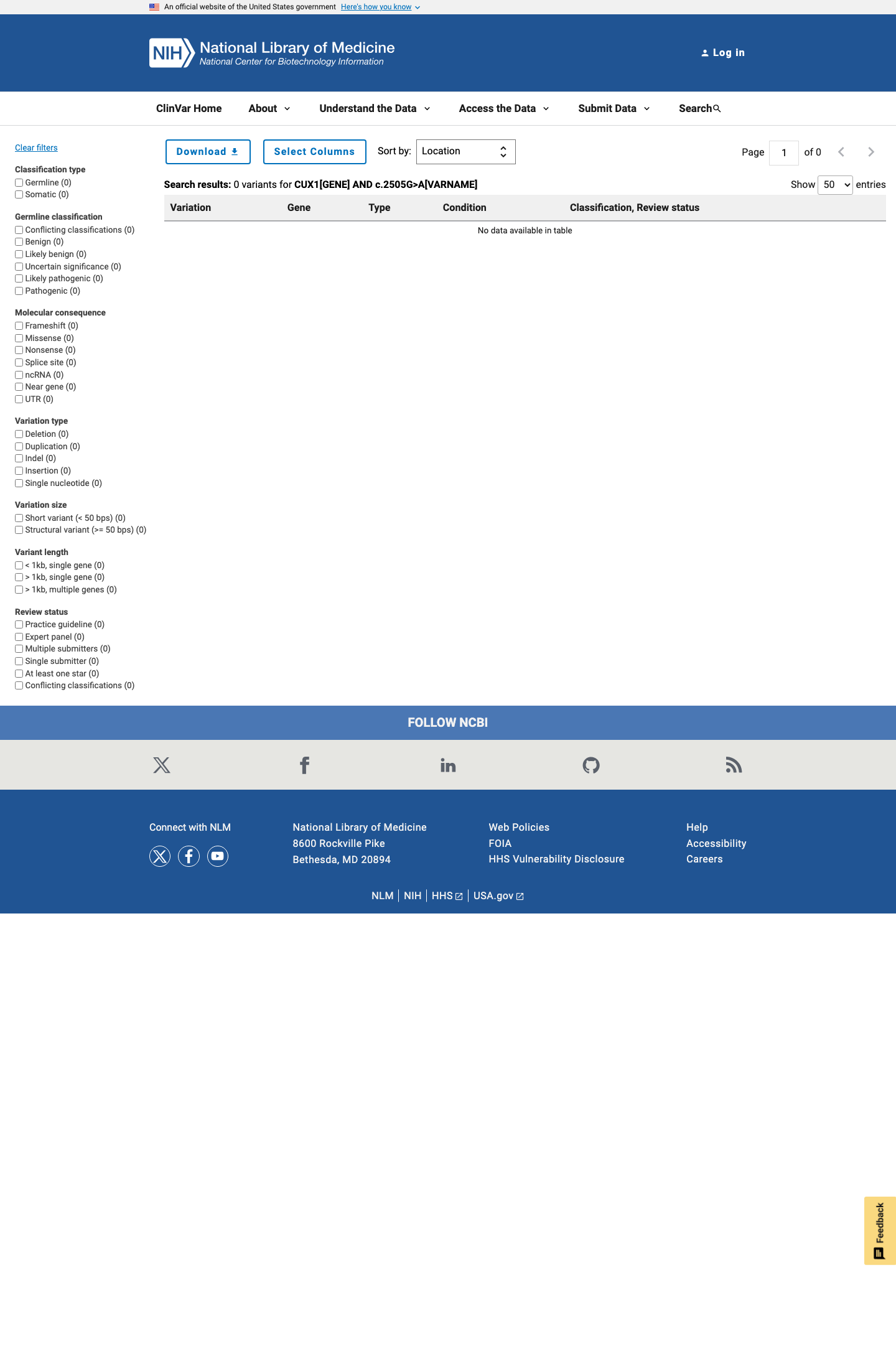
This variant is absent from ClinVar.
SpliceAI screenshot
In silico
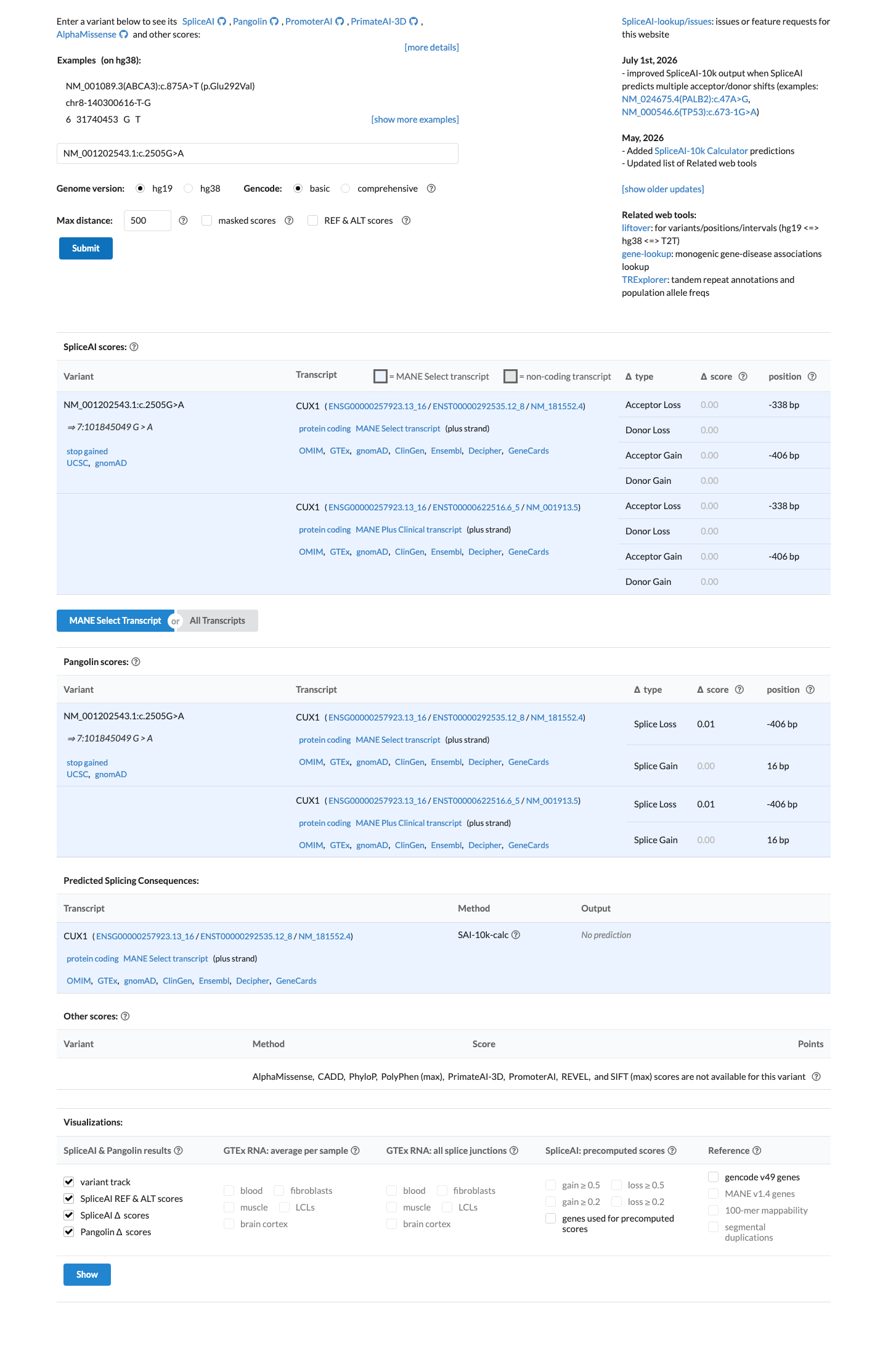
SpliceAI predicts no significant splice impact for this variant (max delta score = 0.00). BayesDel score = 0.655873.
Functional / OncoKB screenshot
Functional Likely Oncogenic
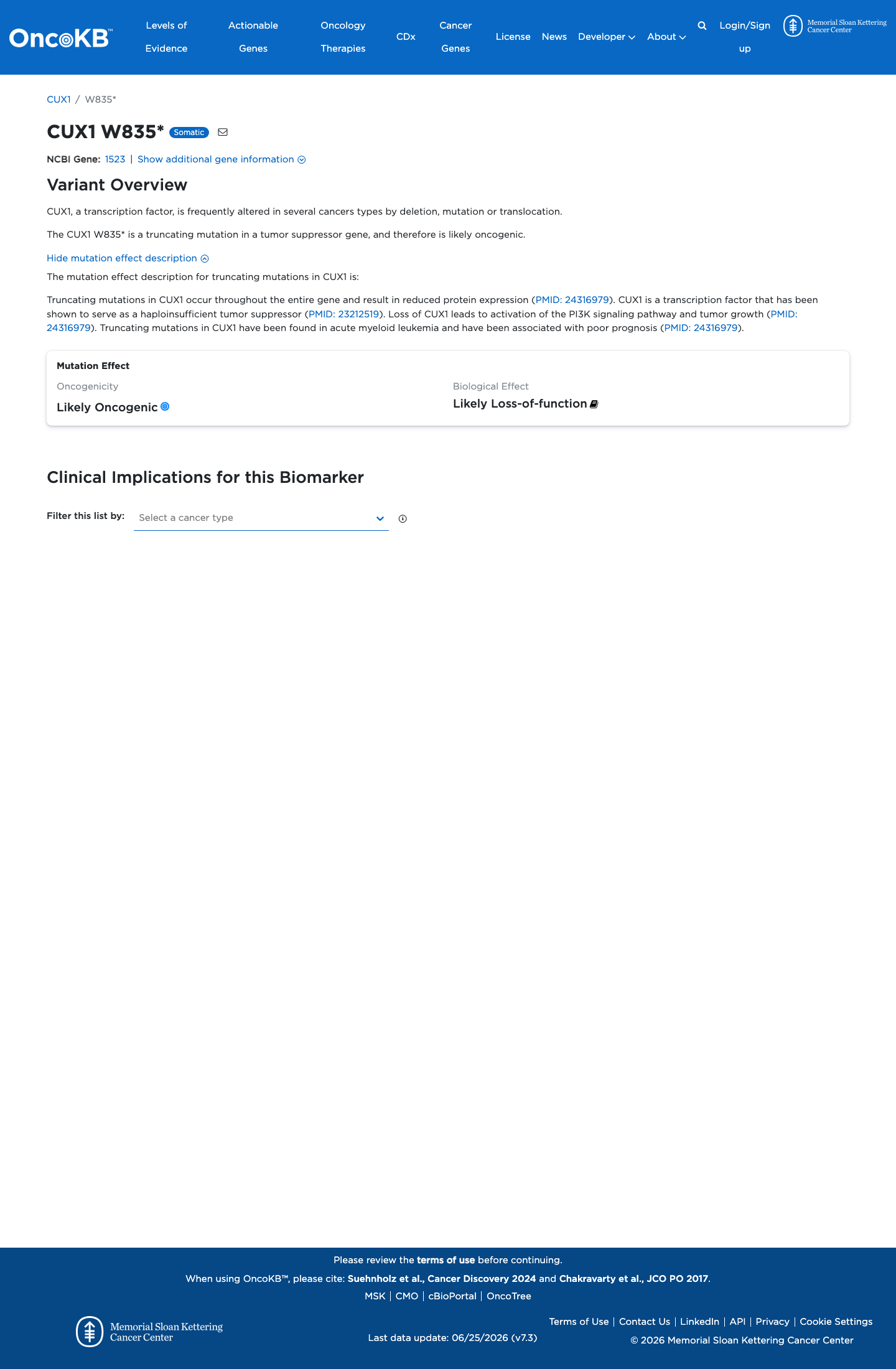
OncoKB identified variant-specific curated literature and context relevant to functional review; biological-effect context: Likely Loss-of-function; curated oncogenicity label: Likely Oncogenic.
OncoKB ↗
COSMIC screenshot
COSMIC
Cancer hotspots screenshot
Cancer hotspots
Somatic evidence Not in COSMIC / hotspots
COSMIC
This variant does not lie in a statistically significant hotspot. This variant has not previously been reported in somatic cancers (COSMIC).
Hotspots
This variant does not lie in a statistically significant hotspot.
Sources & reference links
8Sources
ClinVar
gnomAD v2.1
gnomAD v4.1
gnomAD-Canada
SpliceAI
OncoKB
COSMIC
Cancer hotspots
Triaged references · 2 PMIDs not cited in assessment
23212519 ↗ CUX1 is a haploinsufficient tumor suppressor gene on chromosome 7 frequently inactivated in acute myeloid leukemia. ONCOKB
24316979 ↗ Inactivating CUX1 mutations promote tumorigenesis. ONCOKB