NM_022552.4:c.1256del (p.Pro419LeufsTer232) is a frameshift deletion in exon 10 of DNMT3A, predicted to cause nonsense-mediated decay and complete loss of protein function. DNMT3A loss of function is an established mechanism for Tatton-Brown-Rahman syndrome (DNMT3A overgrowth syndrome), a germline disorder characterized by overgrowth, intellectual disability, and facial dysmorphism.1 The variant is absent from gnomAD v2.1, v4.1, and gnomAD-Canada population databases, supporting rarity in the general population.2 No variant-specific functional studies, de novo reports, case-control data, or segregation analyses were identified in the reviewed literature for this specific variant. A single ClinVar submission from a clinical laboratory classifies the variant as Likely pathogenic for Tatton-Brown-Rahman overgrowth syndrome, but the evidence trail is limited to guideline citations without variant-specific published data.3 Under generic ACMG/AMP 2015 criteria, the combination of PVS1 (very_strong) and PM2 (supporting) is insufficient to reach a Likely Pathogenic classification, which requires at minimum 1 Very Strong + 1 Moderate or 1 Strong + 1-2 Moderate or 2 Moderate + 2 Supporting criteria. The classification falls into Variant of Uncertain Significance (VUS), favoring pathogenic, pending additional clinical or functional evidence.4
Final classification
VUS
PVS1PM2
DNMT3A
c.1256del
p.Pro419LeufsTer232
This variant
NM_022552.4:c.1256del (p.Pro419LeufsTer232) is a frameshift deletion in exon 10 of DNMT3A, predicted to cause nonsense-mediated decay and complete loss of protein function. DNMT3A loss of function is an established mechanism for Tatton-Brown-Rahman syndrome (DNMT3A overgrowth syndrome), a germline disorder characterized by overgrowth, intellectual disability, and facial dysmorphism.
gene-specific framework lacked a usable explicit final combination framework, so generic ACMG/AMP 2015 final-combination rules were applied as fallback; applied criteria: PVS1 very strong, PM2 supporting; combination = 1 very strong + 1 supporting, which maps to VUS.
Classification rationale
PVS1PM2
VUS
DNMT3A c.1256del
PVS1 + PM2
→
VUS
1
pvs1_generic_framework ↗pvs1_gene_context
4
generic_acmg_combination_rules
LYFE Sciences is an AI system, and it can make mistakes. Criteria
may be applied incorrectly, sources may be misread, and a confident-looking
classification can still be wrong. Double-check every criterion and
its underlying evidence before relying on any call.
Gene diagram
· NM_022552.4 · variants mapped to exon structure
DNMT3A
NM_022552.4
Fetching transcript structure from UCSC…
Applied criteria · 2 applied · 18 assessed
MetEvidence satisfies this criterion.
Not metEvaluated against available evidence; threshold not reached.
Not assessedApplies in principle, but no evidence was found to evaluate it.
N/ADoesn't apply to this variant type.
Applied · 2
Strength
Supporting
Moderate
Strong
Very strong
PVS1
very strong
Pathogenic
NM_022552.4:c.1256del is a frameshift deletion in exon 10 of 23, predicted to introduce a premature termination codon at p.Pro419LeufsTer232 with consequent nonsense-mediated decay. DNMT3A loss of function is an established mechanism for Tatton-Brown-Rahman syndrome (DNMT3A overgrowth syndrome), a germline overgrowth disorder. Under ClinGen SVI PVS1 recommendations (PMC6185798), this frameshift variant meets PVS1 at full strength.
Frameshift variant in exon 10/23 introducing PTC at codon 419 with predicted NMDDNMT3A germline loss of function is an established disease mechanism for Tatton-Brown-Rahman syndrome (PMID:24614070PMID:37160317
PM2
supporting
Pathogenic
NM_022552.4:c.1256del is absent from gnomAD v2.1 (exomes), gnomAD v4.1 (exomes/genomes), and gnomAD-Canada v1.0 (HostSeq genomes). Under generic ACMG/AMP, absence from large population databases in a gene where LoF variants are not commonly observed in controls supports PM2 at supporting level.
Absent from gnomAD v2.1 (0 alleles)Absent from gnomAD v4.1 (0 alleles)Absent from gnomAD-Canada v1.0 (0 alleles)
Assessed · not applied
· 18 not met · 0 not assessed
Pathogenic
PS2
No de novo occurrence of NM_022552.4:c.1256del was identified in any reviewed publication.
PS3
No variant-specific functional studies for NM_022552.4:c.1256del were identified in the reviewed literature.
PS4
No case-control or prevalence data are available to demonstrate that this variant is significantly enriched in affected individuals compared with controls.
PM1
NM_022552.4:c.1256del is located in exon 10, which lies between the PWWP domain (exons 8-9) and the ADD domain (exons 13-15) of DNMT3A.
PM6
No assumed de novo report was identified for NM_022552.4:c.1256del in any reviewed publication.
PP1
No cosegregation data are available for NM_022552.4:c.1256del in affected families.
PP3
SpliceAI predicts no significant splice impact (max delta score 0.03, well below the 0.2 threshold).
PP4
No patient phenotype or family history data are available for individuals carrying NM_022552.4:c.1256del.
PP5
PP5 requires a reputable source to have reported the variant as pathogenic with evidence not available for independent evaluation.
Benign
BA1
NM_022552.4:c.1256del is absent from gnomAD v2.1, gnomAD v4.1, and gnomAD-Canada, with an allele frequency of 0.
BS1
NM_022552.4:c.1256del is absent from all population databases.
BS2
No observations of NM_022552.4:c.1256del in healthy adults for a recessive condition or in trans with a pathogenic variant for a dominant condition are available.
BS3
No well-established functional studies demonstrating no damaging effect of NM_022552.4:c.1256del were identified.
BS4
No segregation data are available for NM_022552.4:c.1256del.
BP2
No observation of NM_022552.4:c.1256del in trans with a pathogenic variant for a fully penetrant dominant disorder or in cis with a pathogenic variant is available.
BP4
SpliceAI predicts no significant splice impact (max delta 0.03).
BP5
No observation of NM_022552.4:c.1256del in an individual with an alternate molecular basis for disease has been reported.
BP6
No reputable source has reported NM_022552.4:c.1256del as benign.
N/A · 8
PS1 · PM3 · PM4 · PM5 · PP2 · BP1 · BP3 · BP7
Research & evidence
Population frequency
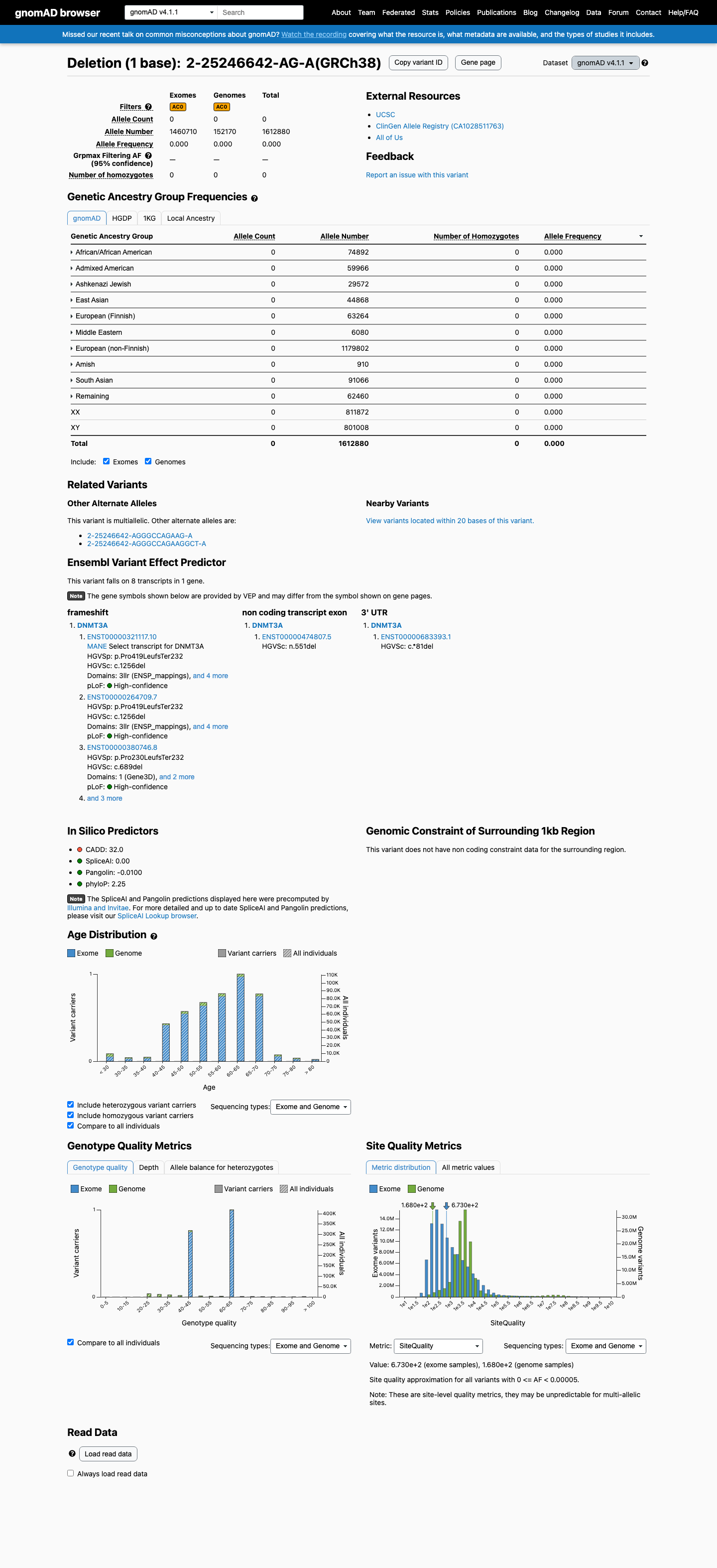
gnomAD v4.1
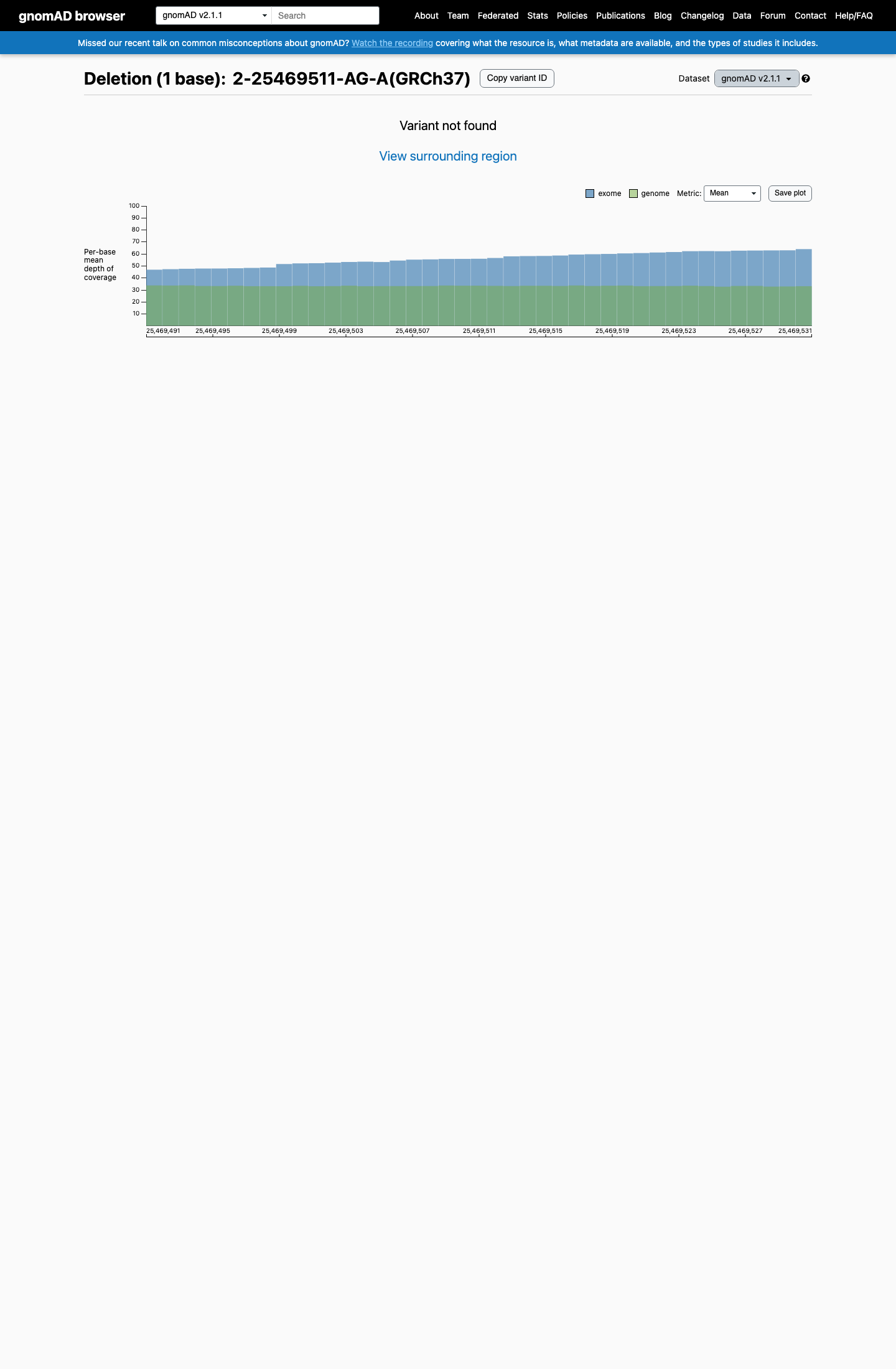
gnomAD v2.1
v4.1
Absent from gnomAD v4.1.
v2.1
Absent from gnomAD v2.1.
🇨🇦 CA
Absent from gnomAD-Canada v1.0.
Allele frequency by ancestry
three datasets · side by side
gnomAD v4.1
Absent
· 0 / ?
0 hom
0 hom
Not observed in any ancestry group.
gnomAD v2.1
Absent
· 0 / ?
0 hom
0 hom
Not observed in any ancestry group.
gnomAD Canada 🇨🇦
Absent
· 0 / ?
0 hom
0 hom
Not observed in any ancestry group.
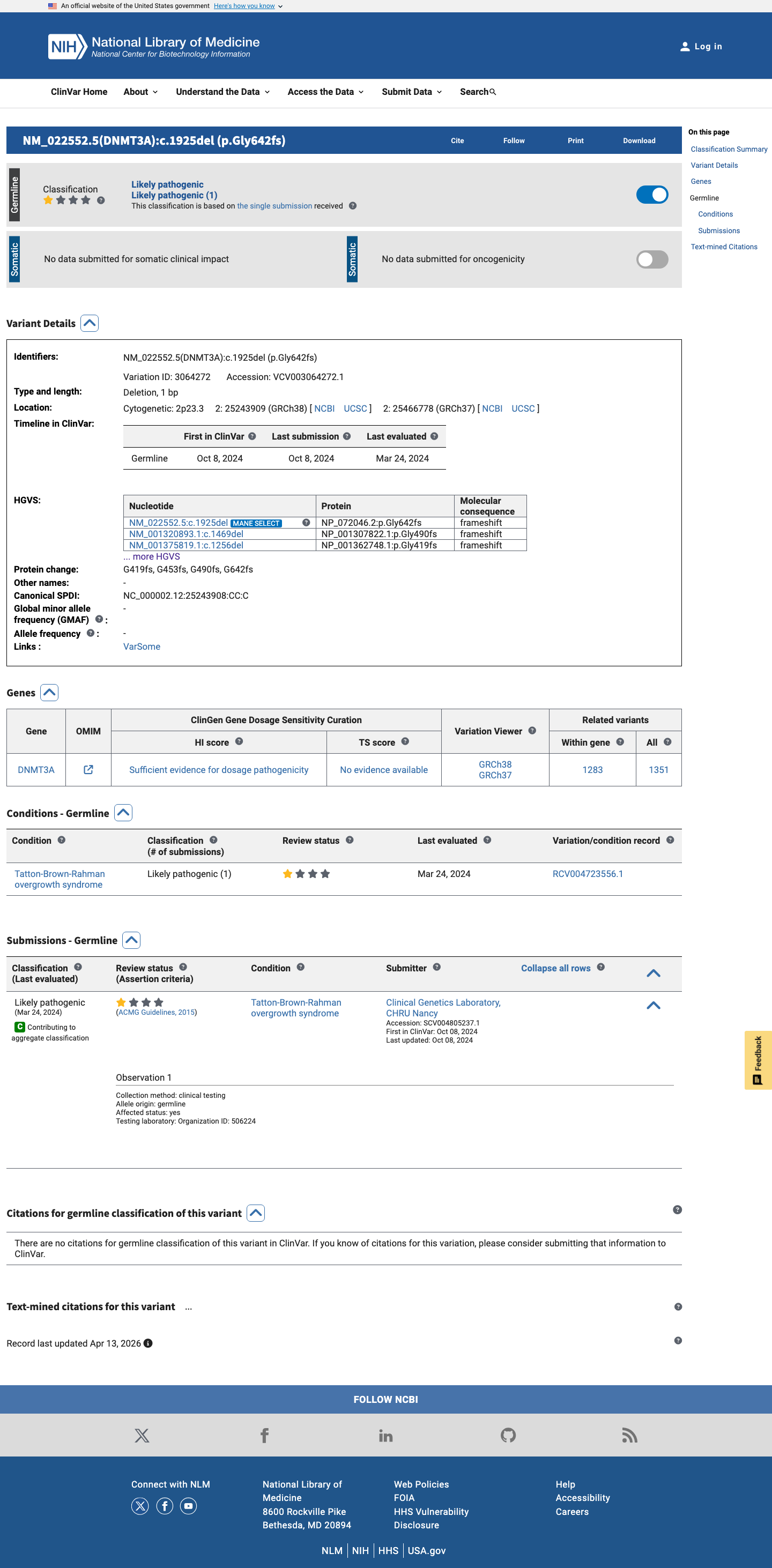
ClinVar
This variant is present in ClinVar (Variation ID: 3064272); submission details unavailable.
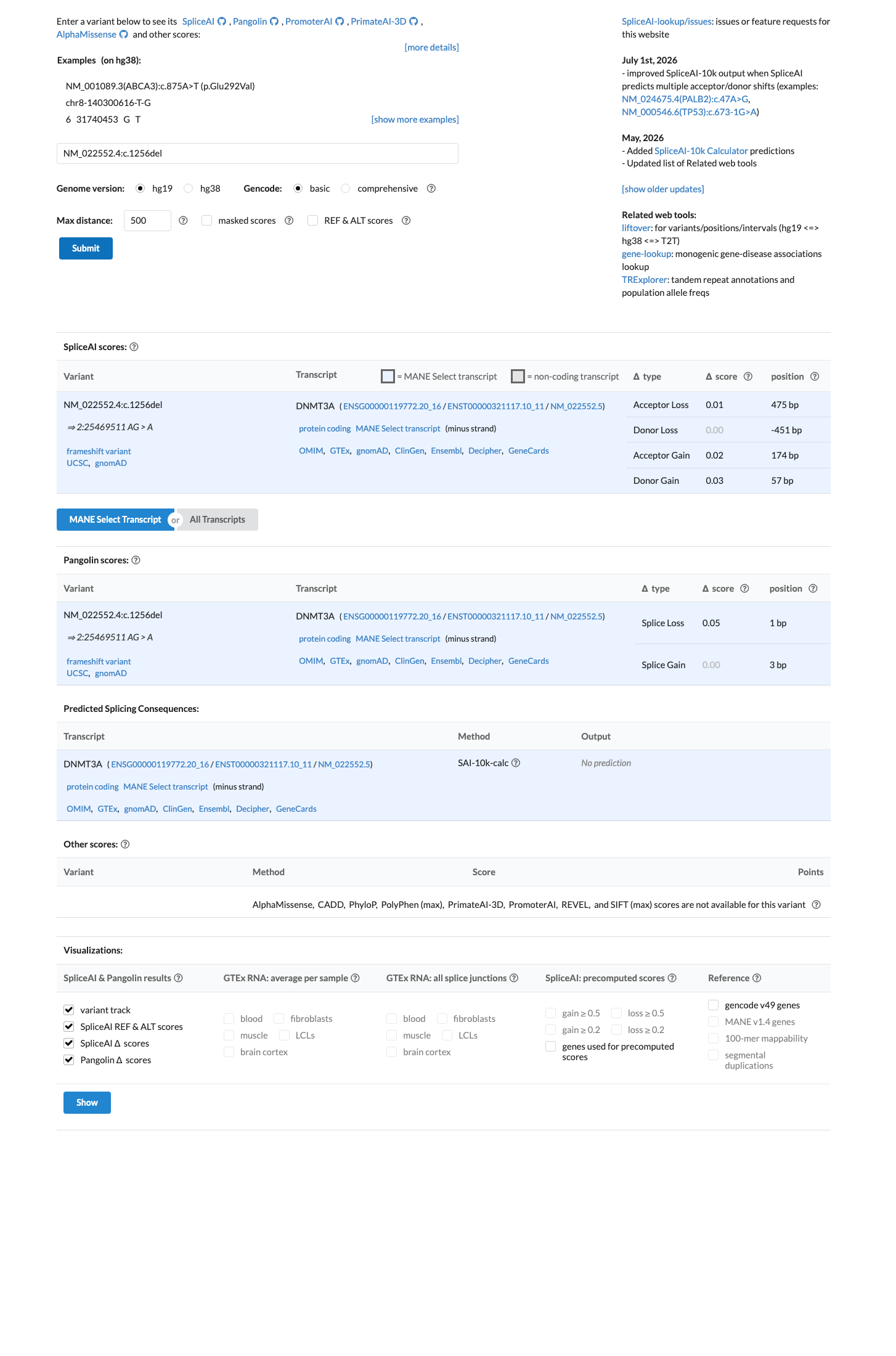
In silico
SpliceAI predicts no significant splice impact for this variant (max delta score = 0.03).
Functional
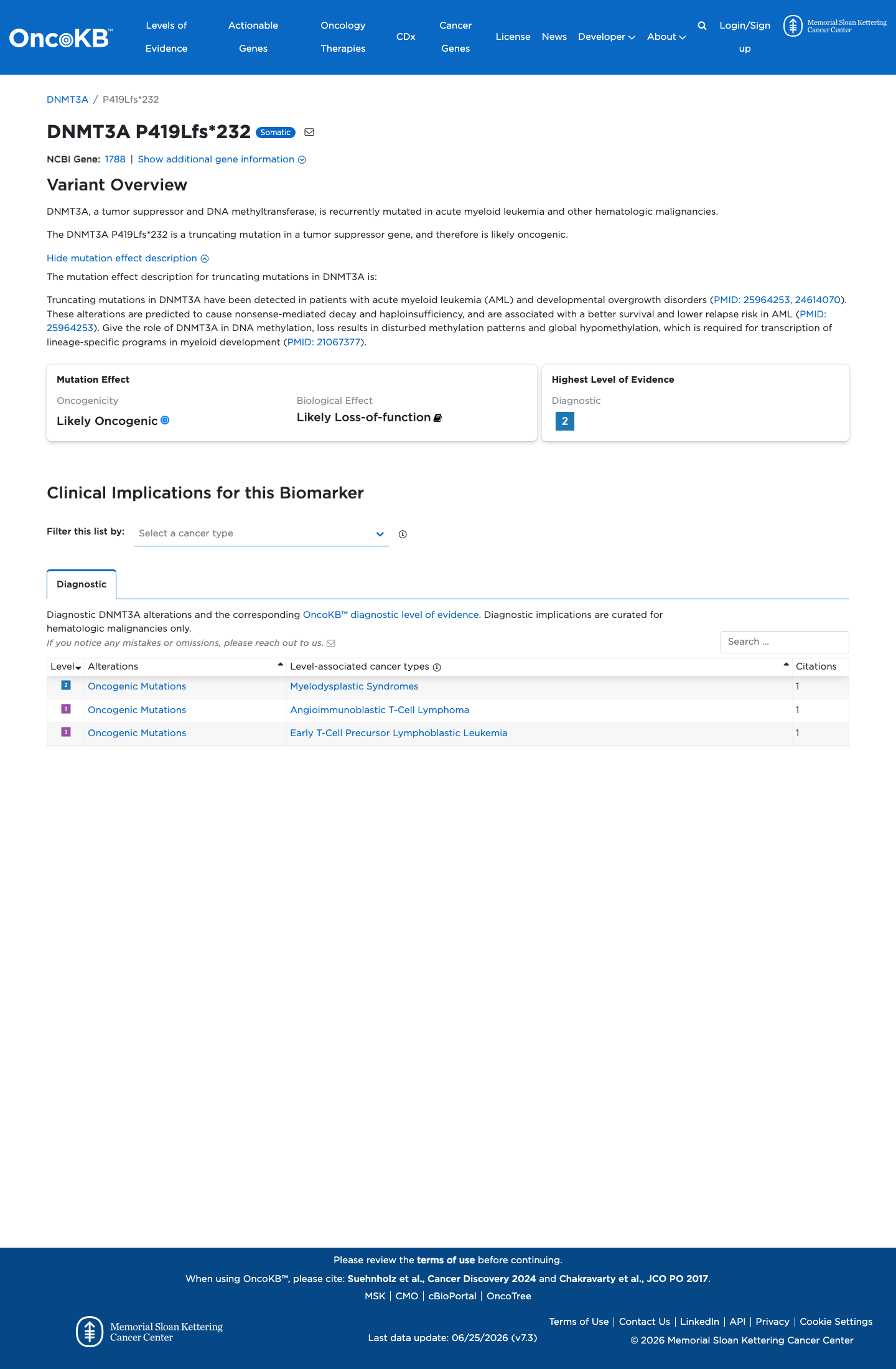
Likely Oncogenic
OncoKB identified variant-specific curated literature and context relevant to functional review; biological-effect context: Likely Loss-of-function; curated oncogenicity label: Likely Oncogenic.
COSMIC

Cancer hotspots
Somatic evidence
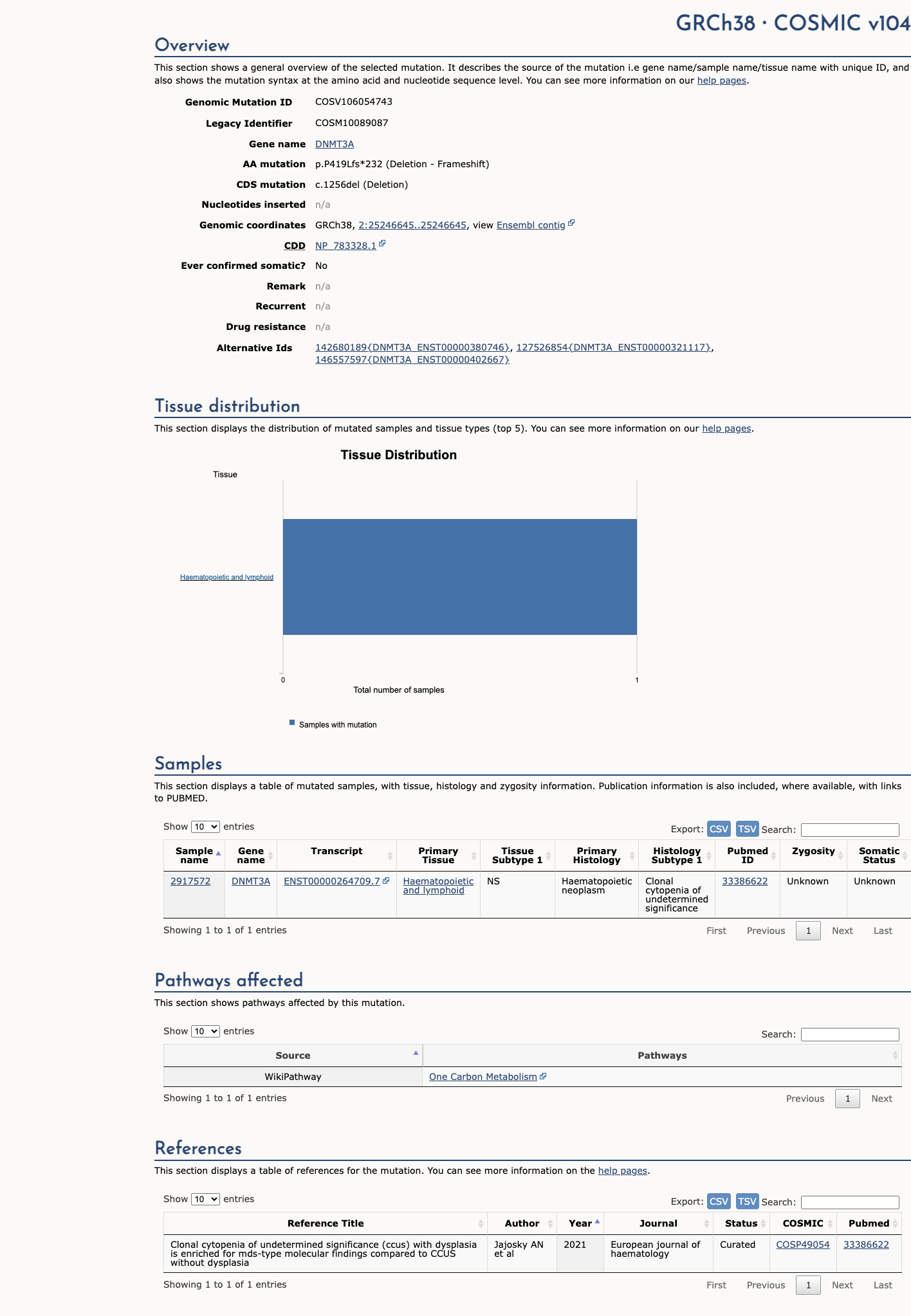
Not in COSMIC / hotspots
COSMIC
This variant does not lie in a statistically significant hotspot. This variant has previously been reported in somatic cancers (COSMIC; COSV106054743, n = 1 times).
Hotspots
This variant does not lie in a statistically significant hotspot.
Sources & reference links
Triaged references · 5 PMIDs not cited in assessment
24614070 ↗
Mutations in the DNA methyltransferase gene DNMT3A cause an overgrowth syndrome with intellectual disability.
ONCOKB
25964253 ↗
Simpson's Paradox and the Impact of Different DNMT3A Mutations on Outcome in Younger Adults With Acute Myeloid Leukemia.
ONCOKB
25741868 ↗
Standards and guidelines for the interpretation of sequence variants: a joint consensus recommendation of the American College of Medical Genetics and Genomics and the Association for Molecular Pathology.
CLINVAR