NM_007294.4:c.738del (p.Asn247ThrfsTer51) is a frameshift deletion in BRCA1 exon 10 predicted to produce a premature termination codon and trigger nonsense-mediated decay.1 PVS1 (Very Strong) is assigned per ENIGMA Specifications Table 4: PTC variants in BRCA1 exon 10 receive full PVS1 weight.2 PM5_Strong (PTC) is assigned per ENIGMA Specifications Table 4: BRCA1 exon 10 PTC variants receive PM5_Strong under the PTC-specific PM5 framework.3 The variant is absent from gnomAD v2.1, v4.1, and gnomAD-Canada population databases. PM2 is not applicable per ENIGMA rules — deletions are excluded from PM2 application.4 ENIGMA criteria PS2/PM6, PS3/BS3 (Table 9), PM1, PM4, PP2, PP3, BP1, BP3, BP4, BP7, BP2, PP5, and BP6 are not applicable to this frameshift variant under the ENIGMA v1.2 specification framework.5 No publications with variant-specific evidence for NM_007294.4:c.738del were identified in the literature review. Seven full-text papers and associated abstracts were reviewed; none mention this exact variant.
BRCA1
Final classification
Pathogenic
BRCA1 c.738del · p.Asn247ThrfsTer51
BRCA1
NM_007294.4:c.738del (p.Asn247ThrfsTer51) is a frameshift deletion in BRCA1 exon 10 predicted to produce a premature termination codon and trigger nonsense-mediated decay.
ENIGMA BRCA1/BRCA2 v1.2 Table 3: 1 Very Strong criterion (PVS1) plus 1 Strong criterion (PM5) satisfies the Pathogenic combination rule. PVS1 assigned for frameshift deletion NM_007294.4:c.738del creating a premature termination codon (p.Asn247ThrfsTer51) in BRCA1 exon 10, an established loss-of-function disease mechanism. PM5 assigned at Strong weight per ENIGMA Table 4 for PTC variants in exon 10. No benign criteria are met; no conflicting evidence is present.
Classification rationale
PVS1PM5
Pathogenic
BRCA1 c.738del
PVS1 + PM5
→
Pathogenic
Gene diagram
· NM_007294.4 · variants mapped to exon structure
BRCA1
NM_007294.4
Fetching transcript structure from UCSC…
Applied criteria · 2 applied · 8 assessed
Applied · 2
Strength
Supporting
Moderate
Strong
Very strong
✓
PVS1
very strong
Pathogenic
NM_007294.4:c.738del is a frameshift deletion in BRCA1 exon 10 that creates a premature termination codon at p.(Asn247ThrfsTer51). Loss of function is an established disease mechanism for BRCA1. Under ENIGMA Specifications Table 4, PTC variants in exon 10 are assigned PVS1 at full strength. The truncation occurs early in the coding sequence (codon 247 of 1864), far upstream of the clinically important BRCT domains (aa 1650-1857), and is expected to trigger nonsense-mediated decay.
ENIGMA BRCA1 Table 4: exon 10 PTC row assigns PVS1 (full strength)Frameshift variant creating PTC at codon 247predicted to undergo NMD
✓
PM5
strong
Pathogenic
Under ENIGMA Specifications Table 4, PTC variants in BRCA1 exon 10 are assigned PM5_Strong (PTC). This criterion provides additional weight for protein termination codon variants in exons where proven pathogenic PTC variants have been previously observed. BRCA1 exon 10 is the largest coding exon and contains numerous established pathogenic PTC variants.
ENIGMA Table 4 Column L: exon 10 PTC row assigns PM5_Strong (PTC)Exon 10 is the largest BRCA1 exon with many proven pathogenic truncating variants
Assessed · not applied
Pathogenic
PS4
No case-control data meeting ENIGMA PS4 criteria (p≤0.05, OR≥4, CI excludes 2.0) was identified for this variant.
PP1
No co-segregation data meeting ENIGMA PP1 criteria (quantitative Bayes score LR≥2.08) is available for this variant.
PP4
No clinical-history likelihood ratio data is available for this variant in the Li et al.
Benign
BA1
BA1 requires filter allele frequency >0.1% in gnomAD non-founder populations.
BS1
BS1 requires FAF>0.01% (Strong) or FAF>0.002% (Supporting) in gnomAD non-founder populations.
BS2
BS2 requires evidence of co-occurrence with a pathogenic variant in the absence of Fanconi anemia features.
BS4
No lack-of-segregation data meeting ENIGMA BS4 criteria (quantitative Bayes score LR≤0.48) is available for this variant.
BP5
No clinical-history likelihood ratio data is available for this variant in the Li et al.
N/A · 18
PS1 · PS2 · PS3 · PM1 · PM2 · PM3 · PM4 · PM6 · PP2 · PP3 · PP5 · BS3 · BP1 · BP2 · BP3 · BP4 · BP6 · BP7
Research & evidence
Population frequency · supports pathogenic
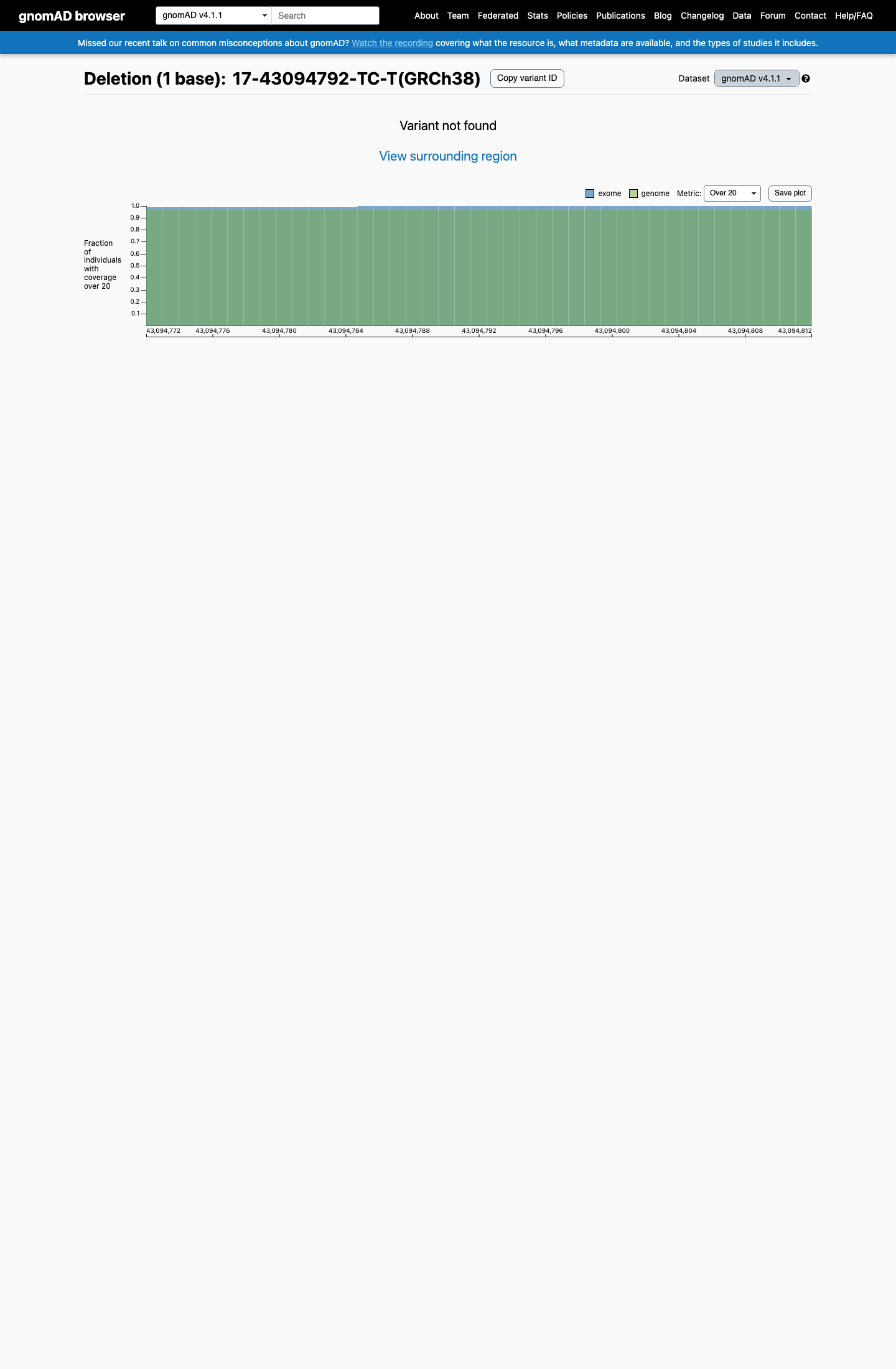
gnomAD v4.1
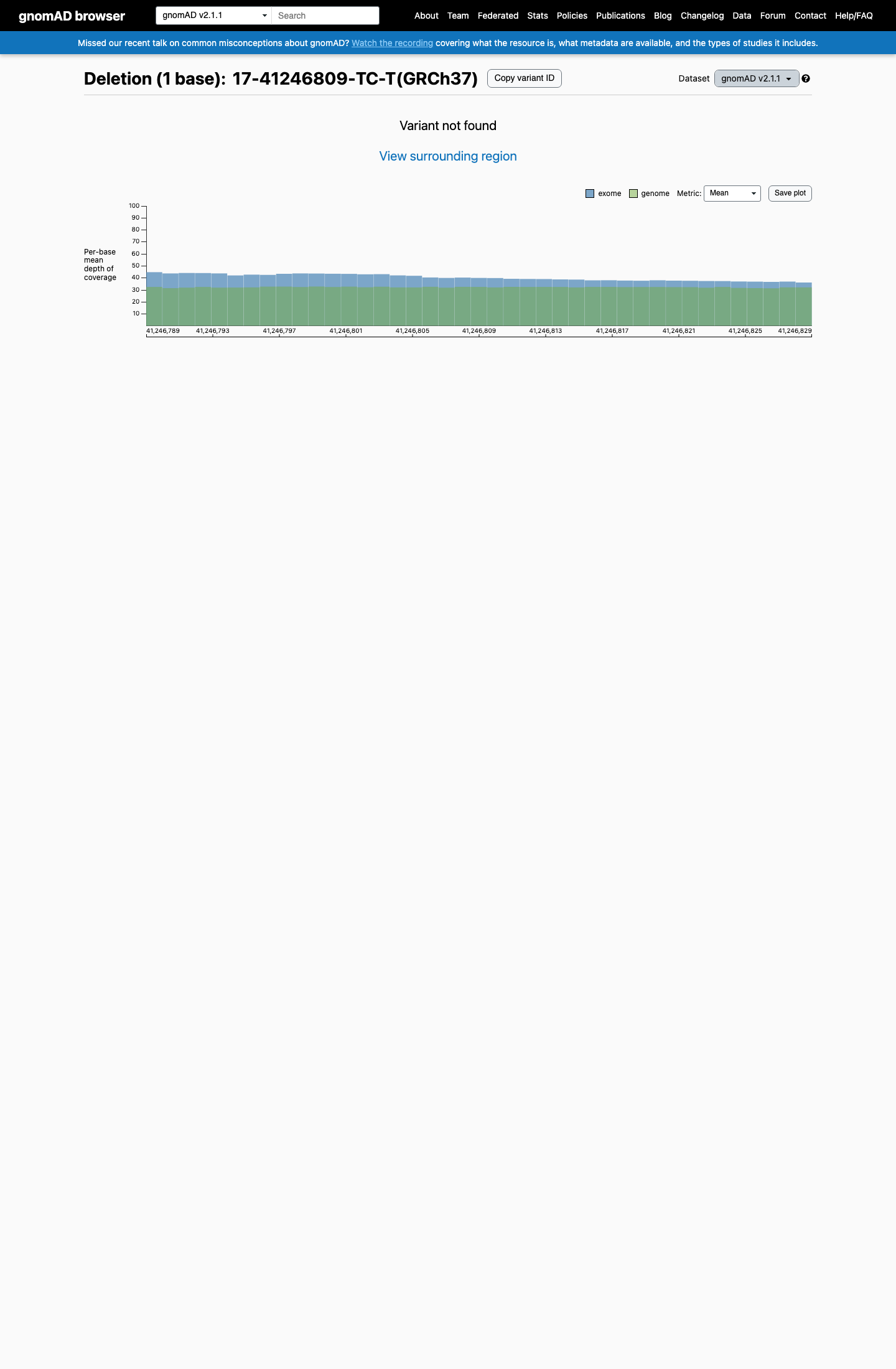
gnomAD v2.1
v4.1
Absent from gnomAD v4.1.
v2.1
Absent from gnomAD v2.1.
🇨🇦 CA
Absent from gnomAD-Canada v1.0.
Allele frequency by ancestry
three datasets · side by side
gnomAD v4.1
Absent
· 0 / ?
0 hom
0 hom
Not observed in any ancestry group.
gnomAD v2.1
Absent
· 0 / ?
0 hom
0 hom
Not observed in any ancestry group.
gnomAD Canada 🇨🇦
Absent
· 0 / ?
0 hom
0 hom
Not observed in any ancestry group.
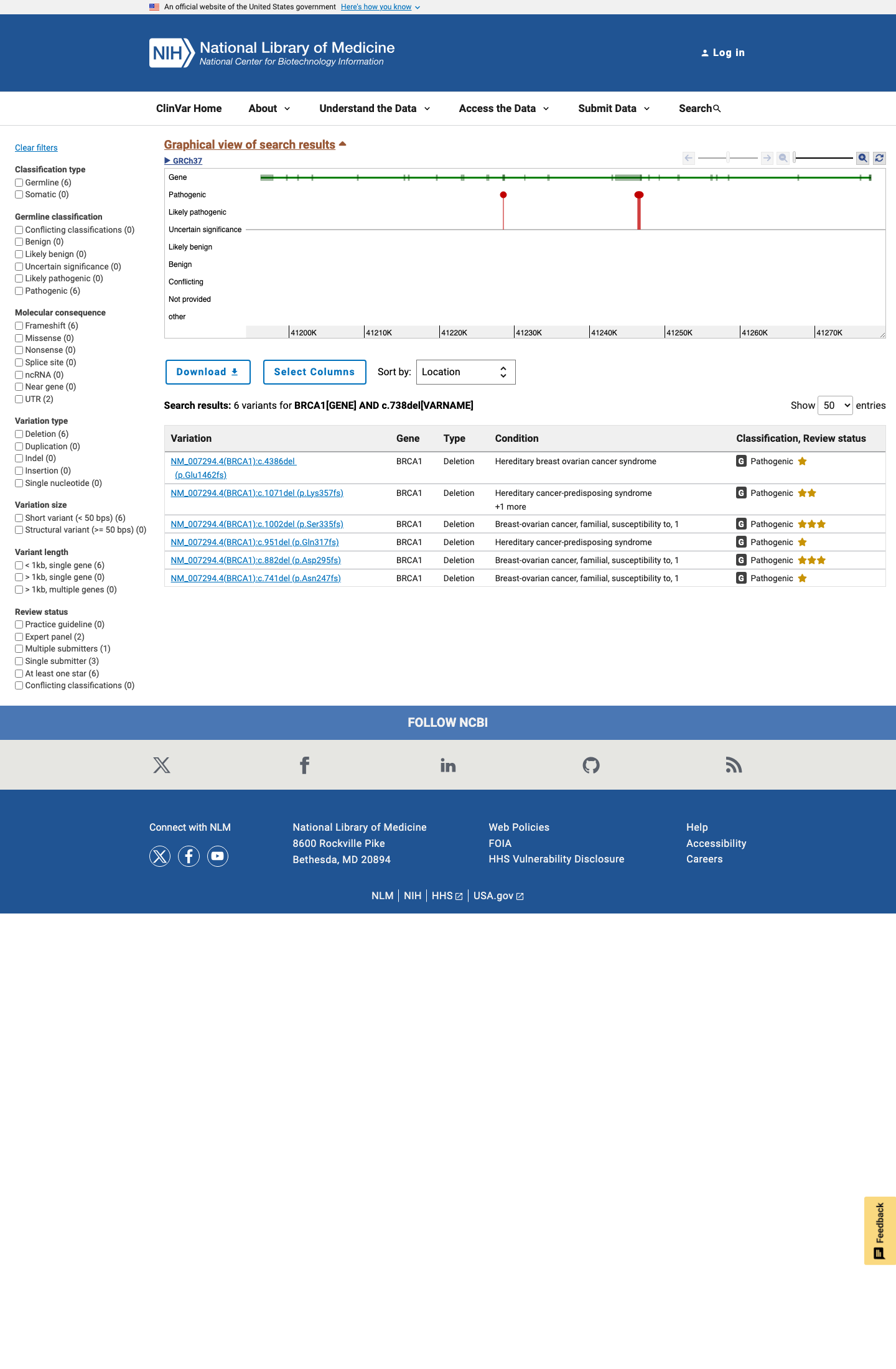
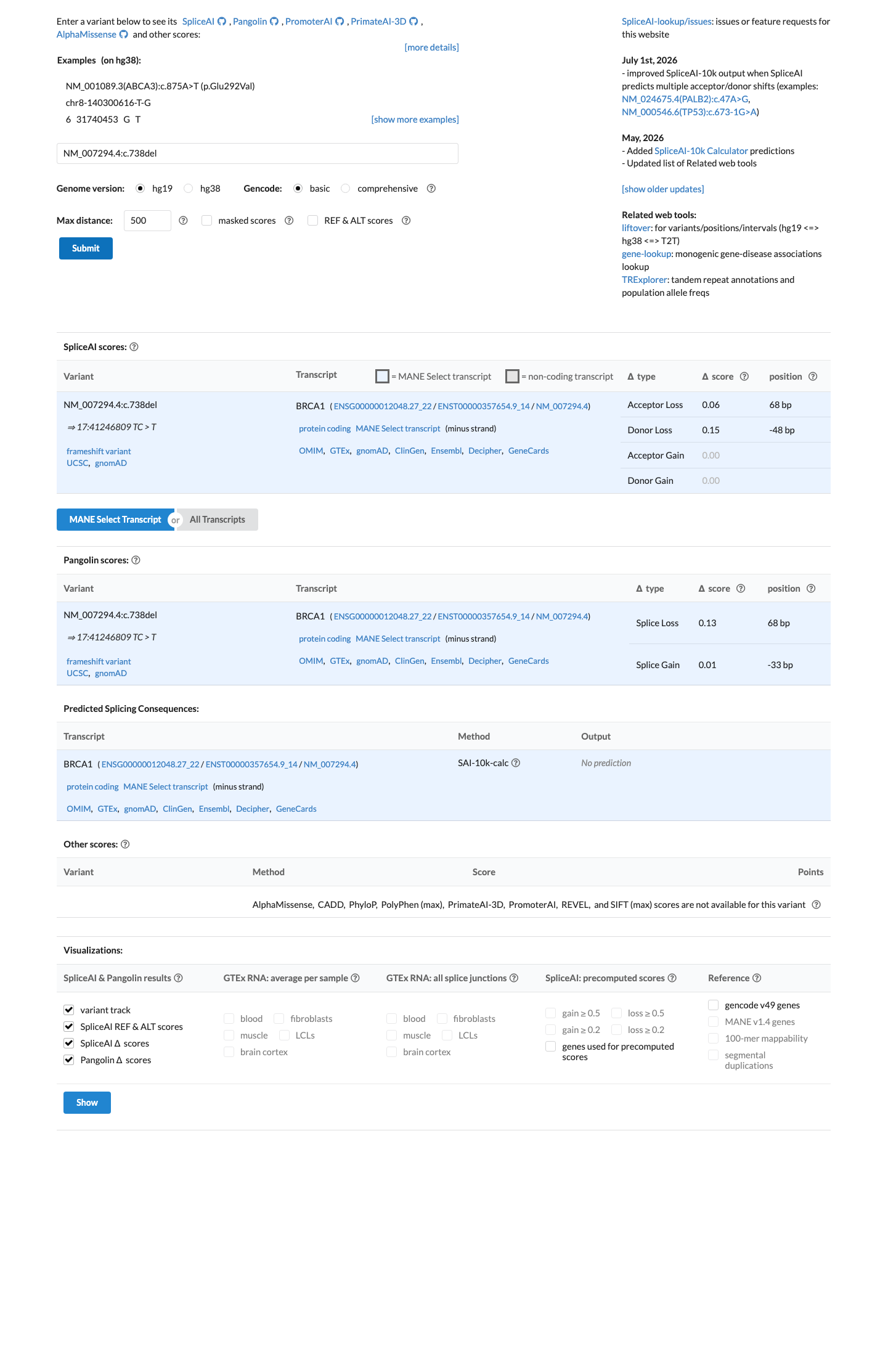
In silico
SpliceAI predicts no significant splice impact for this variant (max delta score = 0.15).
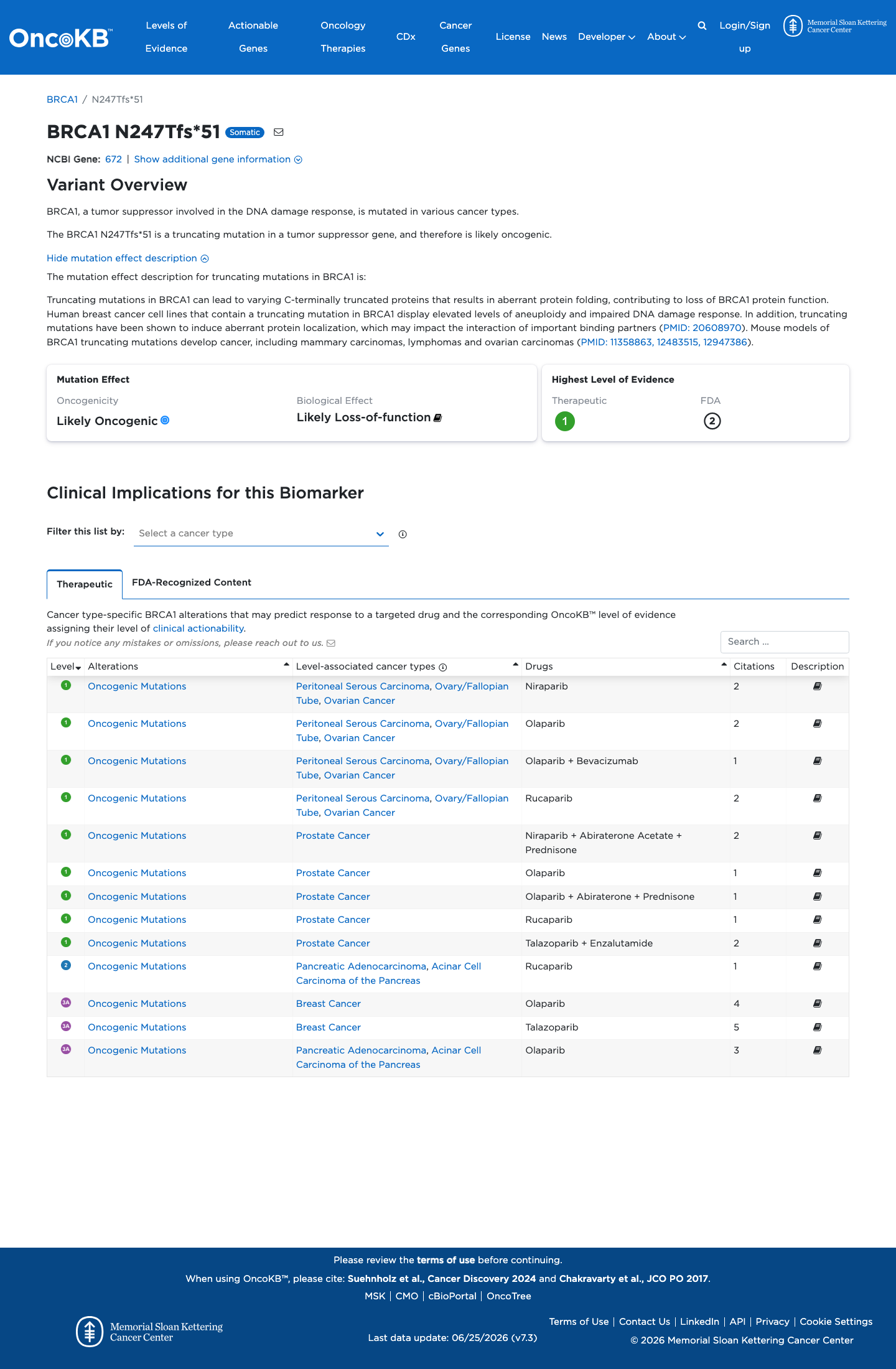
Functional
Likely Oncogenic
OncoKB identified variant-specific curated literature and context relevant to functional review; biological-effect context: Likely Loss-of-function; curated oncogenicity label: Likely Oncogenic.

COSMIC

Cancer hotspots
Somatic evidence
Not in COSMIC / hotspots
COSMIC
This variant does not lie in a statistically significant hotspot. This variant has not previously been reported in somatic cancers (COSMIC).
Hotspots
This variant does not lie in a statistically significant hotspot.
Sources & reference links
9Sources
Triaged references · 8 PMIDs not cited in assessment
12947386 ↗
Roles of BRCA1 and BRCA2 in homologous recombination, DNA replication fidelity and the cellular response to ionizing radiation.
ONCOKB
20608970 ↗
BRCA1 16 years later: risk-associated BRCA1 mutations and their functional implications.
ONCOKB
12692171 ↗
American Society of Clinical Oncology policy statement update: genetic testing for cancer susceptibility.
CLINVAR
20065170 ↗
American Society of Clinical Oncology policy statement update: genetic and genomic testing for cancer susceptibility.
CLINVAR
23188549 ↗
NSGC practice guideline: risk assessment and genetic counseling for hereditary breast and ovarian cancer.
CLINVAR