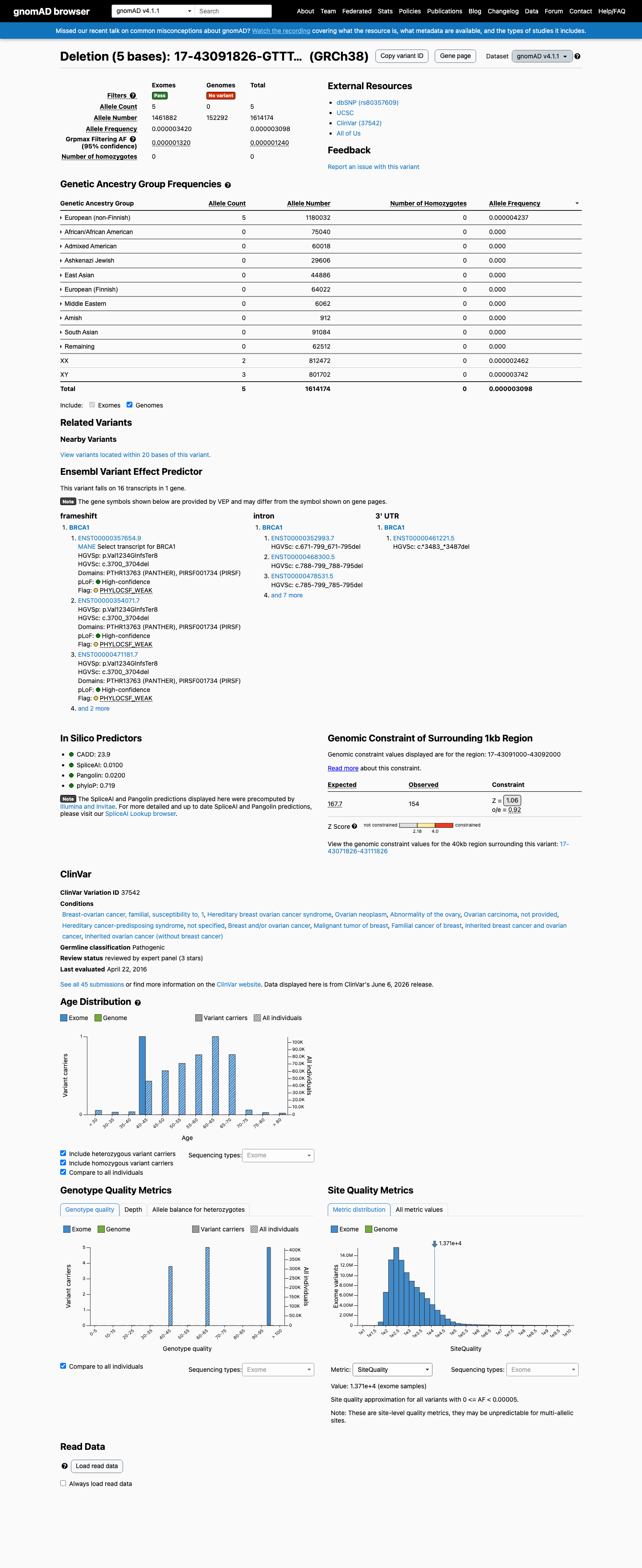
NM_007294.4:c.3700_3704del (p.Val1234GlnfsTer8) is a frameshift deletion in BRCA1 exon 10 that creates a premature termination codon, meeting PVS1 at very strong strength per ENIGMA Table 4 for PTC variants in E10(11).1 The variant is absent from gnomAD v2.1 and present at extremely low frequency in gnomAD v4.1 (5/1,614,374 alleles; MAF 0.00031%; grpmax FAF=1.24e-06), meeting PM2_Supporting.2 ENIGMA Table 4 assigns PM5_Strong (PTC) for protein termination codon variants in BRCA1 exon 10(11), an exon with multiple established pathogenic PTC variants.3 Clinical-history likelihood ratio analysis from Li et al. 2020 (PMID:31853058) yields LR = 57.23 (N_Probands = 10), meeting PP4_Strong (LR ≥18.7), indicating significant enrichment of breast/ovarian cancer phenotype in carriers.4 The variant has been classified as Pathogenic by the ENIGMA expert panel in ClinVar (ClinVar ID 37542) and has been observed as a recurrent founder mutation in multiple Central European populations.5 Overall classification: Pathogenic under ENIGMA Table 3 rules (1 Very Strong + ≥1 Strong). Criteria met: PVS1 (Very Strong), PM5_Strong (PTC), PP4_Strong, PM2_Supporting.6
Final classification
Pathogenic
PVS1PM2PM5PP4PP5
BRCA1
c.3700_3704del
p.Val1234GlnfsTer8
This variant
NM_007294.4:c.3700_3704del (p.Val1234GlnfsTer8) is a frameshift deletion in BRCA1 exon 10 that creates a premature termination codon, meeting PVS1 at very strong strength per ENIGMA Table 4 for PTC variants in E10(11).
ENIGMA BRCA1/BRCA2 Specification v1.2.0 Table 3. The variant accumulates 1 Very Strong criterion (PVS1) and 2 Strong criteria (PM5_Strong, PP4_Strong), satisfying the pathogenic rule: 1 Very Strong + ≥1 Strong. Additionally, 2 Supporting criteria (PM2_Supporting, PP5_Supporting) provide further corroboration but are not required for this call.
Classification rationale
PVS1PM2PM5PP4PP5
Pathogenic
BRCA1 c.3700_3704del
PVS1 + PM2 + PM5 + PP4 + PP5
→
Pathogenic
1
cspec ↗vcep_specifications_table4_v1_2_2024_11_18
3
vcep_specifications_table4_v1_2_2024_11_18
4
PMID:31853058 ↗vcep_pmid_31853058_brca1_clinical_history_lr
6
cspec ↗
LYFE Sciences is an AI system, and it can make mistakes. Criteria
may be applied incorrectly, sources may be misread, and a confident-looking
classification can still be wrong. Double-check every criterion and
its underlying evidence before relying on any call.
Gene diagram
· NM_007294.4 · variants mapped to exon structure
BRCA1
NM_007294.4
Fetching transcript structure from UCSC…
Applied criteria · 5 applied · 8 assessed
MetEvidence satisfies this criterion.
Not metEvaluated against available evidence; threshold not reached.
Not assessedApplies in principle, but no evidence was found to evaluate it.
N/ADoesn't apply to this variant type.
Applied · 5
Strength
Supporting
Moderate
Strong
Very strong
PVS1
very strong
Pathogenic
NM_007294.4:c.3700_3704del is a frameshift deletion in BRCA1 exon 10 (legacy exon 11), resulting in a premature termination codon (p.Val1234GlnfsTer8) predicted to undergo nonsense-mediated decay. Loss of function is an established disease mechanism for BRCA1. The ENIGMA BRCA1 specification (v1.2) assigns PVS1 at full strength for PTC variants in exon 10(11) per Table 4.
Frameshift deletion creating PTC at codon 1234 (p.Val1234GlnfsTer8)Located in BRCA1 exon 10 (legacy exon 11)within the large exon encoding aa 224-1366
PM2
supporting
Pathogenic
The variant is absent from gnomAD v2.1 (non-cancer, exome) and present in gnomAD v4.1 at extremely low frequency (5/1,614,374 alleles; MAF 0.00031%; grpmax FAF 1.24e-06). This meets ENIGMA PM2_Supporting: absent from controls in an outbred population per gnomAD v2.1/v3.1 criteria.
Absent from gnomAD v2.1 (non-cancerexome)gnomAD v4.1: 5/1
PM5
strong
Pathogenic
This is a protein termination codon (PTC) variant in BRCA1 exon 10 (legacy exon 11), where multiple proven pathogenic PTC variants have been observed (e.g., c.5266dupC). ENIGMA Table 4 assigns PM5_Strong (PTC) for PTC variants in exon E10(11). This criterion captures the additional weight beyond PVS1 for a PTC in an exon with established pathogenic PTCs.
ENIGMA Table 4E10(11) PTC row: Column L = PM5_Strong (PTC)Exon 10(11) contains well-established pathogenic PTC variants (founder c.5266dupC among others)
PP4
strong
Pathogenic
The variant's clinical-history likelihood ratio from Li et al. 2020 (PMID:31853058) is LR = 57.23 (LOG(LR) = 4.047, N_Probands = 10). This exceeds the PP4_Strong threshold of LR ≥18.7 and is based on personal and family cancer history data from multigene panel testing, indicating significant enrichment of a breast/ovarian cancer phenotype in carriers compared to non-carriers.
LR = 57.23 from PMID:31853058 clinical-history model (N_Probands = 10)Exceeds ENIGMA PP4_Strong threshold (LR ≥18.7)
PP5
supporting
Pathogenic
Expert panel Evidence-based Network for the Interpretation of Germline Mutant Alleles (ENIGMA) classified as Pathogenic.
ClinVar expert panel classification
Assessed · not applied
· 8 not met · 0 not assessed
Pathogenic
PS4
PS4 requires a case-control study with p-value ≤0.05 and OR ≥4 (lower CI excludes 2.0).
PP1
PP1 requires quantitative co-segregation analysis with LR ≥2.08.
PP3
PP3 in ENIGMA applies to missense/in-frame variants in functional domains with BayesDel ≥0.28, or variants with predicted splicing impact (SpliceAI ≥0.2).
Benign
BA1
BA1 requires filter allele frequency (FAF) > 0.1% (0.001) in gnomAD.
BS1
BS1_Supporting requires FAF > 0.00002 (0.002%) in gnomAD.
BS2
BS2 requires documented absence of Fanconi Anemia features in homozygous or compound heterozygous individuals.
BS4
BS4 requires quantitative lack-of-segregation analysis with LR ≤0.48.
BP5
BP5 requires a combined likelihood ratio against pathogenicity (LR ≤0.48).
N/A · 15
PS1 · PS2 · PS3 · PM1 · PM3 · PM4 · PM6 · PP2 · BS3 · BP1 · BP2 · BP3 · BP4 · BP6 · BP7
Research & evidence
Population frequency · supports pathogenic
gnomAD v4.1
gnomAD v2.1
v4.1
This variant is present in gnomAD v4.1 (AF= 3.09756e-06; MAF= 0.00031%, 5/1614174 alleles, homozygotes = 0) and has highest observed frequency in the European (non-Finnish) population (AF= 4.23717e-06; MAF= 0.00042%, 5/1180032 alleles, homozygotes = 0); grpmax FAF= 1.24e-06.
v2.1
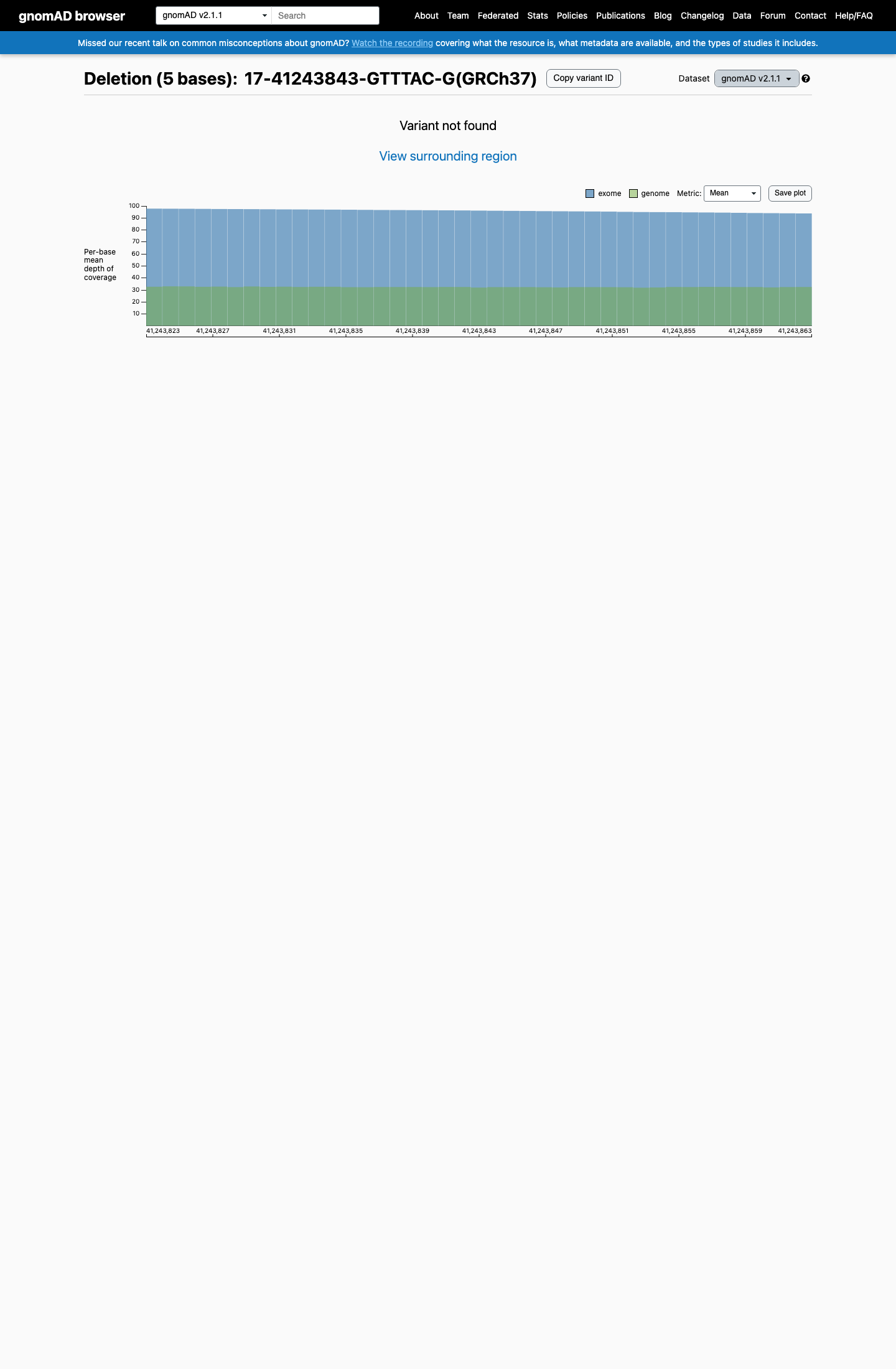
Absent from gnomAD v2.1.
🇨🇦 CA
Absent from gnomAD-Canada v1.0.
Allele frequency by ancestry
three datasets · side by side
gnomAD v4.1
0.00031%
· 5 / 1,614,174
0 hom · FAF 0.00012%
0 hom · FAF 0.00012%
European (non-Finnish) 5 / 1,180,032 |
0.00042% |
+ 9 not observed (Remaining individuals, Admixed American, European (Finnish), Amish, East Asian, Middle Eastern, South Asian, Ashkenazi Jewish, African/African American)
gnomAD v2.1
Absent
· 0 / ?
0 hom
0 hom
Not observed in any ancestry group.
gnomAD Canada 🇨🇦
Absent
· 0 / ?
0 hom
0 hom
Not observed in any ancestry group.

ClinVar
This variant has been reported in ClinVar as Pathogenic (38 clinical laboratories) and as pathogenic (3 clinical laboratories) and as Pathogenic by Evidence-based Network for the Interpretation of Germline Mutant Alleles (ENIGMA) (expert panel). (ClinVarID = 37542)

In silico
SpliceAI predicts no significant splice impact for this variant (max delta score = 0.05).
Functional
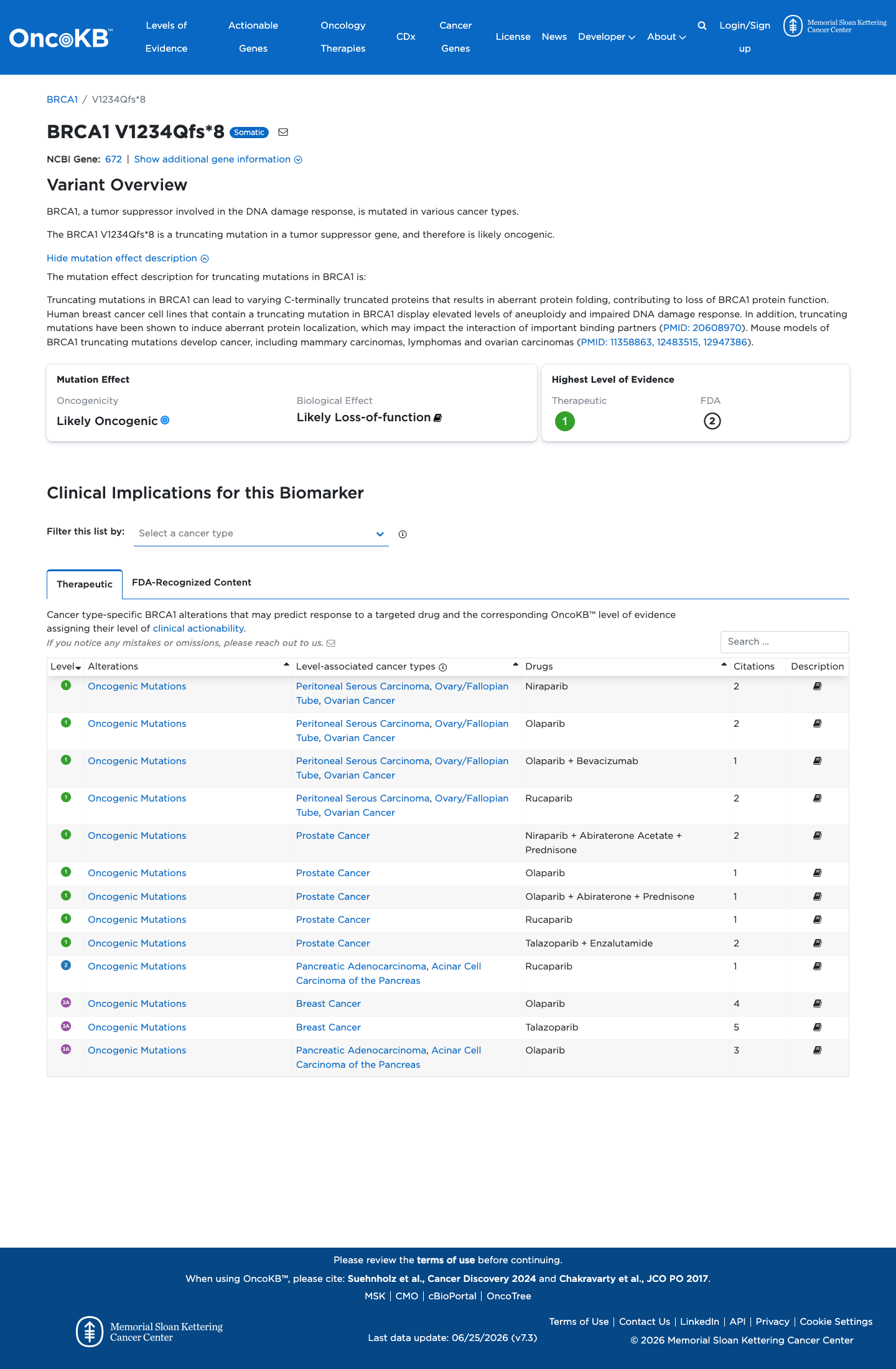
Likely Oncogenic
OncoKB identified variant-specific curated literature and context relevant to functional review; biological-effect context: Likely Loss-of-function; curated oncogenicity label: Likely Oncogenic.

COSMIC

Cancer hotspots
Somatic evidence
Not in COSMIC / hotspots
COSMIC
This variant does not lie in a statistically significant hotspot. This variant has not previously been reported in somatic cancers (COSMIC).
Hotspots
This variant does not lie in a statistically significant hotspot.
Literature · how each cited paper was used
2papers cited
Each card is an audit: what was searched, what was found, whether it names the variant, which criteria it fed, and why. 7 further PMIDs triaged but not cited — see Sources & references.
Spectrum and characterisation of BRCA1 and BRCA2 deleterious mutations in high-risk Czech patients with breast and/or ovarian cancer.
Searched
c.3700_3704del3700_3704del53819_3823del5Val1234Glnfs
Found
Identified c.3700_3704del5 (NM_007294.4:c.3700_3704del) as one of three BRCA1 founder mutations in the Czech population, detected in 29 of 204 (14.2%) BRCA1-mutation-positive families. Described as a frameshift mutation leading to p.Val1234GlnfsX8.
Variant
✓ Names this variant — characterised directly
Applied to
→PM5
met
Why
Variant confirmed as recurrent founder mutation in Czech population; supports established pathogenicity. Referenced in PS4 and PM5 assessments.
The BRCA1 c.3700_3704del5 mutation is a frequent mutation in Germany. Three BRCA1 Czech founder mutations (p.Cys61Gly, c.3700_3704del5, and c.5266dupC) accounted for 9.8%, 14.2% and 36.8% of the BRCA1 mutations identified, respectively.
Location Table 1 (BRCA1 mutations); Results, Discussion (founder mutations section) · full text
Li et al. 2020 BRCA1/2 clinical-history likelihood-ratio model
Searched
c.3700_3704delc.3700_3704delGTAAA3700
Found
Li et al. 2020 clinical-history likelihood-ratio model. The variant c.3700_3704delGTAAA (NM_007294.4:c.3700_3704del) has a LOG(LR) of 4.047 (LR = 57.23) based on 10 probands, providing strong evidence toward pathogenicity from personal and family cancer history.
Variant
✓ Names this variant — characterised directly
Applied to
→PP4
met
Why
Clinical-history LR exceeds PP4_Strong threshold (≥18.7). Used as primary evidence for PP4_Strong.
c.3700_3704delGTAAA: LOG(LR) = 4.047027111053467, LR = 57.22707417000815, N_Probands = 10
Location MOESM2 clinical-history LR spreadsheet (PMID_31853058_BRCA1_clinical_history_LR.xlsx) · full text
Sources & reference links
9Sources
Triaged references · 7 PMIDs not cited in assessment
12947386 ↗
Roles of BRCA1 and BRCA2 in homologous recombination, DNA replication fidelity and the cellular response to ionizing radiation.
ONCOKB
20608970 ↗
BRCA1 16 years later: risk-associated BRCA1 mutations and their functional implications.
ONCOKB
11802209 ↗
Comprehensive analysis of 989 patients with breast or ovarian cancer provides BRCA1 and BRCA2 mutation profiles and frequencies for the German population.
CLINVAR
20104584 ↗
Characterization of BRCA1 and BRCA2 deleterious mutations and variants of unknown clinical significance in unilateral and bilateral breast cancer: the WECARE study.
CLINVAR
30702160 ↗
Germline variation in BRCA1/2 is highly ethnic-specific: Evidence from over 30,000 Chinese hereditary breast and ovarian cancer patients.
CLINVAR