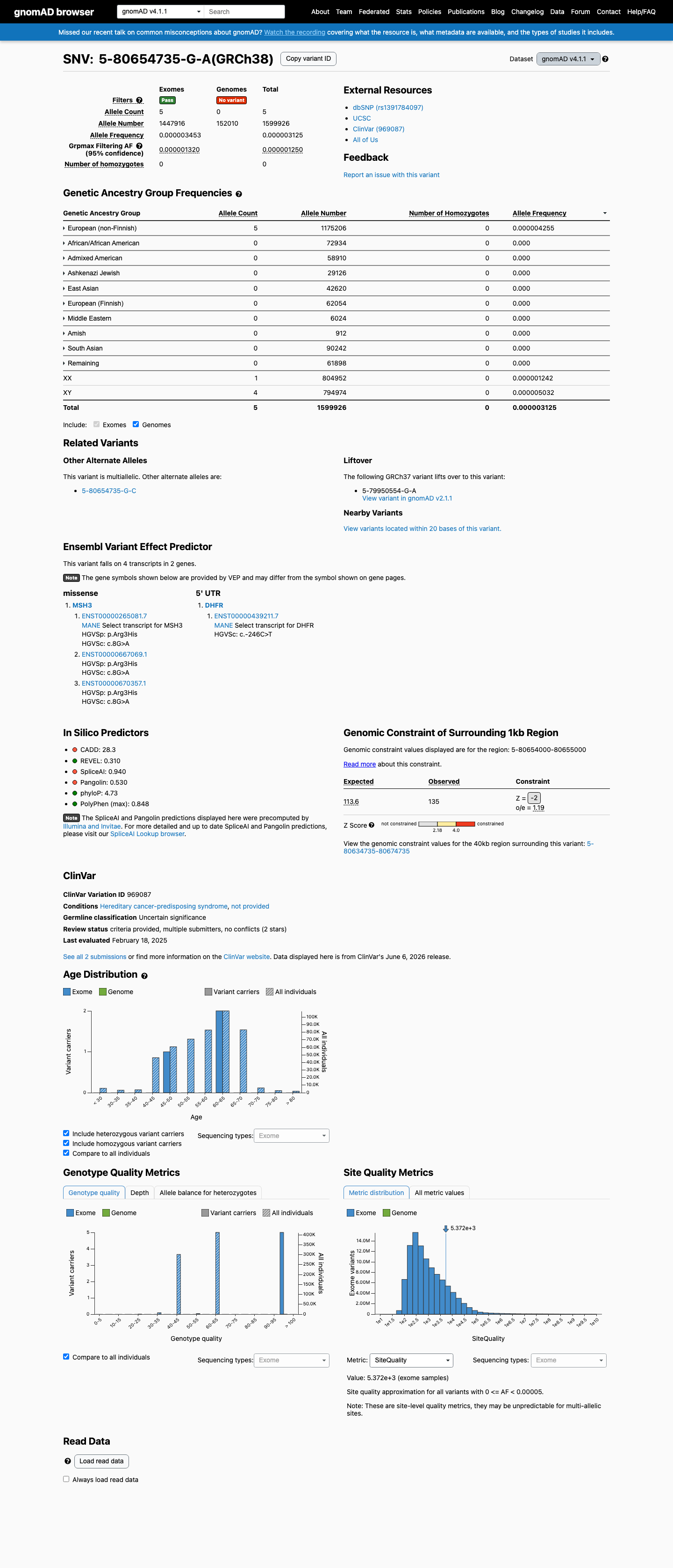
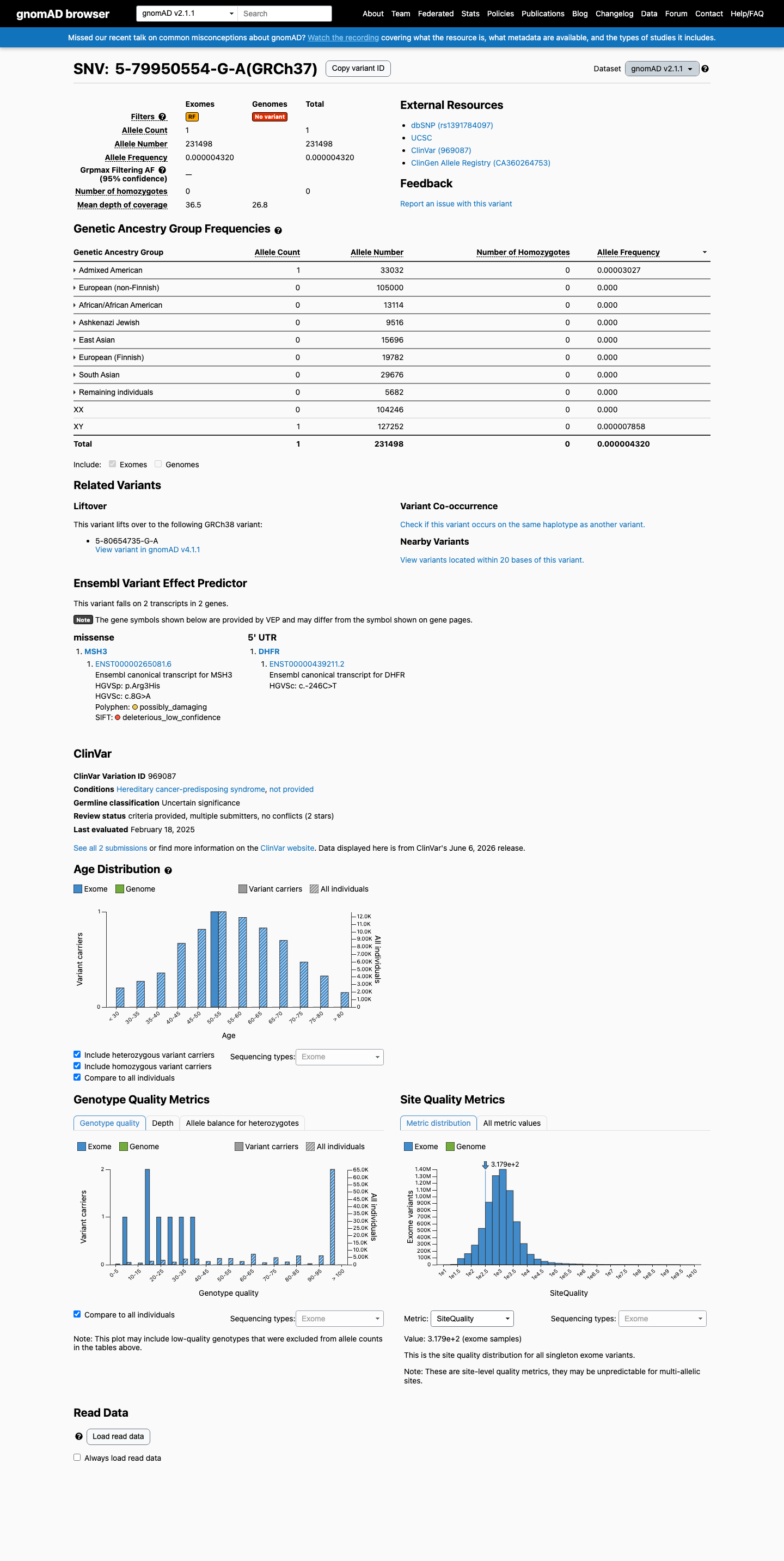
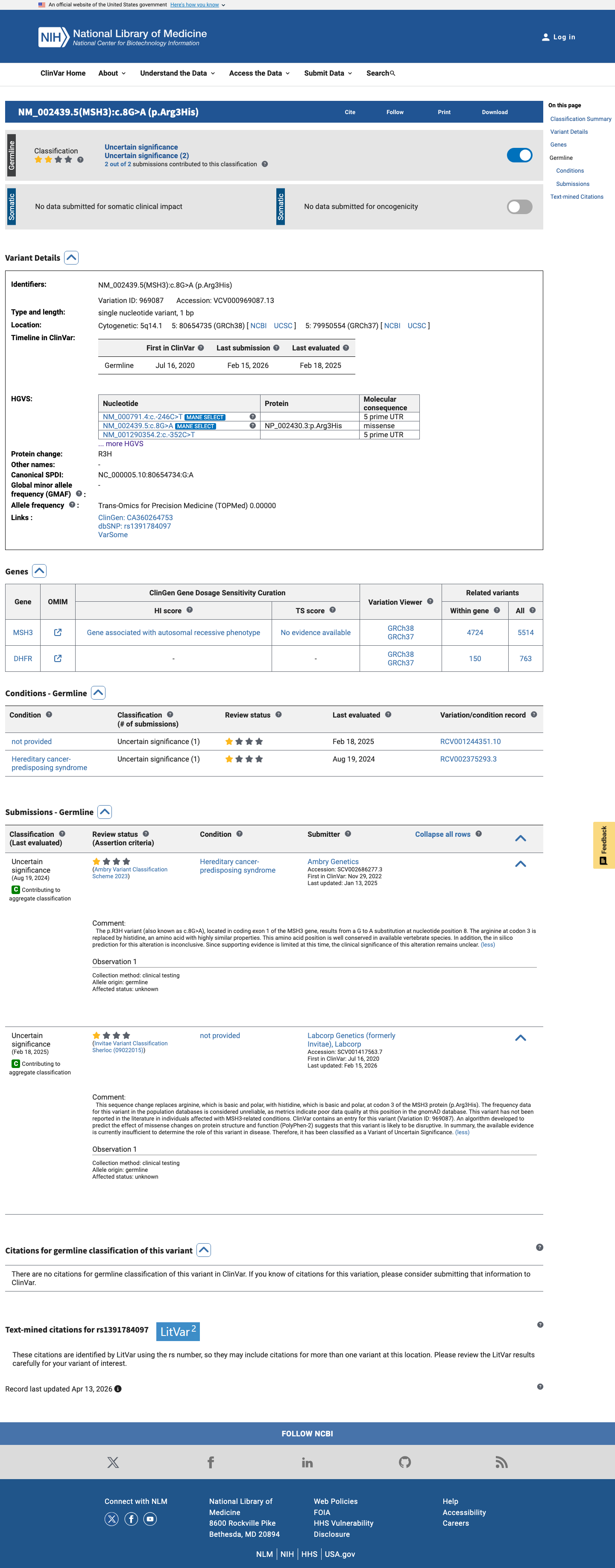
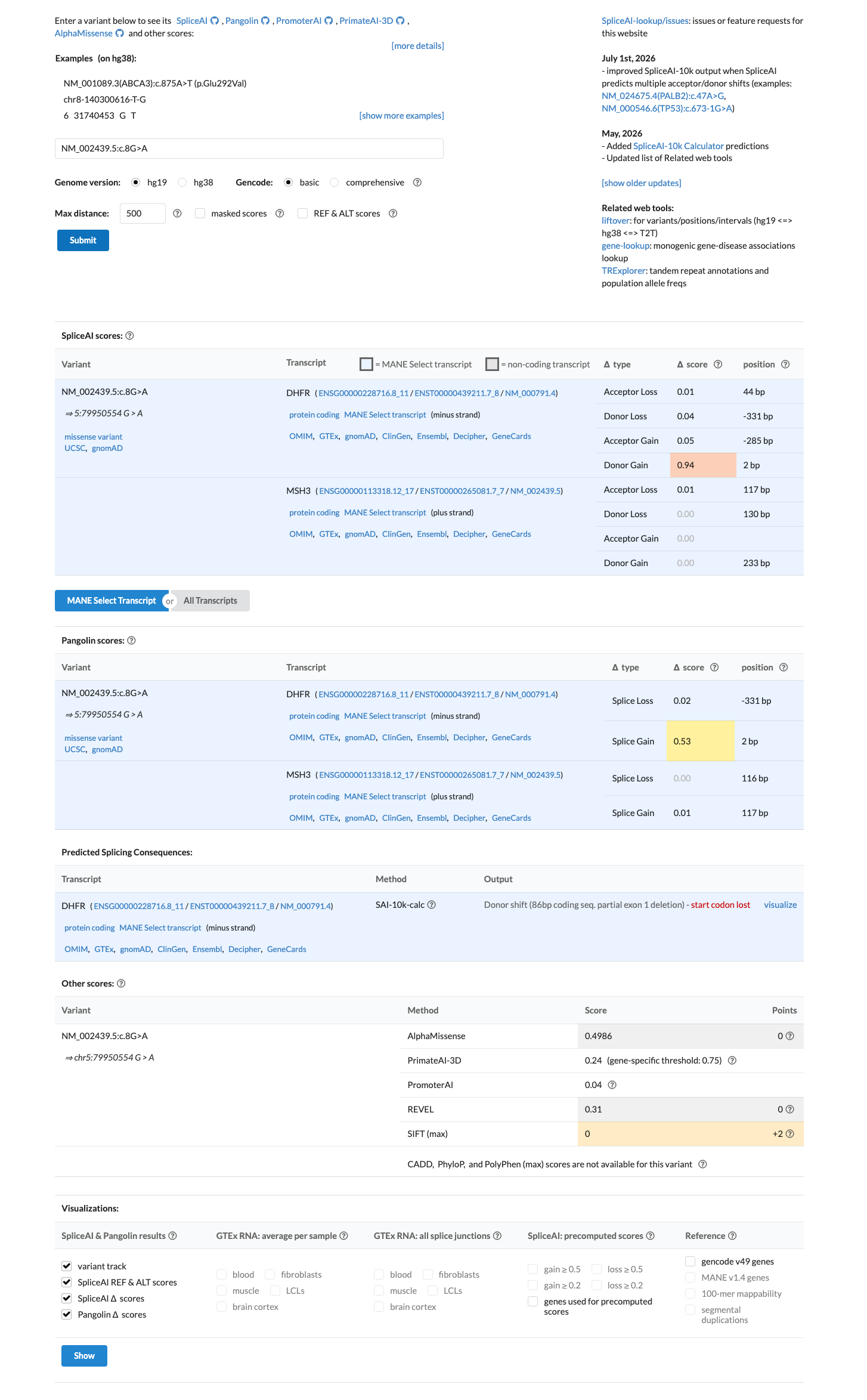
NM_002439.5:c.8G>A (p.Arg3His) in MSH3 is a missense variant in exon 1. This variant is extremely rare in population databases (gnomAD v4.1 AF=3.13×10⁻⁶, 5/1,599,926 alleles; gnomAD v2.1 AF=4.32×10⁻⁶, 1/231,498 alleles; 0 homozygotes observed).1 The variant has been reported in ClinVar as Uncertain significance by two clinical laboratories (ClinVar ID: 969087). No expert panel classification is available. The ClinVar-associated references (PMID:25394175, a cancer referral practice guideline, and PMID:28492532, the Sherloc classification framework paper) do not provide variant-specific evidence for NM_002439.5:c.8G>A.2 Computational predictors do not support a deleterious effect: REVEL score 0.31 (below pathogenic threshold), BayesDel score -0.0159 (not damaging), and SpliceAI max delta 0.00 (no splicing impact predicted).3 No functional studies, segregation data, de novo reports, or case-control observations have been published for this variant. OncoKB reports Unknown Oncogenic Effect with no variant-specific functional evidence.4 Evidence weighting: one moderate pathogenic criterion (PM2 — extremely low population frequency) and two supporting benign criteria (BP1 — missense in a primarily loss-of-function disease gene; BP4 — multiple concordant benign computational predictions). The net evidence is insufficient to classify this variant as pathogenic or benign, consistent with a variant of uncertain significance.5
MSH3
Final classification
Likely Benign
MSH3 c.8G>A · p.Arg3His
MSH3
NM_002439.5:c.8G>A (p.Arg3His) in MSH3 is a missense variant in exon 1. This variant is extremely rare in population databases (gnomAD v4.1 AF=3.13×10⁻⁶, 5/1,599,926 alleles; gnomAD v2.1 AF=4.32×10⁻⁶, 1/231,498 alleles; 0 homozygotes observed).
gene-specific framework lacked a usable explicit final combination framework, so generic ACMG/AMP 2015 final-combination rules were applied as fallback; applied criteria: PM2 moderate, BP1 supporting benign, BP4 supporting benign; combination = 1 moderate + 2 supporting benign, which maps to Likely Benign.
Classification rationale
PM2
BP1BP4
Likely Benign
MSH3 c.8G>A
PM2 + BP1 + BP4
→
Likely Benign
3
revelbayesdelspliceai ↗
4
oncokb ↗
5
gnomad_v2 ↗gnomad_v4 ↗pvs1_gene_contextrevelbayesdelspliceai ↗
Gene diagram
· NM_002439.5 · variants mapped to exon structure
MSH3
NM_002439.5
Fetching transcript structure from UCSC…
Applied criteria · 3 applied · 20 assessed
Applied · 3
Strength
Supporting
Moderate
Strong
Very strong
✓
PM2
moderate
Pathogenic
This variant is extremely rare in large population databases: gnomAD v2.1 AF=4.32×10⁻⁶ (1/231,498 alleles), gnomAD v4.1 AF=3.13×10⁻⁶ (5/1,599,926 alleles), grpmax FAF=1.25×10⁻⁶, and absent from gnomAD-Canada. All observed allele frequencies are well below the 0.1% PM2 threshold. No homozygous individuals have been observed. One ClinVar submitter (Labcorp/Invitae) noted potential data quality concerns at this position in gnomAD but did not provide alternative frequency data.
gnomAD v2.1: 1/231498 (AF=0.00043%). gnomAD v4.1: 5/1599
✓
BP1
supporting
Benign
This is a missense variant (p.Arg3His) in MSH3, a gene for which the established disease mechanism is primarily biallelic loss-of-function via truncating variants. MSH3-related autosomal recessive adenomatous polyposis is caused by biallelic LoF variants. A missense variant in a gene where primarily truncating variants are known to cause disease meets BP1.
MSH3 disease mechanism: biallelic loss-of-function. PVS1 gene context confirms LoF mechanism supported. Missense variants are not the primary disease mechanism.
✓
BP4
supporting
Benign
Multiple lines of computational evidence suggest no impact on the gene product. REVEL score is 0.31 (below pathogenic threshold of 0.5). BayesDel score is -0.0159 (not damaging). SpliceAI predicts no splicing impact (max delta 0.00). The concordant benign predictions from multiple algorithm types support BP4.
REVEL: 0.31 (benign range). BayesDel: -0.0159 (not damaging). SpliceAI: max delta 0.00 (no splice alteration). Multiple concordant benign predictions.
Assessed · not applied
Pathogenic
PS1
No evidence of a different nucleotide change at the same position (c.8) leading to the same amino acid change (p.Arg3His) has been identified in ClinVar, COSMIC, or the reviewed literature.
PS2
No de novo occurrence has been reported for this variant in any publication or database.
PS3
No well-established functional studies demonstrating a damaging effect have been identified for this variant.
PS4
The variant has not been observed in multiple unrelated probands with the same phenotype in peer-reviewed literature.
PM1
The variant (p.Arg3His) is located at the extreme N-terminus of MSH3 (position 3 of 1137 amino acids), far from the conserved MutS domain that mediates DNA mismatch recognition.
PM6
No de novo occurrence of this variant has been reported in any publication or ClinVar submission.
PP1
No co-segregation data are available for this variant.
PP2
PP2 requires a gene with a low rate of benign missense variation where missense variants are a common mechanism of disease.
PP3
Multiple in silico predictors do not support a deleterious effect.
PP4
No specific phenotypic or clinical data are available for individuals carrying this variant.
PP5
The variant is classified as Uncertain significance in ClinVar (2 clinical laboratories), not as pathogenic or likely pathogenic from a reputable source.
Benign
BA1
The variant is extremely rare in population databases, not common.
BS1
The variant allele frequency is far below the 0.3% BS1 threshold.
BS2
No homozygous individuals have been observed in gnomAD (v2.1 or v4.1).
BS3
No well-established functional studies demonstrating no deleterious effect are available for this variant.
BS4
No non-segregation data are available.
BP2
No observation of this variant in trans with a known pathogenic variant in MSH3 has been reported.
BP5
No clinical data are available to determine whether an alternative molecular basis for disease has been identified in any proband carrying this variant.
BP6
ClinVar classification for this variant is Uncertain significance, not Benign or Likely benign.
BP7
BP7 applies to synonymous variants predicted to have no impact on splicing.
N/A · 5
PVS1 · PM3 · PM4 · PM5 · BP3
Research & evidence
Population frequency · supports benign
gnomAD v4.1
gnomAD v2.1
v4.1
This variant is present in gnomAD v4.1 (AF= 3.12514e-06; MAF= 0.00031%, 5/1599926 alleles, homozygotes = 0) and has highest observed frequency in the European (non-Finnish) population (AF= 4.25457e-06; MAF= 0.00043%, 5/1175206 alleles, homozygotes = 0); grpmax FAF= 1.25e-06.
v2.1
This variant is present in gnomAD v2.1 (AF= 4.31969e-06; MAF= 0.00043%, 1/231498 alleles, homozygotes = 0) and has highest observed frequency in the Admixed American population (AF= 3.02737e-05; MAF= 0.00303%, 1/33032 alleles, homozygotes = 0).
🇨🇦 CA
Absent from gnomAD-Canada v1.0.
Allele frequency by ancestry
three datasets · side by side
gnomAD v4.1
0.00031%
· 5 / 1,599,926
0 hom · FAF 0.00013%
0 hom · FAF 0.00013%
European (non-Finnish) 5 / 1,175,206 |
0.00043% |
+ 9 not observed (Remaining individuals, Admixed American, European (Finnish), Amish, East Asian, Middle Eastern, South Asian, Ashkenazi Jewish, African/African American)
gnomAD v2.1
0.00043%
· 1 / 231,498
0 hom
0 hom
Admixed American 1 / 33,032 |
0.003% |
+ 7 not observed (African/African American, Ashkenazi Jewish, East Asian, European (Finnish), European (non-Finnish), Remaining individuals, South Asian)
gnomAD Canada 🇨🇦
Absent
· 0 / ?
0 hom
0 hom
Not observed in any ancestry group.
ClinVar
This variant has been reported in ClinVar as Uncertain significance (2 clinical laboratories). (ClinVarID = 969087)
In silico
SpliceAI predicts no significant splice impact for this variant (max delta score = 0.00). REVEL score = 0.31. BayesDel score = -0.015906.
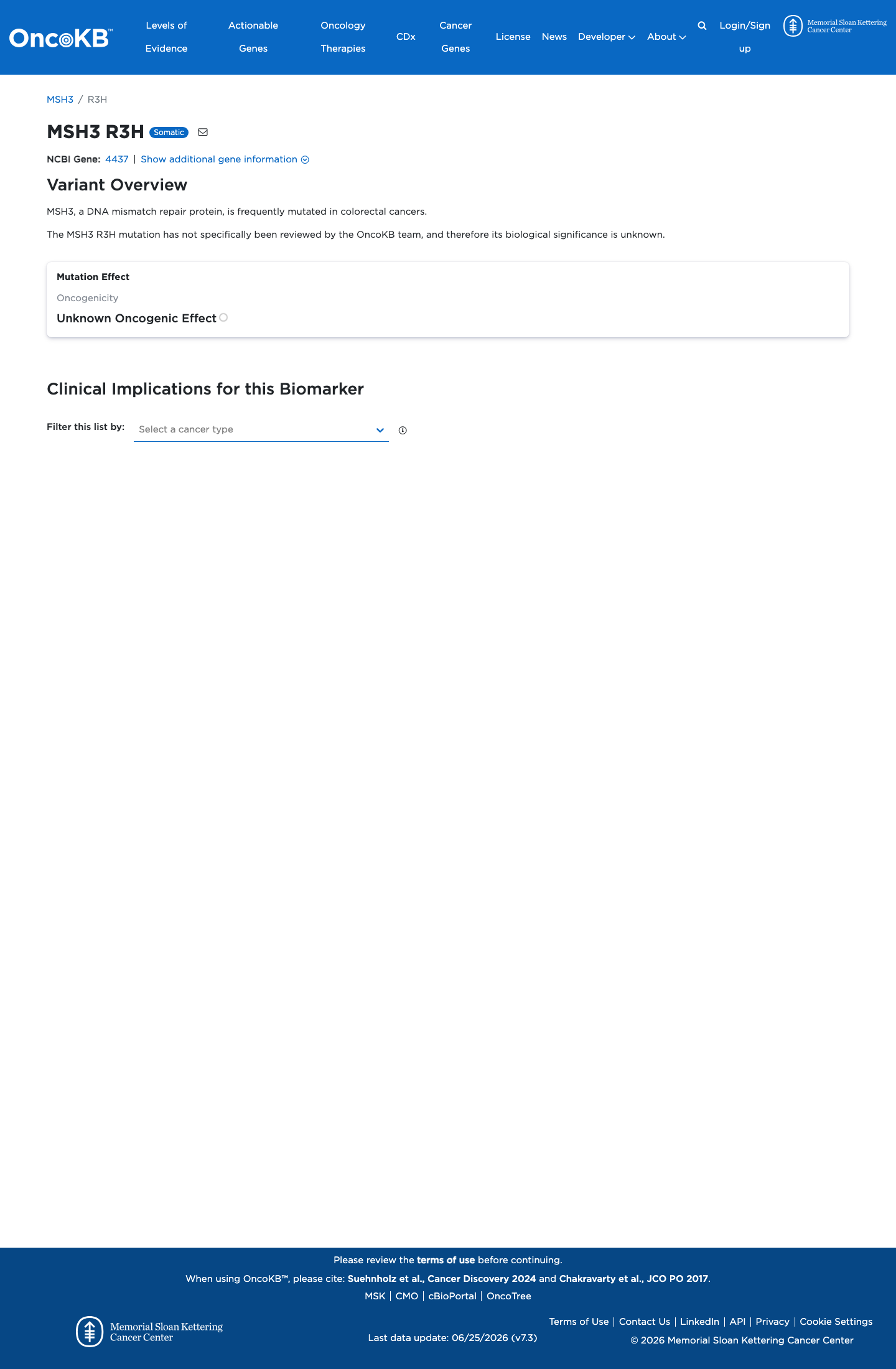
Functional
Unknown Oncogenic Effect
OncoKB did not identify variant-specific reviewed functional evidence for this variant; gene-level curated context is available for reviewer follow-up. MSH3, a DNA mismatch repair protein, is frequently mutated in colorectal cancers.

COSMIC

Cancer hotspots
Somatic evidence
Not in COSMIC / hotspots
COSMIC
This variant does not lie in a statistically significant hotspot. This variant has not previously been reported in somatic cancers (COSMIC).
Hotspots
This variant does not lie in a statistically significant hotspot.
Sources & reference links
Triaged references · 1 PMID not cited in assessment
25394175 ↗
A practice guideline from the American College of Medical Genetics and Genomics and the National Society of Genetic Counselors: referral indications for cancer predisposition assessment.
CLINVAR