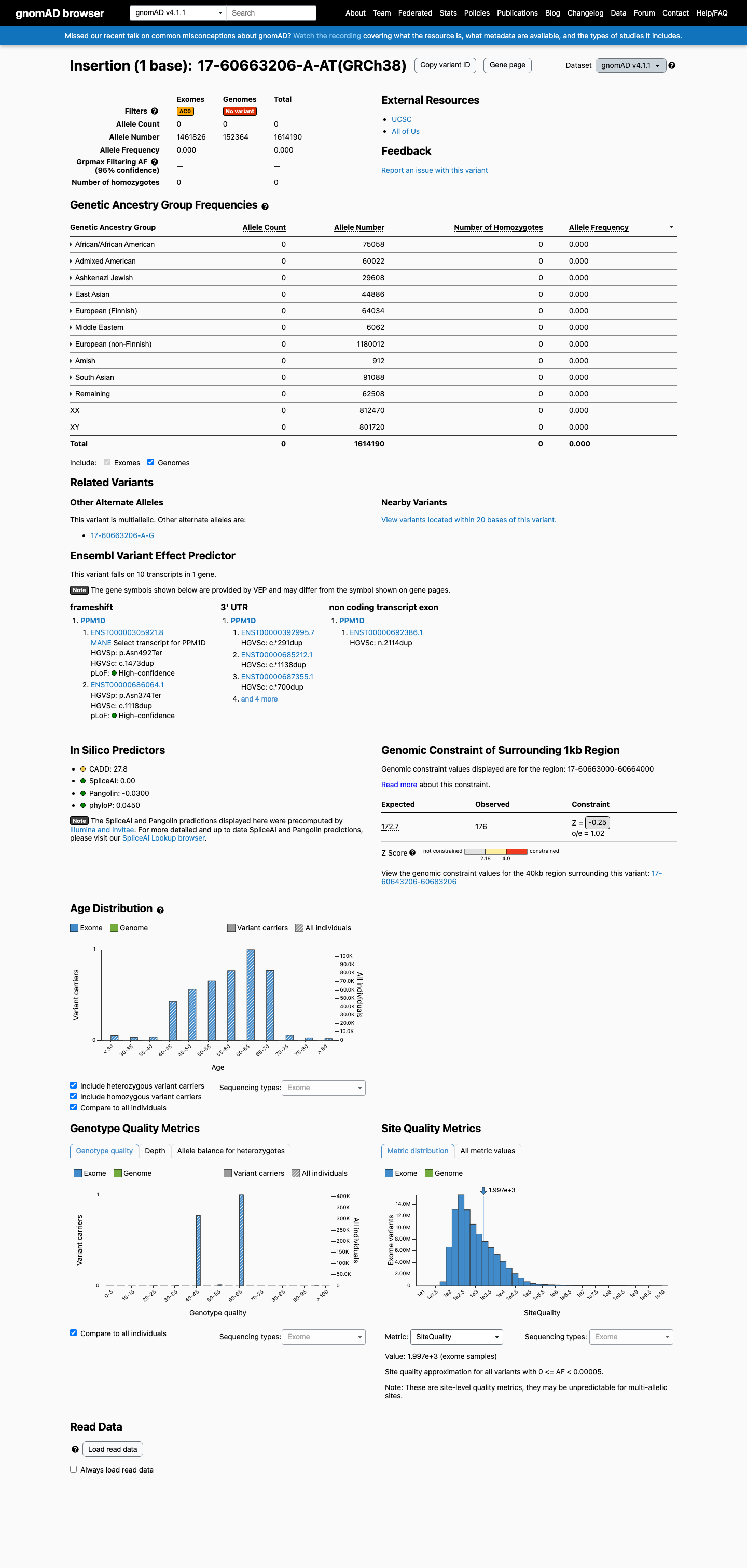
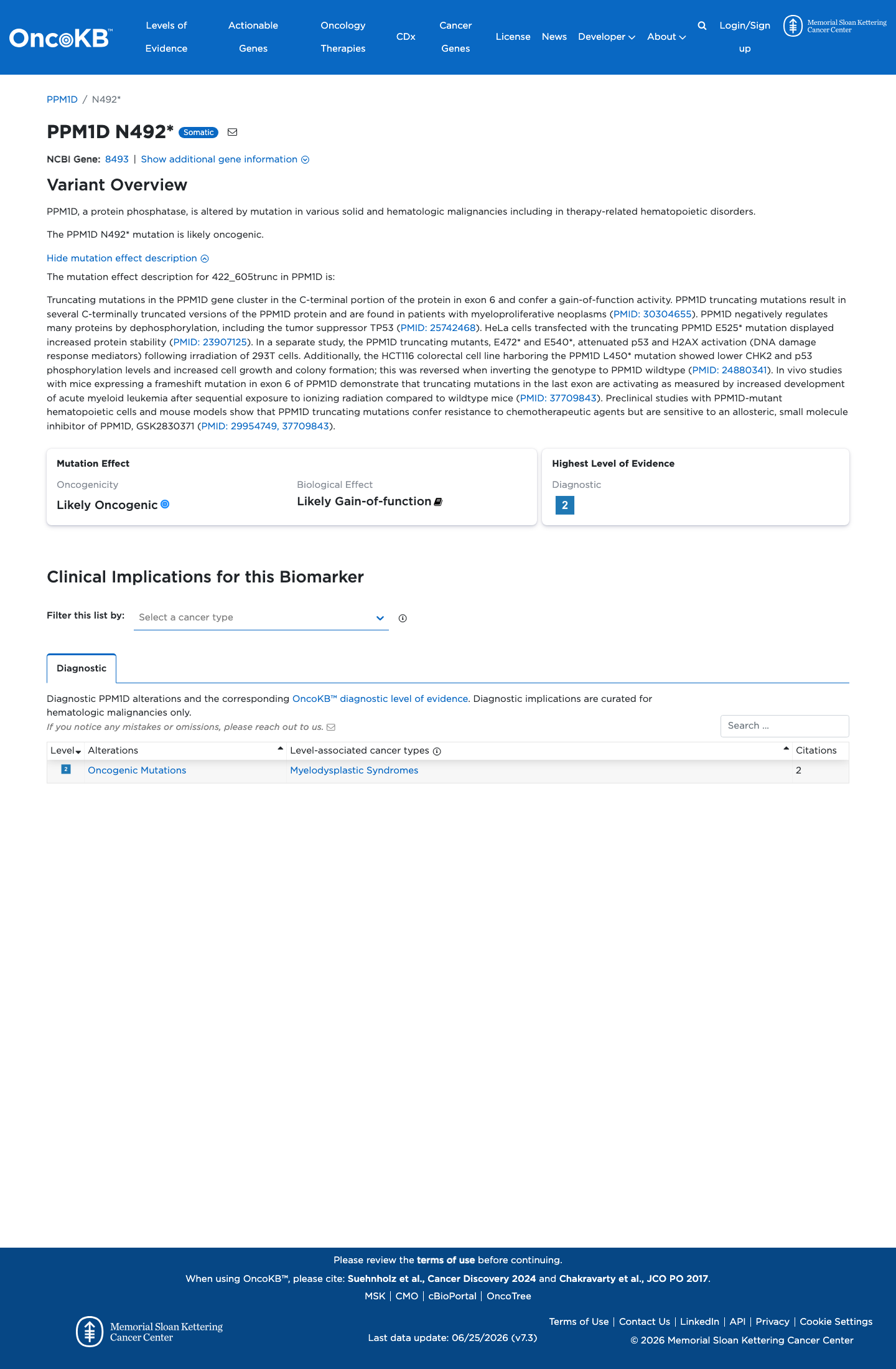
NM_003620.3:c.1473dupT (p.Asn492Ter) is a nonsense variant in exon 6 of PPM1D that truncates the protein within the C-terminal degradation domain. This variant is absent from gnomAD v4.1 (0/1,614,190 alleles), satisfying PM2 at supporting level.1 Functional evidence from a CRISPR-Cas9 tiling screen demonstrates that truncating mutations in the PPM1D exon 6 region (amino acids 400-585, encompassing N492) confer chemoresistance and selective advantage through a gain-of-function mechanism (PMID:29954749).2 Multiple independent studies confirm that exon 6 truncating PPM1D mutations produce a hyperstable protein with enhanced phosphatase activity due to loss of the C-terminal degradation domain (PMID:24880341, PMID:25742468, PMID:23907125).3 OncoKB classifies p.N492* as Likely Oncogenic with Likely Gain-of-function biological effect.4 PVS1 is not met because truncating PPM1D exon 6 mutations are gain-of-function, not loss-of-function; the variant produces a hyperstable, hyperactive protein rather than a null allele.5 PM1 is met at moderate level: p.Asn492Ter removes the C-terminal degradation domain, a critical regulatory region whose loss is functionally characterized across multiple studies.6 Overall classification: Likely Pathogenic based on PS3 (strong), PM1 (moderate), and PM2 (supporting) according to ACMG/AMP 2015 combination rules (1 strong + 1 moderate).7
PPM1D
Final classification
Likely Pathogenic
PPM1D c.1473dup · p.Asn492Ter
PPM1D
NM_003620.3:c.1473dupT (p.Asn492Ter) is a nonsense variant in exon 6 of PPM1D that truncates the protein within the C-terminal degradation domain.
gene-specific framework lacked a usable explicit final combination framework, so generic ACMG/AMP 2015 final-combination rules were applied as fallback; applied criteria: PS3 strong, PM1 moderate, PM2 supporting; combination = 1 strong + 1 moderate + 1 supporting, which maps to Likely Pathogenic.
Classification rationale
PS3PM1PM2
Likely Pathogenic
PPM1D c.1473dup
PS3 + PM1 + PM2
→
Likely Pathogenic
4
oncokb ↗
7
generic_acmg_combination_rules
Gene diagram
· NM_003620.3 · variants mapped to exon structure
PPM1D
NM_003620.3
Fetching transcript structure from UCSC…
Applied criteria · 3 applied · 13 assessed
Applied · 3
Strength
Supporting
Moderate
Strong
Very strong
✓
PS3
strong
Pathogenic
The variant p.Asn492Ter falls within the C-terminal degradation domain (amino acids ~400-605) of PPM1D that has been systematically characterized as a gain-of-function region by a CRISPR-Cas9 tiling screen (PMID:29954749, 265 gRNAs spanning the entire protein-coding region). This screen demonstrated that truncating mutations in amino acids 400-585 confer chemoresistance and selective advantage under DNA-damaging agents. Multiple independent publications confirm the gain-of-function mechanism: exon 6 truncating mutations produce a hyperstable protein with enhanced phosphatase activity that suppresses p53 and CHK2 phosphorylation (PMID:24880341, PMID:25742468, PMID:23907125). The variant is functionally characterized within a systematically tested range in >=2 independent publications.
CRISPR-Cas9 tiling screen (265 gRNAs across PPM1D) in PMID:29954749 shows truncating mutations in aa 400-585 confer chemoresistanceN492 falls within this systematically characterized rangePMID:24880341 demonstrates exon 6 truncating mutations enhance ability to suppress Chk2 phosphorylation (gain-of-function)
✓
PM1
moderate
Pathogenic
p.Asn492Ter truncates the protein within the well-characterized C-terminal degradation domain of PPM1D (exon 6, approximately amino acids 400-605). This domain is established as a critical regulatory region in multiple publications: its loss results in a hyperstable protein with enhanced phosphatase activity due to impaired proteasomal degradation (PMID:29954749, PMID:25742468, PMID:23907125). The truncation removes this functionally characterized degradation domain, consistent with the domain-level application of PM1.
Variant truncates PPM1D within the C-terminal degradation domain (exon 6aa ~400-605)Loss of this domain results in hyperstable protein with enhanced phosphatase activity (PMID:29954749)
✓
PM2
supporting
Pathogenic
NM_003620.3:c.1473dupT is absent from gnomAD v4.1 (0/1,614,190 alleles) and gnomAD v2.1. Under generic ACMG/AMP, allele frequency below 0.1% in population databases supports PM2 at supporting level.
Absent from gnomAD v4.1 (0/1614190 alleles
Assessed · not applied
Pathogenic
PVS1
While NM_003620.3:c.1473dupT (p.Asn492Ter) is a nonsense variant predicted to truncate the protein, truncating mutations in exon 6 of PPM1D are functionally characterized as gain-of-function, not loss-of-function.
PS2
No de novo report for NM_003620.3:c.1473dupT was identified in any publication reviewed.
PS4
No case-control study or significant enrichment data for NM_003620.3:c.1473dupT was identified in the reviewed literature.
PP1
No segregation data for NM_003620.3:c.1473dupT was identified in any reviewed publication.
PP3
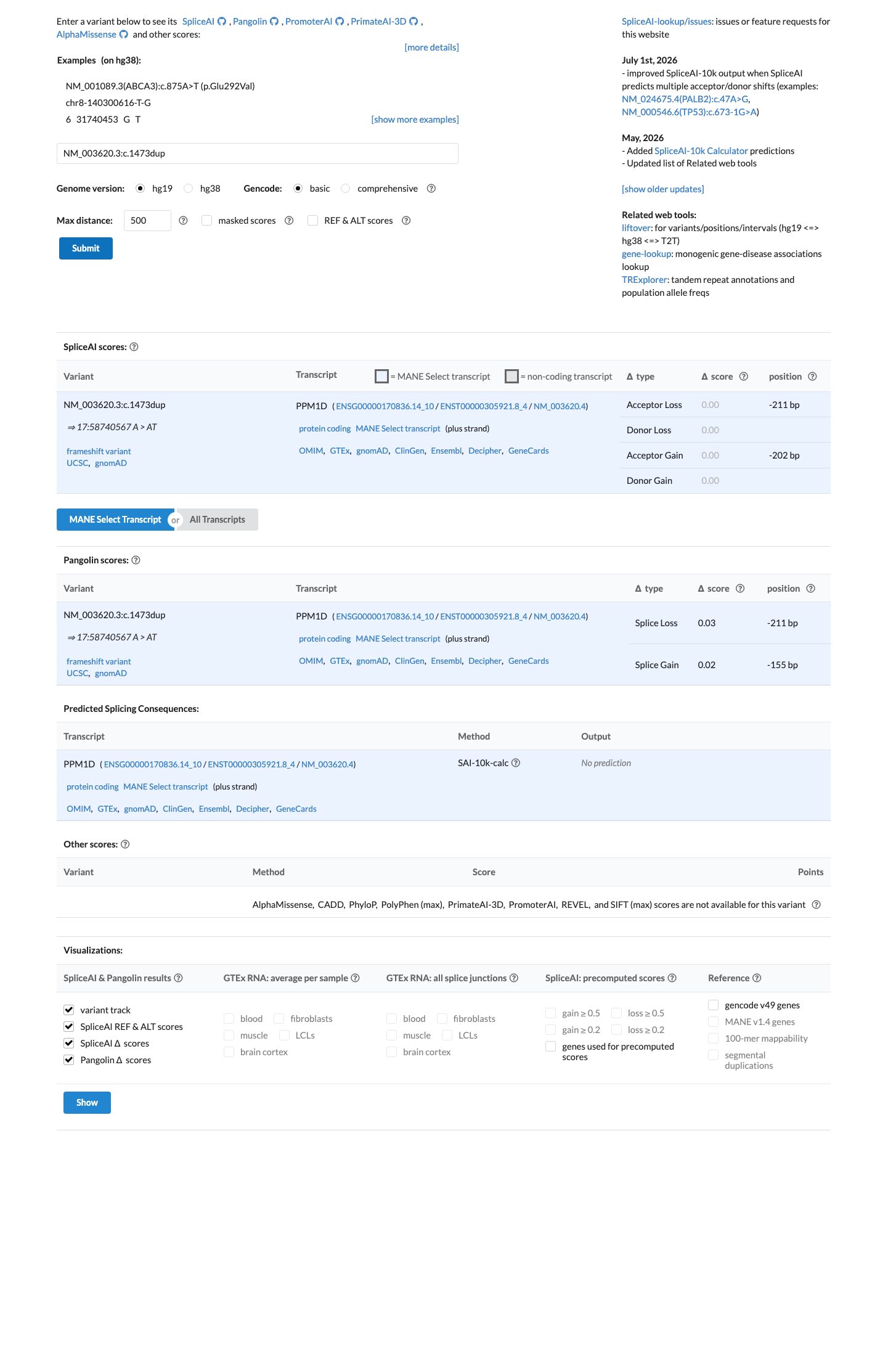
SpliceAI predicts no significant splice impact (max delta score = 0.00).
PP4
No specific phenotype or clinical data for the proband carrying NM_003620.3:c.1473dupT was available for review.
PP5
NM_003620.3:c.1473dupT is absent from ClinVar; no reputable source has classified this variant as pathogenic.
Benign
BA1
Variant is absent from gnomAD (0/1,614,190 alleles).
BS1
Variant is absent from gnomAD (0/1,614,190 alleles).
BS3
No benign functional studies for NM_003620.3:c.1473dupT were identified.
BP3
Not an in-frame deletion/insertion in a repetitive region without known function.
BP4
SpliceAI max delta score = 0.00, indicating no predicted splice impact.
BP7
Not a synonymous variant.
N/A · 12
PS1 · PM3 · PM4 · PM5 · PM6 · PP2 · BS2 · BS4 · BP1 · BP2 · BP5 · BP6
Research & evidence
Population frequency · supports pathogenic
gnomAD v4.1

gnomAD v2.1
v4.1
This variant is present in gnomAD v4.1 (AF= 0; MAF= 0.00000%, 0/1614190 alleles, homozygotes = 0) and has highest observed frequency in the African/African American population (AF= 0; MAF= 0.00000%, 0/75058 alleles, homozygotes = 0).
v2.1
Absent from gnomAD v2.1.
🇨🇦 CA
Absent from gnomAD-Canada v1.0.
Allele frequency by ancestry
three datasets · side by side
gnomAD v4.1
Absent
· 0 / 1,614,190
0 hom
0 hom
Not observed in any ancestry group.
+ 10 not observed (Remaining individuals, Admixed American, European (Finnish), Amish, East Asian, Middle Eastern, South Asian, Ashkenazi Jewish, African/African American, European (non-Finnish))
gnomAD v2.1
Absent
· 0 / ?
0 hom
0 hom
Not observed in any ancestry group.
gnomAD Canada 🇨🇦
Absent
· 0 / ?
0 hom
0 hom
Not observed in any ancestry group.

In silico
SpliceAI predicts no significant splice impact for this variant (max delta score = 0.00).
Functional
Likely Oncogenic
OncoKB identified variant-specific curated literature and context relevant to functional review; biological-effect context: Likely Gain-of-function; curated oncogenicity label: Likely Oncogenic.

COSMIC

Cancer hotspots
Somatic evidence
Not in COSMIC / hotspots
COSMIC
This variant does not lie in a statistically significant hotspot. This variant has not previously been reported in somatic cancers (COSMIC).
Hotspots
This variant does not lie in a statistically significant hotspot.
Literature · how each cited paper was used
3papers cited
Each card is an audit: what was searched, what was found, whether it names the variant, which criteria it fed, and why. 2 further PMIDs triaged but not cited — see Sources & References.
Exome sequencing identifies somatic gain-of-function PPM1D mutations in brainstem gliomas.
Searched
c.1473dupN492*Asn492TerN492Ter1473dupT
Found
Identifies somatic truncating PPM1D mutations in exon 6 in 37.5% of brainstem gliomas harboring H3F3A K27M mutations. Functional characterization shows these truncating mutations enhance PPM1D-mediated suppression of Chk2 phosphorylation, demonstrating gain-of-function. The specific variant p.Asn492Ter was not individually identified or studied.
Variant
◇ Residue / gene-level — variant not named
Applied to
→PM1 supports · met
→PS3 supports · met
Why
Variant not individually identified but paper provides independent functional confirmation of gain-of-function mechanism for exon 6 truncating PPM1D mutations; referenced in PS3 and PM1 assessments.
PPM1D mutations were truncating alterations in exon 6 that enhanced the ability for PPM1D to suppress the activation of DNA damage response checkpoint protein Chk2.
Location Introductory Paragraph; Results (Fig. 1) · Context Exome sequencing of brainstem and thalamic gliomas; in vitro functional assays of PPM1D truncating mutations on Chk2 phosphorylation · full text
Truncating mutations of PPM1D are found in blood DNA samples of lung cancer patients.
Searched
c.1473dupN492*Asn492TerN492Ter1473dupT
Found
Describes truncating PPM1D mutations (nonsense and frameshift) in exon 6 found in blood DNA of lung cancer patients. Reports these mutations as gain-of-function with retained phosphatase activity, and contextualizes them as mosaic rather than true germline. The specific variant p.Asn492Ter was not identified or studied.
Variant
◇ Residue / gene-level — variant not named
Applied to
→PM1 supports · met
→PS3 supports · met
Why
Variant not identified in this paper. Provides independent confirmation of gain-of-function mechanism for exon 6 truncating PPM1D mutations; referenced in PS3 and PM1 assessments.
These mutants code for gain-of-function PPM1D with retained phosphatase activity.
Location Introduction/Background section · Context Sequencing of exon 6 in blood DNA from lung cancer patients; functional characterization of truncating mutations · full text
PPM1D-truncating mutations confer resistance to chemotherapy and sensitivity to PPM1D inhibition in hematopoietic cells.
Searched
c.1473dupN492*Asn492TerN492Ter1473dupT
Found
Demonstrates that truncating PPM1D mutations in exon 6 confer chemotherapy resistance and selective expansion of hematopoietic cells via a gain-of-function mechanism (loss of C-terminal degradation domain, hyperstable protein, enhanced phosphatase activity). A CRISPR-Cas9 tiling screen of 265 gRNAs identified amino acids 400-585 as the critical region where truncating mutations produce the chemoresistance phenotype. N492 falls within this systematically characterized range. The specific variant p.Asn492Ter was not individually tested.
Variant
◇ Residue / gene-level — variant not named
Applied to
→PM1 supports · met
→PS3 supports · met
Why
The variant falls within the systematically characterized range (aa 400-585) shown to produce gain-of-function chemoresistance. This is the primary functional evidence supporting PS3 at strong level and PM1 at moderate level.
After treating the transduced cells for 24 days with cytarabine, we observed a selective outgrowth of cells carrying gRNAs targeting amino acids 400 – 585.
Location Results: 'In vitro chemotherapy treatment selects for the same PPM1D mutations identified in patient samples'; Fig. 2A; Discussion · Context CRISPR-Cas9 tiling screen in Molm13 leukemia cells; competition assays; proteasome degradation reporter; phosphoproteomic mass spectrometry; in vivo mouse transplantation · full text
Sources & reference links
Triaged references · 2 PMIDs not cited in assessment