NM_000157.4:c.1226A>G (p.Asn409Ser; N370S) in GBA1 is a well-established pathogenic missense variant causing Gaucher disease type 1.1 Multiple independent functional studies demonstrate consistently reduced glucocerebrosidase enzymatic activity for the N370S variant, satisfying PS3 at strong strength.2 This variant is classified as Pathogenic in ClinVar by 45 clinical laboratories and is the most common Gaucher disease-associated mutation worldwide, satisfying PS4 at strong strength.3 The N370 residue lies at the interface of the catalytic TIM barrel domain (domain III) and the immunoglobulin-like domain (domain II) of glucocerebrosidase, a critical functional region; disruption by N370S satisfies PM1 at moderate strength.4 The REVEL in silico score of 0.673 supports a deleterious effect (PP3, supporting). The variant is associated with the highly specific phenotype of Gaucher disease type 1 (PP4, supporting).5 The overall gnomAD allele frequency of 0.223% exceeds the PM2 threshold; PM2 is not met. The frequency is below both the BA1 (>1%) and BS1 (>0.3%) benign thresholds.6 Applying the ACMG/AMP 2015 combination rules: PS3 (strong) + PS4 (strong) + PM1 (moderate) + PP3 (supporting) + PP4 (supporting) meets the threshold for Pathogenic classification.7
Final classification
Pathogenic
PS3PS4PM1PP3PP4
GBA1
c.1226A>G
p.Asn409Ser
This variant
NM_000157.4:c.1226A>G (p.Asn409Ser; N370S) in GBA1 is a well-established pathogenic missense variant causing Gaucher disease type 1.
ClinGen Parkinson's Disease Expert Panel Specifications to the ACMG/AMP Variant Interpretation Guidelines for GBA1 Version 1.0.0 v1.0.0 lacked a usable explicit final combination framework, so generic ACMG/AMP 2015 final-combination rules were applied as fallback; applied criteria: PS3 strong, PS4 strong, PM1 moderate, PP3 supporting, PP4 supporting; combination = 2 strong + 1 moderate + 2 supporting, which maps to Pathogenic.
Classification rationale
PS3PS4PM1PP3PP4
Pathogenic
GBA1 c.1226A>G
PS3 + PS4 + PM1 + PP3 + PP4
→
Pathogenic
5
revelclinvar ↗
7
generic_acmg_combination_rules
LYFE Sciences is an AI system, and it can make mistakes. Criteria
may be applied incorrectly, sources may be misread, and a confident-looking
classification can still be wrong. Double-check every criterion and
its underlying evidence before relying on any call.
Gene diagram
· NM_000157.4 · variants mapped to exon structure
GBA1
NM_000157.4
Fetching transcript structure from UCSC…
Applied criteria · 5 applied · 13 assessed
MetEvidence satisfies this criterion.
Not metEvaluated against available evidence; threshold not reached.
Not assessedApplies in principle, but no evidence was found to evaluate it.
N/ADoesn't apply to this variant type.
Applied · 5
Strength
Supporting
Moderate
Strong
Very strong
PS3
strong
Pathogenic
The N370S (p.Asn409Ser) variant has been directly tested in multiple independent functional studies demonstrating consistently reduced glucocerebrosidase enzymatic activity. Alfonso et al. (PMID:14757438) showed 32.1% residual activity in COS cells. Montfort et al. (PMID:15146461) showed 7.5% residual activity (11.6% CRIM-corrected) in Sf9 cells. Liou et al. (PMID:16293621) systematically characterized N370S with 12-15% CRIM SA and demonstrated defects in phospholipid activation. Offman et al. (PMID:20980259) used molecular dynamics to demonstrate the structural basis for reduced N370S catalytic activity. Two or more independent publications with variant-specific functional data qualify PS3 at strong strength.
PMID:14757438: N370S expressed in COS-7 cells32.1% residual GCase activity versus wild-type.PMID:15146461: N370S expressed in Sf9 cells via baculovirus
PS4
strong
Pathogenic
This variant has been reported in ClinVar as Pathogenic by 45 clinical laboratories and as Likely pathogenic by 4 clinical laboratories. It is the single most common Gaucher disease-associated variant worldwide, with extensive clinical observation in affected individuals. The variant is exclusively associated with type 1 (non-neuronopathic) Gaucher disease. A large international multicenter study (PMID:19846850) confirmed significant enrichment in Parkinson disease patients (OR 3.96, 95% CI 2.6-6.02).
ClinVar Variation ID 4290: Pathogenic45 clinical laboratoriesLikely pathogenic
PM1
moderate
Pathogenic
The N370 (p.Asn409) residue is located at the interface of domains II and III of glucocerebrosidase (the TIM barrel domain), a well-characterized critical functional region. Functional studies demonstrate that N370S disrupts saposin C interaction and anionic phospholipid-mediated enzyme activation (PMID:15146461, PMID:16293621, PMID:20980259). The variant lies within a critical functional domain of the enzyme.
N370 is located at the interface of the TIM barrel catalytic domain (domain III) and the immunoglobulin-like domain (domain II).PMID:16293621: N370S shows deficits in saposin C enhancement of kcat and altered phospholipid activation.PMID:20980259: N370S alters active site hydrogen bonding network
PP3
supporting
Pathogenic
REVEL score of 0.673 (>0.5 threshold) supports a deleterious effect. BayesDel score of 0.0416 is low but does not independently contradict. SpliceAI max delta = 0.00 indicates no predicted splicing impact. A single in silico predictor (REVEL) supports pathogenicity at the supporting level.
REVEL: 0.673 (>0.5supports deleterious).BayesDel: 0.0416 (low
PP4
supporting
Pathogenic
Gaucher disease is a highly specific clinical phenotype. The N370S variant is the most common cause of type 1 Gaucher disease and is exclusively associated with the non-neuronopathic form. The phenotype is well-characterized and highly specific for GBA1 deficiency.
N370S is exclusively associated with type 1 (non-neuronopathic) Gaucher disease.The variant is neuroprotective: presence of one N370S allele prevents neuronopathic disease.
Assessed · not applied
· 9 not met · 4 not assessed
Pathogenic
PS2
No de novo data were reviewed for this case; GBA1-associated Gaucher disease is autosomal recessive, and PS2 (de novo) is rarely applicable.
PM2
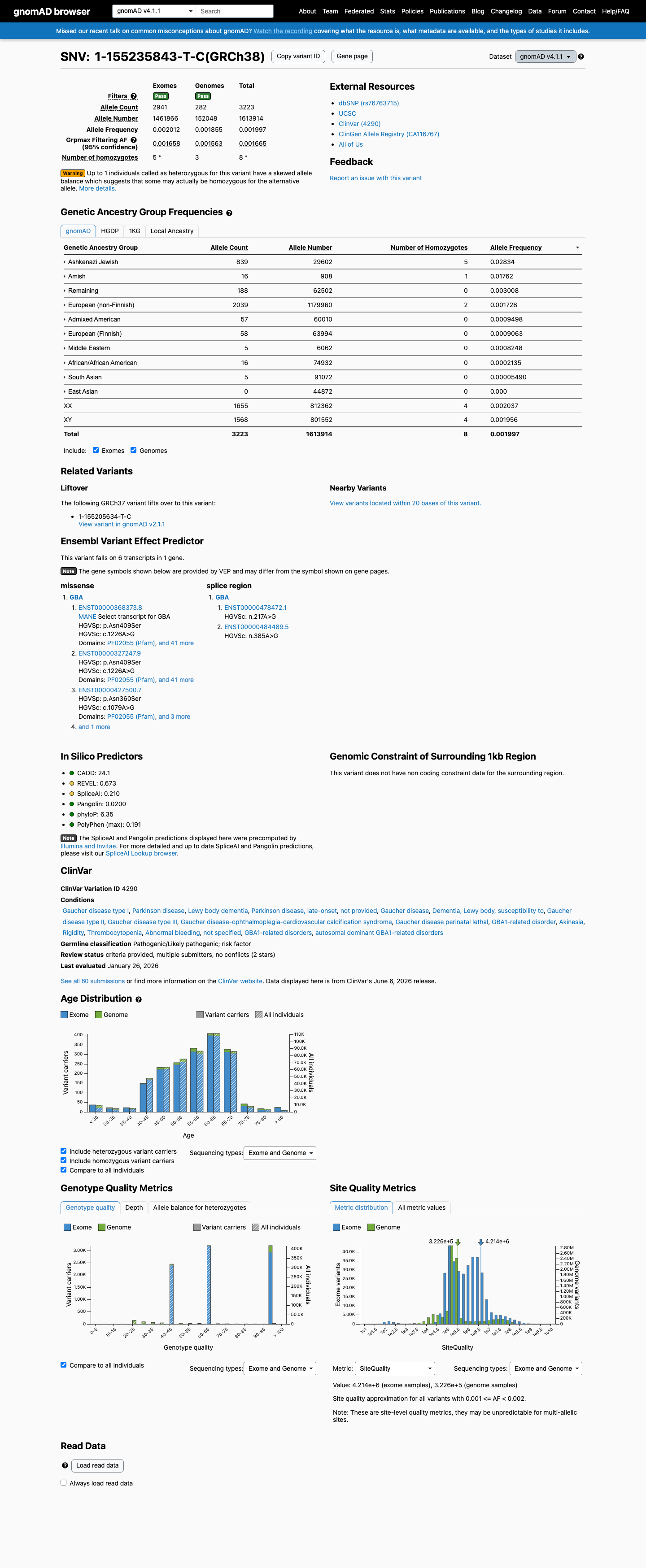
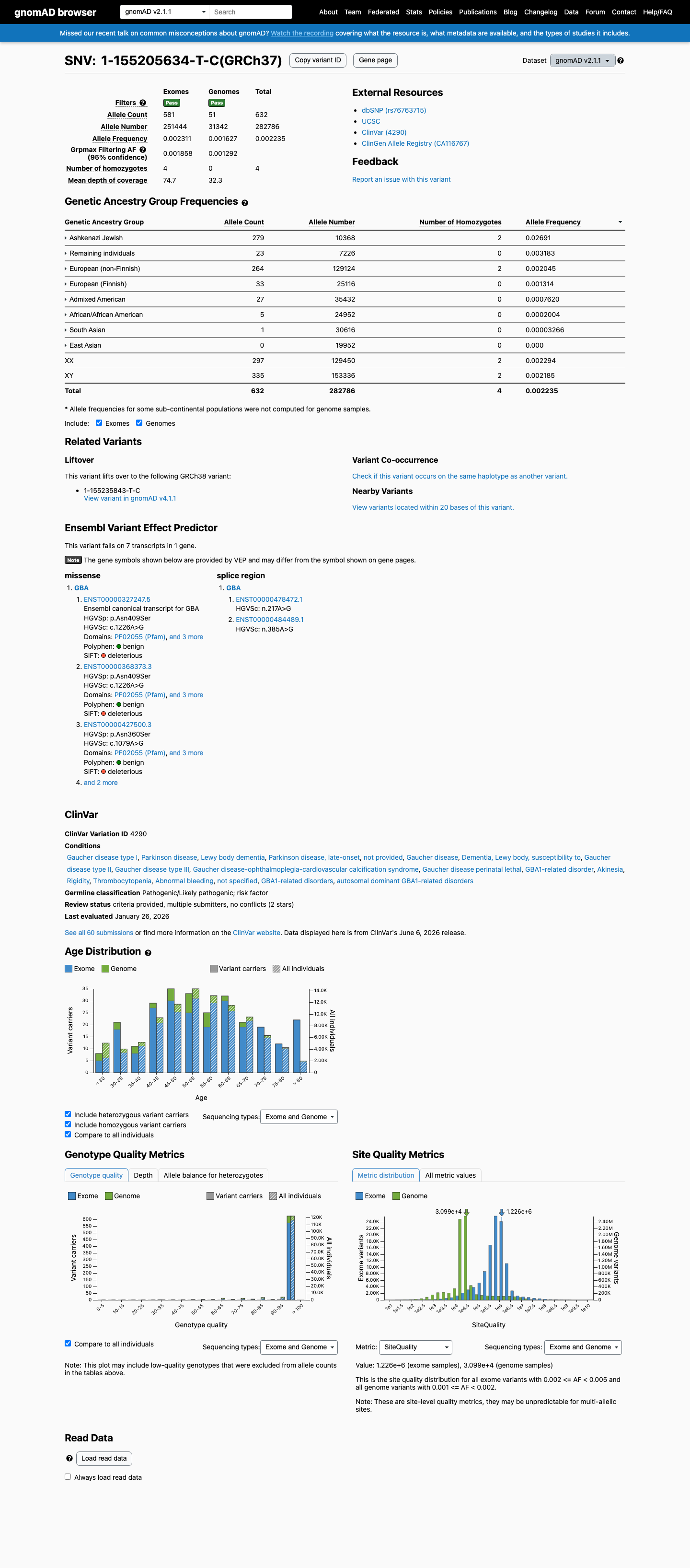
The variant is present in gnomAD v2.1 at an overall allele frequency of 0.223% (632/282,786 alleles) and in gnomAD v4.1 at 0.200% (3223/1,613,914 alleles).
PM5
No confirmed same-residue comparator variants (classic PM5 semantics) were identified.
PP1
No co-segregation data were reviewed in the case materials.
PP2
GBA1 has a well-established spectrum of pathogenic missense variants, but it also harbors known benign or low-penetrance missense variants (e.g., E326K, T369M).
Benign
BA1
Overall gnomAD v2.1 allele frequency of 0.223% is below the BA1 threshold of >1%.
BS1
Overall gnomAD v2.1 allele frequency of 0.223% is below the BS1 threshold of >0.3%.
BS2
While homozygous individuals are observed in gnomAD (4 in v2.1, 8 in v4.1), Gaucher disease type 1 is an adult-onset, often mild disorder compatible with survival into population databases.
BS3
All functional studies demonstrate reduced glucocerebrosidase enzymatic activity for N370S.
BS4
No segregation data were reviewed in the case materials.
BP1
GBA1 has many well-established pathogenic missense variants (including N370S itself, L444P, D409H, and others).
BP4
REVEL score of 0.673 (>0.5) supports a deleterious effect.
BP7
NM_000157.4:c.1226A>G is a missense variant (p.Asn409Ser), not a synonymous or intronic variant.
N/A · 10
PVS1 · PS1 · PM3 · PM4 · PM6 · PP5 · BP2 · BP3 · BP5 · BP6
Research & evidence
Population frequency · supports pathogenic
gnomAD v4.1
gnomAD v2.1
v4.1
This variant is present in gnomAD v4.1 (AF= 0.00199701; MAF= 0.19970%, 3223/1613914 alleles, homozygotes = 8) and has highest observed frequency in the Ashkenazi Jewish population (AF= 0.0283427; MAF= 2.83427%, 839/29602 alleles, homozygotes = 5); grpmax FAF= 0.00166478.
v2.1
This variant is present in gnomAD v2.1 (AF= 0.00223491; MAF= 0.22349%, 632/282786 alleles, homozygotes = 4) and has highest observed frequency in the Ashkenazi Jewish population (AF= 0.0269097; MAF= 2.69097%, 279/10368 alleles, homozygotes = 2); grpmax FAF= 0.00185794.
🇨🇦 CA
This variant is present in gnomAD-Canada v1.0 (AF= 0.0028773072747014113, 53/18420 alleles, homozygotes = 0).
Allele frequency by ancestry
three datasets · side by side
gnomAD v4.1
0.2%
· 3223 / 1,613,914
8 hom · FAF 0.17%
8 hom · FAF 0.17%
Ashkenazi Jewish 839 / 29,602 |
2.8% 5 hom |
Amish 16 / 908 |
1.8% 1 hom |
Remaining individuals 188 / 62,502 |
0.3% |
European (non-Finnish) 2039 / 1,179,960 |
0.17% 2 hom |
Admixed American 57 / 60,010 |
0.095% |
European (Finnish) 58 / 63,994 |
0.091% |
Middle Eastern 5 / 6,062 |
0.082% |
African/African American 16 / 74,932 |
0.021% |
South Asian 5 / 91,072 |
0.0055% |
+ 1 not observed (East Asian)
gnomAD v2.1
0.22%
· 632 / 282,786
4 hom · FAF 0.19%
4 hom · FAF 0.19%
Ashkenazi Jewish 279 / 10,368 |
2.7% 2 hom |
Remaining individuals 23 / 7,226 |
0.32% |
European (non-Finnish) 264 / 129,124 |
0.2% 2 hom |
European (Finnish) 33 / 25,116 |
0.13% |
Admixed American 27 / 35,432 |
0.076% |
African/African American 5 / 24,952 |
0.02% |
South Asian 1 / 30,616 |
0.0033% |
+ 1 not observed (East Asian)
gnomAD Canada 🇨🇦
0.29%
· 53 / 18,420
0 hom · FAF 0.11%
0 hom · FAF 0.11%
Ashkenazi Jewish 29 / 832 |
3.5% |
Remaining individuals 4 / 1,138 |
0.35% |
European (non-Finnish) 19 / 11,740 |
0.16% |
Latino/Admixed American 1 / 838 |
0.12% |
+ 5 not observed (African/African American, East Asian, European (Finnish), Middle Eastern, South Asian)

ClinVar
This variant has been reported in ClinVar as Pathogenic (45 clinical laboratories) and as Likely pathogenic (4 clinical laboratories) and as risk factor (1 clinical laboratory). (ClinVarID = 4290)

In silico
SpliceAI predicts no significant splice impact for this variant (max delta score = 0.00). REVEL score = 0.673. BayesDel score = 0.0416346.
Functional
No data
No calibrated functional assay or RNA evidence was identified for this variant.

COSMIC

Cancer hotspots
Somatic evidence
Not in COSMIC / hotspots
COSMIC
This variant does not lie in a statistically significant hotspot. This variant has not previously been reported in somatic cancers (COSMIC).
Hotspots
This variant does not lie in a statistically significant hotspot.
Literature · how each cited paper was used
7papers cited
Each card is an audit: what was searched, what was found, whether it names the variant, which criteria it fed, and why. 2 further PMIDs triaged but not cited — see Sources & references.
Non-pseudogene-derived complex acid beta-glucosidase mutations causing mild type 1 and severe type 2 gaucher disease.
Searched
N370Sc.1226A>GAsn370Ser1226
Found
Describes N370S as the most common Gaucher disease mutation, with heteroallelism or homoallelism for N370S found in approximately 50% of Ashkenazi Jewish patients with type 1 disease. Reports that the N370S allele encodes a protein with significant CRIM SA and is neuroprotective, precluding neurologic manifestations. Expresses and characterizes N370S alongside other mutants in the baculovirus system, confirming N370S has ~20-24% of normal CRIM SA.
Variant
✓ Names this variant — characterised directly
Applied to
→PS3
met
→PM1
met
→PP4
met
Why
Variant-specific functional data and clinical characterization confirmed; referenced in PS3, PM1, and PP4 assessments.
the presence of one N370S allele, which encodes a protein with significant CRIM SA, is neuroprotective, precluding the development of neurologic manifestations and resulting in the type 1 phenotype
Location Introduction, Results, Table 3, Discussion · Context Baculovirus expression in Sf9 cells; CRIM SA quantified from immunoblots · full text
Expression and functional characterization of mutated glucocerebrosidase alleles causing Gaucher disease in Spanish patients.
Searched
c.1226A>GN370S1226N370
Found
Expressed c.1226A>G (N370S) in COS-7 cells along with six novel GBA mutations. N370S showed 32.1% residual glucocerebrosidase activity using the synthetic 4MU-Glu substrate, used as a 'mild' mutation reference. Confirmed N370S is exclusively associated with type 1 Gaucher disease.
Variant
✓ Names this variant — characterised directly
Applied to
→PS3
met
→PP4
met
Why
Variant-specific functional data confirmed; N370S residual activity of 32.1% supports PS3 (strong).
the N370S mutation has been associated exclusively with type 1 GD
Location Abstract, Introduction, Results (Fig. 1), Discussion · Context Transient transfection in COS-7 cells; activity measured with 4-methylumbelliferyl-beta-D-glucopyranoside (4MU-Glu) · full text
Functional analysis of 13 GBA mutant alleles identified in Gaucher disease patients: Pathogenic changes and "modifier" polymorphisms.
Searched
c.1226A>GN370S1226N370
Found
Expressed c.1226A>G (N370S) in Sf9 cells using baculovirus expression alongside 12 other GBA mutant alleles. N370S showed 7.5% residual glucocerebrosidase activity (11.6% after CRIM correction), consistent with previously reported in vitro results for this mild mutation. The N370S enzyme showed reduced CRIM amounts on immunoblot. Comparative analysis across multiple expression systems is provided in Table 4.
Variant
✓ Names this variant — characterised directly
Applied to
→PS3
met
→PM1
met
→PP4
met
Why
Variant-specific functional data confirmed; 7.5% residual activity (11.6% CRIM-corrected) supports PS3 (strong).
One surprising but repetitive result is that mutation c.1226A4G (p.N370S), always associated with a mild phenotype, shows low levels of activity when expressed in vitro
Location Abstract, Results (Fig. 2, Table 3, Table 4), Discussion · Context Baculovirus expression in Sf9 insect cells; activity measured with 4MU-Glu; CRIM correction via Western blot with polyclonal antibody · full text
Analyses of variant acid beta-glucosidases: effects of Gaucher disease mutations.
Searched
N370S1226N370
Found
Systematically characterized 52 GCase single amino acid substitutions including N370S expressed in Sf21 cells via baculovirus. N370S showed CRIM SA of 12-15% of wild-type, with a defect in negatively charged phospholipid activation. N370S was classified among variants with moderate CRIM SA (approximately 10%). The N370 residue is at the interface of domains II and III, flanking the active site. Saposin C enhancement of kcat was preserved but phospholipid activation was altered.
Variant
✓ Names this variant — characterised directly
Applied to
→PS3
met
→PM1
met
Why
Variant-specific functional data confirmed in a systematic characterization; supports PS3 (strong) and PM1 (moderate) - N370 position lies at a critical domain interface.
A defect in negatively charged phospholipid activation was present in the majority of variant GCases but was increased in two, N370S and V394L
Location Abstract, Results, Table 1, Discussion, Figs. 1-6 · Context Baculovirus expression in Sf21 cells; purified GCases; 4MUG substrate; phospholipid activation and saposin C enhancement assays; cathepsin D sensitivity assays · full text
Multicenter analysis of glucocerebrosidase mutations in Parkinson's disease.
Searched
N370S1226N370
Found
International multicenter collaborative study screening 5691 Parkinson disease cases and 4898 controls for GBA mutations. N370S was one of two primary mutations screened. Combined OR for N370S across centers was 3.96 (95% CI 2.6-6.02) for Parkinson disease risk. N370S was particularly prevalent among Ashkenazi Jews (OR 5.62, 95% CI 3.04-10.39) and absent among Asians. Fourteen N370S homozygotes were identified among patients (genotype N370S/N370S).
Variant
✓ Names this variant — characterised directly
Applied to
→PS4
met
Why
Large-scale observational data confirm N370S enrichment in Parkinson disease; supports PS4 (strong) for disease association.
Combined ORs for Mantel-Haenszel analyses were homogenous for L444P and N370S... Combined ORs attributable to N370S (OR = 3.96, 95% CI 2.6-6.02)
Location Abstract, Introduction, Results, Figure 1, Supplementary material · Context Multicenter case-control genotyping; various screening methods including full sequencing · full text
Molecular basis of reduced glucosylceramidase activity in the most common Gaucher disease mutant, N370S.
Searched
N370S1226N370
Found
Molecular dynamics simulations of wild-type and N370S glucocerebrosidase at various pH values with and without chaperone (NB-DNJ). N370S is more stable than WT at pH 7.4 but has altered active site hydrogen bonding at pH 4.5, explaining the reduced catalytic activity. NB-DNJ binding stabilizes the N370S-saposin C interaction interface. The structural basis for the shifted pH optimum (5.5-6.4 vs. 4.5 for WT) is demonstrated.
Variant
✓ Names this variant — characterised directly
Applied to
→PS3
met
→PM1
met
Why
Structural mechanism of N370S pathogenicity elucidated; supports PS3 (strong) and PM1 (moderate).
the most dramatic and statistically significant changes between WT and N370S in HBs were observed for the amino acid pairs 312-370, 313-340, 313-342, and 315-366, which are likely to affect the integrity of the active site, causing the reduced catalytic activity of GCase(N370S)-pH 4.5
Location Abstract, Results (RMSF Analysis, Active Site Volume, HB Network), Discussion · Context Molecular dynamics simulations using AMBER10; 25 independent MD runs; active site volume, hydrogen bonding, RMSF, and solvent-accessible surface analyses · full text
Acid β-glucosidase mutants linked to Gaucher disease, Parkinson disease, and Lewy body dementia alter α-synuclein processing.
Searched
N370S1226N370
Found
Investigated the effect of GBA mutants (N370S, L444P, D409H, D409V, E235A, E340A) on alpha-synuclein processing. N370S overexpression in neural MES23.5 and PC12 cells significantly raised human SNCA levels (124% of vector control, p<0.05) without altering GCase activity. This provides a biochemical link between GBA1 mutation carrier status and increased synucleinopathy risk. N370S shows a gain-of-function effect on SNCA accumulation independent of GCase activity loss.
Variant
✓ Names this variant — characterised directly
Applied to
→PS3
met
Why
N370S gain-of-function effect on alpha-synuclein processing confirmed; consistent with pathogenic mechanism in Parkinson disease context.
overexpression of all GBA mutants examined (N370S, L444P, D409H, D409V, E235A, and E340A) significantly raised human SNCA levels to 121 to 248% of vector control (p < 0.029)
Location Abstract, Results, Table · Context Neural MES23.5-SNCA, PC12-SNCA, and HEK293-SNCA cell lines; transient cDNA overexpression; ELISA for SNCA quantification · full text
Sources & reference links
9Sources
Triaged references · 2 PMIDs not cited in assessment
23676350 ↗
Mutations in GBA and risk of Parkinson's disease: a meta-analysis based on 25 case-control studies.
CLINVAR