This frameshift deletion (c.873_876del) in MSH2 exon 5 introduces a premature termination codon at position ~300 (p.Thr292LeufsTer8), well before the VCEP codon 891 threshold, meeting PVS1 at Very Strong strength.1 The variant is absent from all gnomAD population databases (v2.1, v4.1, Canada v1.0), meeting the VCEP PM2_Supporting threshold of <1 in 50,000 alleles.2 One patient with a colorectal tumor demonstrating MSI-H and loss of MSH2 protein expression by IHC (consistent with variant location) has been reported, meeting PP4_Supporting.3 ClinVar reports this variant as Pathogenic by the InSiGHT expert panel and by five clinical laboratories (ClinVar ID: 91236).4 Under the VCEP combining rules (Rule 4): one Very Strong (PVS1) plus two Supporting (PM2_Supporting + PP4_Supporting) criteria yields a final classification of Pathogenic.5
Final classification
Pathogenic
PVS1PM2PP4PP5
MSH2
c.873_876del
p.Thr292LeufsTer8
This variant
This frameshift deletion (c.873_876del) in MSH2 exon 5 introduces a premature termination codon at position ~300 (p.Thr292LeufsTer8), well before the VCEP codon 891 threshold, meeting PVS1 at Very Strong strength.
Richards et.al., 2015 - Combining rules v2.0.0 criteria-combination framework: matched Rule4 (1 Pathogenic.Very Strong + Pathogenic.Supporting >=2) with applied criteria: PVS1 very strong, PM2 supporting, PP4 supporting, PP5 supporting; maps to Pathogenic.
Classification rationale
PVS1PM2PP4PP5
Pathogenic
MSH2 c.873_876del
PVS1 + PM2 + PP4 + PP5
→
Pathogenic
LYFE Sciences is an AI system, and it can make mistakes. Criteria
may be applied incorrectly, sources may be misread, and a confident-looking
classification can still be wrong. Double-check every criterion and
its underlying evidence before relying on any call.
Gene diagram
· NM_000251.2 · variants mapped to exon structure
MSH2
NM_000251.2
Fetching transcript structure from UCSC…
Applied criteria · 4 applied · 12 assessed
MetEvidence satisfies this criterion.
Not metEvaluated against available evidence; threshold not reached.
Not assessedApplies in principle, but no evidence was found to evaluate it.
N/ADoesn't apply to this variant type.
Applied · 4
Strength
Supporting
Moderate
Strong
Very strong
PVS1
very strong
Pathogenic
This frameshift deletion (c.873_876del) in exon 5 of MSH2 introduces a premature termination codon at position ~300 (p.Thr292LeufsTer8), which is ≤ codon 891. Per the InSiGHT VCEP PVS1 rule for MSH2, nonsense/frameshift variants introducing a PTC ≤ codon 891 qualify for PVS1 at Very Strong strength. Loss of function is an established disease mechanism for MSH2 in Lynch syndrome.
Frameshift variant introducing premature termination codon at amino acid position ~300well before the codon 891 threshold specified in the VCEP ruleGermline loss-of-function is established disease mechanism per InSiGHT CSPEC
PM2
supporting
Pathogenic
This variant is absent from gnomAD v2.1 (exomes), gnomAD v4.1 (exomes), and gnomAD-Canada v1.0. Per the VCEP PM2 rule, absence from gnomAD v4 (<1 in 50,000 alleles; AF < 0.00002) qualifies for PM2_Supporting.
Absent from gnomAD v2.1 (0 alleles)Absent from gnomAD v4.1 (0 alleles)Absent from gnomAD-Canada v1.0 (0 alleles)
PP4
supporting
Pathogenic
Kunstmann et al. 2004 (PMID:15217520) reports one patient (0660-6) with a colorectal tumor that was MSI-H, MSH2-negative by IHC (and MSH6-negative, consistent with MSH2 mutation location). This meets the VCEP PP4_Supporting criterion: 1 CRC MSI-H tumor with loss of MMR protein expression consistent with the variant location.
Patient 0660-6 in Kunstmann et al. 2004: CRC with MSI-HMSH2-negative and MSH6-negative IHCconsistent with MSH2 variant location
PP5
supporting
Pathogenic
Expert panel International Society for Gastrointestinal Hereditary Tumours (InSiGHT) classified as Pathogenic.
ClinVar expert panel classification
Assessed · not applied
· 12 not met · 0 not assessed
Pathogenic
PS2
No de novo data are available for this variant.
PS3
The InSiGHT VCEP functional assay documentation applies to missense, splice-site, and synonymous variants, not frameshift deletions.
PP1
No co-segregation data are available for this variant.
PP3
The VCEP PP3 rule applies to missense variants (HCI prior >0.68) or non-canonical splice variants (SpliceAI delta ≥0.2).
Benign
BA1
Variant is absent from gnomAD v4.1.
BS1
Variant is absent from gnomAD v4.1.
BS2
No data on co-occurrence in trans with a known pathogenic MSH2 variant have been reported for this variant.
BS3
The InSiGHT VCEP BS3 rule requires calibrated functional assay data showing proficient function (functional odds for pathogenicity ≤0.05 for Strong, or >0.05 and ≤0.48 for Supporting).
BS4
No co-segregation data are available to evaluate lack of segregation with disease.
BP4
The VCEP BP4 rule applies to missense variants with HCI prior <0.11 or intronic/synonymous variants with SpliceAI delta ≤0.1.
BP5
The available clinical data show the opposite of what BP5 requires.
BP7
The VCEP BP7 rule applies only to synonymous (silent) or intronic variants at or beyond -21/+7 exon boundaries.
N/A · 11
PS1 · PS4 · PM1 · PM4 · PM5 · PM6 · PP2 · BP1 · BP2 · BP3 · BP6
Research & evidence
Population frequency · supports pathogenic
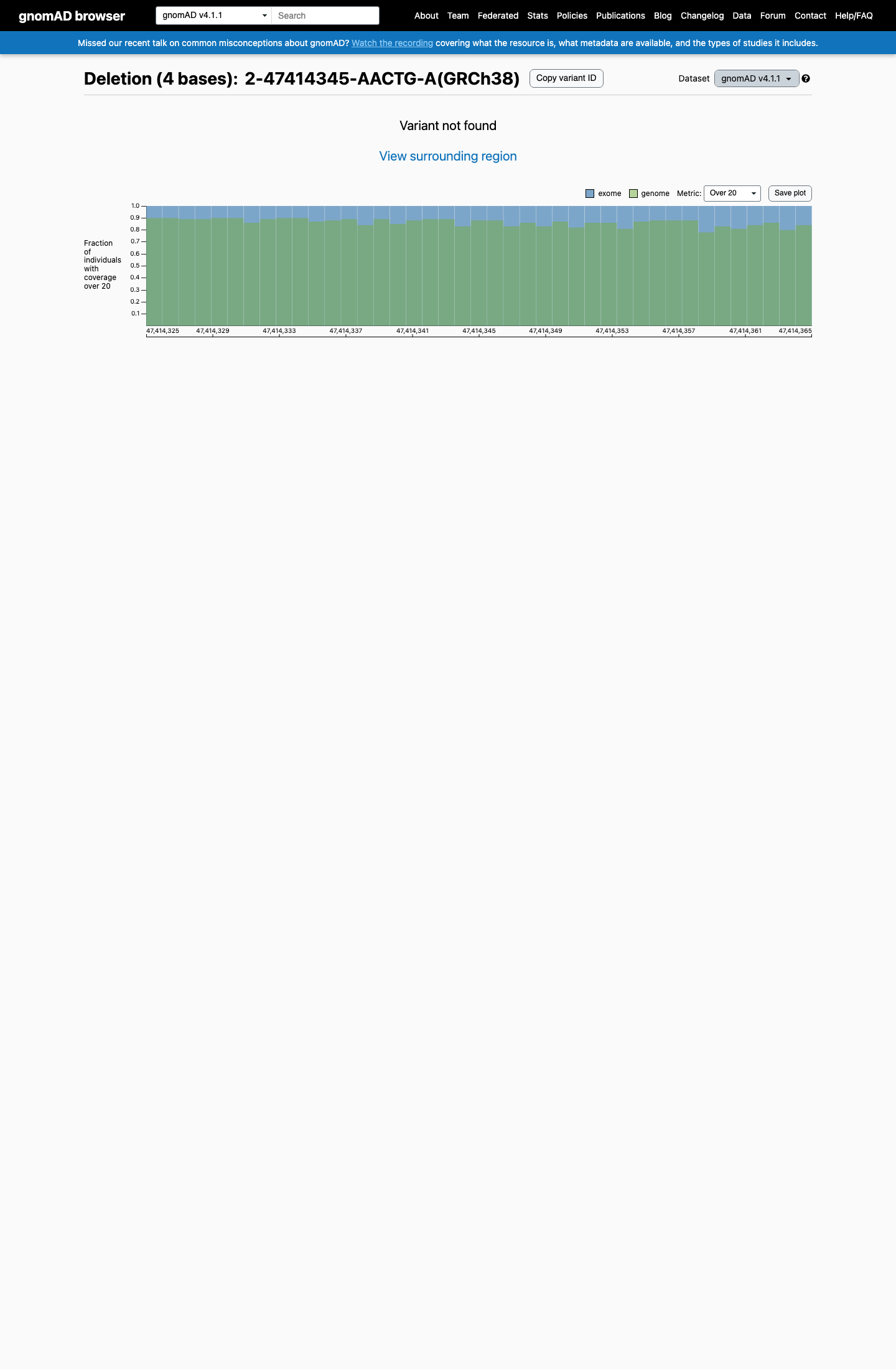
gnomAD v4.1
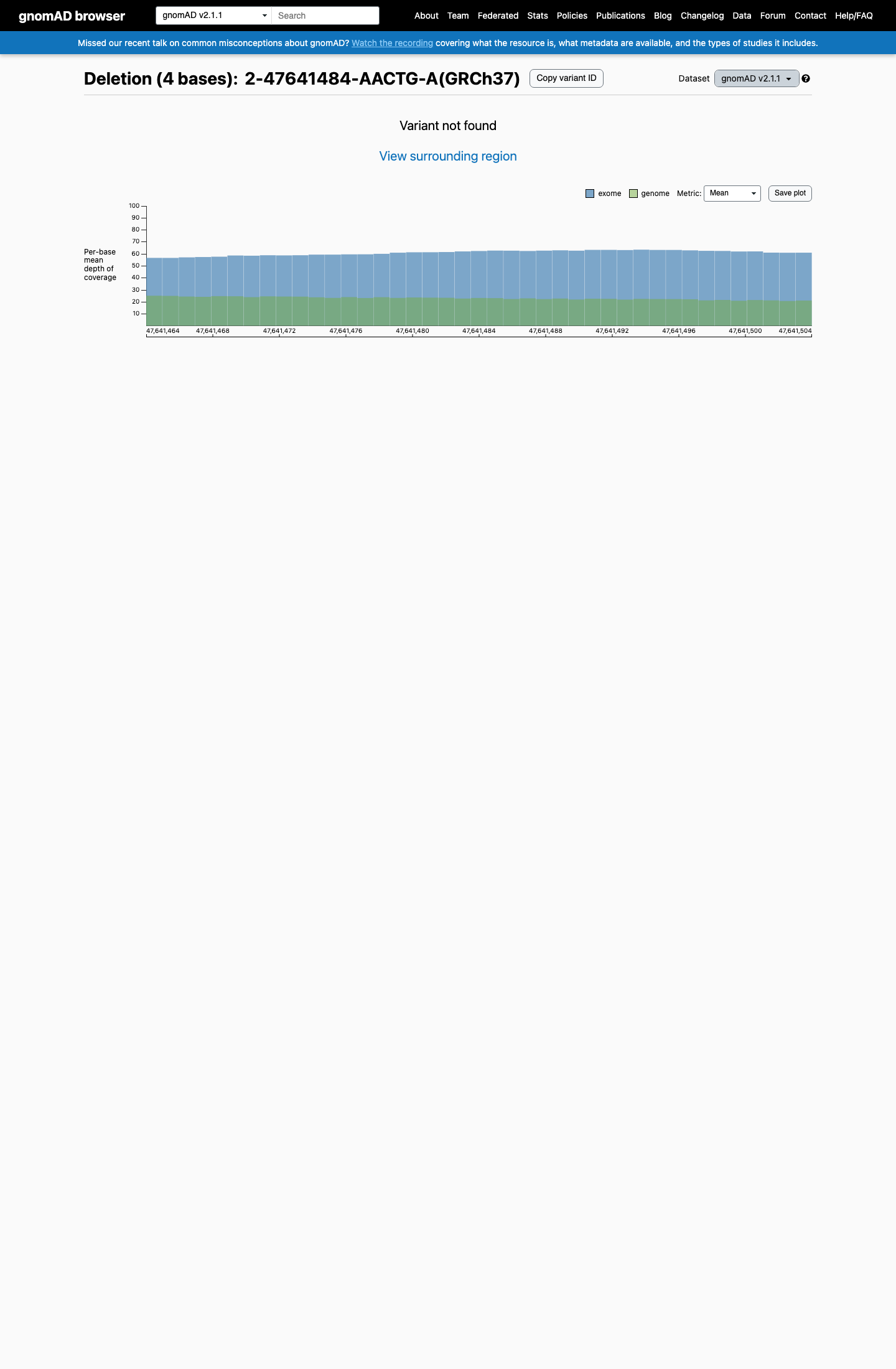
gnomAD v2.1
v4.1
Absent from gnomAD v4.1.
v2.1
Absent from gnomAD v2.1.
🇨🇦 CA
Absent from gnomAD-Canada v1.0.
Allele frequency by ancestry
three datasets · side by side
gnomAD v4.1
Absent
· 0 / ?
0 hom
0 hom
Not observed in any ancestry group.
gnomAD v2.1
Absent
· 0 / ?
0 hom
0 hom
Not observed in any ancestry group.
gnomAD Canada 🇨🇦
Absent
· 0 / ?
0 hom
0 hom
Not observed in any ancestry group.
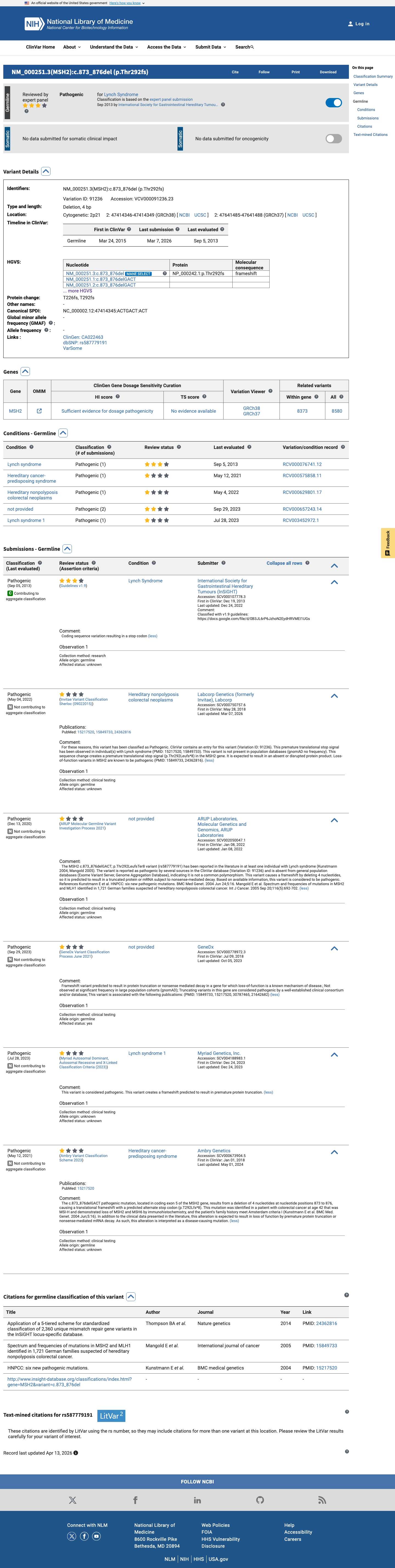
ClinVar
This variant has been reported in ClinVar as Pathogenic (5 clinical laboratories) and as Pathogenic by International Society for Gastrointestinal Hereditary Tumours (InSiGHT) (expert panel). (ClinVarID = 91236)
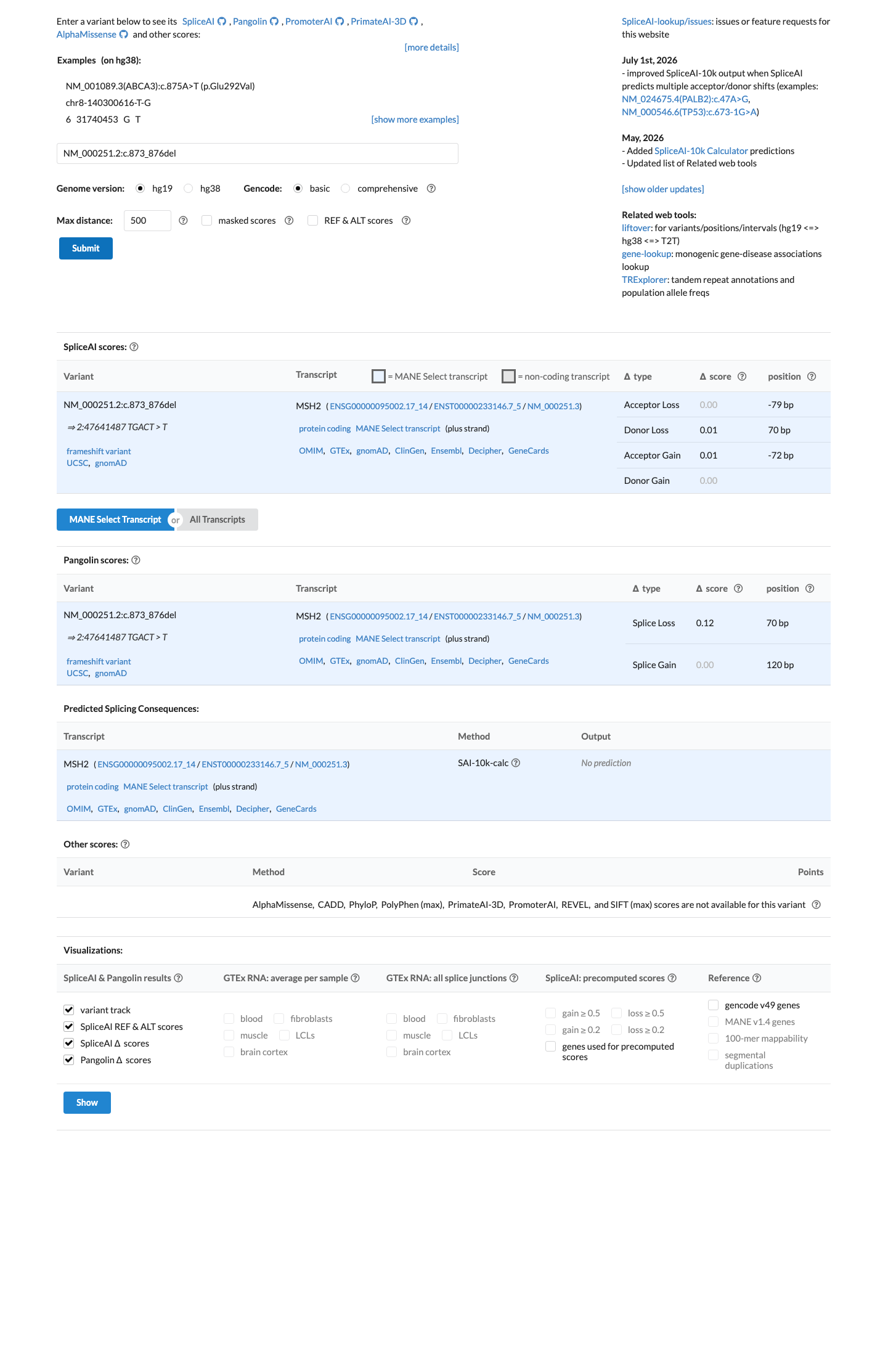
In silico
SpliceAI predicts no significant splice impact for this variant (max delta score = 0.01).
Functional
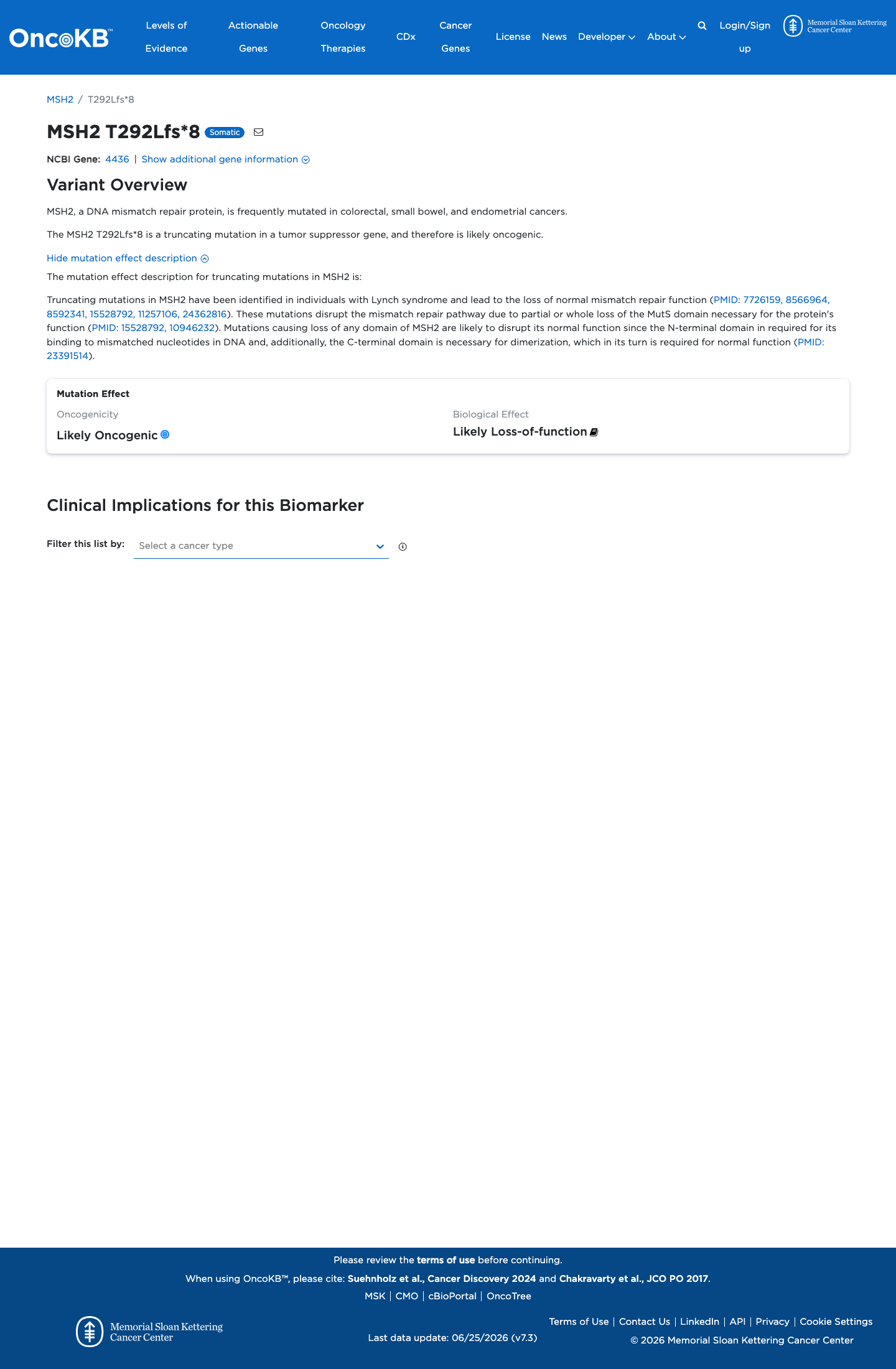
Likely Oncogenic
OncoKB identified variant-specific curated literature and context relevant to functional review; biological-effect context: Likely Loss-of-function; curated oncogenicity label: Likely Oncogenic.

COSMIC

Cancer hotspots
Somatic evidence
Not in COSMIC / hotspots
COSMIC
This variant does not lie in a statistically significant hotspot. This variant has not previously been reported in somatic cancers (COSMIC).
Hotspots
This variant does not lie in a statistically significant hotspot.
Literature · how each cited paper was used
2papers cited
Each card is an audit: what was searched, what was found, whether it names the variant, which criteria it fed, and why. 5 further PMIDs triaged but not cited — see Sources & references.
HNPCC: six new pathogenic mutations.
Searched
c.873_876delc.873_876delGACTp.L292fsL292fsX298
Found
Reported c.873_876delGACT (p.L292fsX298) as a novel pathogenic MSH2 frameshift mutation in a German HNPCC family. Patient 0660-6 had colorectal cancer at age 42, tumor was MSI-H with loss of MSH2 and MSH6 protein expression by IHC. Family fulfilled Amsterdam I criteria.
Variant
✓ Names this variant — characterised directly
Applied to
→PVS1
met
→PP4
met
Why
Variant-specific pathogenic frameshift mutation confirmed; tumor MSI-H/MSH2 IHC loss consistent with Lynch syndrome. Referenced in PVS1 and PP4 assessments.
c.873_876delGACT [p.L292fsX298]
Location Abstract; Results (Table 2, page 3); Results and Discussion paragraphs 5-6 (page 4) · Context Clinical: germline sequencing of MSH2 in patient meeting Amsterdam I criteria. Tumor: MSI testing with BAT-25, BAT-26, D5S346, D17S250, D2S123, BAT-40 panel; IHC for MLH1, MSH2, MSH6 on FFPE tissue. · full text
Spectrum and frequencies of mutations in MSH2 and MLH1 identified in 1,721 German families suspected of hereditary nonpolyposis colorectal cancer.
Searched
c.873_876delc.873_876delGACT873_876
Found
Listed c.873_876delGACT (p.Leu291fs) as a pathogenic MSH2 frameshift mutation identified in the German HNPCC Consortium cohort of 1,721 families. Found in 1 index patient in exon 5.
Variant
✓ Names this variant — characterised directly
Applied to
→PVS1
met
→PP4
met
Why
Variant confirmed as pathogenic MSH2 mutation in independent large German cohort. Referenced in PVS1 and PP4 assessments.
c.873_876delGACT
Location Table IV: Pathogenic MSH2 mutations (exon 5 section, page 15 of PDF) · full text
Sources & reference links
9Sources
Triaged references · 5 PMIDs not cited in assessment
24362816 ↗
Application of a 5-tiered scheme for standardized classification of 2,360 unique mismatch repair gene variants in the InSiGHT locus-specific database.
ONCOKB
15528792 ↗
Mutations associated with HNPCC predisposition -- Update of ICG-HNPCC/INSiGHT mutation database.
ONCOKB
23391514 ↗
Structural, molecular and cellular functions of MSH2 and MSH6 during DNA mismatch repair, damage signaling and other noncanonical activities.
ONCOKB