Analysis in progress
Initialising…
0%
complete
This report is still being assembled — sections appear as each stage finishes. It isn't final yet.
GNAQ
Final classification
Likely Pathogenic
GNAQ c.627A>C · p.Gln209His
GNAQ

The variant is located at codon 209 within the GTPase domain of GNAQ, a well-established functional hotspot (PM1).

Gene
GNAQ
Transcript
NM_002072.5
HGVS · transcript:coding
NM_002072.5:c.627A>C
Consequence
N/A
GRCh38
chr9:77794571 T>G
GRCh37
chr9:80409487 T>G
Basis gene-specific framework lacked a usable explicit final combination framework, so generic ACMG/AMP 2015 final-combination rules were applied as fallback; applied criteria: PM1 moderate, PM2 moderate, PM5 moderate, PP5 supporting; combination = 3 moderate + 1 supporting, which maps to Likely Pathogenic.
gene-specific framework lacked a usable explicit final combination framework, so generic ACMG/AMP 2015 final-combination rules were applied as fallback; applied criteria: PM1 moderate, PM2 moderate, PM5 moderate, PP5 supporting; combination = 3 moderate + 1 supporting, which maps to Likely Pathogenic.
Classification rationale
PM1PM2PM5PP5 Likely Pathogenic
GNAQ c.627A>C

The variant is located at codon 209 within the GTPase domain of GNAQ, a well-established functional hotspot (PM1).1 The variant is absent from gnomAD v2.1, v4.1, and gnomAD-Canada (PM2).2 A different pathogenic missense change at the same codon, p.Gln209Leu, has been established as a gain-of-function activating mutation in functional studies (PM5).3 This variant has been reported as Pathogenic in ClinVar by two clinical laboratories (PP5).4 Three moderate criteria (PM1, PM2, PM5) and one supporting criterion (PP5) are met, reaching the Likely Pathogenic threshold per ACMG/AMP 2015 generic combination rules (3 moderate criteria).5

PM1 + PM2 + PM5 + PP5 Likely Pathogenic
Gene diagram · NM_002072.5 · variants mapped to exon structure
GNAQ NM_002072.5
Fetching transcript structure from UCSC…
Applied criteria · 4 applied · 15 assessed
Applied · 4
Strength Supporting Moderate Strong Very strong
PM1 moderate Pathogenic
The variant is located at codon 209 (p.Gln209His) within the GTPase domain of GNAQ, a well-established functional hotspot. Codon 209 is a statistically significant hotspot at cancerhotspots.org, and substitutions at this residue (p.Gln209Leu, p.Gln209Pro) are known activating mutations that disrupt GTP hydrolysis, leading to constitutive Gαq signaling.
Residue 209 is a statistically significant hotspot at cancerhotspots.orgCodon 209 lies within the GTPase domain critical for G-protein inactivationPMID:23656586 demonstrates p.Gln209Leu strongly activates MAPK and SRE signaling
PM2 moderate Pathogenic
The variant is absent from gnomAD v2.1, v4.1, and gnomAD-Canada v1.0, consistent with a rare pathogenic variant (allele frequency <0.1% threshold for non-VCEP assessment).
Absent from gnomAD v2.1 (exomes)Absent from gnomAD v4.1 (exomes)Absent from gnomAD-Canada v1.0 (genomes)
PM5 moderate Pathogenic
p.Gln209His is a novel missense change at codon 209 where a different missense change, p.Gln209Leu (c.626A>T), has been established as pathogenic. p.Gln209Leu is a well-characterized gain-of-function mutation in uveal melanoma and was experimentally confirmed to activate MAPK signaling in functional studies (PMID:23656586).
p.Gln209Leu (c.626A>T) is an established pathogenic missense at the same codonPMID:23656586 confirms p.Gln209Leu as gain-of-function via ERK activation and luciferase reporter assays in HEK293T cellsOncoKB reports codon 209 variants as oncogenic/gain-of-function
PP5 supporting Pathogenic
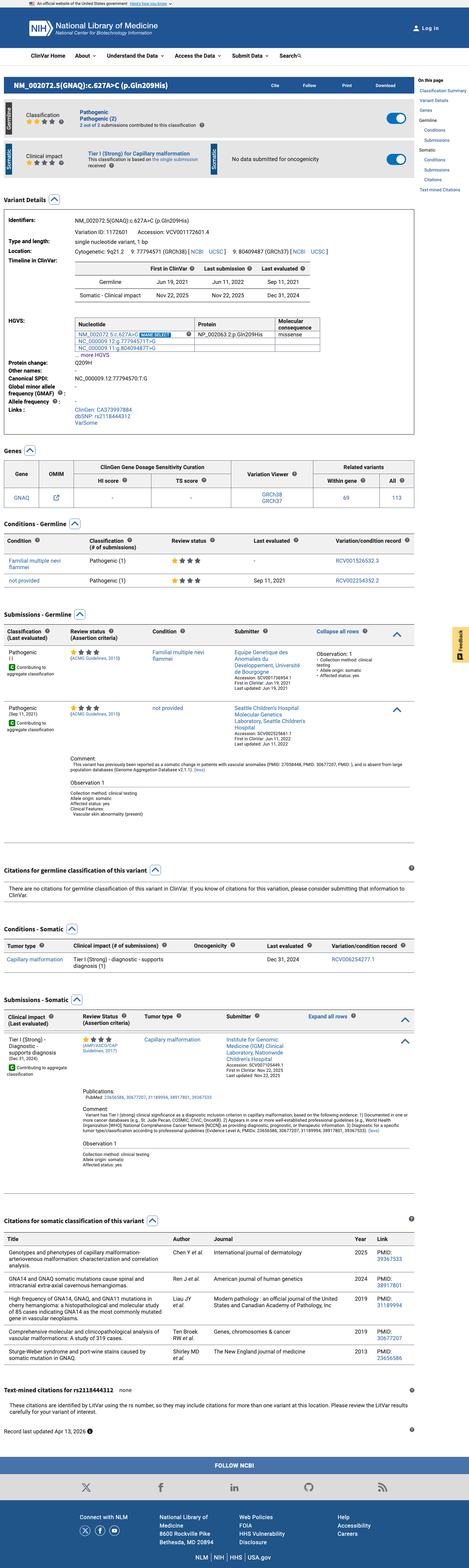
This variant has been reported as Pathogenic in ClinVar (Variation ID 1172601) by two clinical laboratories, though the evidence supporting the classification is not available for independent evaluation.
ClinVar Variation ID 1172601: Pathogenic2 clinical laboratory submissionsReview status: criteria provided
Assessed · not applied
Pathogenic
PS3 No variant-specific functional data for c.627A>C (p.Gln209His) was identified in the literature.
PS4 No case-control or cohort prevalence data are available to establish significantly increased prevalence of this variant in affected individuals compared with controls.
PP1 No co-segregation data are available for this variant.
PP2 HCI prior score is not available for GNAQ, and gene-level missense constraint data are insufficient to determine whether GNAQ has a low rate of benign missense variation.
PP3 Computational evidence is mixed and does not meet the multiple-lines threshold.
PP4 No phenotype or family history data are available for this variant.
Benign
BA1 The variant is absent from gnomAD v2.1, v4.1, and gnomAD-Canada.
BS1 The variant is absent from gnomAD.
BS2 No data are available regarding observation of this variant in healthy adult controls with full penetrance expected.
BS3 No well-established functional studies show a benign effect.
BS4 No segregation data are available to assess lack of co-segregation with disease.
BP2 No data are available regarding observation of this variant in trans with a known pathogenic variant.
BP4 Computational evidence does not support a benign effect.
BP5 No evidence is available that this variant is found in a case with an alternate molecular basis for disease.
BP6 This variant is not reported as benign by any reputable source.
N/A · 6 PVS1 · PS1 · PS2 · PM6 · BP1 · BP7
Research & evidence
Population frequency · supports pathogenic
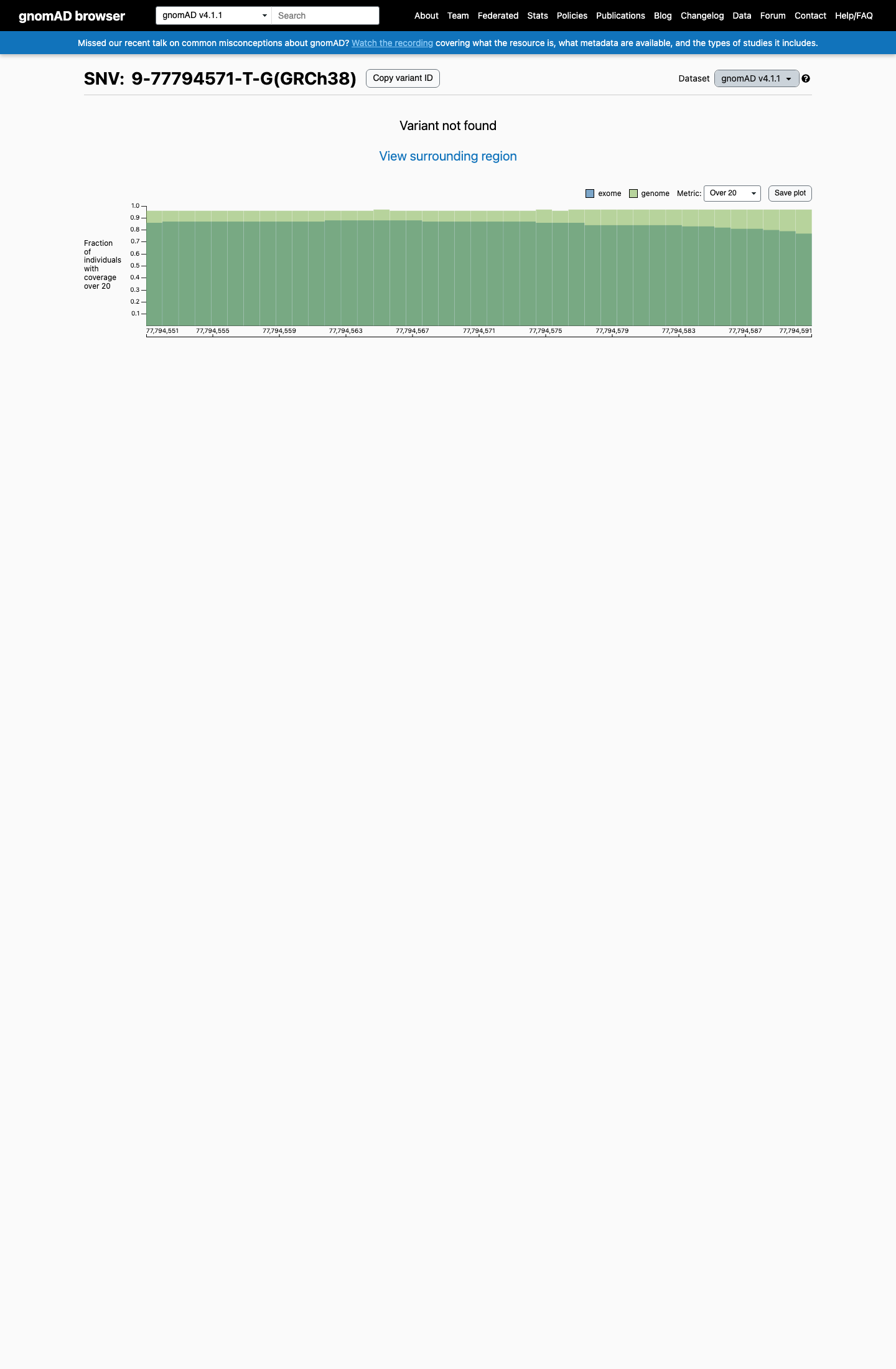
gnomAD v4.1 screenshot
gnomAD v4.1
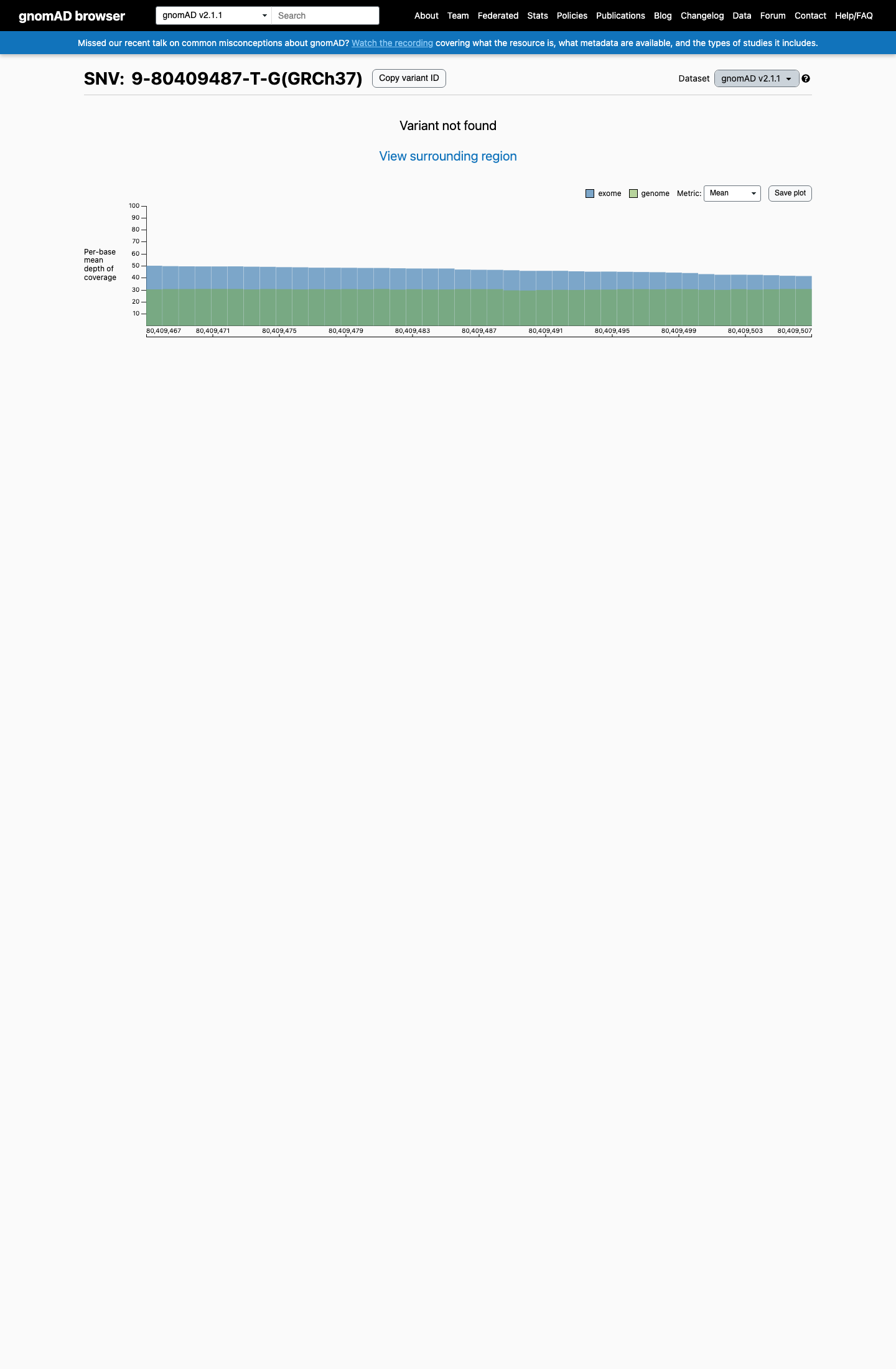
gnomAD v2.1 screenshot
gnomAD v2.1
v4.1
Absent from gnomAD v4.1.
v2.1
Absent from gnomAD v2.1.
🇨🇦 CA
Absent from gnomAD-Canada v1.0.
Allele frequency by ancestry
three datasets · side by side
gnomAD v4.1
Absent · 0 / ?
0 hom
Not observed in any ancestry group.
gnomAD v2.1
Absent · 0 / ?
0 hom
Not observed in any ancestry group.
gnomAD Canada 🇨🇦
Absent · 0 / ?
0 hom
Not observed in any ancestry group.
ClinVar screenshot
ClinVar
This variant has been reported in ClinVar as Pathogenic (2 clinical laboratories). (ClinVarID = 1172601)
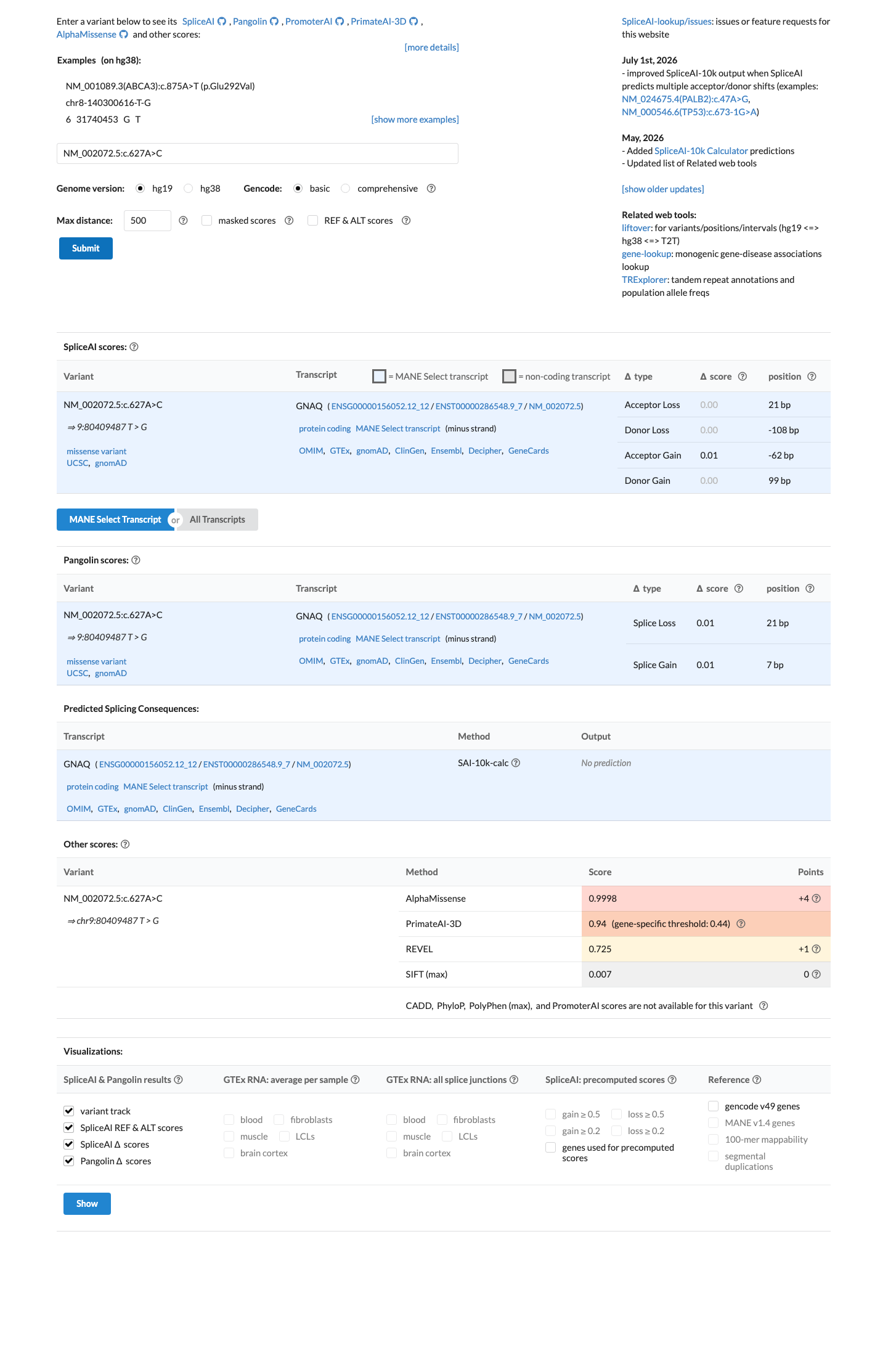
SpliceAI screenshot
In silico
SpliceAI predicts no significant splice impact for this variant (max delta score = 0.01). REVEL score = 0.725. BayesDel score = 0.163625.
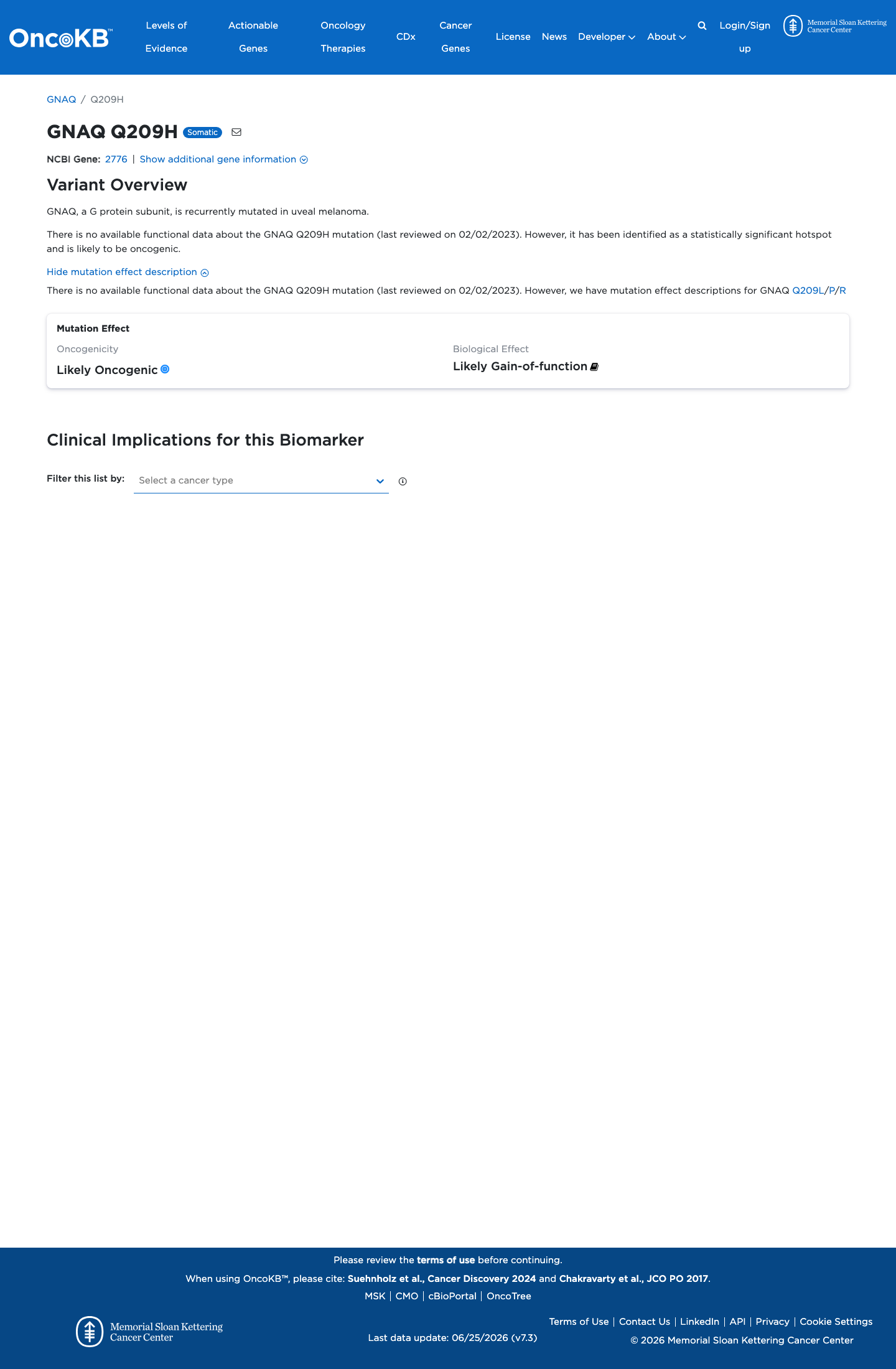
Functional / OncoKB screenshot
Functional Likely Oncogenic
OncoKB identified variant-specific curated literature and context relevant to functional review; biological-effect context: Likely Gain-of-function; curated oncogenicity label: Likely Oncogenic.
OncoKB ↗
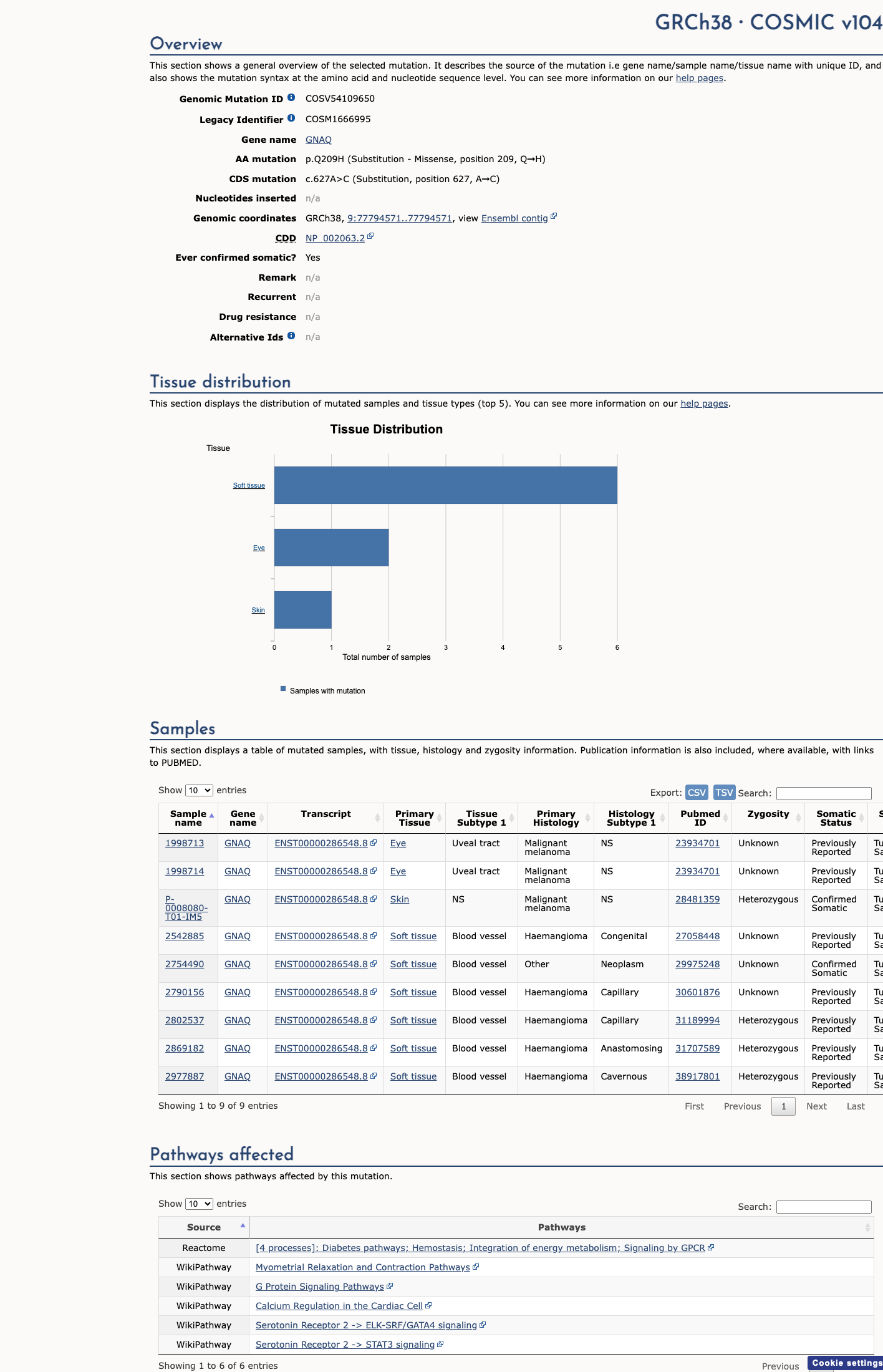
COSMIC screenshot
COSMIC
Cancer hotspots screenshot
Cancer hotspots
Somatic evidence Hotspot
COSMIC
This variant lies in a statistically significant hotspot. This variant has previously been reported in somatic cancers (COSMIC; COSV54109650, n = 9 times).
Hotspots
This variant lies in a statistically significant hotspot.
Literature · how each cited paper was used
1papers cited
Each card is an audit: what was searched, what was found, whether it names the variant, which criteria it fed, and why. 5 further PMIDs triaged but not cited — see Sources & References.
Sturge-Weber syndrome and port-wine stains caused by somatic mutation in GNAQ.
Searched
c.627A>Cp.Gln209HisQ209Hc.627Gln209
Found
Shirley et al. identified somatic mosaic c.548G>A (p.Arg183Gln) in GNAQ as the cause of Sturge-Weber syndrome and nonsyndromic port-wine stains. The study tested p.Gln209Leu (c.626A>T) as a positive control in functional experiments, demonstrating gain-of-function activation of MAPK signaling (ERK, p38, JNK) and SRE promoter activity in HEK293T cells. NM_002072.5:c.627A>C (p.Gln209His) was not studied or mentioned.
Variant
◇ Residue / gene-level — variant not named
Applied to
PM1 supports · met PM5 supports · met
Why
Variant c.627A>C was not identified in this paper. The functional characterization of p.Gln209Leu at the same codon supports PM1 (functional hotspot) and PM5 (different pathogenic missense at same residue).
Two specific mutations, c.548G→A (encoding p.Arg183Gln) and c.626A→T (encoding p.Gln209 Leu), were introduced separately into GNAQ with the use of primers for site-directed mutagenesis.
Location Methods (Plasmids section); Results (Effect of Mutation on MAPK Signaling Pathway, Figure 2); Discussion  ·  Context HEK293T cells; luciferase reporter assay (pSRE-Luc); Western blotting for ERK, p38, JNK activation  ·  full text
Sources & reference links
8Sources
ClinVar
gnomAD v2.1
gnomAD v4.1
gnomAD-Canada
SpliceAI
OncoKB
COSMIC
Cancer hotspots
Triaged references · 5 PMIDs not cited in assessment
25741868 ↗ Standards and guidelines for the interpretation of sequence variants: a joint consensus recommendation of the American College of Medical Genetics and Genomics and the Association for Molecular Pathology. CLINVAR
38917801 ↗ GNA14 and GNAQ somatic mutations cause spinal and intracranial extra-axial cavernous hemangiomas. CLINVAR
31189994 ↗ High frequency of GNA14, GNAQ, and GNA11 mutations in cherry hemangioma: a histopathological and molecular study of 85 cases indicating GNA14 as the most commonly mutated gene in vascular neoplasms. CLINVAR
39367533 ↗ Genotypes and phenotypes of capillary malformation-arteriovenous malformation: characterization and correlation analysis. CLINVAR
27993330 ↗ Standards and Guidelines for the Interpretation and Reporting of Sequence Variants in Cancer: A Joint Consensus Recommendation of the Association for Molecular Pathology, American Society of Clinical Oncology, and College of American Pathologists. CLINVAR