NM_177438.2:c.5125G>C (p.Asp1709His) alters a metal ion-binding residue in the RNase IIIb catalytic domain of DICER1, meeting PM1 at moderate strength per the ClinGen DICER1 VCEP. The variant is absent from gnomAD v2.1, v4.1, and gnomAD-Canada, meeting PM2 at supporting strength (VCEP threshold: AF <0.000005).1 REVEL score of 0.988 exceeds the VCEP PP3 threshold of ≥0.750, with no predicted splicing impact (SpliceAI max delta = 0.00), meeting PP3 at supporting strength.2 A confirmed de novo occurrence was reported in an infant with pituitary blastoma, bilateral lung cysts, and bilateral renal cystic masses (de Kock et al. 2014), meeting PS2 at moderate strength (1 de novo point).3 Per the DICER1 VCEP Tavtigian point-based system: PM1_Moderate (2) + PM2_Supporting (1) + PP3_Supporting (1) + PS2_Moderate (2) = 6 points, which falls in the Likely Pathogenic range (≥6, ≤9).
Final classification
Likely Pathogenic
PS2PM1PM2PP3
DICER1
c.5125G>C
p.Asp1709His
This variant
NM_177438.2:c.5125G>C (p.Asp1709His) alters a metal ion-binding residue in the RNase IIIb catalytic domain of DICER1, meeting PM1 at moderate strength per the ClinGen DICER1 VCEP.
ClinGen DICER1 and miRNA-Processing Gene Expert Panel Specifications to the ACMG/AMP Variant Interpretation Guidelines for DICER1 Version 1.4.0 v1.4.0 point-based framework: PS2 moderate (+2) + PM1 moderate (+2) + PM2 supporting (+1) + PP3 supporting (+1) = 6 points, which maps to Likely Pathogenic.
Classification rationale
PS2PM1PM2PP3
Likely Pathogenic
DICER1 c.5125G>C
PS2 + PM1 + PM2 + PP3
→
Likely Pathogenic
LYFE Sciences is an AI system, and it can make mistakes. Criteria
may be applied incorrectly, sources may be misread, and a confident-looking
classification can still be wrong. Double-check every criterion and
its underlying evidence before relying on any call.
Gene diagram
· NM_177438.2 · variants mapped to exon structure
DICER1
NM_177438.2
Fetching transcript structure from UCSC…
Applied criteria · 4 applied · 12 assessed
MetEvidence satisfies this criterion.
Not metEvaluated against available evidence; threshold not reached.
Not assessedApplies in principle, but no evidence was found to evaluate it.
N/ADoesn't apply to this variant type.
Applied · 4
Strength
Supporting
Moderate
Strong
Very strong
PS2
moderate
Pathogenic
A confirmed de novo occurrence of NM_177438.2:c.5125G>C (p.Asp1709His) was reported in a child (case 12) with pituitary blastoma, bilateral lung cysts, and bilateral renal cystic masses (de Kock et al. 2014, PMID:24839956). Per DICER1 VCEP PS2 rules, one confirmed de novo observation yields 1 de novo point, meeting the moderate threshold (≥1 but <2 points).
Single confirmed de novo observation in case 12 (PMID:24839956): infant with pituitary blastomamulti-focal bilateral lung cystsand bilateral renal cystic masses. The paper explicitly states the mutation is de novo (Fig. 2f).
PM1
moderate
Pathogenic
p.Asp1709 is one of seven metal ion-binding residues (p.S1344, p.E1705, p.D1709, p.D1713, p.G1809, p.D1810, p.E1813) explicitly defined by the DICER1 VCEP as meeting PM1 at moderate strength. The variant p.Asp1709His alters a critical metal ion-binding residue in the RNase IIIb catalytic domain.
VCEP explicitly lists p.D1709 as a PM1_Moderate metal ion-binding residue. Cancerhotspots.org confirms this is a statistically significant hotspot residue. PMID:24839956 discusses Asp1709 as a metal ion-binding residue critical for 5p miRNA processing.
PM2
supporting
Pathogenic
NM_177438.2:c.5125G>C is absent from gnomAD v2.1, v4.1, and gnomAD-Canada. This satisfies the DICER1 VCEP PM2 rule: allele frequency <0.000005 across gnomAD with no more than one allele in any subpopulation.
Absent from gnomAD v2.1 (exomes)absent from gnomAD v4.1 (exomes)absent from gnomAD-Canada v1.0.
PP3
supporting
Pathogenic
REVEL score is 0.988, which is ≥0.750, meeting the DICER1 VCEP PP3 threshold for missense variants. SpliceAI predicts no splicing impact (max delta = 0.00), consistent with pathogenicity being mediated through the amino acid change rather than altered splicing.
REVEL score = 0.988 (≥0.750 threshold). SpliceAI max delta = 0.00confirming no cryptic splicing confounder.
Assessed · not applied
· 12 not met · 0 not assessed
Pathogenic
PS1
PS1 requires a different nucleotide change producing the same amino acid change (p.Asp1709His) that is classified as pathogenic by the ClinGen DICER1 VCEP.
PS3
The DICER1 VCEP PS3 rules require variant-specific RNA splicing assay or in vitro cleavage assay data.
PS4
The DICER1 VCEP PS4 rule requires phenotype points from unrelated probands with DICER1-specific phenotypes.
PM5
The DICER1 VCEP PM5 rule explicitly states it cannot be applied in combination with PM1 or PS1.
PP1
No co-segregation data are available for this variant.
Benign
BA1
The variant is absent from gnomAD v2.1 and v4.1.
BS1
The variant is absent from gnomAD.
BS2
No observations of homozygosity and no data on tumor-free adult females through age 50 are available for this variant.
BS3
The DICER1 VCEP BS3 requires functional evidence of no splicing impact or intact pre-miRNA cleavage.
BS4
No segregation data demonstrating lack of segregation in affected family members are available.
BP2
No observations of this variant in trans with a pathogenic/likely pathogenic DICER1 variant or in cis with multiple P/LP variants are available.
BP4
The DICER1 VCEP BP4 rule for missense variants requires REVEL <0.500 and agreement in splicing predictors of no splicing effect.
N/A · 9
PVS1 · PM6 · PP2 · PP4 · PP5 · BP1 · BP5 · BP6 · BP7
Research & evidence
Population frequency · supports pathogenic
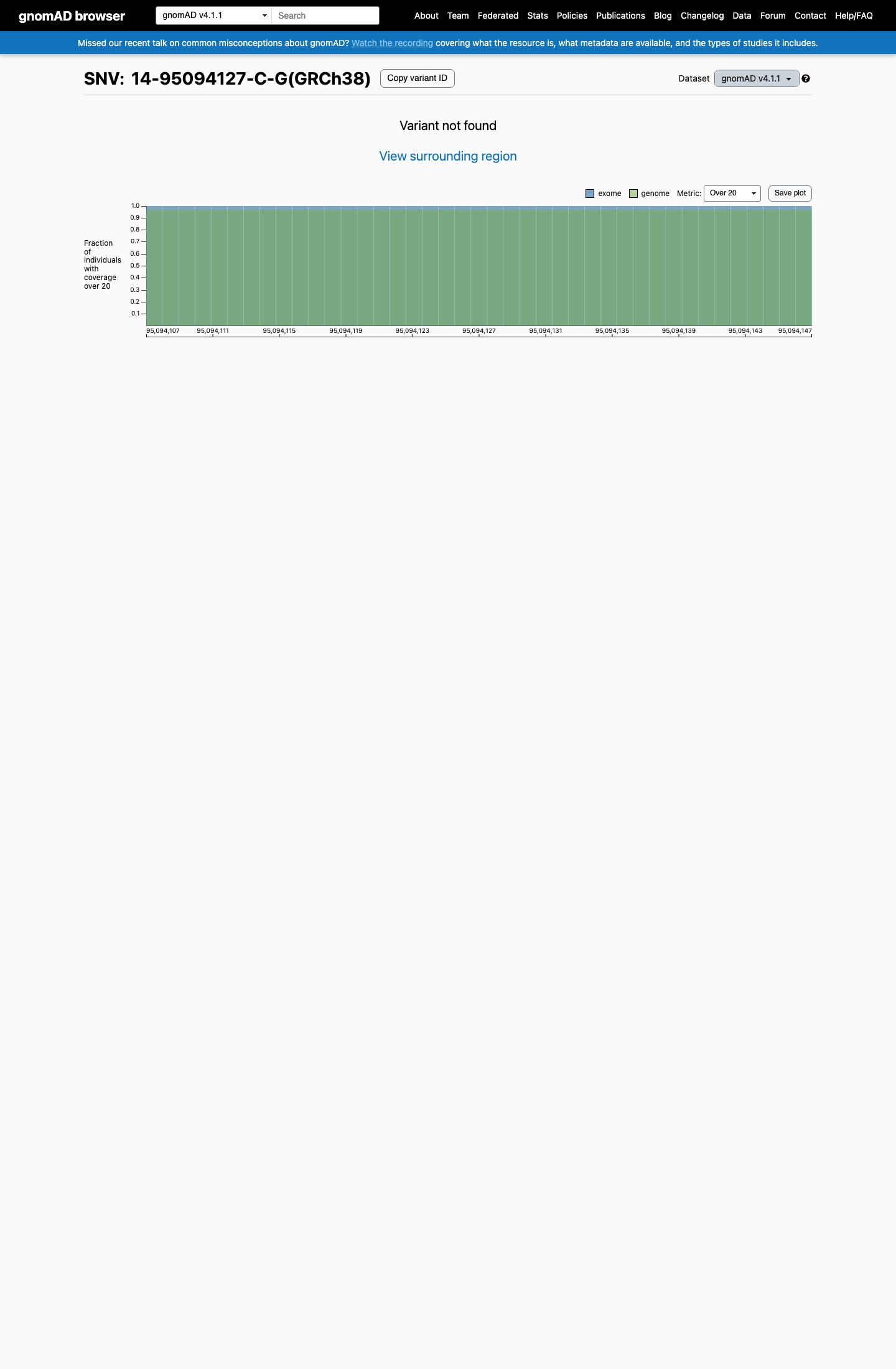
gnomAD v4.1
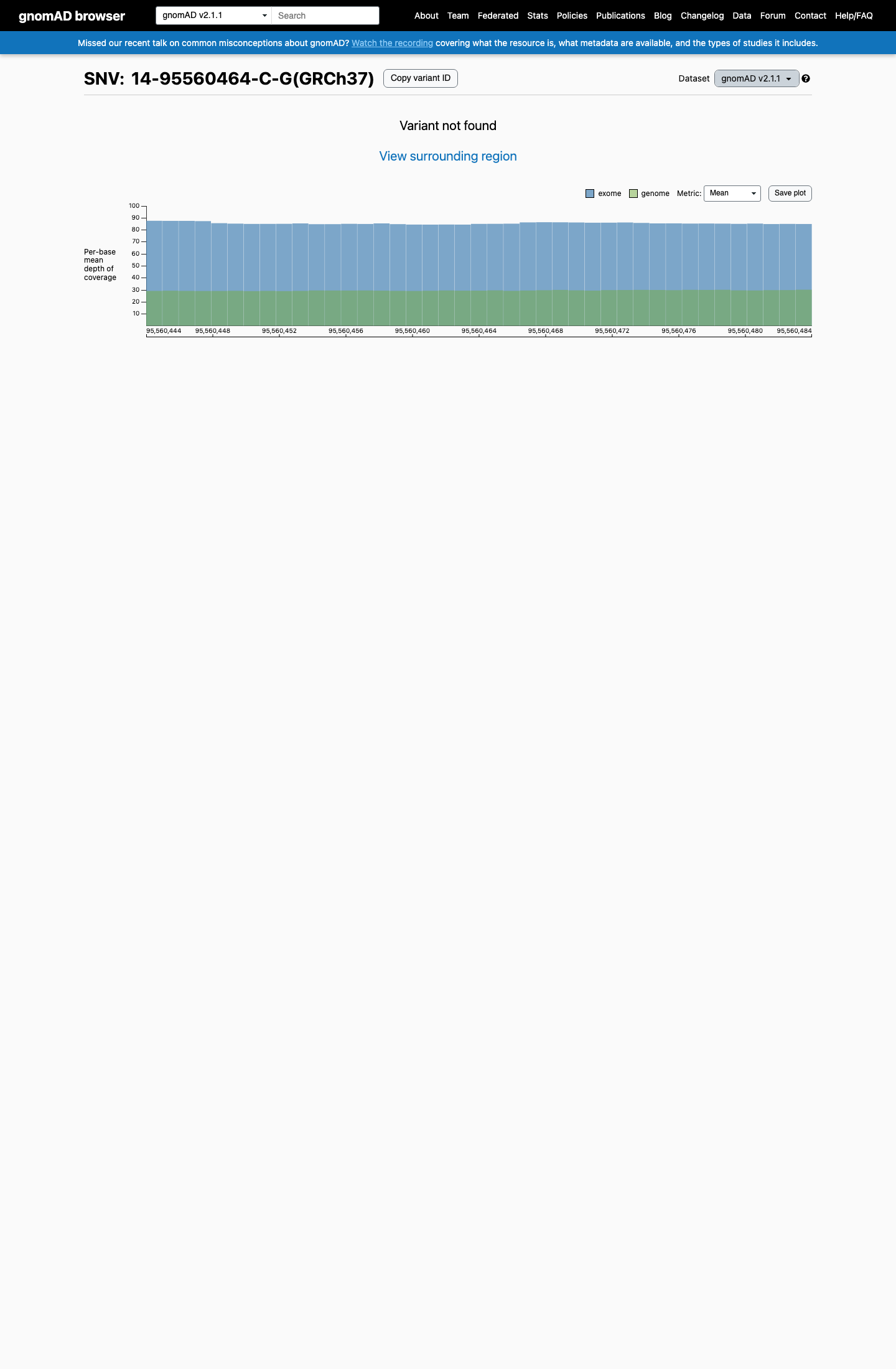
gnomAD v2.1
v4.1
Absent from gnomAD v4.1.
v2.1
Absent from gnomAD v2.1.
🇨🇦 CA
Absent from gnomAD-Canada v1.0.
Allele frequency by ancestry
three datasets · side by side
gnomAD v4.1
Absent
· 0 / ?
0 hom
0 hom
Not observed in any ancestry group.
gnomAD v2.1
Absent
· 0 / ?
0 hom
0 hom
Not observed in any ancestry group.
gnomAD Canada 🇨🇦
Absent
· 0 / ?
0 hom
0 hom
Not observed in any ancestry group.
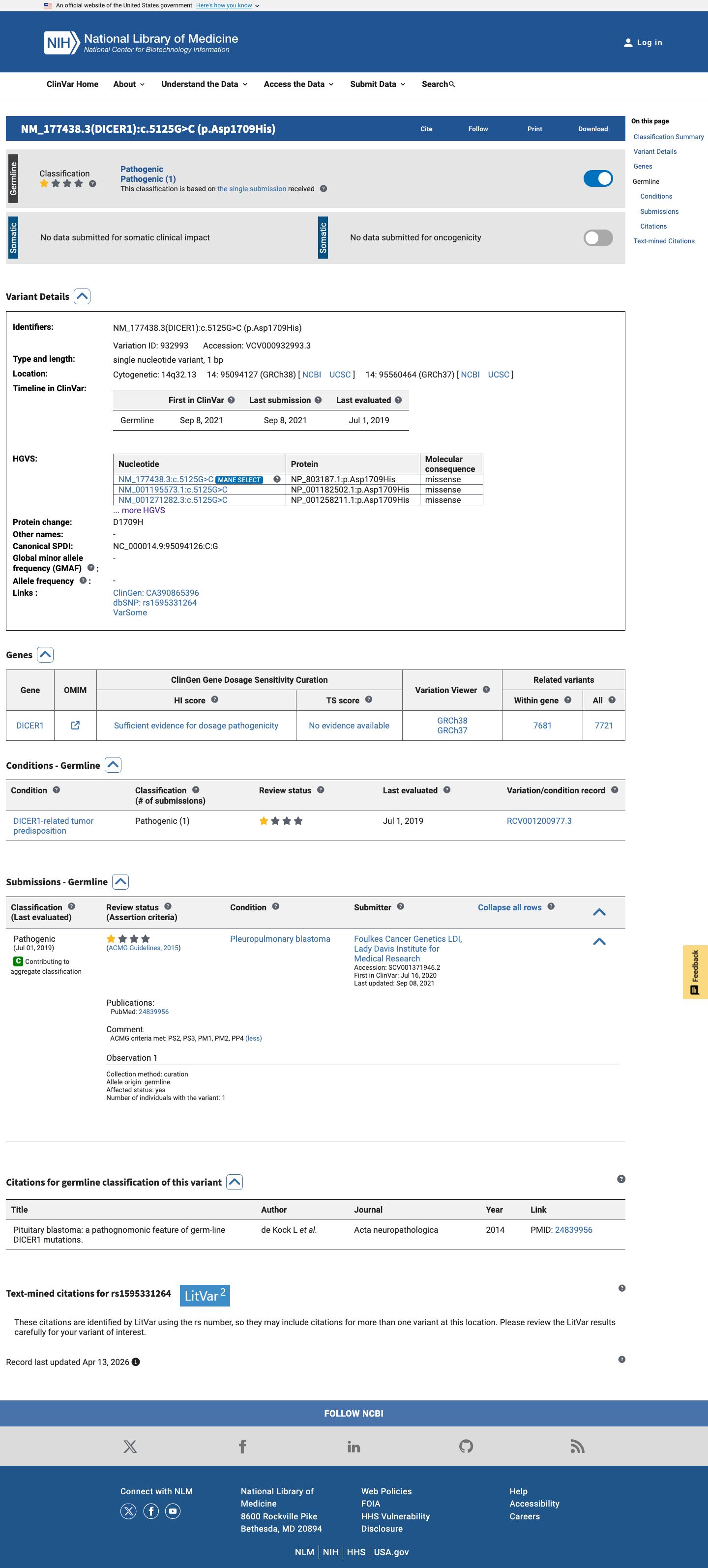
ClinVar
This variant has been reported in ClinVar but submission details could not be extracted. (ClinVarID = 932993)
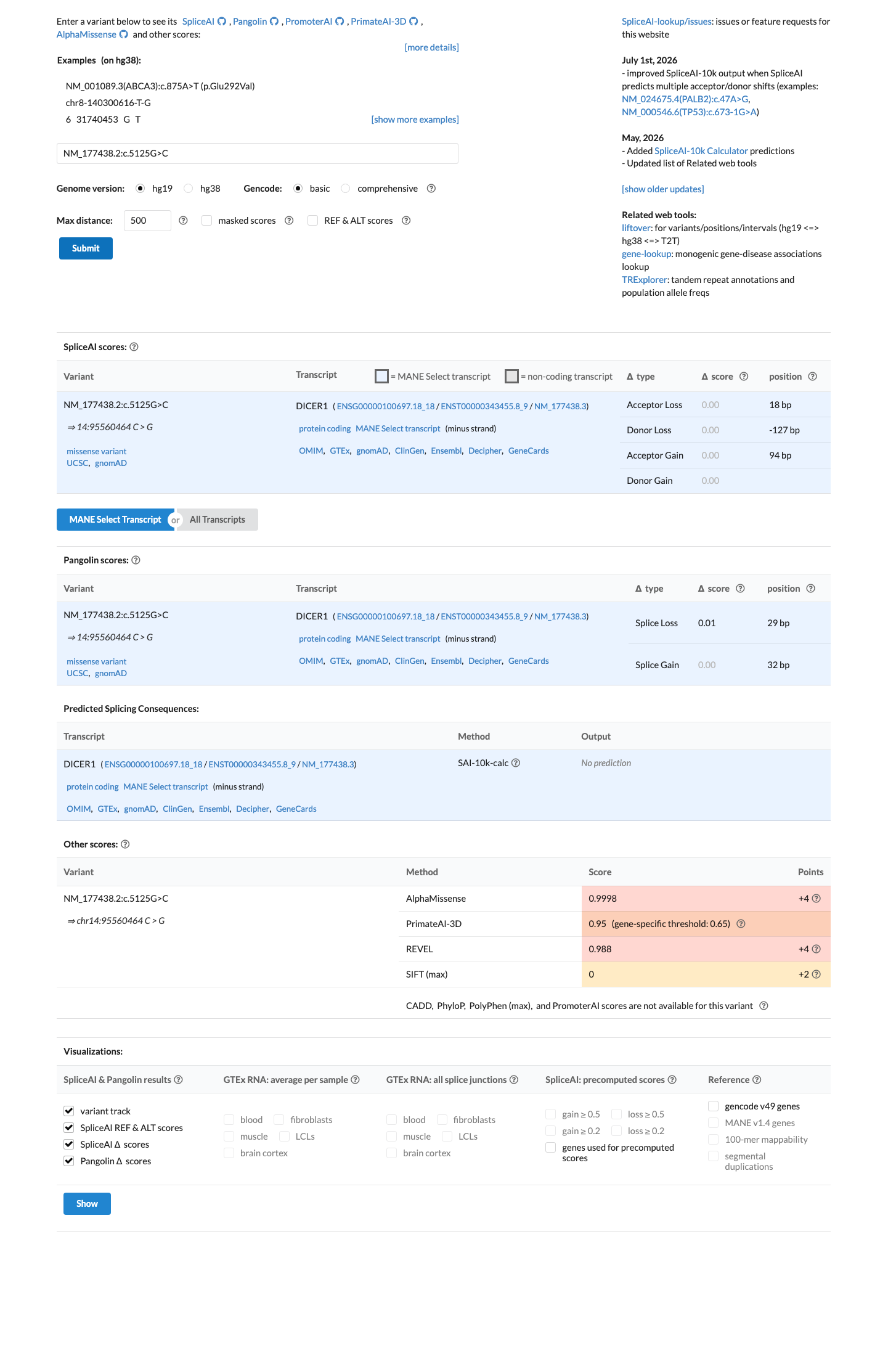
In silico
SpliceAI predicts no significant splice impact for this variant (max delta score = 0.00). REVEL score = 0.988. BayesDel score = 0.503763.
Functional
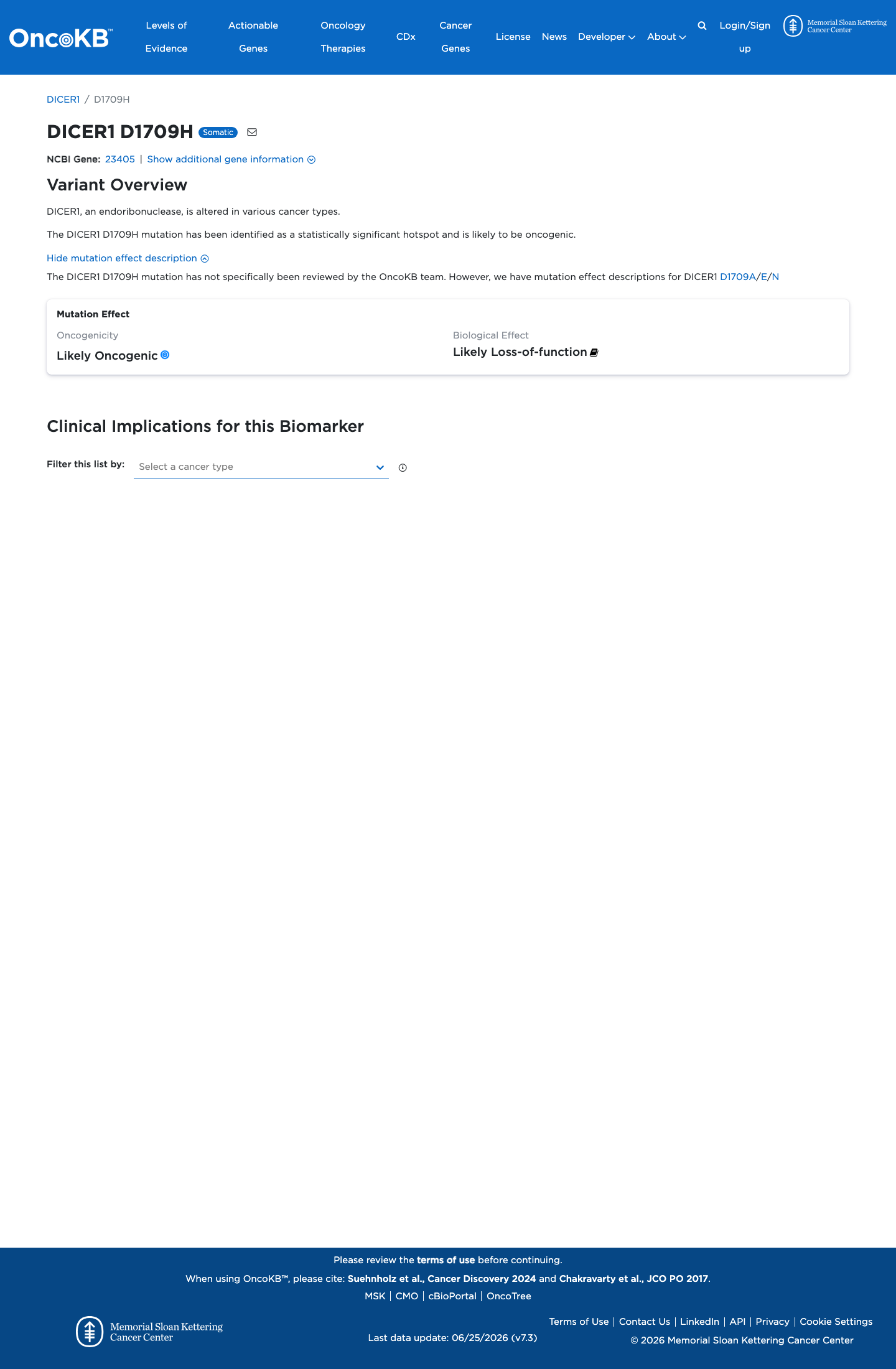
Likely Oncogenic
OncoKB did not identify variant-specific reviewed functional evidence for this variant; gene-level curated context is available for reviewer follow-up. DICER1, an endoribonuclease, is altered in various cancer types.

COSMIC

Cancer hotspots
Somatic evidence
Hotspot
COSMIC
This variant lies in a statistically significant hotspot. This variant has not previously been reported in somatic cancers (COSMIC).
Hotspots
This variant lies in a statistically significant hotspot.
Literature · how each cited paper was used
1papers cited
Each card is an audit: what was searched, what was found, whether it names the variant, which criteria it fed, and why. 2 further PMIDs triaged but not cited — see Sources & references.
Pituitary blastoma: a pathognomonic feature of germ-line DICER1 mutations.
Searched
c.5125G>Cp.Asp1709HisD1709H5125
Found
Reports NM_177438.2:c.5125G>C (p.Asp1709His) as a de novo germline mutation in an infant (case 12) with pituitary blastoma, extensive multi-focal bilateral lung cysts, and bilateral renal cystic masses. The somatic second hit was loss of the wild-type allele (LOH). Asp1709 is a metal ion-binding residue in the RNase IIIb domain; mutations at such residues reduce 5p miRNA processing, shifting expression toward 3p-derived miRNAs.
Variant
✓ Names this variant — characterised directly
Applied to
→PS2
met
→PM1
met
Why
Variant-specific de novo observation confirmed; used to support PS2_Moderate (1 de novo point) and PM1_Moderate (metal ion-binding residue).
The de novo mutation, c.5125G>C [p.(Asp1709His)], is the third reported DICER1 mutation in lymphocyte gDNA affecting a metal ion-binding residue within an RNase III domain [9].
Location Discussion, paragraph on case 12; Results, final paragraph; Table 1 and Fig. 5 · Context Germline DNA from blood lymphocytes; tumor DNA from FFPE pituitary blastoma. Sanger sequencing confirmation. LOH of wild-type allele in tumor confirmed by comparing germline and tumor gDNA peak ratios. · full text
Sources & reference links
9Sources
Triaged references · 2 PMIDs not cited in assessment
25741868 ↗
Standards and guidelines for the interpretation of sequence variants: a joint consensus recommendation of the American College of Medical Genetics and Genomics and the Association for Molecular Pathology.
CLINVAR