NM_002253.3:c.3299C>T (p.Ser1100Phe) is a missense variant in exon 24 of KDR encoding the VEGFR2 receptor tyrosine kinase. This variant is absent from all population databases including gnomAD v2.1, v4.1, and gnomAD-Canada v1.0 (PM2).1 In silico prediction with REVEL score of 0.904 supports a deleterious effect on protein function (PP3).2 Functional studies demonstrate that S1100F VEGFR2 promotes tumor growth in a colorectal cancer cell line xenograft model, confirming oncogenic potential (PS3_moderate; Toledo et al., 2018).3 The variant has been observed in somatic cancers (COSMIC COSV55764136, n=13) and is classified as Likely Oncogenic by OncoKB.4 No de novo observations, segregation data, clinical case reports, or same-residue pathogenic comparators are available. Applying generic ACMG/AMP 2015 combination rules (PMID:25741868): one moderate criterion (PS3) plus two supporting criteria (PM2, PP3) = Likely Pathogenic.5
Final classification
VUS
PS3PM2PP3
KDR
c.3299C>T
p.Ser1100Phe
This variant
NM_002253.3:c.3299C>T (p.Ser1100Phe) is a missense variant in exon 24 of KDR encoding the VEGFR2 receptor tyrosine kinase.
gene-specific framework lacked a usable explicit final combination framework, so generic ACMG/AMP 2015 final-combination rules were applied as fallback; applied criteria: PS3 moderate, PM2 supporting, PP3 supporting; combination = 1 moderate + 2 supporting, which maps to VUS.
Classification rationale
PS3PM2PP3
VUS
KDR c.3299C>T
PS3 + PM2 + PP3
→
VUS
LYFE Sciences is an AI system, and it can make mistakes. Criteria
may be applied incorrectly, sources may be misread, and a confident-looking
classification can still be wrong. Double-check every criterion and
its underlying evidence before relying on any call.
Gene diagram
· NM_002253.3 · variants mapped to exon structure
KDR
NM_002253.3
Fetching transcript structure from UCSC…
Applied criteria · 3 applied · 18 assessed
MetEvidence satisfies this criterion.
Not metEvaluated against available evidence; threshold not reached.
Not assessedApplies in principle, but no evidence was found to evaluate it.
N/ADoesn't apply to this variant type.
Applied · 3
Strength
Supporting
Moderate
Strong
Very strong
PS3
moderate
review
Pathogenic
The KDR S1100F (VEGFR2 p.Ser1100Phe) variant was directly tested in a Colo-320 colorectal cancer cell line xenograft model. Stable expression of S1100F VEGFR2 promoted tumor growth in mice, demonstrating oncogenic functional effect (Toledo et al., 2018, PMID:29588308). Single publication with direct variant-specific functional data in a xenograft assay.
S1100F VEGFR2 directly tested in Colo-320 xenograft modelpromoted tumor growth in mice reaching humane endpoint.S1100F was one of nine VEGFR2 cancer-associated mutants tested
PM2
supporting
Pathogenic
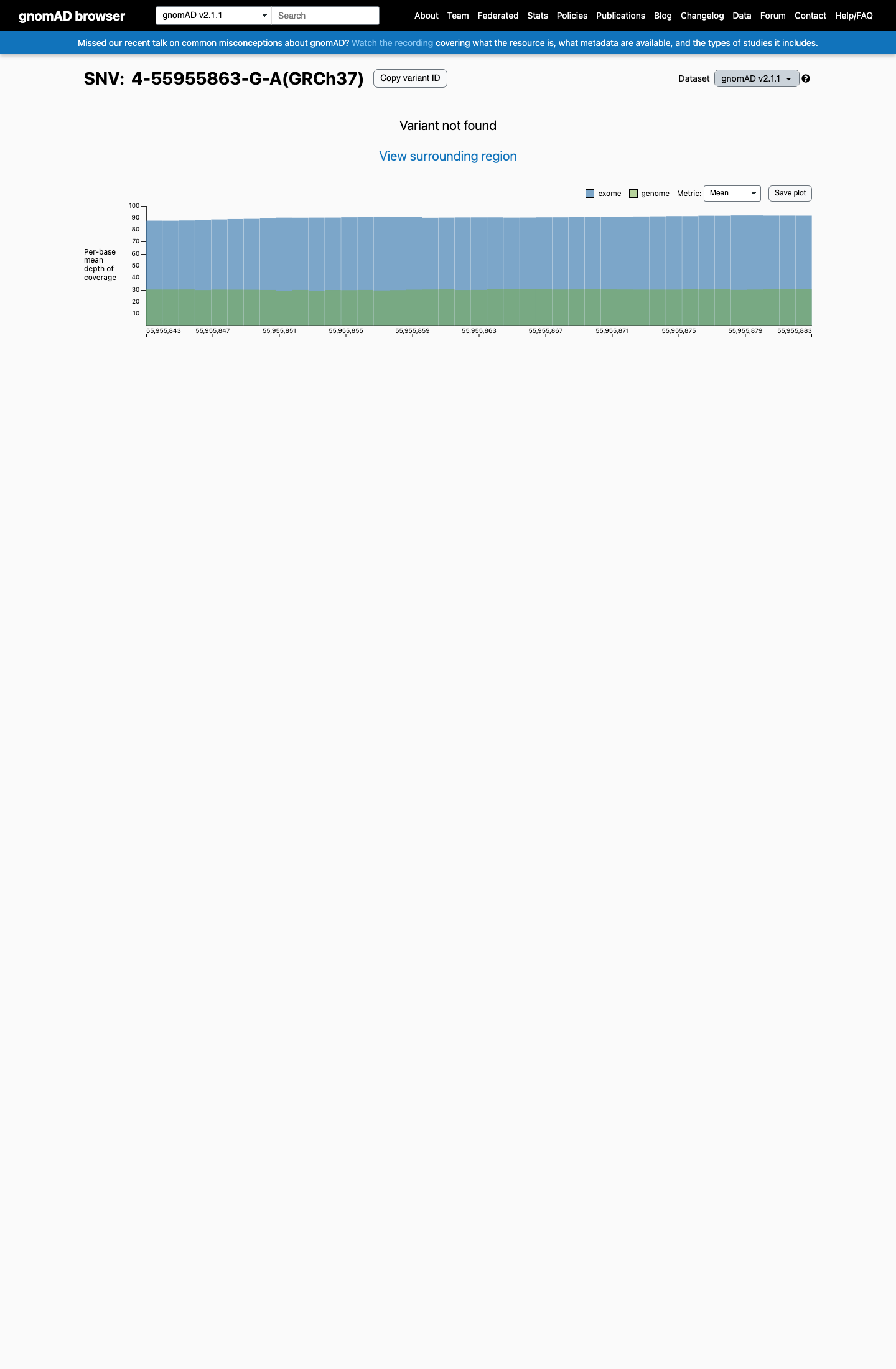
NM_002253.3:c.3299C>T is absent from gnomAD v2.1, v4.1, and gnomAD-Canada v1.0, consistent with a rare variant below the 0.1% population frequency threshold.
Absent from gnomAD v2.1 (0 alleles).Absent from gnomAD v4.1 (0 alleles).Absent from gnomAD-Canada v1.0 (0 alleles).
PP3
supporting
Pathogenic
REVEL score of 0.904 strongly predicts a deleterious effect for this missense variant. SpliceAI max delta score is 0.02, indicating no significant splice impact, consistent with the predicted effect being at the amino acid level. BayesDel score of 0.434 is equivocal.
REVEL score 0.904 (highly deleterious prediction).SpliceAI max delta 0.02 (no splicing impact).BayesDel score 0.434 (equivocal).
Assessed · not applied
· 18 not met · 0 not assessed
Pathogenic
PS2
No de novo observation has been reported for NM_002253.3:c.3299C>T.
PS4
No case-control or patient cohort data available.
PM1
The variant does not lie in a statistically significant mutational hotspot (cancerhotspots.org negative).
PM6
No de novo observation has been reported for this variant.
PP1
No segregation data available for this variant.
PP2
KDR does not have an established low rate of benign missense variation in a germline disease context.
PP4
No clinical phenotype data available for patients carrying this variant.
PP5
This variant has not been reported as pathogenic by a reputable clinical laboratory or expert panel.
Benign
BA1
Variant is absent from gnomAD, with an allele frequency of 0, well below the 1% BA1 threshold.
BS1
Variant is absent from gnomAD, with an allele frequency of 0, well below the 0.3% BS1 threshold.
BS2
No observation in healthy adult controls.
BS3
Functional data from PMID:29588308 demonstrates that S1100F VEGFR2 promotes tumor growth in a xenograft model, consistent with a deleterious (oncogenic) effect, not a benign effect.
BS4
No segregation data available showing lack of co-segregation with disease.
BP1
BP1 applies to missense variants in genes where only truncating variants are known to cause disease.
BP2
No observation of this variant in trans with a known pathogenic variant in KDR.
BP4
REVEL score of 0.904 strongly predicts a deleterious effect, inconsistent with BP4 which requires multiple lines of computational evidence suggesting no impact.
BP5
No observation of this variant in a case with an alternate molecular basis for disease.
BP6
No reputable source classifies this variant as benign.
N/A · 4
PVS1 · PS1 · PM5 · BP7
Research & evidence
Population frequency

gnomAD v4.1
gnomAD v2.1
v4.1
Absent from gnomAD v4.1.
v2.1
Absent from gnomAD v2.1.
🇨🇦 CA
Absent from gnomAD-Canada v1.0.
Allele frequency by ancestry
three datasets · side by side
gnomAD v4.1
Absent
· 0 / ?
0 hom
0 hom
Not observed in any ancestry group.
gnomAD v2.1
Absent
· 0 / ?
0 hom
0 hom
Not observed in any ancestry group.
gnomAD Canada 🇨🇦
Absent
· 0 / ?
0 hom
0 hom
Not observed in any ancestry group.

In silico
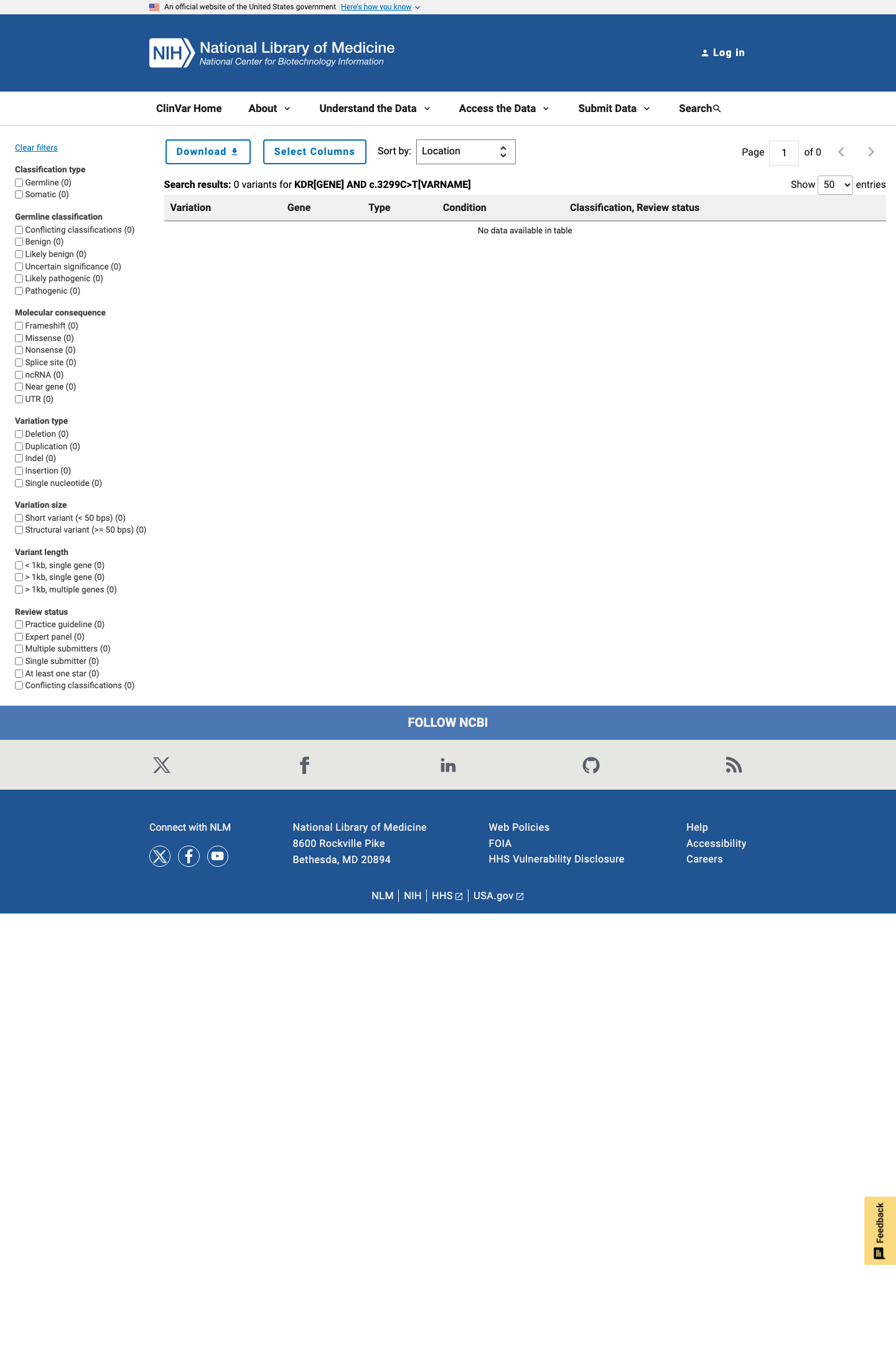
SpliceAI predicts no significant splice impact for this variant (max delta score = 0.02). REVEL score = 0.904. BayesDel score = 0.433866.
Functional
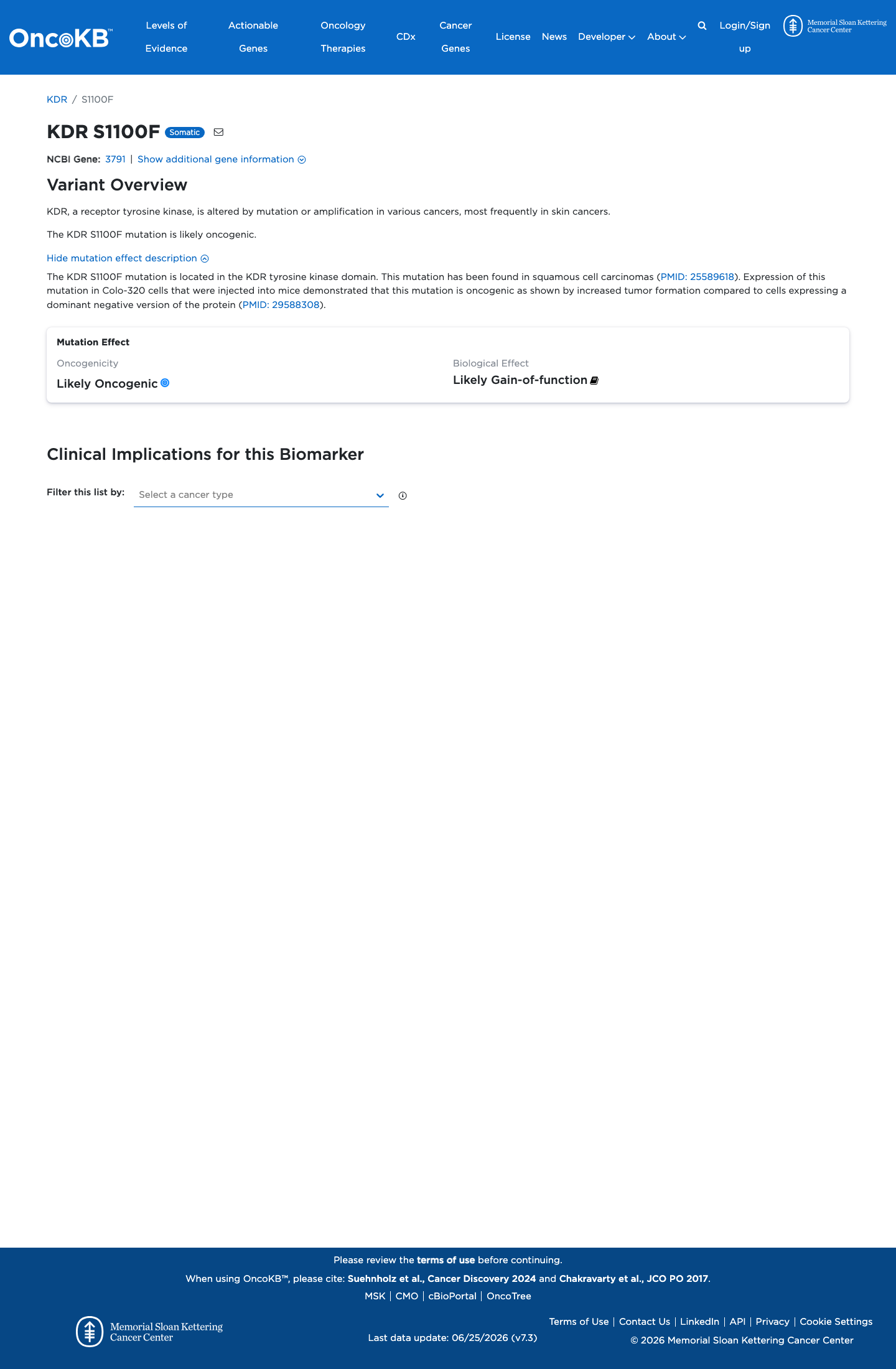
Likely Oncogenic
OncoKB identified variant-specific curated literature and context relevant to functional review; biological-effect context: Likely Gain-of-function; curated oncogenicity label: Likely Oncogenic.
COSMIC

Cancer hotspots
Somatic evidence
Not in COSMIC / hotspots
COSMIC
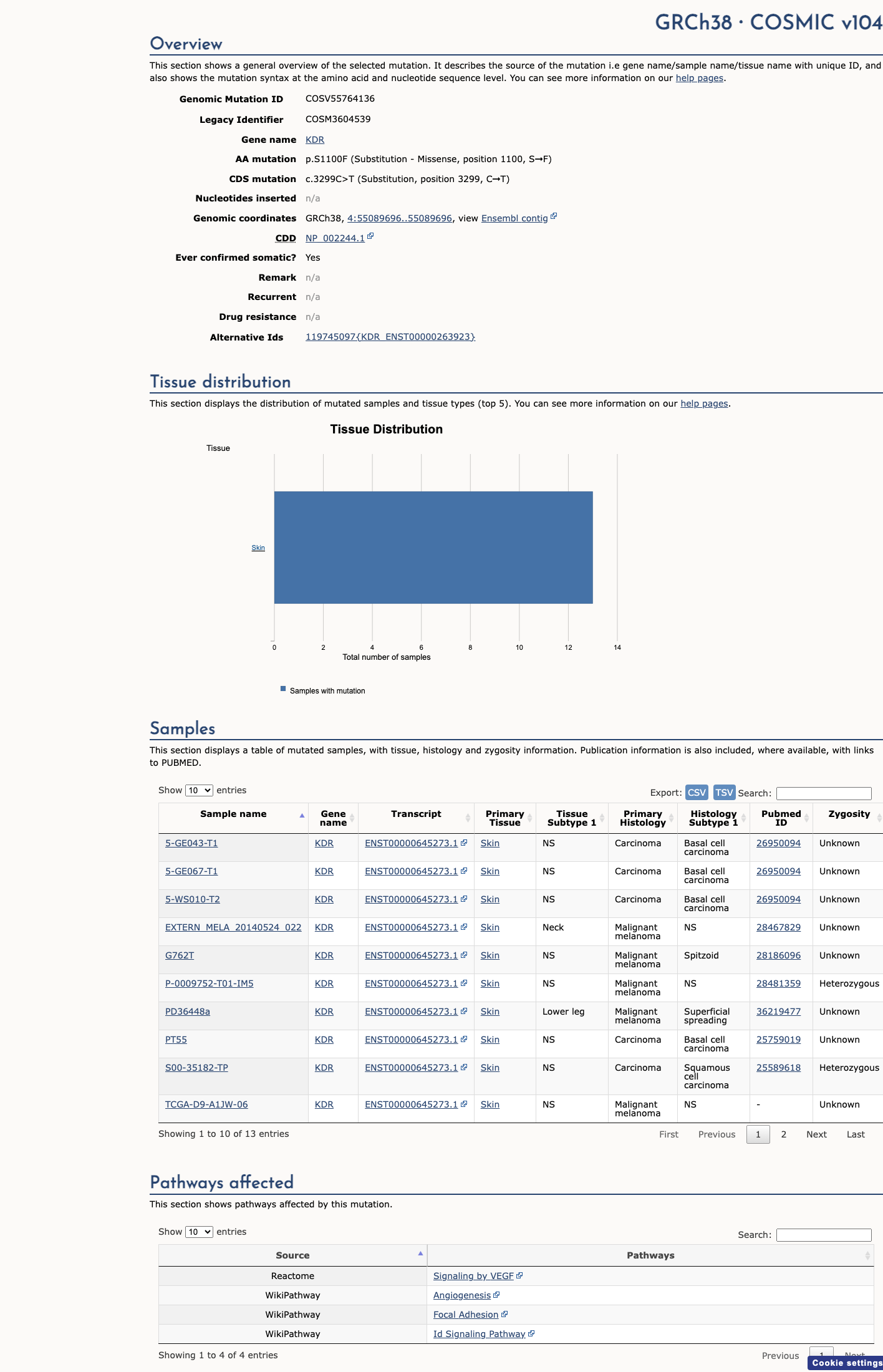
This variant does not lie in a statistically significant hotspot. This variant has previously been reported in somatic cancers (COSMIC; COSV55764136, n = 13 times).
Hotspots
This variant does not lie in a statistically significant hotspot.
Literature · how each cited paper was used
1papers cited
Each card is an audit: what was searched, what was found, whether it names the variant, which criteria it fed, and why. 1 further PMID triaged but not cited — see Sources & references.
Exome Sequencing of Plasma DNA Portrays the Mutation Landscape of Colorectal Cancer and Discovers Mutated VEGFR2 Receptors as Modulators of Antiangiogenic Therapies.
Searched
S1100FSer1100Phec.3299C>T3299
Found
S1100F VEGFR2 was tested alongside eight other cancer-associated VEGFR2 mutants in a Colo-320 colorectal cancer cell line xenograft model. Stable expression of S1100F VEGFR2 promoted tumor growth in mice, with tumors reaching the established humane endpoint, whereas empty vector and kinase-dead K868M controls did not generate tumors within 120 days. No kinase assay, phosphorylation, or drug sensitivity data specific to S1100F are reported.
Variant
✓ Names this variant — characterised directly
Applied to
→PS3
met
Why
Variant-specific functional data confirmed oncogenic effect in xenograft model; single study, no independent replication. Referenced in PS3 assessment at moderate strength.
Colo-320 cells stably expressing D717V, G800D, G800R, L840F, G843D, S925F, R1022Q, R1032Q, and S1100F VEGFR2, when injected in mice, even in small numbers and without Matrigel, could generate tumors that reached the established humane endpoint.
Location Abstract (line 80); Results, Xenograft section (lines 539-548); Figure 2D protein diagram (line 775) · Context Colo-320 colorectal cancer cell line xenograft model, nude mice, subcutaneous injection of 4x10^5 cells, tumor growth monitored up to 120 days · full text
Sources & reference links
Triaged references · 1 PMID not cited in assessment