p.Leu424Ile is an exonuclease-domain missense variant explicitly assigned PM1 at moderate strength in the León-Castillo et al. 2020 custom POLE framework based on recurrence in the TCGA endometrial carcinoma cohort (n=2) and classification in the pathogenic POLE-score tier.1 The variant is absent from gnomAD v2.1, v4.1, and gnomAD-Canada population databases, meeting the PM2 threshold of <0.1% allele frequency.2 A different pathogenic missense variant at the same codon, c.1270C>G (p.Leu424Val), is established as a high-penetrance germline cause of polymerase proofreading-associated polyposis across multiple independent cohorts (Palles et al. 2013, Valle et al. 2014, Elsayed et al. 2014, Spier et al. 2015), satisfying PM5 at moderate strength.3 In silico assessment from Supplementary Table S2 shows REVEL class 'likely disease causing' with only 1 benign result (SIFT=Deleterious, PANTHER=Probably damaging, SNAP2=effect, PolyPhen2=Probably damaging, PROVEAN=Neutral), meeting the custom POLE PP3_Supporting rule.4 No variant-specific functional data, de novo observations, segregation data, or germline case-control evidence exist for c.1270C>A; eight publications citing POLE codon 424 all refer to the sister variant c.1270C>G (p.Leu424Val) and do not mention c.1270C>A.5
Final classification
Likely Pathogenic
PM1PM2PM5PP3
POLE
c.1270C>A
p.Leu424Ile
This variant
p.Leu424Ile is an exonuclease-domain missense variant explicitly assigned PM1 at moderate strength in the León-Castillo et al. 2020 custom POLE framework based on recurrence in the TCGA endometrial carcinoma cohort (n=2) and classification in the pathogenic POLE-score tier.
Three moderate-strength pathogenic criteria are met (PM1, PM2, PM5) with one additional supporting criterion (PP3). The León-Castillo et al. 2020 custom POLE framework was used for criterion triggering and strength selection, but the framework explicitly retains standard ACMG/AMP 2015 final-combination thresholds. Under the standard ACMG/AMP combination rules, >=3 moderate criteria alone qualifies as Likely Pathogenic. No benign criteria are met, so there is no conflicting evidence.
Classification rationale
PM1PM2PM5PP3
Likely Pathogenic
POLE c.1270C>A
PM1 + PM2 + PM5 + PP3
→
Likely Pathogenic
1
vcep_path_250_323vcep_path_250_323_s002
4
vcep_path_250_323_s003revelspliceai ↗
LYFE Sciences is an AI system, and it can make mistakes. Criteria
may be applied incorrectly, sources may be misread, and a confident-looking
classification can still be wrong. Double-check every criterion and
its underlying evidence before relying on any call.
Gene diagram
· NM_006231.4 · variants mapped to exon structure
POLE
NM_006231.4
Fetching transcript structure from UCSC…
Applied criteria · 4 applied · 19 assessed
MetEvidence satisfies this criterion.
Not metEvaluated against available evidence; threshold not reached.
Not assessedApplies in principle, but no evidence was found to evaluate it.
N/ADoesn't apply to this variant type.
Applied · 4
Strength
Supporting
Moderate
Strong
Very strong
PM1
moderate
Pathogenic
p.Leu424Ile is explicitly listed in the León-Castillo et al. 2020 custom POLE framework as a non-hotspot exonuclease-domain missense variant qualifying for PM1_Moderate. The variant falls within the exonuclease proofreading domain (residues 268-471) and was classified in the pathogenic tier (POLE-score >=4) in the TCGA-based analysis.
León-Castillo et al. 2020 framework explicitly assigns PM1_Moderate to p.L424Ivariant is in the exonuclease domain and recurrent in TCGA EC cohort (n=2).
PM2
moderate
Pathogenic
NM_006231.4:c.1270C>A is absent from gnomAD v2.1, gnomAD v4.1, and gnomAD-Canada v1.0, meeting the non-VCEP PM2 threshold of allele frequency <0.1%.
Absent from gnomAD v2.1 (exomes)gnomAD v4.1 (exomes)and gnomAD-Canada v1.0 (genomes).
PM5
moderate
Pathogenic
A different pathogenic missense variant at the same codon — c.1270C>G (p.Leu424Val) — is established as a high-penetrance germline pathogenic variant causing polymerase proofreading-associated polyposis (PPAP), confirmed across multiple independent cohorts (Palles et al. 2013, Valle et al. 2014, Elsayed et al. 2014, Spier et al. 2015). The novel c.1270C>A (p.Leu424Ile) substitution at the same residue therefore meets PM5 at moderate strength.
c.1270C>G (p.Leu424Val) is a well-established pathogenic variant at the same codon in germline PPAPp.Leu424Ile is a different missense change at the same residue.
PP3
supporting
Pathogenic
p.L424I appears in Supplementary Table S2 of León-Castillo et al. 2020 with REVEL class 'likely disease causing' and only 1 benign in silico result (<=1), meeting the custom POLE PP3_Supporting rule. SpliceAI predicts no splicing impact (max delta score = 0.00).
Table S2: L424I — SIFT=DeleteriousPANTHER=Probably damagingSNAP2=effect
Assessed · not applied
· 19 not met · 0 not assessed
Pathogenic
PS2
No de novo occurrence of NM_006231.4:c.1270C>A has been reported in the reviewed literature.
PS3
No variant-specific functional data exist for NM_006231.4:c.1270C>A (p.Leu424Ile) in the reviewed literature.
PS4
The custom POLE PS4 rule requires recurrence in both COSMIC and TCGA with combined EC count >=10 and membership in the established pathogenic hotspot set.
PM6
No de novo observation has been reported for NM_006231.4:c.1270C>A specifically.
PP1
No segregation data are available for NM_006231.4:c.1270C>A in any reviewed publication.
PP2
Insufficient data to determine whether POLE has a low rate of benign missense variation; no gene-level missense constraint metric (e.g., gnomAD Z-score, HCI prior) was available for this assessment.
PP4
No specific phenotypic data are available for any individual carrying NM_006231.4:c.1270C>A.
PP5
No reputable source has classified NM_006231.4:c.1270C>A as pathogenic.
Benign
BA1
The variant is absent from gnomAD v2.1, v4.1, and gnomAD-Canada.
BS1
The variant is absent from gnomAD.
BS2
No observation of this variant in healthy adult controls; the variant is absent from population databases.
BS3
No functional studies demonstrating no deleterious effect for NM_006231.4:c.1270C>A (p.Leu424Ile) exist in the reviewed literature.
BS4
No segregation data demonstrating lack of cosegregation with disease are available for this variant.
BP1
Missense variants in POLE, particularly in the exonuclease domain, are a well-established mechanism of disease (PPAP).
BP2
No observation of this variant in trans with a pathogenic POLE variant has been reported.
BP4
The custom POLE BP4_Supporting rule requires REVEL class 'Likely benign' and >=4 benign in silico results.
BP5
No alternative molecular cause for the observed phenotype has been identified in any individual carrying this variant.
BP6
ClinVar classification is 'Uncertain significance' (single submitter), not 'Benign' or 'Likely benign' from a reputable source.
BP7
NM_006231.4:c.1270C>A is a missense variant, not a synonymous variant.
N/A · 2
PVS1 · PS1
Research & evidence
Population frequency · supports pathogenic
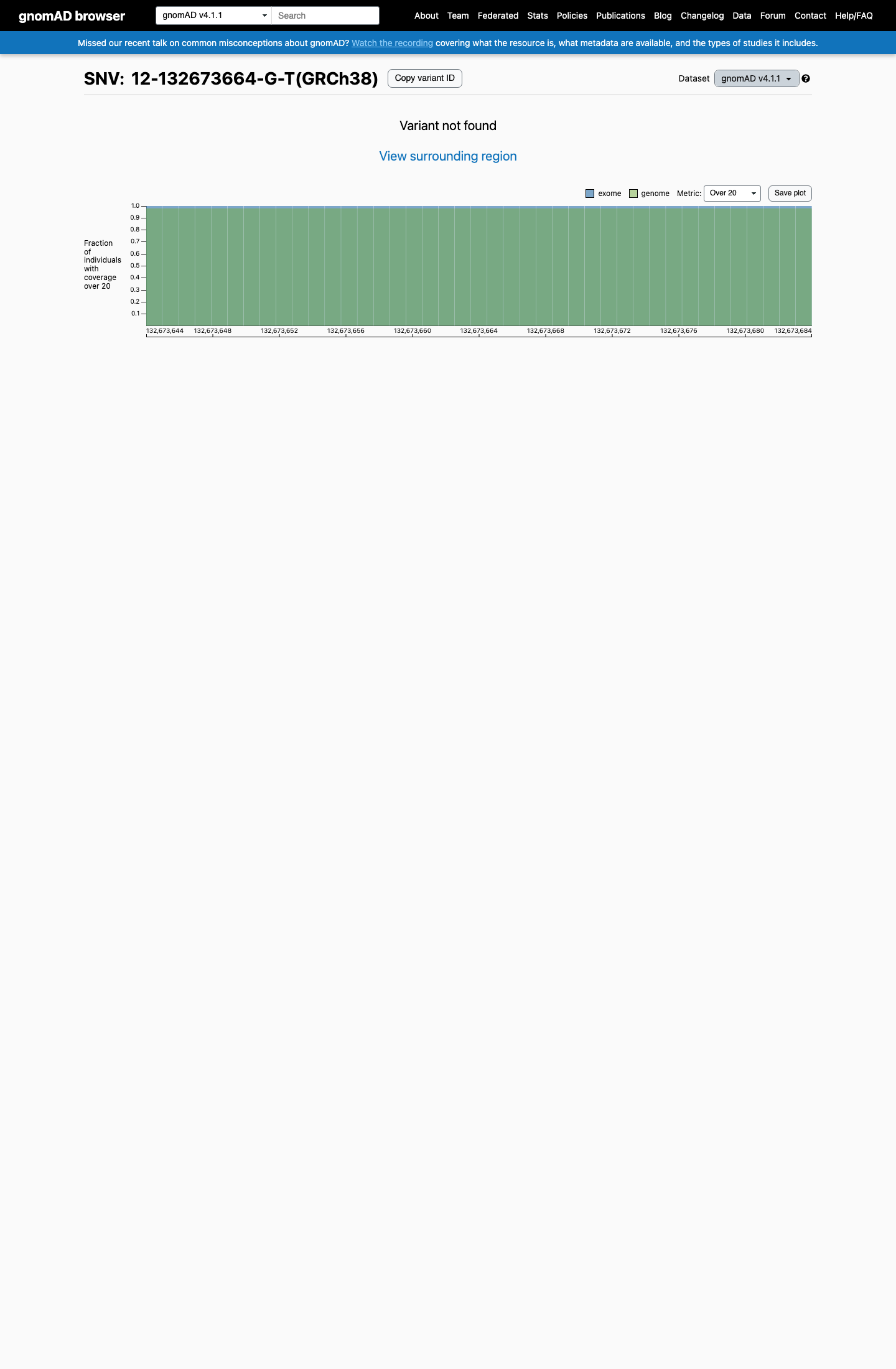
gnomAD v4.1
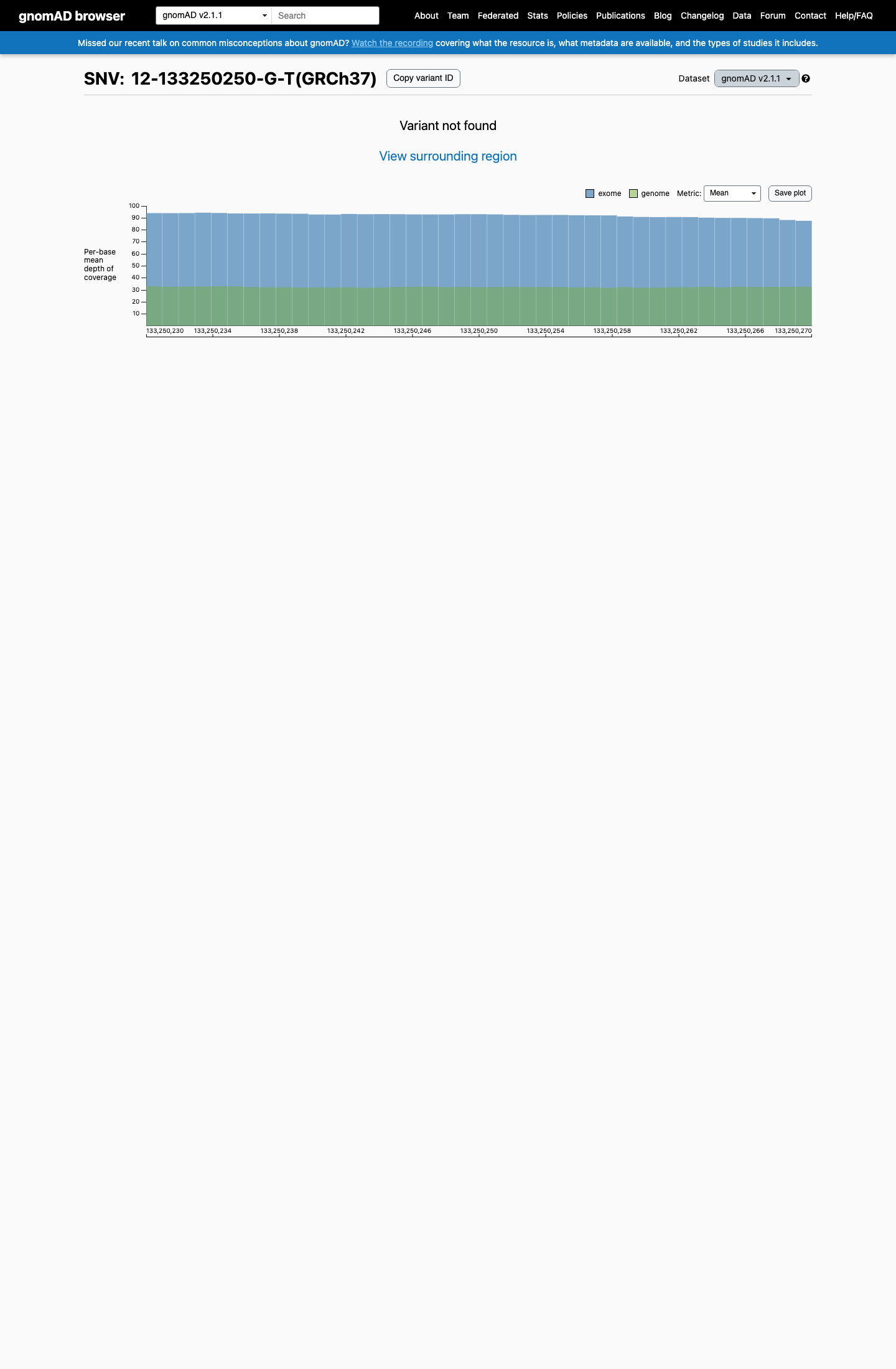
gnomAD v2.1
v4.1
Absent from gnomAD v4.1.
v2.1
Absent from gnomAD v2.1.
🇨🇦 CA
Absent from gnomAD-Canada v1.0.
Allele frequency by ancestry
three datasets · side by side
gnomAD v4.1
Absent
· 0 / ?
0 hom
0 hom
Not observed in any ancestry group.
gnomAD v2.1
Absent
· 0 / ?
0 hom
0 hom
Not observed in any ancestry group.
gnomAD Canada 🇨🇦
Absent
· 0 / ?
0 hom
0 hom
Not observed in any ancestry group.
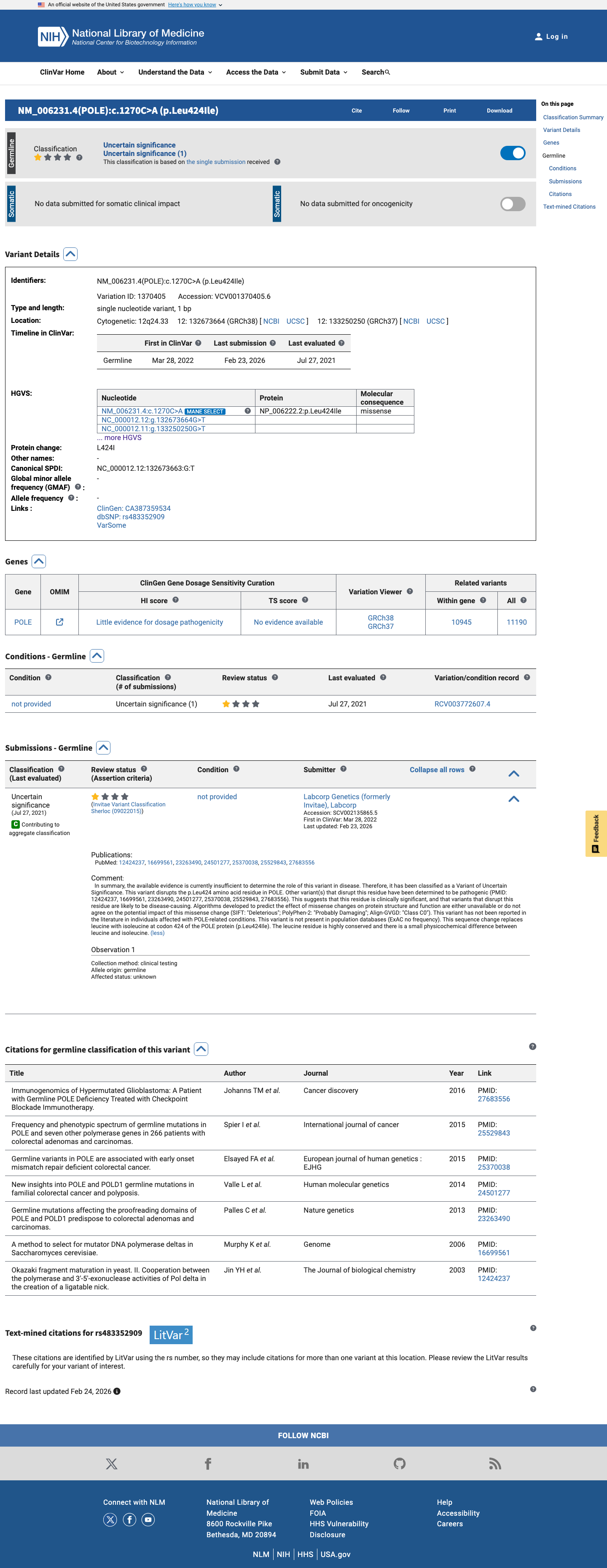
ClinVar
This variant has been reported in ClinVar as Uncertain significance (1 clinical laboratory). (ClinVarID = 1370405)
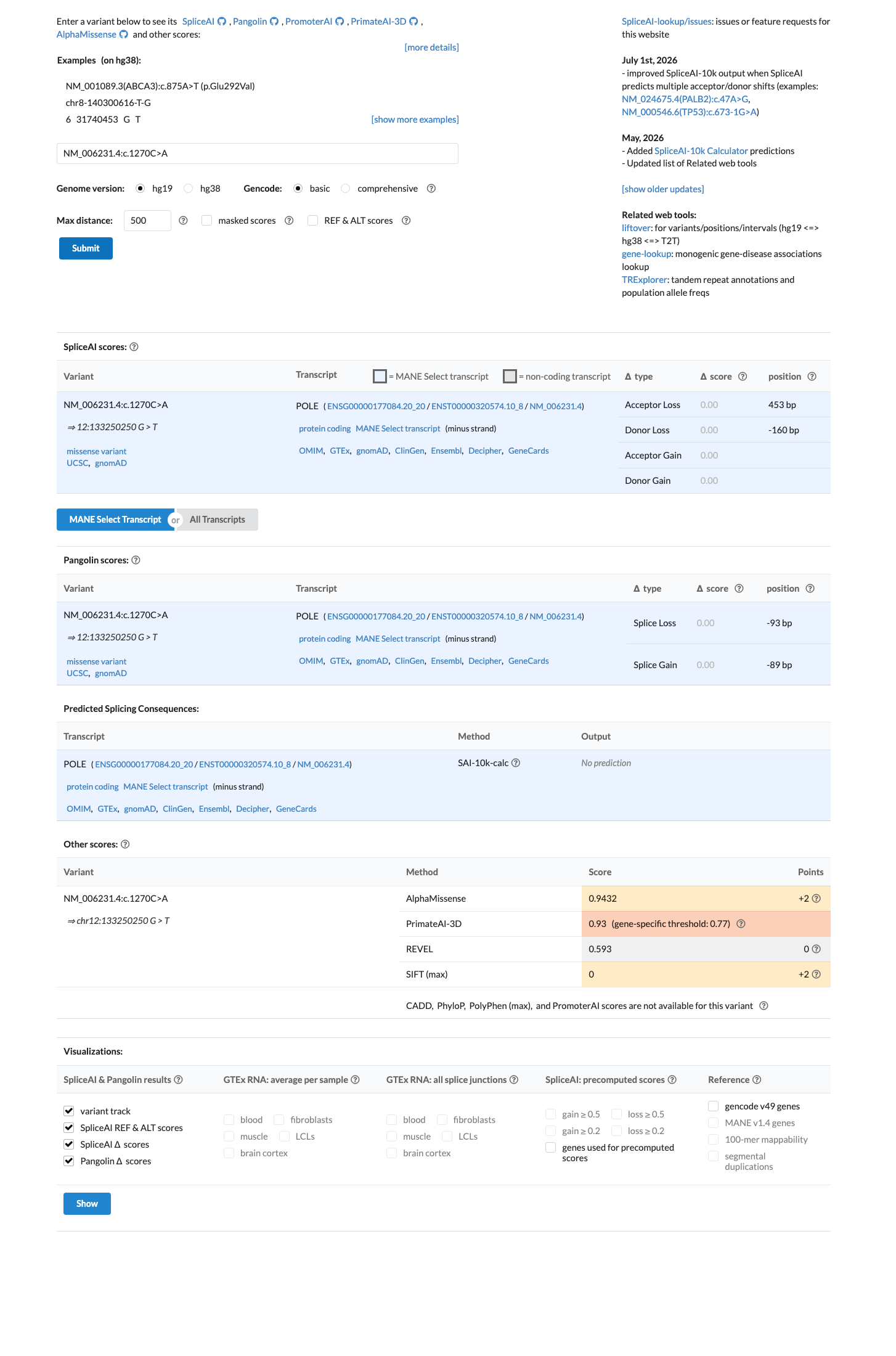
In silico
SpliceAI predicts no significant splice impact for this variant (max delta score = 0.00). REVEL score = 0.593. BayesDel score = -0.0845628.
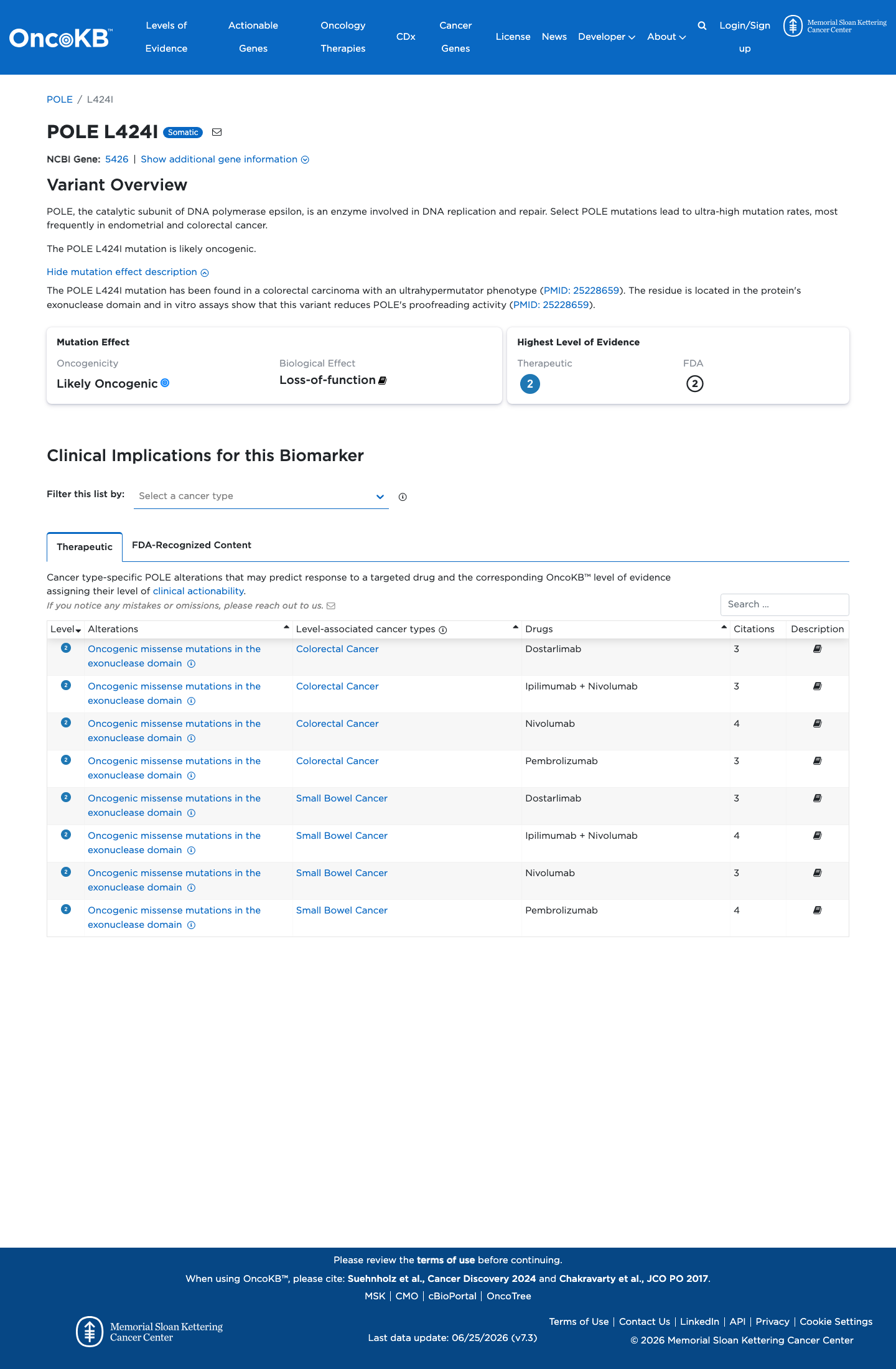
Functional
Likely Oncogenic
OncoKB identified variant-specific curated literature and context relevant to functional review; biological-effect context: Loss-of-function; curated oncogenicity label: Likely Oncogenic.
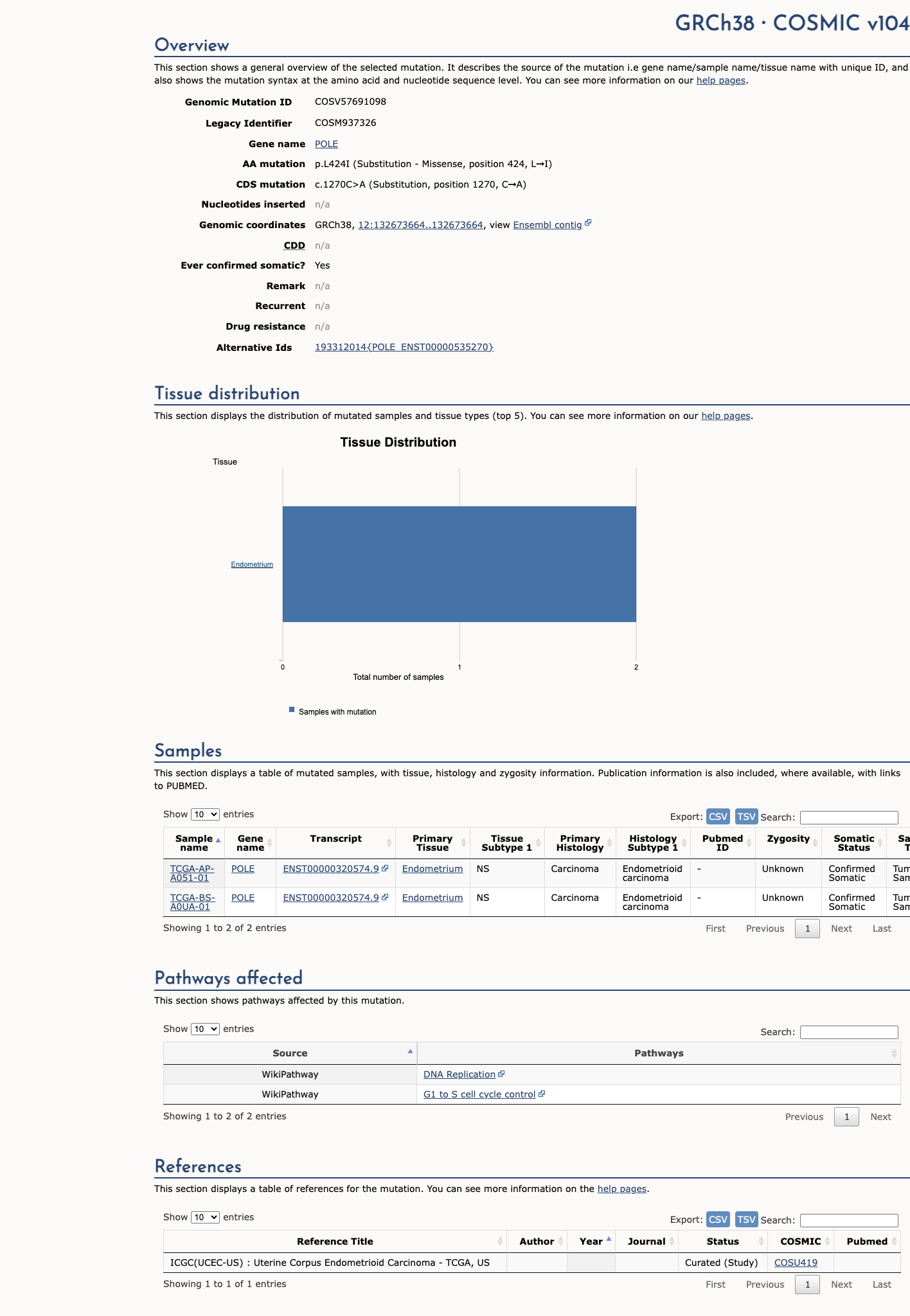
COSMIC

Cancer hotspots
Somatic evidence
Not in COSMIC / hotspots
COSMIC
This variant does not lie in a statistically significant hotspot. This variant has previously been reported in somatic cancers (COSMIC; COSV57691098, n = 2 times).
Hotspots
This variant does not lie in a statistically significant hotspot.
Literature · how each cited paper was used
5papers cited
Each card is an audit: what was searched, what was found, whether it names the variant, which criteria it fed, and why. 4 further PMIDs triaged but not cited — see Sources & references.
Rule & framework references · cited for criterion definitions, not variant evidence
23263490 ↗
Germline mutations affecting the proofreading domains of POLE and POLD1 predispose to colorectal adenomas and carcinomas.
24501277 ↗
New insights into POLE and POLD1 germline mutations in familial colorectal cancer and polyposis.
25370038 ↗
Germline variants in POLE are associated with early onset mismatch repair deficient colorectal cancer.
25529843 ↗
Frequency and phenotypic spectrum of germline mutations in POLE and seven other polymerase genes in 266 patients with colorectal adenomas and carcinomas.
27683556 ↗
Immunogenomics of Hypermutated Glioblastoma: A Patient with Germline POLE Deficiency Treated with Checkpoint Blockade Immunotherapy.
Sources & reference links
Triaged references · 4 PMIDs not cited in assessment
25228659 ↗
Exonuclease mutations in DNA polymerase epsilon reveal replication strand specific mutation patterns and human origins of replication.
ONCOKB
12424237 ↗
Okazaki fragment maturation in yeast. II. Cooperation between the polymerase and 3'-5'-exonuclease activities of Pol delta in the creation of a ligatable nick.
CLINVAR
16699561 ↗
A method to select for mutator DNA polymerase deltas in Saccharomyces cerevisiae.
CLINVAR
28492532 ↗
Sherloc: a comprehensive refinement of the ACMG-AMP variant classification criteria.
CLINVAR