Analysis in progress
Initialising…
0%
complete
This report is still being assembled — sections appear as each stage finishes. It isn't final yet.
PIK3CA
Final classification
VUS
PIK3CA c.3133G>A · p.Asp1045Asn
PIK3CA

The p.Asp1045Asn substitution lies within the PIK3CA C-terminal kinase domain (AA 797-1068), a critical functional domain defined in Table 4 of the Brain Malformations VCEP specification (PM1_Supporting).

Gene
PIK3CA
Transcript
NM_006218.3
HGVS · transcript:coding
NM_006218.3:c.3133G>A
Consequence
N/A
GRCh38
chr3:179234290 G>A
GRCh37
chr3:178952078 G>A
Basis Brain Malformations Specification Tavtigian point framework v1.1.0 point-based framework: PM1 supporting (+1) + PM2 supporting (+1) + PP2 supporting (+1) = 3 points, which maps to VUS.
Brain Malformations Specification Tavtigian point framework v1.1.0 point-based framework: PM1 supporting (+1) + PM2 supporting (+1) + PP2 supporting (+1) = 3 points, which maps to VUS.
Classification rationale
PM1PM2PP2 VUS
PIK3CA c.3133G>A

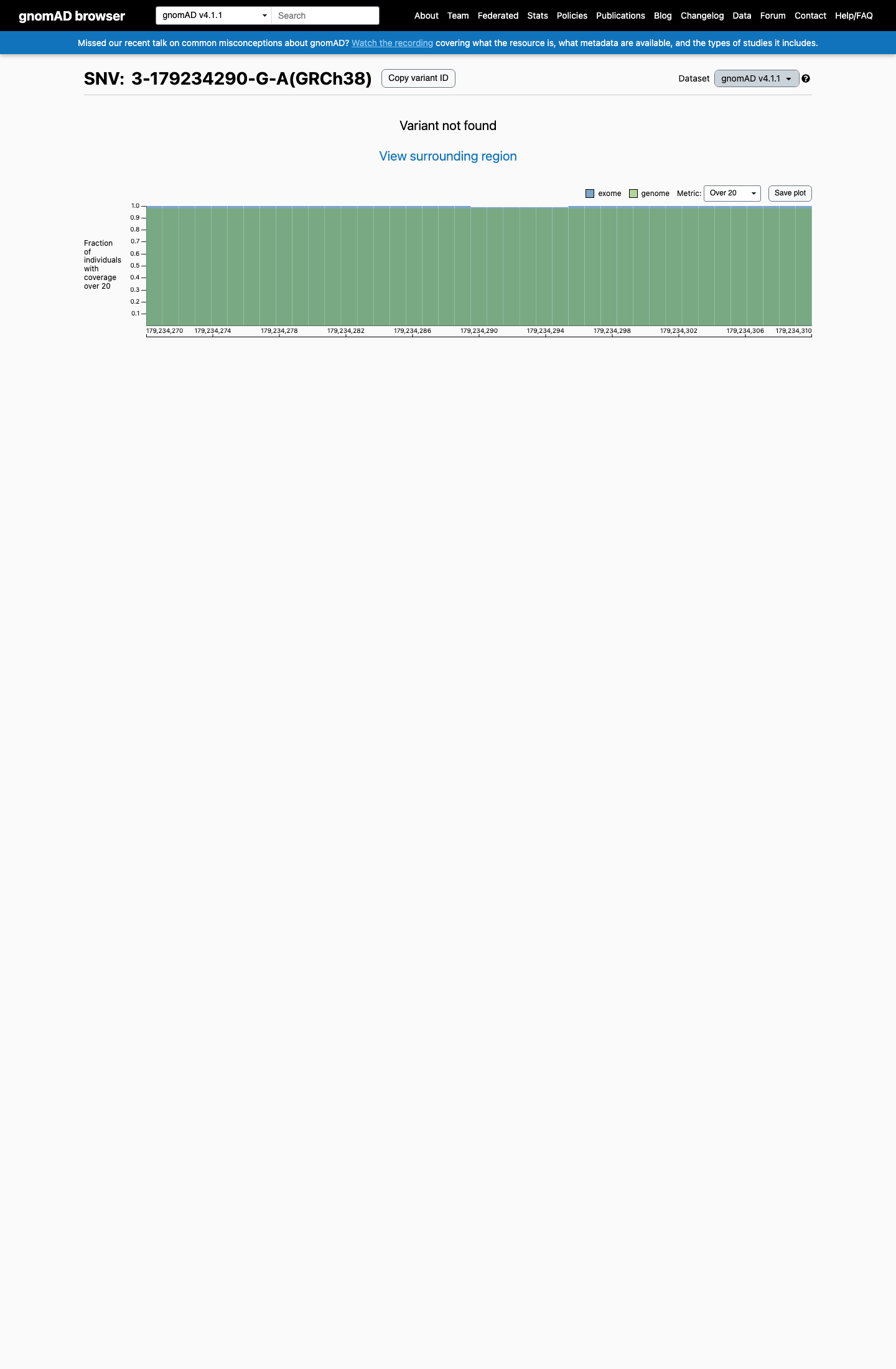
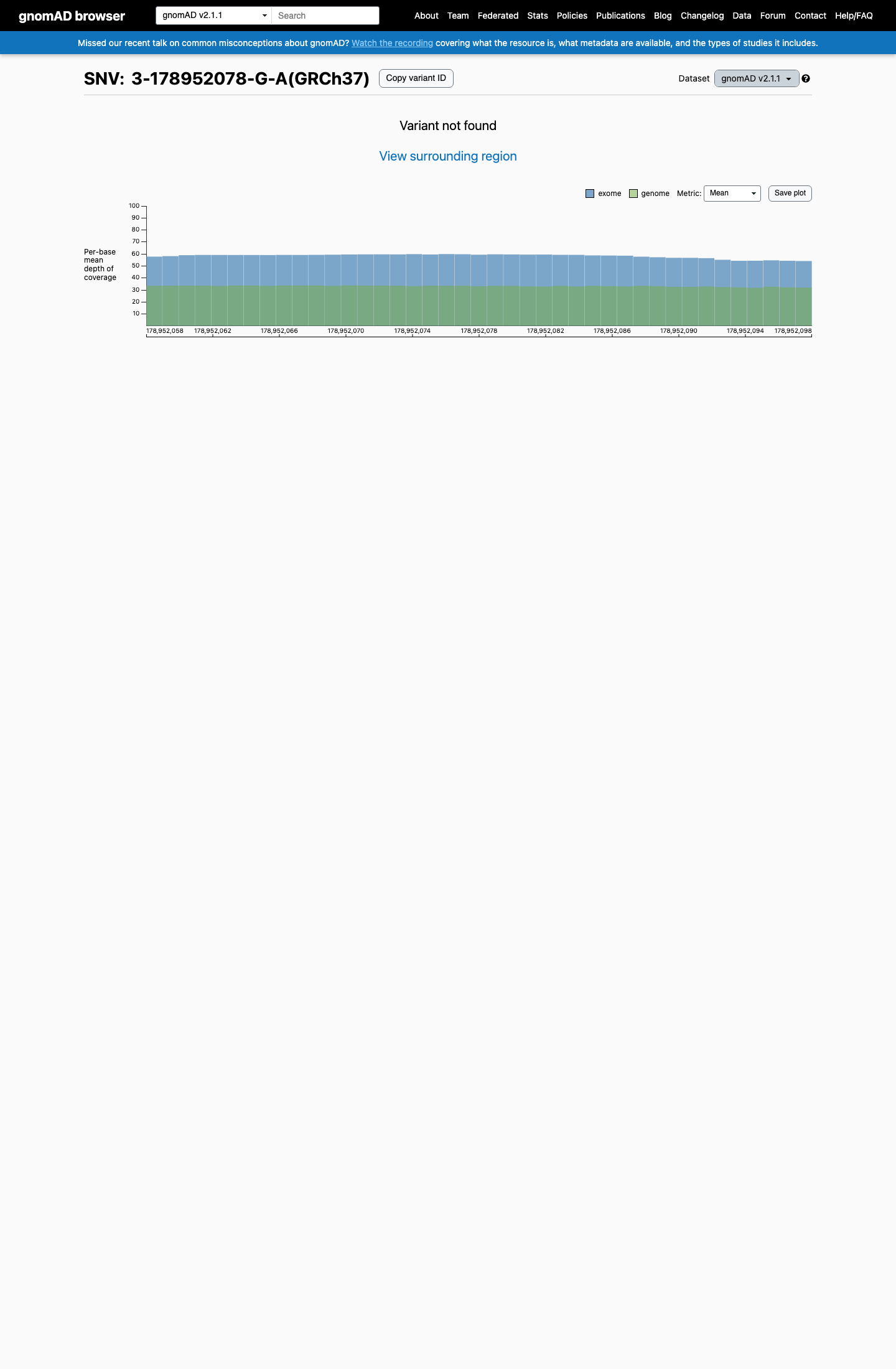
The p.Asp1045Asn substitution lies within the PIK3CA C-terminal kinase domain (AA 797-1068), a critical functional domain defined in Table 4 of the Brain Malformations VCEP specification (PM1_Supporting).1 This variant is absent from gnomAD v2.1, gnomAD v4.1, and gnomAD-Canada v1.0 population databases (PM2_Supporting).2 PIK3CA exhibits strong missense constraint with a gnomAD missense Z-score exceeding 3.09, meeting the VCEP threshold for PP2_Supporting.3 Under the Brain Malformations VCEP Tavtigian point framework, total points = +3 (PM1_Supporting +1, PM2_Supporting +1, PP2_Supporting +1), which falls within the VUS range (0-5 points). The final classification is Uncertain Significance.4

PM1 + PM2 + PP2 VUS
1 cspec ↗vcep_clingen_brainmalform_acmg_specifications_v1_1
3 cspec ↗vcep_clingen_brainmalform_acmg_specifications_v1_1
4 final_classification_frameworkcspec ↗
Gene diagram · NM_006218.3 · variants mapped to exon structure
PIK3CA NM_006218.3
Fetching transcript structure from UCSC…
Applied criteria · 3 applied · 11 assessed
Applied · 3
Strength Supporting Moderate Strong Very strong
PM1 supporting Pathogenic
Residue p.Asp1045 lies within the PIK3CA C-terminal kinase domain (AA 797-1068), which is listed as a critical functional domain in Table 4 of the Brain Malformations VCEP specification. Per VCEP rules, PM1_Supporting is domain-based and does not require hotspot recurrence when the residue falls inside an approved Table 4 domain.
Residue D1045 is within the PIK3CA kinase domain (AA 797-1068) per VCEP Table 4 approved critical functional domains.
PM2 supporting Pathogenic
This variant is absent from gnomAD v2.1, gnomAD v4.1, and gnomAD-Canada v1.0 population databases. Per VCEP specification, PM2 is applied at Supporting strength for variants absent or rare (≤1) in an ethnically-matched cohort population sample.
Absent from gnomAD v2.1gnomAD v4.1and gnomAD-Canada v1.0.
PP2 supporting Pathogenic
PIK3CA is a gene with a low rate of benign missense variation. Per the VCEP specification, PP2 is awarded for PIK3CA because the missense constraint Z-score in gnomAD/ExAC exceeds 3.09, and PIK3CA is explicitly listed as an applicable gene for this criterion.
PIK3CA missense Z-score in gnomAD exceeds the 3.09 threshold. VCEP explicitly lists PIK3CA as applicable for PP2.
Assessed · not applied
Pathogenic
PS1 No other nucleotide change resulting in the same amino acid substitution (p.Asp1045Asn) has been identified as pathogenic in ClinVar or the literature.
PS2 No de novo evidence is available.
PS3 No variant-specific functional studies were identified.
PS4 Under the VCEP PS4 point-based system, phenotyped cases from literature are required for point assignment.
PM5 No different pathogenic missense variant has been identified at the same amino acid residue (p.Asp1045).
Benign
BA1 The VCEP BA1 threshold is allele frequency >0.0926%.
BS1 The VCEP BS1 threshold is allele frequency >0.0185%.
BS2 Under the VCEP, BS2 requires ≥3 homozygotes in gnomAD or ≥3 heterozygous in well-phenotyped family members.
BS3 No well-established in vitro or in vivo functional studies demonstrating no damaging effect on protein function or splicing were identified for this variant.
BP2 No evidence that this variant has been observed in cis or trans with a known pathogenic variant in PIK3CA.
BP5 No alternate molecular basis for disease has been identified in a case carrying this variant.
N/A · 11 PVS1 · PM6 · PP1 · PP3 · PP4 · PP5 · BS4 · BP1 · BP4 · BP6 · BP7
Research & evidence
Population frequency
gnomAD v4.1 screenshot
gnomAD v4.1
gnomAD v2.1 screenshot
gnomAD v2.1
v4.1
Absent from gnomAD v4.1.
v2.1
Absent from gnomAD v2.1.
🇨🇦 CA
Absent from gnomAD-Canada v1.0.
Allele frequency by ancestry
three datasets · side by side
gnomAD v4.1
Absent · 0 / ?
0 hom
Not observed in any ancestry group.
gnomAD v2.1
Absent · 0 / ?
0 hom
Not observed in any ancestry group.
gnomAD Canada 🇨🇦
Absent · 0 / ?
0 hom
Not observed in any ancestry group.
ClinVar screenshot
ClinVar
This variant has been reported in ClinVar as Uncertain significance (1 clinical laboratory). (ClinVarID = 3774060)
SpliceAI screenshot
In silico
SpliceAI predicts no significant splice impact for this variant (max delta score = 0.05). REVEL score = 0.377. BayesDel score = -0.280982.
Functional / OncoKB screenshot
Functional Unknown Oncogenic Effect
OncoKB did not identify variant-specific reviewed functional evidence for this variant; gene-level curated context is available for reviewer follow-up. PIK3CA, the catalytic subunit of PI3-kinase, is frequently mutated in a diverse range of cancers including breast, endometrial and cervical cancers.
OncoKB ↗
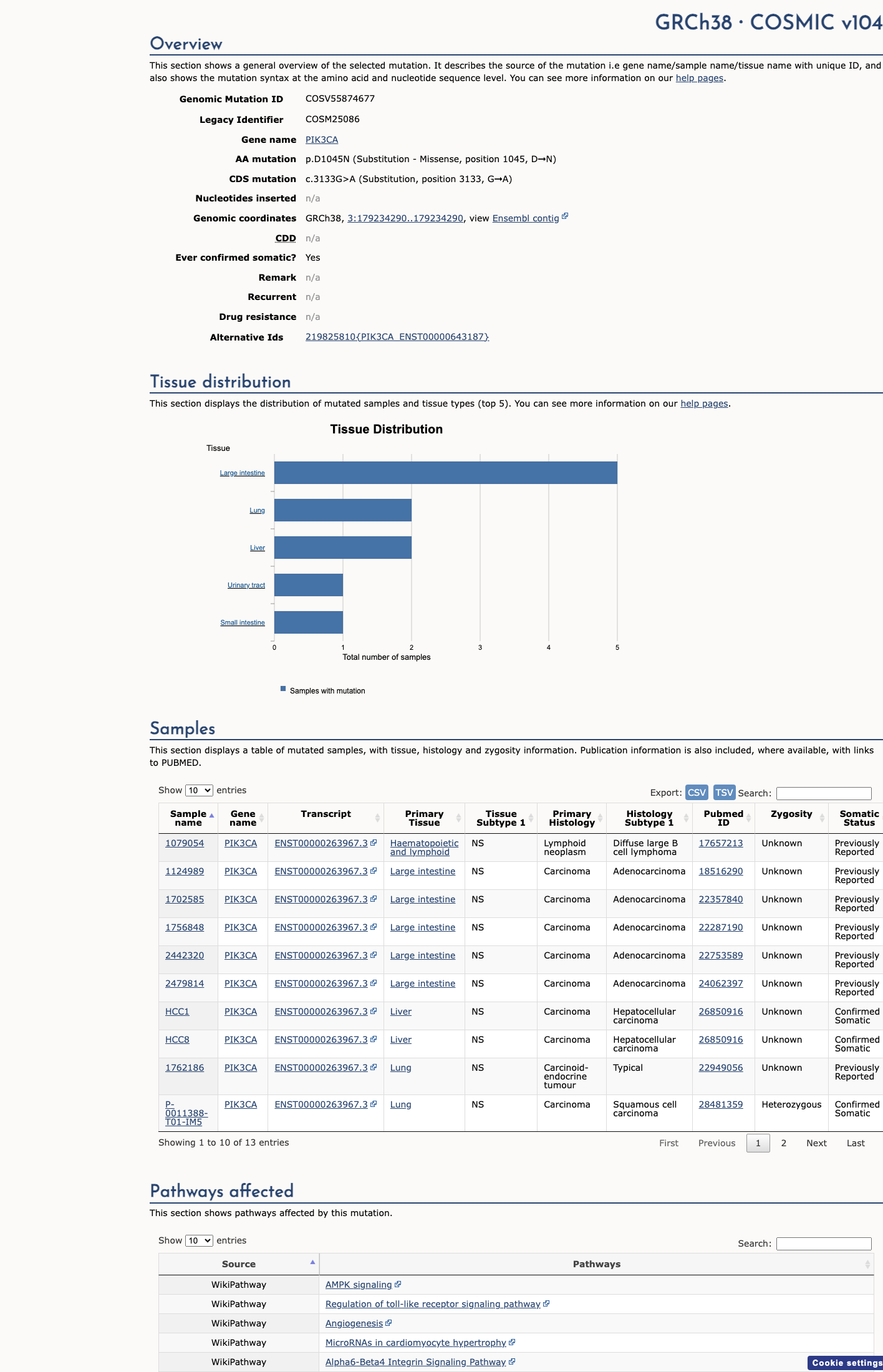
COSMIC screenshot
COSMIC
Cancer hotspots screenshot
Cancer hotspots
Somatic evidence Not in COSMIC / hotspots
COSMIC
This variant does not lie in a statistically significant hotspot. This variant has previously been reported in somatic cancers (COSMIC; COSV55874677, n = 13 times).
Hotspots
This variant does not lie in a statistically significant hotspot.
Sources & reference links
9Sources
CSpec VCEP
ClinVar
gnomAD v2.1
gnomAD v4.1
gnomAD-Canada
SpliceAI
OncoKB
COSMIC
Cancer hotspots