NM_000314.8:c.106G>C (p.Gly36Arg) is a missense variant in PTEN exon 2. It is absent from all large population databases (gnomAD v2.1, v4.1, gnomAD-Canada).1 The same amino acid change (p.Gly36Arg) from a different nucleotide substitution (c.106G>A) is classified as Likely Pathogenic by the ClinGen PTEN Variant Curation Expert Panel in ClinVar (VCV000189400, 3-star review).2 Saturation mutagenesis functional data from Mighell et al. 2018 (PMID:29706350) demonstrate a severe damaging effect: G36R cumulative fitness score is -2.69 (threshold for PS3_Moderate is <= -1.11).3 Additional functional studies corroborate the damaging effect: PMID:10772390 demonstrated 90% loss of phosphatase activity for G36R, and PMID:21828076 confirmed loss of function in a yeast in vivo assay.4 In silico predictions uniformly support pathogenicity: REVEL score 0.995 and BayesDel score 0.617.5 Applying the ClinGen PTEN VCEP v3.2.0 combination rules: PS1 (strong) is met (same amino acid change as established pathogenic c.106G>A); PS3_Moderate is met (Mighell et al. Cum_score -2.69 <= -1.11); and multiple supporting criteria are met (PM2_Supporting, PP2, PP3, PP5). Per VCEP Rule 11, one strong criterion (PS1) plus one moderate criterion (PS3_Moderate) is sufficient for a Likely Pathogenic classification.6
Final classification
Pathogenic
PS1PS3PM2PP2PP3PP5
PTEN
c.106G>C
p.Gly36Arg
This variant
NM_000314.8:c.106G>C (p.Gly36Arg) is a missense variant in PTEN exon 2. It is absent from all large population databases (gnomAD v2.1, v4.1, gnomAD-Canada).
Richards et.al., 2015 - Combining rules v3.2.0 criteria-combination framework: matched Rule8 (1 Pathogenic.Strong + 1 Pathogenic.Moderate + Pathogenic.Supporting >=4) with applied criteria: PS1 strong, PS3 moderate, PM2 supporting, PP2 supporting, PP3 supporting, PP5 supporting; maps to Pathogenic.
Classification rationale
PS1PS3PM2PP2PP3PP5
Pathogenic
PTEN c.106G>C
PS1 + PS3 + PM2 + PP2 + PP3 + PP5
→
Pathogenic
3
vcep_mmc2
5
revelbayesdel
LYFE Sciences is an AI system, and it can make mistakes. Criteria
may be applied incorrectly, sources may be misread, and a confident-looking
classification can still be wrong. Double-check every criterion and
its underlying evidence before relying on any call.
Gene diagram
· NM_000314.8 · variants mapped to exon structure
PTEN
NM_000314.8
Fetching transcript structure from UCSC…
Applied criteria · 6 applied · 15 assessed
MetEvidence satisfies this criterion.
Not metEvaluated against available evidence; threshold not reached.
Not assessedApplies in principle, but no evidence was found to evaluate it.
N/ADoesn't apply to this variant type.
Applied · 6
Strength
Supporting
Moderate
Strong
Very strong
PS1
strong
Pathogenic
NM_000314.8:c.106G>C encodes p.Gly36Arg (G36R). A different nucleotide substitution at the same codon, NM_000314.8:c.106G>A, also encoding p.Gly36Arg, is established as pathogenic: ClinVar 3-star expert panel classifies it as Likely Pathogenic (VCV000189400), and it has been reported in a Cowden syndrome proband with bilateral breast cancer (PMID:10772390) with demonstrated 90% loss of phosphatase activity. The VCEP PS1 rule is satisfied: same amino acid change as a previously established pathogenic variant regardless of nucleotide change.
Same amino acid change (p.Gly36Arg) as NM_000314.8:c.106G>Awhich is classified Likely Pathogenic by ClinGen PTEN VCEP in ClinVar (VCV0001894003-star)
PS3
moderate
Pathogenic
The PTEN G36R variant has a cumulative fitness score (Cum_score) of -2.69 in the Mighell et al. 2018 (PMID:29706350) saturation mutagenesis functional assay (mmc2.xlsx Table S2), meeting the VCEP PS3_Moderate threshold of Cum_score <= -1.11. High_conf = True and the variant Pass SE Filter. This is a massively parallel phosphatase activity assay directly testing all possible PTEN missense variants. The damaging functional effect is corroborated by PMID:10772390 (90% loss of phosphatase activity for G36R from c.106G>A) and PMID:21828076 (G36R tested among PHTS-associated mutations in yeast in vivo model, showing loss of function).
Mighell et al. 2018 saturation mutagenesis: G36R Cum_score = -2.69296249 <= -1.11 (High_conf=TruePass SE Filter)PMID:10772390: G36R (from c.106G>A) recombinant protein showed 90% loss of phosphatase activity
PM2
supporting
Pathogenic
NM_000314.8:c.106G>C is absent from all large population databases: gnomAD v2.1 (exomes), gnomAD v4.1 (exomes), and gnomAD-Canada v1.0 (HostSeq genomes). The VCEP PTEN PM2 rule applies at supporting strength when a variant is absent or present at <0.00001 (0.001%) allele frequency in gnomAD or another large sequenced population.
Absent from gnomAD v2.1Absent from gnomAD v4.1Absent from gnomAD-Canada v1.0
PP2
supporting
Pathogenic
PTEN has a low rate of benign missense variation and missense variants are a common mechanism of disease in PTEN hamartoma tumor syndrome. NM_000314.8:c.106G>C is a missense variant in a gene meeting these criteria, satisfying the VCEP PTEN PP2 rule at supporting strength.
PTEN is established as a gene with low benign missense variation rate and missense variants as a common disease mechanism
PP3
supporting
Pathogenic
Multiple lines of in silico evidence support a deleterious effect. The REVEL score is 0.995, which exceeds the VCEP PTEN PP3 threshold of >0.7 for missense variants. The BayesDel score is 0.617, providing additional orthogonal support for a damaging prediction.
REVEL score 0.995 > 0.7 (VCEP threshold)BayesDel score 0.617 (supports damaging prediction)
PP5
supporting
Pathogenic
Expert panel Clingen PTEN Variant Curation Expert Panel, Clingen classified as Likely pathogenic.
ClinVar VCV000189400: Likely Pathogenicreviewed by expert panel (ClinGen PTEN VCEP3-star)
Assessed · not applied
· 15 not met · 0 not assessed
Pathogenic
PS2
No de novo observation has been identified for this variant.
PS4
Only a single proband with this variant has been identified in the reviewed literature (PMID:10772390 reports a Cowden syndrome patient with c.106G>A, same amino acid change).
PM1
G36 is located in the N-terminal region of PTEN (position 36 of NP_000305.3).
PM5
No different missense variant at residue G36 has been independently classified as Pathogenic or Likely Pathogenic in ClinVar with expert panel review to satisfy the VCEP PM5 rule.
PM6
No de novo observation has been identified for NM_000314.8:c.106G>C.
PP1
No co-segregation data are available for this variant.
Benign
BA1
The variant is absent from gnomAD v2.1, v4.1, and gnomAD-Canada.
BS1
The variant is absent from gnomAD.
BS2
No homozygous observations of this variant have been identified in healthy or PHTS-unaffected individuals.
BS3
The functional data demonstrate a damaging effect, not a benign effect.
BS4
No segregation data are available to evaluate lack of segregation.
BP2
No observations of this variant in trans with a pathogenic or likely pathogenic PTEN variant, nor three or more observations in cis or unknown phase with different P/LP PTEN variants, have been identified.
BP4
Computational evidence does not suggest a benign impact.
BP5
No case has been identified where this variant was found in a patient with an alternate molecular basis for disease.
BP7
NM_000314.8:c.106G>C is a missense variant (p.Gly36Arg), not a synonymous or intronic variant.
N/A · 7
PVS1 · PM3 · PM4 · PP4 · BP1 · BP3 · BP6
Research & evidence
Population frequency · supports pathogenic
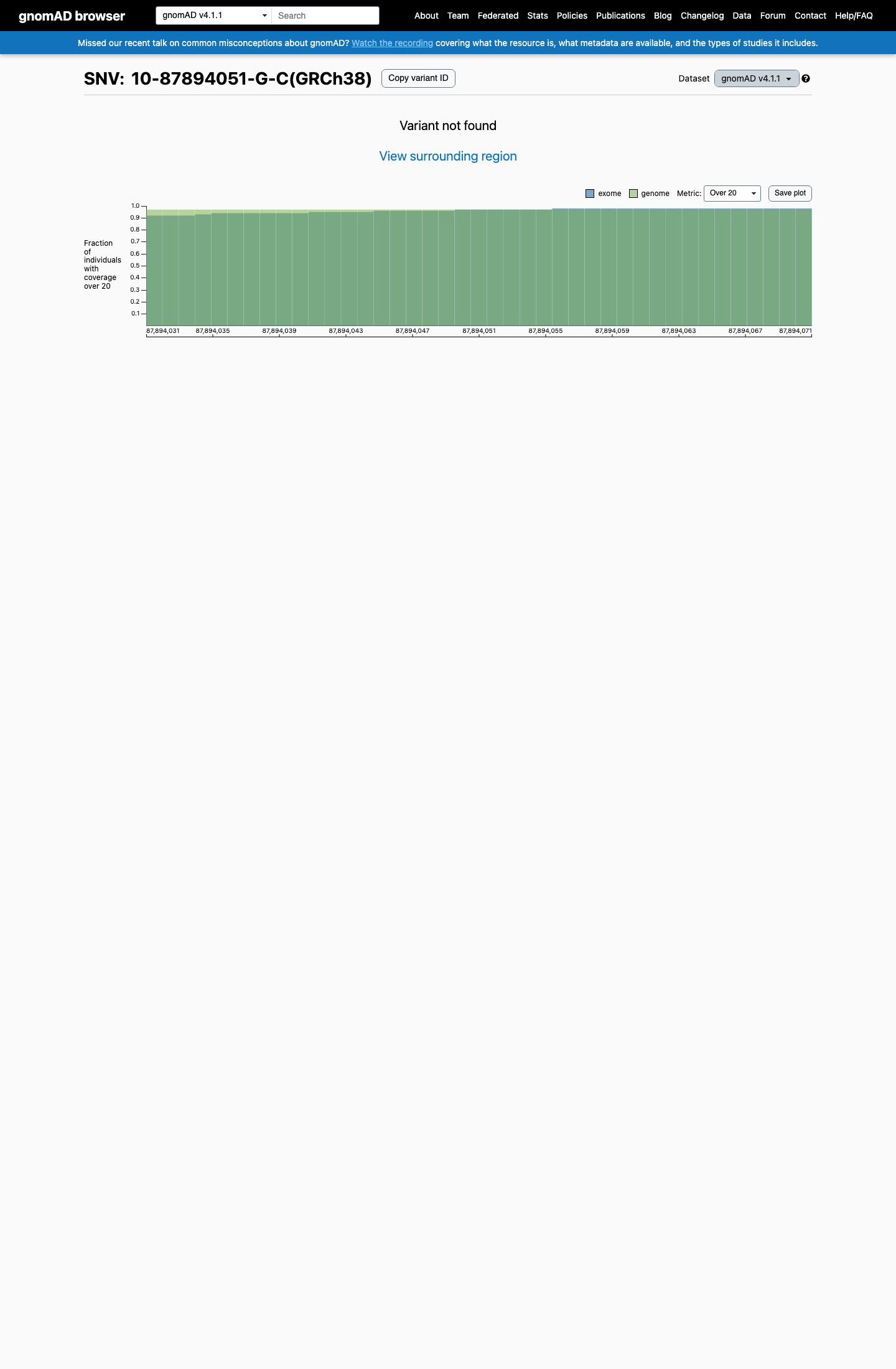
gnomAD v4.1
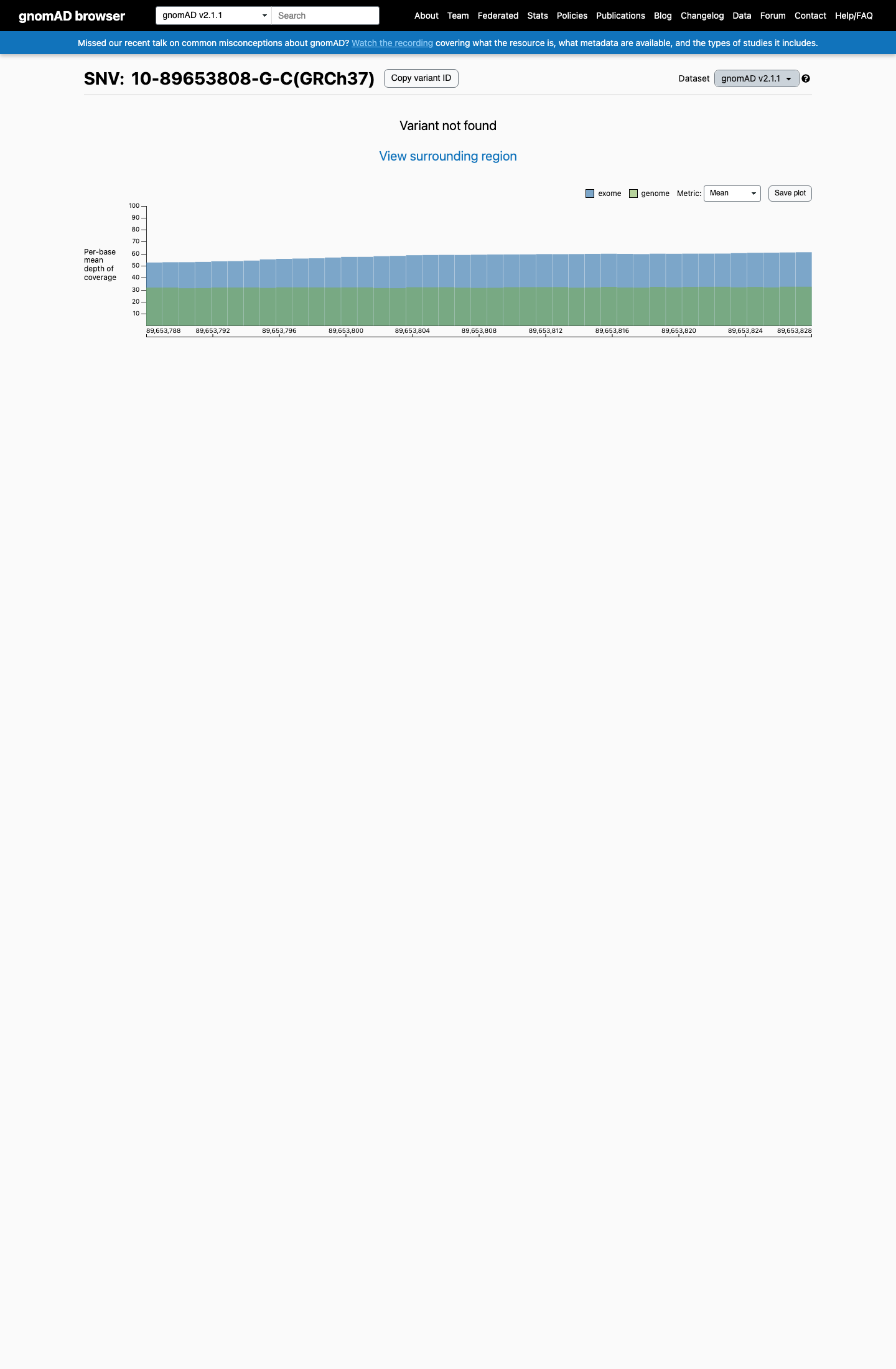
gnomAD v2.1
v4.1
Absent from gnomAD v4.1.
v2.1
Absent from gnomAD v2.1.
🇨🇦 CA
Absent from gnomAD-Canada v1.0.
Allele frequency by ancestry
three datasets · side by side
gnomAD v4.1
Absent
· 0 / ?
0 hom
0 hom
Not observed in any ancestry group.
gnomAD v2.1
Absent
· 0 / ?
0 hom
0 hom
Not observed in any ancestry group.
gnomAD Canada 🇨🇦
Absent
· 0 / ?
0 hom
0 hom
Not observed in any ancestry group.
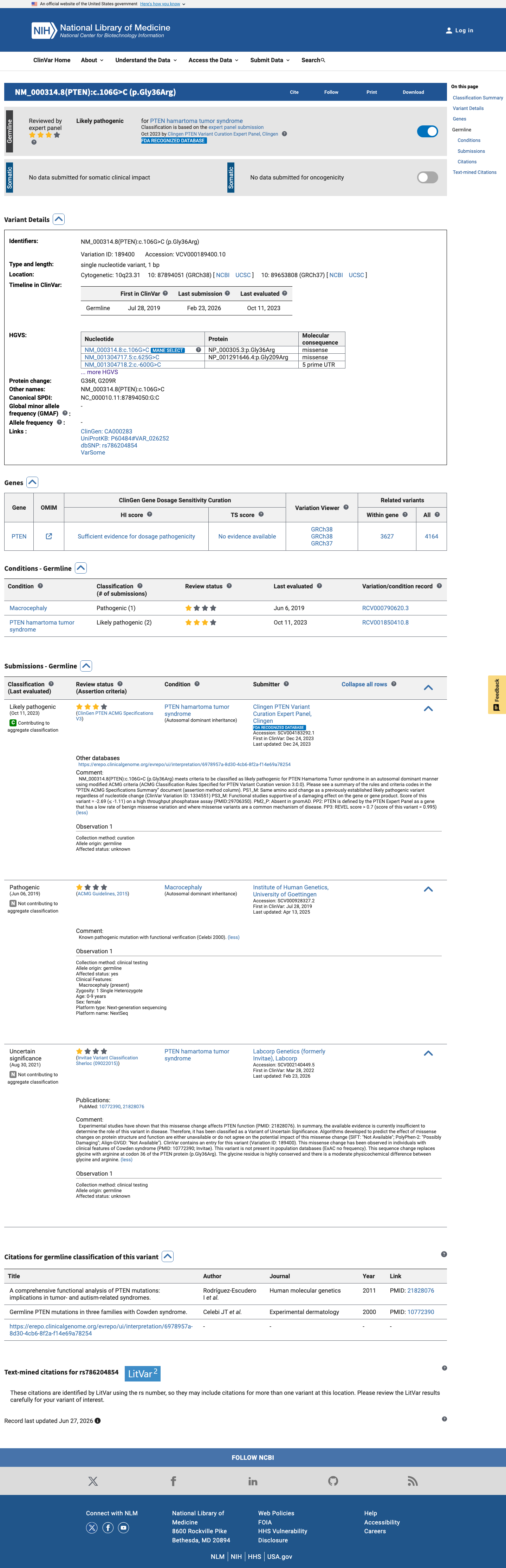
ClinVar
This variant has been reported in ClinVar as Pathogenic (1 clinical laboratory) and as Uncertain significance (1 clinical laboratory) and as Likely pathogenic by Clingen PTEN Variant Curation Expert Panel, Clingen (expert panel). (ClinVarID = 189400)
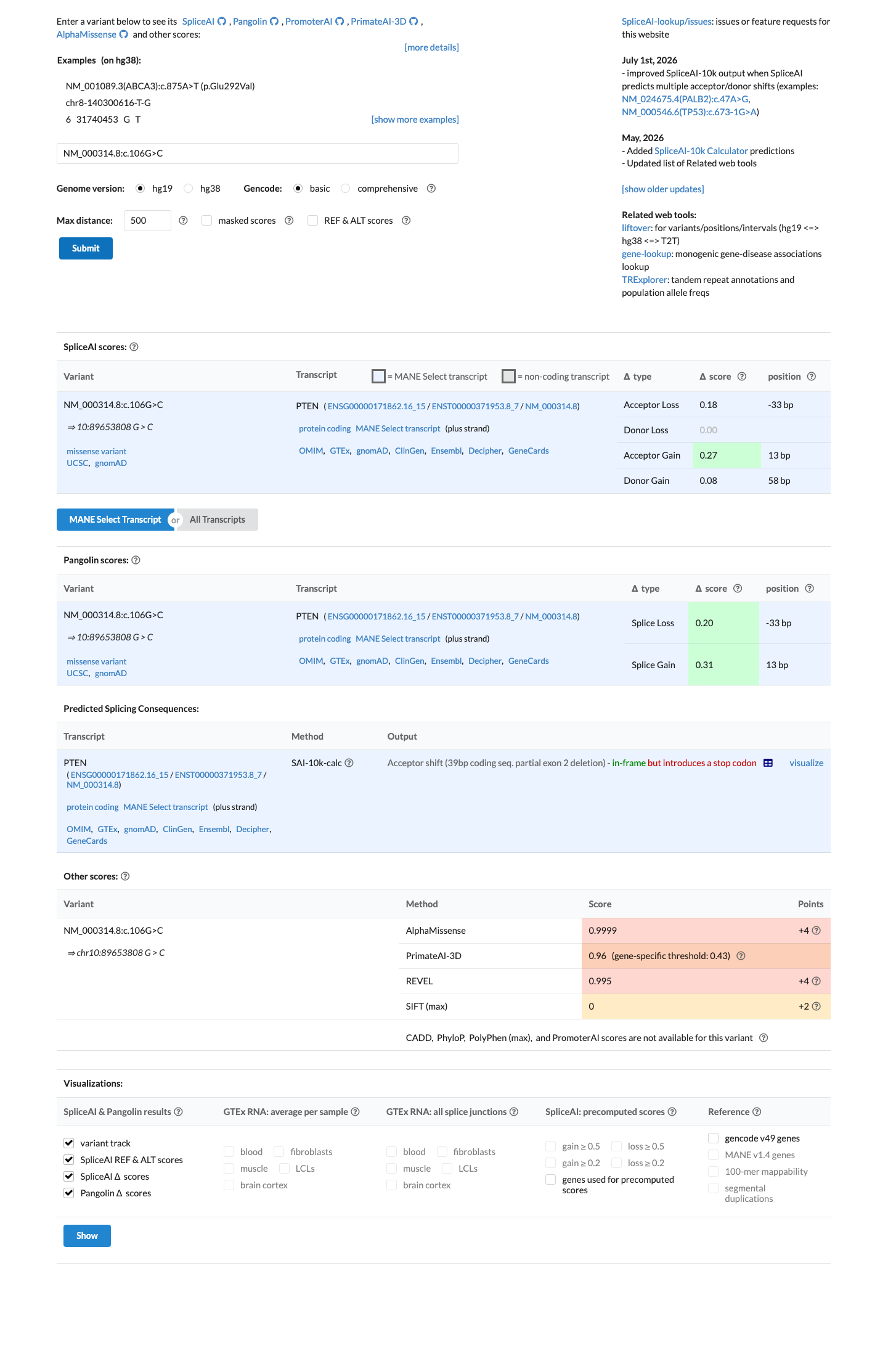
In silico
SpliceAI predicts possible splice impact for this variant (max delta score = 0.27). REVEL score = 0.995. BayesDel score = 0.616964.
Functional
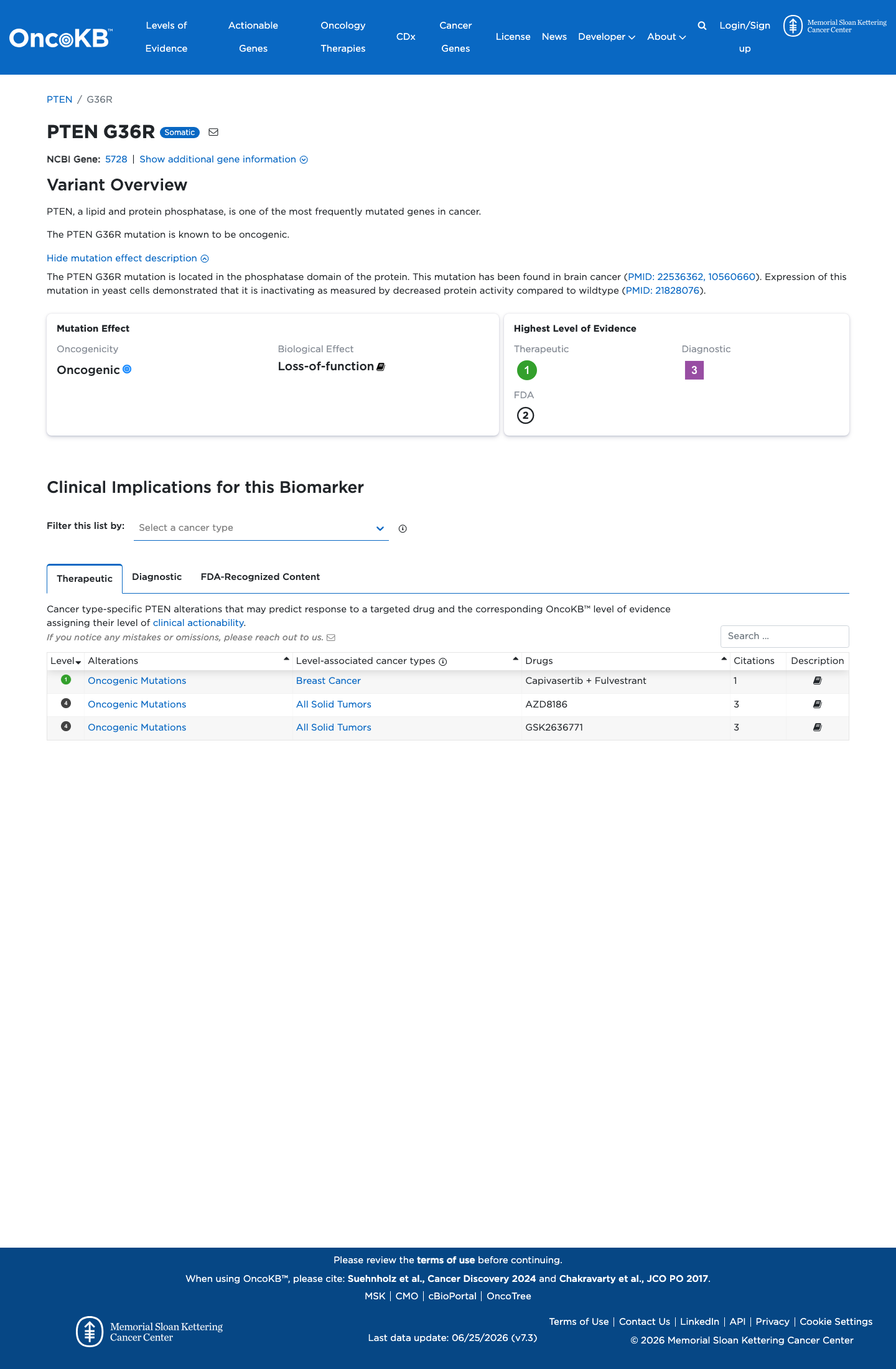
Oncogenic
OncoKB identified variant-specific curated literature and context relevant to functional review; biological-effect context: Loss-of-function; curated oncogenicity label: Oncogenic.
COSMIC

Cancer hotspots
Somatic evidence
Hotspot
COSMIC
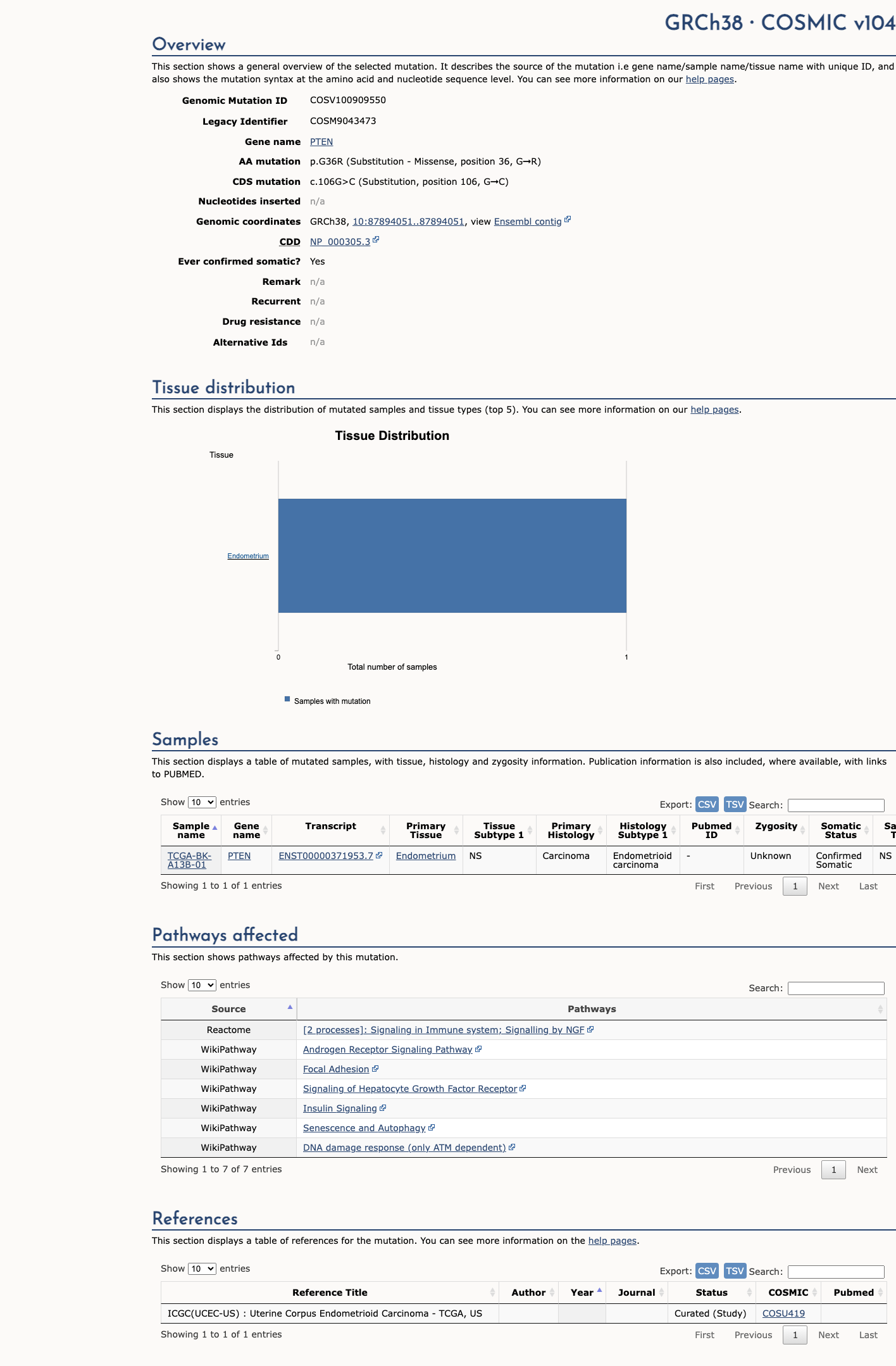
This variant lies in a statistically significant hotspot. This variant has previously been reported in somatic cancers (COSMIC; COSV100909550, n = 1 times).
Hotspots
This variant lies in a statistically significant hotspot.
Literature · how each cited paper was used
2papers cited
Each card is an audit: what was searched, what was found, whether it names the variant, which criteria it fed, and why. 5 further PMIDs triaged but not cited — see Sources & references.
Germline PTEN mutations in three families with Cowden syndrome.
Searched
c.106G>Cc.106G>AG36RGly36Arg106G
Found
Reports NM_000314.8:c.106G>A (p.Gly36Arg) in a 47-year-old female with Cowden syndrome presenting with trichilemmomas, oral papillomatosis, acral keratosis, uterine fibroids, gastrointestinal polyps, macrocephaly, and bilateral breast carcinoma diagnosed at ages 28 and 31. The recombinant mutant PTEN protein showed 90% loss of phosphatase activity. The variant was confirmed absent in 30 unaffected unrelated individuals.
Variant
✓ Names this variant — characterised directly
Applied to
→PS1
met
→PS3
met
Why
Same amino acid change (G36R) from c.106G>A supports PS1; functional data corroborates PS3. Does not independently provide proband count sufficient for PS4.
the recombinant mutant PTEN protein showed a 90% loss of its phosphatase activity
Location Results, Table 1 (MHS-65-1); Discussion paragraphs 1-2 · Context In vitro phosphatase assay using recombinant PTEN protein · full text
A comprehensive functional analysis of PTEN mutations: implications in tumor- and autism-related syndromes.
Searched
G36RGly36Argc.106G
Found
G36R was tested among a panel of 24 PHTS-associated PTEN missense mutations in a yeast in vivo heterologous reconstitution system measuring PIP3 phosphatase activity. Most PHTS-associated mutations, including G36R, generated total or partial loss of function. Global comparison demonstrated that PHTS-associated mutations were significantly more deleterious than ASD/DD-associated mutations (p<0.001).
Variant
✓ Names this variant — characterised directly
Applied to
→PS3
met
Why
Provides supporting functional evidence consistent with loss of function for G36R; reinforces PS3_Moderate from saturation mutagenesis data.
mutations A34D, M35R, G36R, N48K, H61D, Y68D, D92E, H93Y, P96Q, H123D, C124S, G129E, R130G, Y155C, G165E, G165V, S170R, L181P, V217N, P246L, R335L, V343E; L345V and F347L
Location Results, PHTS mutations section; Figure 6A; Supplementary Material Table S1 · Context Yeast S. cerevisiae heterologous expression system; p110alpha-CAAX co-expression; GFP-Akt1 membrane localization readout · full text
Sources & reference links
9Sources
Triaged references · 5 PMIDs not cited in assessment
10560660 ↗
Mutational profile of the PTEN gene in primary human astrocytic tumors and cultivated xenografts.
ONCOKB
22536362 ↗
Characterizing mutational heterogeneity in a glioblastoma patient with double recurrence.
ONCOKB
25645574 ↗
ACG clinical guideline: Genetic testing and management of hereditary gastrointestinal cancer syndromes.
CLINVAR
25741868 ↗
Standards and guidelines for the interpretation of sequence variants: a joint consensus recommendation of the American College of Medical Genetics and Genomics and the Association for Molecular Pathology.
CLINVAR
17392385 ↗
American Cancer Society guidelines for breast screening with MRI as an adjunct to mammography.
CLINVAR