NM_000465.4:c.1788del (p.Lys596AsnfsTer9) is a frameshift deletion in exon 8 of the BARD1 gene, predicted to trigger nonsense-mediated decay and remove the C-terminal BRCT domains essential for homology-directed DNA repair and tumor suppression.1 BARD1 loss of function is an established mechanism for hereditary breast and ovarian cancer susceptibility, supported by multiple publications identifying deleterious truncating germline BARD1 mutations in affected families.2 The variant is absent from gnomAD v2.1, v4.1, and gnomAD-Canada population databases, indicating it is extremely rare in the general population.3 Three independent clinical laboratories in ClinVar classify this variant as Pathogenic or Likely pathogenic (ClinVar Variation ID: 801882), providing additional supporting evidence.4 Applying generic ACMG/AMP 2015 classification rules: PVS1 (very strong) + PM2 (moderate) + PP5 (supporting) meets the pathogenic threshold of 1 Very Strong + 1 Moderate + 1 Supporting.5 Overall classification: PATHOGENIC.6
Final classification
Pathogenic
PVS1PM2PP5
BARD1
c.1788del
p.Lys596AsnfsTer9
This variant
NM_000465.4:c.1788del (p.Lys596AsnfsTer9) is a frameshift deletion in exon 8 of the BARD1 gene, predicted to trigger nonsense-mediated decay and remove the C-terminal BRCT domains essential for homology-directed DNA repair and tumor suppression.
gene-specific framework lacked a usable explicit final combination framework, so generic ACMG/AMP 2015 final-combination rules were applied as fallback; applied criteria: PVS1 very strong, PM2 moderate, PP5 supporting; combination = 1 very strong + 1 moderate + 1 supporting, which maps to Pathogenic.
Classification rationale
PVS1PM2PP5
Pathogenic
BARD1 c.1788del
PVS1 + PM2 + PP5
→
Pathogenic
1
pvs1_variant_assessmentPMID:20077502 ↗
2
pvs1_gene_contextPMID:20077502 ↗PMID:21344236 ↗
5
generic_acmg_combination_rules
6
generic_acmg_combination_rules
LYFE Sciences is an AI system, and it can make mistakes. Criteria
may be applied incorrectly, sources may be misread, and a confident-looking
classification can still be wrong. Double-check every criterion and
its underlying evidence before relying on any call.
Gene diagram
· NM_000465.4 · variants mapped to exon structure
BARD1
NM_000465.4
Fetching transcript structure from UCSC…
Applied criteria · 3 applied · 16 assessed
MetEvidence satisfies this criterion.
Not metEvaluated against available evidence; threshold not reached.
Not assessedApplies in principle, but no evidence was found to evaluate it.
N/ADoesn't apply to this variant type.
Applied · 3
Strength
Supporting
Moderate
Strong
Very strong
PVS1
very strong
Pathogenic
NM_000465.4:c.1788del is a frameshift deletion in exon 8 of 11, predicted to cause a premature termination codon (p.Lys596AsnfsTer9) at codon 604, well upstream of the last exon-exon junction, and is expected to trigger nonsense-mediated decay. BARD1 loss of function is an established mechanism for hereditary breast and ovarian cancer susceptibility. The transcript NM_000465.4 is the MANE Select transcript and is biologically relevant. Under the ClinGen SVI PVS1 decision framework (PMC6185798), this null variant in a gene where LOF is a known disease mechanism qualifies for PVS1 at very strong strength.
Frameshift deletion c.1788del in exon 8/11 produces premature stop at codon 604upstream of NMD boundaryBARD1 loss of function is an established germline disease mechanism for hereditary breast/ovarian cancer
PM2
moderate
Pathogenic
NM_000465.4:c.1788del is absent from gnomAD v2.1 (exomes), gnomAD v4.1 (exomes/genomes), and gnomAD-Canada v1.0. This satisfies the PM2 threshold for a rare variant absent from large population databases (allele frequency <0.1% under generic ACMG).
Absent from gnomAD v2.1Absent from gnomAD v4.1Absent from gnomAD-Canada v1.0
PP5
supporting
Pathogenic
NM_000465.4:c.1788del is classified as Pathogenic by two clinical laboratories and Likely pathogenic by one clinical laboratory in ClinVar (ClinVarID: 801882). While the review status is 'criteria provided, single submitter' (1-star, not expert panel), the concordant classification from three independent clinical testing laboratories provides supporting evidence for pathogenicity. The evidence used by these laboratories is partially verifiable (PM2 — absence from population databases).
ClinVar: Pathogenic (Labcorp/InvitaeMyriad Genetics)Likely pathogenic (Mendelics)
Assessed · not applied
· 16 not met · 0 not assessed
Pathogenic
PS2
No de novo observation was identified for NM_000465.4:c.1788del in the reviewed literature or ClinVar submissions.
PS3
No variant-specific functional data was identified for NM_000465.4:c.1788del.
PS4
The variant is reported in ClinVar as Pathogenic/Likely pathogenic by three clinical laboratories, indicating it has been observed in affected individuals.
PM6
No de novo observation was identified for NM_000465.4:c.1788del in the reviewed literature or ClinVar submissions.
PP1
No cosegregation data was identified for NM_000465.4:c.1788del.
PP3
SpliceAI predicts no significant splice impact (max delta score = 0.03).
PP4
No specific patient phenotype or family history data is available for the individual(s) carrying NM_000465.4:c.1788del.
Benign
BA1
NM_000465.4:c.1788del is absent from gnomAD v2.1, v4.1, and gnomAD-Canada.
BS1
NM_000465.4:c.1788del is absent from gnomAD v2.1, v4.1, and gnomAD-Canada.
BS2
No data on observation of NM_000465.4:c.1788del in healthy adults.
BS3
No functional studies were identified that demonstrate NM_000465.4:c.1788del has no damaging effect on protein function or splicing.
BS4
No cosegregation data is available for NM_000465.4:c.1788del.
BP2
No data on observation of NM_000465.4:c.1788del in trans with a known pathogenic BARD1 variant.
BP4
SpliceAI predicts no significant splice impact (max delta = 0.03), but this is a single computational data point, not 'multiple lines of computational evidence' as required by BP4.
BP5
No evidence was identified that NM_000465.4:c.1788del occurs in a case with an alternate molecular basis for disease.
BP6
ClinVar classifies NM_000465.4:c.1788del as Pathogenic/Likely pathogenic, not benign.
N/A · 9
PS1 · PM1 · PM3 · PM4 · PM5 · PP2 · BP1 · BP3 · BP7
Research & evidence
Population frequency · supports pathogenic
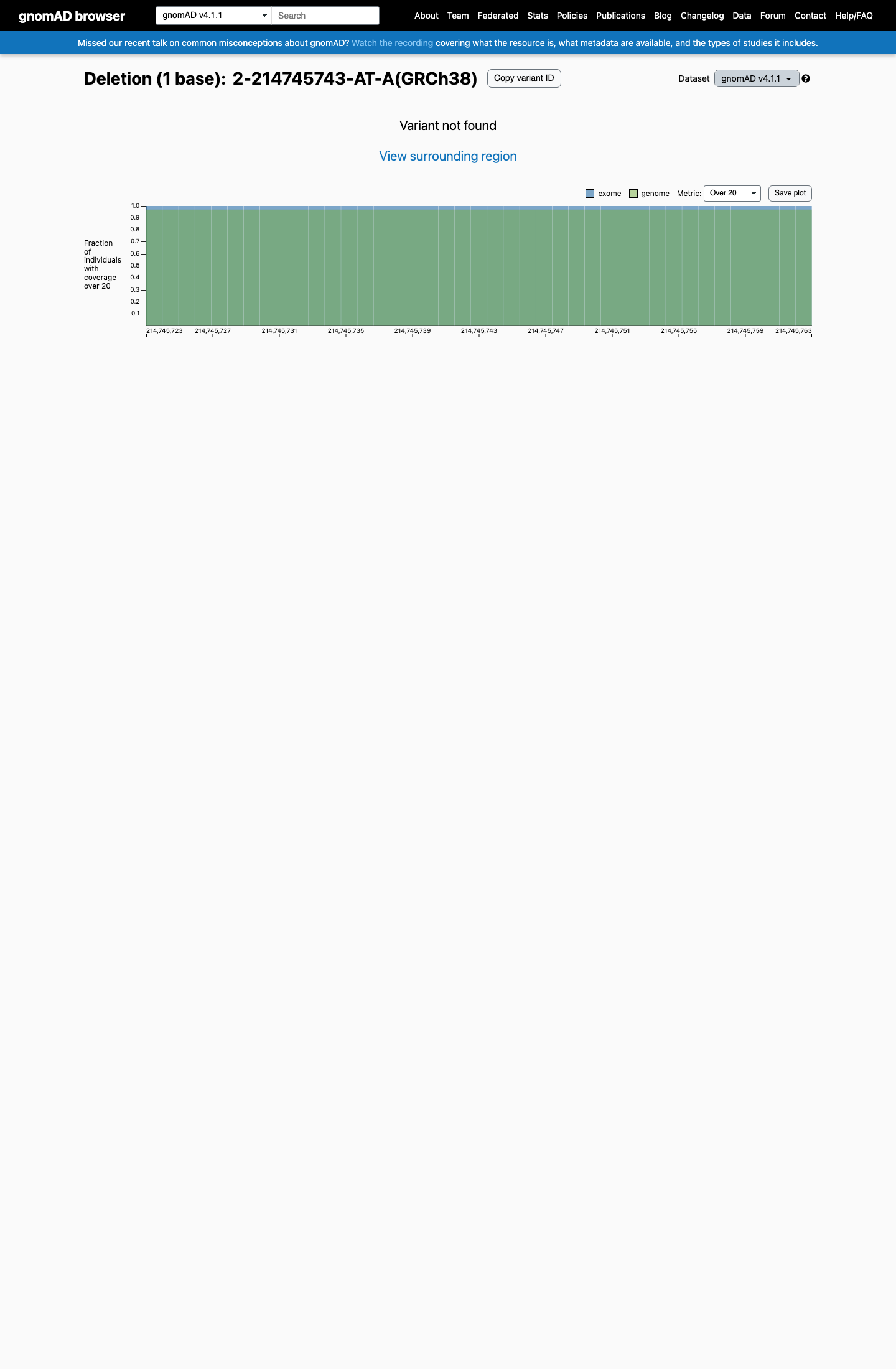
gnomAD v4.1
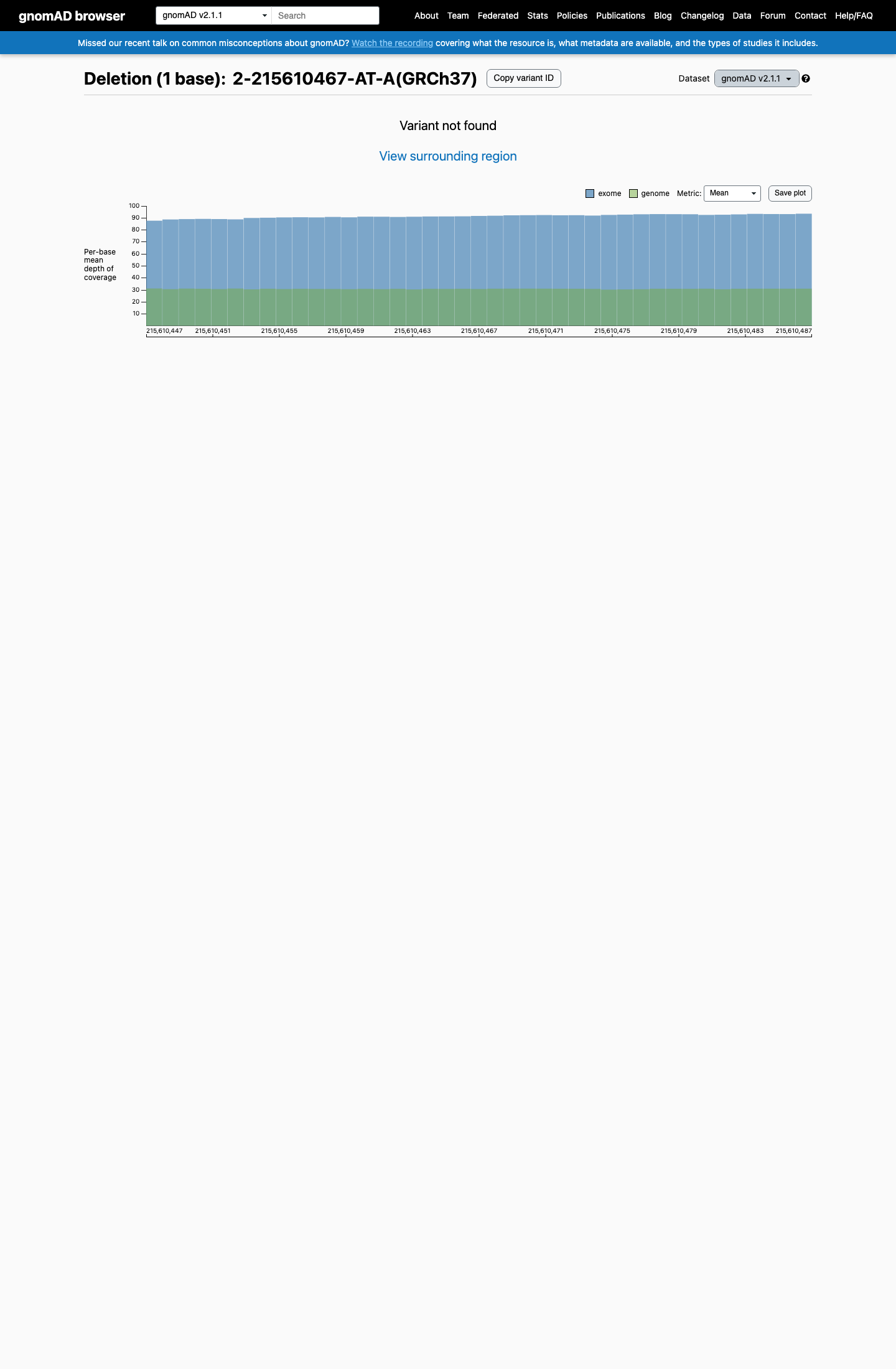
gnomAD v2.1
v4.1
Absent from gnomAD v4.1.
v2.1
Absent from gnomAD v2.1.
🇨🇦 CA
Absent from gnomAD-Canada v1.0.
Allele frequency by ancestry
three datasets · side by side
gnomAD v4.1
Absent
· 0 / ?
0 hom
0 hom
Not observed in any ancestry group.
gnomAD v2.1
Absent
· 0 / ?
0 hom
0 hom
Not observed in any ancestry group.
gnomAD Canada 🇨🇦
Absent
· 0 / ?
0 hom
0 hom
Not observed in any ancestry group.
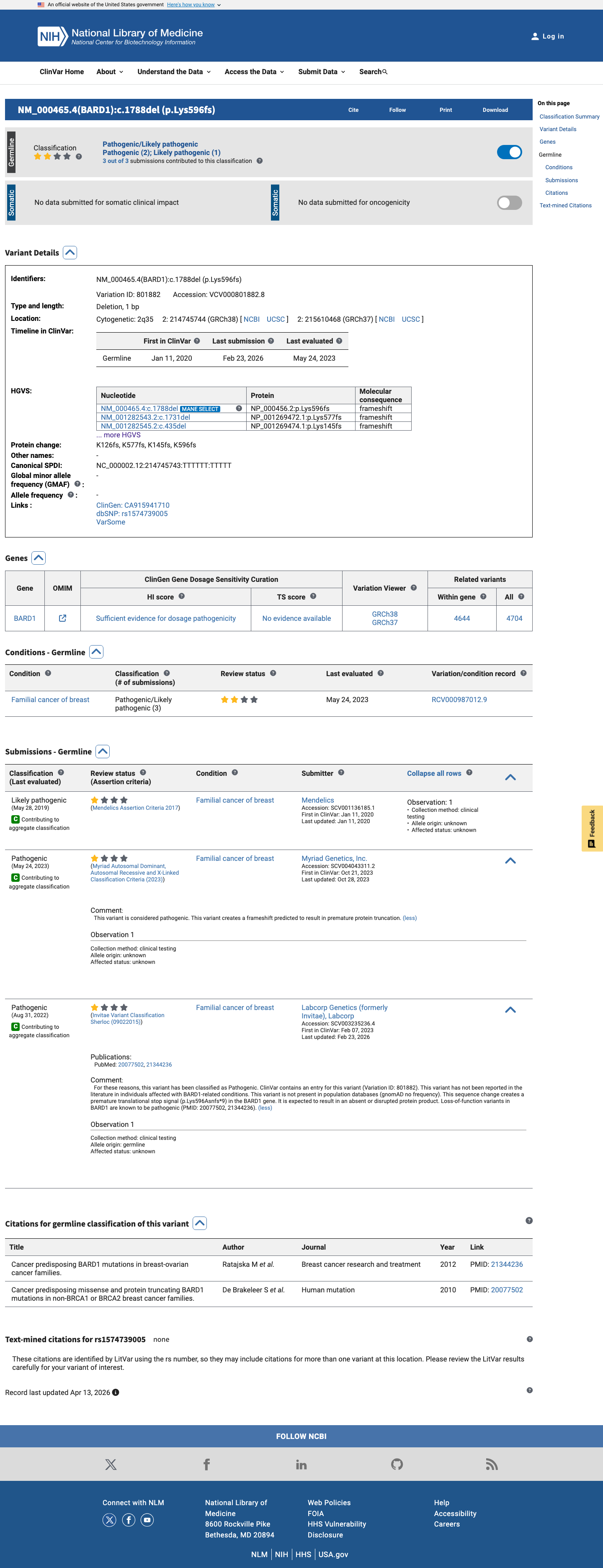
ClinVar
This variant has been reported in ClinVar as Pathogenic (2 clinical laboratories) and as Likely pathogenic (1 clinical laboratory). (ClinVarID = 801882)
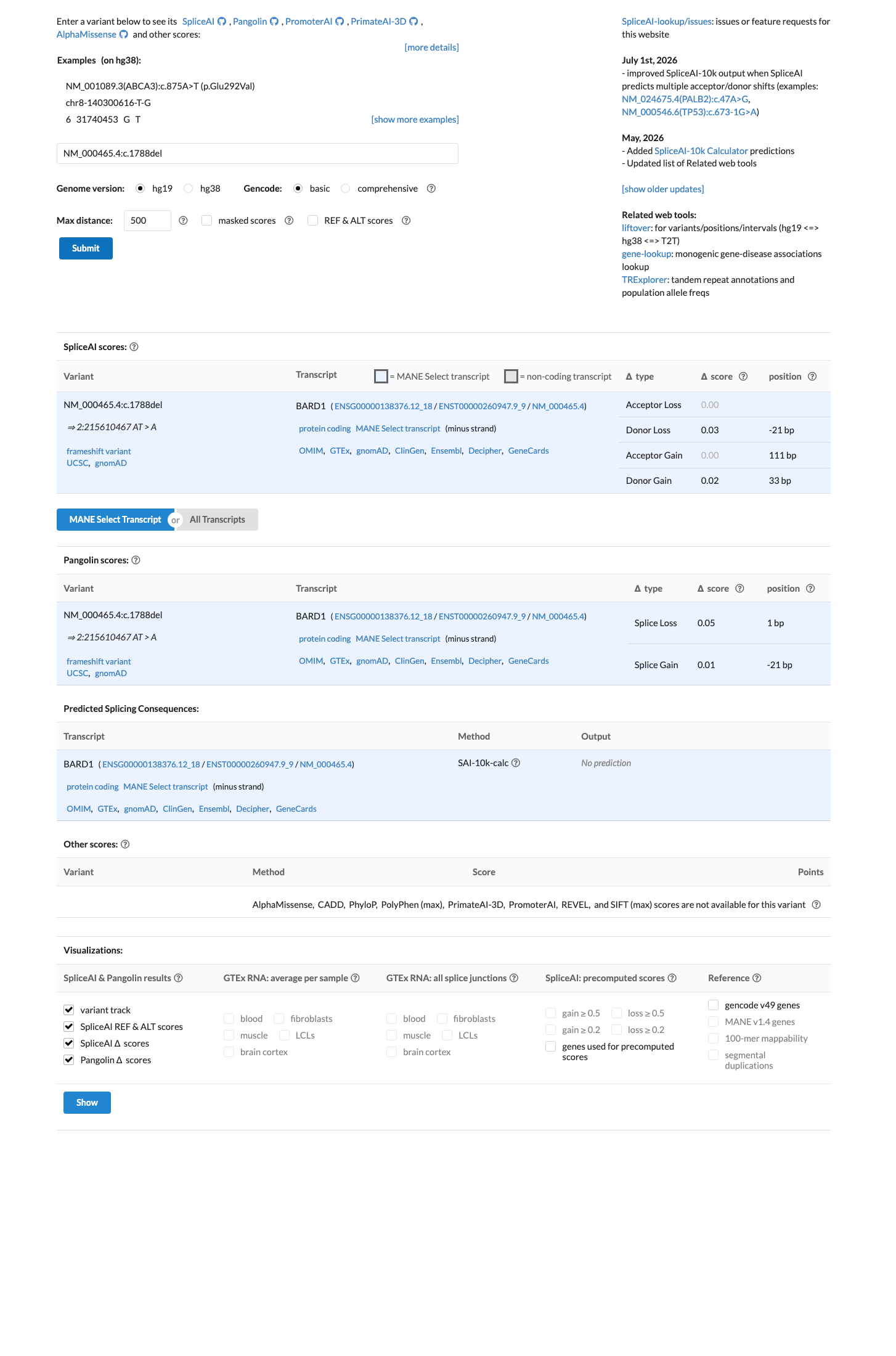
In silico
SpliceAI predicts no significant splice impact for this variant (max delta score = 0.03).
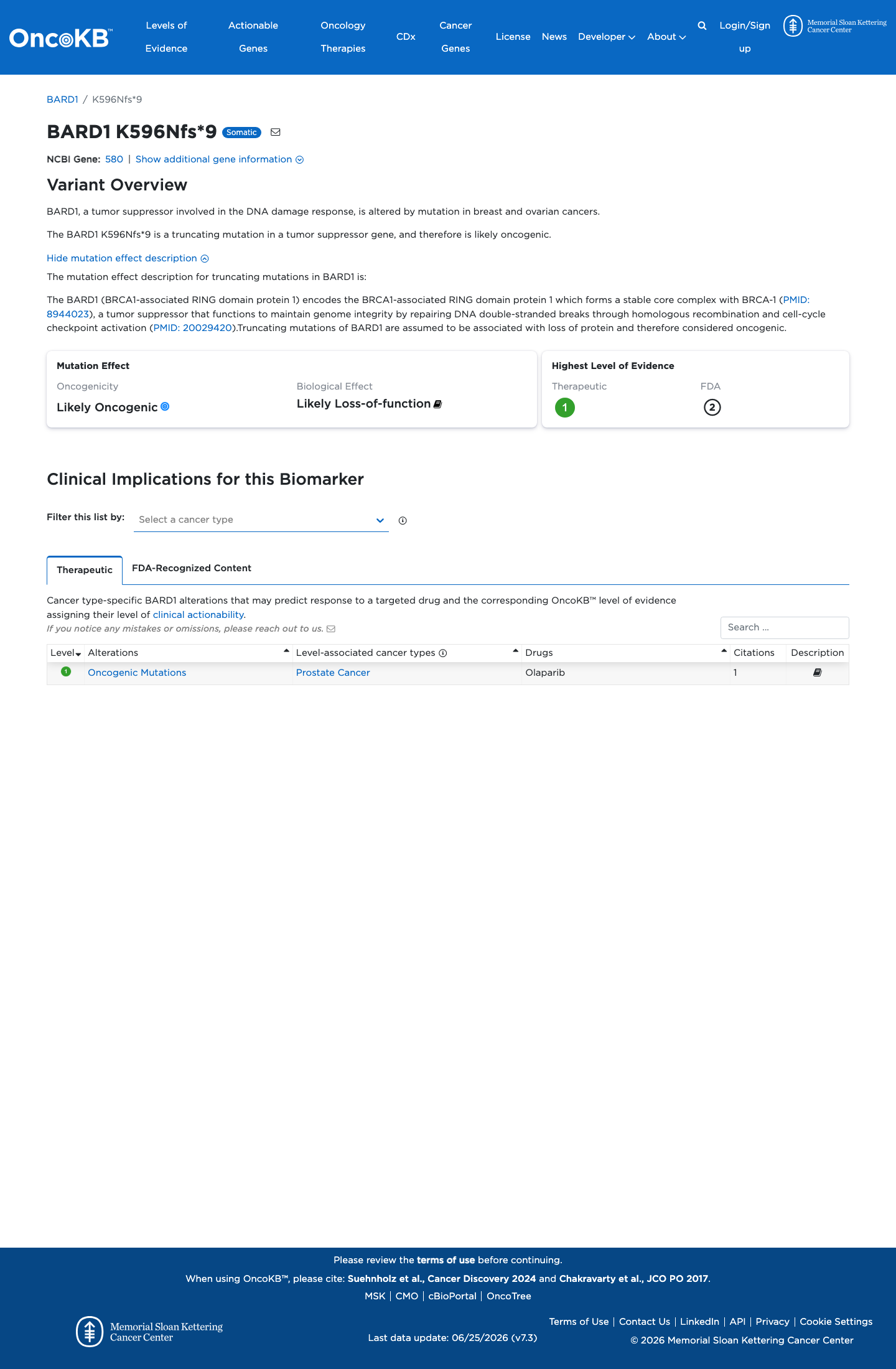
Functional
Likely Oncogenic
OncoKB identified variant-specific curated literature and context relevant to functional review; biological-effect context: Likely Loss-of-function; curated oncogenicity label: Likely Oncogenic.

COSMIC

Cancer hotspots
Somatic evidence
Not in COSMIC / hotspots
COSMIC
This variant does not lie in a statistically significant hotspot. This variant has not previously been reported in somatic cancers (COSMIC).
Hotspots
This variant does not lie in a statistically significant hotspot.
Sources & reference links
Triaged references · 8 PMIDs not cited in assessment
8944023 ↗
Identification of a RING protein that can interact in vivo with the BRCA1 gene product.
ONCOKB
20077502 ↗
Cancer predisposing missense and protein truncating BARD1 mutations in non-BRCA1 or BRCA2 breast cancer families.
CLINVAR
24366376 ↗
Risk assessment, genetic counseling, and genetic testing for BRCA-related cancer in women: U.S. Preventive Services Task Force recommendation statement.
CLINVAR
24366402 ↗
Summaries for patients. Assessing the genetic risk for BRCA-related breast or ovarian cancer in women: recommendations from the U.S. Preventive Services Task Force.
CLINVAR