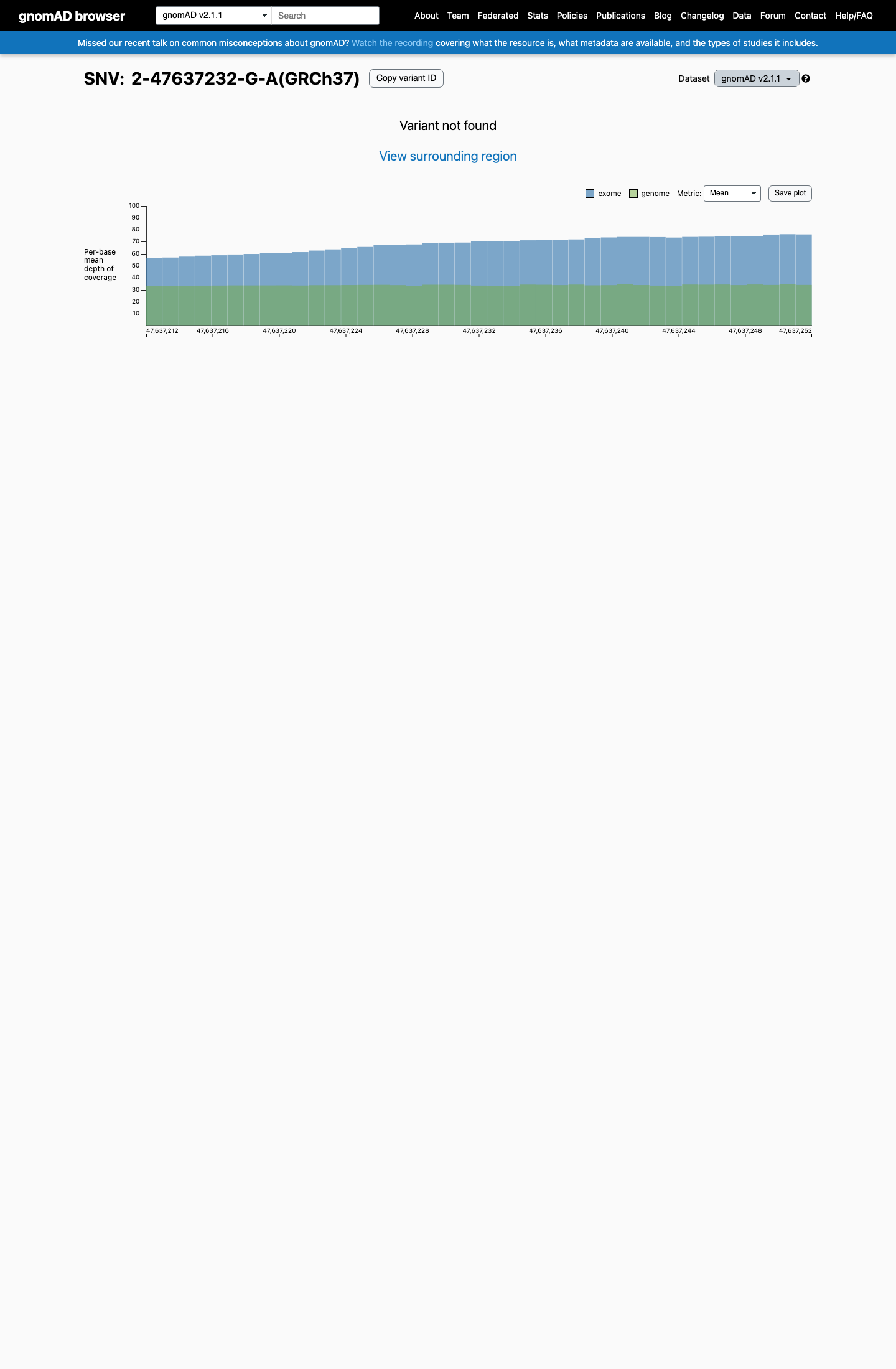
NM_000251.2:c.367-1G>A is a canonical splice acceptor variant (IVS2-1G>A) disrupting the invariant AG dinucleotide of intron 2 in MSH2, a gene for which loss of function is an established mechanism for Lynch syndrome.1 SpliceAI predicts strong splice disruption with a maximum delta score of 0.99 (acceptor loss 0.99), and cDNA analysis from patient lymphocytes (Wolf et al. 2005, PMID:15926618) confirmed aberrant splicing: the variant creates a new splice acceptor 1 bp downstream, resulting in deletion of a guanine (r.367delg) and a frameshift (p.122fsX173) predicted to introduce a premature termination codon subject to nonsense-mediated decay.2 Under InSiGHT MMR VCEP v2.0, canonical splice site variants at IVS+/-1 or IVS+/-2 where exon skipping or cryptic splice site use disrupts the reading frame and is predicted to undergo NMD qualify for PVS1 at very_strong strength. The premature termination codon at position 173 is well upstream of the MSH2 NMD boundary at codon 891.3 The variant is absent from gnomAD v2.1, v4.1, and gnomAD-Canada, meeting the VCEP PM2_Supporting threshold of <0.00002 allele frequency. It was also absent from 100 healthy control alleles in the Wolf et al. study.4 ClinVar classifies this variant as Likely pathogenic (Variation ID 91075), reviewed by the InSiGHT expert panel, consistent with the VCEP assessment.5 No benign or conflicting evidence was identified. BS3 is contradicted by the confirmed splicing aberration. BP4 is contradicted by the strong SpliceAI prediction. PP3 is not applied per VCEP rules prohibiting combination with PVS1 for canonical splice variants.6 Under InSiGHT MMR VCEP v2.0 combination rules (Rule 1): 1 PVS1_VeryStrong criterion is sufficient for Pathogenic classification.7
Final classification
Pathogenic
PVS1PM2PP5
MSH2
c.367-1G>A
p.?
This variant
NM_000251.2:c.367-1G>A is a canonical splice acceptor variant (IVS2-1G>A) disrupting the invariant AG dinucleotide of intron 2 in MSH2, a gene for which loss of function is an established mechanism for Lynch syndrome.
ClinGen InSiGHT Hereditary Colorectal Cancer/Polyposis Expert Panel Specifications to the ACMG/AMP Variant Interpretation Guidelines for MSH2 Version 2.0 v2.0 criteria-combination framework: matched Rule4 (1 Pathogenic.Very Strong + Pathogenic.Supporting >=2) with applied criteria: PVS1 very strong, PM2 supporting, PP5 supporting; maps to Pathogenic.
Classification rationale
PVS1PM2PP5
Pathogenic
MSH2 c.367-1G>A
PVS1 + PM2 + PP5
→
Pathogenic
Gene diagram
· NM_000251.2 · variants mapped to exon structure
MSH2
NM_000251.2
Fetching transcript structure from UCSC…
Applied criteria · 3 applied · 12 assessed
MetEvidence satisfies this criterion.
Not metEvaluated against available evidence; threshold not reached.
Not assessedApplies in principle, but no evidence was found to evaluate it.
N/ADoesn't apply to this variant type.
Applied · 3
Strength
Supporting
Moderate
Strong
Very strong
PVS1
very strong
Pathogenic
Canonical splice acceptor variant (IVS2-1G>A, NM_000251.2:c.367-1G>A) disrupting the invariant AG dinucleotide. cDNA analysis from patient blood (Wolf et al., PMID:15926618) confirmed the variant generates a new splice acceptor site 1 bp downstream, resulting in deletion of a guanine (r.367delg) and a frameshift predicted to produce a premature termination codon (p.122fsX173) subject to nonsense-mediated decay. Under InSiGHT MMR VCEP v2.0 PVS1 rules, IVS+/-1 or IVS+/-2 variants where exon skipping or cryptic splice site use disrupts the reading frame and is predicted to undergo NMD qualify for PVS1 at very_strong strength. Confirmed by patient-derived mRNA assay; no additional independent confirmation required as this is a canonical splice site variant.
Variant at canonical splice acceptor position IVS2-1 (AG→AA)SpliceAI max delta score 0.99 (acceptor loss 0.99)predicting strong splice disruption
PM2
supporting
Pathogenic
Absent from gnomAD v2.1 (exomes), gnomAD v4.1, and gnomAD-Canada v1.0. Under InSiGHT MMR VCEP v2.0, PM2_Supporting applies when allele frequency is <0.00002 (<1 in 50,000 alleles) in gnomAD v4. The variant is completely absent from all population databases, satisfying this threshold.
Absent from gnomAD v2.1 (0 alleles observed)Absent from gnomAD v4.1 (0 alleles observed)Absent from gnomAD-Canada v1.0
PP5
supporting
Pathogenic
Expert panel International Society for Gastrointestinal Hereditary Tumours (InSiGHT) classified as Likely pathogenic.
ClinVar expert panel classification
Assessed · not applied
· 12 not met · 0 not assessed
Pathogenic
PS2
No de novo occurrence data identified in the literature for NM_000251.2:c.367-1G>A.
PS3
Under InSiGHT MMR VCEP v2.0, PS3 requires calibrated functional assay data with defined odds of pathogenicity (as documented in Functional-assay-SVI-documentation-MMR.xlsx) or MMR function defect per the functional assay flowchart.
PP1
No co-segregation data available for NM_000251.2:c.367-1G>A.
PP4
Under InSiGHT MMR VCEP v2.0, PP4 requires CRC/endometrial MSI-H tumors with consistent loss of MMR protein expression.
Benign
BA1
Under InSiGHT MMR VCEP v2.0, BA1 requires gnomAD v4 Grpmax filtering allele frequency >=0.001 (0.1%).
BS1
Under InSiGHT MMR VCEP v2.0, BS1 requires gnomAD v4 Grpmax filtering allele frequency >=0.0001 and <0.001 (0.01-0.1%).
BS2
Under InSiGHT MMR VCEP v2.0, BS2 requires co-occurrence in trans with a known pathogenic variant in the same gene in a CRC patient after age 45 without CMMRD features.
BS3
Under InSiGHT MMR VCEP v2.0, BS3 requires calibrated functional assays demonstrating functional odds for pathogenicity <=0.05, or synonymous/intronic variants with no associated mRNA aberration by NMD-inhibited lab assays.
BS4
Under InSiGHT MMR VCEP v2.0, BS4 requires formal co-segregation analysis demonstrating lack of co-segregation with disease (Bayes Likelihood Ratio <0.05 for strong, >0.05 and <=0.48 for supporting).
BP4
Under InSiGHT MMR VCEP v2.0, BP4 Supporting applies to (a) missense variants with HCI prior probability <0.11, or (b) intronic/synonymous variants with SpliceAI delta score <=0.1.
BP5
Under InSiGHT MMR VCEP v2.0, BP5 requires tumor data demonstrating MSS and/or no loss of MMR protein expression consistent with the variant gene, or BRAF V600E/MLH1 methylation in appropriate tumor context.
BP7
Under InSiGHT MMR VCEP v2.0, BP7 applies to synonymous or intronic variants at or beyond position -21 (3' splice site) or +7 (5' splice site) from the exon boundary.
N/A · 11
PS1 · PS4 · PM1 · PM5 · PM6 · PP2 · PP3 · BP1 · BP2 · BP3 · BP6
Research & evidence
Population frequency · supports pathogenic

gnomAD v4.1
gnomAD v2.1
v4.1
Absent from gnomAD v4.1.
v2.1
Absent from gnomAD v2.1.
🇨🇦 CA
Absent from gnomAD-Canada v1.0.
Allele frequency by ancestry
three datasets · side by side
gnomAD v4.1
Absent
· 0 / ?
0 hom
0 hom
Not observed in any ancestry group.
gnomAD v2.1
Absent
· 0 / ?
0 hom
0 hom
Not observed in any ancestry group.
gnomAD Canada 🇨🇦
Absent
· 0 / ?
0 hom
0 hom
Not observed in any ancestry group.
ClinVar
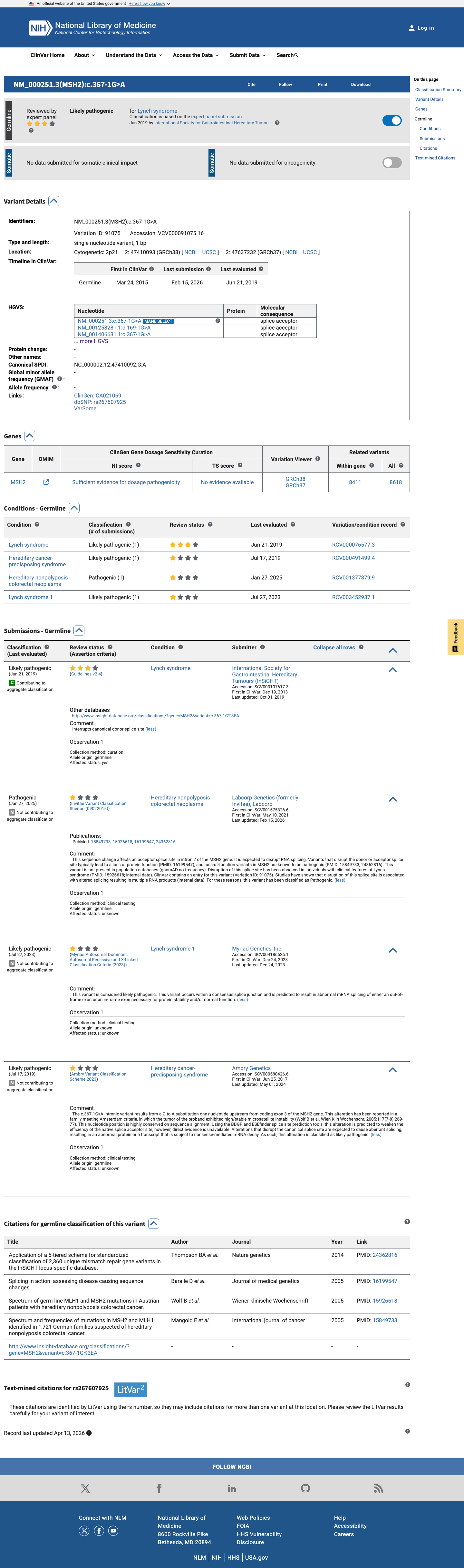
This variant has been reported in ClinVar as Likely pathogenic (2 clinical laboratories) and as Pathogenic (1 clinical laboratory) and as Likely pathogenic by International Society for Gastrointestinal Hereditary Tumours (InSiGHT) (expert panel). (ClinVarID = 91075)
In silico
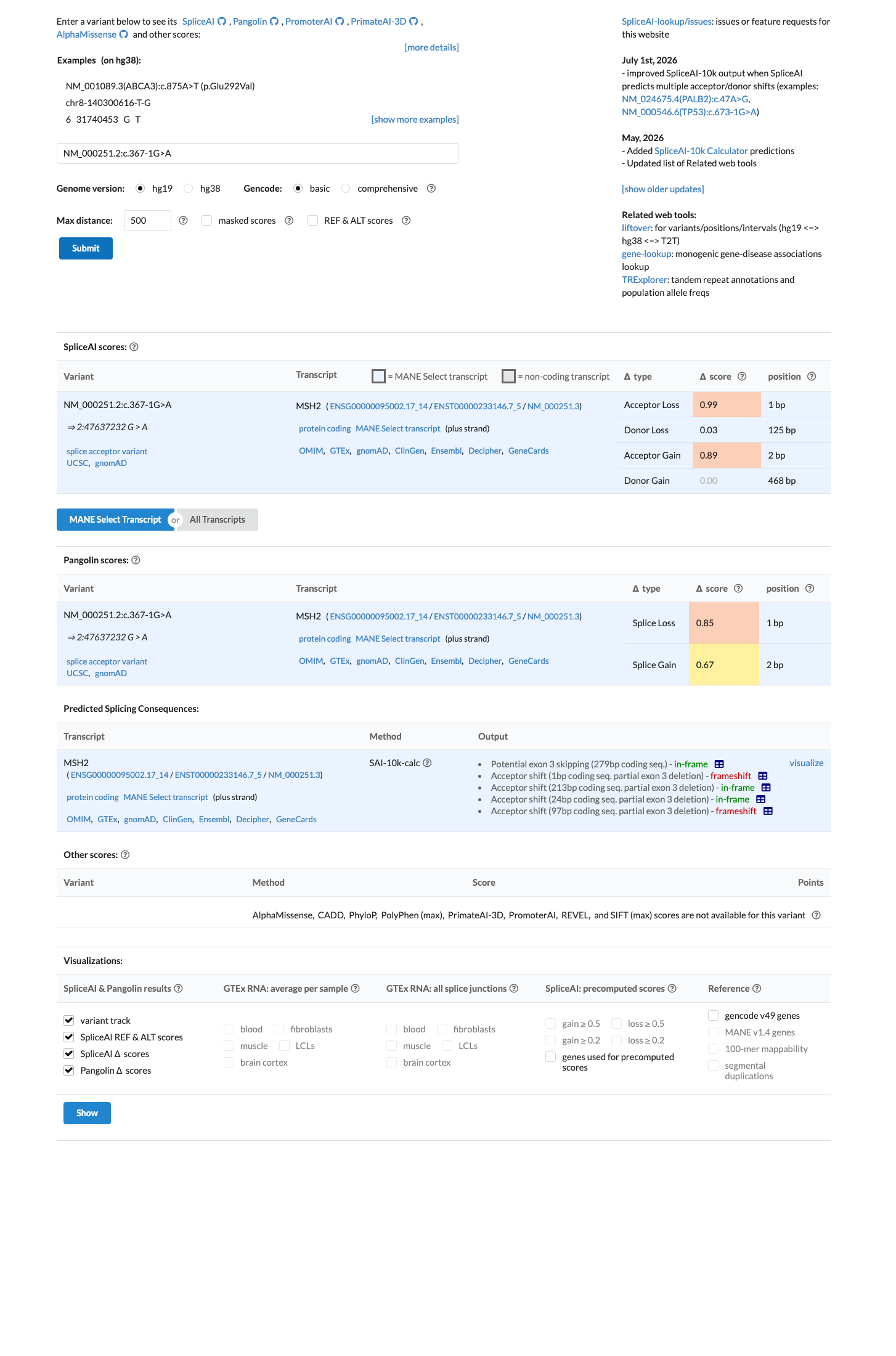
SpliceAI predicts possible splice impact for this variant (max delta score = 0.99). BayesDel score = 0.66.
Functional
No data
No calibrated functional assay or RNA evidence was identified for this variant.

COSMIC
Somatic evidence
COSMIC
This variant has not previously been reported in somatic cancers (COSMIC).
Hotspots
This variant does not lie in a statistically significant cancer hotspot.
Literature · how each cited paper was used
1papers cited
Each card is an audit: what was searched, what was found, whether it names the variant, which criteria it fed, and why. 7 further PMIDs triaged but not cited — see Sources & references.
Spectrum of germ-line MLH1 and MSH2 mutations in Austrian patients with hereditary nonpolyposis colorectal cancer.
Searched
c.367-1G>Ac.367-1367-1G367delg122fs
Found
NM_000251.2:c.367-1G>A was identified in an Austrian HNPCC family (FH12) fulfilling Amsterdam criteria. cDNA analysis from patient lymphocytes demonstrated that the variant in the invariant splice acceptor site of MSH2 exon 3 generates a new splice acceptor site 1 bp downstream, resulting in deletion of a guanine (r.367delg) and a frameshift mutation (p.Ile122fsTer173) leading to a premature termination codon. The variant was absent from 100 healthy control alleles.
Variant
✓ Names this variant — characterised directly
Applied to
→PVS1
met
→PM2
met
Why
Variant-specific functional confirmation of splicing aberration; primary evidence for PVS1 at very_strong strength. Also supports PM2 (absent from 100 controls) and provides limited PP4 data (one MSI-H tumor in the family, insufficient for VCEP PP4 Supporting threshold).
cDNA analysis revealed that the substitution MSH2, c.367-1G > A in the invariant splice acceptor site of exon 3 generated a new splice acceptor site 1 bp downstream and resulted in a frameshift mutation due to deletion of a G.
Location Results, paragraph describing splice site variants; Table 4 (MSH2 variants); cDNA analysis methods · Context cDNA synthesized from patient peripheral blood lymphocyte RNA; RT-PCR and Sanger sequencing · full text
Sources & reference links
Triaged references · 7 PMIDs not cited in assessment
15849733 ↗
Spectrum and frequencies of mutations in MSH2 and MLH1 identified in 1,721 German families suspected of hereditary nonpolyposis colorectal cancer.
CLINVAR
24362816 ↗
Application of a 5-tiered scheme for standardized classification of 2,360 unique mismatch repair gene variants in the InSiGHT locus-specific database.
CLINVAR
24310308 ↗
ACMG technical standards and guidelines for genetic testing for inherited colorectal cancer (Lynch syndrome, familial adenomatous polyposis, and MYH-associated polyposis).
CLINVAR
25394175 ↗
A practice guideline from the American College of Medical Genetics and Genomics and the National Society of Genetic Counselors: referral indications for cancer predisposition assessment.
CLINVAR
25452455 ↗
Hereditary colorectal cancer syndromes: American Society of Clinical Oncology Clinical Practice Guideline endorsement of the familial risk-colorectal cancer: European Society for Medical Oncology Clinical Practice Guidelines.
CLINVAR