NM_006218.4:c.1458C>T is a synonymous variant (p.Phe486=) in PIK3CA exon 9. Under the ClinGen Brain Malformations VCEP v1.1, PVS1, PP1, PP3, PP4, PP5, PM6, BS4, BP1, and BP6 are not applicable.1 PS1, PS5, and PM5 are not applicable because the variant is synonymous and produces no amino acid change.2 The variant is present in gnomAD v2.1 (2/249,396 alleles; 0.0008%) and v4.1 (19/1,613,762 alleles; 0.00118%), exceeding the VCEP PM2_Supporting threshold of ≤1 allele. The allele frequency does not reach BA1 (>0.0926%) or BS1 (>0.0185%) thresholds. Zero homozygotes are observed (BS2 not met).3 Residue 486 lies outside both PIK3CA critical functional domains defined by the VCEP Table 4 (AA 322-483 and AA 797-1068); PM1_Supporting is not met.4 No functional studies, de novo occurrences, brain malformation case reports, or co-segregation data were identified for this variant. ClinVar classifies it as Likely benign (3 clinical laboratories, single submitter, no expert panel review).5 BP4 and BP7 remain unassessed due to missing splicing prediction (varSEAK, MaxEntScan) and conservation (PhyloP) data. SpliceAI predicts no splice impact (max delta 0.01).6 No reviewable publications contained variant-specific evidence. All ClinVar-associated PMIDs are guideline or policy documents that do not mention NM_006218.4:c.1458C>T.
Final classification
VUS
PIK3CA
c.1458C>T
p.Phe486=
This variant
NM_006218.4:c.1458C>T is a synonymous variant (p.Phe486=) in PIK3CA exon 9. Under the ClinGen Brain Malformations VCEP v1.1, PVS1, PP1, PP3, PP4, PP5, PM6, BS4, BP1, and BP6 are not applicable.
ClinGen Brain Malformations Expert Panel Specifications to the ACMG/AMP Variant Interpretation Guidelines Version 1.1 v1.1 lacked a usable explicit final combination framework, so generic ACMG/AMP 2015 final-combination rules were applied as fallback; applied criteria: none; combination = no applied criteria, which maps to VUS.
Classification rationale
VUS
PIK3CA c.1458C>T
Gene diagram
· NM_006218.4 · variants mapped to exon structure
PIK3CA
NM_006218.4
Fetching transcript structure from UCSC…
Applied criteria · 0 applied · 14 assessed
MetEvidence satisfies this criterion.
Not metEvaluated against available evidence; threshold not reached.
Not assessedApplies in principle, but no evidence was found to evaluate it.
N/ADoesn't apply to this variant type.
Applied · 0
No criteria were applied for this variant.
Assessed · not applied
· 12 not met · 2 not assessed
Pathogenic
PS2
No de novo occurrence has been reported for this variant.
PS3
No well-established in vitro or in vivo functional studies are available for this variant.
PS4
VCEP PS4 requires PM2 first.
PM1
VCEP PM1_Supporting requires location within a Table 4 critical functional domain.
PM2
VCEP PM2_Supporting requires ≤1 allele in ethnically matched control populations.
PP2
VCEP PP2 requires a missense constraint z-score > 3.09 in gnomAD.
Benign
BA1
VCEP BA1 threshold is allele frequency > 0.0926%.
BS1
VCEP BS1 threshold is allele frequency > 0.0185%.
BS2
VCEP BS2 requires ≥3 homozygotes in gnomAD or ≥3 well-phenotyped heterozygous family members.
BS3
No well-established in vitro or in vivo functional studies demonstrate a benign effect for this variant.
BP2
No evidence of this variant observed in cis or trans with a known pathogenic variant in PIK3CA.
BP4
VCEP BP4 is applicable to synonymous variants but requires 2 of 3 splicing prediction tools (varSEAK, SpliceAI, MaxEntScan) to predict no impact.
BP5
No alternate molecular basis for disease has been identified that would explain the phenotype independently of this variant.
BP7
VCEP BP7 is applicable to synonymous variants and requires non-conservation (PhyloP score < 0.1 or absence across vertebrates).
N/A · 14
PVS1 · PS1 · PM3 · PM4 · PM5 · PM6 · PP1 · PP3 · PP4 · PP5 · BS4 · BP1 · BP3 · BP6
Research & evidence
Population frequency
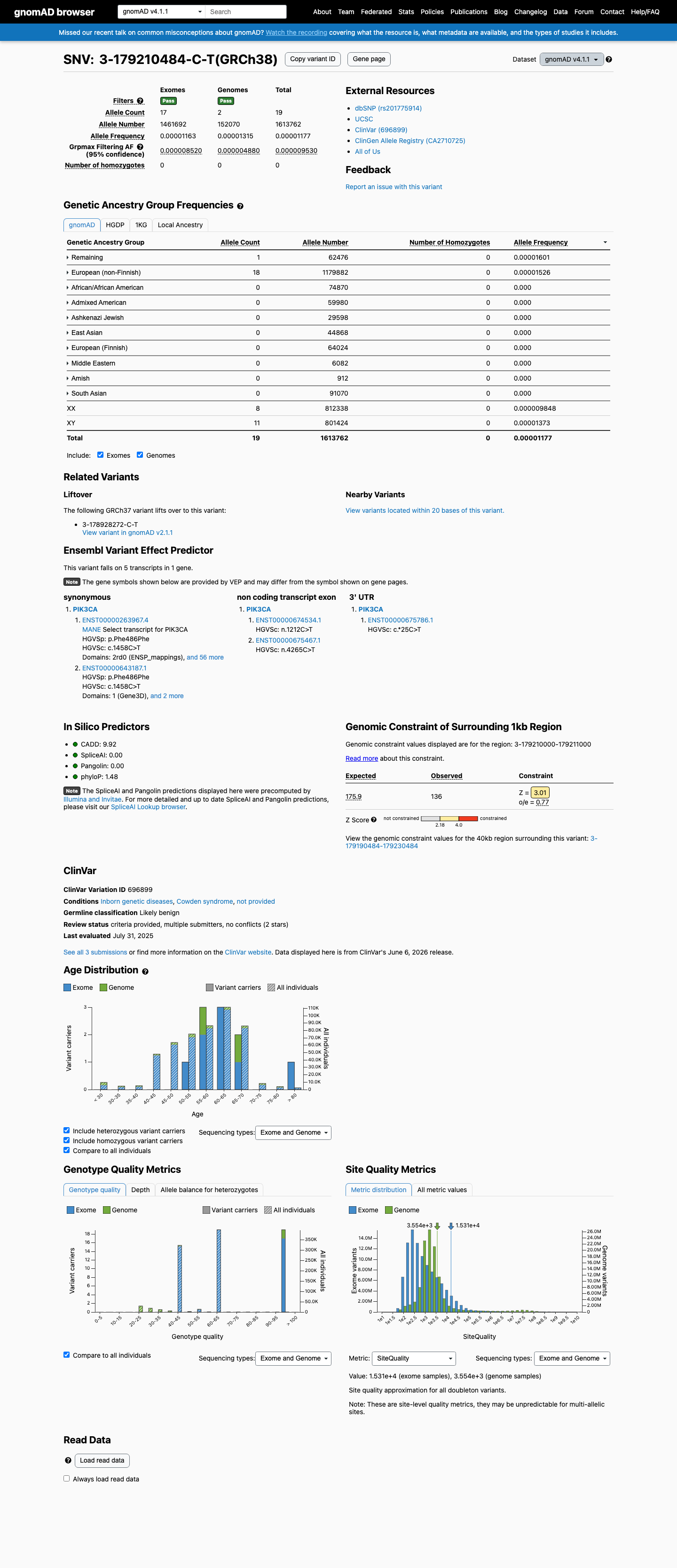
gnomAD v4.1
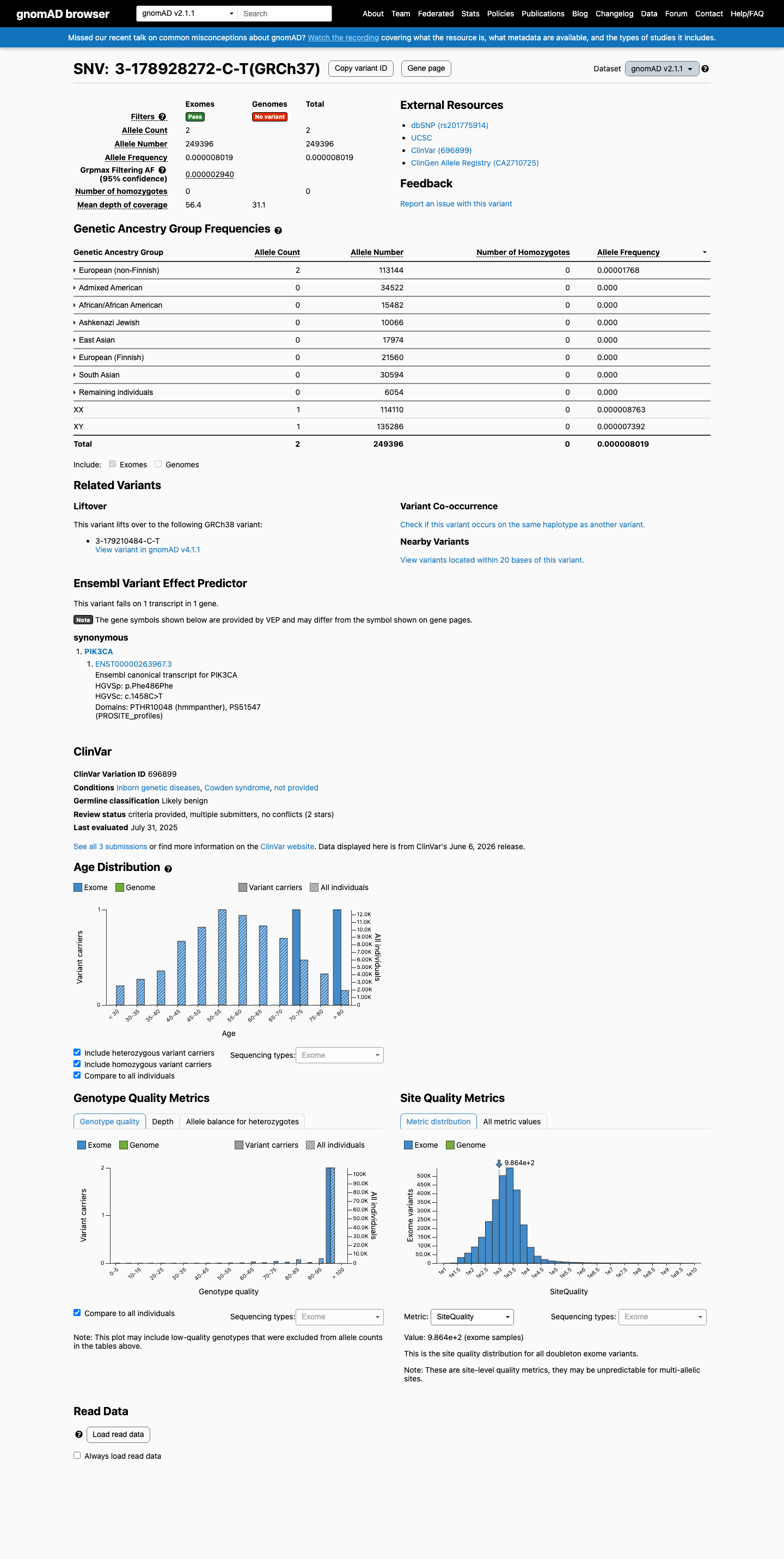
gnomAD v2.1
v4.1
This variant is present in gnomAD v4.1 (AF= 1.17737e-05; MAF= 0.00118%, 19/1613762 alleles, homozygotes = 0) and has highest observed frequency in the Remaining individuals population (AF= 1.60061e-05; MAF= 0.00160%, 1/62476 alleles, homozygotes = 0); grpmax FAF= 9.53e-06.
v2.1
This variant is present in gnomAD v2.1 (AF= 8.01937e-06; MAF= 0.00080%, 2/249396 alleles, homozygotes = 0) and has highest observed frequency in the European (non-Finnish) population (AF= 1.76766e-05; MAF= 0.00177%, 2/113144 alleles, homozygotes = 0); grpmax FAF= 2.94e-06.
🇨🇦 CA
Absent from gnomAD-Canada v1.0.
Allele frequency by ancestry
three datasets · side by side
gnomAD v4.1
0.0012%
· 19 / 1,613,762
0 hom · FAF 0.00095%
0 hom · FAF 0.00095%
Remaining individuals 1 / 62,476 |
0.0016% |
European (non-Finnish) 18 / 1,179,882 |
0.0015% |
+ 8 not observed (Admixed American, European (Finnish), Amish, East Asian, Middle Eastern, South Asian, Ashkenazi Jewish, African/African American)
gnomAD v2.1
0.0008%
· 2 / 249,396
0 hom · FAF 0.00029%
0 hom · FAF 0.00029%
European (non-Finnish) 2 / 113,144 |
0.0018% |
+ 7 not observed (African/African American, Admixed American, Ashkenazi Jewish, East Asian, European (Finnish), Remaining individuals, South Asian)
gnomAD Canada 🇨🇦
Absent
· 0 / ?
0 hom
0 hom
Not observed in any ancestry group.
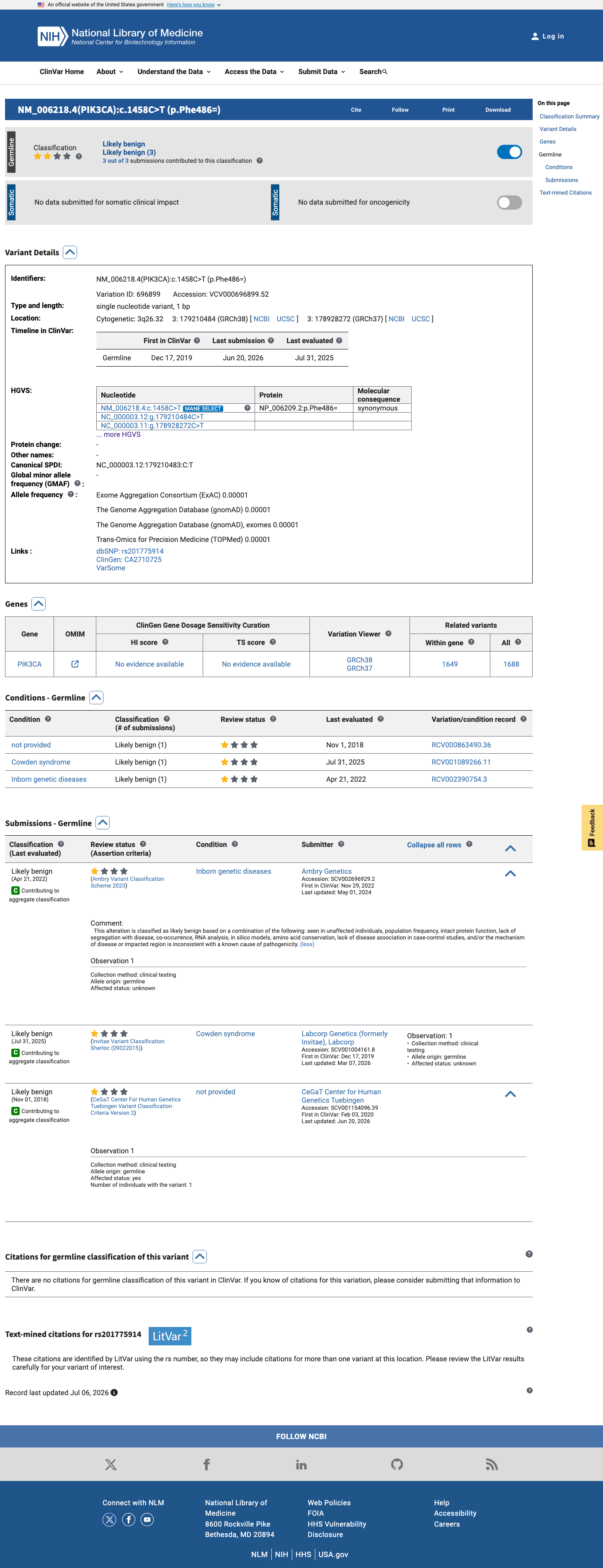
ClinVar
This variant has been reported in ClinVar as Likely benign (3 clinical laboratories). (ClinVarID = 696899)
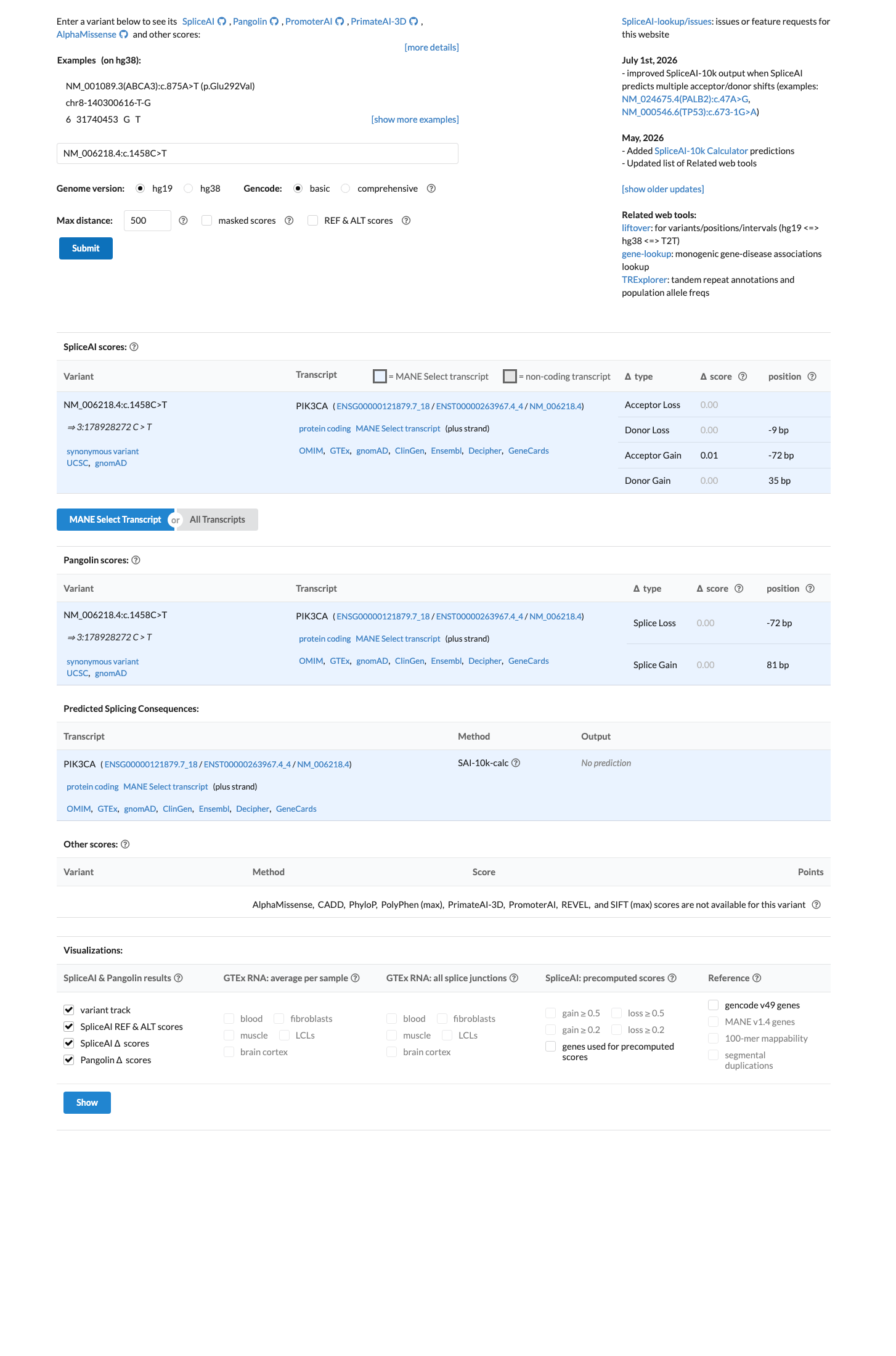
In silico
SpliceAI predicts no significant splice impact for this variant (max delta score = 0.01).
Functional
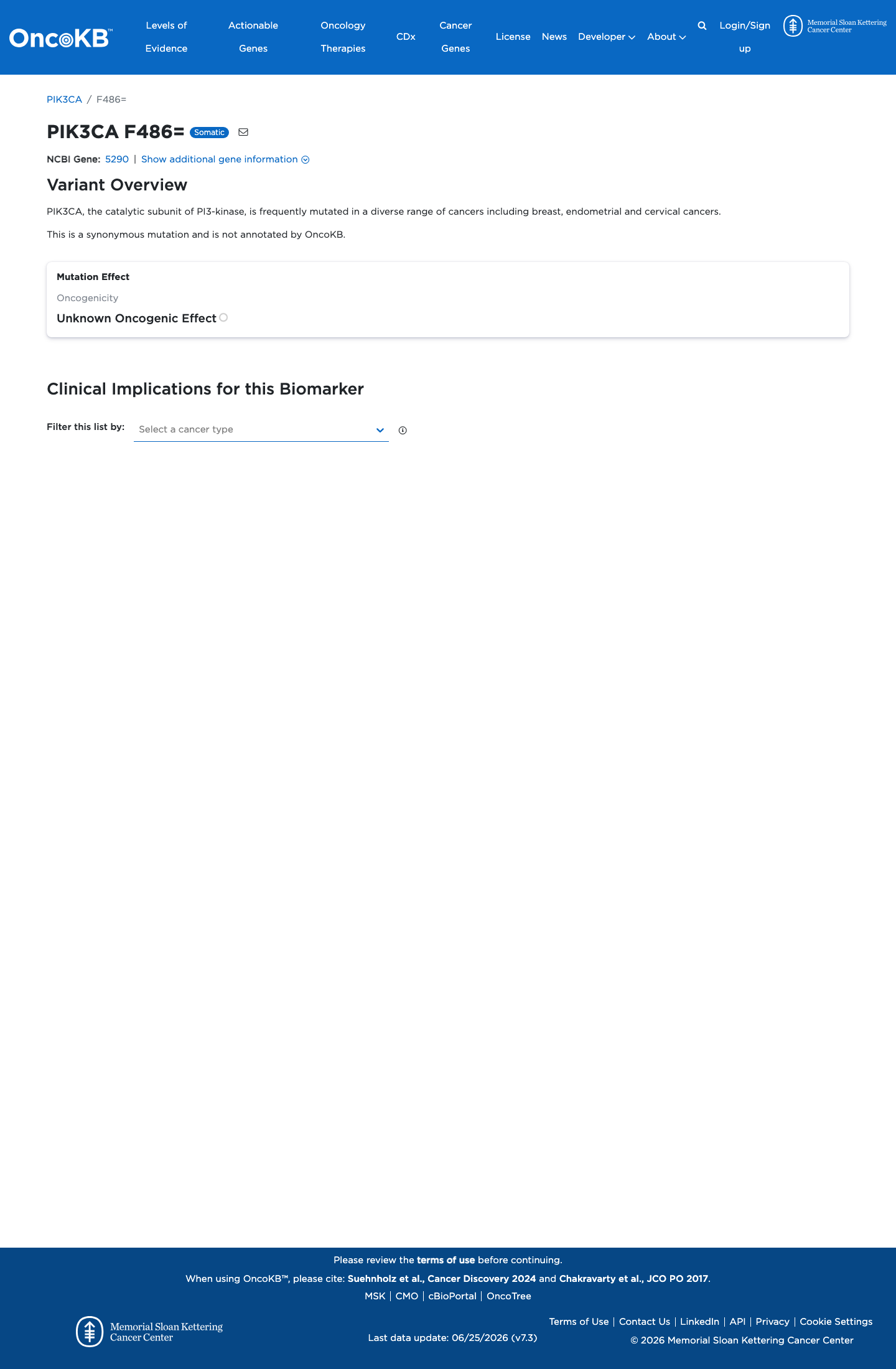
Unknown Oncogenic Effect
OncoKB identified curated literature and non-variant-specific oncogenicity context for review; listed oncogenicity label: Unknown Oncogenic Effect.

COSMIC

Cancer hotspots
Somatic evidence
Not in COSMIC / hotspots
COSMIC
This variant does not lie in a statistically significant hotspot. This variant has not previously been reported in somatic cancers (COSMIC).
Hotspots
This variant does not lie in a statistically significant hotspot.
Sources & reference links
9Sources
Triaged references · 6 PMIDs not cited in assessment
23652378 ↗
A framework to start the debate on neonatal screening policies in the EU: an Expert Opinion Document.
CLINVAR
25730230 ↗
Expanded carrier screening in reproductive medicine-points to consider: a joint statement of the American College of Medical Genetics and Genomics, American College of Obstetricians and Gynecologists, National Society of Genetic Counselors, Perinatal Quality Foundation, and Society for Maternal-Fetal Medicine.
CLINVAR
23519317 ↗
Clinical genetics evaluation in identifying the etiology of autism spectrum disorders: 2013 guideline revisions.
CLINVAR
23037933 ↗
Including the initial newborn screening bloodspot collection device serial number on birth certificates: basis and recommendations from the Secretary of Health and Human Services' Advisory Committee on Heritable Disorders in Newborns and Children.
CLINVAR
24394680 ↗
Parental permission for pilot newborn screening research: guidelines from the NBSTRN.
CLINVAR
28492532 ↗
Sherloc: a comprehensive refinement of the ACMG-AMP variant classification criteria.
CLINVAR