NM_000314.8:c.413A>G (p.Tyr138Cys) is a missense variant in exon 5 of PTEN. It is absent from all population databases (gnomAD v2.1, v4.1, gnomAD-Canada), satisfying PM2_Supporting per PTEN VCEP criteria.1 Functional evidence from Mighell et al. 2018 (PMID:29706350) saturation mutagenesis demonstrates that Y138C has a cumulative fitness score of -1.766, meeting the PTEN VCEP threshold of ≤ -1.11 for PS3_Moderate. Independently, Tibarewal et al. 2012 (PMID:22375056) characterized Y138C and demonstrated that it retains lipid phosphatase activity but selectively lacks protein phosphatase activity, with failure to suppress cellular invasion — confirming a damaging functional effect.2 Computational evidence supports pathogenicity: REVEL score 0.962 (>0.7, meeting PP3 threshold per PTEN VCEP). PTEN has a low rate of benign missense variation and missense variants are a known disease mechanism for PTEN hamartoma tumor syndrome (PP2 per VCEP).3 The variant is classified as Uncertain Significance in ClinVar (variation ID 486230) by all four submitting clinical laboratories. It has been observed in somatic cancers (COSMIC, n=6).4 Applying the PTEN VCEP classification rules: 1 moderate pathogenic criterion (PS3_Moderate) and 3 supporting pathogenic criteria (PM2_Supporting, PP2, PP3) are met. No benign criteria are met. Per the VCEP combination rules, this evidence profile does not reach the Likely Pathogenic threshold (requires ≥3 moderate, or 2 moderate + ≥2 supporting, or 1 strong + 1 moderate, or 1 moderate + ≥4 supporting). The variant is classified as a Variant of Uncertain Significance (VUS).5 Key gap: the Mighell et al. functional data for Y138C has a High_conf=False quality flag ('Fail Both'), indicating the measurement did not pass high-confidence filters. Additional functional validation, segregation data, de novo observations, or clinical case-level phenotype data could resolve this VUS.6
Final classification
VUS
PS3PM2PP2PP3
PTEN
c.413A>G
p.Tyr138Cys
This variant
NM_000314.8:c.413A>G (p.Tyr138Cys) is a missense variant in exon 5 of PTEN. It is absent from all population databases (gnomAD v2.1, v4.1, gnomAD-Canada), satisfying PM2_Supporting per PTEN VCEP criteria.
ClinGen PTEN Expert Panel Specifications to the ACMG/AMP Variant Interpretation Guidelines for PTEN Version 3.2 v3.2 criteria-combination framework was evaluated deterministically with applied criteria: PS3 moderate, PM2 supporting, PP2 supporting, PP3 supporting; no rule matched the adjudicated criteria.
Classification rationale
PS3PM2PP2PP3
VUS
PTEN c.413A>G
PS3 + PM2 + PP2 + PP3
→
VUS
Gene diagram
· NM_000314.8 · variants mapped to exon structure
PTEN
NM_000314.8
Fetching transcript structure from UCSC…
Applied criteria · 4 applied · 15 assessed
MetEvidence satisfies this criterion.
Not metEvaluated against available evidence; threshold not reached.
Not assessedApplies in principle, but no evidence was found to evaluate it.
N/ADoesn't apply to this variant type.
Applied · 4
Strength
Supporting
Moderate
Strong
Very strong
PS3
moderate
review
Pathogenic
Per PTEN VCEP specifications, PS3_Moderate is applied when phosphatase activity cumulative fitness score (Cum_score) ≤ -1.11 in the Mighell et al. 2018 (PMID:29706350) saturation mutagenesis assay. Y138C has a Cum_score of -1.766 in Table S2, meeting this threshold. Independently, Tibarewal et al. 2012 (PMID:22375056) directly characterized Y138C, demonstrating retained lipid phosphatase activity with selective loss of protein phosphatase activity and failure to suppress cellular invasion — consistent with a damaging functional effect.
Mighell et al. 2018 (PMID:29706350) PTEN saturation mutagenesis: Y138C Cum_score = -1.766meeting VCEP PS3_Moderate threshold of ≤ -1.11 (Table S2). Note: High_conf=False ('Fail Both') quality flag.Tibarewal et al. 2012 (PMID:22375056): Y138C retains lipid phosphatase activity but selectively lacks protein phosphatase activity
PM2
supporting
Pathogenic
Per PTEN VCEP specifications, PM2_Supporting is applied when the variant is absent from population databases at allele frequency < 0.00001 (0.001%). NM_000314.8:c.413A>G is absent from gnomAD v2.1, gnomAD v4.1, and gnomAD-Canada v1.0.
Absent from gnomAD v2.1 (exomes).Absent from gnomAD v4.1 (exomes).Absent from gnomAD-Canada v1.0 (genomes).
PP2
supporting
Pathogenic
Per PTEN VCEP specifications, PP2 applies to missense variants in PTEN, a gene with a low rate of benign missense variation where missense variants are a common mechanism of disease. PTEN is a well-established tumor suppressor with an observed deficit of benign missense variation and an established role for missense mutations in PHTS.
PTEN has a low rate of benign missense variation and missense variants are an established disease mechanism for PTEN hamartoma tumor syndrome (autosomal dominant).
PP3
supporting
Pathogenic
Per PTEN VCEP specifications, PP3 is applied for missense variants when REVEL score > 0.7. The REVEL score for NM_000314.8:c.413A>G (p.Tyr138Cys) is 0.962, substantially exceeding the 0.7 threshold. BayesDel score is 0.518. SpliceAI max delta score is 0.00 (no predicted splicing impact).
REVEL score 0.962 (>0.7 threshold per PTEN VCEP).BayesDel score 0.518 (above neutral but not independently diagnostic).SpliceAI max delta 0.00 (no splicing impact predicted).
Assessed · not applied
· 9 not met · 6 not assessed
Pathogenic
PS1
PS1 requires that the same amino acid change (p.Tyr138Cys) has been previously established as pathogenic.
PS2
No de novo observation data is available in the evidence packet.
PS4
No proband counts or case-control data are available to calculate a PTEN specificity score under the VCEP PS4 framework.
PM1
Per PTEN VCEP specifications, PM1 is restricted to residues within the defined catalytic motifs: 90-94, 123-130, and 166-168 (NP_000305.3).
PM5
PM5 requires a different pathogenic or likely pathogenic missense change at the same amino acid residue (p.Tyr138).
PM6
No de novo occurrence data is available in the evidence packet.
PP1
No co-segregation data is available.
Benign
BA1
Per PTEN VCEP, BA1 requires gnomAD filtering allele frequency > 0.00056 (0.056%).
BS1
Per PTEN VCEP, BS1 requires gnomAD filtering allele frequency from 0.000043 (0.0043%) to 0.00056 (0.056%).
BS2
Per PTEN VCEP, BS2 requires observation in the homozygous state in a healthy or PHTS-unaffected individual.
BS3
BS3 requires functional studies showing no damaging effect on protein function.
BS4
No segregation data is available.
BP2
Per PTEN VCEP, BP2 requires observation in trans with a pathogenic or likely pathogenic PTEN variant, or at least three observations in cis/phase unknown with different pathogenic/likely pathogenic PTEN variants.
BP4
Per PTEN VCEP, BP4 is applied for missense variants when REVEL score < 0.5 (multiple lines of computational evidence suggest no impact).
BP5
BP5 requires the variant to be found in a case with an alternate molecular basis for disease.
N/A · 6
PVS1 · PP4 · PP5 · BP1 · BP6 · BP7
Research & evidence
Population frequency
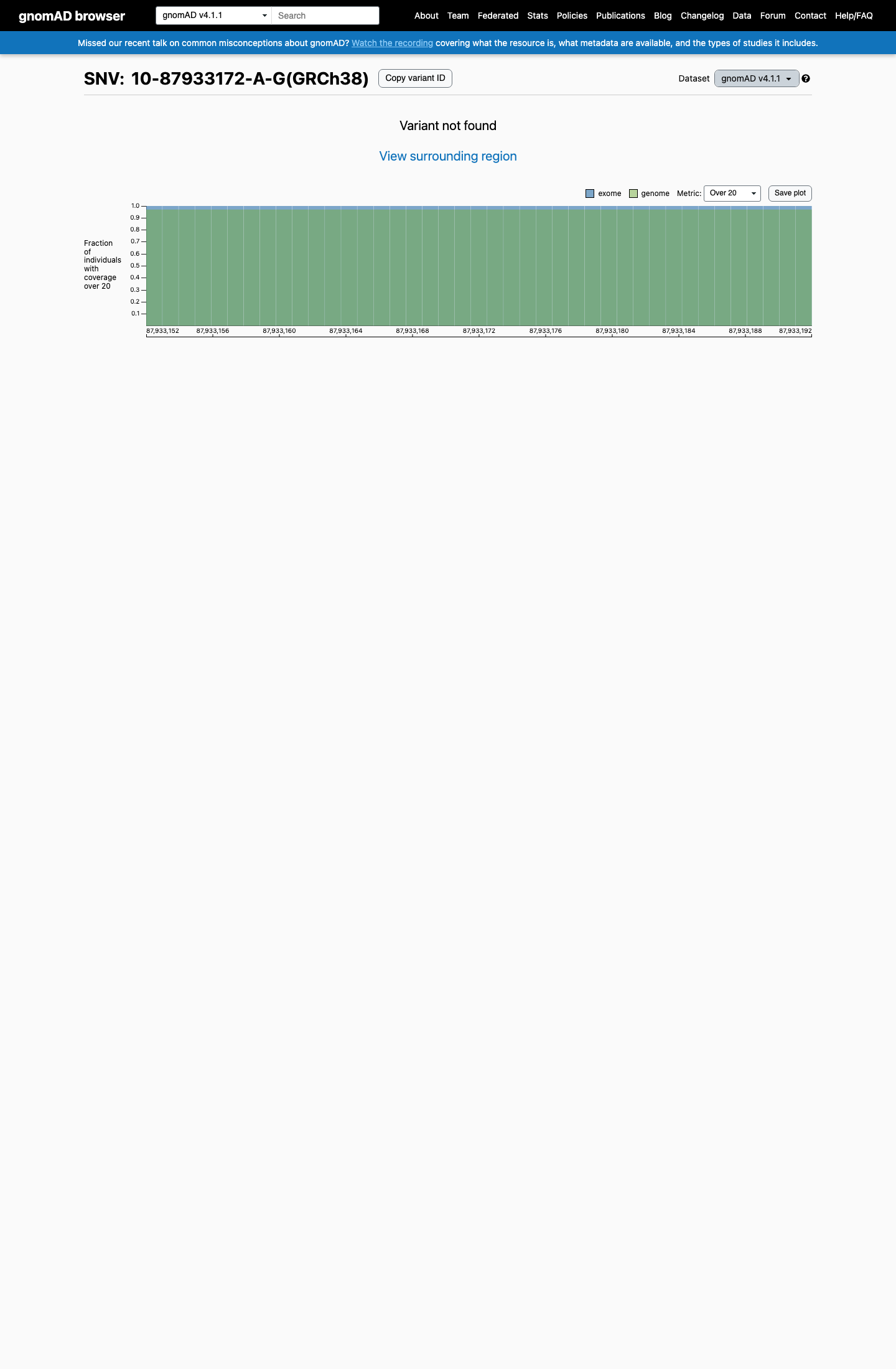
gnomAD v4.1
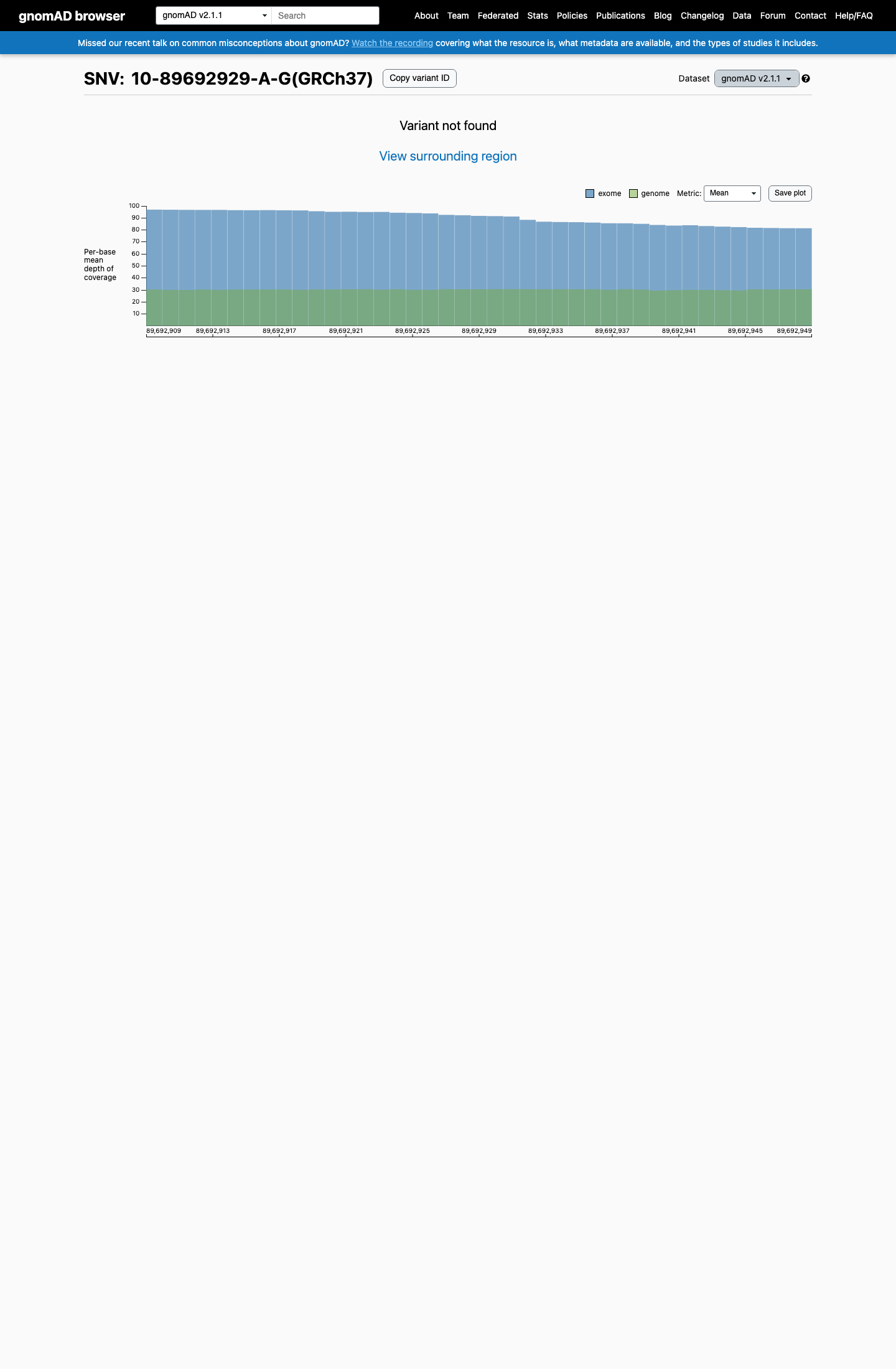
gnomAD v2.1
v4.1
Absent from gnomAD v4.1.
v2.1
Absent from gnomAD v2.1.
🇨🇦 CA
Absent from gnomAD-Canada v1.0.
Allele frequency by ancestry
three datasets · side by side
gnomAD v4.1
Absent
· 0 / ?
0 hom
0 hom
Not observed in any ancestry group.
gnomAD v2.1
Absent
· 0 / ?
0 hom
0 hom
Not observed in any ancestry group.
gnomAD Canada 🇨🇦
Absent
· 0 / ?
0 hom
0 hom
Not observed in any ancestry group.
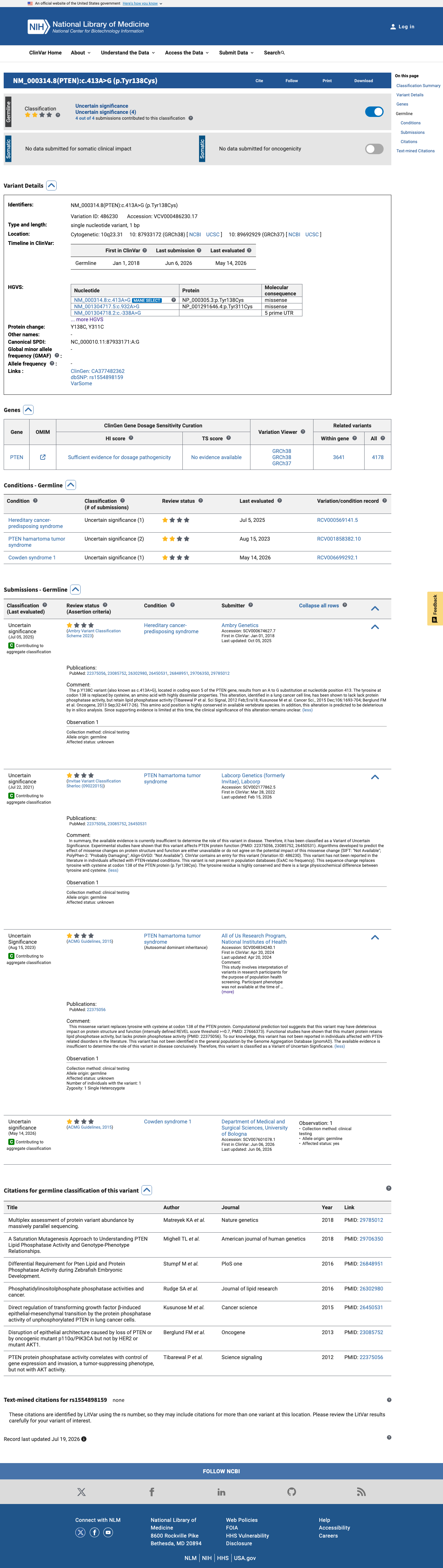
ClinVar
This variant has been reported in ClinVar as Uncertain significance (3 clinical laboratories) and as Uncertain Significance (1 clinical laboratory). (ClinVarID = 486230)
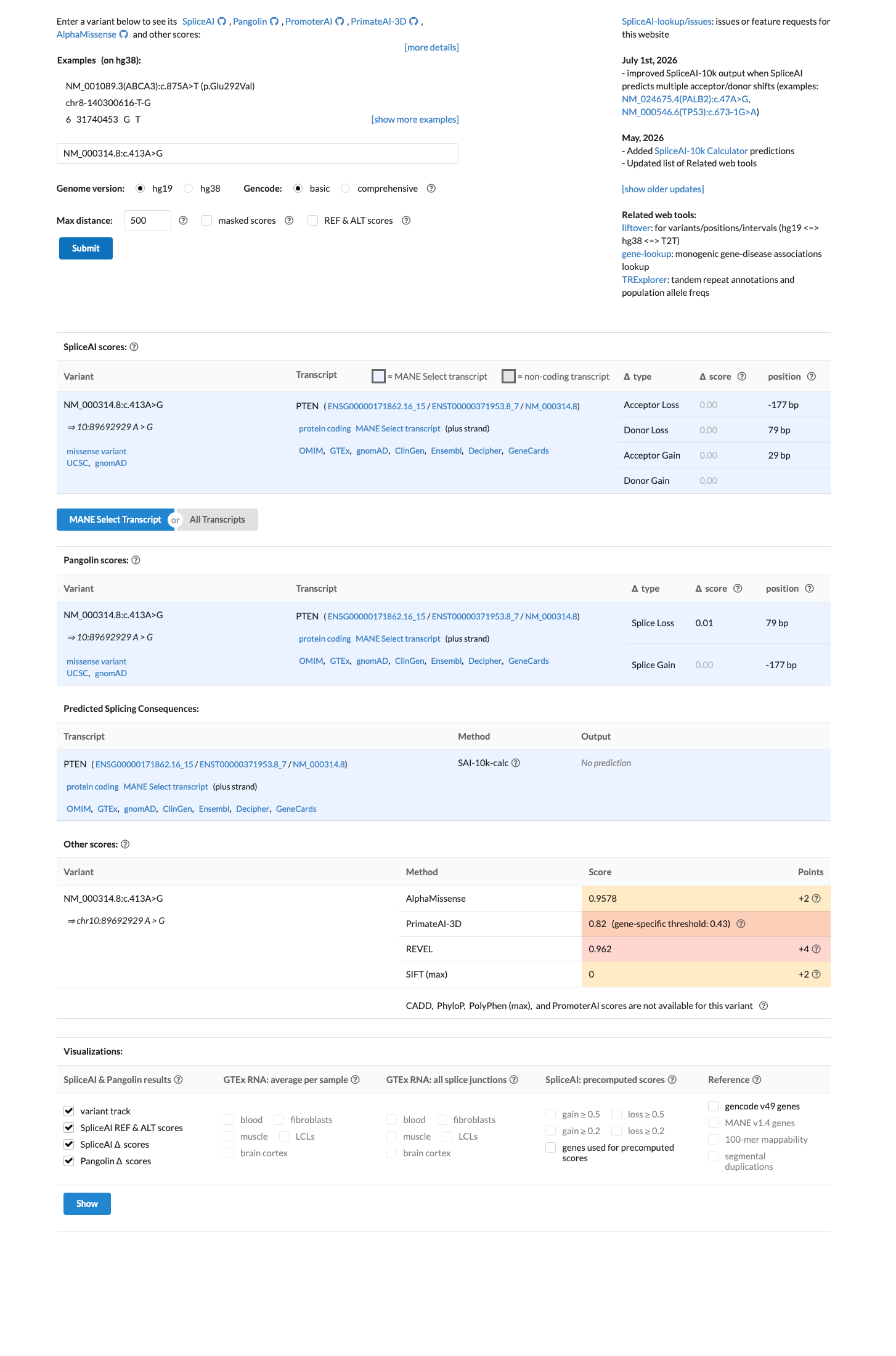
In silico
SpliceAI predicts no significant splice impact for this variant (max delta score = 0.00). REVEL score = 0.962. BayesDel score = 0.518367.
Functional
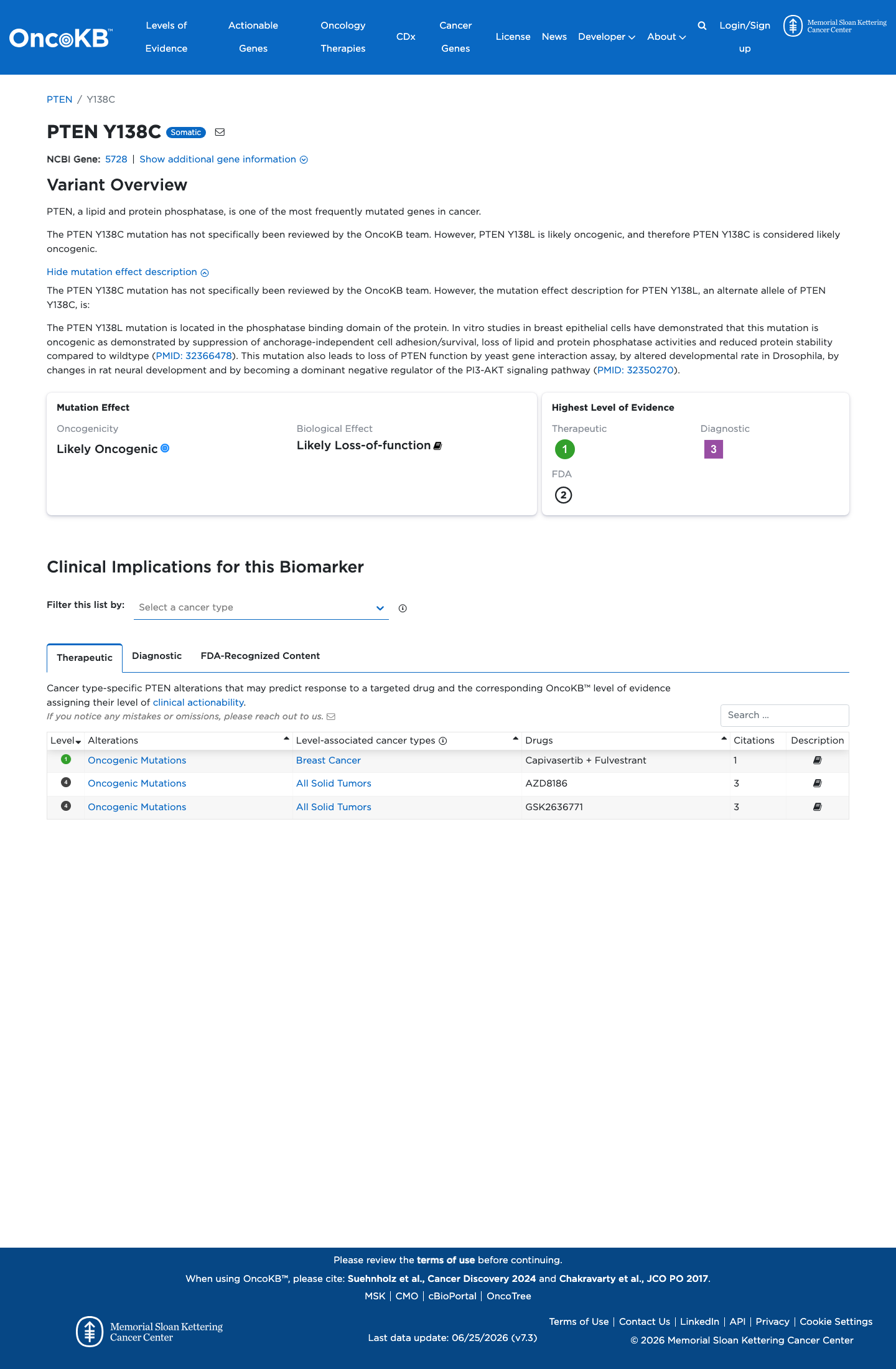
Likely Oncogenic
OncoKB did not identify variant-specific reviewed functional evidence for this variant; gene-level curated context is available for reviewer follow-up. PTEN, a lipid and protein phosphatase, is one of the most frequently mutated genes in cancer.
COSMIC

Cancer hotspots
Somatic evidence
Hotspot
COSMIC
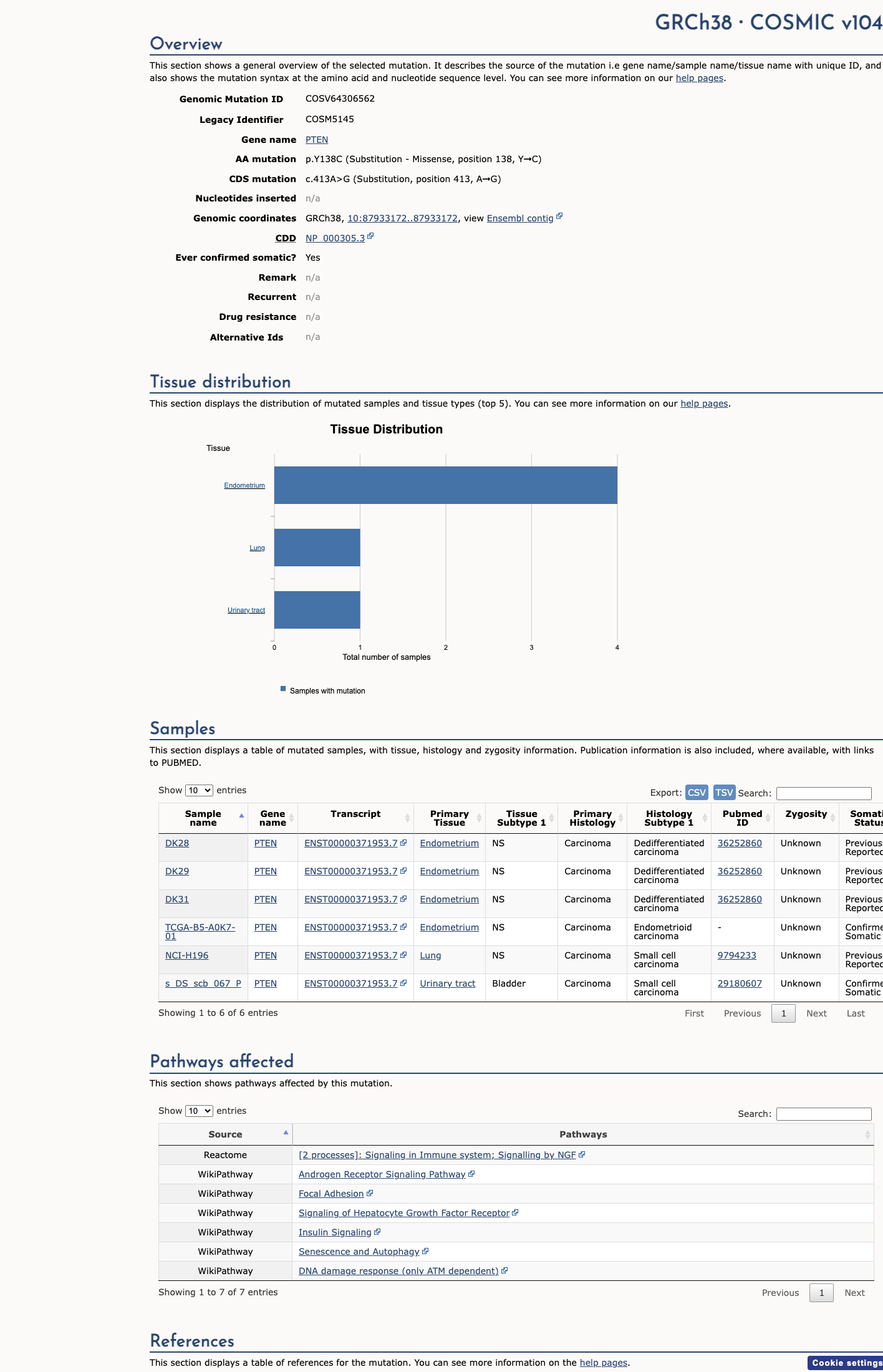
This variant lies in a statistically significant hotspot. This variant has previously been reported in somatic cancers (COSMIC; COSV64306562, n = 6 times).
Hotspots
This variant lies in a statistically significant hotspot.
Literature · how each cited paper was used
1papers cited
Each card is an audit: what was searched, what was found, whether it names the variant, which criteria it fed, and why. 7 further PMIDs triaged but not cited — see Sources & references.
PTEN protein phosphatase activity correlates with control of gene expression and invasion, a tumor-suppressing phenotype, but not with AKT activity.
Searched
c.413A>GY138CTyr138Cysp.Tyr138Cys
Found
Y138C (Tyr138Cys) was directly characterized as a tumor-derived PTEN mutant from small cell lung cancer cell line NCI-H196. When expressed in PTEN-null U87MG glioma cells, Y138C retained wild-type lipid phosphatase activity (suppressed PIP3 and AKT phosphorylation) but selectively lacked protein phosphatase activity and failed to suppress cellular invasion in Matrigel. Endogenous Y138C in NCI-H196 cells showed robust lipid phosphatase activity with little or no protein phosphatase activity and increased Thr366 phosphorylation, consistent with loss of autodephosphorylation. A second mutant at the same position, Y138L, showed identical properties.
Variant
✓ Names this variant — characterised directly
Applied to
→PS3
met
Why
Variant-specific functional data confirmed damaging effect (selective loss of protein phosphatase activity). Referenced in PS3 assessment as independent supporting evidence alongside Mighell et al. saturation mutagenesis data.
we analyzed a PTEN Tyr138Cys (Y138C) mutant identified in a metastatic small cell lung cancer cell line, NCI-H196. When expressed, purified, and assayed in vitro, PTEN Y138C had catalytic properties like those of PTEN Y138L, displaying lipid phosphatase activity, but not protein phosphatase activity.
Location Results: 'A tumor-derived PTEN mutant...' section (pp. 5-7); Figure 6 and Figure 7 · Context In vitro phosphatase assays with purified recombinant protein; lentiviral expression in PTEN-null U87MG glioblastoma cells; endogenous expression in NCI-H196 small cell lung cancer cells; Matrigel invasion assay; phosphospecific immunoblotting for Thr366 · full text
Sources & reference links
9Sources
Triaged references · 7 PMIDs not cited in assessment
32350270 ↗
Multi-model functionalization of disease-associated PTEN missense mutations identifies multiple molecular mechanisms underlying protein dysfunction.
ONCOKB
32366478 ↗
A Premalignant Cell-Based Model for Functionalization and Classification of PTEN Variants.
ONCOKB
23085752 ↗
Disruption of epithelial architecture caused by loss of PTEN or by oncogenic mutant p110α/PIK3CA but not by HER2 or mutant AKT1.
CLINVAR
25645574 ↗
ACG clinical guideline: Genetic testing and management of hereditary gastrointestinal cancer syndromes.
CLINVAR
25741868 ↗
Standards and guidelines for the interpretation of sequence variants: a joint consensus recommendation of the American College of Medical Genetics and Genomics and the Association for Molecular Pathology.
CLINVAR
26450531 ↗
Direct regulation of transforming growth factor β-induced epithelial-mesenchymal transition by the protein phosphatase activity of unphosphorylated PTEN in lung cancer cells.
CLINVAR
26848951 ↗
Differential Requirement for Pten Lipid and Protein Phosphatase Activity during Zebrafish Embryonic Development.
CLINVAR