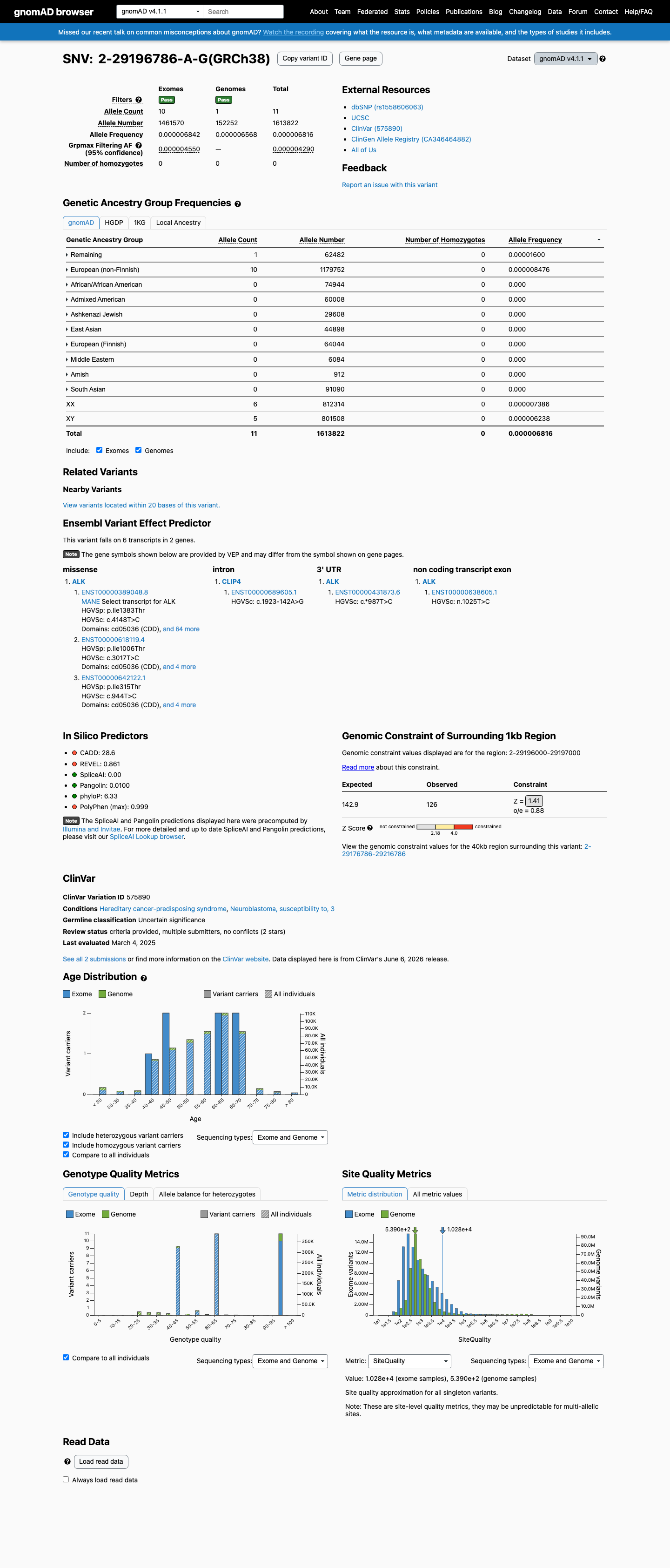
NM_004304.4:c.4148T>C (p.Ile1383Thr) is a missense variant in exon 28 of the ALK gene. It is absent from gnomAD v2.1 and present at extremely low frequency in gnomAD v4.1 (AF=6.82e-6, 11/1,613,822 alleles, 0 homozygotes).1 In silico analysis with REVEL predicts a damaging effect (score=0.861), though additional predictors are equivocal (BayesDel score=0.373; SpliceAI max delta=0.0). Ambry Genetics cited in silico evidence (PP3) in their ClinVar submission.2 ClinVar Variation ID 575890: classified as Uncertain Significance by 2 clinical laboratories (review status: criteria provided, single submitter). No expert panel classification exists.3 No variant-specific functional data, cosegregation data, case-control data, or de novo reports were identified in the literature. OncoKB classifies this variant as Unknown Oncogenic Effect.4 This variant is not a null variant (PVS1 not applicable) and does not fall in a statistically significant mutational hotspot (PM1 not met). No same-residue pathogenic comparators were identified (PM5 not applicable).5 No benign criteria are met: the variant is too rare for BA1/BS1, not observed in homozygous state (BS2 not met), and no benign functional evidence exists (BS3 not met). In silico predictors are mixed and do not support multiple lines of benign evidence (BP4 not met). BP1 is not applicable as ALK missense variants are established disease-causing mechanisms.6
Final classification
VUS
PM2PP3
ALK
c.4148T>C
p.Ile1383Thr
This variant
NM_004304.4:c.4148T>C (p.Ile1383Thr) is a missense variant in exon 28 of the ALK gene. It is absent from gnomAD v2.1 and present at extremely low frequency in gnomAD v4.1 (AF=6.82e-6, 11/1,613,822 alleles, 0 homozygotes).
gene-specific framework lacked a usable explicit final combination framework, so generic ACMG/AMP 2015 final-combination rules were applied as fallback; applied criteria: PM2 supporting, PP3 supporting; combination = 2 supporting, which maps to VUS.
Classification rationale
PM2PP3
VUS
ALK c.4148T>C
PM2 + PP3
→
VUS
2
revelbayesdelspliceai ↗clinvar ↗
4
oncokb ↗
5
pvs1_variant_assessmentpm5_candidates
6
gnomad_v4 ↗revelpvs1_gene_context
Gene diagram
· NM_004304.4 · variants mapped to exon structure
ALK
NM_004304.4
Fetching transcript structure from UCSC…
Applied criteria · 2 applied · 16 assessed
MetEvidence satisfies this criterion.
Not metEvaluated against available evidence; threshold not reached.
Not assessedApplies in principle, but no evidence was found to evaluate it.
N/ADoesn't apply to this variant type.
Applied · 2
Strength
Supporting
Moderate
Strong
Very strong
PM2
supporting
Pathogenic
This variant is absent from gnomAD v2.1 and present at extremely low frequency in gnomAD v4.1 (AF=6.82e-6, 11/1,613,822 alleles, 0 homozygotes; grpmax FAF=4.29e-6). The allele frequency is well below the 0.1% threshold for PM2 under generic ACMG.
gnomAD v2.1: absent. gnomAD v4.1: AF=6.82e-6 (11/1613822 alleles)
PP3
supporting
Pathogenic
REVEL predicts a damaging effect (score=0.861, above the 0.75 threshold). BayesDel is borderline (score=0.373, below 0.5) and SpliceAI predicts no splice impact (max delta=0.0). While in silico predictors are mixed, the strong REVEL score supports a deleterious prediction and is consistent with one ClinVar submitter (Ambry Genetics) citing in silico evidence for this variant. Applied at supporting strength due to lack of full multi-tool concordance.
REVEL: 0.861 (damaging). BayesDel: 0.373 (borderline). SpliceAI max delta: 0.0 (no splice impact). Ambry Genetics ClinVar submission (SCV003898311) cited PP3 based on in silico analysis.
Assessed · not applied
· 16 not met · 0 not assessed
Pathogenic
PS3
No variant-specific functional studies were identified.
PS4
No variant-specific case-control or prevalence data in affected individuals are available.
PM1
This variant (p.Ile1383Thr) lies within the ALK kinase domain (residues ~1116-1392), a functionally important region.
PP1
No cosegregation data with disease in families are available for this variant.
PP2
No gene-level missense constraint data (e.g., gnomAD missense Z-score) were available in the evidence packet to assess whether ALK has a low rate of benign missense variation.
PP4
No patient-specific phenotype or family history data are available for this case.
PP5
ClinVar classifies this variant as Uncertain Significance (2 clinical laboratories, review status: criteria provided, single submitter).
Benign
BA1
The variant allele frequency in gnomAD v4.1 is 6.82e-6 (0.00068%), far below the 1% BA1 threshold.
BS1
The variant allele frequency in gnomAD v4.1 is 6.82e-6 (0.00068%), far below the 0.3% BS1 threshold.
BS2
No homozygous individuals are observed in gnomAD v4.1 (0 homozygotes out of 1,613,822 alleles).
BS3
No well-established functional studies show no damaging effect for this variant.
BS4
No non-segregation data with disease in families are available for this variant.
BP2
No evidence that this variant has been observed in trans with a pathogenic variant in a fully penetrant dominant disorder.
BP4
REVEL predicts a damaging effect (score=0.861).
BP5
No evidence that this variant has been found in a case with an alternate molecular basis for disease.
BP6
ClinVar classifies this variant as Uncertain Significance, not benign/likely benign.
N/A · 10
PVS1 · PS1 · PS2 · PM3 · PM4 · PM5 · PM6 · BP1 · BP3 · BP7
Research & evidence
Population frequency
gnomAD v4.1
gnomAD v2.1
v4.1
This variant is present in gnomAD v4.1 (AF= 6.81612e-06; MAF= 0.00068%, 11/1613822 alleles, homozygotes = 0) and has highest observed frequency in the Remaining individuals population (AF= 1.60046e-05; MAF= 0.00160%, 1/62482 alleles, homozygotes = 0); grpmax FAF= 4.29e-06.
v2.1
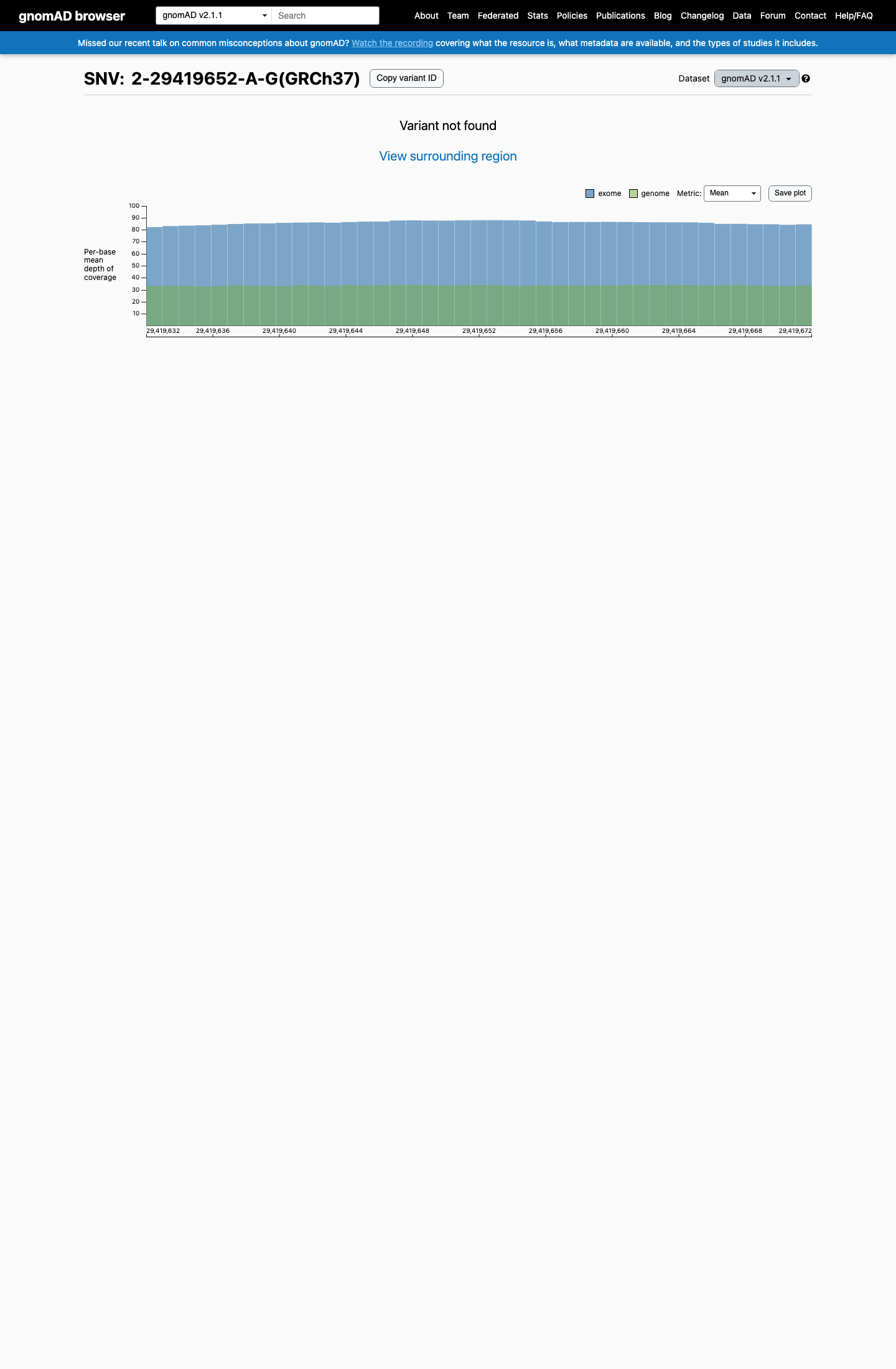
Absent from gnomAD v2.1.
🇨🇦 CA
Absent from gnomAD-Canada v1.0.
Allele frequency by ancestry
three datasets · side by side
gnomAD v4.1
0.00068%
· 11 / 1,613,822
0 hom · FAF 0.00043%
0 hom · FAF 0.00043%
Remaining individuals 1 / 62,482 |
0.0016% |
European (non-Finnish) 10 / 1,179,752 |
0.00085% |
+ 8 not observed (Admixed American, European (Finnish), Amish, East Asian, Middle Eastern, South Asian, Ashkenazi Jewish, African/African American)
gnomAD v2.1
Absent
· 0 / ?
0 hom
0 hom
Not observed in any ancestry group.
gnomAD Canada 🇨🇦
Absent
· 0 / ?
0 hom
0 hom
Not observed in any ancestry group.
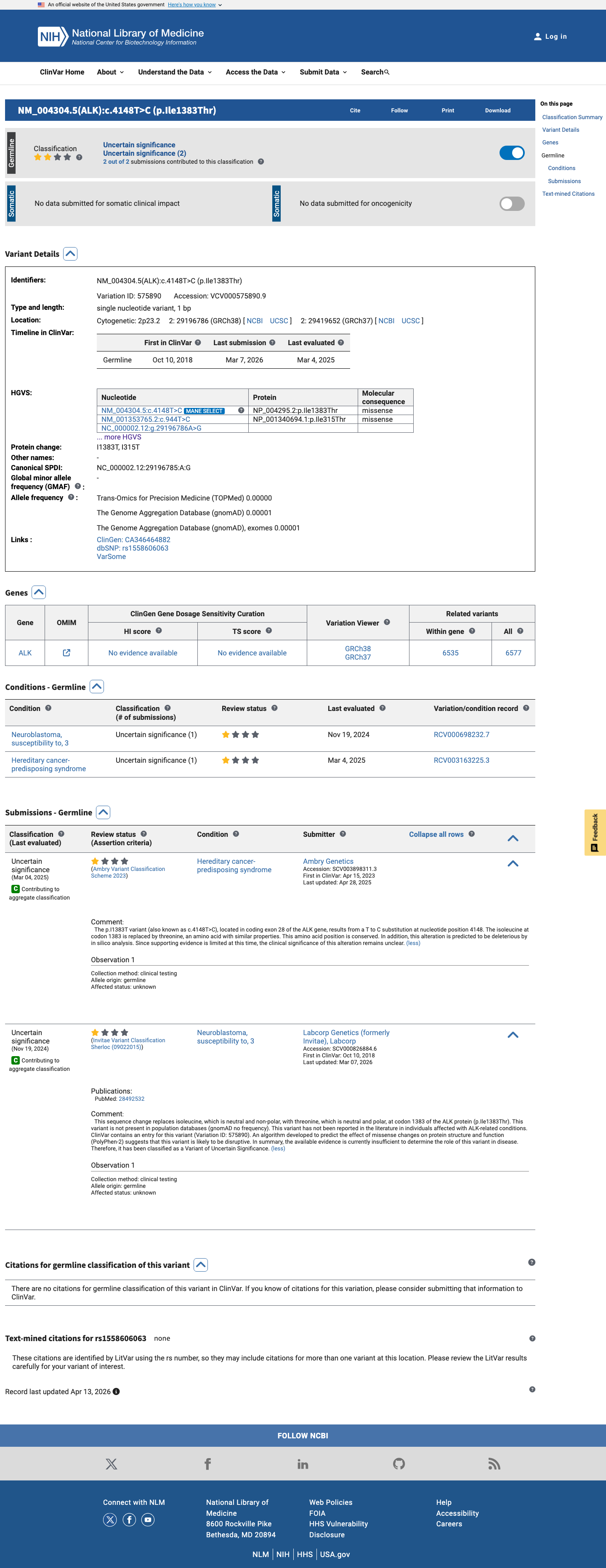
ClinVar
This variant has been reported in ClinVar as Uncertain significance (2 clinical laboratories). (ClinVarID = 575890)

In silico
SpliceAI predicts no significant splice impact for this variant (max delta score = 0.00). REVEL score = 0.861. BayesDel score = 0.373142.
Functional
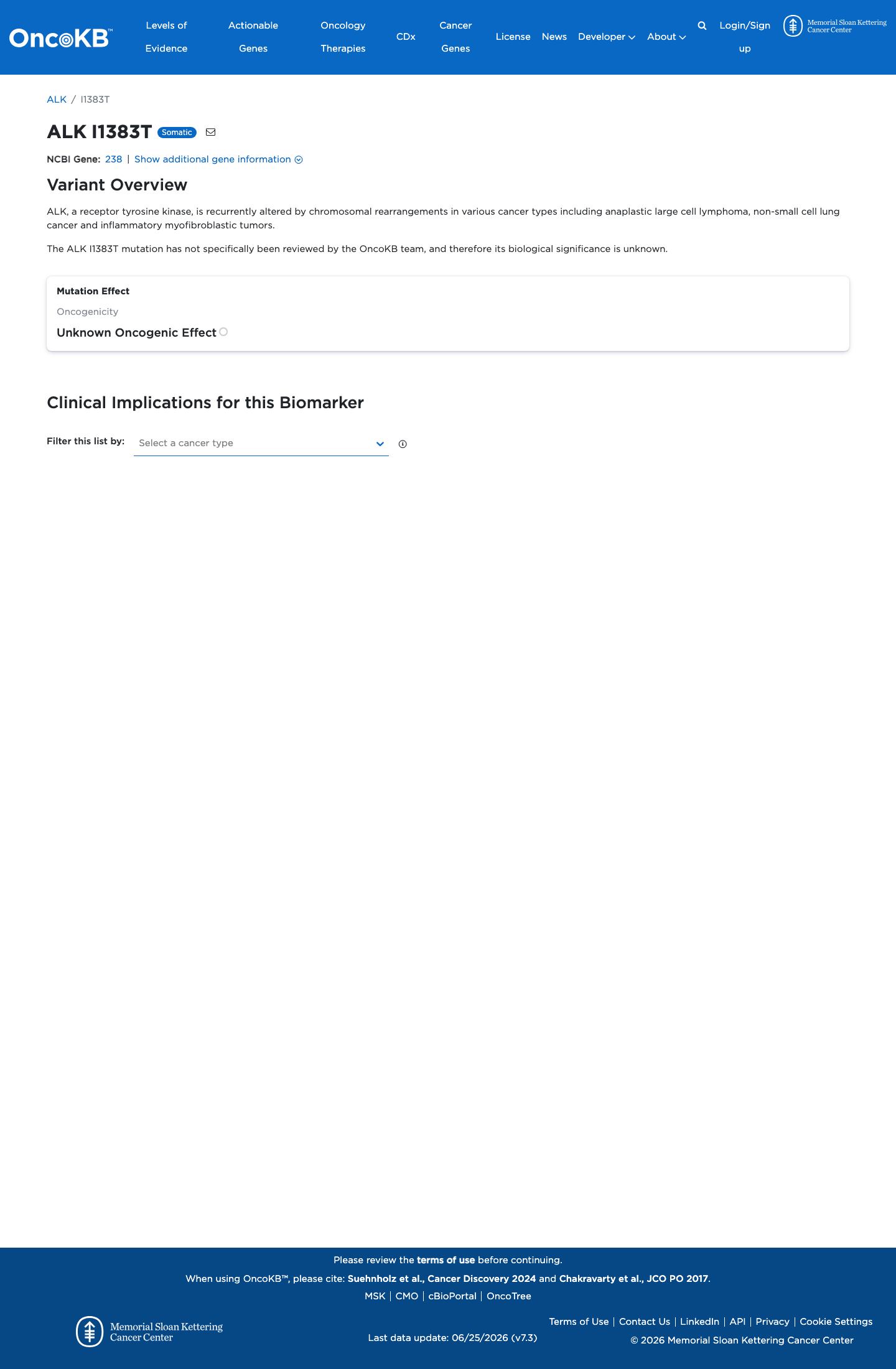
Unknown Oncogenic Effect
OncoKB did not identify variant-specific reviewed functional evidence for this variant; gene-level curated context is available for reviewer follow-up. ALK, a receptor tyrosine kinase, is recurrently altered by chromosomal rearrangements in various cancer types including anaplastic large cell lymphoma

COSMIC

Cancer hotspots
Somatic evidence
Not in COSMIC / hotspots
COSMIC
This variant does not lie in a statistically significant hotspot. This variant has not previously been reported in somatic cancers (COSMIC).
Hotspots
This variant does not lie in a statistically significant hotspot.
Sources & reference links
Triaged references · 2 PMIDs not cited in assessment
25394175 ↗
A practice guideline from the American College of Medical Genetics and Genomics and the National Society of Genetic Counselors: referral indications for cancer predisposition assessment.
CLINVAR