FGFR1 c.1731C>A (p.Asn577Lys) is a missense variant in the tyrosine kinase domain, a well-established mutational hotspot.1 The variant is completely absent from gnomAD v2.1, v4.1, and gnomAD-Canada across all populations (PM2).2 The variant lies within the tyrosine kinase domain hinge region, a critical functional domain and statistically significant hotspot (PM1).3 Multiple independent functional studies demonstrate that this variant causes gain-of-function effects: 25-fold increase in FGFR1 autophosphorylation rate, disrupted ordered phosphorylation, elevated MAPK/ERK signaling, and cellular transformation (PS3_strong).4 The variant has been reported in multiple unrelated probands with consistent phenotypes including encephalocraniocutaneous lipomatosis, pilocytic astrocytoma, dysembryoplastic neuroepithelial tumor, and other glioneuronal tumors (PS4_moderate).5 ClinVar classifies this variant as Pathogenic (Variation ID 224896) based on submissions from three clinical laboratories (PP5).6 No benign criteria are met; functional studies show gain-of-function effects that contradict BS3 and BP4, the variant is absent from population databases (contradicting BA1, BS1, BS2), and ClinVar reports the variant as Pathogenic (contradicting BP6).7
Final classification
Pathogenic
PS3PS4PM1PM2PP5
FGFR1
c.1731C>A
p.Asn577Lys
This variant
FGFR1 c.1731C>A (p.Asn577Lys) is a missense variant in the tyrosine kinase domain, a well-established mutational hotspot.
gene-specific framework lacked a usable explicit final combination framework, so generic ACMG/AMP 2015 final-combination rules were applied as fallback; applied criteria: PS3 strong, PS4 moderate, PM1 moderate, PM2 moderate, PP5 supporting; combination = 1 strong + 3 moderate + 1 supporting, which maps to Pathogenic.
Classification rationale
PS3PS4PM1PM2PP5
Pathogenic
FGFR1 c.1731C>A
PS3 + PS4 + PM1 + PM2 + PP5
→
Pathogenic
Gene diagram
· NM_001174067.1 · variants mapped to exon structure
FGFR1
NM_001174067.1
Fetching transcript structure from UCSC…
Applied criteria · 5 applied · 17 assessed
MetEvidence satisfies this criterion.
Not metEvaluated against available evidence; threshold not reached.
Not assessedApplies in principle, but no evidence was found to evaluate it.
N/ADoesn't apply to this variant type.
Applied · 5
Strength
Supporting
Moderate
Strong
Very strong
PS3
strong
Pathogenic
The exact variant (FGFR1 p.Asn577Lys / p.Asn546Lys on canonical transcript NM_023110.3) has been directly tested in multiple independent functional studies demonstrating unequivocal gain-of-function effects. PMID:19224897 (Lew et al., 2009) showed the N546K mutant increases FGFR1 autophosphorylation rate 25-fold, disrupts ordered autophosphorylation kinetics, and induces morphological transformation in Rat-1 cells. PMID:26920151 (Rivera et al., 2016) demonstrated constitutive FGFR1 phosphorylation, elevated phospho-ERK under both starvation and reactivation conditions, and oncogene-induced senescence in HEK293 cells. PMID:14602678 (Liu et al., 2003) showed N546K induces ectopic Gbx2, Fgf8, and Spry1 expression and midbrain enlargement in chick embryo electroporation assays. Three independent publications provide direct variant-specific experimental evidence of gain-of-function, meeting PS3 at strong strength.
FGFR1 N546K kinase domain: 25x increase in autophosphorylation ratedisrupted ordered phosphorylationRat-1 cell transformation (PMID:19224897).
PS4
moderate
Pathogenic
This variant is completely absent from gnomAD v2.1, v4.1, and gnomAD-Canada across all populations, and has been reported in multiple unrelated probands with consistent phenotypes. At least five independent publications describe this variant in affected individuals: mosaic activating mutation causing encephalocraniocutaneous lipomatosis (PMID:26942290), recurrent somatic mutation in pilocytic astrocytoma (PMID:23817572, n=5+), DNET (PMID:26920151), papillary glioneuronal tumor (PMID:24777483), diffuse leptomeningeal tumor (PMID:27061725), and rosette-forming glioneuronal tumor (PMID:27626068). ClinVar reports classification as Pathogenic by three clinical laboratories (ClinVar ID 224896). The complete absence from population databases combined with multiple proband observations supports PS4 at moderate strength.
Absent from gnomAD v2.1v4.1and gnomAD-Canada (all populations).
PM1
moderate
Pathogenic
The variant alters residue Asn577 (Asn546 on canonical transcript NM_023110.3), which lies within the tyrosine kinase domain of FGFR1. This position is a well-established mutational hotspot in the kinase hinge region. Cancerhotspots.org identifies this residue as a statistically significant hotspot. The tyrosine kinase domain is a critical functional domain; mutations at this residue (N546K) have been shown to alter kinase autoinhibition and increase catalytic activity (PMID:19224897). Multiple independent tumor types harbor mutations at this exact codon (PMID:23817572, PMID:26920151). PM1 is met at moderate strength.
Residue located in the tyrosine kinase domain hinge regiona critical functional domain.Cancerhotspots.org identifies this position as a statistically significant hotspot.
PM2
moderate
Pathogenic
This variant is completely absent from gnomAD v2.1 (exomes), gnomAD v4.1 (exomes), and gnomAD-Canada v1.0 (genomes) across all populations. Under generic ACMG/AMP 2015 rules, absence from large population databases supports PM2 at moderate strength for a rare disease variant.
Absent from gnomAD v2.1 (allele count = 0).Absent from gnomAD v4.1 (allele count = 0).Absent from gnomAD-Canada v1.0 (allele count = 0).
PP5
supporting
Pathogenic
ClinVar reports this variant as Pathogenic (Variation ID 224896) by three clinical laboratories. Although the aggregate review status is 'criteria provided, single submitter' (1-star), the variant is classified as Pathogenic by multiple reputable clinical laboratories, which meets the generic ACMG/AMP PP5 criterion: a reputable source reports the variant as pathogenic but the evidence is not independently evaluated. Applied at supporting strength.
ClinVar Variation ID 224896 classified as Pathogenic by 3 clinical laboratories.Multiple submissions with consistent pathogenic interpretation.
Assessed · not applied
· 13 not met · 4 not assessed
Pathogenic
PS1
PS1 requires the same amino acid change (p.Asn577Lys) resulting from a different nucleotide change to have been previously established as pathogenic.
PS2
No confirmed de novo occurrence with both maternity and paternity confirmed was identified.
PM6
No confirmed de novo occurrence with parental confirmation was identified.
PP1
No co-segregation data in affected families was identified.
PP2
PP2 applies to missense variants in genes where missense variants are a common mechanism of disease and the gene has a low rate of benign missense variation.
PP3
In silico evidence is mixed and does not provide multiple lines of computational support for a deleterious effect.
PP4
PP4 requires the patient's phenotype or family history to be highly specific for a disease with a single genetic etiology.
Benign
BA1
This variant is completely absent from gnomAD v2.1, v4.1, and gnomAD-Canada.
BS1
This variant is completely absent from gnomAD v2.1, v4.1, and gnomAD-Canada.
BS2
The variant is absent from all population databases, and there is no evidence of healthy adult carriers.
BS3
Well-established functional studies show a gain-of-function deleterious effect, not a benign effect.
BS4
No co-segregation or lack-of-segregation data in affected families was identified for this variant.
BP1
BP1 applies to missense variants in genes where only truncating variants cause disease.
BP2
BP2 requires observation of the variant in trans with a known pathogenic variant for a fully penetrant dominant disorder.
BP4
BP4 requires multiple lines of computational evidence suggesting no impact on gene or gene product.
BP5
BP5 requires the variant to be found in a case with an alternate molecular basis for disease.
BP6
BP6 requires a reputable source to report the variant as benign.
N/A · 3
PVS1 · PM5 · BP7
Research & evidence
Population frequency · supports pathogenic
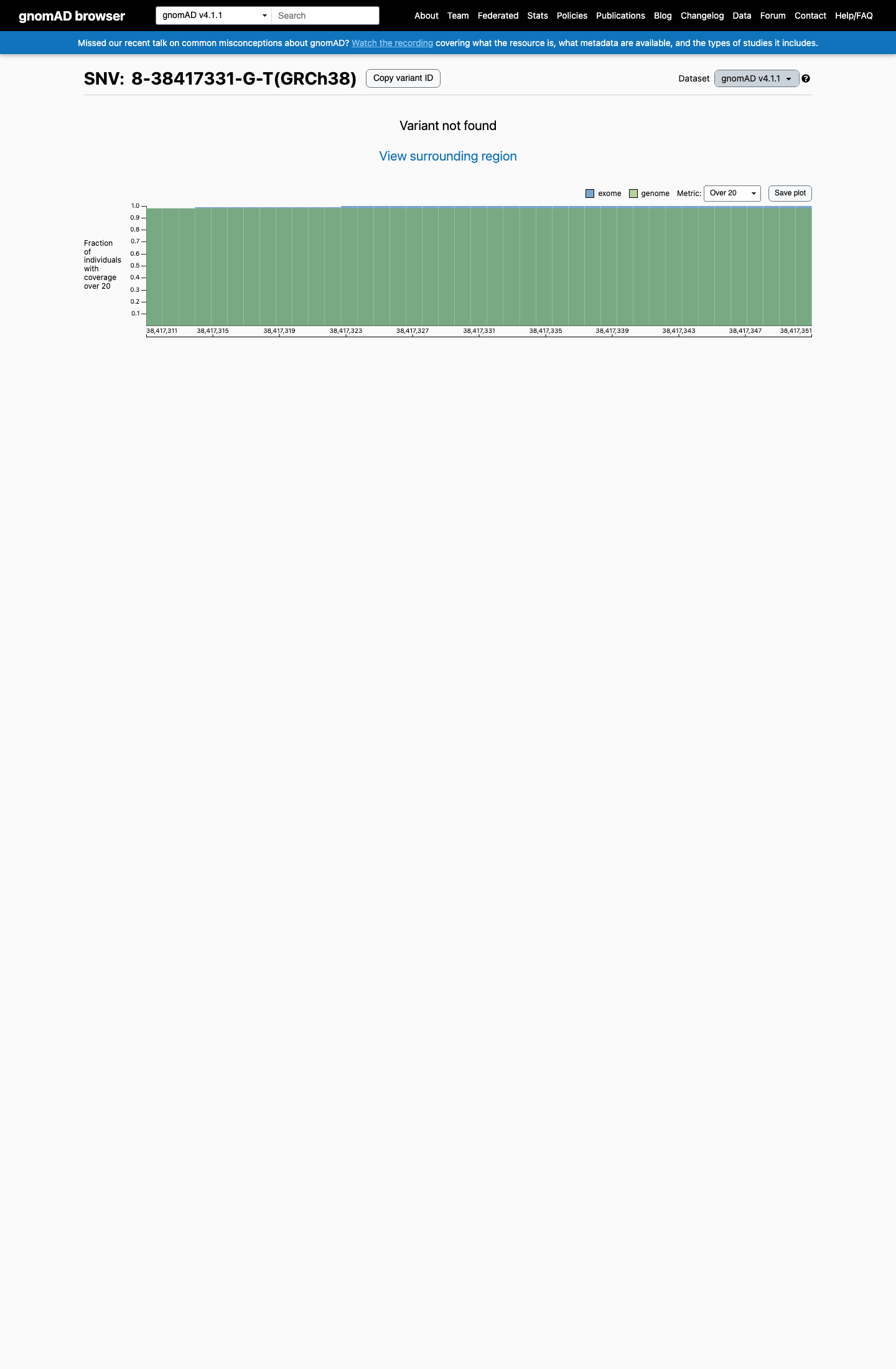
gnomAD v4.1
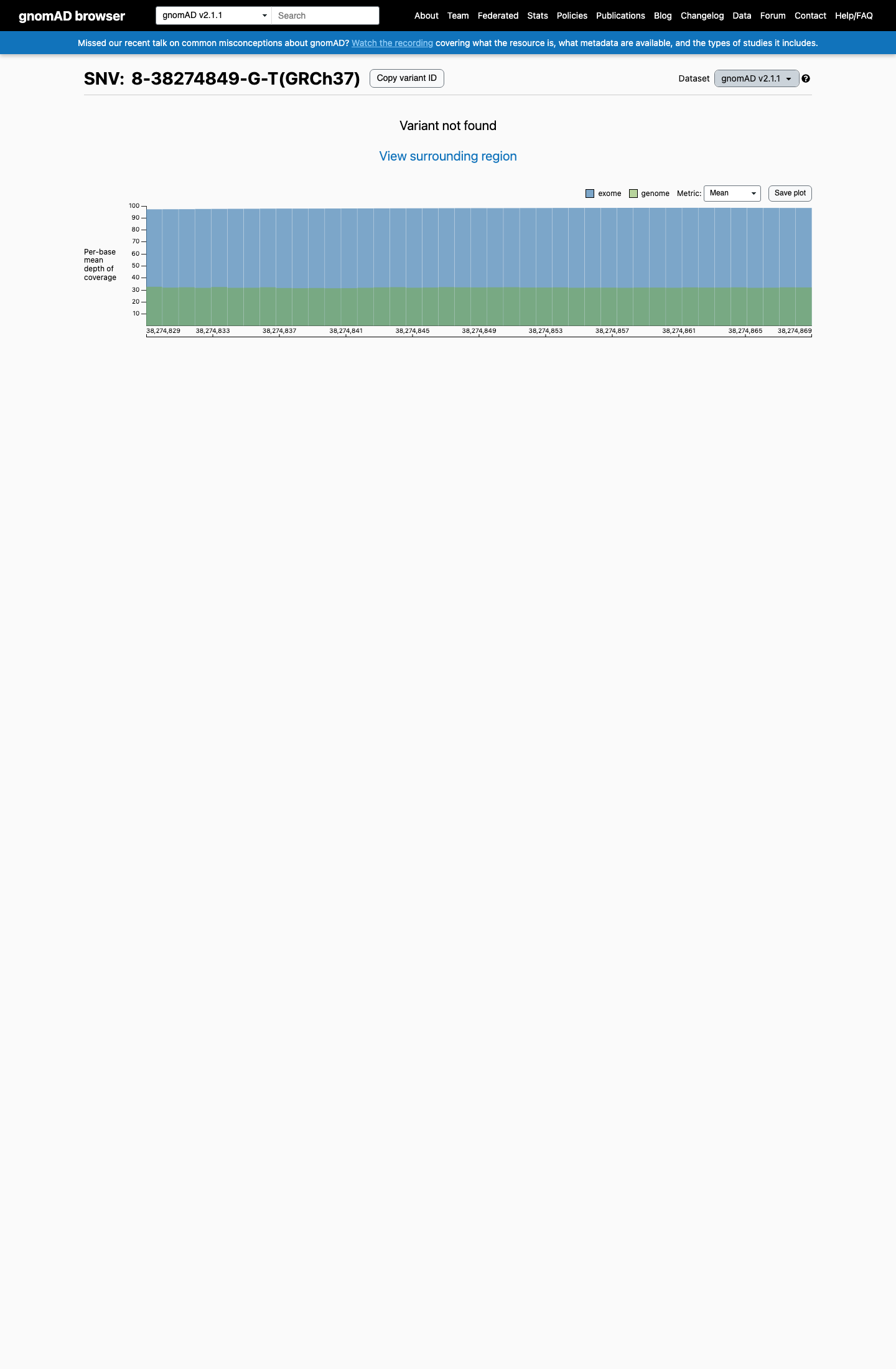
gnomAD v2.1
v4.1
Absent from gnomAD v4.1.
v2.1
Absent from gnomAD v2.1.
🇨🇦 CA
Absent from gnomAD-Canada v1.0.
Allele frequency by ancestry
three datasets · side by side
gnomAD v4.1
Absent
· 0 / ?
0 hom
0 hom
Not observed in any ancestry group.
gnomAD v2.1
Absent
· 0 / ?
0 hom
0 hom
Not observed in any ancestry group.
gnomAD Canada 🇨🇦
Absent
· 0 / ?
0 hom
0 hom
Not observed in any ancestry group.

ClinVar
This variant has been reported in ClinVar as Pathogenic (3 clinical laboratories). (ClinVarID = 224896)

In silico
SpliceAI predicts no significant splice impact for this variant (max delta score = 0.00). REVEL score = 0.646. BayesDel score = -0.0722477.
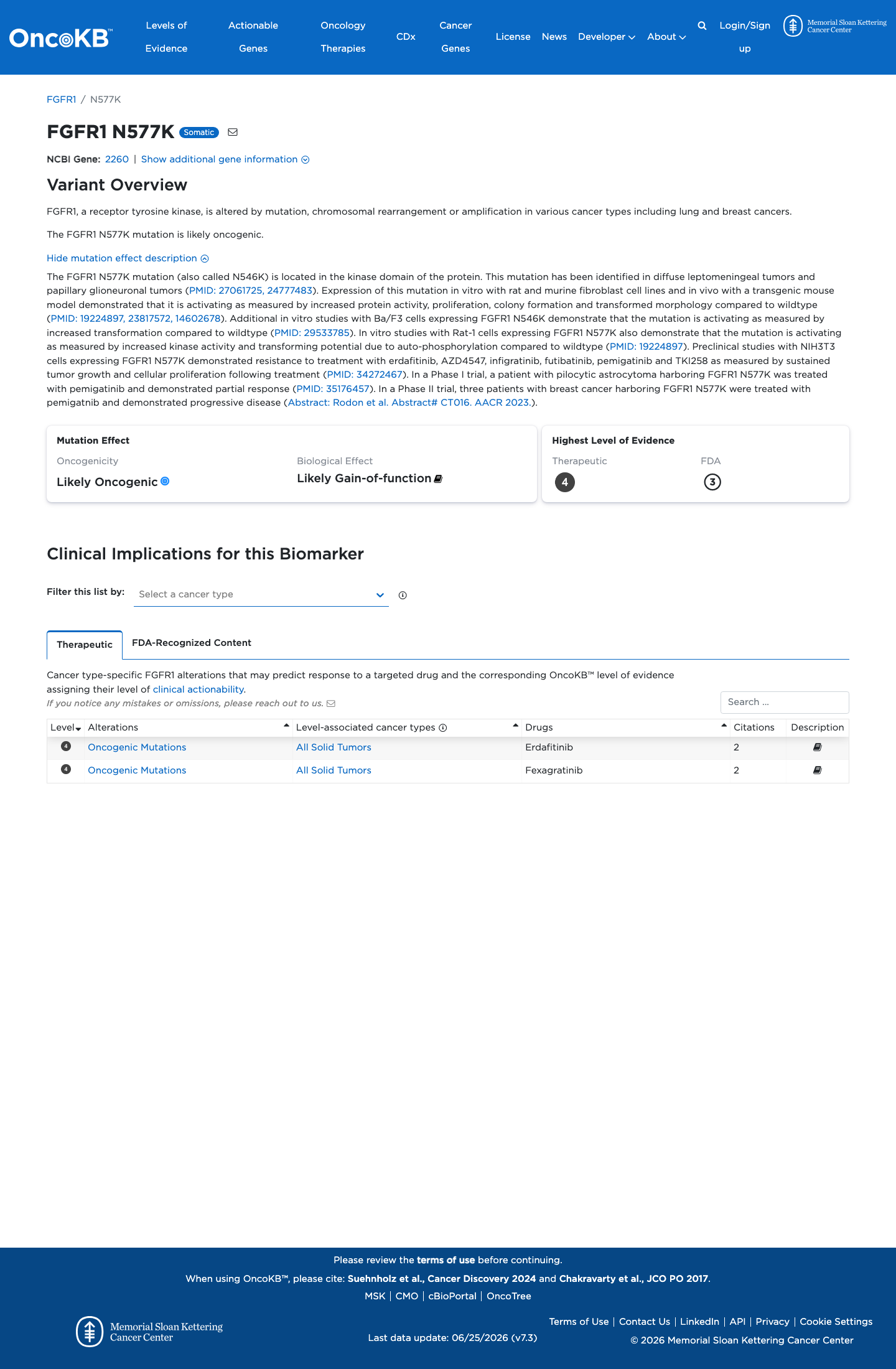
Functional
Likely Oncogenic
OncoKB identified variant-specific curated literature and context relevant to functional review; biological-effect context: Likely Gain-of-function; curated oncogenicity label: Likely Oncogenic.
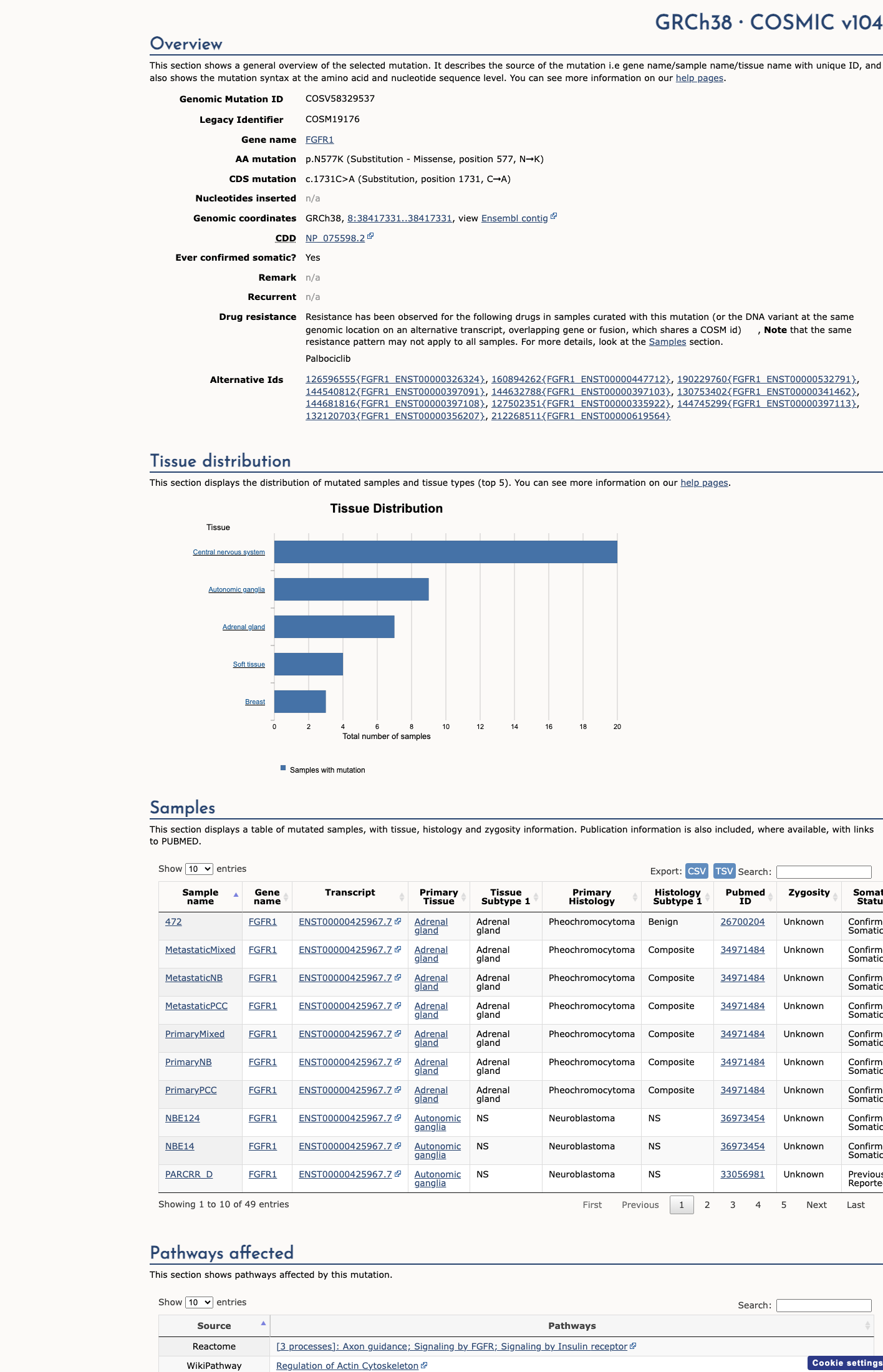
COSMIC

Cancer hotspots
Somatic evidence
Hotspot
COSMIC
This variant lies in a statistically significant hotspot. This variant has previously been reported in somatic cancers (COSMIC; COSV58329537, n = 49 times).
Hotspots
This variant lies in a statistically significant hotspot.
Literature · how each cited paper was used
6papers cited
Each card is an audit: what was searched, what was found, whether it names the variant, which criteria it fed, and why.
FGF17b and FGF18 have different midbrain regulatory properties from FGF8b or activated FGF receptors.
Searched
N546KN577Kc.1638C>Ac.1731C>A
Found
FGFR1 N546K (equivalent to N577K) was directly tested via chick embryo electroporation. The mutant induced ectopic expression of Gbx2, Fgf8, and Spry1 in scattered midbrain cells, and produced an enlarged midbrain phenotype at later stages. Gene expression changes were similar to those induced by activated FGFR2, consistent with gain-of-function.
Variant
✓ Names this variant — characterised directly
Applied to
→PS3
met
Why
Direct variant-specific functional data in developmental context; supports PS3 assessment. Shows N546K produces gain-of-function signaling changes but phenotype differs from FGF8b (enlarged midbrain rather than cerebellar transformation).
Two mutant forms of human FGFR1, N546K and K656E (M. Mohammadi, unpublished), as well as one mutant form of human FGFR2, C342Y, were used in this study.
Location Results, paragraphs on activated FGFRs; Table 1; Figure 5 · Context Chick in ovo electroporation, stage 9-12 embryos, midbrain/caudal forebrain; mouse brain explant culture · full text
The precise sequence of FGF receptor autophosphorylation is kinetically driven and is disrupted by oncogenic mutations.
Searched
N546KN577K
Found
FGFR1 N546K was directly tested in the isolated kinase domain. The mutation increased the rate of first-stage autophosphorylation 25-fold (0.25 s-1 vs 0.009 s-1 wild-type) and disrupted the ordered autophosphorylation sequence, producing heterogeneous phosphorylation. Stable expression of full-length FGFR1 N546K in Rat-1 cells induced morphological transformation characterized by decreased cell spreading and adhesion.
Variant
✓ Names this variant — characterised directly
Applied to
→PS3
met
→PM1
met
Why
Direct variant-specific functional data demonstrating gain-of-function at the biochemical level (increased kinase activity, disordered autophosphorylation) and cellular transformation; supports PS3 at strong level and PM1.
one of these mutations, N546K, resides in the vicinity of the hinge region between the N and C lobes... Formation of the monophosphorylated species (0P to 1P) was 25 times faster with the N546K mutant (0.25 s-1) than with wild-type FGFR1 kinase (0.009 s-1)
Location Results (sections on glioblastoma FGFR1 mutant); Figure 5; Discussion paragraph 4 · Context In vitro kinase assay with purified FGFR1 kinase domain; stable expression in Rat-1 fibroblasts · full text
Recurrent somatic alterations of FGFR1 and NTRK2 in pilocytic astrocytoma.
Searched
N546KN577Kc.1638
Found
FGFR1 N546K identified as a recurrent somatic hotspot mutation in pilocytic astrocytoma. Found in 5 tumors in the discovery cohort and confirmed in 9 additional cases in the validation cohort. All FGFR1-mutant tumors were extra-cerebellar and midline. Immunohistochemistry showed strong phospho-FGFR1 positivity in all N546K-mutant tumors. The mutation was mutually exclusive with other MAPK pathway alterations (BRAF, KRAS, NF1).
Variant
✓ Names this variant — characterised directly
Applied to
→PS4
met
→PM1
met
Why
Key discovery paper establishing N546K as a recurrent MAPK-pathway-activating hotspot in brain tumors; supports PS4 (multiple probands) and PM1 (hotspot).
mutation of two hotspot residues (N546 and K656) in the kinase domain of FGFR1, was seen in five tumors... The N546K mutation alters FGFR1 auto-phosphorylation, resulting in increased kinase activity and transforming potential
Location Results (FGFR1 section); Supplementary Table 3; Figure 3a · Context Whole-genome sequencing of 96 pilocytic astrocytomas; targeted validation in 45 additional cases; immunohistochemistry for phospho-FGFR1 and phospho-ERK · full text
FGFR1 N546K mutation in a case of papillary glioneuronal tumor (PGNT).
Searched
N546KN577K
Found
FGFR1 N546K mutation identified in a papillary glioneuronal tumor (PGNT) in a 33-year-old male. This was the first report of FGFR1 N546K in a glioneuronal tumor. Tumor cells were positive for phospho-ERK and focally positive for phospho-FGFR1 by immunohistochemistry.
Variant
✓ Names this variant — characterised directly
Applied to
→PS4
met
Why
Case report providing additional proband with N546K in glioneuronal tumor; supports PS4.
The pyrosequencing analysis of the two hotspots of the FGFR1 gene revealed at codon 546 an AAC->AAA substitution corresponding to an Asn->Lys mutation
Location Results; Figure 1g, 1h · Context Pyrosequencing of FFPE tumor tissue; immunohistochemistry for phospho-FGFR1 and phospho-ERK · full text
Germline and somatic FGFR1 abnormalities in dysembryoplastic neuroepithelial tumors.
Searched
N546KN577Kc.1638C>A
Found
FGFR1 N546K (c.1638C>A) identified as a somatic hotspot mutation in dysembryoplastic neuroepithelial tumors (DNET). Multiple sporadic DNETs harbored this mutation. Functional characterization in HEK293 cells showed that N546K causes constitutive FGFR1 phosphorylation, significantly elevated phospho-ERK under both serum starvation and reactivation conditions, and oncogene-induced senescence by beta-galactosidase assay. In silico modeling predicted the mutation favors the active kinase conformation.
Variant
✓ Names this variant — characterised directly
Applied to
→PS3
met
→PS4
met
Why
Direct variant-specific functional data demonstrating constitutive kinase activation, elevated MAPK signaling, and senescence; supports PS3 at strong level. Multiple DNET cases support PS4.
Immunoblotting of phospho-FGFR1 revealed constitutive phosphorylation of FGFR1 in the p.N546K mutant under normal growth conditions... p.N546K showed higher levels of phospho-ERK than cells overexpressing either FGFR1-wild type or p.R661P (both p < 0.05)
Location Results (Molecular Investigation, MAPK-ERK signaling); Figure 4; Table 2 · Context HEK293 cells stably expressing FGFR1 N546K; flow cytometry for phospho-ERK; western blot; beta-galactosidase senescence assay · full text
FGFR1 N546K and H3F3A K27M mutations in a diffuse leptomeningeal tumour with glial and neuronal markers.
Searched
N546KN577K
Found
FGFR1 N546K identified in a diffuse leptomeningeal tumor with glial and neuronal markers in a 15-year-old male, co-occurring with H3F3A K27M. The tumor showed elevated Ki-67 (10-15%) and aggressive clinical course. Authors note N546K has been reported in pilocytic astrocytoma, DNET, and other glioneuronal tumors.
Variant
✓ Names this variant — characterised directly
Applied to
→PS4
met
Why
Case report adding to the spectrum of N546K-associated CNS tumors; supports PS4.
Genomic alterations detected by tumor genome profiling identified perturbations in the FGFR1... FGFR1 (N546K)
Location Case Report; Discussion; Table 1 · Context Foundation Medicine tumor genome profiling (315-gene panel); immunohistochemistry · full text
Sources & reference links