NM_005228.4:c.2317_2319dupCAC (p.His773dup) is an in-frame duplication in exon 20 of EGFR, located in the tyrosine kinase domain C-helix/post-C-helix region, a critical functional domain (PM1).1 This variant is absent from all population databases including gnomAD v2.1, v4.1, and gnomAD-Canada (PM2).2 The in-frame duplication results in a protein length change (p.His773dup) in a non-repeat region of EGFR (PM4). ClinVar classifies this variant as Uncertain significance (Variation ID 45261, 0-star review status) based on a single clinical laboratory submission with no assertion criteria provided.3 OncoKB annotates this variant as Likely Oncogenic with gain-of-function biological effect. COSMIC reports 15 somatic observations (COSV51781591), consistent with a role in tumorigenesis.4 No variant-specific functional studies were identified for p.His773dup in the reviewed literature. Sister exon 20 insertion variants at His773 (His773_Val774insHis) have been characterized as conferring EGFR TKI resistance in vitro, but the exact variant has not been experimentally tested.5 SpliceAI predicts no splice alteration (max delta = 0.00). REVEL and BayesDel are not applicable to this variant type.6
EGFR
Final classification
Likely Pathogenic
EGFR c.2317_2319dup · p.His773dup
EGFR
NM_005228.4:c.2317_2319dupCAC (p.His773dup) is an in-frame duplication in exon 20 of EGFR, located in the tyrosine kinase domain C-helix/post-C-helix region, a critical functional domain (PM1).
gene-specific framework lacked a usable explicit final combination framework, so generic ACMG/AMP 2015 final-combination rules were applied as fallback; applied criteria: PM1 moderate, PM2 moderate, PM4 moderate; combination = 3 moderate, which maps to Likely Pathogenic.
Classification rationale
PM1PM2PM4
Likely Pathogenic
EGFR c.2317_2319dup
PM1 + PM2 + PM4
→
Likely Pathogenic
Gene diagram
· NM_005228.4 · variants mapped to exon structure
EGFR
NM_005228.4
Fetching transcript structure from UCSC…
Applied criteria · 3 applied · 17 assessed
Applied · 3
Strength
Supporting
Moderate
Strong
Very strong
✓
PM1
moderate
Pathogenic
p.His773dup is located in the EGFR tyrosine kinase domain, specifically in exon 20 within the C-helix/post-C-helix region (residues 762–823). This is a well-characterized critical functional domain essential for kinase activity and ATP/drug binding. Exon 20 insertions in this region are established oncogenic drivers in NSCLC.
PMID:21764376 (Yasuda 2012): Comprehensive review establishing the C-helix and post-C-helix region of exon 20 as critical for EGFR kinase domain active/inactive conformational control.PMID:18676761 (Wu 2008): Documents exon 20 mutations in the tyrosine kinase domain as functionally significant.OncoKB: Gain-of-function / Likely Oncogenic annotation consistent with location in critical functional domain.
✓
PM2
moderate
Pathogenic
NM_005228.4:c.2317_2319dupCAC is absent from all population databases: gnomAD v2.1 (exomes), gnomAD v4.1 (exomes), and gnomAD-Canada v1.0. Under generic ACMG/AMP non-VCEP rules, absence from population databases meets PM2 at moderate strength (AF < 0.1%).
gnomAD v2.1: absent (AC=nullAN=nullAF=null)
✓
PM4
moderate
Pathogenic
NM_005228.4:c.2317_2319dupCAC causes an in-frame duplication (p.His773dup), resulting in a protein length change by insertion of one amino acid in a non-repeat region of EGFR. PM4 applies to in-frame deletions/insertions in non-repeat regions.
In-frame duplication of CAC at c.2317_2319predicting p.His773dup.EGFR does not contain repetitive regions at this position.
Assessed · not applied
Pathogenic
PS2
No de novo observation has been reported for NM_005228.4:c.2317_2319dupCAC (p.His773dup).
PS3
No direct functional data exists for p.His773dup specifically.
PS4
No case-control data or statistically enriched observation of NM_005228.4:c.2317_2319dupCAC in affected individuals versus controls.
PM6
No de novo observation has been reported for NM_005228.4:c.2317_2319dupCAC in any of the reviewed publications.
PP1
No cosegregation data is available for NM_005228.4:c.2317_2319dupCAC.
PP3
In silico predictors provide no evidence supporting pathogenicity.
PP4
No patient phenotype information is available to evaluate specificity of the patient's clinical presentation for EGFR-related disease.
PP5
ClinVar classifies this variant as Uncertain significance (Variation ID 45261) with review status 'no assertion criteria provided' (0 stars) by a single clinical laboratory.
Benign
BA1
The variant is absent from all population databases (gnomAD v2.1, v4.1, Canada).
BS1
The variant is absent from all population databases.
BS2
No data on observation of this variant in healthy adult controls (homozygous or heterozygous) is available.
BS3
Available evidence suggests gain-of-function, not benign effect.
BS4
No segregation data is available to evaluate lack of cosegregation with disease.
BP2
No data available on whether this variant has been observed in trans with a known pathogenic variant in EGFR.
BP4
No in silico evidence supports a benign effect.
BP5
No data available on whether an alternate molecular basis for disease has been identified in the proband.
BP6
ClinVar classifies this variant as Uncertain significance (Variation ID 45261) with review status 'no assertion criteria provided' (0 stars).
N/A · 7
PVS1 · PS1 · PM5 · PP2 · BP1 · BP3 · BP7
Research & evidence
Population frequency · supports pathogenic
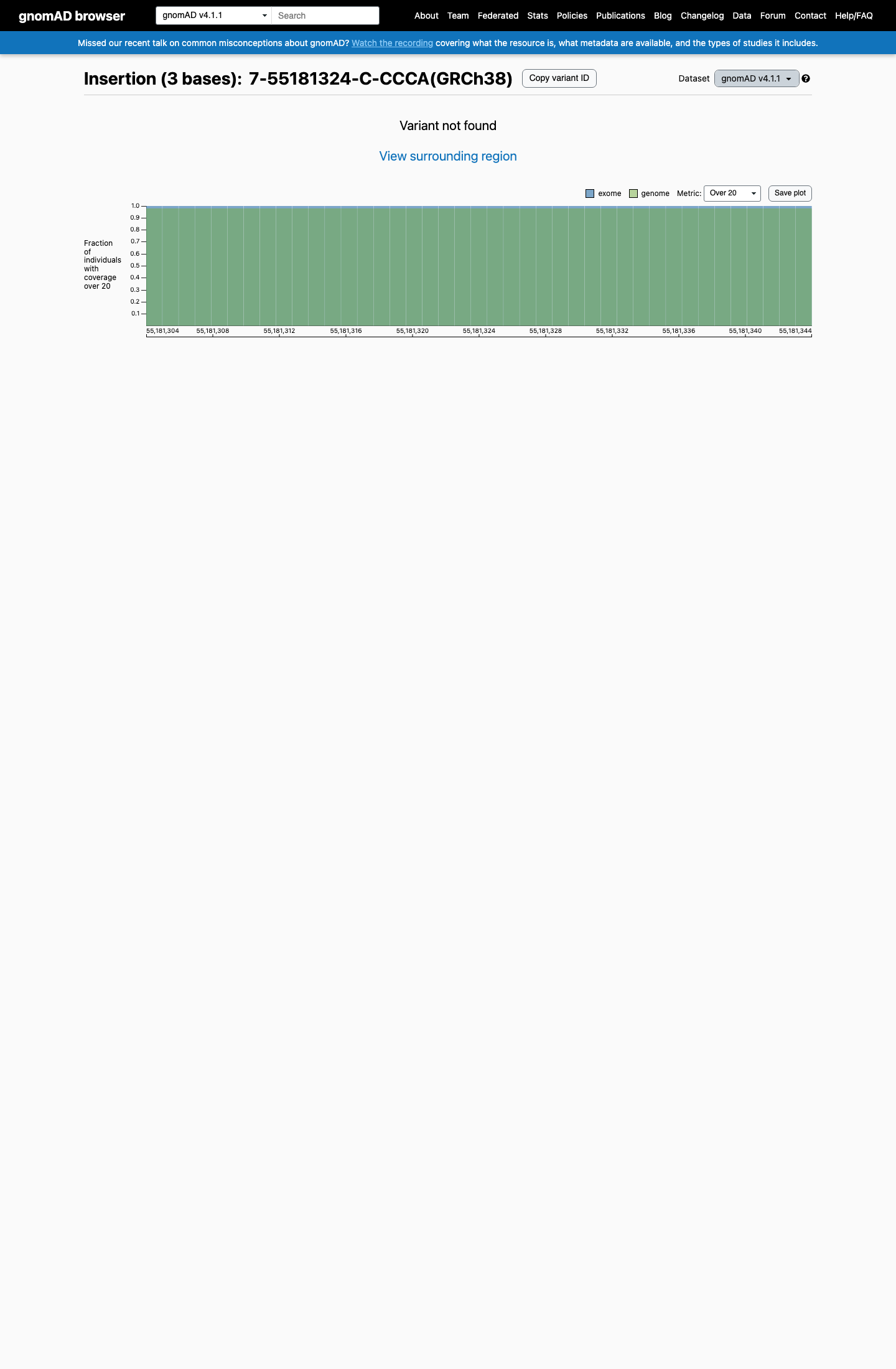
gnomAD v4.1
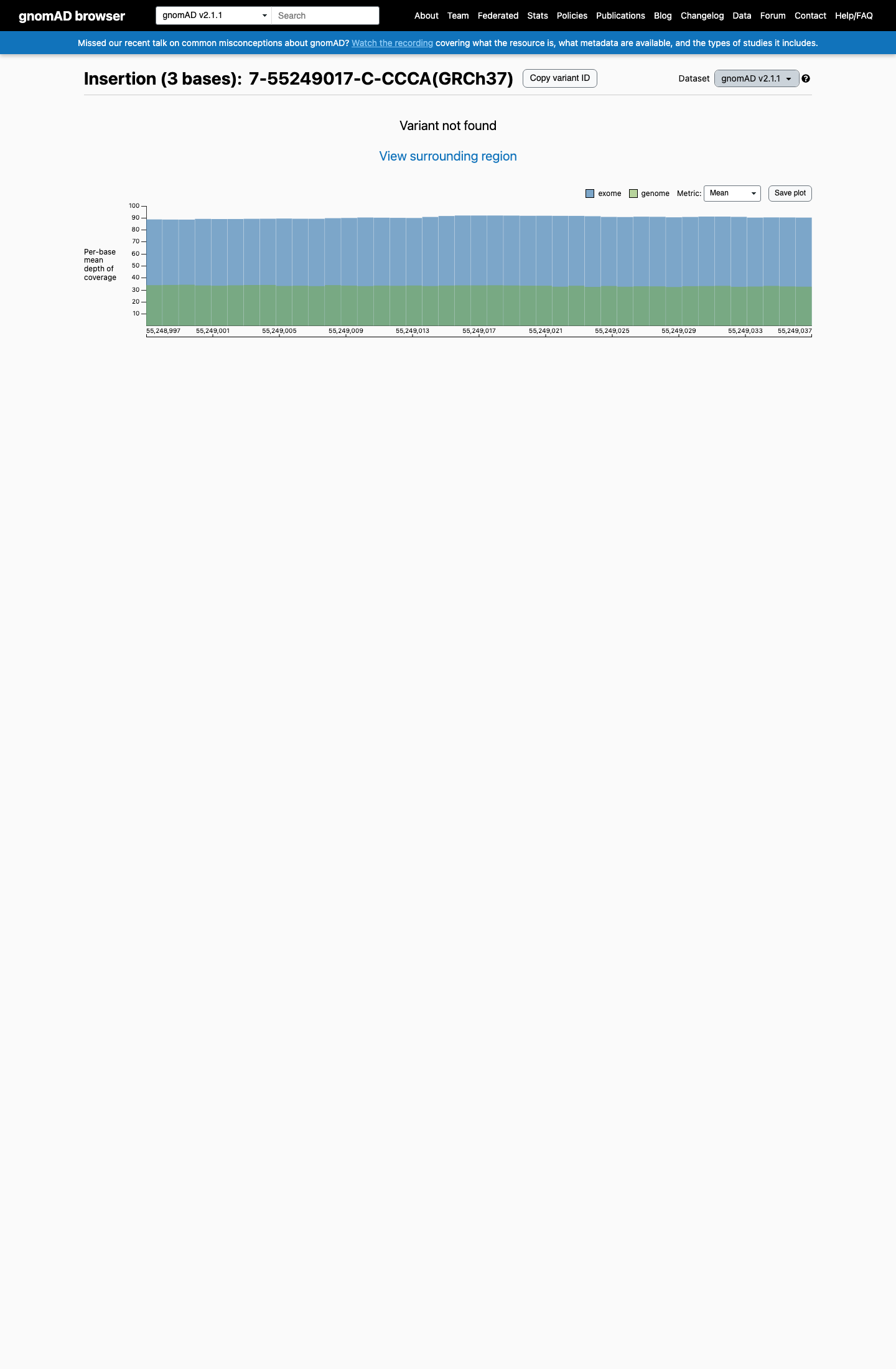
gnomAD v2.1
v4.1
Absent from gnomAD v4.1.
v2.1
Absent from gnomAD v2.1.
🇨🇦 CA
Absent from gnomAD-Canada v1.0.
Allele frequency by ancestry
three datasets · side by side
gnomAD v4.1
Absent
· 0 / ?
0 hom
0 hom
Not observed in any ancestry group.
gnomAD v2.1
Absent
· 0 / ?
0 hom
0 hom
Not observed in any ancestry group.
gnomAD Canada 🇨🇦
Absent
· 0 / ?
0 hom
0 hom
Not observed in any ancestry group.

ClinVar
This variant has been reported in ClinVar as Uncertain significance (1 clinical laboratory). (ClinVarID = 45261)

In silico
SpliceAI predicts no significant splice impact for this variant (max delta score = 0.00).
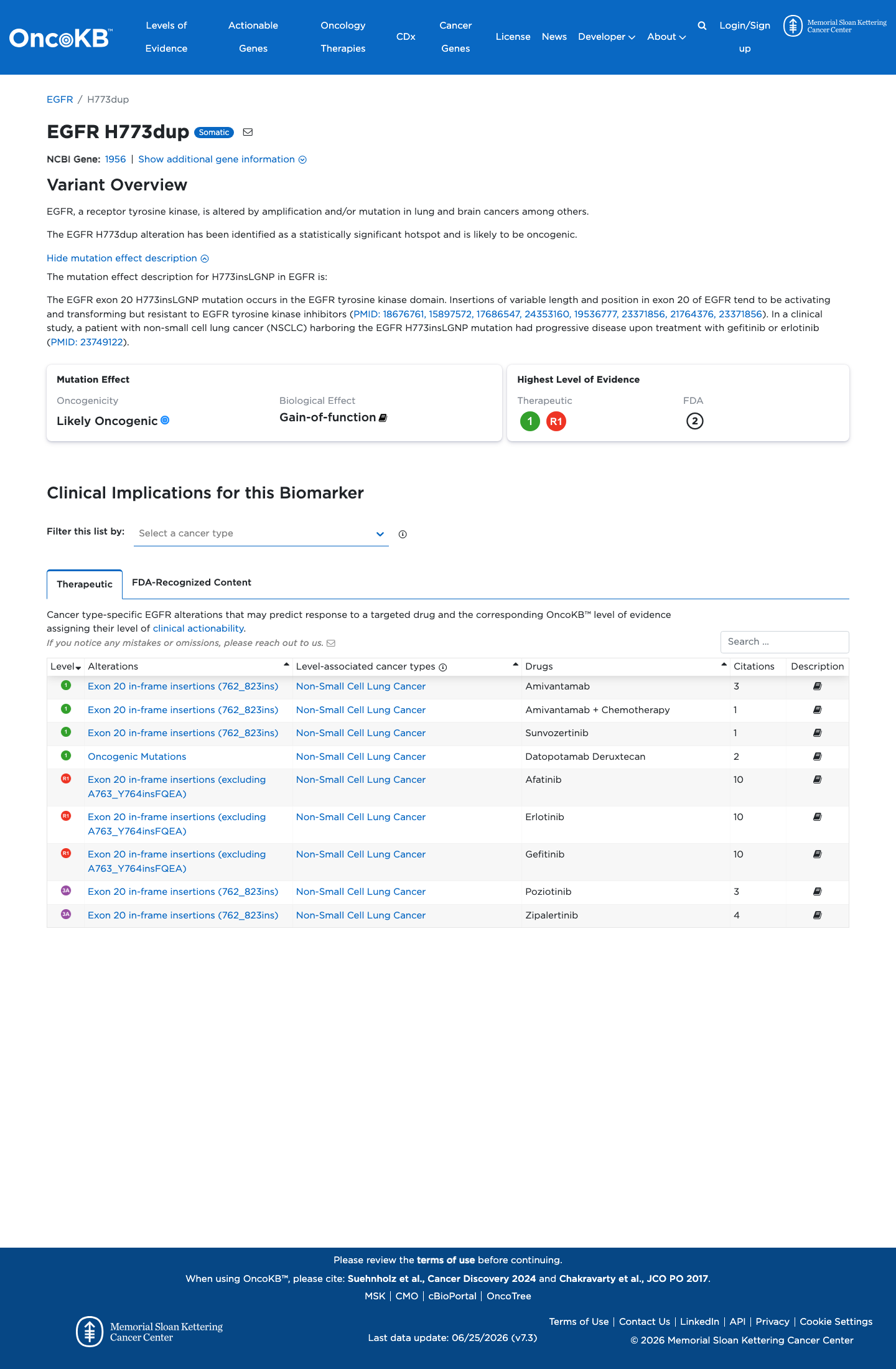
Functional
Likely Oncogenic
OncoKB identified variant-specific curated literature and context relevant to functional review; biological-effect context: Gain-of-function; curated oncogenicity label: Likely Oncogenic.
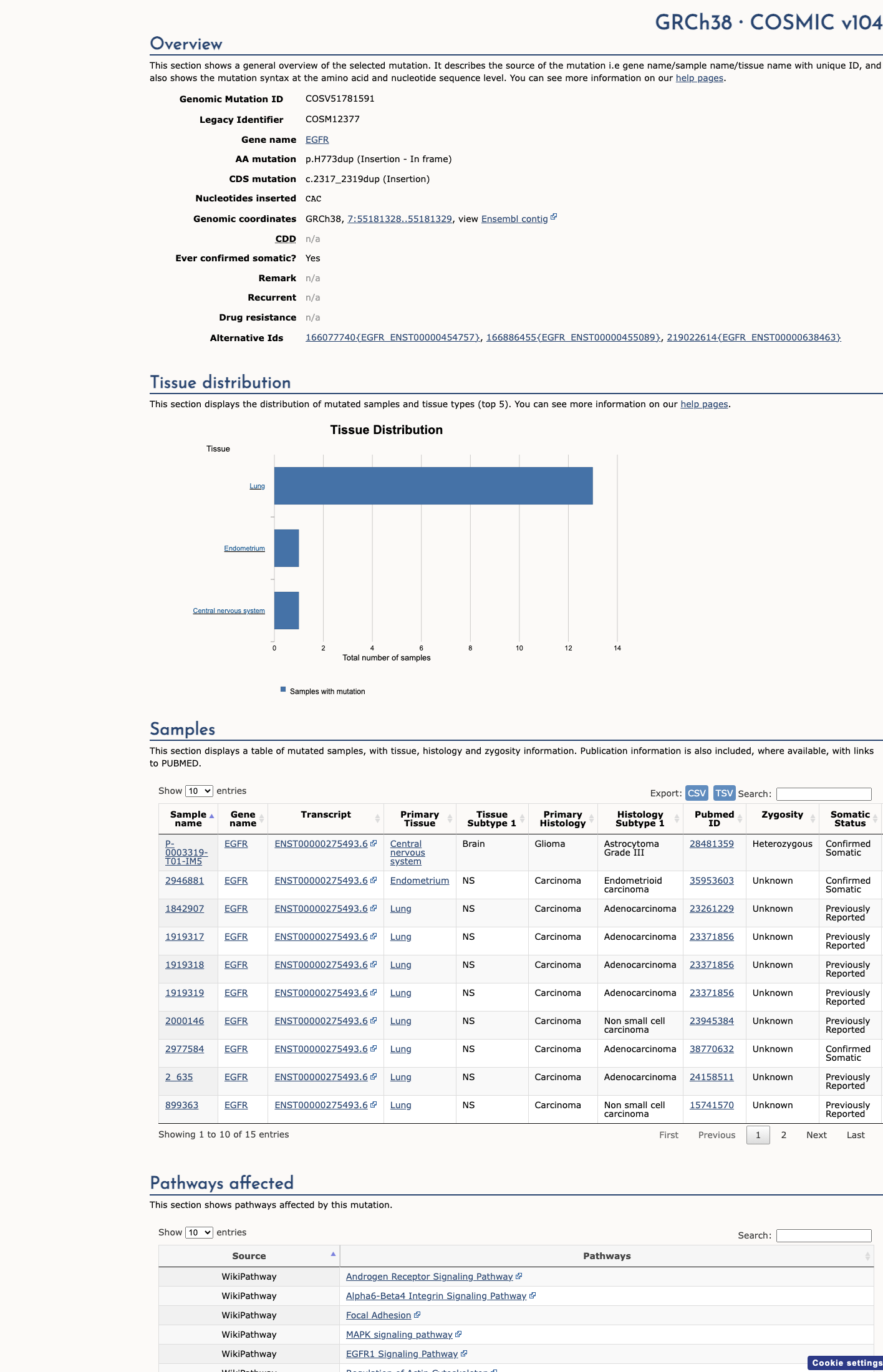
COSMIC

Cancer hotspots
Somatic evidence
Not in COSMIC / hotspots
COSMIC
This variant does not lie in a statistically significant hotspot. This variant has previously been reported in somatic cancers (COSMIC; COSV51781591, n = 15 times).
Hotspots
This variant does not lie in a statistically significant hotspot.
Literature · how each cited paper was used
2papers cited
Each card is an audit: what was searched, what was found, whether it names the variant, which criteria it fed, and why. 6 further PMIDs triaged but not cited — see Sources & References.
Lung cancer with epidermal growth factor receptor exon 20 mutations is associated with poor gefitinib treatment response.
Searched
c.2317_2319dupHis773dupH773dup2317_2319dupCACc.2317
Found
Reports EGFR exon 20 mutations including A767_V769dupASV, H773_V774insH, and H773R as associated with poor gefitinib response in NSCLC. NM_005228.4:c.2317_2319dupCAC (p.His773dup) was not identified; the mutations at residue 773 are distinct (H773_V774insH, H773R, P772_H773insYNP, H773Y).
Variant
◇ Residue / gene-level — variant not named
Applied to
→PM1 supports · met
Why
Variant not identified. Paper provides domain-level evidence that EGFR exon 20 mutations (including those at His773) are functionally significant, supporting PM1 at the domain level.
Mutations in exon 20 could be in-frame duplication and/or insertion, such as A767_V769dupASV or H773_V774insH. They could also be point mutations. Examples of reported exon 20 mutations in literature are V765M, S768I, H773R, and T790M.
Location Table 1, Table 2; introduction (line 42-44) · Context DNA sequencing of NSCLC tumor specimens; clinical cohort (n=23 with exon 20 mutations) · full text
EGFR exon 20 insertion mutations in non-small-cell lung cancer: preclinical data and clinical implications.
Searched
c.2317_2319dupHis773dupH773dup2317_2319dupCACc.2317
Found
Comprehensive review of EGFR exon 20 insertion mutations in NSCLC. Catalogs 122 exon 20 insertions including His773_Val774insHis, His773_Val774dupHisVal, and Pro772_His773insAsn. NM_005228.4:c.2317_2319dupCAC (p.His773dup, a single amino acid duplication) is NOT listed in the compiled mutation table. His773_Val774insHis was tested in vitro and shown resistant to gefitinib/erlotinib (IC50 >3 µM).
Variant
◇ Residue / gene-level — variant not named
Applied to
→PM1 supports · met
Why
Variant not identified. Paper provides domain-level characterization establishing the C-helix/post-C-helix region as critical for EGFR kinase function (supporting PM1) and shows sister variant His773_Val774insHis confers TKI resistance.
His773_Val774insHis,27 have been shown to be resistant to gefitinib and erlotinib; the insertions had 50% inhibitory concentrations (IC50) to gefitinib or erlotinib, of higher than 3 μmol/L.
Location Table 1 (EGFR exon 20 insertion mutations by amino acid position); Preclinical Studies section · Context Review; functional data from Ba/F3 and NIH-3T3 surrogate assays for His773_Val774insHis · full text
Sources & reference links
Triaged references · 6 PMIDs not cited in assessment
15897572 ↗
Mutation in the tyrosine kinase domain of epidermal growth factor receptor is a predictive and prognostic factor for gefitinib treatment in patients with non-small cell lung cancer.
ONCOKB
19536777 ↗
Second-line treatments after first-line gefitinib therapy in advanced nonsmall cell lung cancer.
ONCOKB
24705251 ↗
The genomic landscape of diffuse intrinsic pontine glioma and pediatric non-brainstem high-grade glioma.
CLINVAR
28966033 ↗
Integrated Molecular Meta-Analysis of 1,000 Pediatric High-Grade and Diffuse Intrinsic Pontine Glioma.
CLINVAR
32303840 ↗
Pediatric bithalamic gliomas have a distinct epigenetic signature and frequent EGFR exon 20 insertions resulting in potential sensitivity to targeted kinase inhibition.
CLINVAR