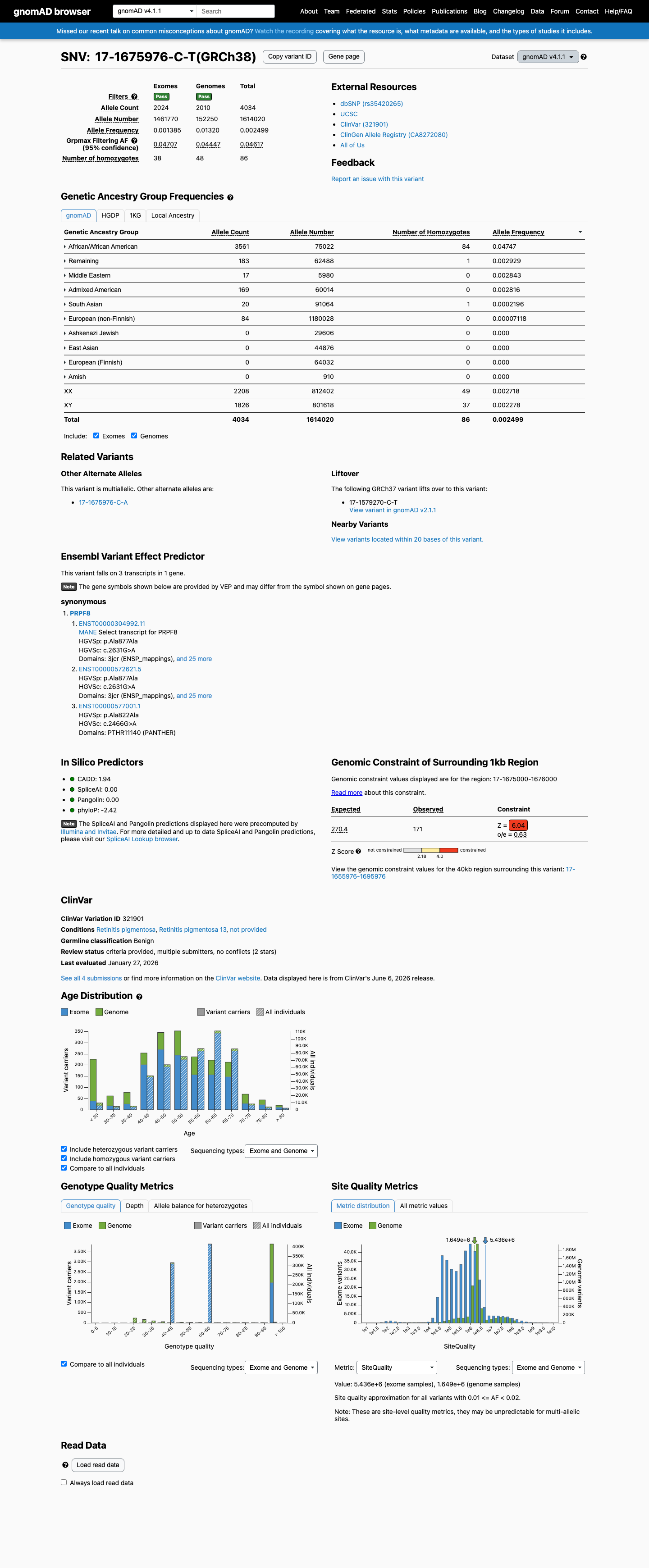
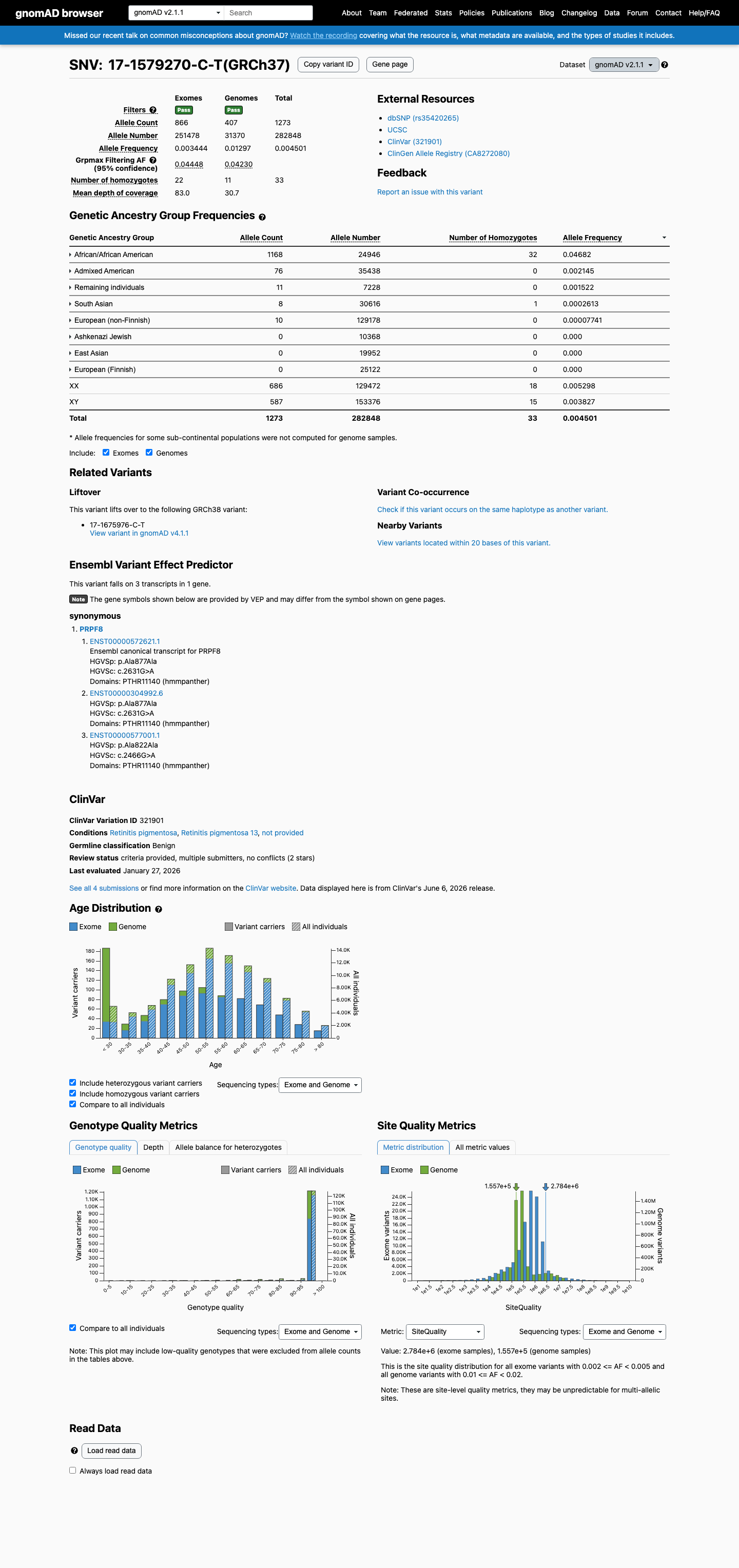
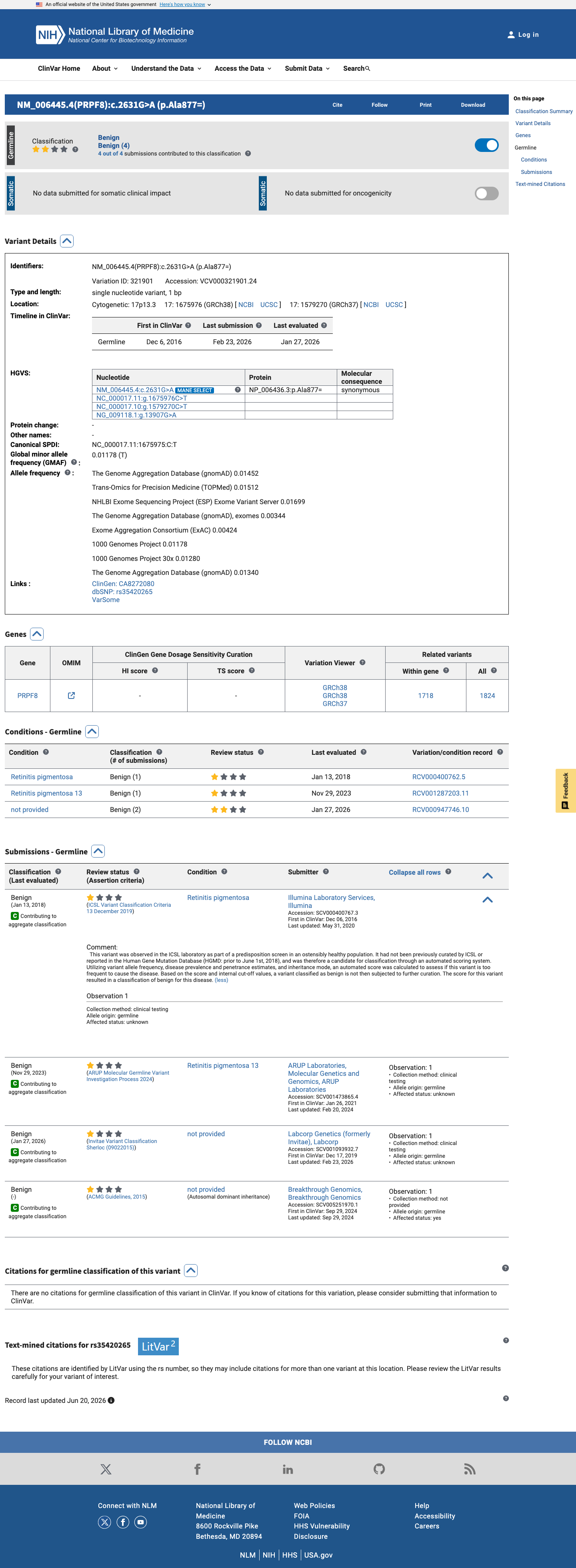
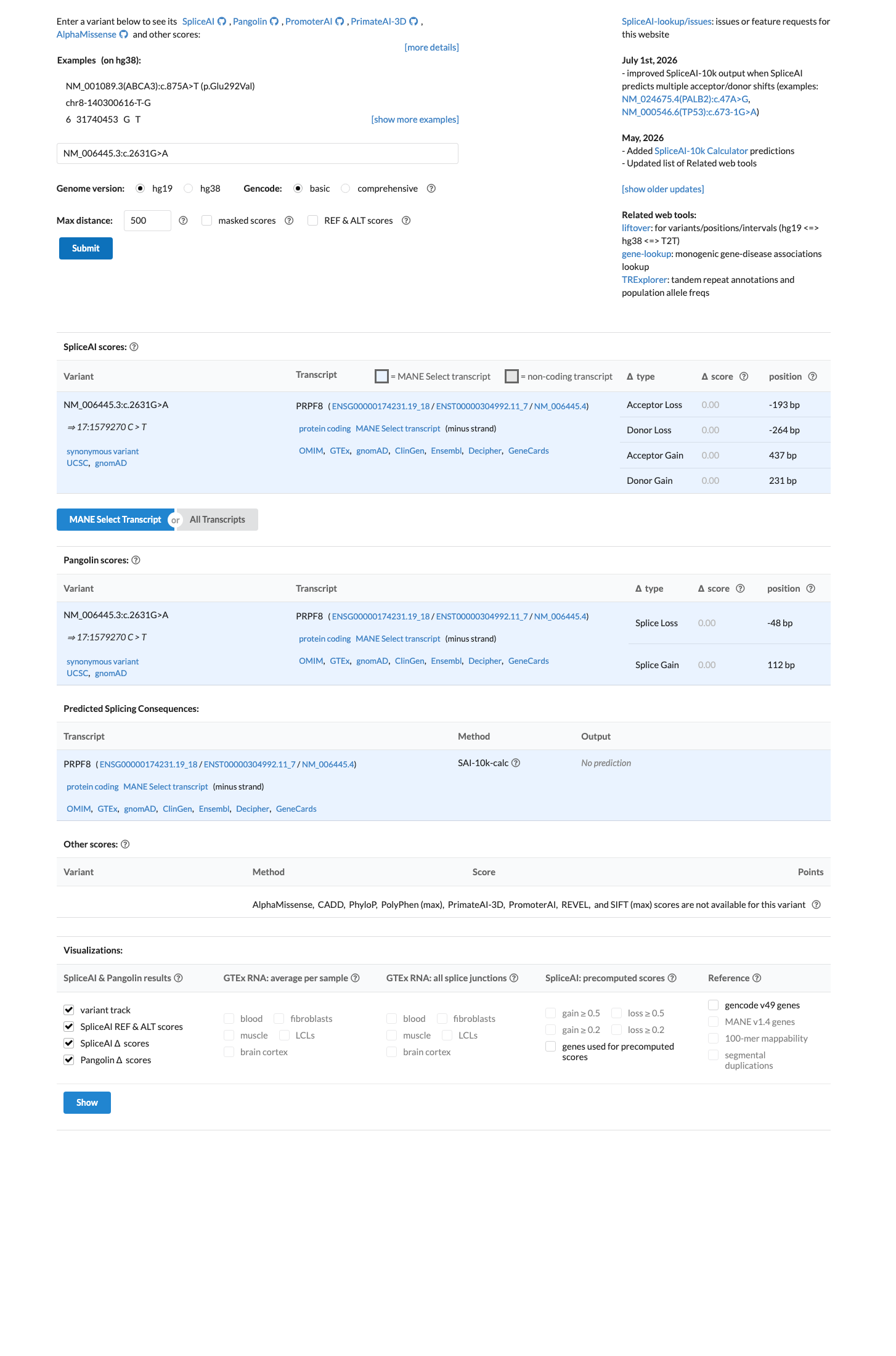
NM_006445.3:c.2631G>A (p.Ala877=) is a synonymous variant in PRPF8. This variant is present at high frequency in population databases, with an allele frequency of 4.68% in the African/African American population in gnomAD v2.1 (1168/24946 alleles, 32 homozygotes) and 4.75% in gnomAD v4.1 (3561/75022 alleles, 84 homozygotes), meeting BA1 (stand-alone benign).1 The variant is observed in the homozygous state in 33 individuals in gnomAD v2.1 and 86 individuals in gnomAD v4.1, consistent with a benign polymorphism (BS2_Supporting).2 ClinVar classifies this variant as Benign with 2-star review status ('criteria provided, multiple submitters, no conflicts'; Variation ID: 321901), meeting BP6 (Supporting).3 SpliceAI predicts no splice impact (max delta = 0.00), meeting BP4 (Supporting) and BP7 (Supporting) for this synonymous variant.4 No pathogenic criteria are met. The combined benign evidence (BA1, BS2_Supporting, BP4_Supporting, BP6_Supporting, BP7_Supporting) strongly supports a Benign classification.
PRPF8
Final classification
Unclassified
PRPF8 c.2631G>A · p.Ala877=
PRPF8
NM_006445.3:c.2631G>A (p.Ala877=) is a synonymous variant in PRPF8.
Classification rationale
BA1BS2BP4BP6BP7
Unclassified
PRPF8 c.2631G>A
· exon NC_000017.10
BA1 + BS2 + BP4 + BP6 + BP7
→
Unclassified
Gene diagram
· NM_006445.3 · variants mapped to exon structure
PRPF8
NM_006445.3
Fetching transcript structure from UCSC…
Applied criteria · 5 applied · 14 assessed
Applied · 5
Strength
Supporting
Moderate
Strong
Very strong
✓
BA1
stand-alone
Benign
Allele frequency exceeds 1% in the African/African American population (AFR AF 4.68% in gnomAD v2.1, 4.75% in gnomAD v4.1). Observed in 33 homozygous individuals in v2.1 and 86 in v4.1. This variant is a common population polymorphism.
gnomAD v2.1 AFR AF: 4.68% (1168/24946 alleles32 homozygotes)gnomAD v4.1 AFR AF: 4.75% (3561/75022 alleles
✓
BS2
supporting
Benign
Observed in the homozygous state in 33 individuals in gnomAD v2.1 and 86 individuals in gnomAD v4.1, presumed healthy population controls. Homozygous observation in a dominantly inherited disorder (RP13) is inconsistent with pathogenicity.
33 homozygotes in gnomAD v2.186 homozygotes in gnomAD v4.1AFR subpopulation: 32 and 84 homozygotes respectively.
✓
BP4
supporting
Benign
SpliceAI predicts no splice impact (max delta = 0.00). As a synonymous variant with no predicted cryptic splice site creation or native splice site disruption, multiple lines of computational evidence support a benign interpretation.
SpliceAI max delta score = 0.00no acceptor gainacceptor loss
✓
BP6
supporting
Benign
ClinVar classifies this variant as Benign (Variation ID: 321901) with review status 'criteria provided, multiple submitters, no conflicts' (2-star). A reputable source consistently reports this variant as benign.
ClinVar classification: Benignreview status: criteria providedmultiple submitters
✓
BP7
supporting
Benign
Synonymous variant (p.Ala877=) with SpliceAI predicting no impact on splicing (max delta = 0.00). The high population frequency (AFR AF 4.7%) also indicates this nucleotide position is not highly conserved. All conditions for BP7 are satisfied.
SpliceAI max delta = 0.00synonymous variantgnomAD AFR AF 4.7% indicates low nucleotide conservation.
Assessed · not applied
Pathogenic
PS2
No de novo occurrence data available for this variant with confirmed maternity and paternity.
PS3
No variant-specific functional studies or systematic range characterization identified for this synonymous variant.
PS4
No case-control or variant enrichment data in affected individuals available.
PM1
Not located in a statistically significant mutational hotspot (cancerhotspots.org) and no evidence of location in a well-established functional domain without benign variation.
PM2
Present at high frequency in population databases (gnomAD global AF 0.45%; AFR AF 4.68%), far exceeding the <0.1% threshold required for PM2 application.
PM6
No de novo reports for this variant (with or without confirmed maternity/paternity).
PP1
No cosegregation data available in affected families.
PP3
SpliceAI predicts no splice impact (max delta = 0.00); REVEL and BayesDel scores are not available for this synonymous variant; no computational evidence supports a pathogenic effect.
PP4
No proband phenotype data provided; cannot assess specificity of patient phenotype for PRPF8-associated disease.
PP5
ClinVar classifies this variant as Benign (Variation ID: 321901), not Pathogenic.
Benign
BS3
No well-established functional studies demonstrate a lack of damaging effect for this variant.
BS4
No segregation data available in affected families to assess lack of cosegregation with disease.
BP2
No data available on observation of this variant in trans with a known pathogenic variant.
BP5
No observation of this variant in cases where an alternate molecular basis for disease has been identified.
N/A · 7
PVS1 · PS1 · PM5 · PP2 · BS1 · BP1 · BP3
Research & evidence
Population frequency
gnomAD v4.1
gnomAD v2.1
v4.1
This variant is present in gnomAD v4.1 (AF= 0.00249935; MAF= 0.24993%, 4034/1614020 alleles, homozygotes = 86) and has highest observed frequency in the African/African American population (AF= 0.0474661; MAF= 4.74661%, 3561/75022 alleles, homozygotes = 84); grpmax FAF= 0.0461652.
v2.1
This variant is present in gnomAD v2.1 (AF= 0.00450065; MAF= 0.45007%, 1273/282848 alleles, homozygotes = 33) and has highest observed frequency in the African/African American population (AF= 0.0468211; MAF= 4.68211%, 1168/24946 alleles, homozygotes = 32); grpmax FAF= 0.0444801.
🇨🇦 CA
This variant is present in gnomAD-Canada v1.0 (AF= 0.0029319144315343684, 54/18418 alleles, homozygotes = 0).
Allele frequency by ancestry
three datasets · side by side
gnomAD v4.1
0.25%
· 4034 / 1,614,020
86 hom · FAF 4.6%
86 hom · FAF 4.6%
African/African American 3561 / 75,022 |
4.7% 84 hom |
Remaining individuals 183 / 62,488 |
0.29% 1 hom |
Middle Eastern 17 / 5,980 |
0.28% |
Admixed American 169 / 60,014 |
0.28% |
South Asian 20 / 91,064 |
0.022% 1 hom |
European (non-Finnish) 84 / 1,180,028 |
0.0071% |
+ 4 not observed (European (Finnish), Amish, East Asian, Ashkenazi Jewish)
gnomAD v2.1
0.45%
· 1273 / 282,848
33 hom · FAF 4.4%
33 hom · FAF 4.4%
African/African American 1168 / 24,946 |
4.7% 32 hom |
Admixed American 76 / 35,438 |
0.21% |
Remaining individuals 11 / 7,228 |
0.15% |
South Asian 8 / 30,616 |
0.026% 1 hom |
European (non-Finnish) 10 / 129,178 |
0.0077% |
+ 3 not observed (Ashkenazi Jewish, East Asian, European (Finnish))
gnomAD Canada 🇨🇦
0.29%
· 54 / 18,418
0 hom · FAF 3%
0 hom · FAF 3%
African/African American 41 / 1,020 |
4% |
Middle Eastern 1 / 144 |
0.69% |
Latino/Admixed American 4 / 838 |
0.48% |
Remaining individuals 3 / 1,138 |
0.26% |
European (non-Finnish) 5 / 11,738 |
0.043% |
+ 4 not observed (Ashkenazi Jewish, East Asian, European (Finnish), South Asian)

COSMIC

Cancer hotspots
Somatic evidence
Not in COSMIC / hotspots
COSMIC
In progress — evidence not uploaded yet.
Hotspots
This variant does not lie in a statistically significant hotspot.
Sources & reference links