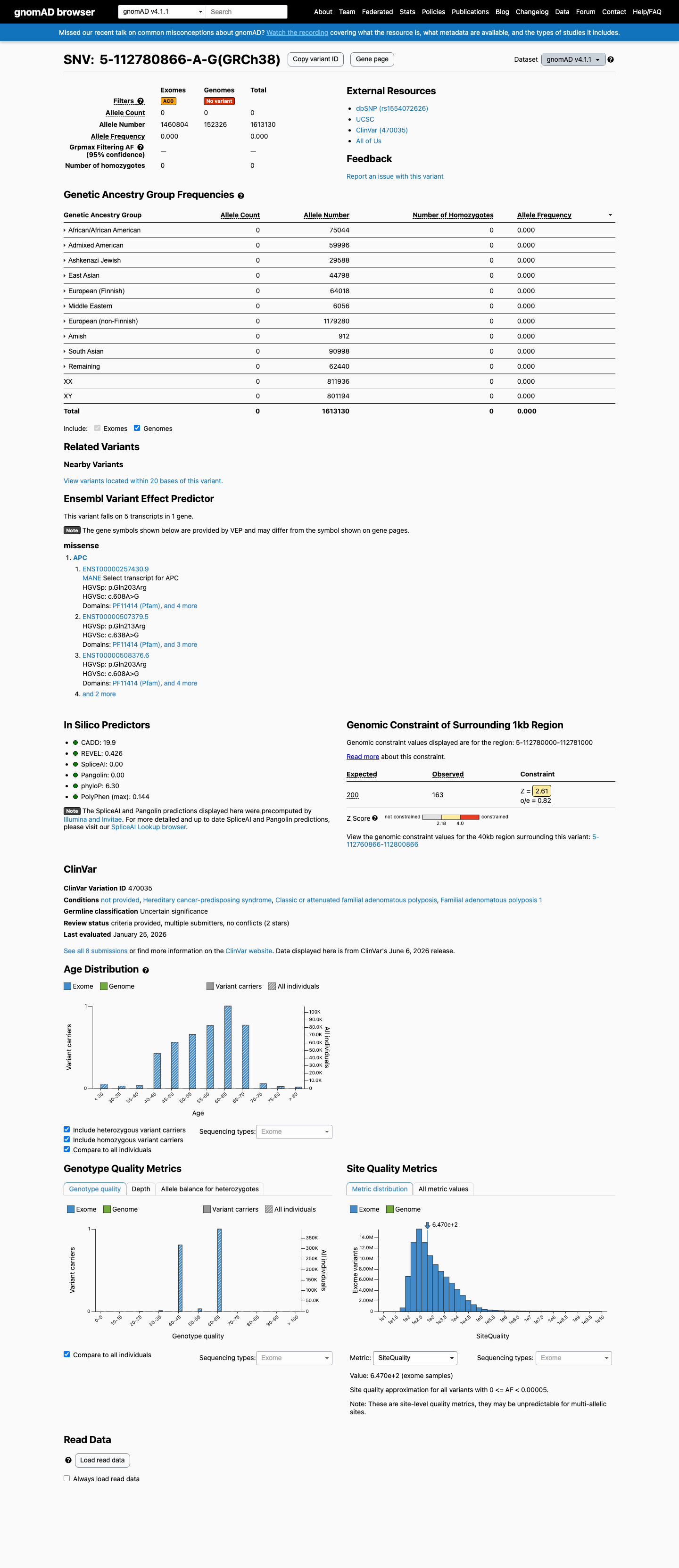
NM_001127510.3:c.608A>G (p.Gln203Arg) is a missense variant in APC, a tumor suppressor gene where loss of function is the established disease mechanism for familial adenomatous polyposis.1 The variant is absent from gnomAD v2.1, v4.1 (0/1,613,130 alleles), and gnomAD-Canada, meeting the APC VCEP PM2_Supporting criterion for rarity in population controls.2 BP1 (supporting benign) is met: APC is a gene where primarily truncating variants cause disease, and this missense variant lies outside the excluded β-catenin binding domain region (codons 1021-1035). SpliceAI (max delta 0.01) shows no cryptic splice effect.3 PVS1 is not met as this is a missense variant, not a null variant eligible under the APC VCEP decision tree.4 No functional studies (PS3/BS3), de novo observations (PS2/PM6), segregation data (PP1/BS4), phenotype points (PS4), or pathogenic missense comparators at codon 203 (PM5) are available. ClinVar reports this variant as Uncertain Significance (criteria provided, single submitter). No expert panel submission exists.5 Per the APC VCEP Rules for Combining Criteria, a variant fulfilling only PM2_Supporting without any other pathogenic criterion remains a Variant of Uncertain Significance.6
APC
Final classification
VUS
APC c.608A>G · p.Gln203Arg
APC
NM_001127510.3:c.608A>G (p.Gln203Arg) is a missense variant in APC, a tumor suppressor gene where loss of function is the established disease mechanism for familial adenomatous polyposis.
ClinGen InSiGHT Hereditary Colorectal Cancer/Polyposis Expert Panel Specifications to the ACMG/AMP Variant Interpretation Guidelines for APC Version 2.1 v2.1 criteria-combination framework was evaluated deterministically with applied criteria: PM2 supporting, BP1 supporting benign; no rule matched the adjudicated criteria.
Classification rationale
PM2
BP1
VUS
APC c.608A>G
PM2 + BP1
→
VUS
Gene diagram
· NM_001127510.3 · variants mapped to exon structure
APC
NM_001127510.3
Fetching transcript structure from UCSC…
Applied criteria · 2 applied · 16 assessed
Applied · 2
Strength
Supporting
Moderate
Strong
Very strong
✓
PM2
supporting
Pathogenic
This variant is absent from gnomAD v2.1, gnomAD v4.1 (0/1,613,130 alleles), and gnomAD-Canada. Per the APC VCEP, PM2_Supporting applies when allele frequency is below the defined threshold: AF ≤ 0.0003% if AC > 1, or AF < 0.001% if AC ≤ 1. The variant meets this criterion as it is entirely absent from population databases.
Absent from gnomAD v2.1Absent from gnomAD v4.1 (0/1613
✓
BP1
supporting
Benign
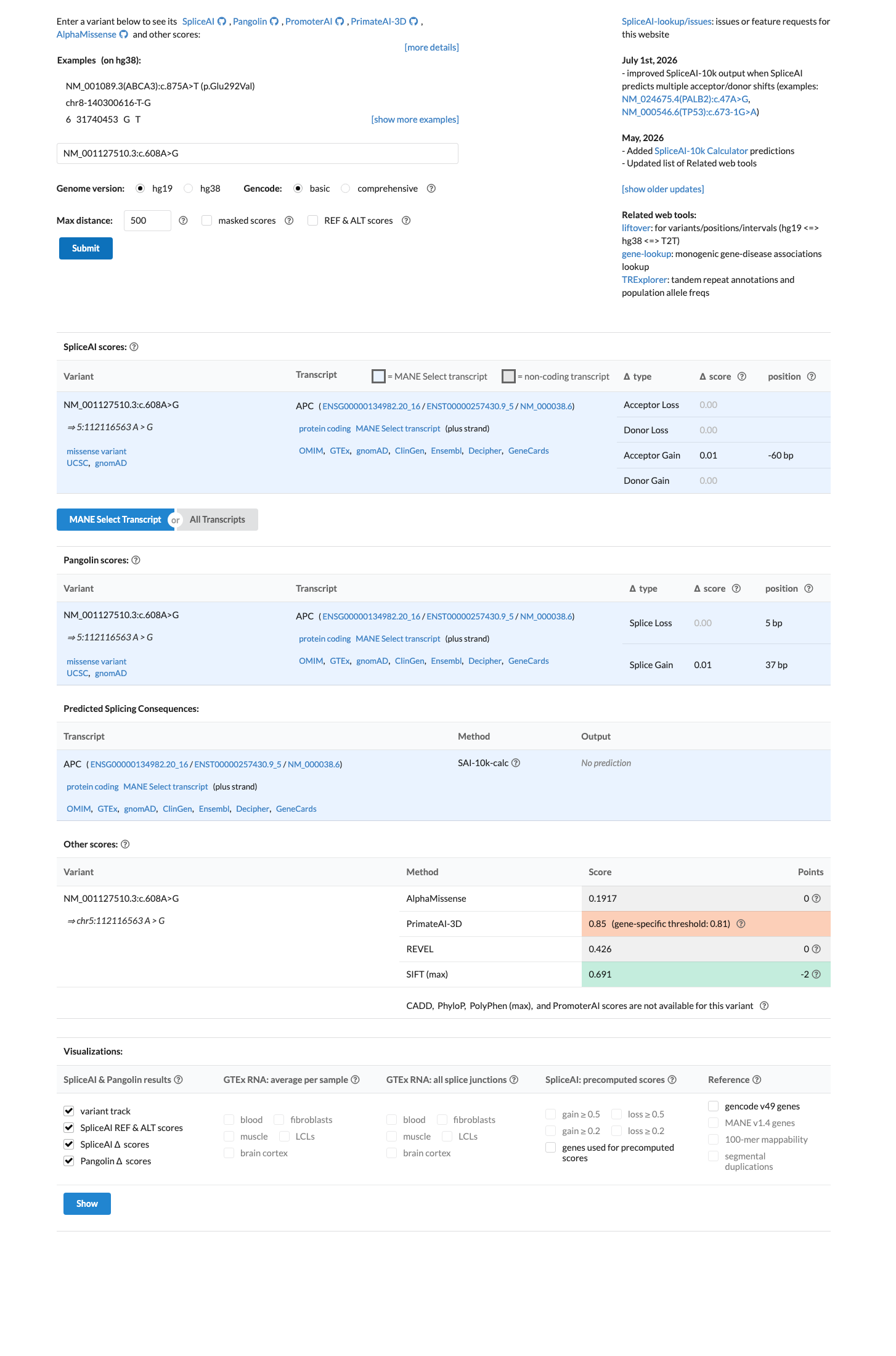
BP1 applies to missense variants in APC, a gene for which primarily truncating variants are known to cause disease. The APC VCEP states BP1 is applicable with the exception of missense variants located in the first 15-amino acid repeat of the β-catenin binding domain (codon 1021-1035). This variant (p.Gln203Arg) is at codon 203, well outside that excluded region. SpliceAI confirms no cryptic splicing (max delta 0.01).
APC is a gene where primarily truncating variants cause disease (FAP)Variant is missense at codon 203outside the excluded β-catenin domain region (codons 1021-1035)
Assessed · not applied
Pathogenic
PVS1
NM_001127510.3:c.608A>G is a missense variant (p.Gln203Arg), not a null variant.
PS1
PS1 requires the same amino acid change as a previously established pathogenic or likely pathogenic variant.
PS2
No de novo observations have been reported for this variant.
PS3
No well-established in vitro or in vivo functional studies have been reported for NM_001127510.3:c.608A>G (p.Gln203Arg).
PS4
No phenotype points can be assigned.
PM5
PM5 requires a different pathogenic or likely pathogenic missense change at the same amino acid residue.
PM6
No assumed de novo observations have been reported.
PP1
No co-segregation data have been reported for this variant.
PP3
The APC VCEP states that for missense variants, computational prediction models for conservation and evolution should not be used.
Benign
BA1
The APC VCEP BA1 threshold is a gnomAD Popmax Filtering Allele Frequency ≥ 0.1% (0.001).
BS1
The APC VCEP BS1 threshold is a gnomAD Popmax Filtering Allele Frequency ≥ 0.001% (0.00001).
BS2
No healthy adult individuals carrying this variant have been reported.
BS3
No well-established functional studies show no damaging effect.
BS4
No data on lack of segregation in affected family members.
BP2
No evidence of this variant observed in trans with a (likely) pathogenic APC variant, nor observed ≥3 times in unknown phase with different (likely) pathogenic APC variants.
BP5
BP5 requires an alternate genetic basis for the colorectal polyposis phenotype (e.g., a pathogenic variant in POLD1, POLE, MUTYH, NTHL1, MSH3, or mismatch repair genes).
N/A · 7
PM1 · PP2 · PP4 · PP5 · BP4 · BP6 · BP7
Research & evidence
Population frequency
gnomAD v4.1

gnomAD v2.1
v4.1
This variant is present in gnomAD v4.1 (AF= 0; MAF= 0.00000%, 0/1613130 alleles, homozygotes = 0) and has highest observed frequency in the African/African American population (AF= 0; MAF= 0.00000%, 0/75044 alleles, homozygotes = 0).
v2.1
Absent from gnomAD v2.1.
🇨🇦 CA
Absent from gnomAD-Canada v1.0.
Allele frequency by ancestry
three datasets · side by side
gnomAD v4.1
Absent
· 0 / 1,613,130
0 hom
0 hom
Not observed in any ancestry group.
+ 10 not observed (Remaining individuals, Admixed American, European (Finnish), Amish, East Asian, Middle Eastern, South Asian, Ashkenazi Jewish, African/African American, European (non-Finnish))
gnomAD v2.1
Absent
· 0 / ?
0 hom
0 hom
Not observed in any ancestry group.
gnomAD Canada 🇨🇦
Absent
· 0 / ?
0 hom
0 hom
Not observed in any ancestry group.
ClinVar
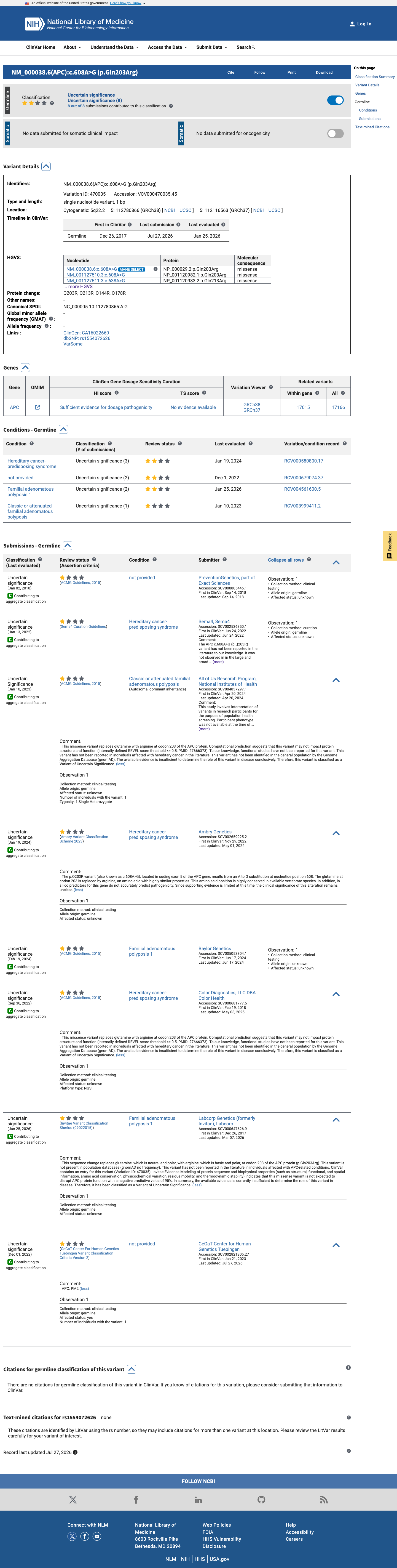
This variant has been reported in ClinVar as Uncertain significance (6 clinical laboratories) and as Uncertain Significance (1 clinical laboratory). (ClinVarID = 470035)
In silico
SpliceAI predicts no significant splice impact for this variant (max delta score = 0.01). REVEL score = 0.426. BayesDel score = 0.206025.

Functional
Unknown Oncogenic Effect
OncoKB did not identify variant-specific reviewed functional evidence for this variant; gene-level curated context is available for reviewer follow-up. APC, a tumor suppressor involved in WNT signaling, is recurrently altered in colorectal cancer.

COSMIC

Cancer hotspots
Somatic evidence
Not in COSMIC / hotspots
COSMIC
This variant does not lie in a statistically significant hotspot. This variant has not previously been reported in somatic cancers (COSMIC).
Hotspots
This variant does not lie in a statistically significant hotspot.
Sources & reference links
9Sources
Triaged references · 6 PMIDs not cited in assessment
25741868 ↗
Standards and guidelines for the interpretation of sequence variants: a joint consensus recommendation of the American College of Medical Genetics and Genomics and the Association for Molecular Pathology.
CLINVAR
11598466 ↗
Practice parameters for the identification and testing of patients at risk for dominantly inherited colorectal cancer--supporting documentation.
CLINVAR
23788249 ↗
ACMG recommendations for reporting of incidental findings in clinical exome and genome sequencing.
CLINVAR
25356965 ↗
ACMG policy statement: updated recommendations regarding analysis and reporting of secondary findings in clinical genome-scale sequencing.
CLINVAR
25394175 ↗
A practice guideline from the American College of Medical Genetics and Genomics and the National Society of Genetic Counselors: referral indications for cancer predisposition assessment.
CLINVAR
35802134 ↗
ACMG SF v3.1 list for reporting of secondary findings in clinical exome and genome sequencing: A policy statement of the American College of Medical Genetics and Genomics (ACMG).
CLINVAR