NM_006231.4:c.1360-6C>T is present in gnomAD v4.1 at an allele frequency of 0.0239% overall (376/1,574,938 alleles) and 0.353% in the African/African American subpopulation (262/74,194 alleles), exceeding the 0.3% threshold for BS1 at supporting benign strength.1 Three homozygous individuals for c.1360-6C>T are observed in gnomAD v4.1 (2 African/African American, 1 South Asian), which is inconsistent with a pathogenic role in an autosomal dominant cancer predisposition syndrome, satisfying BS2 at supporting benign strength.2 SpliceAI predicts no significant splice impact for this intronic variant (max delta score = 0.15, below the 0.2 threshold). The variant does not disrupt the canonical splice consensus sequence.3 This variant has been reported in ClinVar as Likely benign by 8 clinical laboratories and Benign by 5 clinical laboratories (ClinVar ID 240389), with concordance across 13 clinical submitters, consistent with a benign interpretation.4 No pathogenic ACMG/AMP criteria are met. Two supporting benign criteria (BS1 and BS2) are met, satisfying the >=2 supporting benign rule for a Likely Benign classification per the ACMG/AMP 2015 framework with custom POLE specifications.5
POLE
Final classification
Likely Benign
POLE c.1360-6C>T · p.?
POLE
NM_006231.4:c.1360-6C>T is present in gnomAD v4.1 at an allele frequency of 0.0239% overall (376/1,574,938 alleles) and 0.353% in the African/African American subpopulation (262/74,194 alleles), exceeding the 0.3% threshold for BS1 at supporting benign strength.
The León-Castillo et al. 2020 custom POLE framework (local gene-specific) was used. Two supporting benign criteria (BS1 and BS2) are met, satisfying the '>=2 Supporting benign' rule for Likely Benign. No pathogenic criteria are met.
Classification rationale
BS1BS2
Likely Benign
POLE c.1360-6C>T
BS1 + BS2
→
Likely Benign
5
generic_acmg_combination_rulesfinal_classification_framework
Gene diagram
· NM_006231.4 · variants mapped to exon structure
POLE
NM_006231.4
Fetching transcript structure from UCSC…
Applied criteria · 2 applied · 19 assessed
Applied · 2
Strength
Supporting
Moderate
Strong
Very strong
✓
BS1
supporting
Benign
The allele frequency of NM_006231.4:c.1360-6C>T in the African/African American subpopulation exceeds the 0.3% BS1 threshold for non-VCEP assessment: 0.324% in gnomAD v2.1 (81/24,970 alleles) and 0.353% in gnomAD v4.1 (262/74,194 alleles, including 2 homozygotes). The gnomAD v4.1 grpmax FAF is 0.318% (>0.3%). This frequency is greater than expected for a pathogenic variant in a rare cancer predisposition gene.
gnomAD v2.1 African/African American AF: 0.324% (81/24970 alleles)gnomAD v4.1 African/African American AF: 0.353% (262/74
✓
BS2
supporting
Benign
Three homozygous individuals for NM_006231.4:c.1360-6C>T are observed in gnomAD v4.1 (exome data: 2 in the African/African American subpopulation, 1 in the South Asian subpopulation). For a gene where pathogenic germline variants are associated with a rare autosomal dominant cancer predisposition syndrome (POLE-associated polyposis and colorectal cancer), the observation of homozygous individuals in a population database is inconsistent with a pathogenic role.
gnomAD v4.1: 3 homozygous individuals (2 African/African American1 South Asian)Autosomal dominant disease mechanism
Assessed · not applied
Pathogenic
PVS1
NM_006231.4:c.1360-6C>T is an intronic splice region variant located 6 bases upstream of exon 13.
PS2
No de novo observation of NM_006231.4:c.1360-6C>T with confirmed maternity and paternity has been reported in the available literature or ClinVar submissions.
PS3
No variant-specific functional data exists for NM_006231.4:c.1360-6C>T.
PS4
The custom POLE PS4 framework rule requires exact missense variant recurrence in both COSMIC and TCGA endometrial carcinoma cohorts with combined count >=10 and belonging to the established pathogenic set.
PM1
The custom POLE PM1 framework rules apply only to specific missense variants in the exonuclease domain (hotspot and non-hotspot tiers defined by Leon-Castillo et al.
PM2
NM_006231.4:c.1360-6C>T is present in gnomAD at appreciable frequency: v2.1 AF = 0.0357% (101/282,736 alleles), v4.1 AF = 0.0239% (376/1,574,938 alleles).
PM6
No de novo observation of NM_006231.4:c.1360-6C>T with confirmed maternity and paternity has been reported.
PP1
No co-segregation data is available for NM_006231.4:c.1360-6C>T.
PP2
PP2 applies to missense variants in genes with a low rate of benign missense variation and where missense variants are a common mechanism of disease.
PP3
The custom POLE PP3 framework rule requires the exact missense variant to appear in Supplementary Table S2 or S3 with REVEL class 'likely disease causing' and <=1 benign in silico result.
PP4
No specific patient phenotype data is available for individuals harboring NM_006231.4:c.1360-6C>T.
PP5
ClinVar reports NM_006231.4:c.1360-6C>T as Likely benign (8 clinical laboratories) and Benign (5 clinical laboratories), not as pathogenic.
Benign
BA1
The highest subpopulation allele frequency for NM_006231.4:c.1360-6C>T is 0.353% (African/African American in gnomAD v4.1), which is below the 1% BA1 threshold for non-VCEP assessment.
BS3
No well-established in vitro or in vivo functional studies demonstrate that NM_006231.4:c.1360-6C>T has no damaging effect on protein function or splicing.
BS4
No co-segregation data is available to assess lack of segregation with disease.
BP2
No observation of NM_006231.4:c.1360-6C>T in trans with a known pathogenic POLE variant has been reported.
BP4
The custom POLE BP4 framework rule requires the exact missense variant to appear in Supplementary Table S2 or S3 with REVEL class 'Likely benign' and >=4 benign in silico results.
BP5
No evidence is available demonstrating that NM_006231.4:c.1360-6C>T is found in a case with an alternate molecular basis for disease.
BP6
ClinVar reports NM_006231.4:c.1360-6C>T as Likely benign (8 clinical laboratories) and Benign (5 clinical laboratories).
N/A · 5
PS1 · PM5 · BP1 · BP3 · BP7
Research & evidence
Population frequency · supports benign
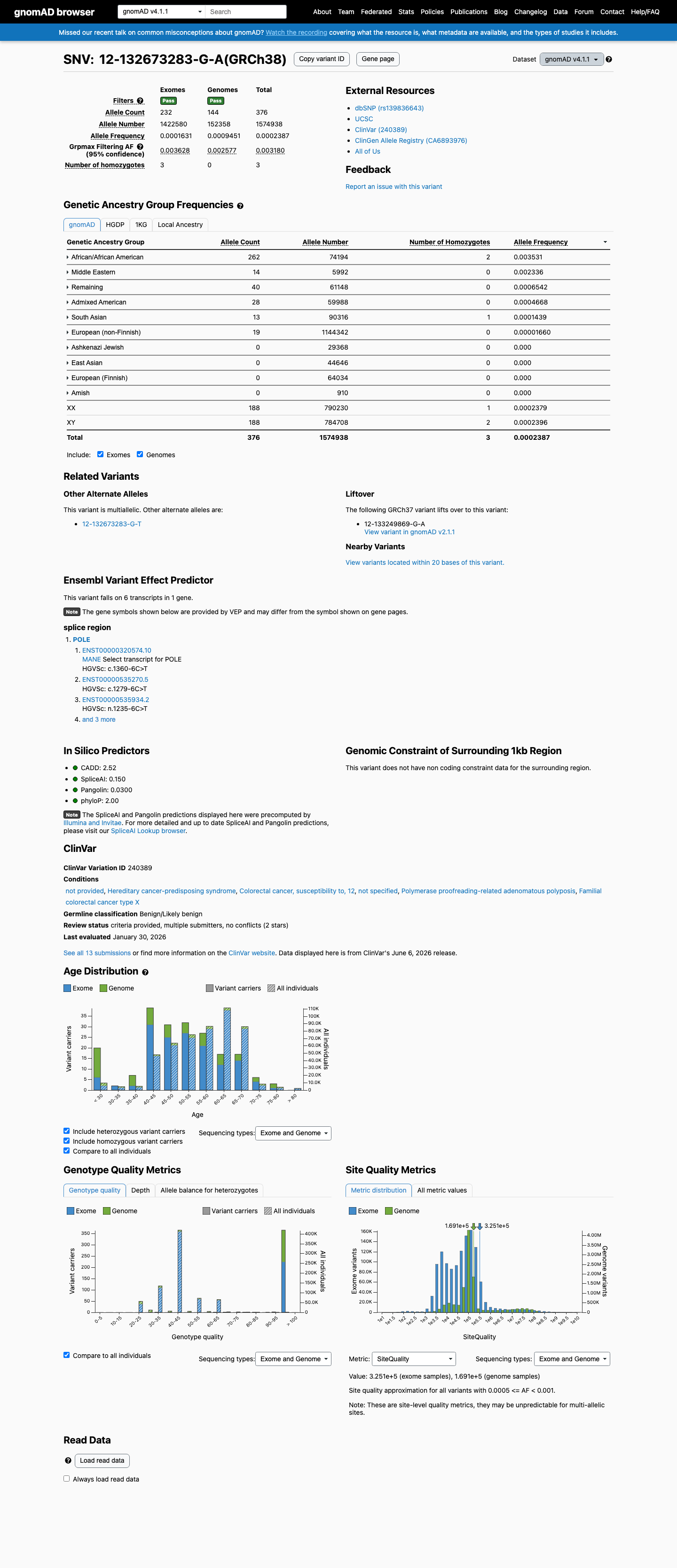
gnomAD v4.1
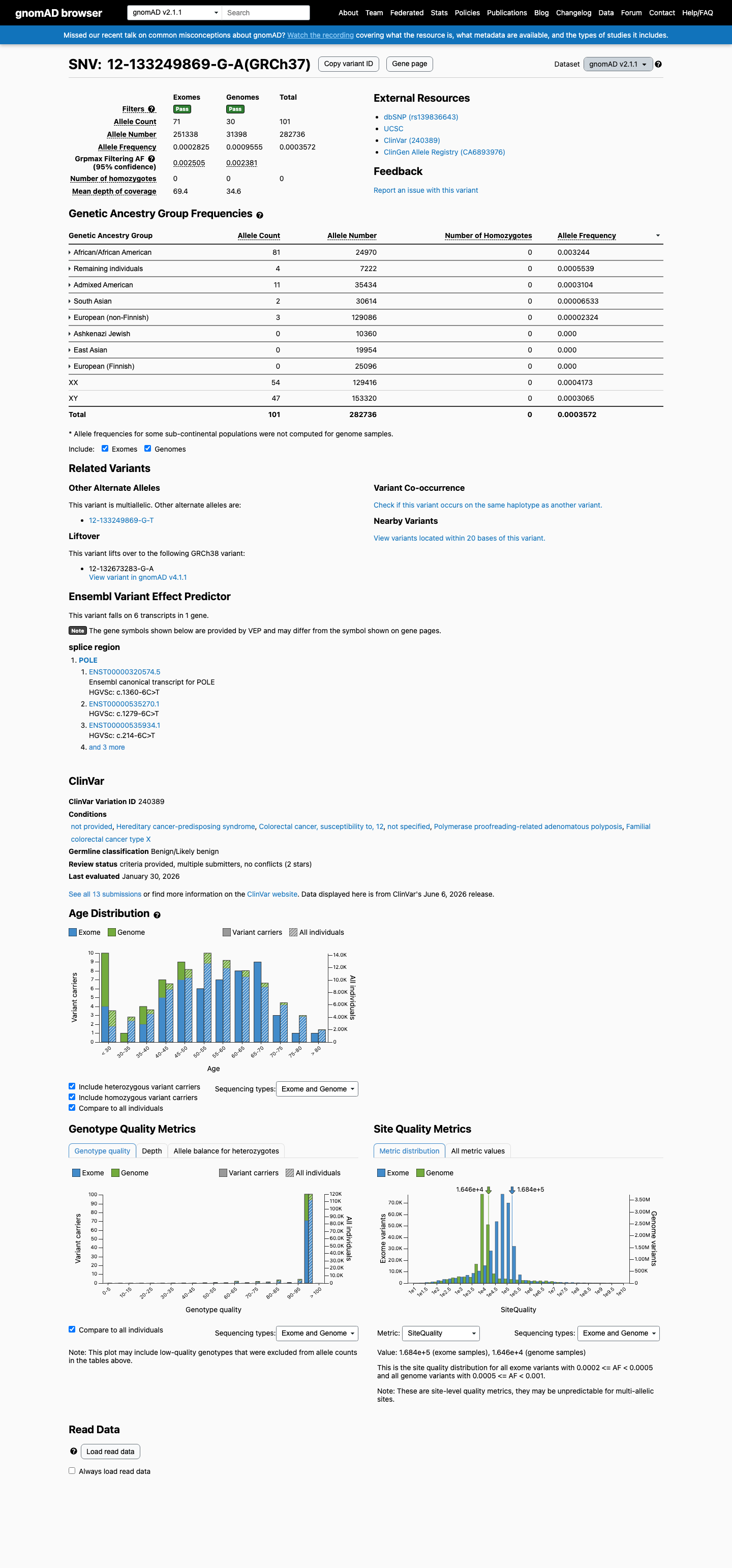
gnomAD v2.1
v4.1
This variant is present in gnomAD v4.1 (AF= 0.00023874; MAF= 0.02387%, 376/1574938 alleles, homozygotes = 3) and has highest observed frequency in the African/African American population (AF= 0.00353128; MAF= 0.35313%, 262/74194 alleles, homozygotes = 2); grpmax FAF= 0.00317984.
v2.1
This variant is present in gnomAD v2.1 (AF= 0.000357224; MAF= 0.03572%, 101/282736 alleles, homozygotes = 0) and has highest observed frequency in the African/African American population (AF= 0.00324389; MAF= 0.32439%, 81/24970 alleles, homozygotes = 0); grpmax FAF= 0.00250493.
🇨🇦 CA
Not available in gnomAD-Canada v1.0.
Allele frequency by ancestry
three datasets · side by side
gnomAD v4.1
0.024%
· 376 / 1,574,938
3 hom · FAF 0.32%
3 hom · FAF 0.32%
African/African American 262 / 74,194 |
0.35% 2 hom |
Middle Eastern 14 / 5,992 |
0.23% |
Remaining individuals 40 / 61,148 |
0.065% |
Admixed American 28 / 59,988 |
0.047% |
South Asian 13 / 90,316 |
0.014% 1 hom |
European (non-Finnish) 19 / 1,144,342 |
0.0017% |
+ 4 not observed (European (Finnish), Amish, East Asian, Ashkenazi Jewish)
gnomAD v2.1
0.036%
· 101 / 282,736
0 hom · FAF 0.25%
0 hom · FAF 0.25%
African/African American 81 / 24,970 |
0.32% |
Remaining individuals 4 / 7,222 |
0.055% |
Admixed American 11 / 35,434 |
0.031% |
South Asian 2 / 30,614 |
0.0065% |
European (non-Finnish) 3 / 129,086 |
0.0023% |
+ 3 not observed (Ashkenazi Jewish, East Asian, European (Finnish))
gnomAD Canada 🇨🇦
Absent
· 0 / ?
0 hom
0 hom
Not observed in any ancestry group.
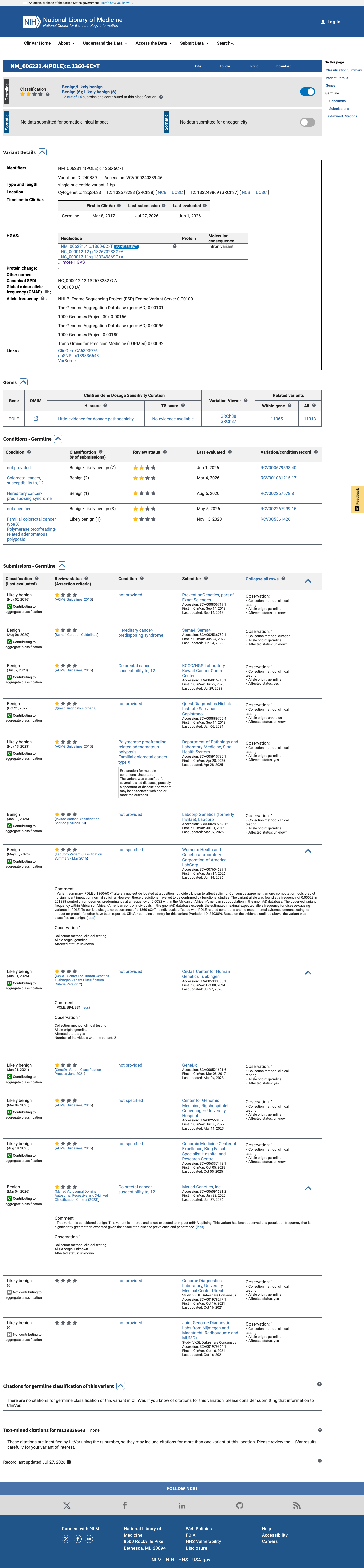
ClinVar
This variant has been reported in ClinVar as Likely benign (8 clinical laboratories) and as Benign (5 clinical laboratories). (ClinVarID = 240389)
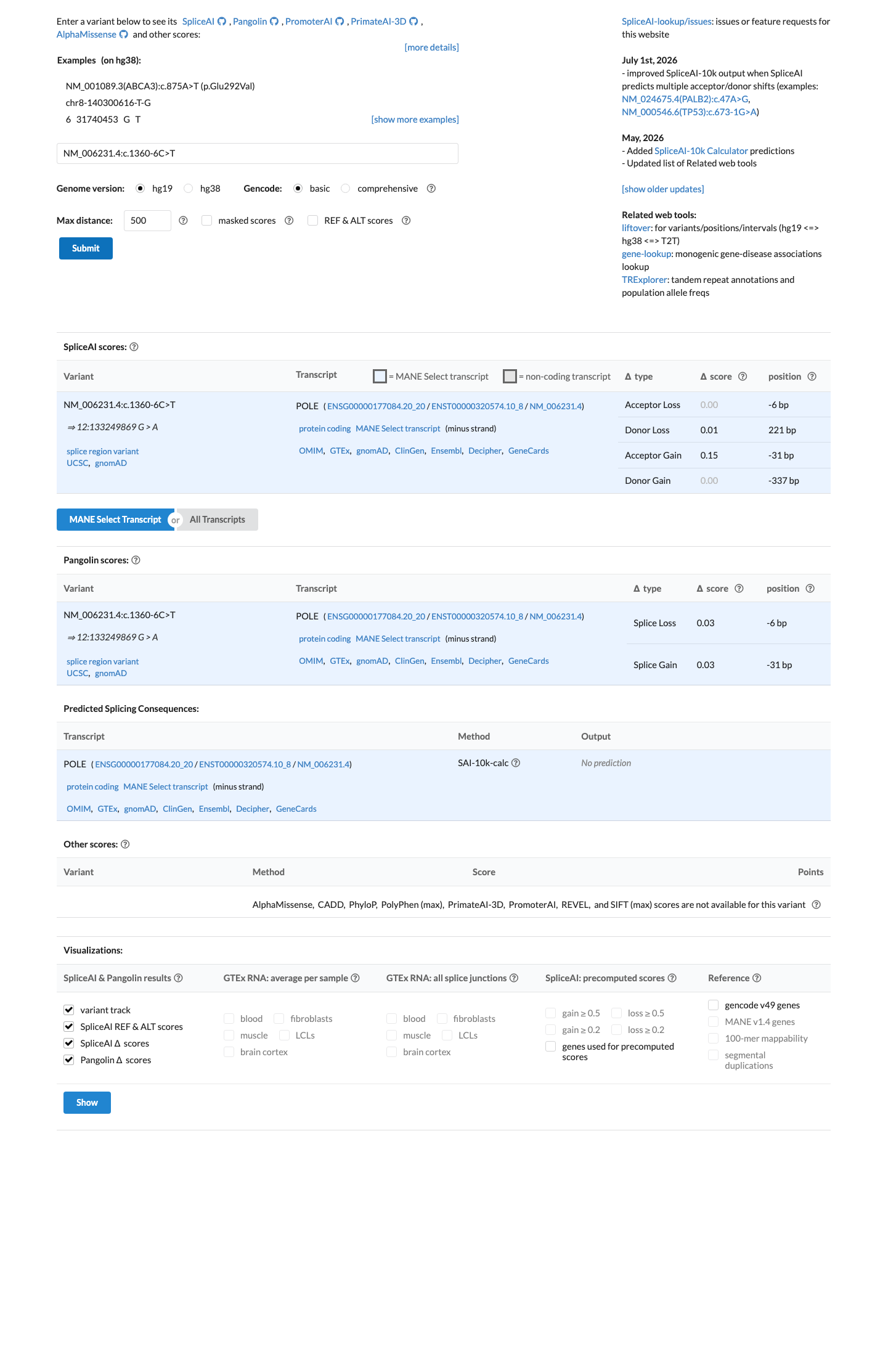
In silico
SpliceAI predicts no significant splice impact for this variant (max delta score = 0.15).
Functional
No data
No calibrated functional assay or RNA evidence was identified for this variant.

COSMIC
Somatic evidence
COSMIC
This variant has not previously been reported in somatic cancers (COSMIC).
Hotspots
This variant does not lie in a statistically significant cancer hotspot.
Sources & reference links
Triaged references · 6 PMIDs not cited in assessment
25741868 ↗
Standards and guidelines for the interpretation of sequence variants: a joint consensus recommendation of the American College of Medical Genetics and Genomics and the Association for Molecular Pathology.
CLINVAR
26467025 ↗
A Standardized DNA Variant Scoring System for Pathogenicity Assessments in Mendelian Disorders.
CLINVAR
25394175 ↗
A practice guideline from the American College of Medical Genetics and Genomics and the National Society of Genetic Counselors: referral indications for cancer predisposition assessment.
CLINVAR
26389258 ↗
Cancer Genetics Risk Assessment and Counseling (PDQ®): Health Professional Version.
CLINVAR
28492532 ↗
Sherloc: a comprehensive refinement of the ACMG-AMP variant classification criteria.
CLINVAR