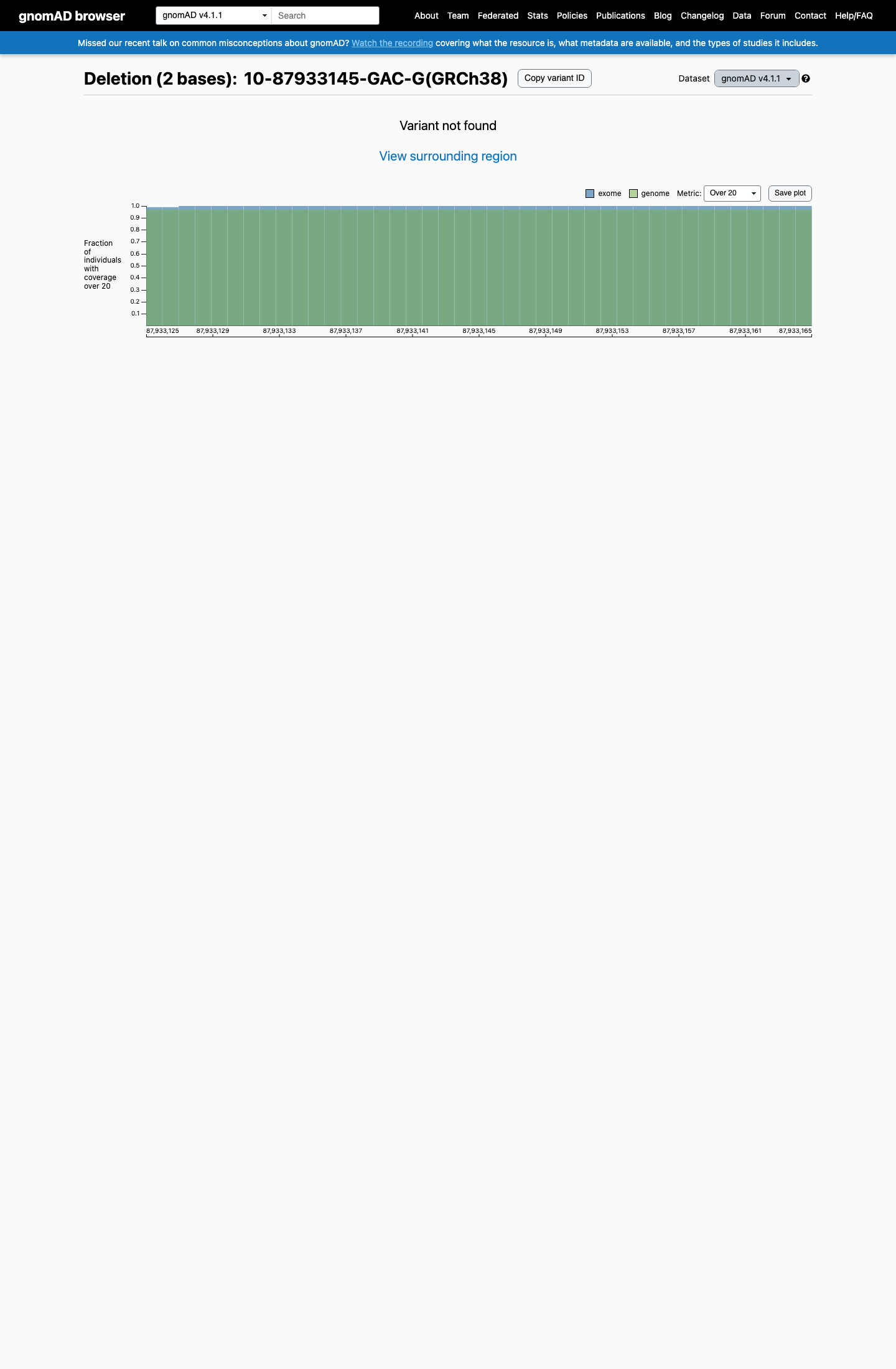
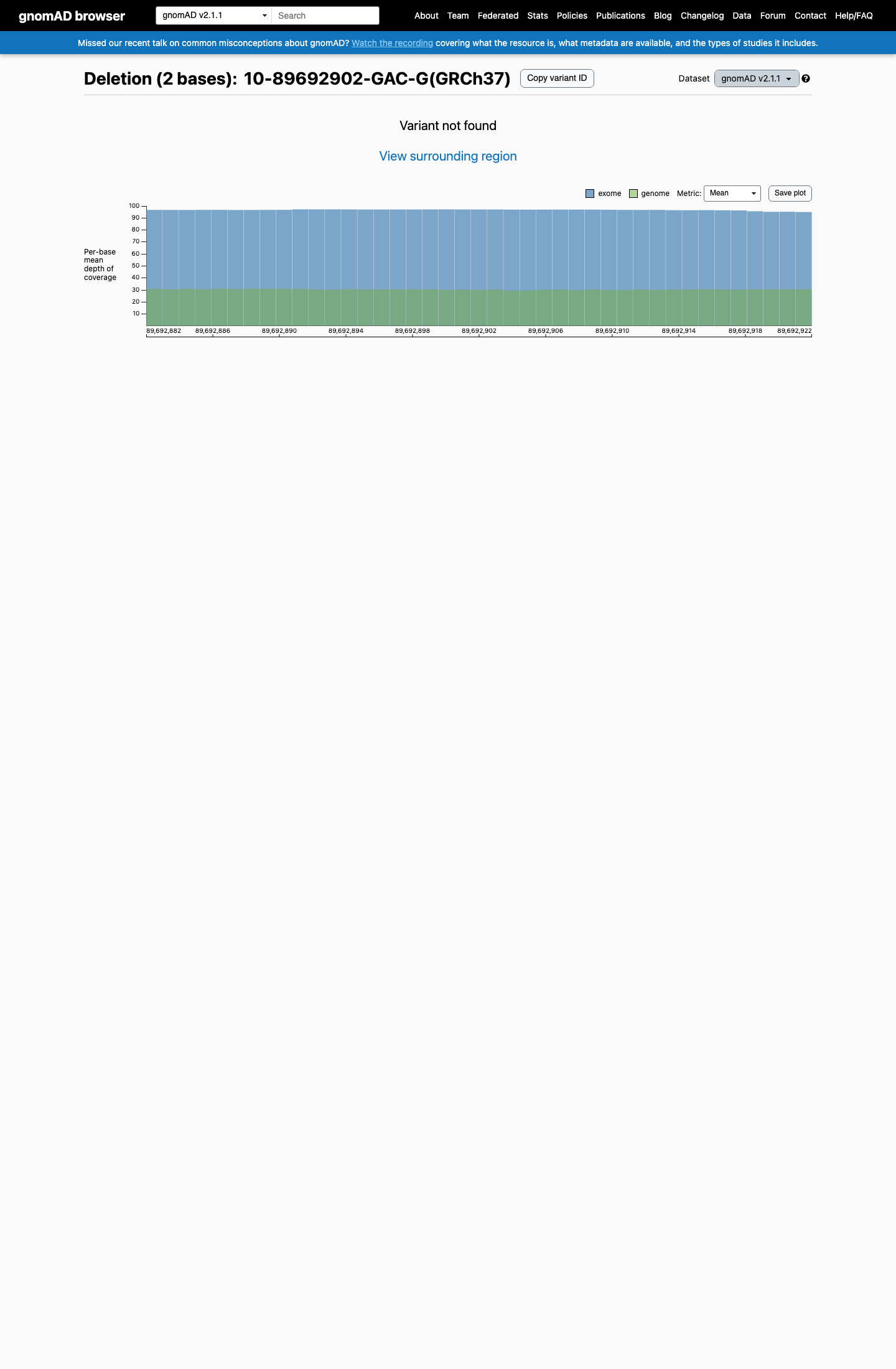
PVS1 (very strong): NM_000314.8:c.387_388del is a frameshift deletion in exon 5 producing p.(Arg130AsnfsTer49) with a premature termination codon at position 178, well 5' of the PTEN VCEP p.D375 (c.1121) threshold. The variant is predicted to undergo NMD in the biologically-relevant transcript NM_000314.8.1 PM1 (moderate): The variant disrupts residue R130, which lies within the PTEN catalytic motif (residues 123-130, NP_000305.3) as defined by the VCEP. This residue is also identified as a statistically significant hotspot by cancerhotspots.org.2 PM2 (supporting): The variant is absent from all gnomAD population databases (v2.1, v4.1, Canada v1.0), meeting the VCEP threshold for PM2_Supporting (allele frequency < 0.001%).3 Under the PTEN VCEP v3.2 classification rules (Rule 10): PVS1 (very strong) + 1 moderate criterion (PM1) = Likely Pathogenic. PM2 (supporting) provides additional supportive evidence.4
PTEN
Final classification
Pathogenic
PTEN c.387_388del · p.Arg130AsnfsTer49
PTEN
PVS1 (very strong): NM_000314.8:c.387_388del is a frameshift deletion in exon 5 producing p.(Arg130AsnfsTer49) with a premature termination codon at position 178, well 5' of the PTEN VCEP p.D375 (c.1121) threshold. The variant is predicted to undergo NMD in the biologically-relevant transcript NM_000314.8.
ClinGen PTEN Expert Panel Specifications to the ACMG/AMP Variant Interpretation Guidelines for PTEN Version 3.2 v3.2 criteria-combination framework: matched Rule3 (1 Pathogenic.Very Strong + 1 Pathogenic.Moderate + 1 Pathogenic.Supporting) with applied criteria: PVS1 very strong, PM1 moderate, PM2 supporting; maps to Pathogenic.
Classification rationale
PVS1PM1PM2
Pathogenic
PTEN c.387_388del
PVS1 + PM1 + PM2
→
Pathogenic
Gene diagram
· NM_000314.8 · variants mapped to exon structure
PTEN
NM_000314.8
Fetching transcript structure from UCSC…
Applied criteria · 3 applied · 14 assessed
Applied · 3
Strength
Supporting
Moderate
Strong
Very strong
✓
PVS1
very strong
Pathogenic
NM_000314.8:c.387_388del is a frameshift deletion in exon 5 producing a premature termination codon at NP_000305.3:p.(Arg130AsnfsTer49). Under the PTEN VCEP PVS1 decision tree, frameshift variants predicted to undergo NMD with a stop codon at or 5' of p.D375 (c.1121) in the biologically-relevant transcript NM_000314.8 are assigned PVS1 at very strong strength. The variant occurs at c.387, well before the c.1121 threshold, and exon 5 is present in NM_000314.8.
PTEN VCEP PVS1 decision tree: frameshiftNMD-predictedstop codon 5' of p.D375 → PVS1
✓
PM1
moderate
Pathogenic
Under the PTEN VCEP, PM1 applies at moderate strength when a variant is located in a mutational hotspot and/or critical functional domain. The catalytic motifs are defined as residues 90-94, 123-130, and 166-168 (NP_000305.3). NM_000314.8:c.387_388del produces p.Arg130AsnfsTer49, disrupting the 123-130 catalytic motif at residue R130. Additionally, cancerhotspots.org identifies this position as a statistically significant hotspot.
VCEP PM1 catalytic motif: residues 123-130 (NP_000305.3)variant disrupts R130Cancerhotspots.org: statistically significant hotspot at this residue
✓
PM2
supporting
Pathogenic
Under the PTEN VCEP, PM2 applies at supporting strength when a variant is absent from gnomAD or present at <0.00001 (0.001%) allele frequency. NM_000314.8:c.387_388del is absent from gnomAD v2.1, gnomAD v4.1, and gnomAD-Canada v1.0.
Absent from gnomAD v2.1Absent from gnomAD v4.1Absent from gnomAD-Canada v1.0
Assessed · not applied
Pathogenic
PS1
PS1 under the PTEN VCEP requires either the same amino acid change as a previously established pathogenic variant, or a different variant at the same nucleotide position as a known pathogenic splicing variant.
PS2
PS2 under the PTEN VCEP requires a de novo observation (maternity and paternity confirmed) in a patient with disease and no family history.
PS3
PS3 under the PTEN VCEP may be applied based on RNA/mini-gene splicing assays (strong), phosphatase activity ≤ -1.11 per Mighell et al.
PS4
PS4 under the PTEN VCEP requires probands with a specificity score or significantly increased prevalence in affected individuals.
PM6
PM6 under the PTEN VCEP requires assumed or confirmed de novo observations in a proband with disease and no family history.
PP1
PP1 under the PTEN VCEP requires co-segregation data with at least 3 meioses.
PP3
Under the PTEN VCEP, PP3 applies to missense variants with REVEL > 0.7 or splicing variants with concordant SpliceAI and VarSeak predictions.
Benign
BA1
BA1 under the PTEN VCEP requires a gnomAD filtering allele frequency >0.00056 (0.056%).
BS1
BS1 under the PTEN VCEP requires a gnomAD filtering allele frequency between 0.000043 (0.0043%) and 0.00056 (0.056%) for strong, or 0.0000043 (0.00043%) to 0.000043 (0.0043%) for supporting.
BS2
BS2 under the PTEN VCEP requires observation in the homozygous state in a healthy or PHTS-unaffected individual.
BS3
BS3 under the PTEN VCEP applies to splicing assays showing no impact (strong) or phosphatase activity >0 per Mighell et al.
BS4
BS4 under the PTEN VCEP requires lack of segregation in affected members of one or more families.
BP2
BP2 under the PTEN VCEP requires observation in trans with a pathogenic/likely pathogenic PTEN variant or at least three observations in cis/unknown phase with different pathogenic/likely pathogenic PTEN variants.
BP5
BP5 under the PTEN VCEP requires at least two cases where the variant is found in individuals with an alternate molecular basis for disease, where the other gene/disorder is highly penetrant and there is no phenotypic overlap.
N/A · 10
PM4 · PM5 · PP2 · PP4 · PP5 · BP1 · BP3 · BP4 · BP6 · BP7
Research & evidence
Population frequency · supports pathogenic
gnomAD v4.1
gnomAD v2.1
v4.1
Absent from gnomAD v4.1.
v2.1
Absent from gnomAD v2.1.
🇨🇦 CA
Absent from gnomAD-Canada v1.0.
Allele frequency by ancestry
three datasets · side by side
gnomAD v4.1
Absent
· 0 / ?
0 hom
0 hom
Not observed in any ancestry group.
gnomAD v2.1
Absent
· 0 / ?
0 hom
0 hom
Not observed in any ancestry group.
gnomAD Canada 🇨🇦
Absent
· 0 / ?
0 hom
0 hom
Not observed in any ancestry group.
In silico
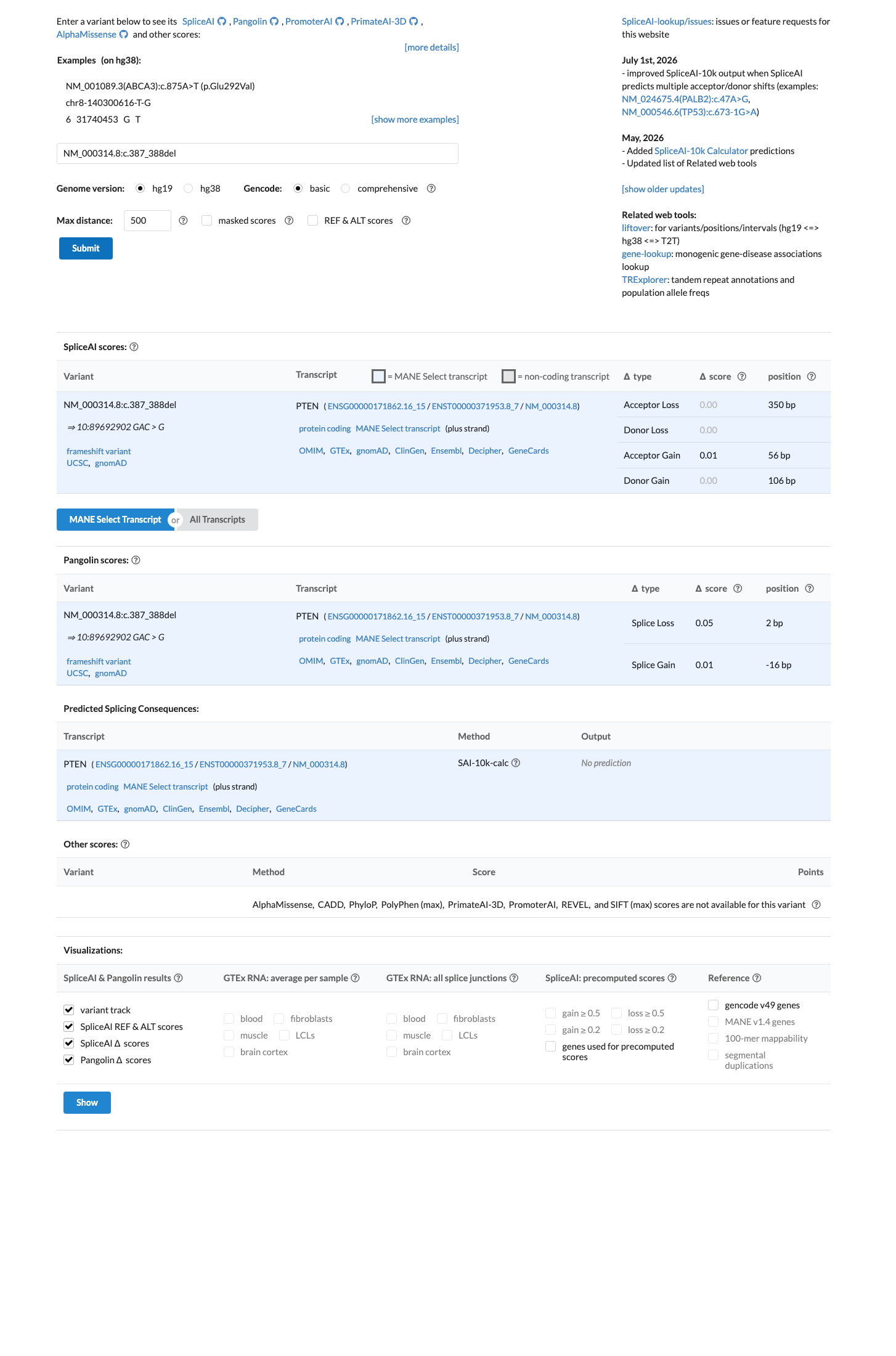
SpliceAI predicts no significant splice impact for this variant (max delta score = 0.01).
Functional
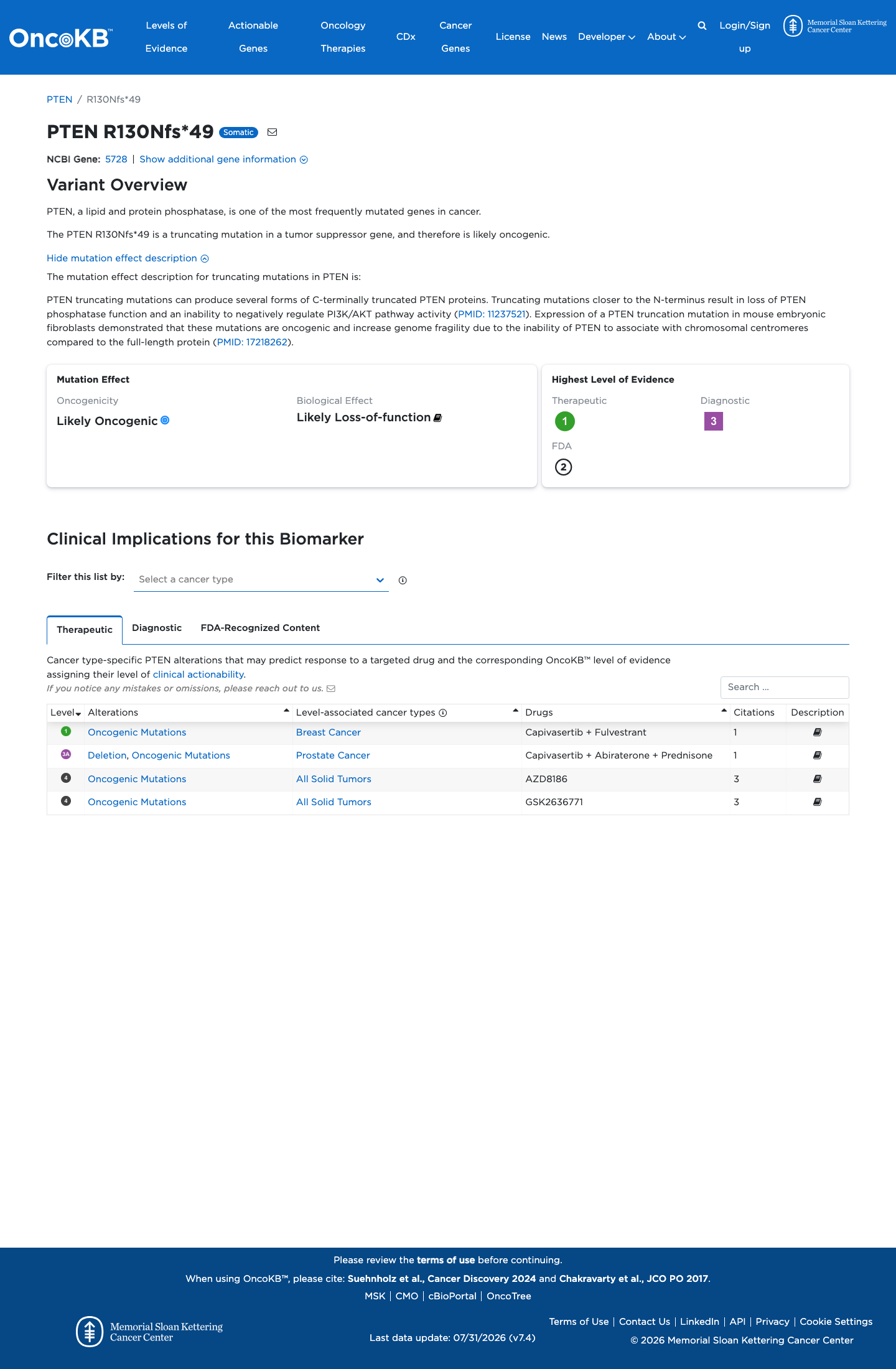
Likely Oncogenic
OncoKB identified variant-specific curated literature and context relevant to functional review; biological-effect context: Likely Loss-of-function; curated oncogenicity label: Likely Oncogenic.

COSMIC

Cancer hotspots
Somatic evidence
Hotspot
COSMIC
This variant lies in a statistically significant hotspot. This variant has not previously been reported in somatic cancers (COSMIC).
Hotspots
This variant lies in a statistically significant hotspot.
Sources & reference links
9Sources
Triaged references · 2 PMIDs not cited in assessment