Analysis in progress
Initialising…
0%
complete
This report is still being assembled — sections appear as each stage finishes. It isn't final yet.
PTEN
Final classification
Pathogenic
PTEN c.387_388del · p.Arg130AsnfsTer49
PTEN

PVS1 (Very Strong): 2-base-pair frameshift deletion (p.Arg130AsnfsTer49) predicted to trigger nonsense-mediated decay; loss of function is an established PTEN disease mechanism and the deletion removes most of the protein.

Gene
PTEN
Transcript
NM_000314.8
HGVS · transcript:coding
NM_000314.8:c.387_388del
Consequence
N/A
GRCh38
chr10:87933145 GAC>G
GRCh37
chr10:89692902 GAC>G
Basis The classification was derived under the ClinGen PTEN Expert Panel Specifications v3.2, the gene-specific rule set for PTEN. Three criteria were met: PVS1 at Very Strong (frameshift p.Arg130AsnfsTer49 predicted to undergo nonsense-mediated decay, with loss of function an established PTEN disease mechanism), PM1 at Moderate (disruption of residue 130 in the catalytic motif, a statistically significant hotspot), and PM2 at Supporting (variant absent from gnomAD v2.1, v4.1, and gnomAD-Canada). This combination exactly satisfies the panel's Rule 3 — one Very Strong plus one Moderate plus one Supporting pathogenic criterion — giving a final classification of Pathogenic. All remaining criteria were not met, not applicable, or could not be assessed and did not contribute to the call.
The classification was derived under the ClinGen PTEN Expert Panel Specifications v3.2, the gene-specific rule set for PTEN. Three criteria were met: PVS1 at Very Strong (frameshift p.Arg130AsnfsTer49 predicted to undergo nonsense-mediated decay, with loss of function an established PTEN disease mechanism), PM1 at Moderate (disruption of residue 130 in the catalytic motif, a statistically significant hotspot), and PM2 at Supporting (variant absent from gnomAD v2.1, v4.1, and gnomAD-Canada). This combination exactly satisfies the panel's Rule 3 — one Very Strong plus one Moderate plus one Supporting pathogenic criterion — giving a final classification of Pathogenic. All remaining criteria were not met, not applicable, or could not be assessed and did not contribute to the call.
Classification rationale
PVS1PM1PM2 Pathogenic
PTEN c.387_388del

PVS1 (Very Strong): 2-base-pair frameshift deletion (p.Arg130AsnfsTer49) predicted to trigger nonsense-mediated decay; loss of function is an established PTEN disease mechanism and the deletion removes most of the protein. PM1 (Moderate): the deletion disrupts residue 130, the terminal residue of the PTEN catalytic motif (residues 123-130), a statistically significant mutational hotspot. PM2 (Supporting): the variant is absent from gnomAD v2.1, gnomAD v4.1, and gnomAD-Canada. Overall classification: Pathogenic — PVS1 (Very Strong) + PM1 (Moderate) + PM2 (Supporting) satisfies Rule 3 of the ClinGen PTEN Expert Panel Specifications v3.2.

PVS1 + PM1 + PM2 Pathogenic
Gene diagram · NM_000314.8 · variants mapped to exon structure
PTEN NM_000314.8
Fetching transcript structure from UCSC…
Applied criteria · 3 applied · 14 assessed
Applied · 3
Strength Supporting Moderate Strong Very strong
PVS1 very strong Pathogenic
This 2-base-pair deletion shifts the reading frame (p.Arg130AsnfsTer49) and creates a premature stop codon at residue 178, well before the final exon-exon junction, so the message is predicted to be destroyed by nonsense-mediated decay. Loss of function is an established cause of PTEN-related disease, and the deletion removes most of the protein, including the C2 domain. Under the ClinGen PTEN expert panel rules, this meets PVS1 at Very Strong strength.
NM_000314.8:c.387_388del is a 2-bp deletion (frameshift) in exon 5 of NM_000314.8the MANE Select / VCEP preferred transcriptNormalized protein prediction NP_000305.3:p.(Arg130AsnfsTer49)
PM1 moderate review Pathogenic
The deletion disrupts codon 130, the terminal residue of the PTEN catalytic motif (residues 123-130), and the variant falls in a statistically significant mutational hotspot. Under the PTEN expert panel rules, which define PM1 positionally, this meets PM1 at Moderate strength.
ClinGen PTEN VCEP v3.2 PM1 rule: catalytic motifs 90-94123-130166-168 (NP_000305.3) — residue 130 in motif 123-130
PM2 supporting Pathogenic
The variant is completely absent (zero alleles) from three large population datasets — gnomAD v2.1, gnomAD v4.1, and gnomAD-Canada — consistent with a disease-causing variant under strong purifying selection. This meets PM2 at Supporting strength.
gnomAD v2.1 (exome): search_status=absentfound=falsegnomAD v4.1 (exome): search_status=absent
Assessed · not applied
Pathogenic
PS2 PS2 requires a confirmed de novo occurrence (new in the patient, with both parents tested).
PS3 PS3 requires variant-specific functional assay evidence.
PS4 PS4 requires either a characteristic phenotype score in affected individuals or variant enrichment in cases versus controls.
PM6 PM6 requires an assumed de novo occurrence (new in the patient without parental confirmation).
PP1 PP1 requires evidence that the variant co-segregates with disease in affected family members.
PP5 PP5 requires an expert-panel classification of this exact variant as pathogenic.
Benign
BA1 BA1 requires a population allele frequency high enough to indicate a benign variant.
BS1 BS1 requires a low-but-present population allele frequency.
BS2 BS2 requires the variant to be seen in the homozygous state in healthy individuals.
BS3 BS3 requires functional studies showing the variant has no damaging effect.
BS4 BS4 requires family data showing the variant does not segregate with disease.
BP2 BP2 requires observations of this variant paired with another pathogenic PTEN variant (in trans, or multiple in cis with phase unknown).
BP5 BP5 requires documentation that the patient's disease has an alternate molecular cause.
BP6 BP6 requires an expert-panel classification of this exact variant as benign.
N/A · 11 PS1 · PM3 · PM4 · PM5 · PP2 · PP3 · PP4 · BP1 · BP3 · BP4 · BP7
Research & evidence
Population frequency · supports pathogenic
gnomAD v4.1 screenshot
gnomAD v4.1
gnomAD v2.1 screenshot
gnomAD v2.1
v4.1
Absent from gnomAD v4.1.
v2.1
Absent from gnomAD v2.1.
🇨🇦 CA
Absent from gnomAD-Canada v1.0.
Allele frequency by ancestry
three datasets · side by side
gnomAD v4.1
Absent · 0 / ?
0 hom
Not observed in any ancestry group.
gnomAD v2.1
Absent · 0 / ?
0 hom
Not observed in any ancestry group.
gnomAD Canada 🇨🇦
Absent · 0 / ?
0 hom
Not observed in any ancestry group.
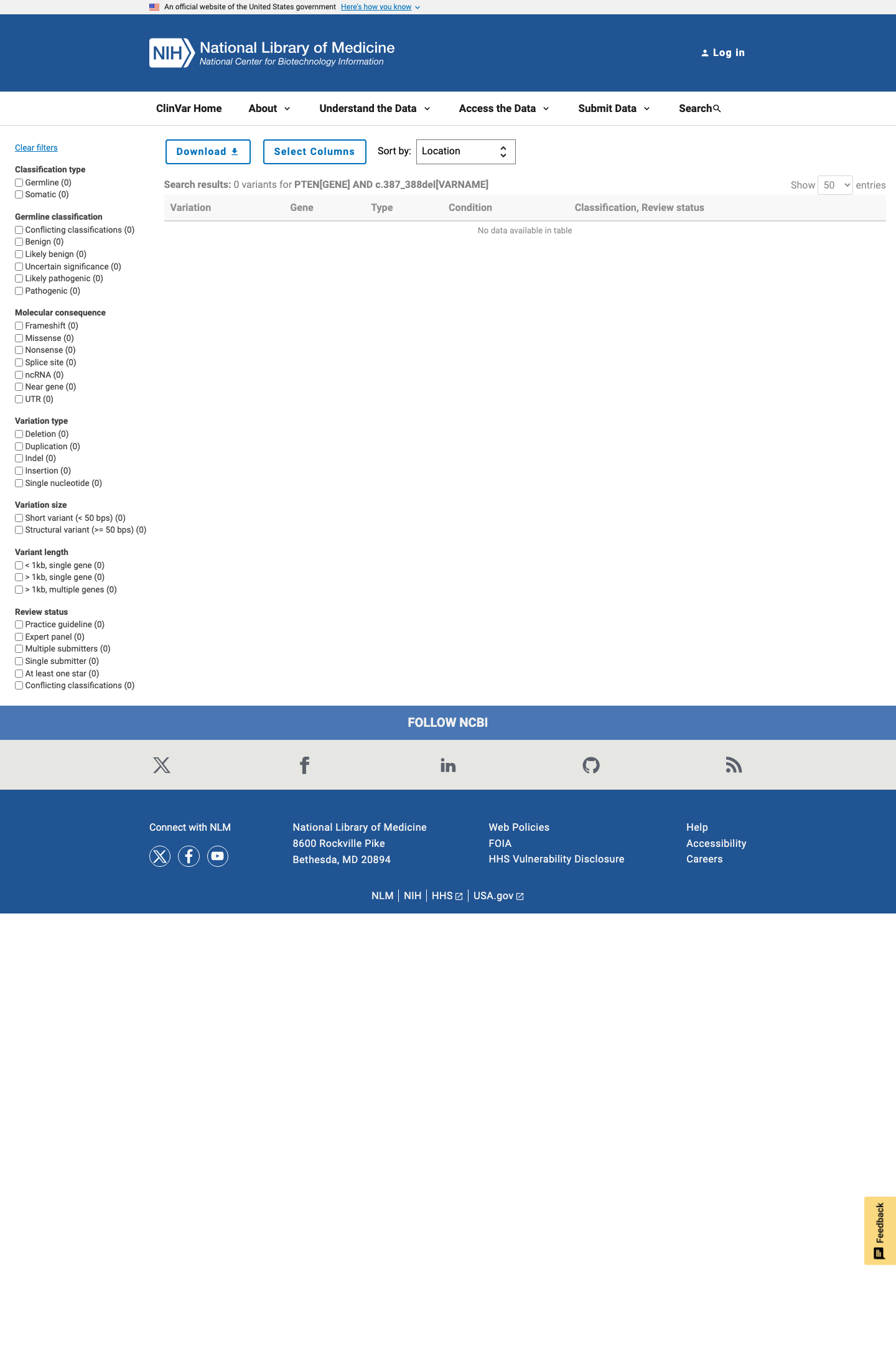
ClinVar screenshot
ClinVar
This variant is absent from ClinVar.
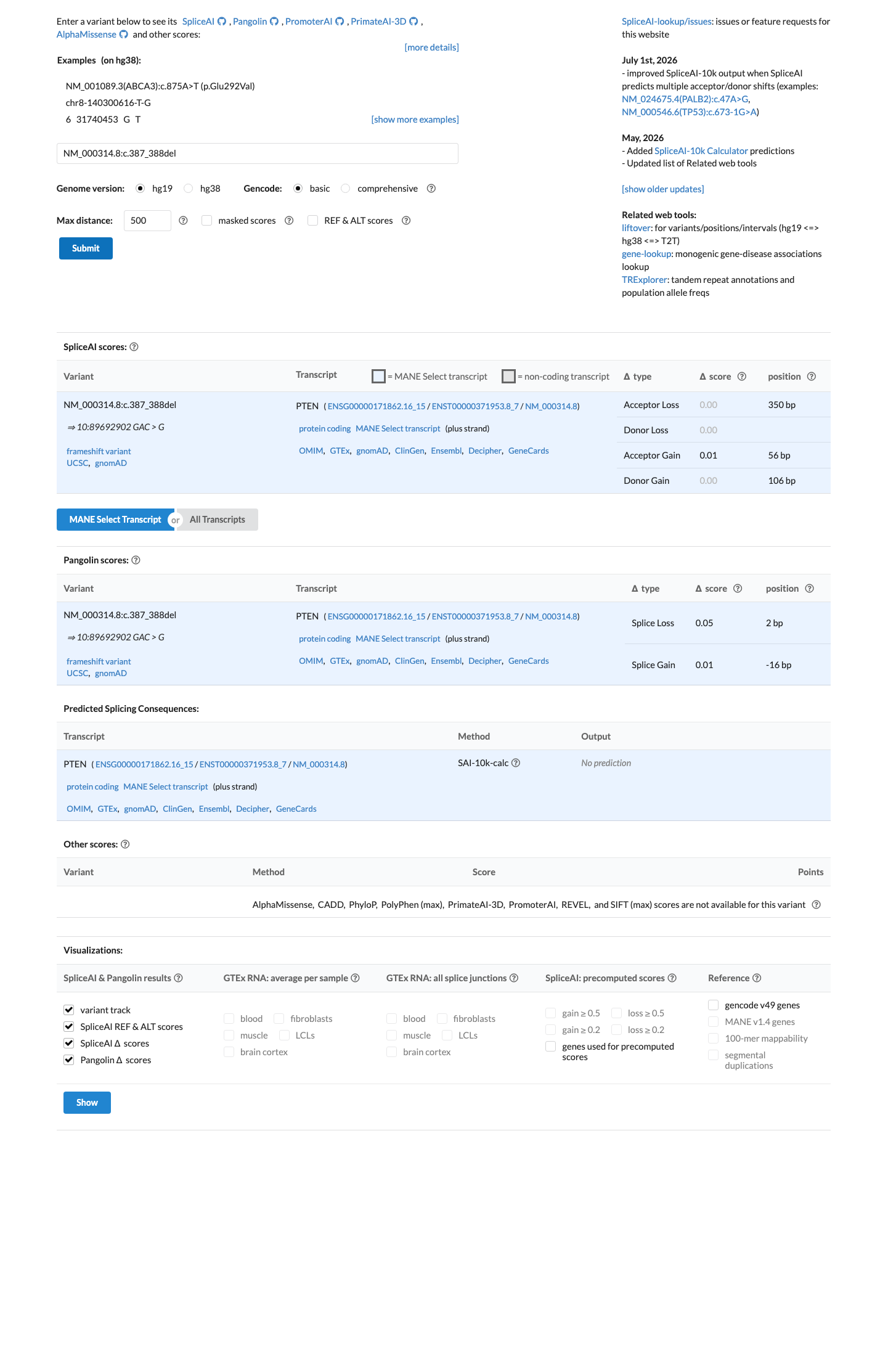
SpliceAI screenshot
In silico
SpliceAI predicts no significant splice impact for this variant (max delta score = 0.01).
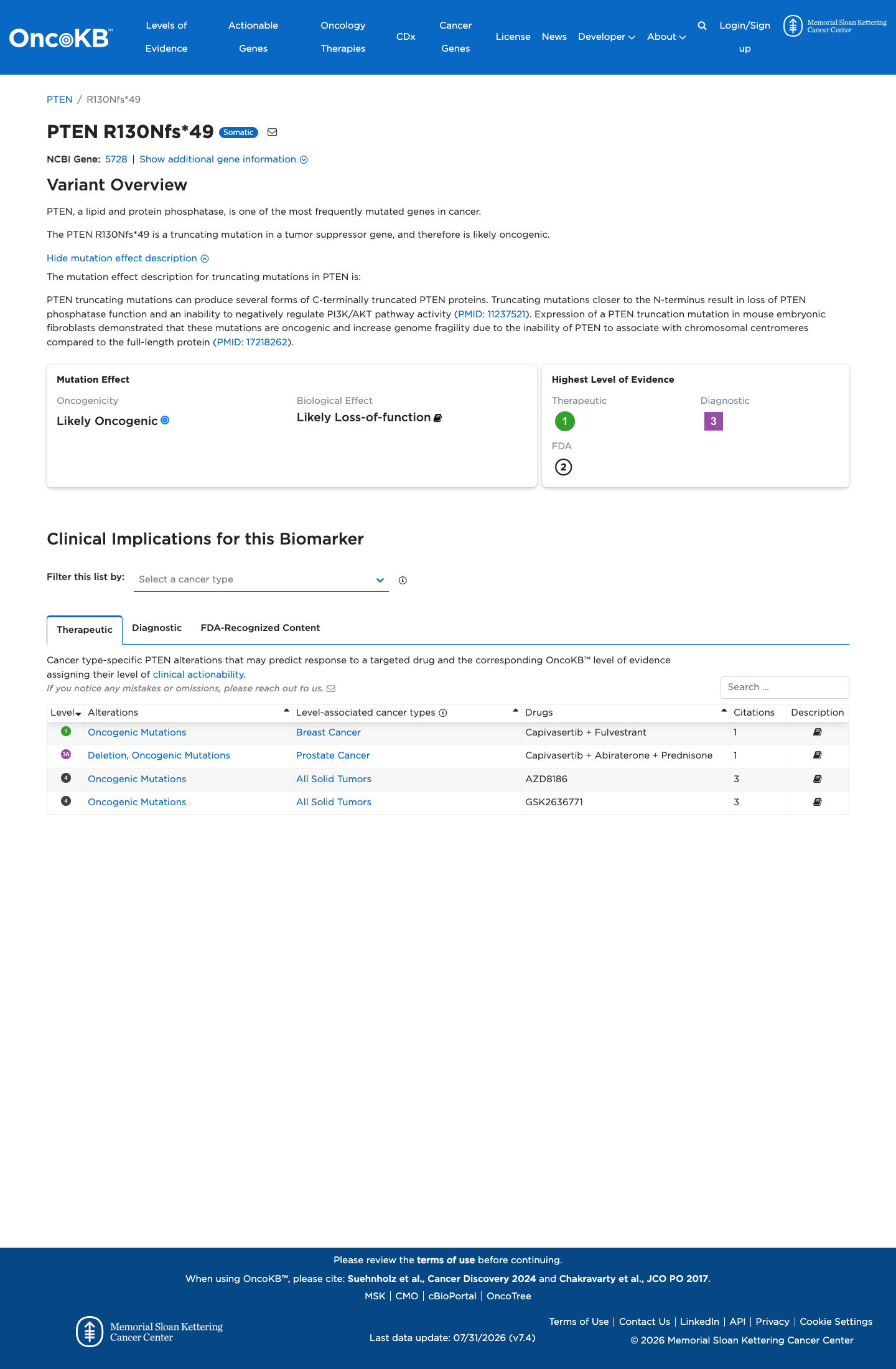
Functional / OncoKB screenshot
Functional Likely Oncogenic
OncoKB identified variant-specific curated literature and context relevant to functional review; biological-effect context: Likely Loss-of-function; curated oncogenicity label: Likely Oncogenic.
OncoKB ↗
COSMIC screenshot
COSMIC
Cancer hotspots screenshot
Cancer hotspots
Somatic evidence Hotspot
COSMIC
This variant lies in a statistically significant hotspot. This variant has not previously been reported in somatic cancers (COSMIC).
Hotspots
This variant lies in a statistically significant hotspot.
Sources & reference links
9Sources
CSpec VCEP
ClinVar
gnomAD v2.1
gnomAD v4.1
gnomAD-Canada
SpliceAI
OncoKB
COSMIC
Cancer hotspots
Triaged references · 2 PMIDs not cited in assessment
11237521 ↗ PTEN: life as a tumor suppressor. ONCOKB
17218262 ↗ Essential role for nuclear PTEN in maintaining chromosomal integrity. ONCOKB