Analysis in progress
Initialising…
0%
complete
This report is still being assembled — sections appear as each stage finishes. It isn't final yet.
ATM
Final classification
VUS
ATM c.3332T>C · p.Leu1111Pro
ATM

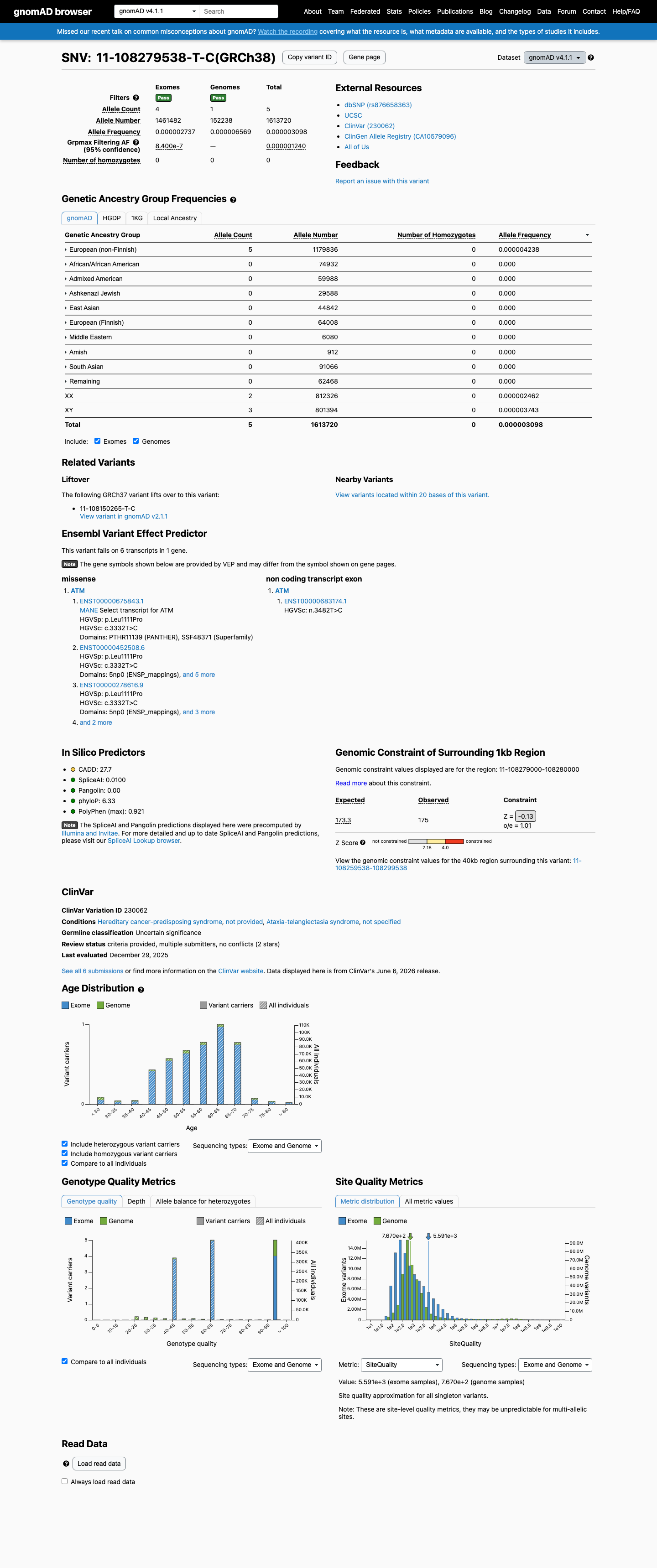
PM2 (Supporting): the variant is extremely rare in population databases — gnomAD v4.1 total allele frequency 0.00031% (5 of 1,613,720 alleles), below the VCEP's 0.001% threshold, with no homozygotes.

Gene
ATM
Transcript
NM_000051.4
HGVS · transcript:coding
NM_000051.4:c.3332T>C
Consequence
N/A
GRCh38
chr11:108279538 T>C
GRCh37
chr11:108150265 T>C
Basis The ClinGen HBOP ATM VCEP v1.5 specification governs this classification. The applied evidence totals one pathogenic-supporting criterion (PM2) and one benign-supporting criterion (BP4), with no very-strong, strong, or moderate pathogenic evidence and no benign stand-alone or strong evidence, so no pathogenic, likely pathogenic, benign, or likely benign combination rule is satisfied. The combination of one benign-supporting and one pathogenic-supporting criterion (VCEP Rule 31) yields 'Uncertain Significance - Conflicting Evidence', reported as VUS; the generic ACMG/AMP 2015 catch-all produces the same result.
The ClinGen HBOP ATM VCEP v1.5 specification governs this classification. The applied evidence totals one pathogenic-supporting criterion (PM2) and one benign-supporting criterion (BP4), with no very-strong, strong, or moderate pathogenic evidence and no benign stand-alone or strong evidence, so no pathogenic, likely pathogenic, benign, or likely benign combination rule is satisfied. The combination of one benign-supporting and one pathogenic-supporting criterion (VCEP Rule 31) yields 'Uncertain Significance - Conflicting Evidence', reported as VUS; the generic ACMG/AMP 2015 catch-all produces the same result.
Classification rationale
PM2 BP4 VUS
ATM c.3332T>C

PM2 (Supporting): the variant is extremely rare in population databases — gnomAD v4.1 total allele frequency 0.00031% (5 of 1,613,720 alleles), below the VCEP's 0.001% threshold, with no homozygotes. BP4 (Supporting): no predicted splicing impact (SpliceAI max delta 0.01, below the 0.1 threshold). Overall classification: VUS. One pathogenic-supporting and one benign-supporting criterion (VCEP Rule 31) produce 'Uncertain Significance - Conflicting Evidence'.

PM2 + BP4 VUS
Gene diagram · NM_000051.4 · variants mapped to exon structure
ATM NM_000051.4
Fetching transcript structure from UCSC…
Applied criteria · 2 applied · 10 assessed
Applied · 2
Strength Supporting Moderate Strong Very strong
PM2 supporting Pathogenic
PM2 is met at supporting strength: the variant is extremely rare in population databases, with a gnomAD v4.1 total allele frequency of 0.00031% (5 of 1,613,720 alleles) — below the VCEP's 0.001% threshold — and no homozygotes in any dataset.
gnomAD v4.1 total AF 3.10e-06 (0.00031%, 5/1,613,720 alleles, 0 homozygotes) <= 0.001% VCEP thresholdgnomAD v4.1 NFE subpopulation AF 4.24e-06 (0.00042%, 5/1,179,836 alleles, 0 homozygotes)gnomAD v2.1 AF 0 (0/250,754 alleles) corroboration
BP4 supporting Benign
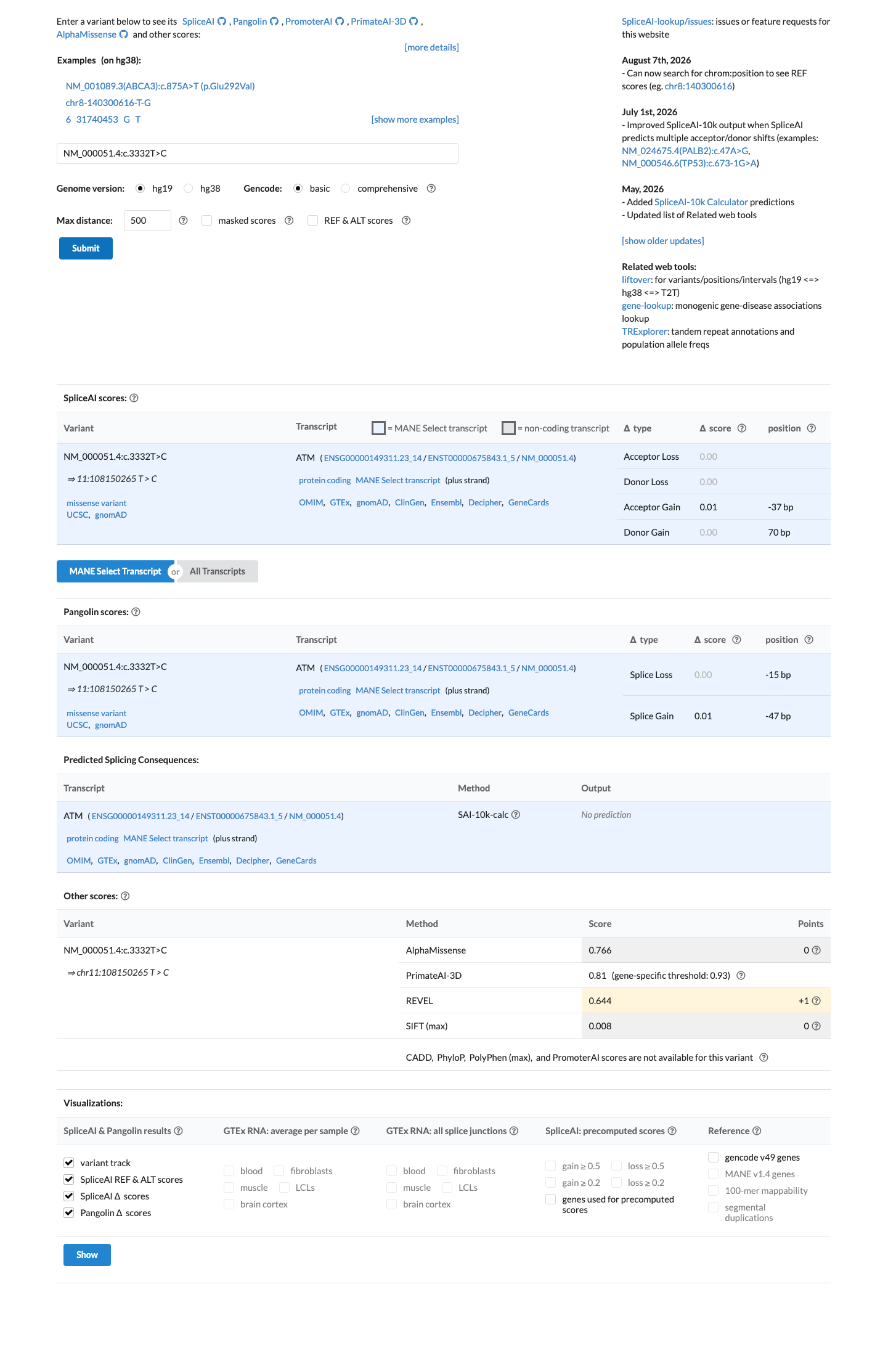
BP4 is met at supporting strength via the splicing sub-path: SpliceAI predicts no splicing impact (max delta 0.01, below the 0.1 threshold). The missense sub-path (REVEL of 0.644 is not at or below 0.249) was not met.
SpliceAI Lookup max delta score 0.01 (splicing sub-path: <=0.1, met)REVEL v1.3 local lookup score 0.644 (missense sub-path: threshold <=0.249, not met)ATM VCEP v1.5 BP4 rule text and instructionsToUse from CSPEC
Assessed · not applied
Pathogenic
PS1 PS1 is not met: no established pathogenic or likely pathogenic classification exists for this exact amino acid change.
PS3 Insufficient evidence was available to assess PS3: the variant was not tested in any of the VCEP-approved functional assays, and no failure-of-rescue result exists.
PS4 PS4 is not met: no case-control or cohort enrichment study of this variant has been reported.
PM3 Insufficient evidence was available to assess PM3: this variant has not been reported in any Ataxia-Telangiectasia proband, and no data exist on a second ATM alteration on the opposite chromosome (allelic phase), so the VCEP's points-based threshold could not be evaluated.
PP1 Insufficient evidence was available to assess PP1: no family-segregation data were documented — no affected relatives tested, no meioses reported, and no non-segregation observations — so no segregation strength could be assigned.
PP3 PP3 is not met: the in-silico predictor REVEL scores the variant 0.644, below the VCEP's 0.7333 threshold, and SpliceAI predicts no splicing impact (max delta 0.01, below the 0.2 threshold).
Benign
BA1 BA1 is not met: the variant's population frequency is far below the 0.5% threshold — gnomAD v4.1 filtering allele frequency 0.000124% and total allele frequency 0.00031%, with no homozygotes.
BS1 BS1 is not met: the highest population-specific frequency (0.00042% in European non-Finnish individuals) is below the VCEP's 0.05% threshold.
BS3 Insufficient evidence was available to assess BS3: the variant was not tested in any of the VCEP-approved functional assays, so no calibrated rescue result exists.
BP2 Insufficient evidence was available to assess BP2: no unaffected-carrier or in-trans observations (an individual carrying this variant opposite a pathogenic ATM variant) were documented, so the VCEP's points-based BP2 could not be evaluated.
N/A · 16 PVS1 · PS2 · PM1 · PM4 · PM5 · PM6 · PP2 · PP4 · PP5 · BS2 · BS4 · BP1 · BP3 · BP5 · BP6 · BP7
Research & evidence
Population frequency
gnomAD v4.1 screenshot
gnomAD v4.1
gnomAD v2.1 screenshot
gnomAD v2.1
v4.1
This variant is present in gnomAD v4.1 (AF= 3.09843e-06; MAF= 0.00031%, 5/1613720 alleles, homozygotes = 0) and has highest observed frequency in the European (non-Finnish) population (AF= 4.23788e-06; MAF= 0.00042%, 5/1179836 alleles, homozygotes = 0); grpmax FAF= 1.24e-06.
v2.1
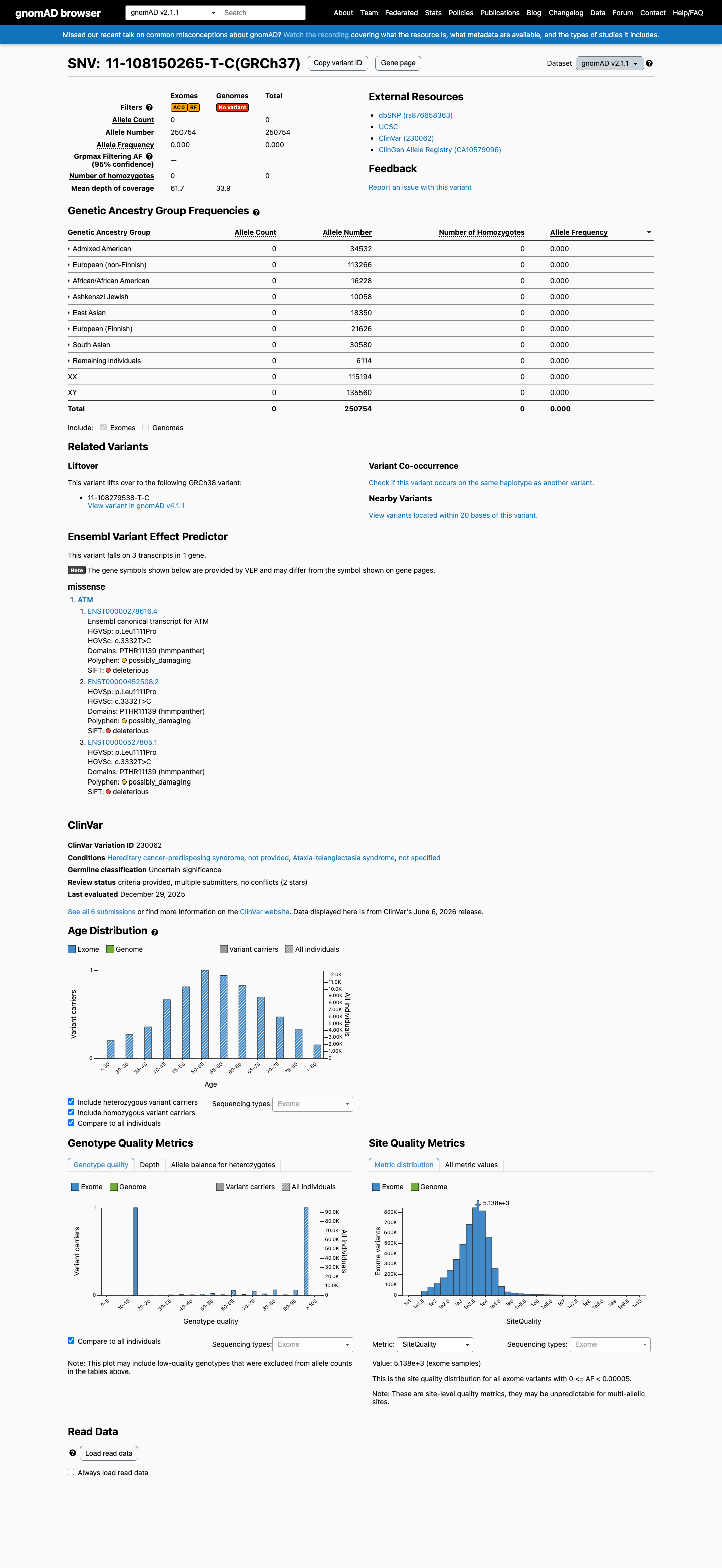
This variant is present in gnomAD v2.1 (AF= 0; MAF= 0.00000%, 0/250754 alleles, homozygotes = 0) and has highest observed frequency in the African/African American population (AF= 0; MAF= 0.00000%, 0/16228 alleles, homozygotes = 0).
🇨🇦 CA
Absent from gnomAD-Canada v1.0.
Allele frequency by ancestry
three datasets · side by side
gnomAD v4.1
0.00031% · 5 / 1,613,720
0 hom · FAF 0.00012%
European (non-Finnish)
5 / 1,179,836
0.00042%
+ 9 not observed (Remaining individuals, Admixed American, European (Finnish), Amish, East Asian, Middle Eastern, South Asian, Ashkenazi Jewish, African/African American)
gnomAD v2.1
Absent · 0 / 250,754
0 hom
Not observed in any ancestry group.
+ 8 not observed (African/African American, Admixed American, Ashkenazi Jewish, East Asian, European (Finnish), European (non-Finnish), Remaining individuals, South Asian)
gnomAD Canada 🇨🇦
Absent · 0 / ?
0 hom
Not observed in any ancestry group.
ClinVar screenshot
ClinVar
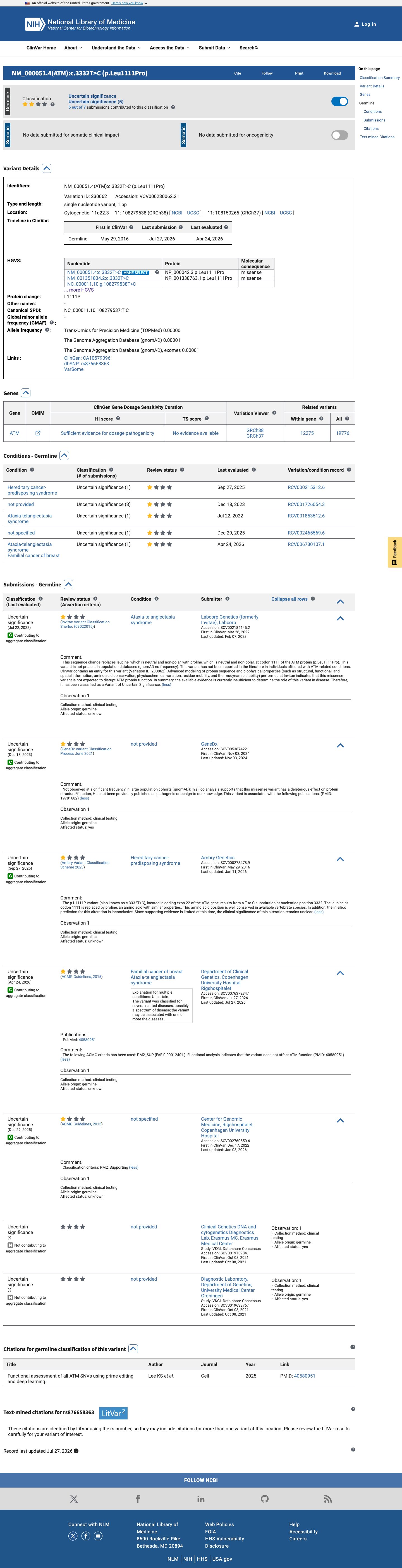
This variant has been reported in ClinVar as Uncertain significance (7 clinical laboratories). (ClinVarID = 230062)
SpliceAI screenshot
In silico
SpliceAI predicts no significant splice impact for this variant (max delta score = 0.01). REVEL score = 0.644. BayesDel score = 0.101685.
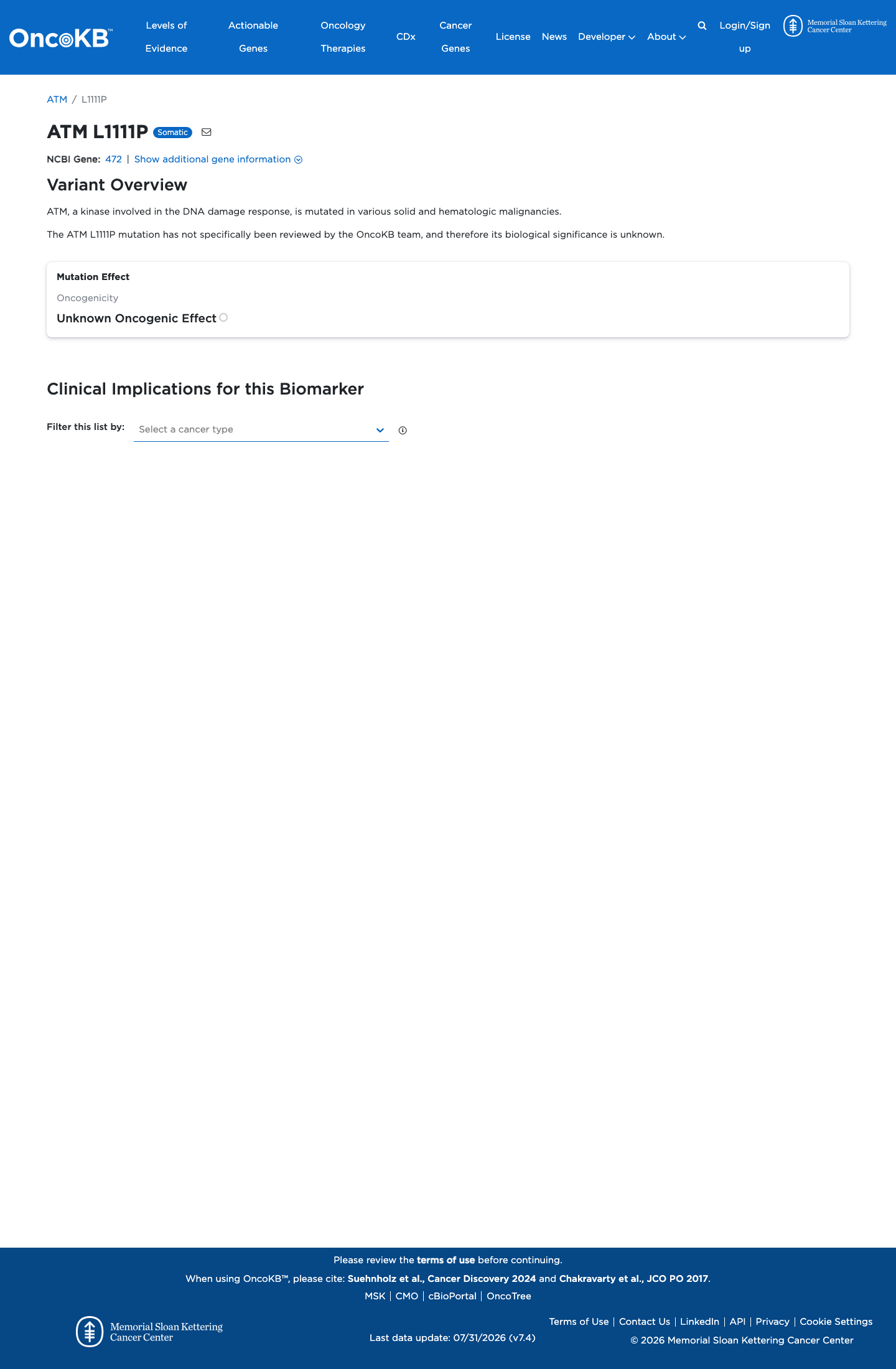
Functional / OncoKB screenshot
Functional Unknown Oncogenic Effect
OncoKB did not identify variant-specific reviewed functional evidence for this variant; gene-level curated context is available for reviewer follow-up. ATM, a kinase involved in the DNA damage response, is mutated in various solid and hematologic malignancies.
OncoKB ↗
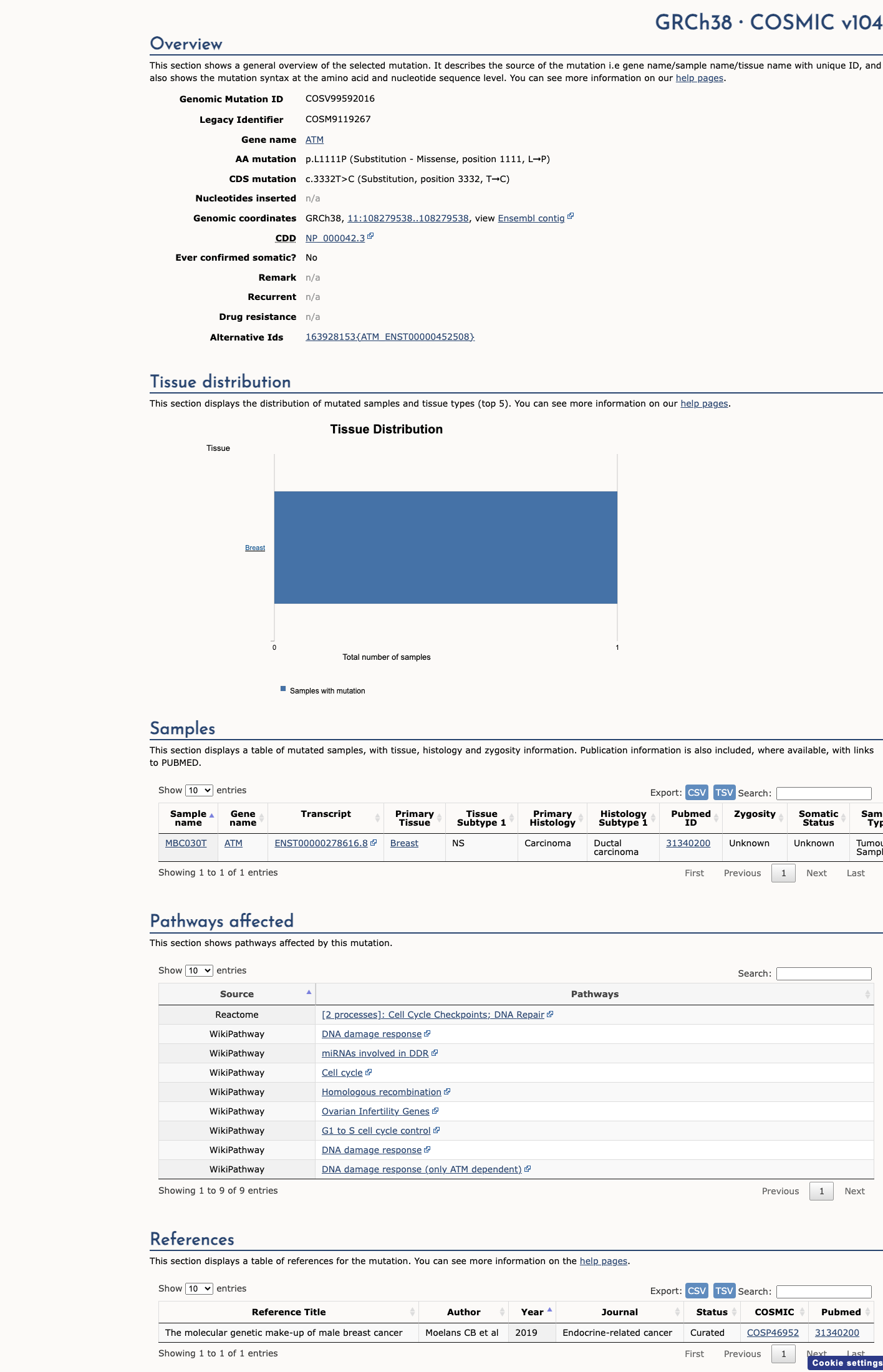
COSMIC screenshot
COSMIC
Cancer hotspots screenshot
Cancer hotspots
Somatic evidence Not in COSMIC / hotspots
COSMIC
This variant does not lie in a statistically significant hotspot. This variant has previously been reported in somatic cancers (COSMIC; COSV99592016, n = 1 times).
Hotspots
This variant does not lie in a statistically significant hotspot.
Literature · how each cited paper was used
1papers cited
Each card is an audit: what was searched, what was found, whether it names the variant, which criteria it fed, and why. 6 further PMIDs triaged but not cited — see Sources & References.
Rule & framework references · cited for criterion definitions, not variant evidence
40580951 ↗ Functional assessment of all ATM SNVs using prime editing and deep learning.
Sources & reference links
9Sources
CSpec VCEP
ClinVar
gnomAD v2.1
gnomAD v4.1
gnomAD-Canada
SpliceAI
OncoKB
COSMIC
Cancer hotspots
Triaged references · 6 PMIDs not cited in assessment
25741868 ↗ Standards and guidelines for the interpretation of sequence variants: a joint consensus recommendation of the American College of Medical Genetics and Genomics and the Association for Molecular Pathology. CLINVAR
34242744 ↗ Customizing local and systemic therapies for women with early breast cancer: the St. Gallen International Consensus Guidelines for treatment of early breast cancer 2021. CLINVAR
17508274 ↗ Risk assessment and genetic counseling for hereditary breast and ovarian cancer: recommendations of the National Society of Genetic Counselors. CLINVAR
20301317 ↗ Hereditary Ataxia Overview. CLINVAR
20301425 ↗ BRCA1- and BRCA2-Associated Hereditary Breast and Ovarian Cancer. CLINVAR
26389258 ↗ Cancer Genetics Risk Assessment and Counseling (PDQ®): Health Professional Versi CLINVAR