Analysis in progress
Initialising…
0%
complete
This report is still being assembled — sections appear as each stage finishes. It isn't final yet.
CCND1
Final classification
VUS
PM2BP4
CCND1
c.844G>A
p.Asp282Asn
missense · exon 5

CCND1 encodes cyclin D1, a cell-cycle regulator that partners with CDK4 and CDK6 to drive the transition from G1 to S phase, promoting cell growth, proliferation, and division. It helps control these processes by phosphorylating and inactivating the RB tumor suppressor, which in turn releases the E2F transcription program needed for cell-cycle entry. CCND1 is a well-established oncogene: its amplification or overexpression is common in many human cancers, including breast, lung, melanoma, and oral squamous cell carcinoma, where it allows cancer cells to proliferate independently of normal growth signals. Disruption of this gene's normal regulation is therefore frequently linked to cancer development and progression.

This variant

CCND1 is an established oncogene whose amplification or overexpression drives many cancers, so individual missense changes are interpreted cautiously. This p.(Asp282Asn) change, absent from population databases and lacking any reported functional or clinical evidence, is classified as a VUS — current data neither support nor exclude a role in cancer.

Transcript
NM_053056.3
HGVS · transcript:coding
NM_053056.3:c.844G>A
GRCh38
chr11:69651238 G>A
GRCh37
chr11:69466006 G>A
Basis Met criteria PM2 (supporting) and BP4 (supporting) do not reach any pathogenic or benign classification threshold under the generic ACMG/AMP 2015 rules, so the variant is classified as VUS.
Met criteria PM2 (supporting) and BP4 (supporting) do not reach any pathogenic or benign classification threshold under the generic ACMG/AMP 2015 rules, so the variant is classified as VUS.
Classification rationale
PM2 BP4 VUS
CCND1 c.844G>A missense · exon 5

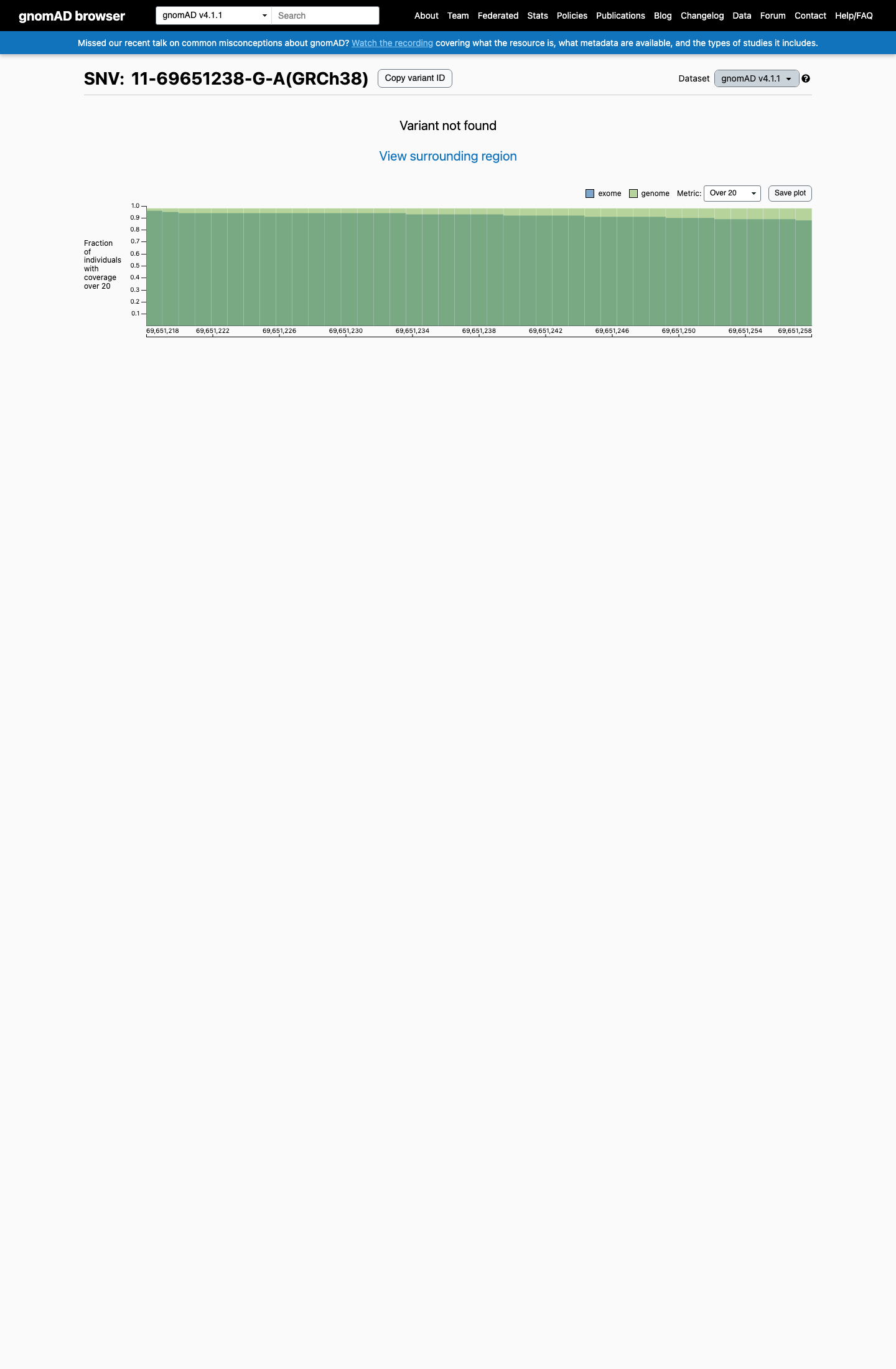
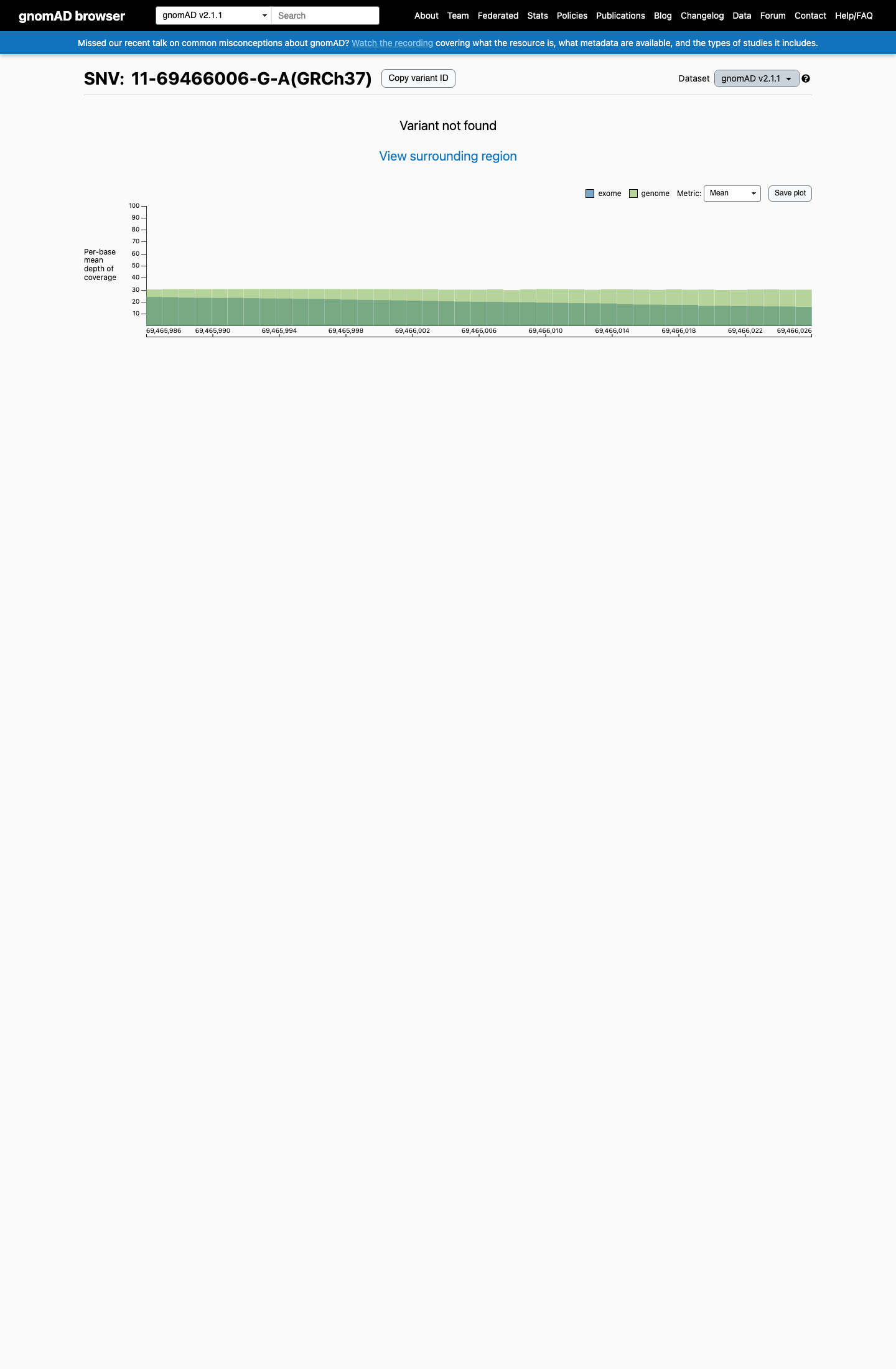
PM2 (Supporting): absent from gnomAD v2.1, gnomAD v4.1, and gnomAD-Canada v1.0 population databases. BP4 (Supporting): REVEL 0.07 and SpliceAI max delta 0.001 predict no functional impact. PM2 and BP4 (both supporting), combined under the generic ACMG/AMP 2015 rules, do not meet any pathogenic or benign threshold, yielding a VUS classification.

PM2 + BP4 VUS
Gene diagram · NM_053056.3 · variants mapped to exon structure
CCND1 NM_053056.3
Fetching transcript structure from UCSC…
Applied criteria · 2 applied · 22 assessed
MetEvidence satisfies this criterion.
Not metEvaluated against available evidence; threshold not reached.
Not assessedApplies in principle, but no evidence was found to evaluate it.
N/ADoesn't apply to this variant type.
Applied · 2
Strength Supporting Moderate Strong Very strong
PM2 supporting Pathogenic
Met (supporting): the variant is absent from gnomAD v2.1, gnomAD v4.1, and gnomAD-Canada v1.0 population databases.
gnomAD v2.1 reports the variant as absent.gnomAD v4.1 reports the variant as absent.gnomAD-Canada v1.0 reports the variant as absent.
BP4 supporting Benign
Met (supporting): REVEL 0.07 is below the 0.29 benign-supporting threshold, indicating no predicted functional impact.
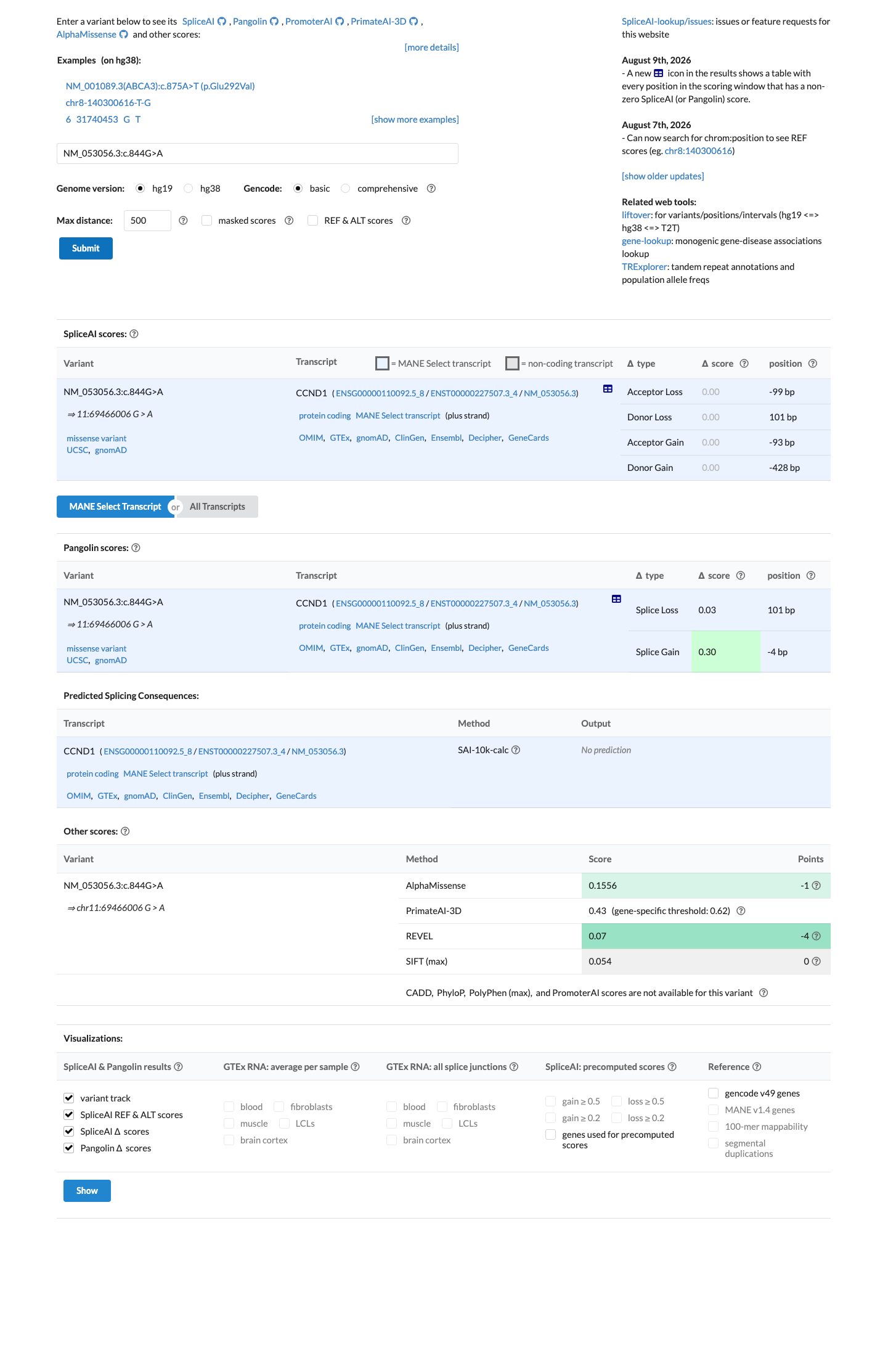
SpliceAI (source_registry 'spliceai') max delta score = 0.001 for NM_053056.3:c.844G>A across DS_AG/DS_AL/DS_DG/DS_DL, indicating no predicted splice disruption.REVEL score = 0.07 (source_registry 'revel'), below the ClinGen SVI-calibrated REVEL benign-supporting thresholds described in Pejaver et al. 2022 (PMID 36413997).BayesDel score -0.503138 was retrieved (source_registry 'bayesdel') but excluded from this determination because no verified, citable published calibration threshold for BayesDel is available to this pipeline.
Assessed · not applied · 3 not met · 19 not assessed
Pathogenic
PS1 Not assessed: no different nucleotide change producing the same p.Asp282Asn amino acid change has been established as pathogenic.
PS2 Not assessed: no de novo observation with parental testing was documented for this variant.
PS3 Not assessed: no published functional assay data (e.g., kinase or cell-cycle assays) were available for this variant.
PS4 Not assessed: no affected-case series, case-control comparison, or prevalence evidence was available.
PM1 Not assessed: no hotspot or functional-domain annotation exists for residue 282; cancerhotspots.org returned no entry.
PM3 Not assessed: no evidence places this variant in trans with a pathogenic variant for a recessive condition.
PM5 Not assessed: no different missense change at residue 282 has been established as pathogenic.
PM6 Not assessed: no suspected de novo occurrence without confirmed parentage was documented.
PP1 Not assessed: no family segregation data, informative meioses, or variant-positive relatives were documented.
PP2 Not assessed: no gene-level missense constraint or benign-variation rate data were available for CCND1.
PP3 Not met: REVEL 0.07 is far below the 0.644 pathogenic-supporting threshold, indicating no predicted damaging effect.
PP4 Not assessed: no patient phenotype or disease-specific clinical features were provided for evaluation.
PP5 Not assessed: the variant has no ClinVar record and no expert-panel pathogenic assertion.
Benign
BA1 Not met: the variant is absent from population databases, so no allele frequency reaches the stand-alone benign threshold.
BS1 Not met: the variant is absent from population datasets, so it does not exceed any expected benign frequency threshold.
BS2 Not assessed: no observations in healthy adults, incompatible phenotypes, or homozygous individuals were available.
BS3 Not assessed: no functional assay data, benign or damaging, were available for this variant.
BS4 Not assessed: no unaffected relative carrying the variant with adequate phenotype evaluation was documented.
BP1 Not assessed: no evidence establishes CCND1's disease mechanism as predominantly loss-of-function, which BP1 requires.
BP2 Not assessed: no phase information or co-occurrence with a pathogenic variant was documented.
BP5 Not assessed: no alternative molecular diagnosis evidence or patient phenotype was available to evaluate.
BP6 Not assessed: the variant has no ClinVar record and no expert-panel benign assertion.
N/A · 4 PVS1 · PM4 · BP3 · BP7
Research & evidence
Population frequency
gnomAD v4.1 screenshot
gnomAD v4.1
gnomAD v2.1 screenshot
gnomAD v2.1
v4.1
Absent from gnomAD v4.1.
v2.1
Absent from gnomAD v2.1.
🇨🇦 CA
Absent from gnomAD-Canada v1.0.
Allele frequency by ancestry
three datasets · side by side
gnomAD v4.1
Absent · 0 / ?
0 hom
Not observed in any ancestry group.
gnomAD v2.1
Absent · 0 / ?
0 hom
Not observed in any ancestry group.
gnomAD Canada 🇨🇦
Absent · 0 / ?
0 hom
Not observed in any ancestry group.
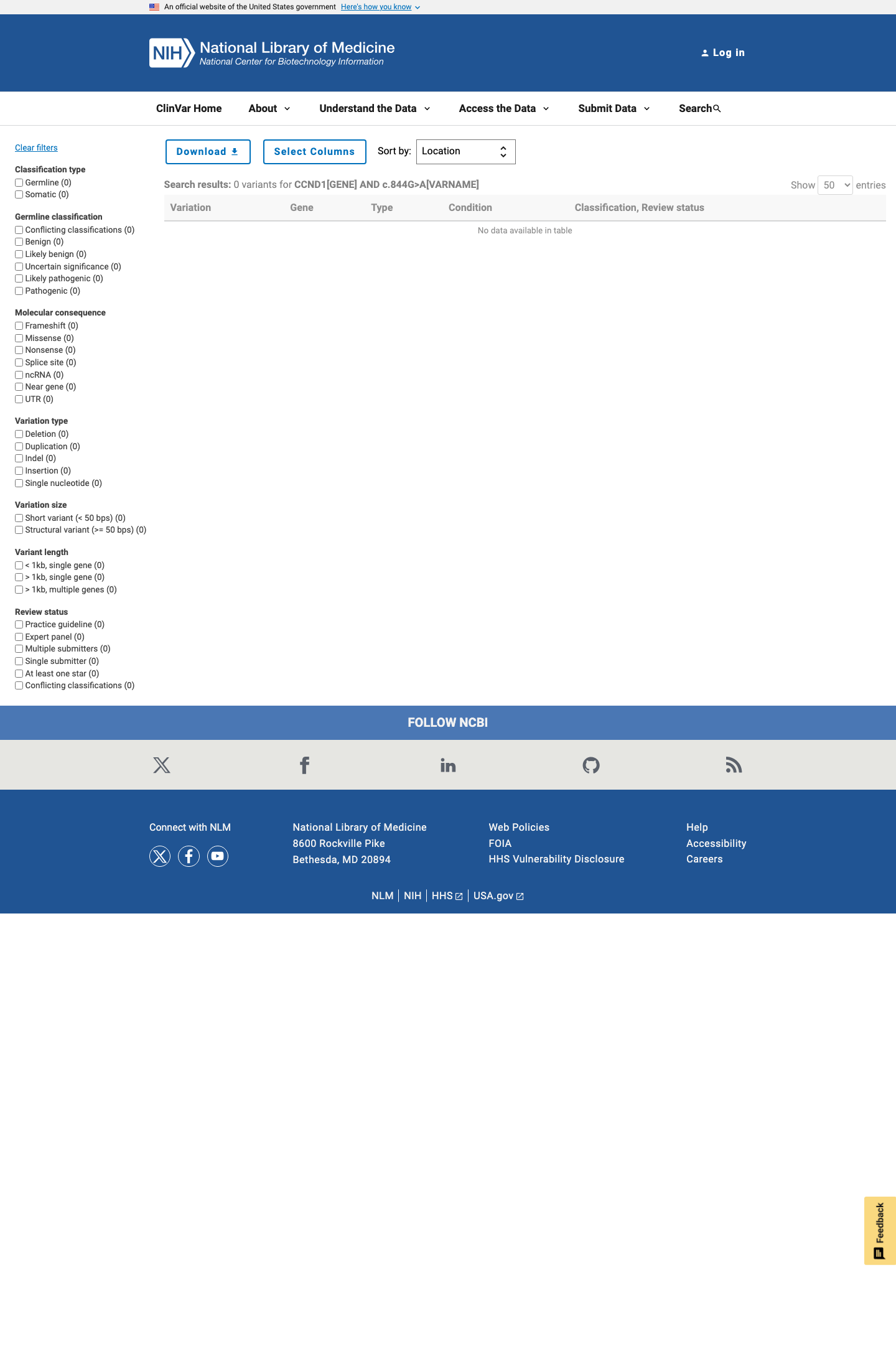
ClinVar screenshot
ClinVar
This variant is absent from ClinVar.
SpliceAI screenshot
In silico
SpliceAI predicts no significant splice impact for this variant (max delta score = 0.00). REVEL score = 0.07. BayesDel score = -0.503138.
Functional / OncoKB screenshot
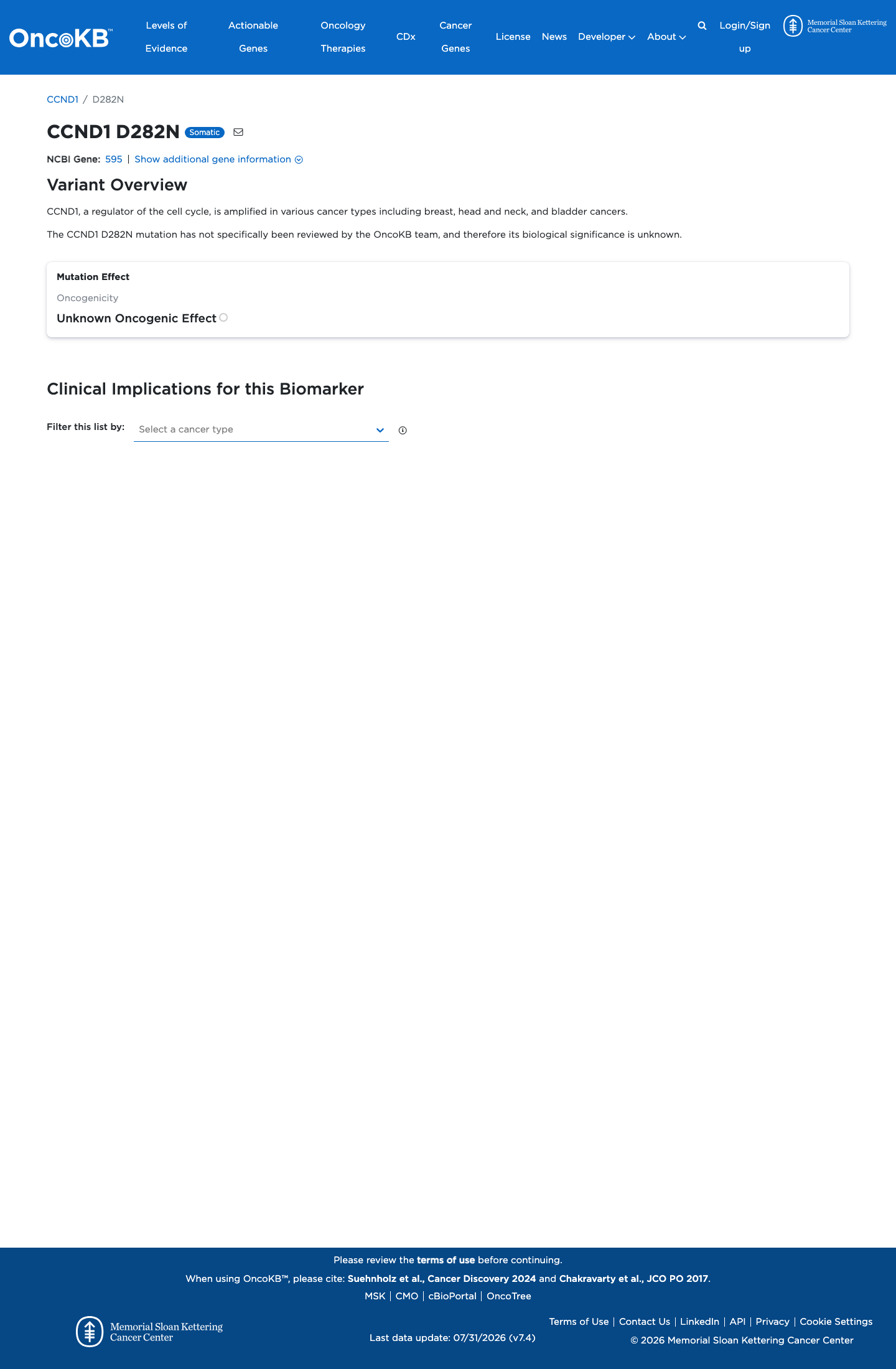
Functional Unknown Oncogenic Effect
OncoKB did not identify variant-specific reviewed functional evidence for this variant; gene-level curated context is available for reviewer follow-up. CCND1, a regulator of the cell cycle, is amplified in various cancer types including breast, head and neck, and bladder cancers.
OncoKB ↗
COSMIC screenshot
COSMIC
Cancer hotspots screenshot
Cancer hotspots
Somatic evidence Not in COSMIC / hotspots
COSMIC
This variant does not lie in a statistically significant hotspot. This variant has not previously been reported in somatic cancers (COSMIC).
Hotspots
This variant does not lie in a statistically significant hotspot.
Sources & reference links
8Sources
ClinVar
gnomAD v2.1
gnomAD v4.1
gnomAD-Canada
SpliceAI
OncoKB
COSMIC
Cancer hotspots