TP53 encodes the p53 protein, a critical tumor suppressor that acts as a transcription factor to protect cells from damage. When activated by cellular stress such as DNA damage, p53 triggers responses including DNA repair, cell cycle arrest, and programmed cell death (apoptosis) to prevent the propagation of damaged cells. TP53 is the most frequently mutated gene in human cancers, and loss of its function contributes to tumor development, invasion, drug resistance, and genomic instability. Inherited mutations in TP53 cause Li-Fraumeni syndrome, a rare hereditary condition that greatly increases the risk of developing multiple types of cancer at a young age.
This variant
TP53 encodes the p53 tumor suppressor, and inherited loss-of-function mutations cause Li-Fraumeni syndrome with high early-onset cancer risk. This variant's Likely Benign classification indicates it is not expected to impair p53's protective function: functional assays show normal protein activity, it is essentially absent from population databases, and computational predictions find no pathogenic effect.
Transcript
NM_000546.6
HGVS · transcript:coding
NM_000546.6:c.1066G>C
GRCh38
chr17:7670643 C>G
GRCh37
chr17:7573961 C>G
BasisCombined point score -6 (PM2_Supporting +1, BS3_Strong -4, BP4_Moderate -2, BP6_Supporting -1) falls within the -6 to -2 range, yielding Likely Benign per TP53 VCEP Rule 4.▾
Combined point score -6 (PM2_Supporting +1, BS3_Strong -4, BP4_Moderate -2, BP6_Supporting -1) falls within the -6 to -2 range, yielding Likely Benign per TP53 VCEP Rule 4.
Classification rationale
PM2BS3BP4BP6Likely Benign
TP53 c.1066G>Cmissense · exon 10
PM2 (Supporting): essentially absent from population databases - gnomAD v4.1 allele frequency 4.34e-06, below the 0.00003 threshold. BS3 (Strong): VCEP functional data show normal protein function (Kato 'Functional', no loss of function). BP4 (Moderate): BayesDel -0.347 and SpliceAI max delta 0.004 indicate no pathogenic computational or splicing evidence. BP6 (Supporting): ClinGen TP53 Expert Panel classified this variant Likely Benign. Final classification: Likely Benign, per TP53 VCEP Rule 4 (combined score -6, within the -6 to -2 range).
PM2 + BS3 + BP4 + BP6→Likely Benign
Gene diagram
· NM_000546.6 · variants mapped to exon structure
TP53NM_000546.6
Fetching transcript structure from UCSC…
Exons
—
Transcript span
—
Strand
—
Variants mapped
—
Source
UCSC ncbiRefSeqCurated
All variants in TP53—click a row to locate it on the plot · use the link column to open its page
Variant ↕
Protein
Location
Classification
Link
Applied criteria · 4 applied · 14 assessed
MetEvidence satisfies this criterion.
Not metEvaluated against available evidence; threshold not reached.
Not assessedApplies in principle, but no evidence was found to evaluate it.
N/ADoesn't apply to this variant type.
Applied · 4
Strength Supporting Moderate Strong Very strong
✓
PM2supportingPathogenic
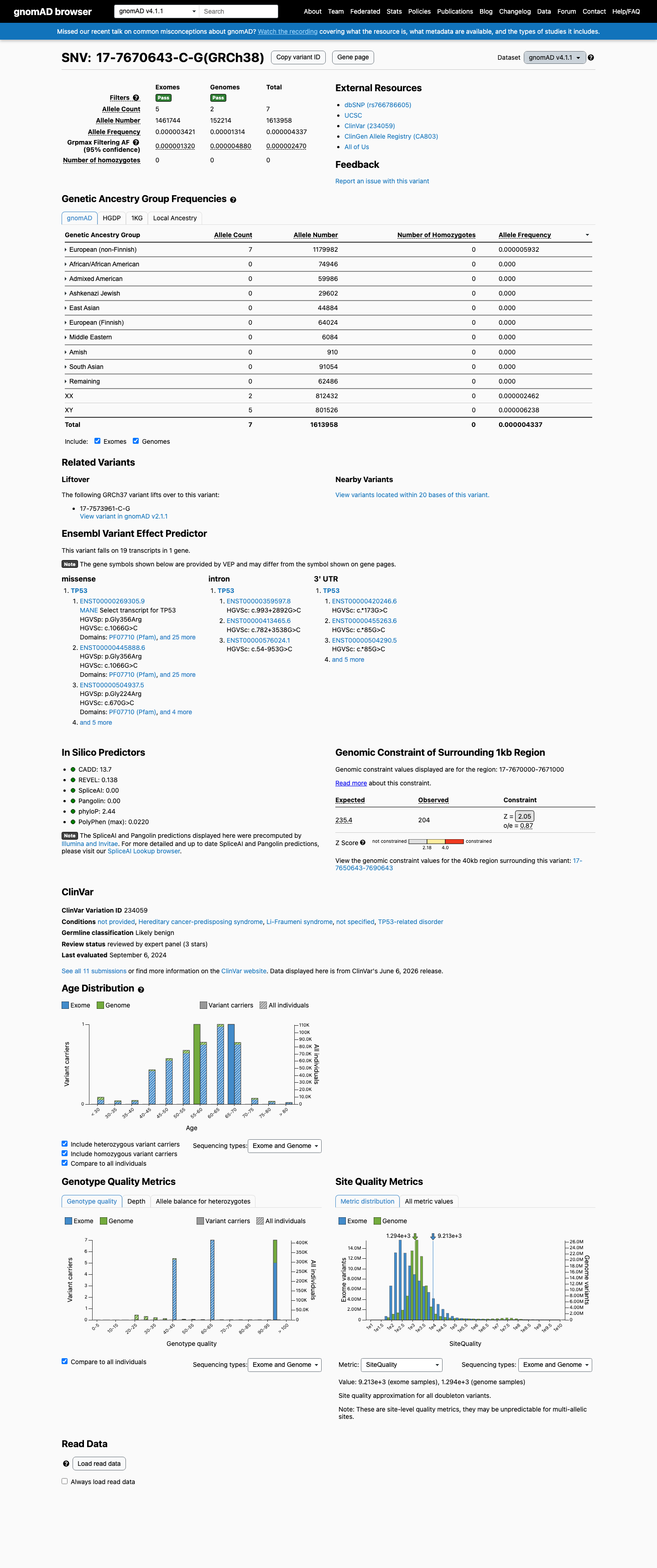
Met (Supporting): gnomAD v4.1 allele frequency 4.34e-06 (7/1,613,958 alleles) is below the 0.00003 threshold.
The TP53 VCEP Version 2.4 PM2 rule applies PM2 at supporting strength when allele frequency is <0.00003 in gnomAD or another large sequenced population; when multiple variant alleles are present within an ancestry group, that group's frequency must be <0.00004, and founder-effect groups are ignored.gnomAD v4.1 reports 7 variant alleles among 1,613,958 total alleles (AF 4.33716e-06), 7 among 1,179,982 European (non-Finnish) alleles (AF 5.93229e-06), and zero homozygotes. The reported grpmax FAF is 2.47e-06.
Met (Strong): VCEP functional worksheet assigns BS3, with Kato 'Functional' and no loss of function across eligible assays.
VCEP Functional-worksheet.xlsx (Supplementary Table S3) row for G356R: Kato column = 'Functional', consensus LOF column = 'noLOF', pre-assigned code = 'BS3' (no '_Supporting' modifier, indicating full Strong-strength assignment per the worksheet's own convention).TP53 VCEP Flowchart-for-application-of-functional-rule-codes.pdf BS3 rule: Strong = Functional on Kato et al. data AND no LOF by the majority of other eligible assays (Kato PMID:12826609, Funk PMID:39774325, Giacomelli PMID:30224644, Kotler PMID:29979965, Kawaguchi PMID:16007150) -- criteria satisfied by the worksheet's Functional/noLOF result.
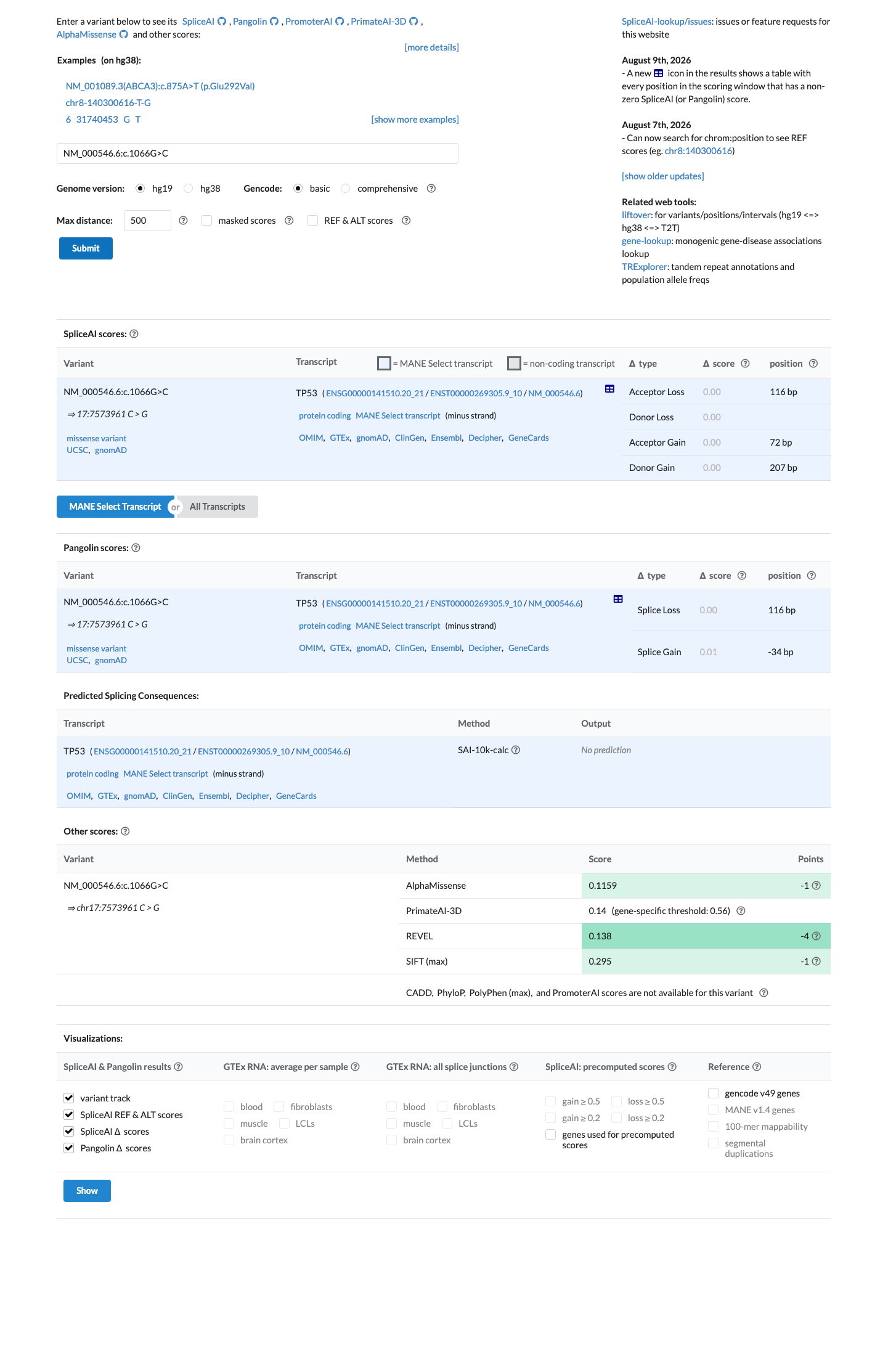
Met (Moderate): BayesDel -0.347 is below the -0.008 cutoff and SpliceAI max delta 0.004 shows no splicing impact. Flagged for human review: aGVGD class not confirmed to exclude C65, which would void BP4.
TP53 VCEP cspec BP4 missense rule: BP4_Moderate = BayesDel <= -0.008 irrespective of aGVGD score (except C65, in which case do not apply BP4_Moderate) AND no predicted differences in splicing (SpliceAI < 0.2).Local BayesDel predictor lookup returns a score of -0.347259 for c.1066G>C, well below the -0.008 BP4_Moderate cutoff.SpliceAI lookup reports max delta score = 0.004, well below the 0.2 threshold used by the VCEP to define 'no predicted differences in splicing'.
Met (Supporting): ClinGen TP53 Variant Curation Expert Panel classified this variant Likely Benign.
ClinVar variation 234059 exactly matches NM_000546.6:c.1066G>C (p.Gly356Arg) and identifies the ClinGen TP53 Variant Curation Expert Panel as the expert-panel submitter with a Likely Benign classification and three-star reviewed-by-expert-panel status.The exact-variant expert-panel classification meets the instructed BP6 trigger for Likely Benign.ClinVar expert panel classification
Assessed · not applied
· 6 not met · 8 not assessed
Pathogenic
PS1Not assessed: insufficient evidence was available to identify an alternate nucleotide change at this residue with an established pathogenic classification.
PS2Not assessed: no proband-level phenotype data or confirmed parental genotypes were available to establish de novo status.
PS3Not met: VCEP functional data show normal protein activity (Kato 'Functional', no loss of function), directly contradicting the loss-of-function requirement.
PS4Not assessed: no verified case series or Li-Fraumeni cancer-point data were available for this variant.
PM1Not met: codon 356 is not among the six VCEP hotspot codons, and cancerhotspots.org shows no hotspot match.
PM5Not assessed: no prior VCEP-classified pathogenic missense variant at residue 356 was documented; insufficient evidence was available.
PP1Not assessed: no family segregation data (affected relatives or meiosis counts) were available.
PP3Not met: BayesDel score -0.347 is far below the 0.16 pathogenic threshold, and SpliceAI max delta is 0.004.
PP4Not assessed: no phenotype-specificity evidence or qualifying VAF observations were available.
PP5Not met: the ClinVar record's ClinGen TP53 Expert Panel classification is Likely Benign, not Pathogenic or Likely Pathogenic.
Benign
BA1Not met: highest gnomAD v4.1 ancestry frequency is 5.93e-06, far below the 0.001 BA1 threshold.
BS1Not met: highest gnomAD v4.1 ancestry frequency is 5.93e-06, below the 0.0003 BS1 threshold.
BS2Not assessed: no cohort data documenting two or more cancer-free women aged 60 or older were available.
BS4Not assessed: no affected-family-member genotype data were available to establish absence of segregation.
This variant is present in gnomAD v4.1 (AF= 4.33716e-06; MAF= 0.00043%, 7/1613958 alleles, homozygotes = 0) and has highest observed frequency in the European (non-Finnish) population (AF= 5.93229e-06; MAF= 0.00059%, 7/1179982 alleles, homozygotes = 0); grpmax FAF= 2.47e-06.
v2.1
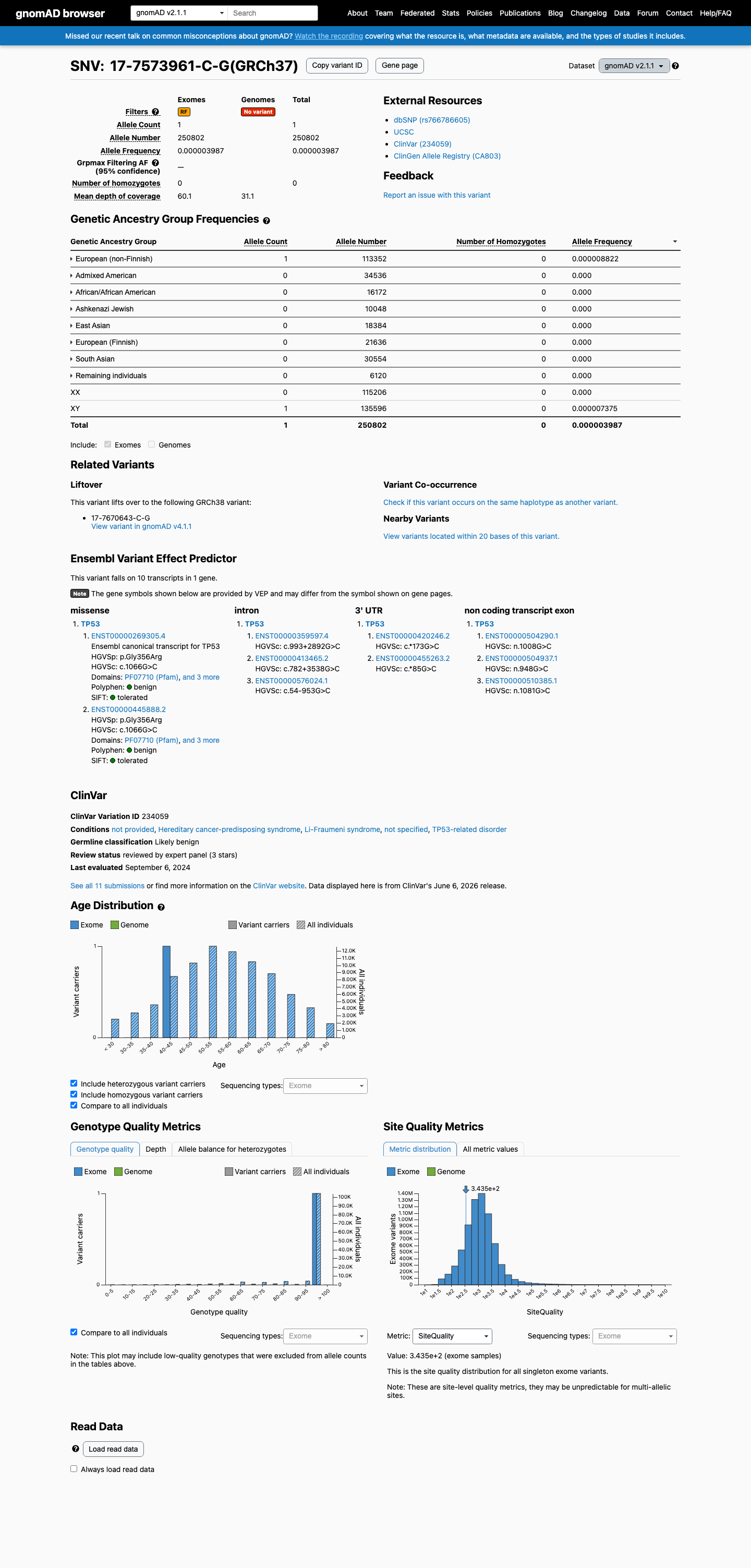
This variant is present in gnomAD v2.1 (AF= 3.98721e-06; MAF= 0.00040%, 1/250802 alleles, homozygotes = 0) and has highest observed frequency in the European (non-Finnish) population (AF= 8.82208e-06; MAF= 0.00088%, 1/113352 alleles, homozygotes = 0).
🇨🇦 CA
Absent from gnomAD-Canada v1.0.
Allele frequency by ancestry
three datasets · side by side
gnomAD v4.1
0.00043%
· 7 / 1,613,958
0 hom · FAF 0.00025%
European (non-Finnish)
7 / 1,179,982
0.00059%
+ 9 not observed (Remaining individuals, Admixed American, European (Finnish), Amish, East Asian, Middle Eastern, South Asian, Ashkenazi Jewish, African/African American)
gnomAD v2.1
0.0004%
· 1 / 250,802
0 hom
European (non-Finnish)
1 / 113,352
0.00088%
+ 7 not observed (African/African American, Admixed American, Ashkenazi Jewish, East Asian, European (Finnish), Remaining individuals, South Asian)
This variant has been reported in ClinVar as Uncertain significance (6 clinical laboratories) and as Likely benign (4 clinical laboratories) and as Uncertain Significance (1 clinical laboratory) and as Likely Benign by ClinGen TP53 Variant Curation Expert Panel, ClinGen (expert panel). (ClinVarID = 234059)
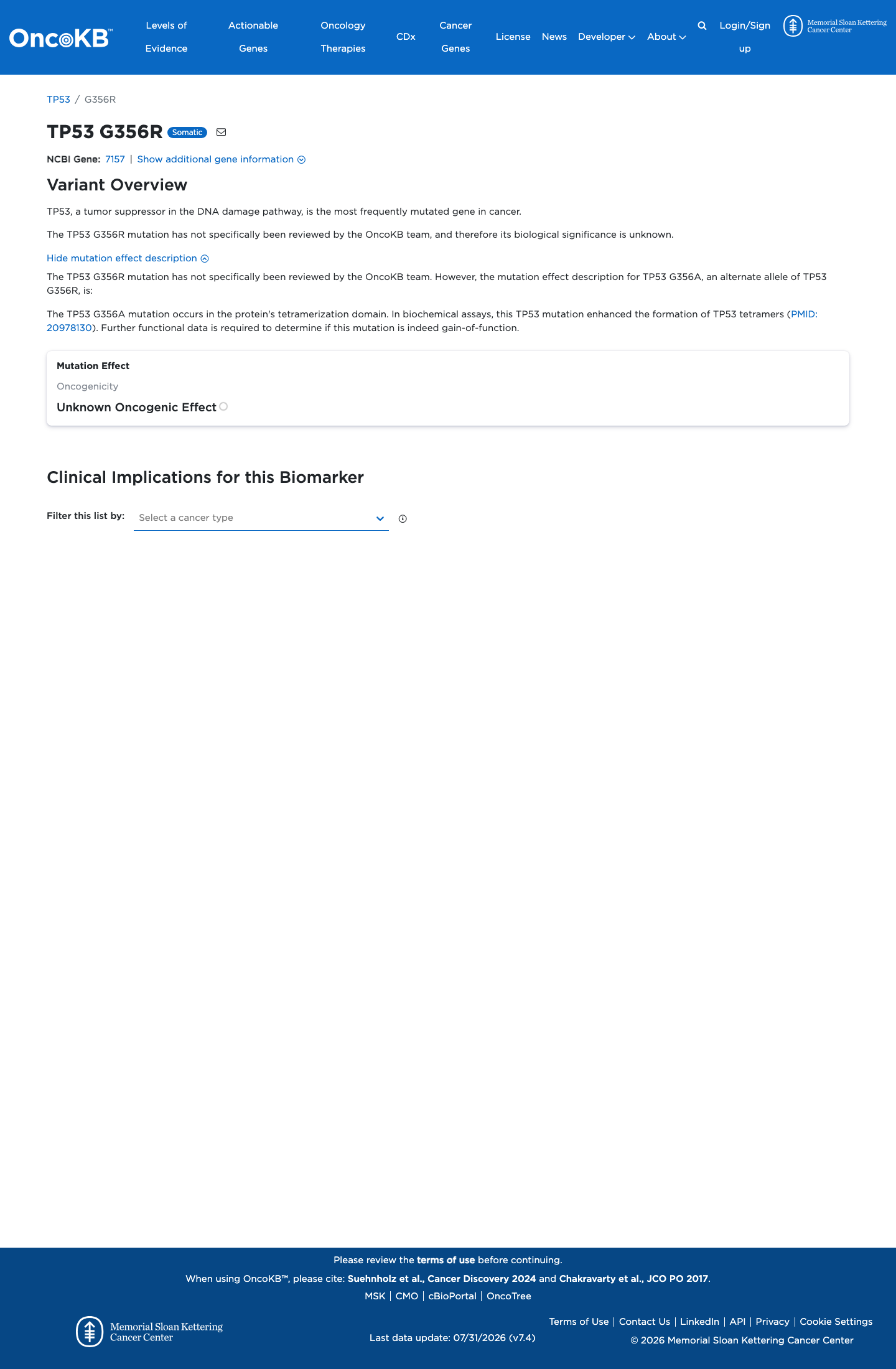
OncoKB did not identify variant-specific reviewed functional evidence for this variant; gene-level curated context is available for reviewer follow-up. TP53, a tumor suppressor in the DNA damage pathway, is the most frequently mutated gene in cancer.
12826609 ↗Understanding the function-structure and function-mutation relationships of p53 tumor suppressor protein by high-resolution missense mutation analysis.CLINVAR
17392385 ↗American Cancer Society guidelines for breast screening with MRI as an adjunct tCLINVAR
21343334 ↗Dominant-negative features of mutant TP53 in germline carriers have limited impact on cancer outcomes.CLINVAR
21519010 ↗TP53 mutations in low-risk myelodysplastic syndromes with del(5q) predict disease progression.CLINVAR
22186996 ↗TP53 alterations in acute myeloid leukemia with complex karyotype correlate with specific copy number alterations, monosomal karyotype, and dismal outcome.CLINVAR
24356096 ↗Molecular profiling of the residual disease of triple-negative breast cancers after neoadjuvant chemotherapy identifies actionable therapeutic targets.CLINVAR