Analysis in progress
Initialising…
0%
complete
This report is still being assembled — sections appear as each stage finishes. It isn't final yet.
HRAS
Final classification
Likely Pathogenic
PS4PM1PM6PP3PP5
HRAS
c.173C>T
p.Thr58Ile
missense · exon 3

HRAS is a membrane-associated GTPase that acts as a molecular switch in cell signaling, cycling between active and inactive states as it binds and hydrolyzes GTP. It belongs to the RAS family of proto-oncogenes and helps transmit growth and survival signals through pathways such as MAPK and PI3K. Germline mutations in HRAS cause Costello syndrome, a developmental disorder marked by distinctive facial features, growth and cognitive problems, and a predisposition to tumors. Somatic HRAS mutations also drive many cancers, including cancers of the thyroid, bladder, and salivary glands.

This variant

HRAS is a RAS-family signaling switch whose germline mutations cause Costello syndrome and whose somatic mutations drive cancers of the thyroid, bladder, and salivary glands. A Likely Pathogenic classification indicates this p.Thr58Ile change very likely causes the RASopathy phenotype in the tested individual, consistent with its location in the Switch II domain critical for HRAS signaling.

Transcript
NM_005343.4
HGVS · transcript:coding
NM_005343.4:c.173C>T
GRCh38
chr11:533883 G>A
GRCh37
chr11:533883 G>A
Basis Likely Pathogenic: PS4 and PM1 at Moderate plus PM6, PP3, and PP5 at Supporting satisfy the HRAS VCEP Rule 14 combination (two Moderate plus two Supporting); no benign criteria were met.
Likely Pathogenic: PS4 and PM1 at Moderate plus PM6, PP3, and PP5 at Supporting satisfy the HRAS VCEP Rule 14 combination (two Moderate plus two Supporting); no benign criteria were met.
Classification rationale
PS4PM1PM6PP3PP5 Likely Pathogenic
HRAS c.173C>T missense · exon 3

PS4 (Moderate): the exact variant was observed in at least 4 independent individuals with a RASopathy. PM1 (Moderate): Thr58 lies in the Switch II domain (amino acids 57-64), a VCEP-defined critical functional region. PM6 (Supporting): the variant was reported de novo or presumably de novo in multiple affected individuals. PP3 (Supporting): REVEL 0.777 meets the VCEP's >=0.7 threshold for a damaging missense prediction. PP5 (Supporting): the ClinGen RASopathy Variant Curation Expert Panel classified this exact variant as Pathogenic. Together these satisfy Rule 14 of the ClinGen RASopathy HRAS VCEP (two Moderate plus at least two Supporting), yielding a final classification of Likely Pathogenic.

PS4 + PM1 + PM6 + PP3 + PP5 Likely Pathogenic
Gene diagram · NM_005343.4 · variants mapped to exon structure
HRAS NM_005343.4
Fetching transcript structure from UCSC…
Applied criteria · 5 applied · 12 assessed
MetEvidence satisfies this criterion.
Not metEvaluated against available evidence; threshold not reached.
Not assessedApplies in principle, but no evidence was found to evaluate it.
N/ADoesn't apply to this variant type.
Applied · 5
Strength Supporting Moderate Strong Very strong
PS4 moderate Pathogenic
Met (Moderate): the exact variant was observed in at least 4 independent individuals with a RASopathy, meeting the 3-point threshold for PS4 Moderate.
The exact ClinVar variant record is NM_005343.4(HRAS):c.173C>T (p.Thr58Ile).The exact-variant ClinVar expert-panel evidence signal states that at least 4 independent occurrences were detected in patients with a RASopathy, including 1 de novo occurrence, and labels the evidence PS4 Moderate.The HRAS VCEP Version 2.3 framework defines PS4 Supporting at ≥1 point, Moderate at ≥3 points, and Strong at ≥5 points.
PM1 moderate Pathogenic
Met (Moderate): Thr58 falls in the Switch II domain (amino acids 57-64), a critical functional region where the VCEP applies PM1 at Moderate strength.
cspec (HRAS VCEP v2.3) PM1 rule: 'Applicable only to critical and well-established functional domains available in the supplementary table (P-loop [AA 10-17], SW1 [AA 25-40], SW2 [AA 57-64], SAK [AA 145-156]). Not applicable to specific amino acid residues (see PM5).'Variant residue is Thr58 (NP_005334.1:p.(Thr58Ile)), which lies within the VCEP-defined SW2 domain range (AA57-64).VCEP Alignment-with-PM1-domains.pptx supplement lists P-loop (HRAS 10-17) and Switch I (HRAS 25-40) domain boundaries in its alignment table, corroborating the domain-boundary structure used to place residue 58 within SW2 per the cspec rule text (SW2 AA57-64 is stated directly in the cspec criterion text, not separately re-tabulated in the excerpted PPTX pages reviewed).
PM6 supporting review Pathogenic
Met (Supporting): the variant arose de novo or presumably de novo in multiple affected individuals, though parental confirmation was not fully documented.
The HRAS VCEP specification defines PM6 as assumed de novo without confirmation of paternity and maternity and assigns 0.5 point at Supporting strength, 1 point at Moderate strength, and 2 points at Strong strength.PMID:18247425 reports the exact p.T58I change in a Costello syndrome patient and describes de novo HRAS mutations as the underlying disease mechanism, but does not provide explicit parental exclusion for that patient in the reviewed abstract.PMID:26888048 reports the exact variant with parental Sanger testing; the abstract confirms testing of the patient and both parents but does not explicitly state parental negativity or de novo status.
PP3 supporting Pathogenic
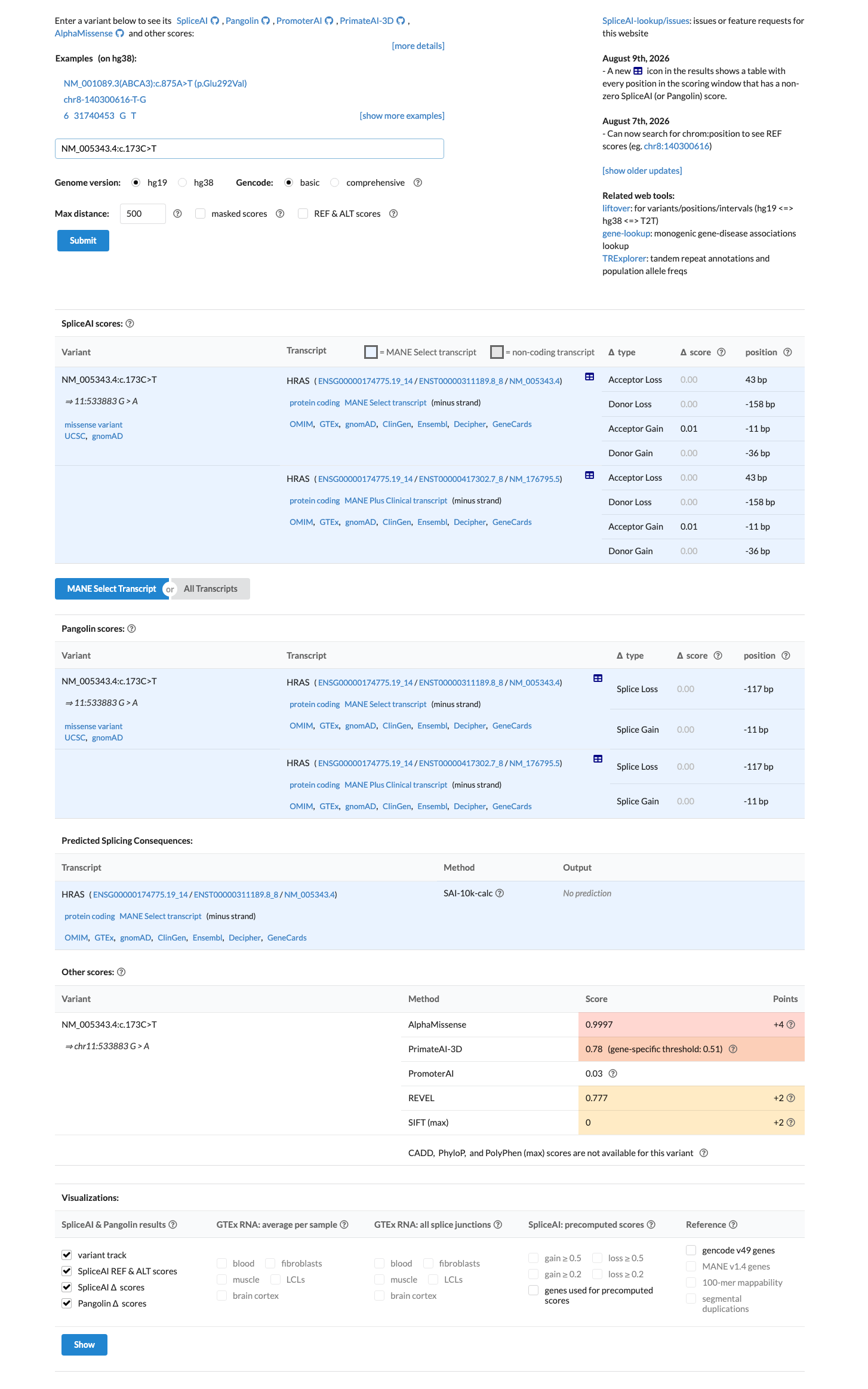
Met (Supporting): the REVEL score of 0.777 exceeds the VCEP's >=0.7 threshold for a damaging missense prediction.
ClinGen RASopathy VCEP HRAS specification v2.3 (cspec): PP3 Supporting applies when REVEL >= 0.7 for missense variants.Local REVEL v1.3 lookup (source_registry key 'revel') for HRAS chr11:533883 G>A returned REVEL score = 0.777, meeting the >=0.7 VCEP threshold.REVEL's pathogenicity threshold calibration is documented in PMID 36413997 (ClinGen SVI-endorsed REVEL threshold recommendations).
PP5 supporting Pathogenic
Met (Supporting): the ClinGen RASopathy Variant Curation Expert Panel classified this exact variant as Pathogenic.
ClinVar identifies the exact variant as NM_005343.4(HRAS):c.173C>T (p.Thr58Ile).ClinVar records an exact-match Pathogenic submission from the ClinGen RASopathy Variant Curation Expert Panel with review status reviewed by expert panel.The eight clinical-laboratory Pathogenic submissions and aggregate ClinVar classification were excluded from the PP5 decision.
Assessed · not applied · 6 not met · 6 not assessed
Pathogenic
PS2 Not assessed: parental testing did not confirm both parents were negative, so confirmed de novo status could not be established.
PS3 Not assessed: no VCEP-approved functional assay (e.g., RAS or MEK activation) was performed on this HRAS variant; functional data exist only for the analogous change in KRAS.
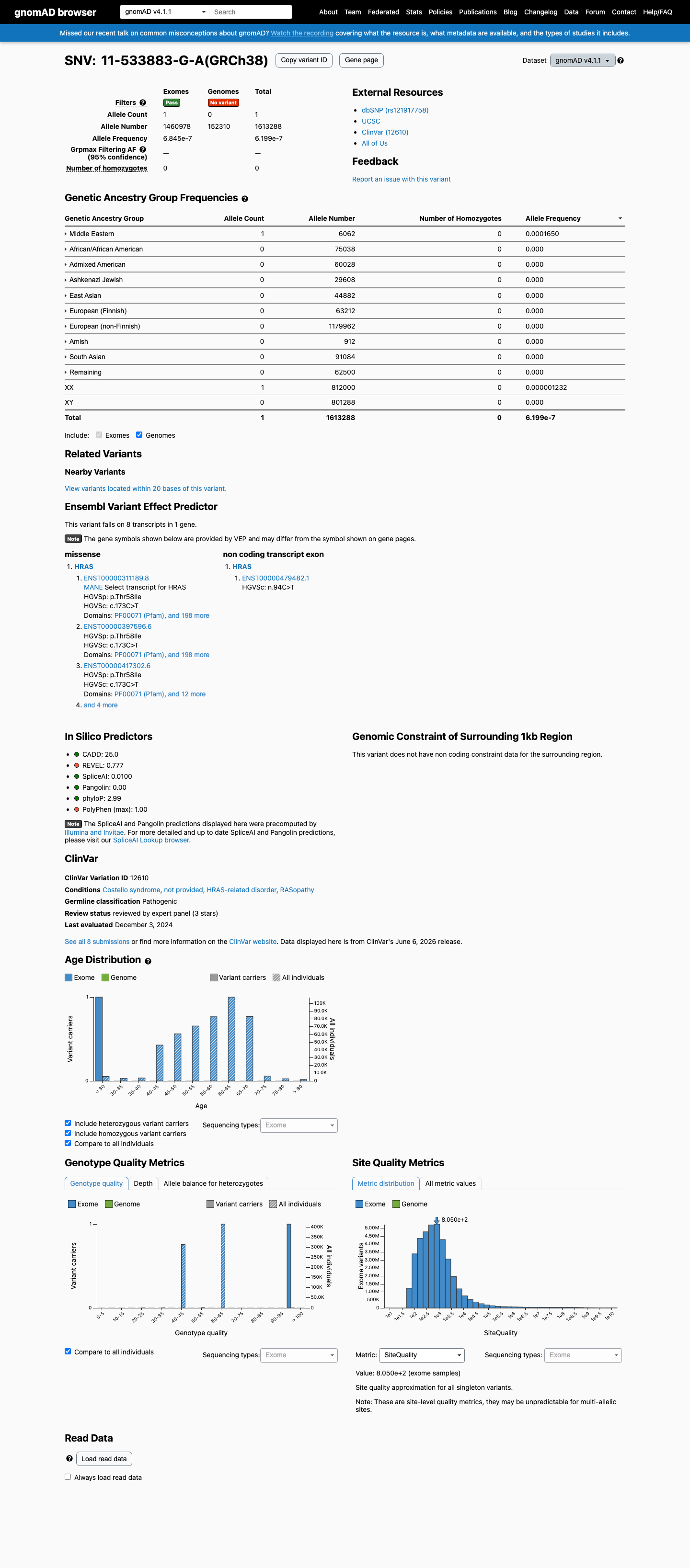
PM2 Not met: the variant is present in gnomAD v4.1 at 1/1,613,288 alleles, so it does not meet the VCEP's requirement of absence from population databases.
PM5 Not assessed: insufficient evidence was available; no other pathogenic amino acid change at codon 58 (e.g., Thr58Ala or Thr58Ser) was identified.
PP1 Not met: father-to-son transmission provides one informative meiosis, below the three required for PP1 Supporting.
Benign
BA1 Not met: at 0.00006% allele frequency (1/1,613,288 alleles), the variant is far below the 0.05% BA1 threshold.
BS1 Not met: the highest subpopulation frequency is 0.01650% (Middle Eastern), below the 0.025% BS1 threshold.
BS2 Not assessed: no evidence showed the variant in a clinically unaffected adult; zero homozygotes in gnomAD does not establish benign carrier status.
BS4 Not met: the variant segregates with disease (affected father to affected son), with no affected non-carrier reported to contradict segregation.
BP2 Not assessed: no second pathogenic HRAS variant or documented cis/trans phase was available, so an alternative same-gene cause could not be evaluated.
BP4 Not met: the REVEL score of 0.777 is well above the <=0.3 BP4 threshold for a benign prediction.
BP5 Not assessed: no competing diagnosis or alternative molecular cause was established in individuals carrying this variant.
N/A · 11 PVS1 · PS1 · PM3 · PM4 · PP2 · PP4 · BS3 · BP1 · BP3 · BP6 · BP7
Research & evidence
Population frequency · supports pathogenic
gnomAD v4.1 screenshot
gnomAD v4.1
gnomAD v2.1 screenshot
gnomAD v2.1
v4.1
This variant is present in gnomAD v4.1 (AF= 6.19852e-07; MAF= 0.00006%, 1/1613288 alleles, homozygotes = 0) and has highest observed frequency in the Middle Eastern population (AF= 0.000164962; MAF= 0.01650%, 1/6062 alleles, homozygotes = 0).
v2.1
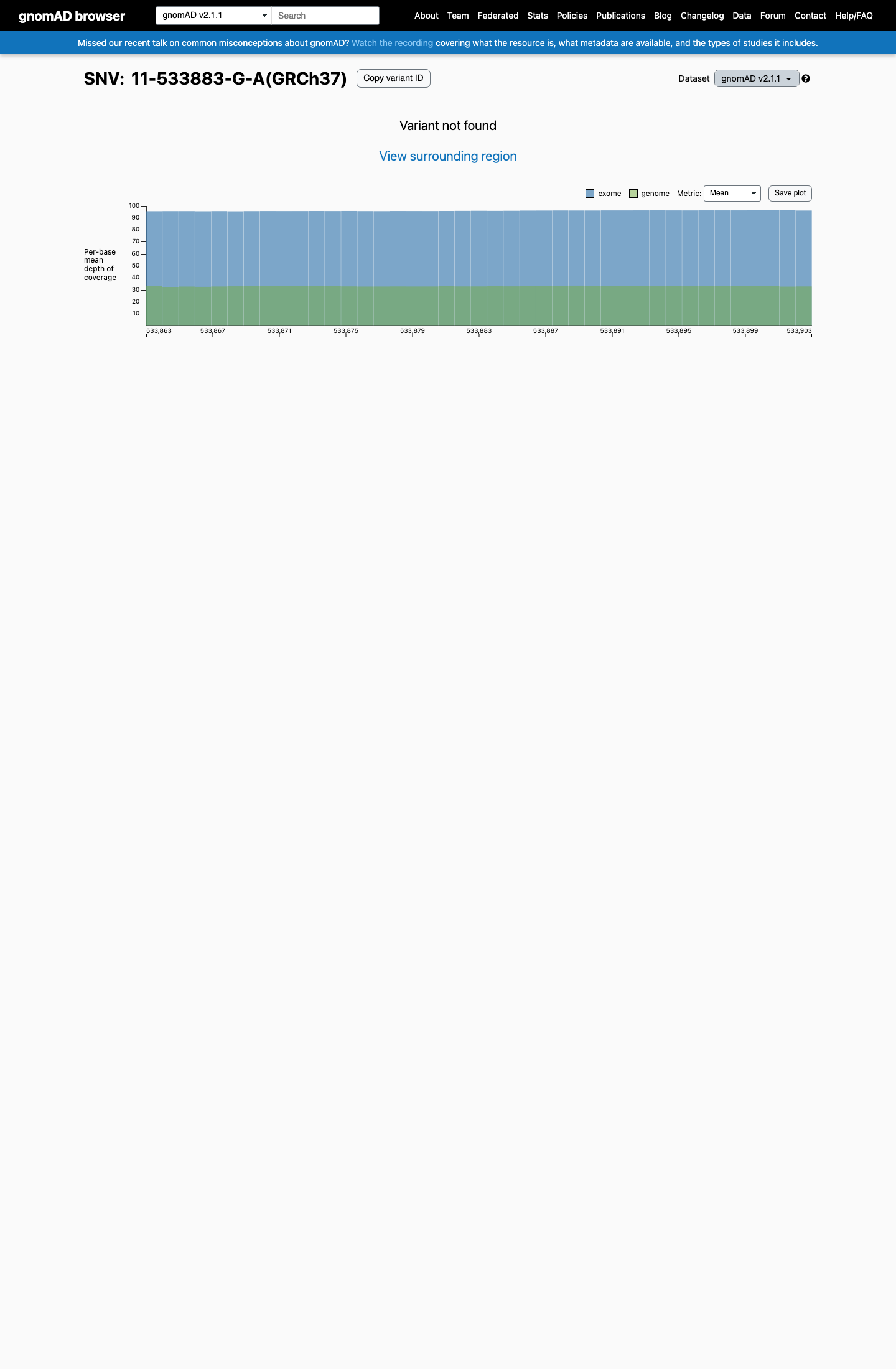
Absent from gnomAD v2.1.
🇨🇦 CA
Absent from gnomAD-Canada v1.0.
Allele frequency by ancestry
three datasets · side by side
gnomAD v4.1
6.2e-05% · 1 / 1,613,288
0 hom
Middle Eastern
1 / 6,062
0.016%
+ 9 not observed (Remaining individuals, Admixed American, European (Finnish), Amish, East Asian, South Asian, Ashkenazi Jewish, African/African American, European (non-Finnish))
gnomAD v2.1
Absent · 0 / ?
0 hom
Not observed in any ancestry group.
gnomAD Canada 🇨🇦
Absent · 0 / ?
0 hom
Not observed in any ancestry group.
ClinVar screenshot
ClinVar
This variant has been reported in ClinVar as Pathogenic (8 clinical laboratories) and as Pathogenic by ClinGen RASopathy Variant Curation Expert Panel (expert panel). (ClinVarID = 12610)
SpliceAI screenshot
In silico
SpliceAI predicts no significant splice impact for this variant (max delta score = 0.00). REVEL score = 0.777. BayesDel score = 0.433392.
Functional / OncoKB screenshot
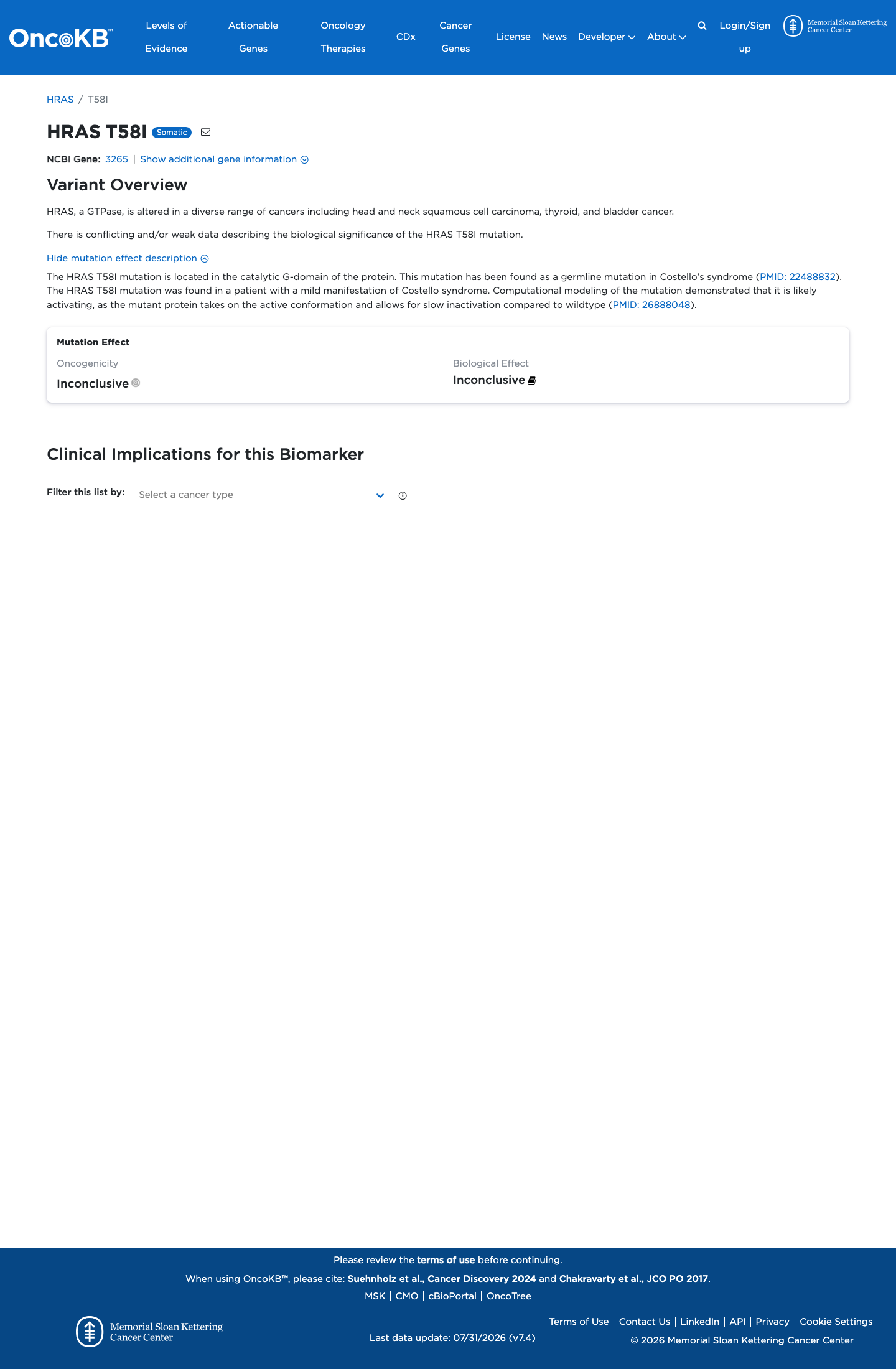
Functional Inconclusive
OncoKB identified variant-specific curated literature and context relevant to functional review; biological-effect context: Inconclusive; curated oncogenicity label: Inconclusive.
OncoKB ↗
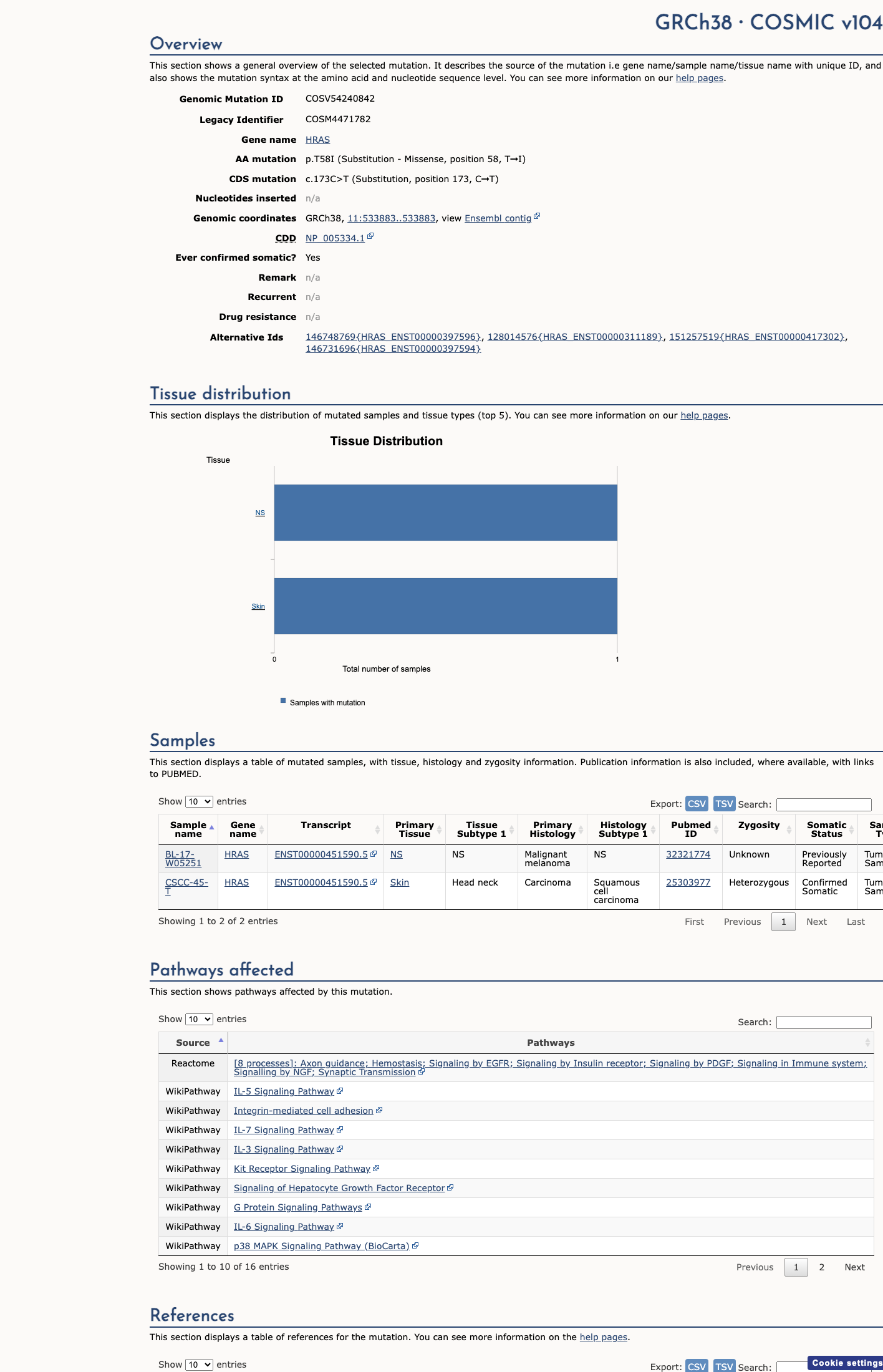
COSMIC screenshot
COSMIC
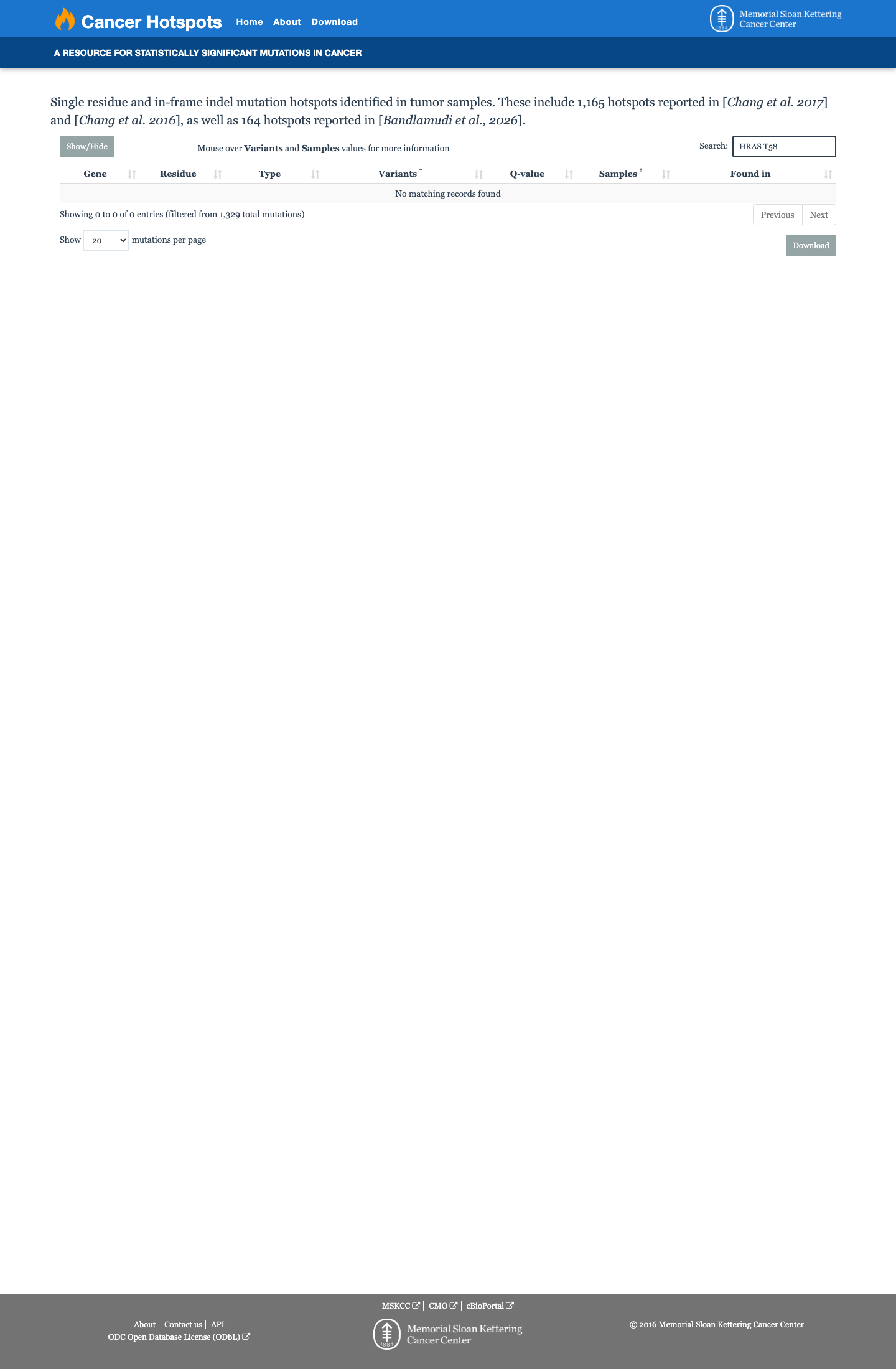
Cancer hotspots screenshot
Cancer hotspots
Somatic evidence Not in COSMIC / hotspots
COSMIC
This variant does not lie in a statistically significant hotspot. This variant has previously been reported in somatic cancers (COSMIC; COSV54240842, n = 2 times).
Hotspots
This variant does not lie in a statistically significant hotspot.
Literature · how each cited paper was used
2papers cited
Each card is an audit: what was searched, what was found, whether it names the variant, which criteria it fed, and why. 4 further PMIDs triaged but not cited — see Sources & references.
Costello syndrome associated with novel germline HRAS mutations: an attenuated phenotype?
Searched
c.173C>Tp.T58Ide novoparent
Found
The abstract reports an exact HRAS p.T58I case among two patients with novel HRAS mutations and describes de novo HRAS mutations as the underlying cause of Costello syndrome, but it does not provide explicit negative parental testing for the p.T58I patient.
Variant
✓ Names this variant
Applied to
PM6 supporting
The exact p.T58I case is discussed in a report describing de novo HRAS disease mechanism, but the abstract does not document confirmed parental exclusion for that case.
Its underlying cause is de novo germline mutations in the oncogene HRAS. We report on two patients with novel HRAS mutations affecting amino acids 58 (T58I) and 146 (A146V), respectively.
Location PubMed abstract  ·  Context Clinical case report of two individuals with Costello syndrome and novel germline HRAS mutations, with review of a broader HRAS-positive cohort.
The rare Costello variant HRAS c.173C>T (p.T58I) with severe neonatal hypertrophic cardiomyopathy.
Searched
c.173C>Tp.T58Iparentsde novo
Found
The abstract reports a 10-year-old girl with the exact HRAS c.173C>T (p.T58I) variant, verified by Sanger sequencing in the patient and her parents. It establishes parental testing but does not explicitly state that the parents were negative or that the variant was de novo.
Variant
✓ Names this variant
Applied to
PM6 supporting
The exact variant and parental testing are directly relevant to presumed de novo assessment, but the abstract does not state parental negativity.
Targeted oligonucleotide-selective sequencing of 101 cardiomyopathy genes revealed the genetic diagnosis, and the mutation was verified by Sanger sequencing in the patient and her parents.
Location PubMed abstract  ·  Context Clinical report of a 10-year-old girl with severe neonatal hypertrophic cardiomyopathy, targeted sequencing of 101 cardiomyopathy genes, parental Sanger confirmation, and protein structural analysis.
Sources & reference links
9Sources
CSpec VCEP
ClinVar
gnomAD v2.1
gnomAD v4.1
gnomAD-Canada
SpliceAI
OncoKB
COSMIC
Cancer hotspots
Triaged references · 4 PMIDs not cited in assessment
22488832 ↗ Transmission of the rare HRAS mutation (c. 173C > T; p.T58I) further illustrates its attenuated phenotype. ONCOKB
16474405 ↗ Germline KRAS mutations cause Noonan syndrome. CLINVAR
16921267 ↗ Germline mutations in components of the Ras signaling pathway in Noonan syndrome and related disorders. CLINVAR
20112233 ↗ Prenatal detection of Noonan syndrome by mutation analysis of the PTPN11 and the KRAS genes. CLINVAR