BRCA1 encodes a large nuclear protein that helps maintain genomic stability by coordinating the repair of DNA double-strand breaks through homologous recombination, and it also regulates transcription and the cell cycle. It acts as a tumor suppressor, working with proteins such as RAD51, BRCA2, BARD1, and PALB2 to preserve genome integrity. Inherited alterations in BRCA1 cause hereditary breast and ovarian cancer syndrome, with elevated risks of breast, ovarian, prostate, and pancreatic cancers, and biallelic loss underlies a rare form of Fanconi anemia. Because BRCA1-driven tumors rely on impaired DNA repair, they are treatable with PARP inhibitors.
This variant
BRCA1 alterations cause hereditary breast and ovarian cancer syndrome, so variant classification directly informs clinical management. This c.3260G>C (p.Gly1087Ala) change is classified Likely Benign: it lies outside the gene's functional domains, shows no predicted splicing impact, and carries benign-direction clinical evidence, indicating it is unlikely to impair BRCA1's tumor-suppressor function.
Transcript
NM_007294.4
HGVS · transcript:coding
NM_007294.4:c.3260G>C
GRCh38
chr17:43092271 C>G
GRCh37
chr17:41244288 C>G
BasisPer ENIGMA BRCA1/2 VCEP v1.2 Table 3, only BP1_Strong and BP5_Supporting are met, both benign-direction; with no pathogenic-direction criterion met, the combination yields Likely Benign.▾
Per ENIGMA BRCA1/2 VCEP v1.2 Table 3, only BP1_Strong and BP5_Supporting are met, both benign-direction; with no pathogenic-direction criterion met, the combination yields Likely Benign.
Classification rationale
BP1BP5Likely Benign
BRCA1 c.3260G>Cmissense · exon 10
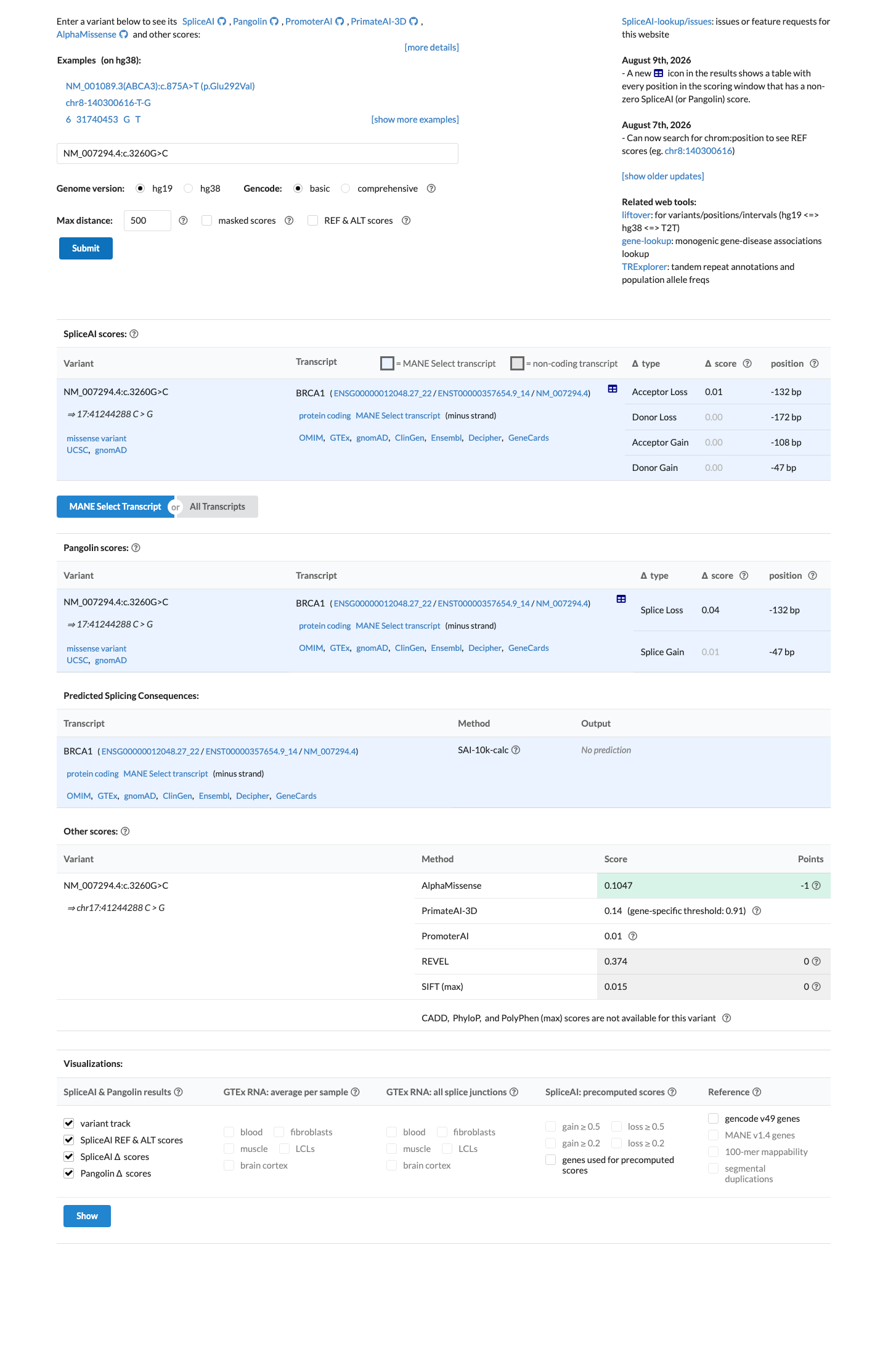
BP1 (Strong): missense at residue 1087, outside all clinically important functional domains, with no predicted splicing impact (SpliceAI max delta 0.015). BP5 (Supporting): clinical-history likelihood ratio of 0.31 from four probands, below the 0.48 supporting threshold. Overall: with only benign-direction criteria applied (BP1_Strong + BP5_Supporting) and no pathogenic-direction evidence, ENIGMA v1.2 Table 3 yields Likely Benign.
BP1 + BP5→Likely Benign
Gene diagram
· NM_007294.4 · variants mapped to exon structure
BRCA1NM_007294.4
Fetching transcript structure from UCSC…
Exons
—
Transcript span
—
Strand
—
Variants mapped
—
Source
UCSC ncbiRefSeqCurated
All variants in BRCA1—click a row to locate it on the plot · use the link column to open its page
Variant ↕
Protein
Location
Classification
Link
Applied criteria · 2 applied · 13 assessed
MetEvidence satisfies this criterion.
Not metEvaluated against available evidence; threshold not reached.
Not assessedApplies in principle, but no evidence was found to evaluate it.
N/ADoesn't apply to this variant type.
Applied · 2
Strength Supporting Moderate Strong Very strong
✓
BP1strongBenign
Met (Strong): missense at residue 1087, outside all functional domains, with no predicted splicing impact (SpliceAI max delta 0.015, below the 0.1 threshold).
ENIGMA BRCA1/2 v1.2 BP1 rule (case_summary.json cspec block): "Apply BP1_Strong for silent substitution, missense or in-frame insertion, deletion or delins variants outside a (potentially) clinically important functional domain AND no splicing predicted (SpliceAI ≤0.1). ... clinically important functional domains are defined as: BRCA1 RING aa 2-101; BRCA1 coiled-coil aa 1391-1424; BRCA1 BRCT repeats aa 1650-1857."Variant residue is Gly1087 (NP_009225.1:p.(Gly1087Ala)), which lies outside all three ENIGMA-defined clinically important functional domains for BRCA1 (RING 2-101, coiled-coil 1391-1424, BRCT 1650-1857).SpliceAI Lookup evidence_sentence: "SpliceAI predicts no significant splice impact for this variant (max delta score = 0.01)" (source_data max_delta_score = 0.015), well under the 0.1 BP1 splicing threshold.
Met (Supporting): clinical-history likelihood ratio of 0.31 from four probands is below the 0.48 supporting threshold.
The ENIGMA clinical-history LR table has an exact BRCA1 c.3260G>C row with N_Probands=4, LOG(LR)=-1.170896887779236, and LR=0.3100887017422507.The ENIGMA BRCA1/2 specification permits BP5 only for combined multifactorial clinical likelihood evidence; Supporting strength requires LR<=0.48.
Assessed · not applied
· 5 not met · 8 not assessed
Pathogenic
PS1Not assessed: no previously classified pathogenic variant at codon 1087 exists to compare, and no splicing impact is predicted (SpliceAI max delta 0.015).
PS3Not assessed: no calibrated functional assay result (e.g., saturation genome editing, HDR) is on record for p.Gly1087Ala.
PS4Not assessed: no case-control study for this exact variant reports an odds ratio with statistical significance.
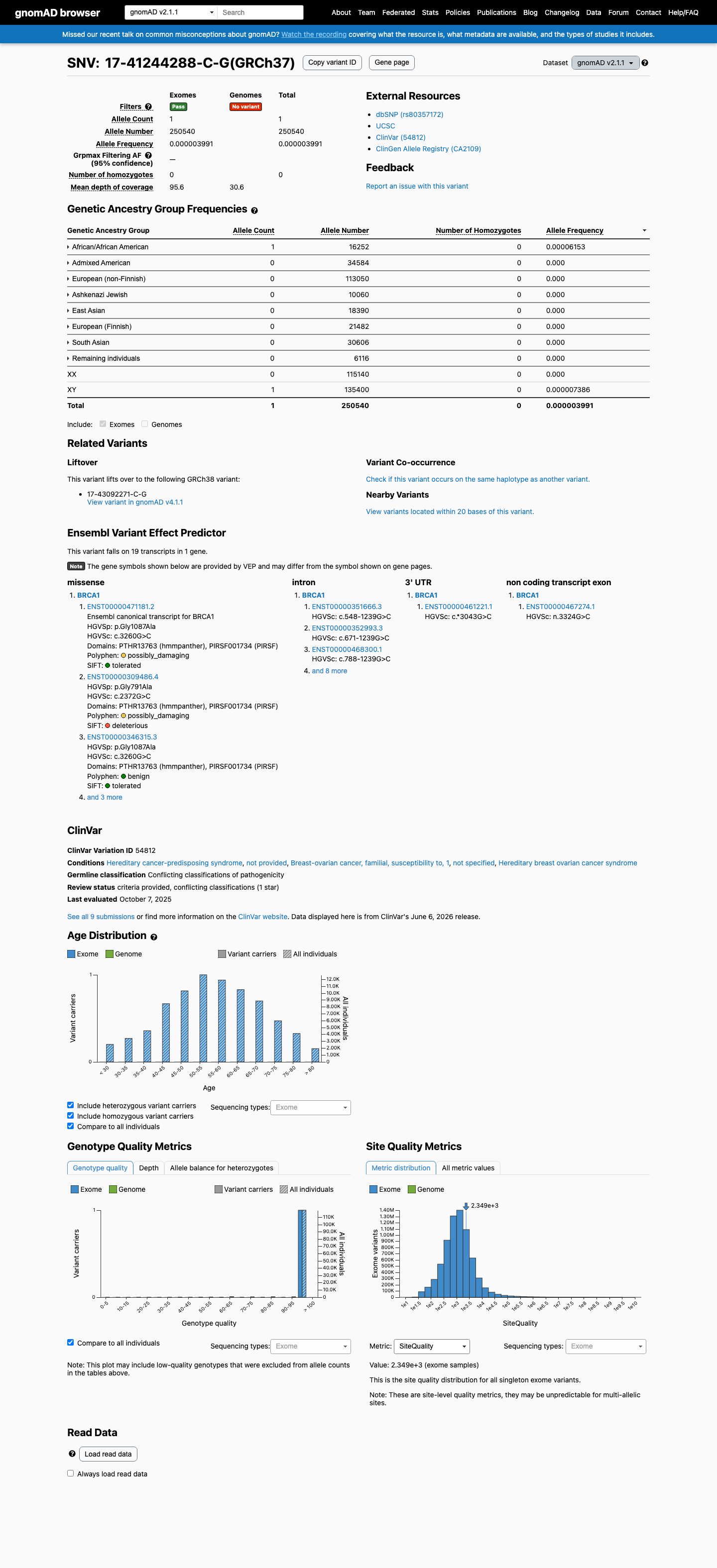
PM2Not met: the variant is observed once in gnomAD v2.1 (1/250,540 alleles), so it is not absent from population databases as PM2 requires.
PM3Not assessed: no affected proband with a Fanconi anemia phenotype and a second BRCA1 variant was available for assessment.
PP1Not assessed: no co-segregation likelihood ratio is available from the ENIGMA multifactorial data.
PP3Not met: SpliceAI max delta 0.015 is far below the 0.2 splicing-impact threshold, and residue 1087 lies outside all functional domains.
PP4Not met: the clinical-history likelihood ratio of 0.31 is below the PP4 supporting threshold of 2.08.
Benign
BA1Not met: the gnomAD v2.1 allele frequency of 1/250,540 (AF 4.0e-06) is far below the BA1 threshold of 0.001.
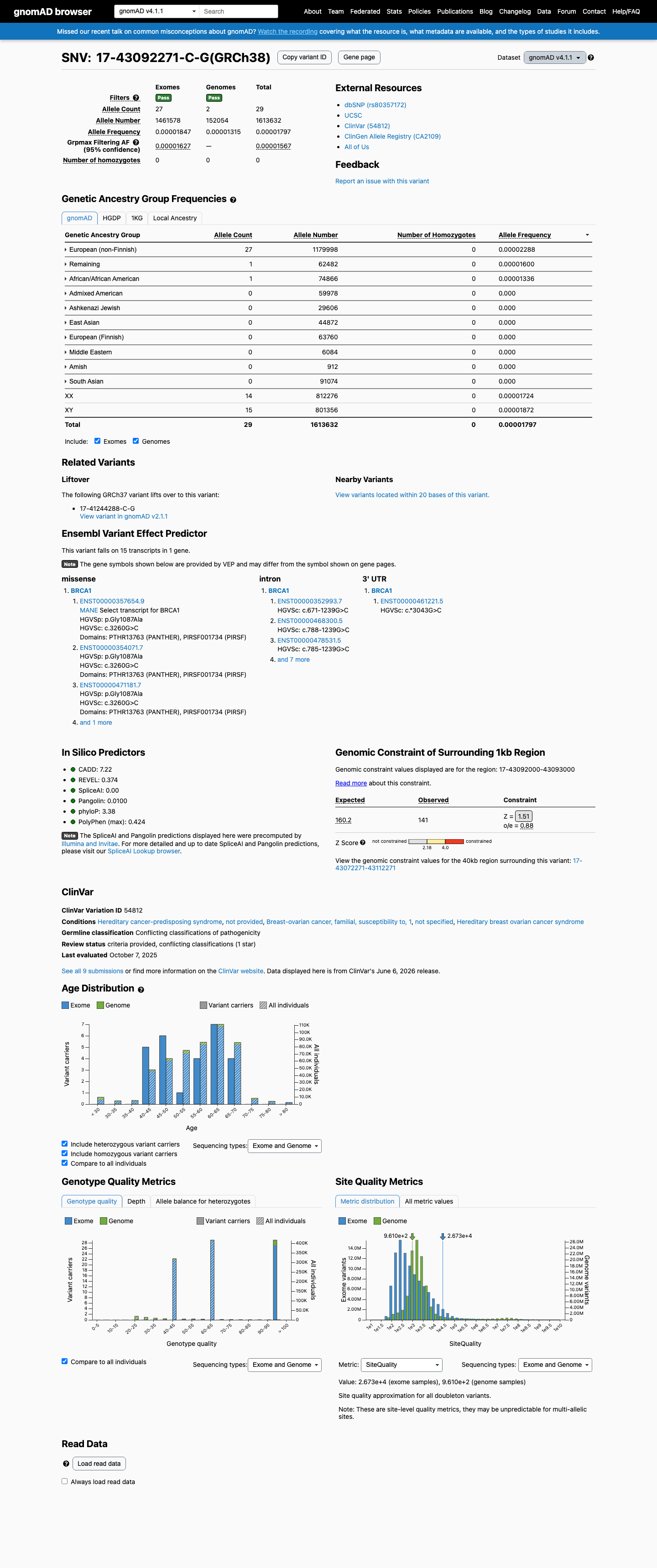
BS1Not met: no filtering allele frequency exceeds the BS1 thresholds; the gnomAD v4.1 grpmax FAF of 1.6e-05 is below the supporting lower bound of 2e-05.
BS2Not assessed: no phenotyped individuals carrying a co-occurring pathogenic BRCA1 variant were available, as BS2 requires.
BS3Not assessed: no published functional assay result for this variant exists to demonstrate normal protein function.
BS4Not assessed: no non-segregation likelihood ratio is available from the ENIGMA multifactorial data.
This variant is present in gnomAD v4.1 (AF= 1.79719e-05; MAF= 0.00180%, 29/1613632 alleles, homozygotes = 0) and has highest observed frequency in the European (non-Finnish) population (AF= 2.28814e-05; MAF= 0.00229%, 27/1179998 alleles, homozygotes = 0); grpmax FAF= 1.567e-05.
v2.1
This variant is present in gnomAD v2.1 (AF= 3.99138e-06; MAF= 0.00040%, 1/250540 alleles, homozygotes = 0) and has highest observed frequency in the African/African American population (AF= 6.15309e-05; MAF= 0.00615%, 1/16252 alleles, homozygotes = 0).
🇨🇦 CA
Not available in gnomAD-Canada v1.0.
Allele frequency by ancestry
three datasets · side by side
gnomAD v4.1
0.0018%
· 29 / 1,613,632
0 hom · FAF 0.0016%
European (non-Finnish)
27 / 1,179,998
0.0023%
Remaining individuals
1 / 62,482
0.0016%
African/African American
1 / 74,866
0.0013%
+ 7 not observed (Admixed American, European (Finnish), Amish, East Asian, Middle Eastern, South Asian, Ashkenazi Jewish)
gnomAD v2.1
0.0004%
· 1 / 250,540
0 hom
African/African American
1 / 16,252
0.0062%
+ 7 not observed (Admixed American, Ashkenazi Jewish, East Asian, European (Finnish), European (non-Finnish), Remaining individuals, South Asian)
This variant has been reported in ClinVar as Uncertain significance (6 clinical laboratories) and as Uncertain Significance (1 clinical laboratory) and as Likely benign (1 clinical laboratory). (ClinVarID = 54812)
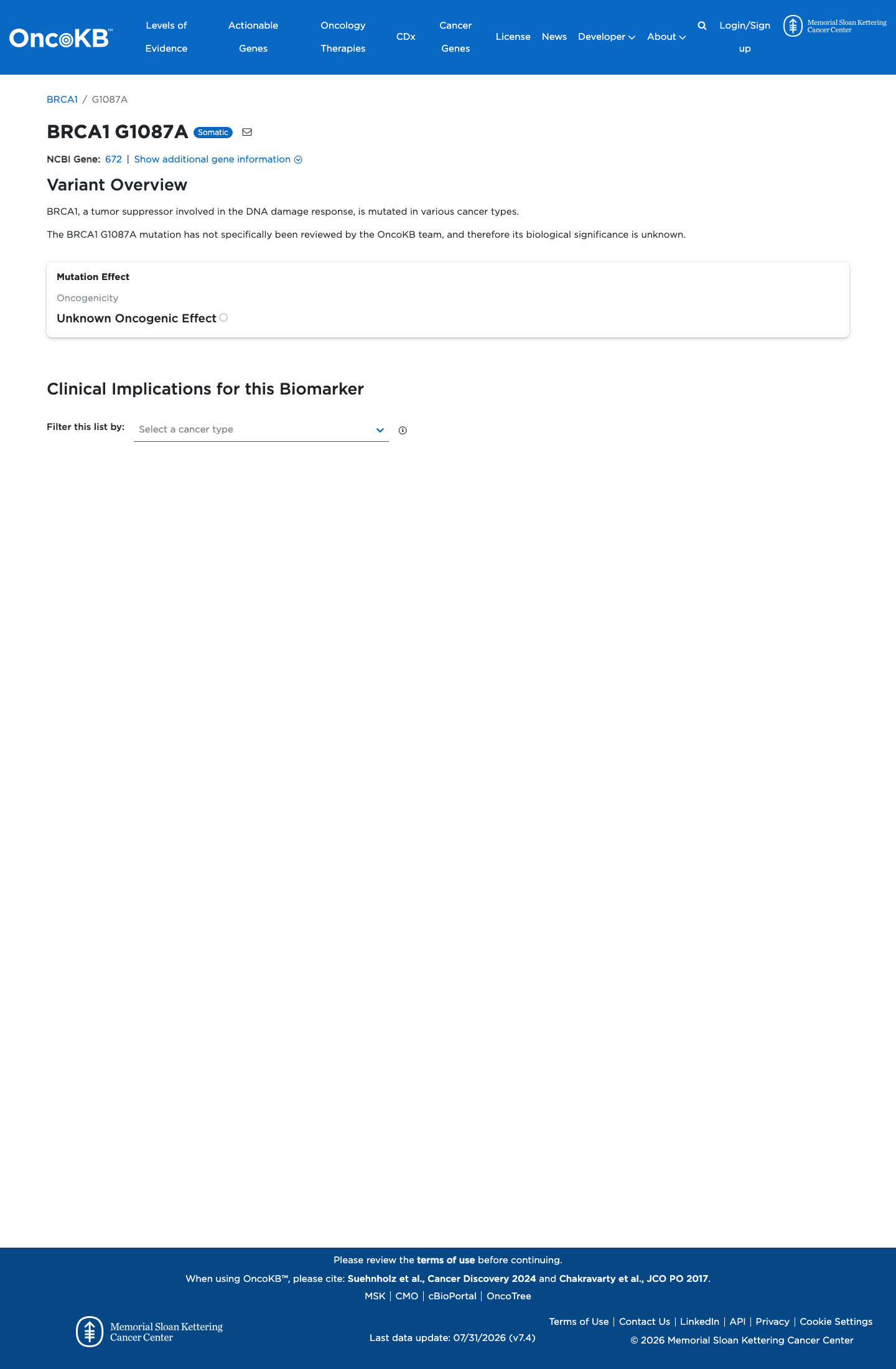
OncoKB did not identify variant-specific reviewed functional evidence for this variant; gene-level curated context is available for reviewer follow-up. BRCA1, a tumor suppressor involved in the DNA damage response, is mutated in various cancer types.
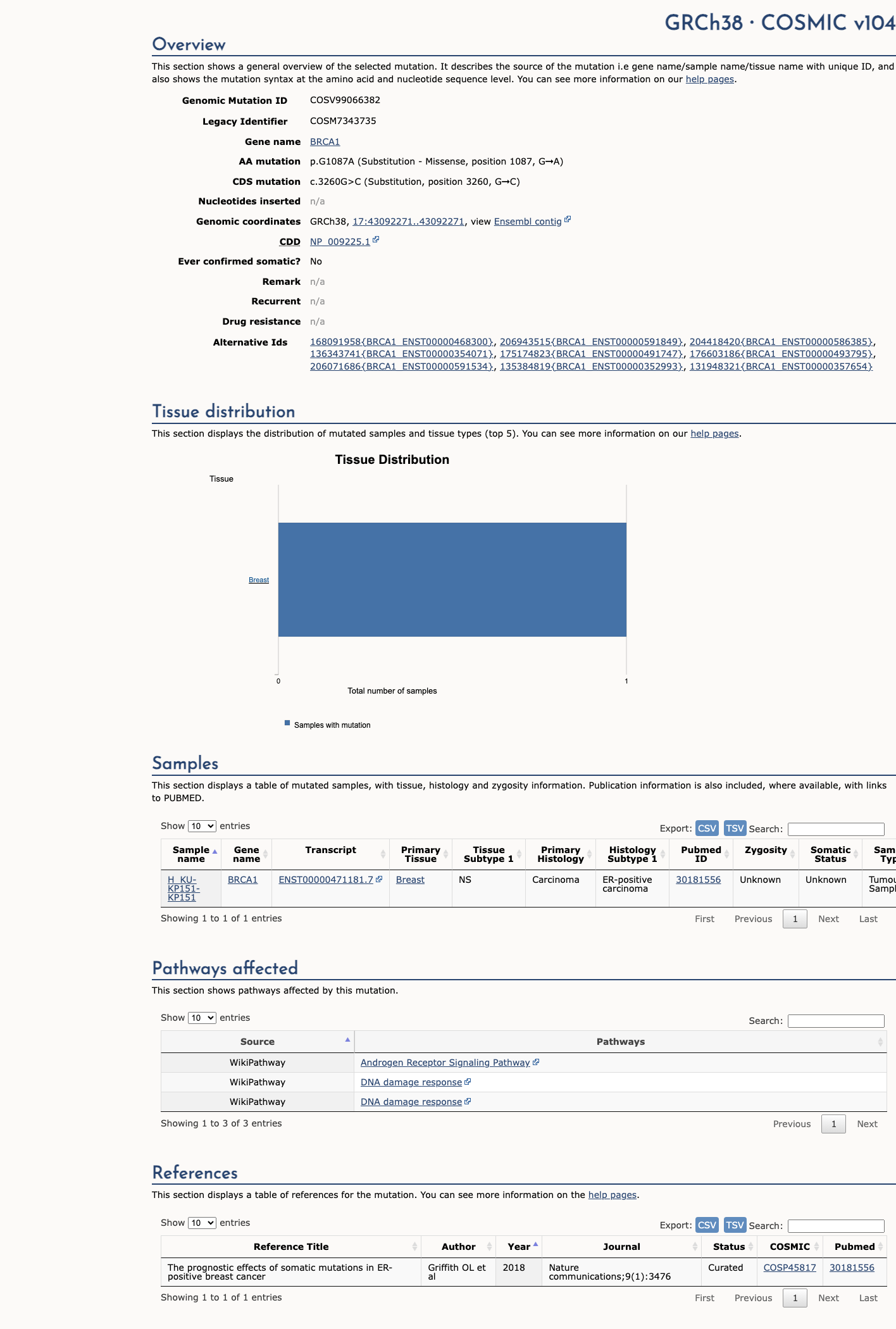
This variant does not lie in a statistically significant hotspot. This variant has previously been reported in somatic cancers (COSMIC; COSV99066382, n = 1 times).
Hotspots
This variant does not lie in a statistically significant hotspot.
Each card is an audit: what was searched, what was found, whether it names the variant, which criteria it fed, and why. 7 further PMIDs triaged but not cited — see Sources & references.
Rule & framework references · cited for criterion definitions, not variant evidence
31911673 ↗Systematic misclassification of missense variants in BRCA1 and BRCA2 "coldspots".
Sources & reference links
9Sources
CSpec VCEP
ClinVar
gnomAD v2.1
gnomAD v4.1
gnomAD-Canada
SpliceAI
OncoKB
COSMIC
Cancer hotspots
Triaged references · 7 PMIDs not cited in assessment
15385441 ↗Evolution of the tumor suppressor BRCA1 locus in primates: implications for cancer predisposition.CLINVAR
25741868 ↗Standards and guidelines for the interpretation of sequence variants: a joint consensus recommendation of the American College of Medical Genetics and Genomics and the Association for Molecular Pathology.CLINVAR
26467025 ↗A Standardized DNA Variant Scoring System for Pathogenicity Assessments in Mendelian Disorders.CLINVAR
15604628 ↗Genetic cancer risk assessment and counseling: recommendations of the national society of genetic counselors.CLINVAR
24493721 ↗American Society of Clinical Oncology Expert Statement: collection and use of a cancer family history for oncology providers.CLINVAR
28492532 ↗Sherloc: a comprehensive refinement of the ACMG-AMP variant classification criteria.CLINVAR
33410258 ↗Risk assessment and genetic counseling for hereditary breast and ovarian cancer syndromes-Practice resource of the National Society of Genetic Counselors.CLINVAR