FGFR1 encodes a receptor tyrosine kinase in the fibroblast growth factor receptor family; when bound by fibroblast growth factors, it activates signaling cascades such as the PI3K/AKT and MAPK pathways that drive cell growth, differentiation, and embryonic development. Germline changes in FGFR1 are associated with congenital conditions including Pfeiffer syndrome, Jackson-Weiss syndrome, Antley-Bixler syndrome, osteoglophonic dysplasia, and Kallmann syndrome 2, and chromosomal rearrangements involving the gene are linked to certain blood disorders. FGFR1 also functions as an oncogene: activating alterations occur in cancers of the lung, breast, prostate, head and neck, and esophagus, and FGF signaling can contribute to treatment resistance, making the receptor a target for small-molecule inhibitor drugs.
This variant
FGFR1-related developmental disorders such as Hartsfield syndrome arise from loss of FGFR1 function, and this truncating variant is predicted to eliminate the tyrosine kinase domain. The Likely Pathogenic classification is therefore consistent with a germline loss-of-function mechanism, in contrast to the activating FGFR1 alterations that act as oncogenic drivers in certain cancers.
Transcript
NM_001174067.1
HGVS · transcript:coding
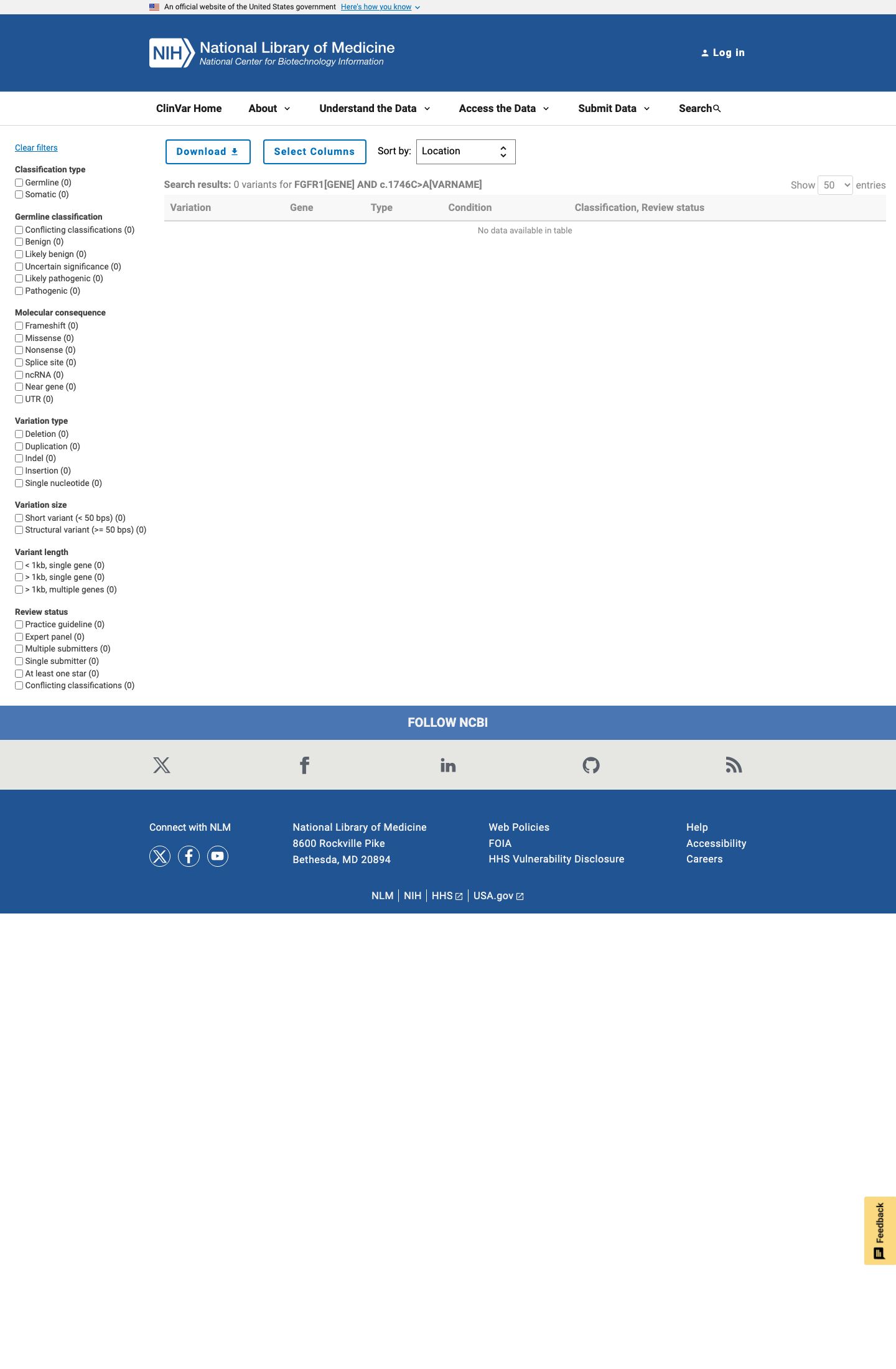
NM_001174067.1:c.1746C>A
GRCh38
chr8:38417316 G>T
GRCh37
chr8:38274834 G>T
BasisLikely Pathogenic: PVS1 (Very Strong) for the truncating nonsense variant, supported by PM2 (variant absent from population databases) and BP4 (no predicted splice impact).▾
Likely Pathogenic: PVS1 (Very Strong) for the truncating nonsense variant, supported by PM2 (variant absent from population databases) and BP4 (no predicted splice impact).
Classification rationale
PVS1PM2BP4Likely Pathogenic
FGFR1 c.1746C>Anonsense · exon 13
PVS1 (Very Strong): nonsense change p.(Cys582Ter) predicted to trigger nonsense-mediated decay, eliminating the tyrosine kinase domain. PM2 (Supporting): variant absent from gnomAD v2.1, v4.1, and gnomAD-Canada v1.0. BP4 (Supporting): no predicted splice impact (SpliceAI max delta 0.00), below the calibrated damaging-splicing threshold. Synthesis: PVS1 (Very Strong) combined with PM2 and BP4 (Supporting) yields Likely Pathogenic under the generic ACMG/AMP framework.
PVS1 + PM2 + BP4→Likely Pathogenic
Gene diagram
· NM_001174067.1 · variants mapped to exon structure
FGFR1NM_001174067.1
Fetching transcript structure from UCSC…
Exons
—
Transcript span
—
Strand
—
Variants mapped
—
Source
UCSC ncbiRefSeqCurated
All variants in FGFR1—click a row to locate it on the plot · use the link column to open its page
Variant ↕
Protein
Location
Classification
Link
Applied criteria · 3 applied · 17 assessed
MetEvidence satisfies this criterion.
Not metEvaluated against available evidence; threshold not reached.
Not assessedApplies in principle, but no evidence was found to evaluate it.
N/ADoesn't apply to this variant type.
Applied · 3
Strength Supporting Moderate Strong Very strong
✓
PVS1very strongPathogenic
Met (Very Strong): nonsense change p.(Cys582Ter) is predicted to trigger nonsense-mediated decay, eliminating the tyrosine kinase domain.
pvs1_gene_context.json: targeted germline literature review found FGFR1 loss-of-function is a supported disease mechanism (FGFR1-Related Hartsfield Syndrome), gating generic PVS1 framework eligibility (pvs1_gene_gate: eligible).pvs1_variant_assessment.json: classifies the variant as a nonsense/consequence_class 'nonsense' change, applies the generic PVS1 framework (framework_cite: pvs1_generic_framework, PMC6185798), with suggested_default_strength PVS1 pending confirmation of transcript relevance, NMD status, and exon importance.Mutalyzer/VariantValidator prefetch normalization data: protein consequence NP_001167538.1:p.(Cys582Ter); reference protein length 854 aa (position_last_original: 854); PTC at residue 582 (position_last_predicted: 582); VariantValidator variant_exonic_positions place the variant in exon 13 (both GRCh37 NC_000008.10 and GRCh38 NC_000008.11), well upstream of the terminal exon 18, supporting NMD prediction per the >50bp/not-last-exon rule.
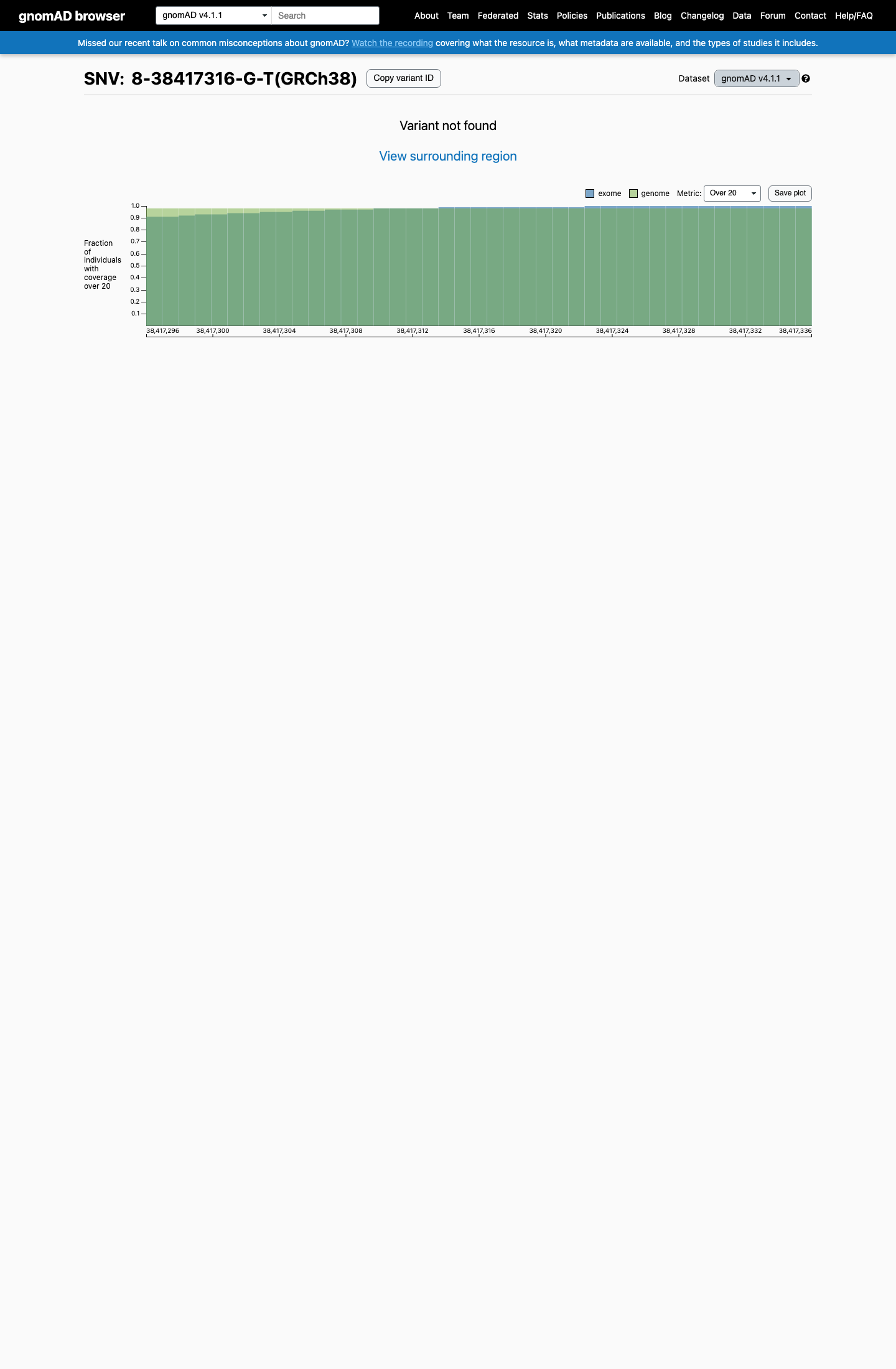
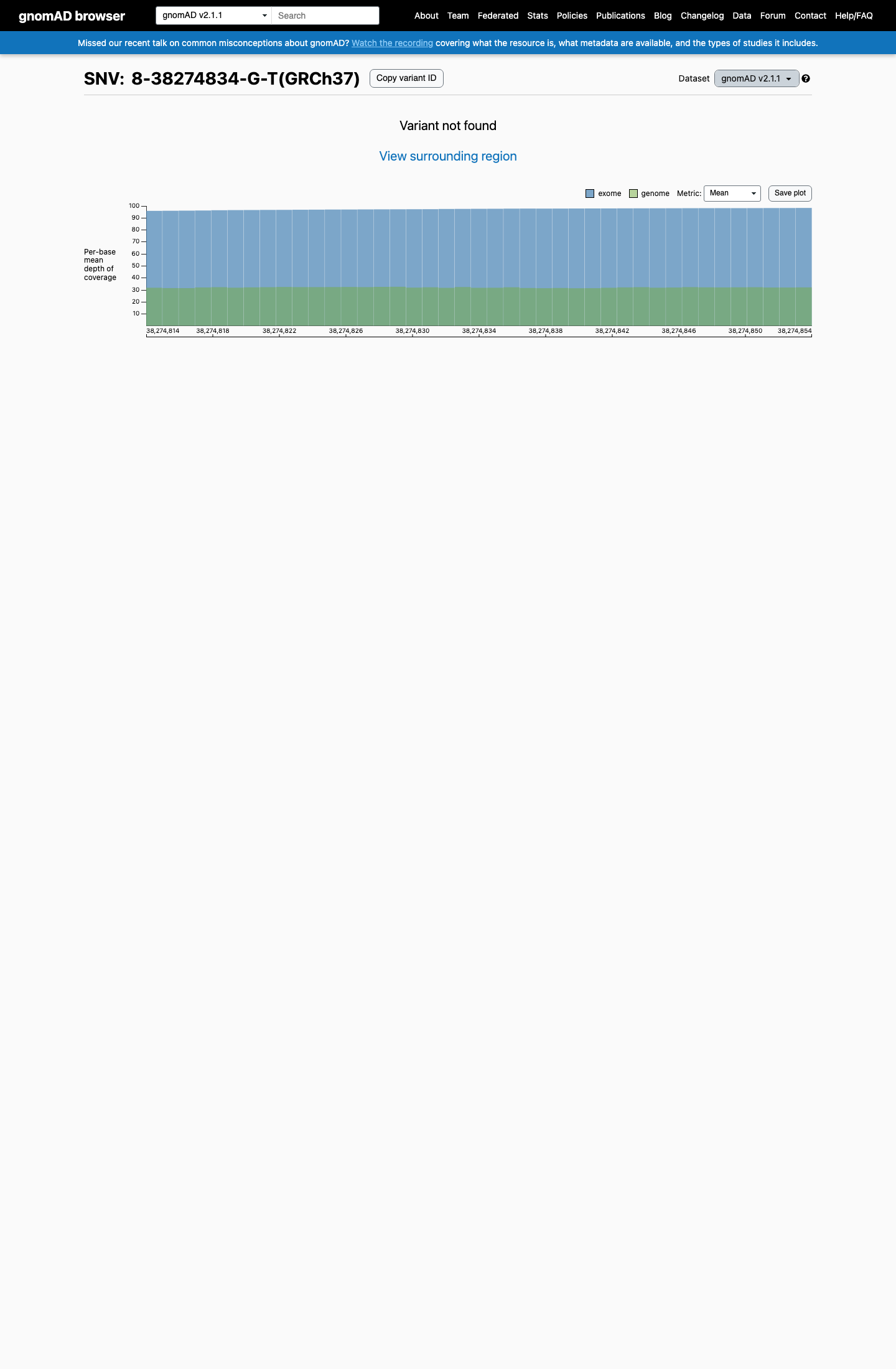
Met (Supporting): the variant is absent from gnomAD v2.1, v4.1, and gnomAD-Canada v1.0 population databases.
The normalized GRCh37 allele 8-38274834-G-T is absent from gnomAD v2.1.The normalized GRCh38 allele chr8-38417316-G-T is absent from gnomAD v4.1 and gnomAD-Canada v1.0.No FGFR1 VCEP/ClinGen gene-specific population-frequency specification was retrieved; generic ACMG/AMP population evidence is therefore used.
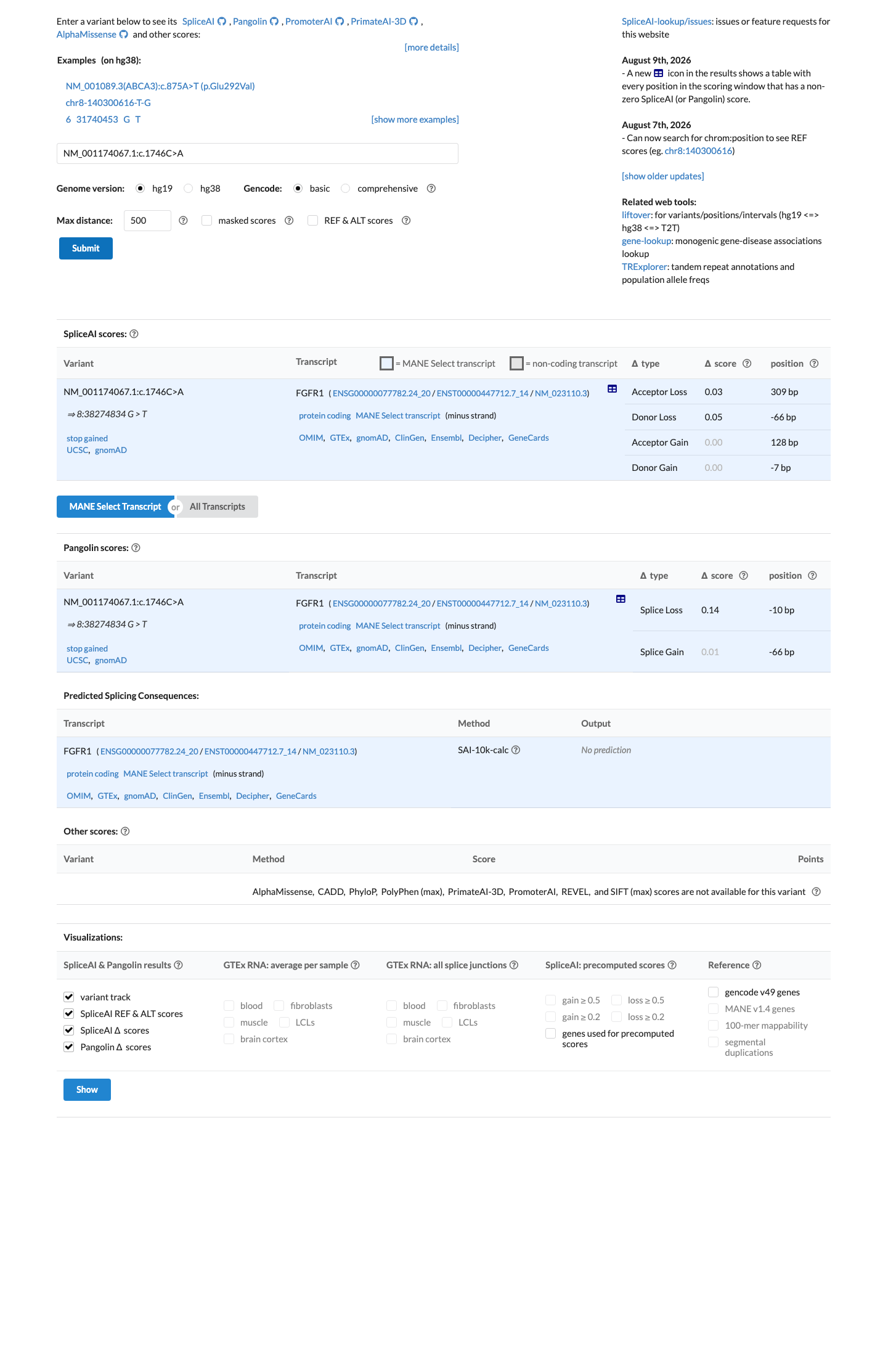
Met (Supporting): no predicted splice impact (SpliceAI max delta 0.00), below the calibrated damaging-splicing threshold.
SpliceAI/Pangolin lookup (spliceai source) shows max delta score = 0.00 (pangolin_SG = 0.005, pangolin_SL = -0.141) for NM_001174067.1:c.1746C>A, indicating no predicted splice-altering effect.SpliceAI's calibrated delta-score framework (Jaganathan et al. 2019, PMID 30661751) supports treating scores at or near 0.00 as evidence against a splice-altering effect.This is a nonsense (stop-gain) variant (NP_001167538.1:p.(Cys582Ter)) located mid-exon (exon boundaries c.1701-1846 per selector data), not at a canonical splice site, consistent with the null SpliceAI prediction.