Analysis in progress
Initialising…
0%
complete
This report is still being assembled — sections appear as each stage finishes. It isn't final yet.
CTNNA1
Final classification
VUS
PM2PP1BP4
CTNNA1
c.347G>A
p.Cys116Tyr
missense · exon 4

CTNNA1 encodes a member of the catenin protein family that plays a central role in cell adhesion by linking cadherins on the cell surface to the actin cytoskeleton; its mechanosensing activity lets cells respond to physical tension and reorganize these connections. Mutations in this gene cause butterfly-shaped pigment dystrophy of the eye. CTNNA1 also acts as a tumor suppressor: its inactivation promotes cellular invasiveness and metastasis, and reduced expression has been observed in several cancers, including bladder cancer, acute myeloid leukemia, and breast cancer.

This variant

CTNNA1 is a tumor suppressor whose inactivation promotes invasiveness, and its mutations also cause patterned macular dystrophy of the eye. This rare missense variant (0.01349% population frequency) remains a VUS: it co-occurs in affected relatives of one family, but evidence is not yet sufficient to determine whether it disrupts CTNNA1's cell-adhesion or tumor-suppressor functions.

Transcript
NM_001903.5
HGVS · transcript:coding
NM_001903.5:c.347G>A
GRCh38
chr5:138810083 G>A
GRCh37
chr5:138145772 G>A
Basis VUS: one pathogenic-supporting (PM2, PP1) and one benign-supporting (BP4) criterion do not meet any Likely Pathogenic, Likely Benign, or Benign threshold under generic ACMG/AMP 2015 rules.
VUS: one pathogenic-supporting (PM2, PP1) and one benign-supporting (BP4) criterion do not meet any Likely Pathogenic, Likely Benign, or Benign threshold under generic ACMG/AMP 2015 rules.
Classification rationale
PM2PP1 BP4 VUS
CTNNA1 c.347G>A missense · exon 4

PM2 (Supporting): highest population allele frequency is 0.01349%, below the 0.1% rare-variant threshold. PP1 (Supporting): the exact variant is reported in three affected members of one family (PMID:33435129), consistent with segregation. BP4 (Supporting): SpliceAI predicts no splice impact (max delta 0.00, below the 0.2 threshold). Overall classification: VUS - the one pathogenic-supporting and one benign-supporting combination meets no Likely Pathogenic or Likely Benign threshold under generic ACMG/AMP 2015 rules.

PM2 + PP1 + BP4 VUS
Gene diagram · NM_001903.5 · variants mapped to exon structure
CTNNA1 NM_001903.5
Fetching transcript structure from UCSC…
Applied criteria · 3 applied · 21 assessed
MetEvidence satisfies this criterion.
Not metEvaluated against available evidence; threshold not reached.
Not assessedApplies in principle, but no evidence was found to evaluate it.
N/ADoesn't apply to this variant type.
Applied · 3
Strength Supporting Moderate Strong Very strong
PM2 supporting Pathogenic
Met (supporting): highest population allele frequency is 0.01349%, below the 0.1% rare-variant threshold.
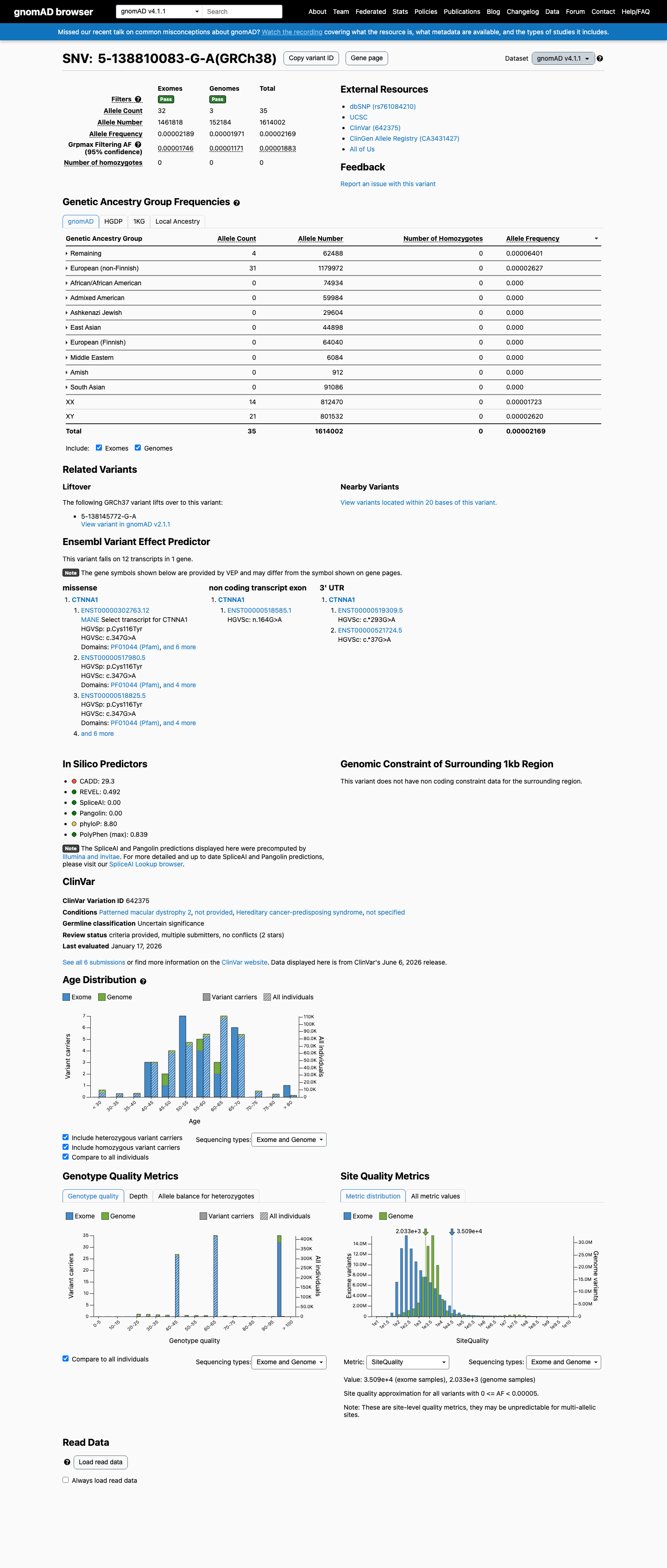
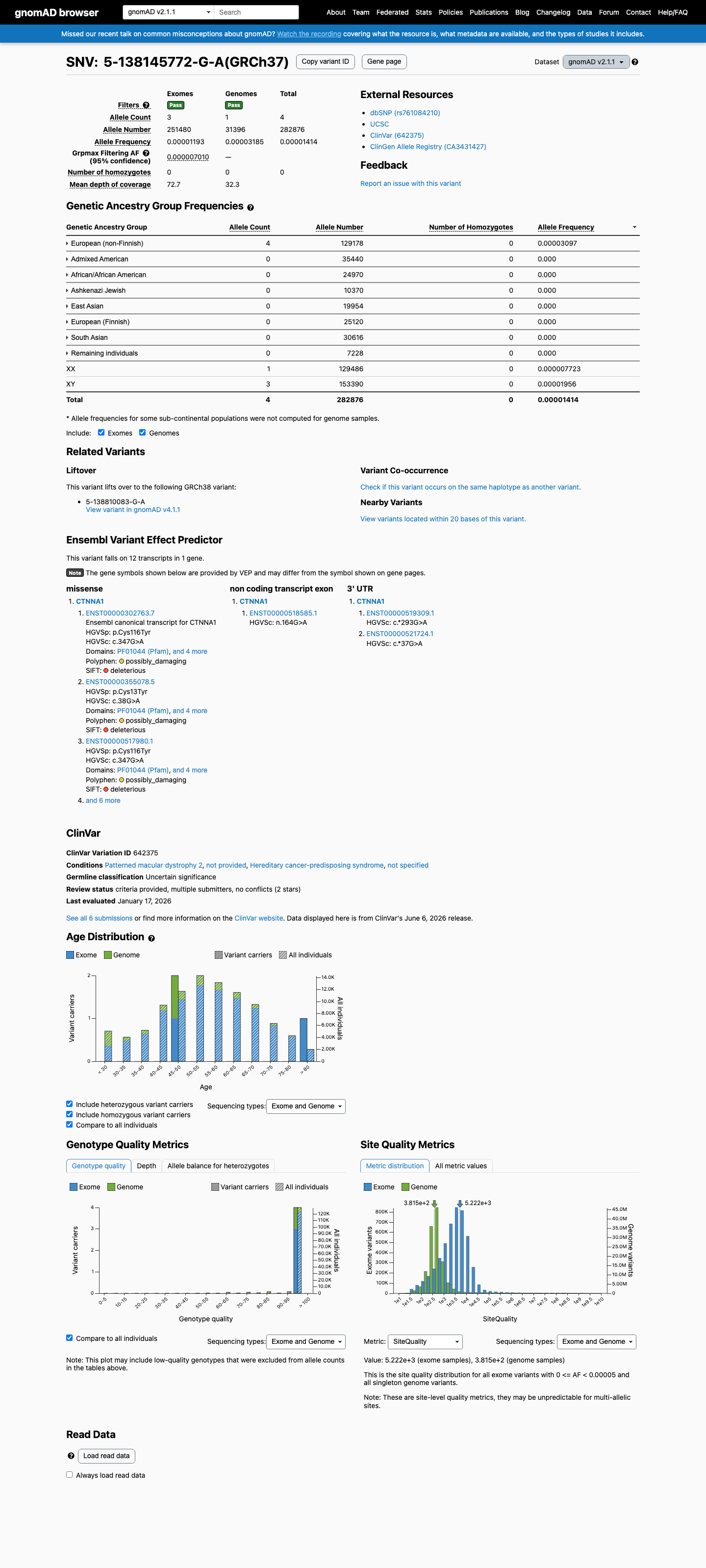
No CTNNA1 VCEP/CSPEC or local gene-specific population-frequency framework is available; generic ACMG/AMP population assessment was used.gnomAD v4.1 reports AF 0.00217% overall (35/1,614,002 alleles), a maximum subgroup AF of 0.01349% (4/29,654 remaining-XY alleles), and zero homozygotes.gnomAD v2.1 reports AF 0.00141% overall (4/282,876 alleles), a maximum population AF of 0.00310% in non-Finnish European individuals, and zero homozygotes.
PP1 supporting review Pathogenic
Met (supporting): the exact variant is reported in three affected members of one family (PMID:33435129).
PMID:33435129 Table 1 lists the exact variant: CTNNA1 c.347G>A (p.C116Y).PMID:33435129 Results states: “Finally, a missense variant in CTNNA1 (Catenin α 1) was observed across multiple cases in Family 15, characterized by comitant esotropia (I.2, II.1, and III.1).”The observation supports only supporting-level PP1 because the report does not provide the pedigree-level information needed to count and independently verify informative meioses or calculate a segregation likelihood ratio.
BP4 supporting Benign
Met (supporting): SpliceAI predicts no splice impact (max delta 0.00, below the 0.2 threshold).
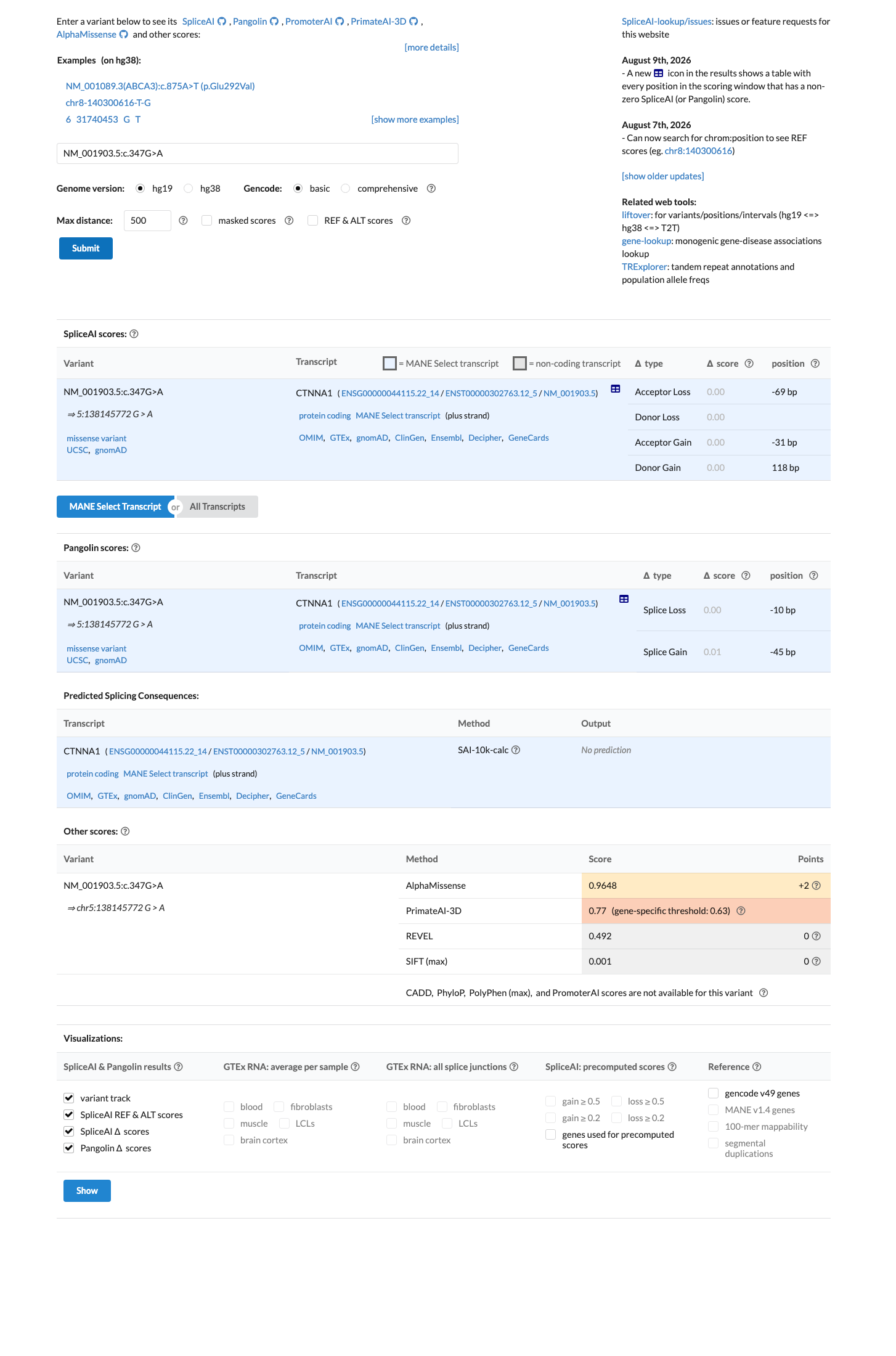
SpliceAI max delta score = 0.00 (DS_AG=0.00, DS_AL=0.00, DS_DG=0.00, DS_DL=0.00), well below the 0.2 default threshold from the original SpliceAI publication (Jaganathan et al. 2019, Cell, PMID 30661751), supports BP4 at supporting strength for absence of predicted splicing impact.REVEL score = 0.492 falls between the ClinGen SVI-calibrated BP4 supporting cutoff (<=0.290) and PP3 supporting cutoff (>=0.644) (Pejaver et al. 2022, PMID 36413997) -- indeterminate, not used to independently support BP4 to avoid double-counting against the splice-based call.BayesDel score = 0.132168 present but no verified published calibration threshold/PMID available to this pipeline, so treated as not_available for BP4 per pipeline policy.
Assessed · not applied · 3 not met · 18 not assessed
Pathogenic
PS1 Not assessed: no established pathogenic variant producing the identical p.Cys116Tyr change was available.
PS2 Not assessed: no parental genotypes were provided to confirm a de novo occurrence.
PS3 Not assessed: no validated functional assay data for this variant were available.
PS4 Not assessed: no case-control enrichment or prevalence analysis for this variant was identified.
PM1 Not assessed: no gene-specific CTNNA1 domain map was available to place residue 116 in a critical functional domain.
PM3 Not assessed: no affected proband is documented with this variant in trans with a pathogenic CTNNA1 variant.
PM5 Not assessed: no established pathogenic missense at codon 116 with a different amino acid substitution was available.
PM6 Not assessed: no parental testing was reported to support an assumed de novo occurrence.
PP2 Not assessed: no missense-constraint or gene-mechanism data were available for CTNNA1.
PP3 Not met: SpliceAI max delta 0.00 is far below the 0.2 splice-impact threshold.
PP4 Not assessed: familial comitant esotropia is not sufficiently specific for a CTNNA1-associated disorder.
PP5 Not assessed: no ClinVar expert-panel pathogenic assertion exists for this exact variant.
Benign
BA1 Not met: highest population allele frequency 0.01349% is far below the 1% BA1 threshold.
BS1 Not met: highest population allele frequency 0.01349% is below the 0.3% BS1 threshold.
BS2 Not assessed: no homozygous carriers or well-phenotyped unaffected adult carriers were documented.
BS3 Not assessed: no functional assay data demonstrating normal activity for this variant were available.
BS4 Not assessed: no affected non-carriers or unaffected carriers were documented to demonstrate non-segregation.
BP1 Not assessed: no evidence establishes that loss-of-function is the primary CTNNA1 disease mechanism.
BP2 Not assessed: the variant is not documented in cis or trans with a pathogenic CTNNA1 variant.
BP5 Not assessed: no independent molecular diagnosis explains the tested phenotype.
BP6 Not assessed: no ClinVar expert-panel benign assertion exists for this exact variant.
N/A · 4 PVS1 · PM4 · BP3 · BP7
Research & evidence
Population frequency
gnomAD v4.1 screenshot
gnomAD v4.1
gnomAD v2.1 screenshot
gnomAD v2.1
v4.1
This variant is present in gnomAD v4.1 (AF= 2.16852e-05; MAF= 0.00217%, 35/1614002 alleles, homozygotes = 0) and has highest observed frequency in the Remaining individuals population (AF= 6.40123e-05; MAF= 0.00640%, 4/62488 alleles, homozygotes = 0); grpmax FAF= 1.883e-05.
v2.1
This variant is present in gnomAD v2.1 (AF= 1.41405e-05; MAF= 0.00141%, 4/282876 alleles, homozygotes = 0) and has highest observed frequency in the European (non-Finnish) population (AF= 3.0965e-05; MAF= 0.00310%, 4/129178 alleles, homozygotes = 0); grpmax FAF= 7.01e-06.
🇨🇦 CA
Absent from gnomAD-Canada v1.0.
Allele frequency by ancestry
three datasets · side by side
gnomAD v4.1
0.0022% · 35 / 1,614,002
0 hom · FAF 0.0019%
Remaining individuals
4 / 62,488
0.0064%
European (non-Finnish)
31 / 1,179,972
0.0026%
+ 8 not observed (Admixed American, European (Finnish), Amish, East Asian, Middle Eastern, South Asian, Ashkenazi Jewish, African/African American)
gnomAD v2.1
0.0014% · 4 / 282,876
0 hom · FAF 0.0007%
European (non-Finnish)
4 / 129,178
0.0031%
+ 7 not observed (African/African American, Admixed American, Ashkenazi Jewish, East Asian, European (Finnish), Remaining individuals, South Asian)
gnomAD Canada 🇨🇦
Absent · 0 / ?
0 hom
Not observed in any ancestry group.
ClinVar screenshot
ClinVar
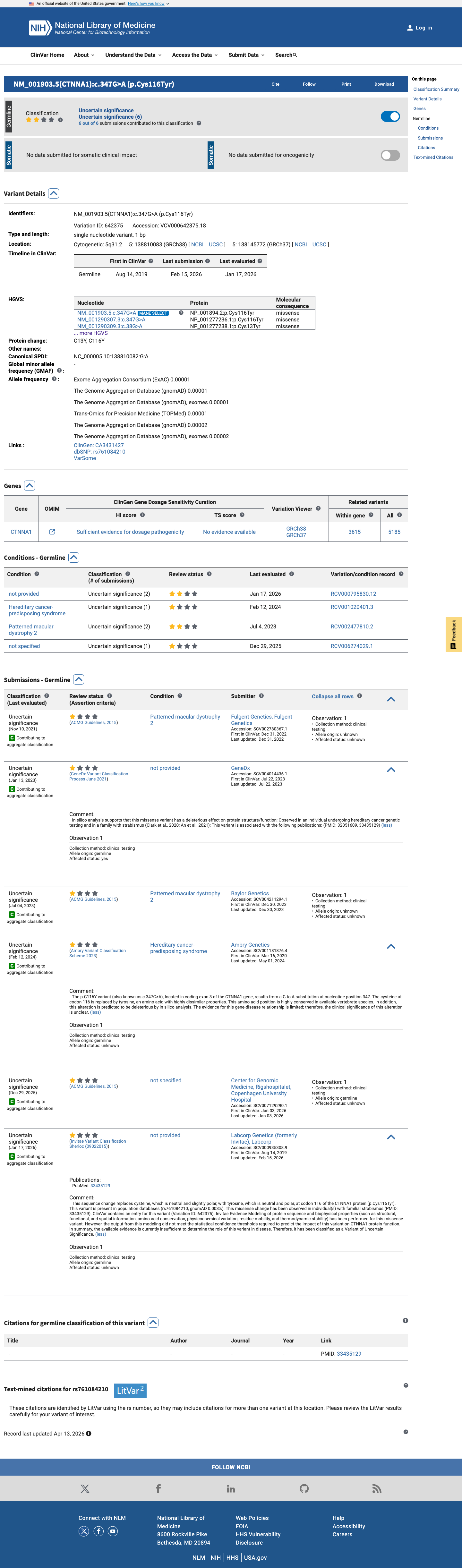
This variant has been reported in ClinVar as Uncertain significance (6 clinical laboratories). (ClinVarID = 642375)
SpliceAI screenshot
In silico
SpliceAI predicts no significant splice impact for this variant (max delta score = 0.00). REVEL score = 0.492. BayesDel score = 0.132168.
Functional / OncoKB screenshot
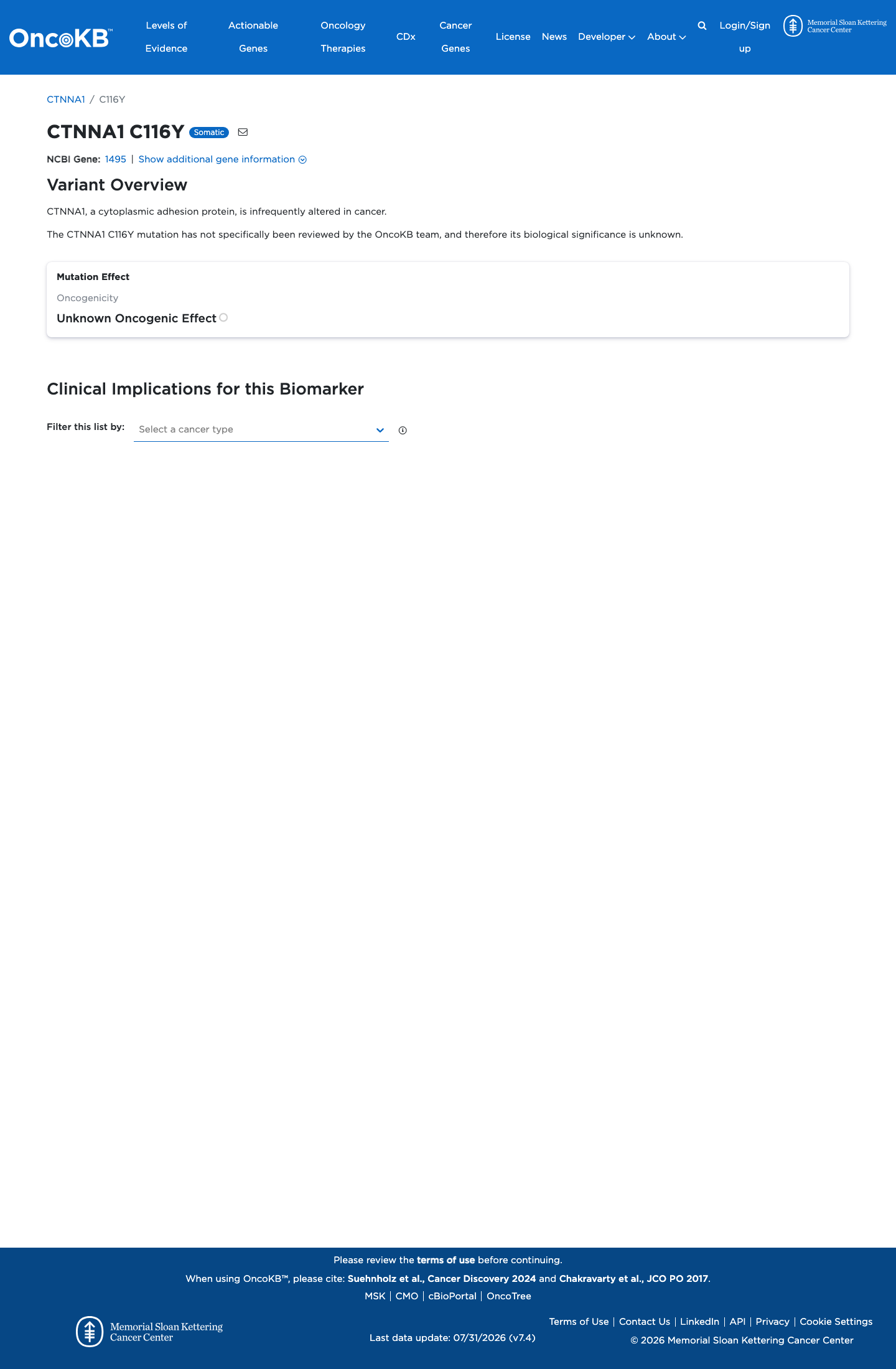
Functional Unknown Oncogenic Effect
OncoKB did not identify variant-specific reviewed functional evidence for this variant; gene-level curated context is available for reviewer follow-up. CTNNA1, a cytoplasmic adhesion protein, is infrequently altered in cancer.
OncoKB ↗
COSMIC screenshot
COSMIC
Cancer hotspots screenshot
Cancer hotspots
Somatic evidence Not in COSMIC / hotspots
COSMIC
This variant does not lie in a statistically significant hotspot. This variant has not previously been reported in somatic cancers (COSMIC).
Hotspots
This variant does not lie in a statistically significant hotspot.
Literature · how each cited paper was used
2papers cited
Each card is an audit: what was searched, what was found, whether it names the variant, which criteria it fed, and why. 2 further PMIDs triaged but not cited — see Sources & references.
Standards and guidelines for the interpretation of sequence variants: a joint consensus recommendation of the American College of Medical Genetics and Genomics and the Association for Molecular Pathology.
Found
Structured finding pending for this record — see source link.
Applied to
PP1 supporting
Identification of Possible Risk Variants of Familial Strabismus Using Exome Sequencing Analysis.
Searched
c.347G>Ap.C116Yp.Cys116TyrCTNNA1Family 15segregationde novo
Found
In a whole-exome sequencing study of 18 families with familial strabismus, the authors list CTNNA1 c.347G>A (p.C116Y) in Table 1 and report that a CTNNA1 missense variant was observed in three Family 15 members (I.2, II.1, and III.1) with comitant esotropia. The report supports supporting-level familial co-occurrence but does not provide the pedigree, unaffected-relative genotypes, parental testing, or quantitative segregation data needed to establish stronger PP1 or assess PS2, PM6, or BS4.
Variant
✓ Names this variant — characterised directly
Applied to
PP1 supporting
The exact variant is listed and reported across three affected members of Family 15 with comitant esotropia.
“CTNNA1 c.347G>A (p.C116Y)” and “Finally, a missense variant in CTNNA1 (Catenin α 1) was observed across multiple cases in Family 15, characterized by comitant esotropia (I.2, II.1, and III.1).”
Location Table 1 (candidate-variant row for CTNNA1); Results section 3.3, paragraph describing Family 15.  ·  Context Whole-exome sequencing analysis of 18 families (53 individuals with strabismus and 34 unaffected family members); the authors prioritized putative risk variants in familial strabismus.  ·  full text
Sources & reference links
8Sources
ClinVar
gnomAD v2.1
gnomAD v4.1
gnomAD-Canada
SpliceAI
OncoKB
COSMIC
Cancer hotspots
Triaged references · 2 PMIDs not cited in assessment
25394175 ↗ A practice guideline from the American College of Medical Genetics and Genomics and the National Society of Genetic Counselors: referral indications for cancer predisposition assessment. CLINVAR
28492532 ↗ Sherloc: a comprehensive refinement of the ACMG-AMP variant classification criteria. CLINVAR