Analysis in progress
Initialising…
0%
complete
This report is still being assembled — sections appear as each stage finishes. It isn't final yet.
AXIN2
Final classification
Benign
BA1BP3BP4
AXIN2
c.2013_2024del
p.Thr672_Arg675del
in_frame_indel_unknown · exon 8

AXIN2 is a scaffolding protein that helps regulate the Wnt signaling pathway, a key developmental pathway controlling cell growth and fate. It is part of the beta-catenin destruction complex, where it helps mark beta-catenin for degradation when Wnt signaling is off, and it also assists in relaying Wnt signals to the nucleus when the pathway is active. AXIN2 acts as a tumor suppressor, and mutations in the gene have been linked to colorectal cancer as well as familial tooth agenesis with predisposition to colorectal cancer. Its expression has also been associated with prostate cancer recurrence.

This variant

AXIN2 is a tumor suppressor in the Wnt signaling pathway associated with colorectal cancer and familial tooth agenesis with predisposition to colorectal cancer. This variant removes four amino acids (p.Thr672_Arg675del) from a repetitive region outside all conserved functional domains and is common in African/African American populations (7.33%), indicating it does not impair the gene's tumor-suppressor function. The Benign classification therefore means this deletion is not expected to contribute to AXIN2-associated disease.

Transcript
NM_004655.4
HGVS · transcript:coding
NM_004655.4:c.2013_2024del
GRCh38
chr17:65536436 ACGGGGGGTGGTG>A
GRCh37
chr17:63532554 ACGGGGGGTGGTG>A
Basis No AXIN2-specific VCEP or local gene framework was available, so generic ACMG/AMP 2015 combination rules were applied. BA1 (stand-alone benign), BP3 (supporting), and BP4 (supporting) were met; no pathogenic criterion was met or applicable, yielding a Benign classification.
No AXIN2-specific VCEP or local gene framework was available, so generic ACMG/AMP 2015 combination rules were applied. BA1 (stand-alone benign), BP3 (supporting), and BP4 (supporting) were met; no pathogenic criterion was met or applicable, yielding a Benign classification.
Classification rationale
BA1BP3BP4 Benign
AXIN2 c.2013_2024del in_frame_indel_unknown · exon 8

BA1 (stand-alone benign): gnomAD v4.1 African/African American allele frequency 7.33% exceeds the 5% BA1 threshold. BP3 (supporting): in-frame 12-nucleotide deletion falls in a repetitive 6-G homopolymer region without known function, outside all conserved domains. BP4 (supporting): SpliceAI max delta 0.019 predicts no splice-altering impact (threshold ~0.2). Overall classification: Benign, per generic ACMG/AMP 2015 fallback combination rules driven by BA1 at stand-alone strength.

BA1 + BP3 + BP4 Benign
Gene diagram · NM_004655.4 · variants mapped to exon structure
AXIN2 NM_004655.4
Fetching transcript structure from UCSC…
Applied criteria · 3 applied · 18 assessed
MetEvidence satisfies this criterion.
Not metEvaluated against available evidence; threshold not reached.
Not assessedApplies in principle, but no evidence was found to evaluate it.
N/ADoesn't apply to this variant type.
Applied · 3
Strength Supporting Moderate Strong Very strong
BA1 stand-alone Benign
Met (stand-alone benign): gnomAD v4.1 African/African American allele frequency 7.33% exceeds the 5% BA1 threshold.
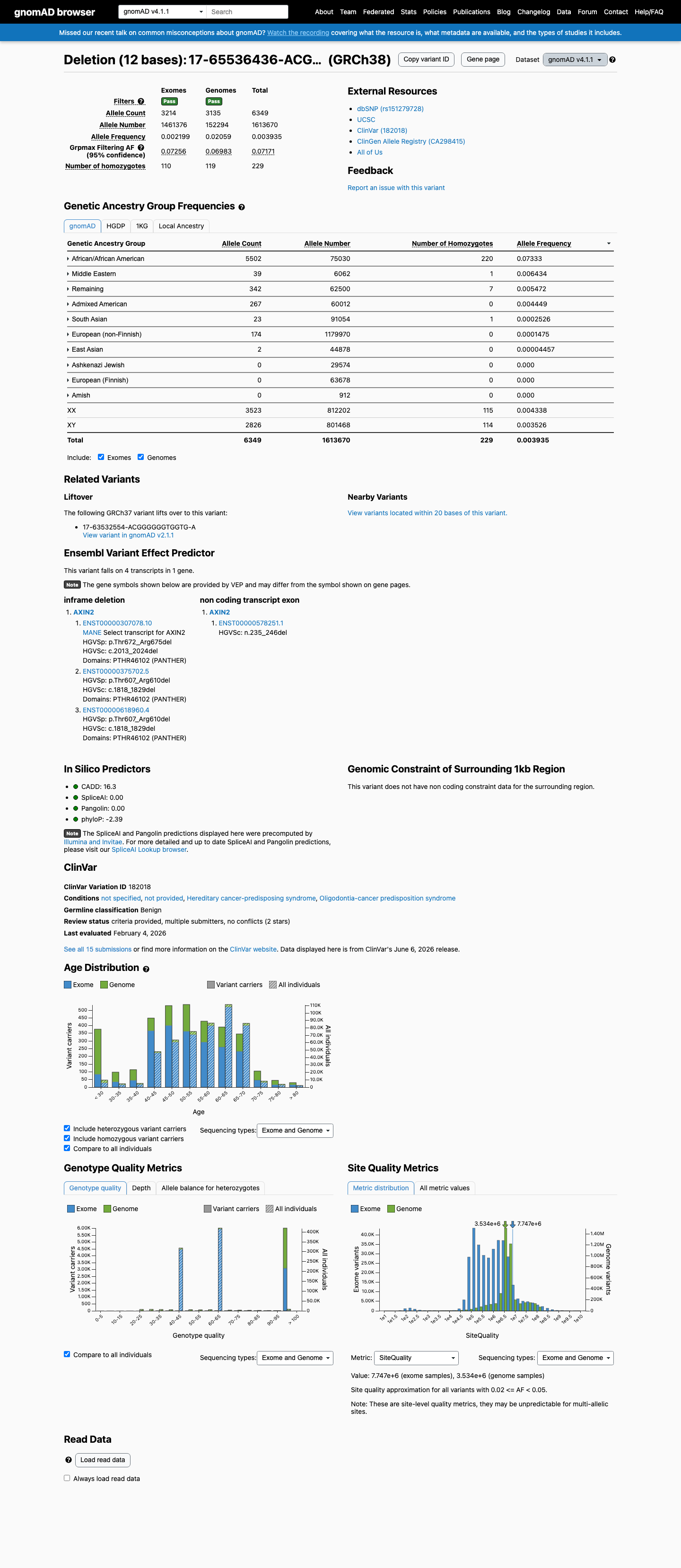
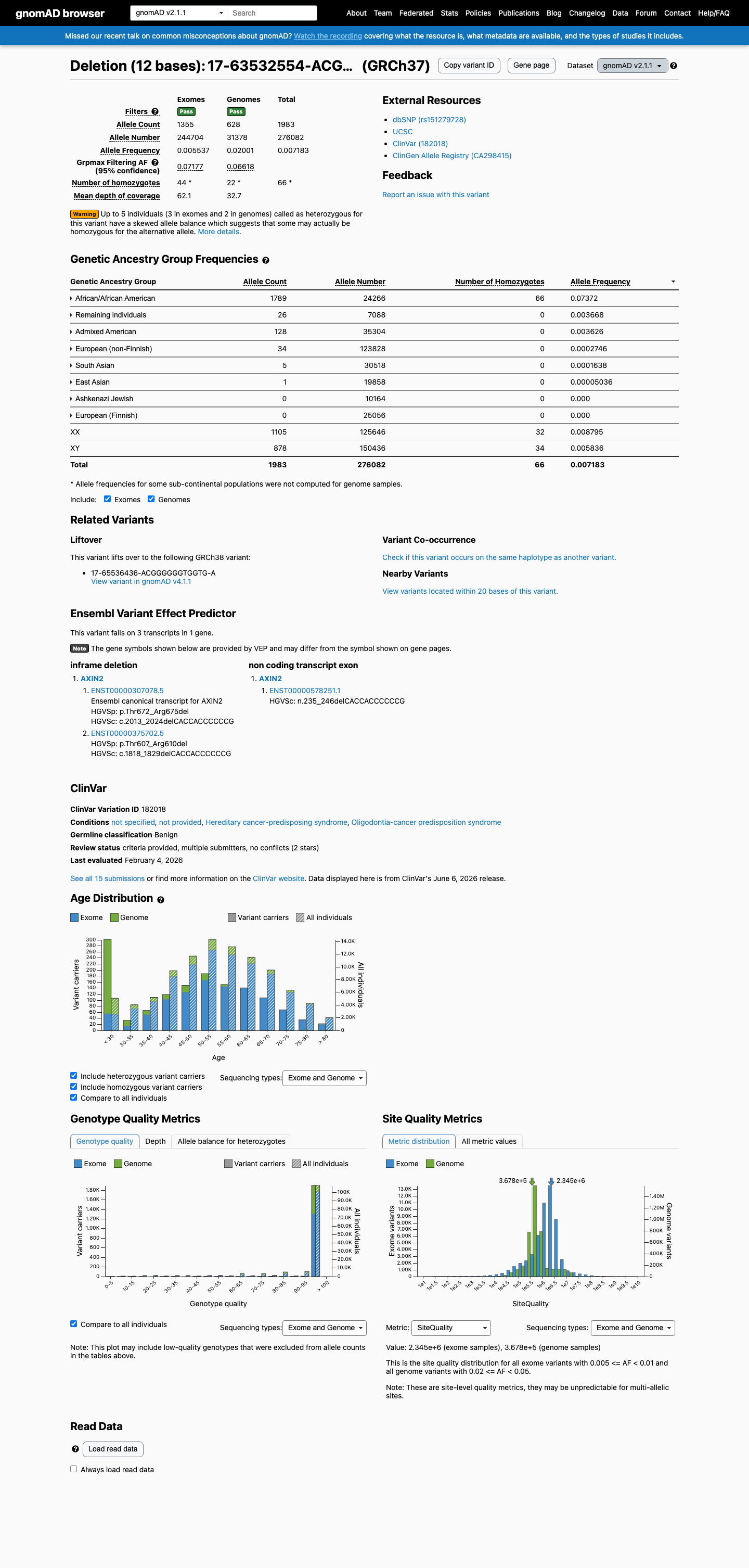
No AXIN2 ClinGen VCEP specification or local gene-specific framework was available; generic ACMG/AMP was therefore used.gnomAD v4.1 reports 220 African/African American homozygotes, and gnomAD v2.1 reports 66, supporting that the high ancestry-specific frequency is a reproducible population observation rather than a single-dataset artifact.The BA1 threshold used is from Richards et al. (PMID:25741868): allele frequency above 5% in a population reference dataset is benign stand-alone evidence.
BP3 supporting Benign
Met (supporting): in-frame 12-nucleotide deletion in a repetitive 6-G homopolymer region outside all known functional domains.
Richards et al. 2015 (PMID:25741868) Table 3 defines BP3 as in-frame deletions/insertions in a repeat region without a known function; the companion PM4 passage retrieved in full text (publications/25741868.txt) confirms the in-frame deletion/insertion framework, though the BP3 sentence itself lies beyond the 40KB truncation of the retrieved text.Consequence: Mutalyzer/VariantValidator (prefetch.json) confirm a 12-nt in-frame deletion, NP_004646.3:p.(Thr672_Arg675del), entirely within exon 8 (VariantValidator start_exon/end_exon = 8; Mutalyzer exon 8 = c.1908-2141) of the MANE Select transcript NM_004655.4; no frameshift, so no NMD is expected.Repeat-region context: the deleted interval ACGGGGGGTGGTG contains a 6-G homopolymer run, and Mutalyzer normalization reports shift 6, indicating the deletion boundaries are ambiguous within a repetitive sequence.
BP4 supporting Benign
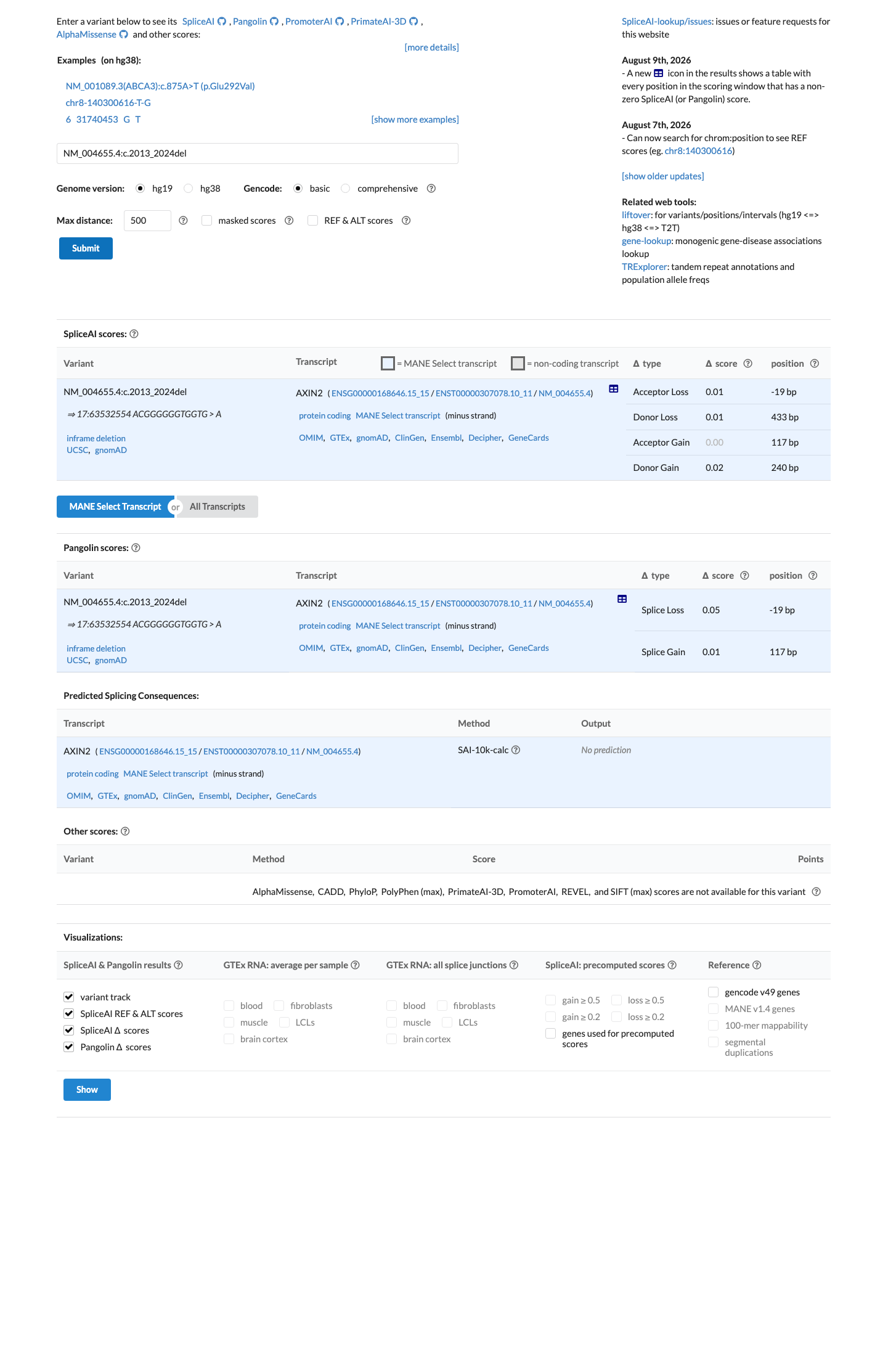
Met (supporting): SpliceAI max delta 0.019, well below the ~0.2 threshold for splice-altering impact.
SpliceAI direct query for NM_004655.4:c.2013_2024del returned max_delta_score=0.019 (DS_AG=0.002, DS_AL=0.013, DS_DG=0.019, DS_DL=0.011), evidence_sentence: 'SpliceAI predicts no significant splice impact for this variant (max delta score = 0.02).'SpliceAI's ~0.2 delta-score threshold for high-precision splice-altering prediction comes from Jaganathan KK et al., 'Predicting Splicing from Primary Sequence with Deep Learning,' Cell 2019, PMID 30661751.The variant is a 12-bp in-frame deletion (p.Thr672_Arg675del), not a missense or synonymous substitution, so REVEL/BayesDel/aGVGD missense predictors and BP7 do not apply.
Assessed · not applied · 6 not met · 12 not assessed
Pathogenic
PS2 Not assessed: no proband phenotype or parental genotype data were available to evaluate a confirmed de novo occurrence.
PS3 Not assessed: no validated functional assay data addressing this variant were available.
PS4 Not assessed: no variant-specific case-control or cohort enrichment data were provided.
PM2 Not met: gnomAD v4.1 African/African American allele frequency is 7.33%, far above rarity thresholds for PM2.
PM3 Not assessed: no proband observation or phase result establishes this variant in trans with a pathogenic allele.
PM4 Not met: the in-frame deletion lies in a repetitive 6-G homopolymer region, which PM4 explicitly excludes.
PM6 Not assessed: no parental genotype data were available to evaluate an assumed de novo occurrence.
PP1 Not assessed: no genotyped relatives or informative meioses were provided, so co-segregation could not be evaluated.
PP3 Not met: SpliceAI max delta 0.019, far below the ~0.2 threshold for predicted splice-altering impact.
PP4 Not assessed: no phenotype-to-gene specificity evidence was provided for the tested individual.
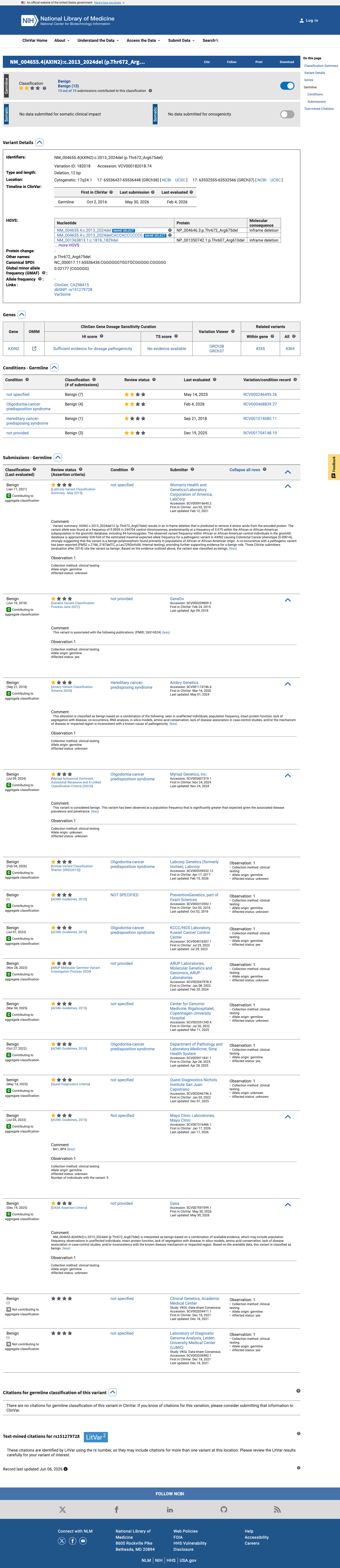
PP5 Not met: the ClinVar record carries no pathogenic or likely pathogenic expert-panel assertion.
Benign
BS1 Not met: BA1 already applies at stand-alone strength, superseding the lower-strength BS1 frequency criterion.
BS2 Not assessed: homozygotes are reported, but individual phenotypes, ages, and disease status are not documented.
BS3 Not assessed: no benign-consistent functional assay result for this variant was available.
BS4 Not assessed: no informative family phenotypes and genotypes were provided to establish lack of segregation.
BP2 Not assessed: no second AXIN2 variant or phase result was provided to evaluate cis/trans configuration.
BP5 Not assessed: no evidence that an alternate molecular diagnosis fully explains the phenotype was provided.
BP6 Not met: the ClinVar record carries no benign or likely benign expert-panel assertion.
N/A · 7 PVS1 · PS1 · PM1 · PM5 · PP2 · BP1 · BP7
Research & evidence
Population frequency · supports benign
gnomAD v4.1 screenshot
gnomAD v4.1
gnomAD v2.1 screenshot
gnomAD v2.1
v4.1
This variant is present in gnomAD v4.1 (AF= 0.00393451; MAF= 0.39345%, 6349/1613670 alleles, homozygotes = 229) and has highest observed frequency in the African/African American population (AF= 0.0733307; MAF= 7.33307%, 5502/75030 alleles, homozygotes = 220); grpmax FAF= 0.0717121.
v2.1
This variant is present in gnomAD v2.1 (AF= 0.00718265; MAF= 0.71826%, 1983/276082 alleles, homozygotes = 66) and has highest observed frequency in the African/African American population (AF= 0.0737246; MAF= 7.37246%, 1789/24266 alleles, homozygotes = 66); grpmax FAF= 0.0717742.
🇨🇦 CA
This variant is present in gnomAD-Canada v1.0 (AF= 0.004562242016076472, 84/18412 alleles, homozygotes = 3).
Allele frequency by ancestry
three datasets · side by side
gnomAD v4.1
0.39% · 6349 / 1,613,670
229 hom · FAF 7.2%
African/African American
5502 / 75,030
7.3%
220 hom
Middle Eastern
39 / 6,062
0.64%
1 hom
Remaining individuals
342 / 62,500
0.55%
7 hom
Admixed American
267 / 60,012
0.44%
South Asian
23 / 91,054
0.025%
1 hom
European (non-Finnish)
174 / 1,179,970
0.015%
East Asian
2 / 44,878
0.0045%
+ 3 not observed (European (Finnish), Amish, Ashkenazi Jewish)
gnomAD v2.1
0.72% · 1983 / 276,082
66 hom · FAF 7.2%
African/African American
1789 / 24,266
7.4%
66 hom
Remaining individuals
26 / 7,088
0.37%
Admixed American
128 / 35,304
0.36%
European (non-Finnish)
34 / 123,828
0.027%
South Asian
5 / 30,518
0.016%
East Asian
1 / 19,858
0.005%
+ 2 not observed (Ashkenazi Jewish, European (Finnish))
gnomAD Canada 🇨🇦
0.46% · 84 / 18,412
3 hom · FAF 5.3%
indel · split
African/African American
67 / 1,018
6.6%
3 hom
Latino/Admixed American
6 / 838
0.72%
Remaining individuals
7 / 1,134
0.62%
European (non-Finnish)
4 / 11,738
0.034%
+ 5 not observed (Ashkenazi Jewish, East Asian, European (Finnish), Middle Eastern, South Asian)
ClinVar screenshot
ClinVar
This variant has been reported in ClinVar as Benign (14 clinical laboratories) and as benign (1 clinical laboratory). (ClinVarID = 182018)
SpliceAI screenshot
In silico
SpliceAI predicts no significant splice impact for this variant (max delta score = 0.02).
Functional / OncoKB screenshot
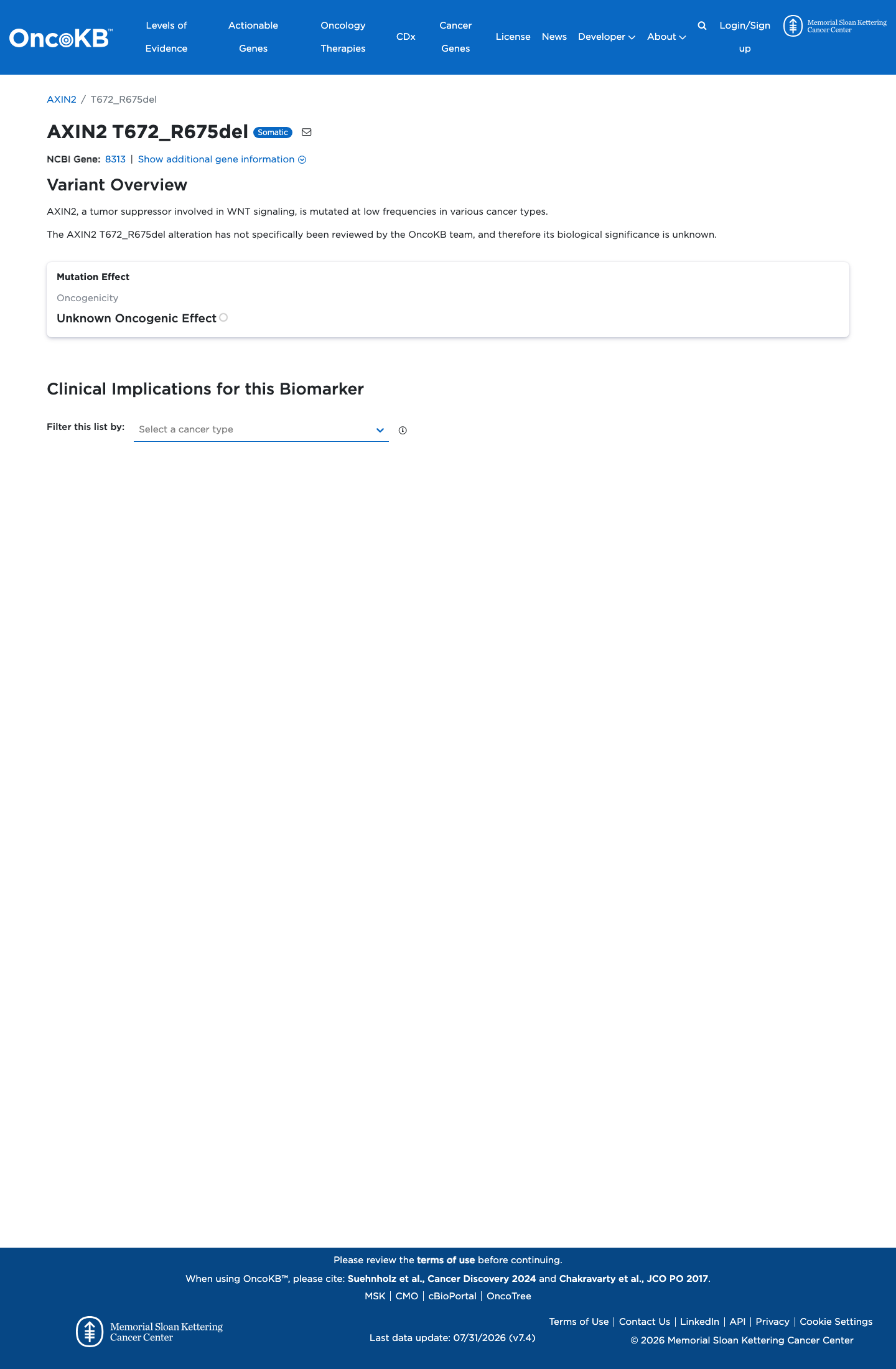
Functional Unknown Oncogenic Effect
OncoKB did not identify variant-specific reviewed functional evidence for this variant; gene-level curated context is available for reviewer follow-up. AXIN2, a tumor suppressor involved in WNT signaling, is mutated at low frequencies in various cancer types.
OncoKB ↗
COSMIC screenshot
COSMIC
Cancer hotspots screenshot
Cancer hotspots
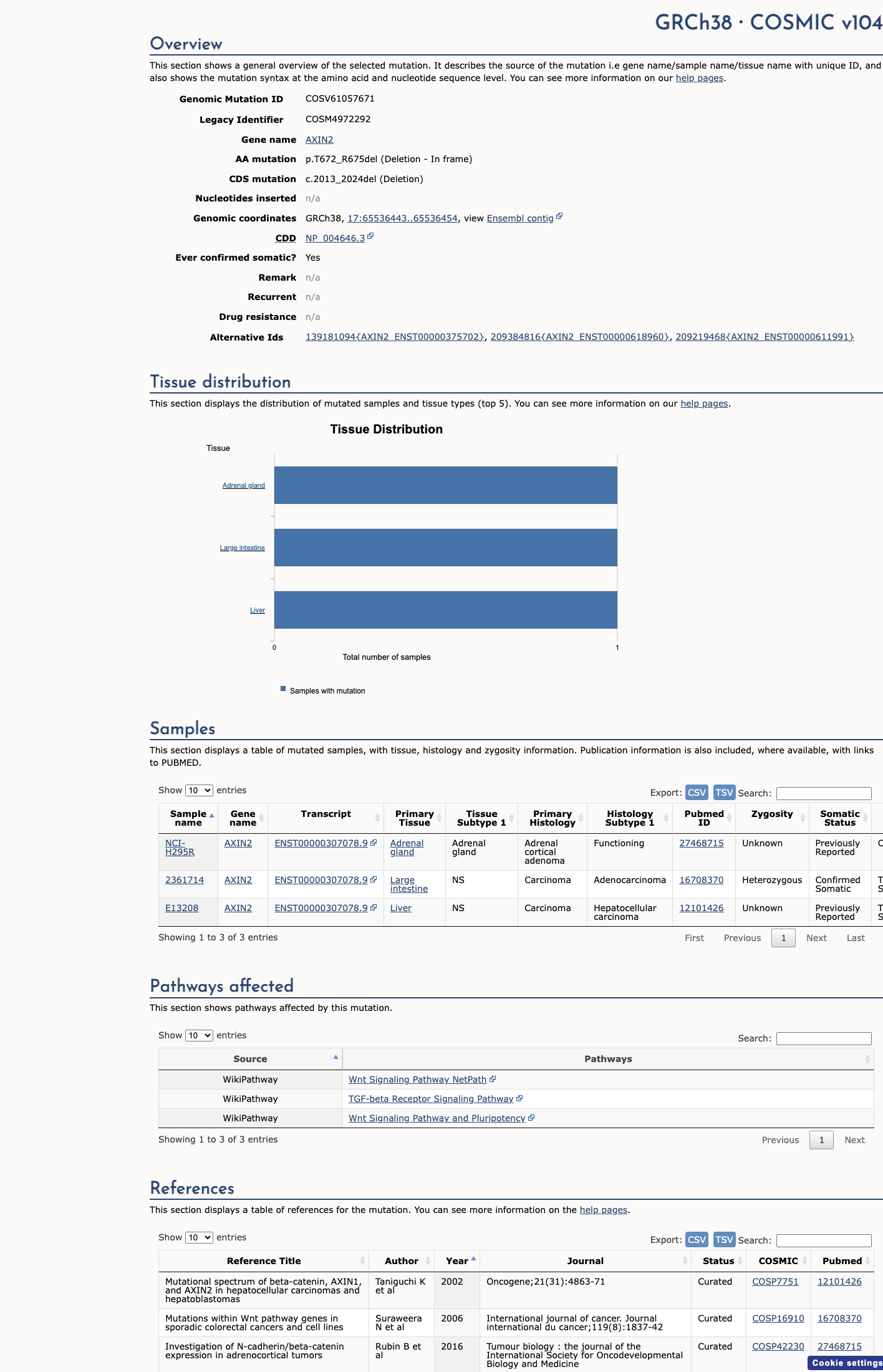
Somatic evidence Not in COSMIC / hotspots
COSMIC
This variant does not lie in a statistically significant hotspot. This variant has previously been reported in somatic cancers (COSMIC; COSV61057671, n = 3 times).
Hotspots
This variant does not lie in a statistically significant hotspot.
Literature · how each cited paper was used
1papers cited
Each card is an audit: what was searched, what was found, whether it names the variant, which criteria it fed, and why. 3 further PMIDs triaged but not cited — see Sources & references.
Rule & framework references · cited for criterion definitions, not variant evidence
25741868 ↗ Standards and guidelines for the interpretation of sequence variants: a joint consensus recommendation of the American College of Medical Genetics and Genomics and the Association for Molecular Pathology.
Sources & reference links
8Sources
ClinVar
gnomAD v2.1
gnomAD v4.1
gnomAD-Canada
SpliceAI
OncoKB
COSMIC
Cancer hotspots
Triaged references · 3 PMIDs not cited in assessment
26467025 ↗ A Standardized DNA Variant Scoring System for Pathogenicity Assessments in Mendelian Disorders. CLINVAR
25394175 ↗ A practice guideline from the American College of Medical Genetics and Genomics and the National Society of Genetic Counselors: referral indications for cancer predisposition assessment. CLINVAR
28492532 ↗ Sherloc: a comprehensive refinement of the ACMG-AMP variant classification criteria. CLINVAR