MSH6 encodes a protein in the DNA mismatch repair system, which fixes errors made during DNA replication. Partnering with MSH2, it forms a complex that recognizes and helps correct mismatched DNA bases, keeping the genetic code stable. Inherited mutations in MSH6 cause Lynch syndrome (hereditary nonpolyposis colorectal cancer), raising the risk of colorectal, endometrial, ovarian, and other cancers, while mutations in both copies lead to constitutional mismatch repair deficiency. Because faulty mismatch repair drives tumor development and produces microsatellite instability, MSH6 acts as a tumor suppressor, and cancers with such repair defects often respond well to immune checkpoint inhibitor therapy.
This variant
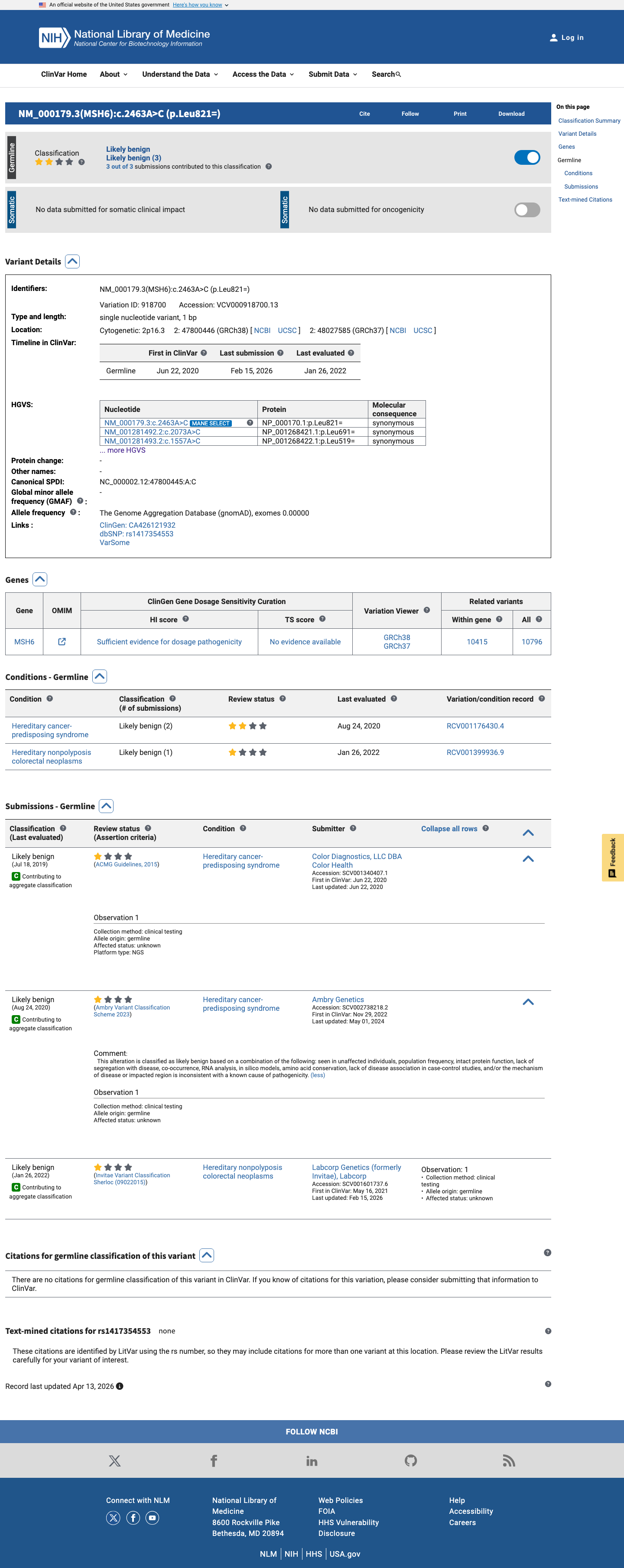
MSH6 mutations cause Lynch syndrome, raising risks of colorectal, endometrial, ovarian, and other cancers. A Likely Benign classification for this synonymous change means it is not expected to impair DNA mismatch repair or contribute to Lynch syndrome risk, so it should not by itself drive cancer-screening decisions.
Transcript
NM_000179.3
HGVS · transcript:coding
NM_000179.3:c.2463A>C
GRCh38
chr2:47800446 A>C
GRCh37
chr2:48027585 A>C
BasisLikely Benign: InSiGHT MSH6 VCEP v2.0 Rule19 (>=2 Benign.Supporting) is satisfied by BP4 and BP7, both supporting.▾
Likely Benign: InSiGHT MSH6 VCEP v2.0 Rule19 (>=2 Benign.Supporting) is satisfied by BP4 and BP7, both supporting.
Classification rationale
BP4BP7Likely Benign
MSH6 c.2463A>Csynonymous · exon 4
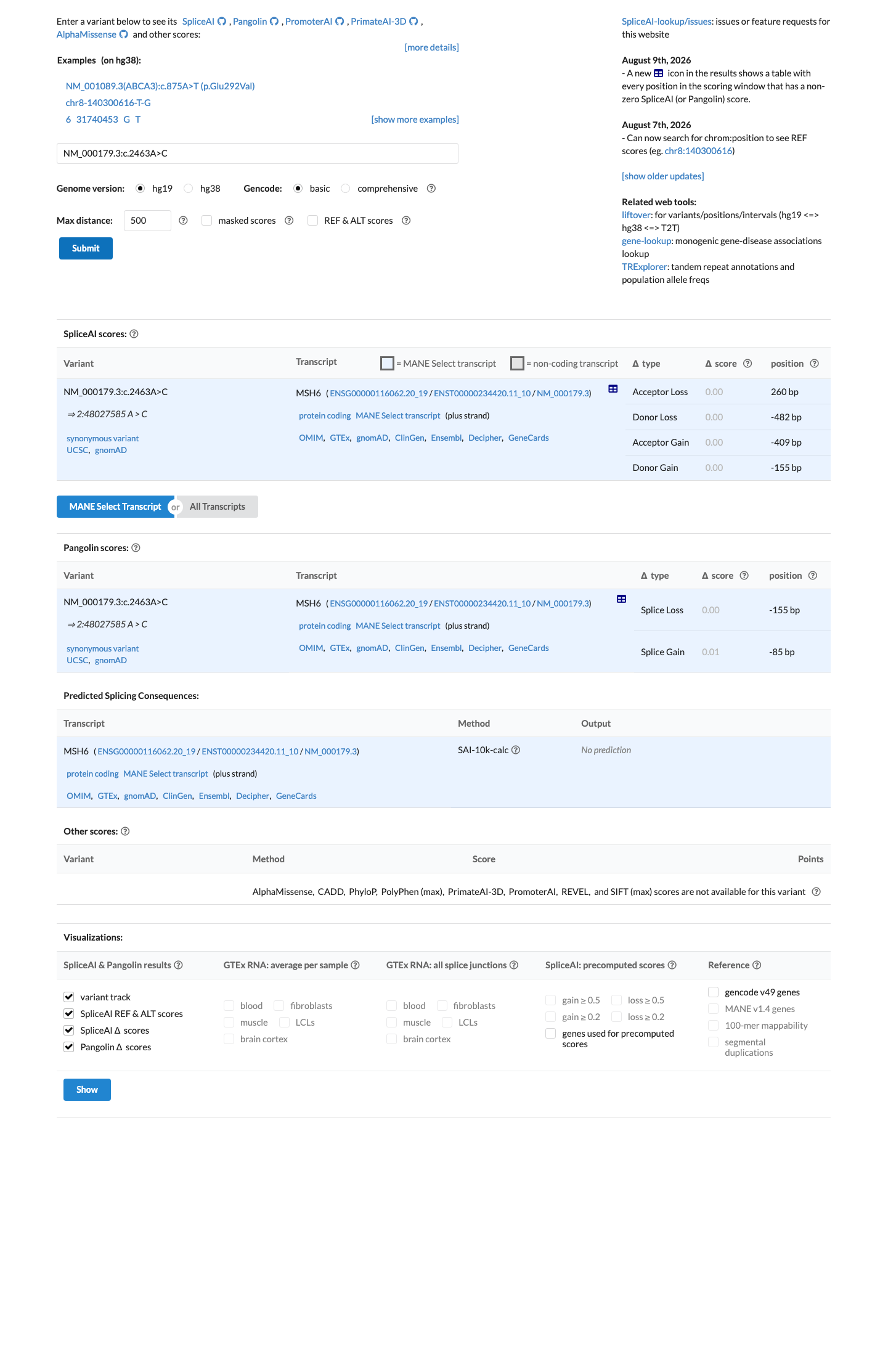
BP4 (Supporting): SpliceAI predicts no splicing impact (max delta 0.001, below the 0.1 threshold) for this synonymous variant. BP7 (Supporting): synonymous variant deep within the exon interior (1835 bp from the 5' splice boundary), with SpliceAI max delta 0.001 confirming no splice impact. Overall: Likely Benign, per InSiGHT MSH6 VCEP v2.0 Rule19 (>=2 Benign.Supporting criteria).
BP4 + BP7→Likely Benign
Gene diagram
· NM_000179.3 · variants mapped to exon structure
MSH6NM_000179.3
Fetching transcript structure from UCSC…
Exons
—
Transcript span
—
Strand
—
Variants mapped
—
Source
UCSC ncbiRefSeqCurated
All variants in MSH6—click a row to locate it on the plot · use the link column to open its page
Variant ↕
Protein
Location
Classification
Link
Applied criteria · 2 applied · 13 assessed
MetEvidence satisfies this criterion.
Not metEvaluated against available evidence; threshold not reached.
Not assessedApplies in principle, but no evidence was found to evaluate it.
N/ADoesn't apply to this variant type.
Applied · 2
Strength Supporting Moderate Strong Very strong
✓
BP4supportingBenign
Met (supporting): SpliceAI max delta 0.001, well below the <=0.1 threshold indicating no splicing impact.
prefetch.json compact_evidence.spliceai evidence_sentence: 'SpliceAI predicts no significant splice impact for this variant (max delta score = 0.00).' Raw scores: DS_AG=0.001, DS_AL=0.0, DS_DG=0.0, DS_DL=0.0, max_delta_score=0.001.cspec BP4 rule (MSH6 VCEP v2.0): 'For intronic and synonymous variants: SpliceAI predicts no splicing impact with delta score <=0.1 as per Walker et al 2023.' Variant qualifies as synonymous with delta well under threshold.
Met (supporting): synonymous variant deep in the exon interior (1835 bp from the 5' splice boundary) with SpliceAI max delta 0.001.
case_summary.json compact_evidence.normalization: protein consequence NP_000170.1:p.(Leu821=) confirms synonymous/silent change.prefetch.json compact_evidence.spliceai: max_delta_score=0.001 supports absence of cryptic splice disruption at this exonic position.cspec BP7 rule (MSH6 VCEP v2.0): 'A synonymous (silent) or intronic variant at or beyond -21/+7 (5'/3' exonic). Variants may satisfy both BP7 and BP4.' Exon boundary data (c.628-c.3172) places the variant far outside the -21/+7 zone.
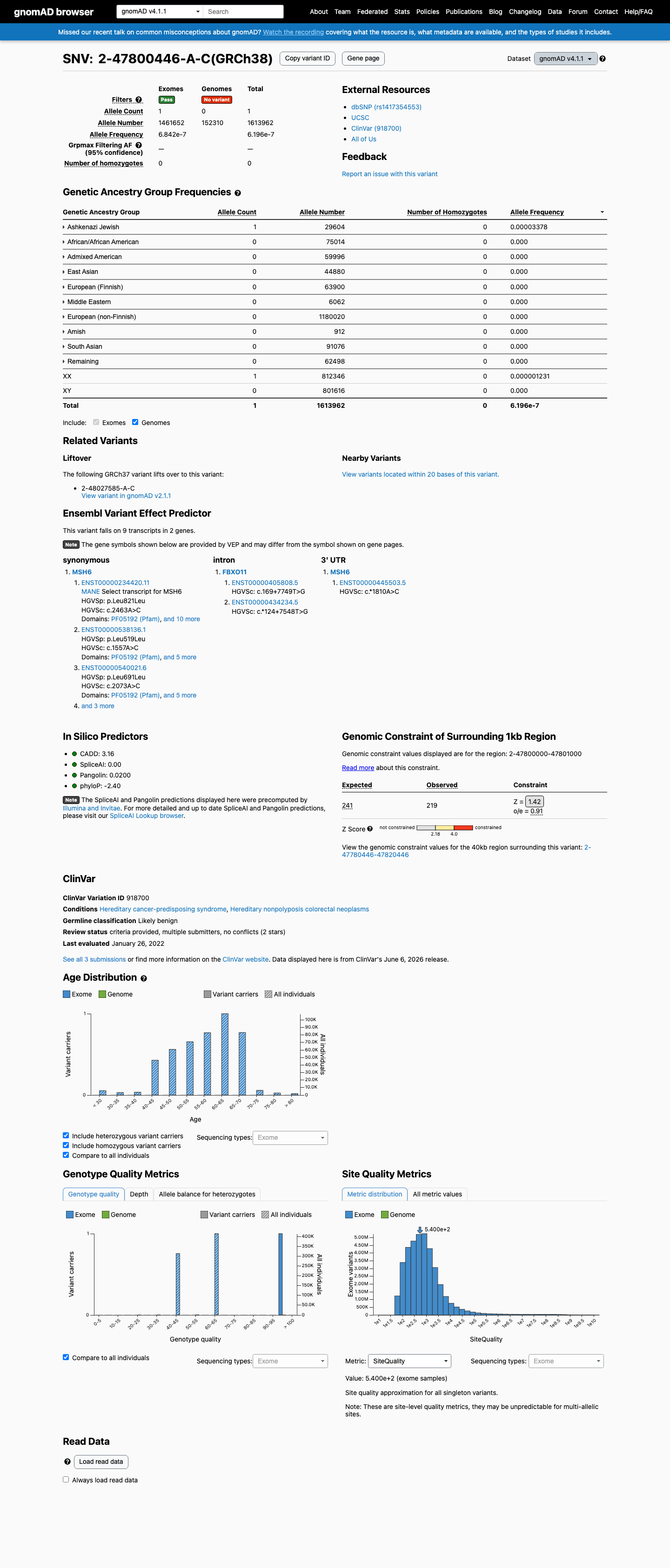
This variant is present in gnomAD v4.1 (AF= 6.19593e-07; MAF= 0.00006%, 1/1613962 alleles, homozygotes = 0) and has highest observed frequency in the Ashkenazi Jewish population (AF= 3.37792e-05; MAF= 0.00338%, 1/29604 alleles, homozygotes = 0).
v2.1
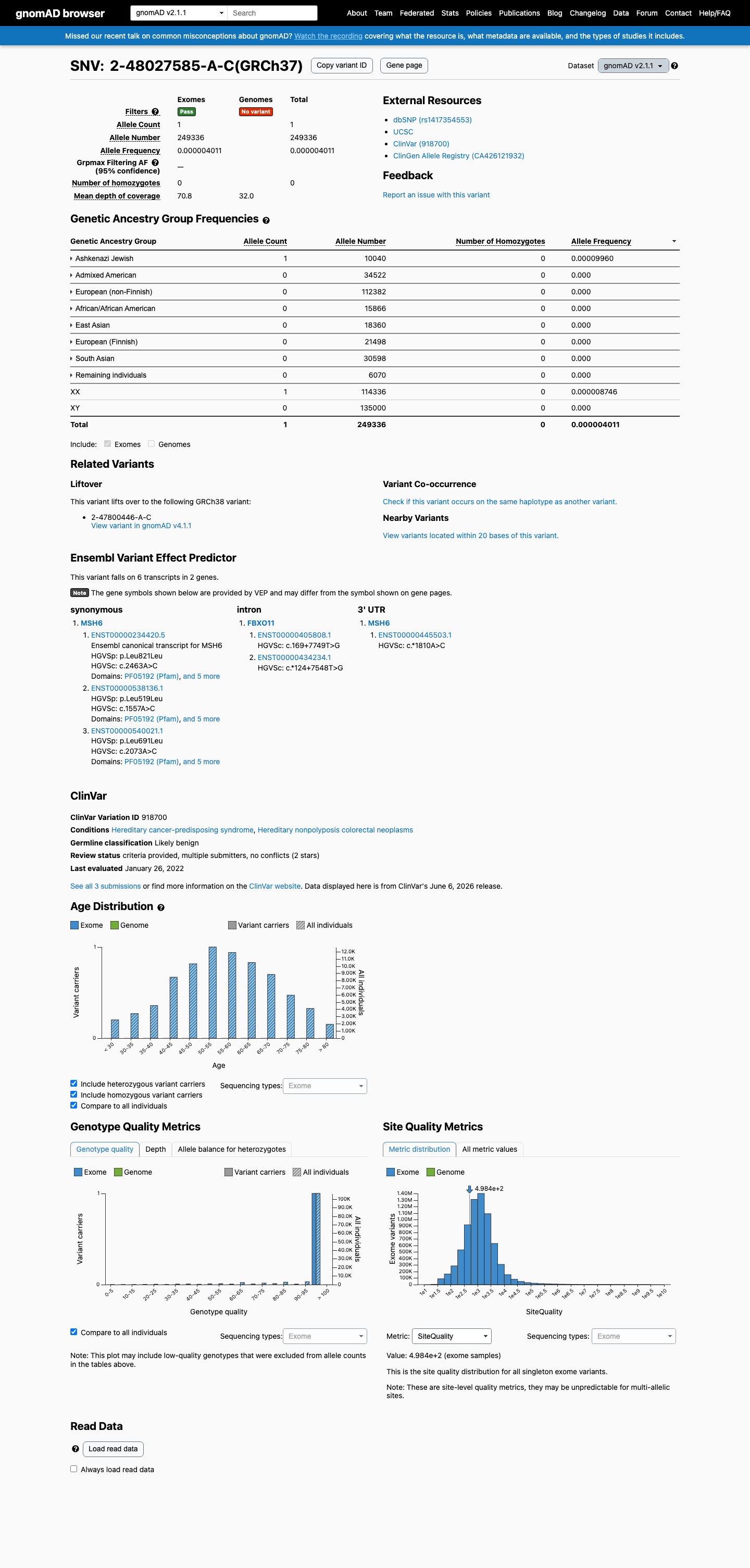
This variant is present in gnomAD v2.1 (AF= 4.01065e-06; MAF= 0.00040%, 1/249336 alleles, homozygotes = 0) and has highest observed frequency in the Ashkenazi Jewish population (AF= 9.96016e-05; MAF= 0.00996%, 1/10040 alleles, homozygotes = 0).
🇨🇦 CA
Absent from gnomAD-Canada v1.0.
Allele frequency by ancestry
three datasets · side by side
gnomAD v4.1
6.2e-05%
· 1 / 1,613,962
0 hom
Ashkenazi Jewish
1 / 29,604
0.0034%
+ 9 not observed (Remaining individuals, Admixed American, European (Finnish), Amish, East Asian, Middle Eastern, South Asian, African/African American, European (non-Finnish))
gnomAD v2.1
0.0004%
· 1 / 249,336
0 hom
Ashkenazi Jewish
1 / 10,040
0.01%
+ 7 not observed (African/African American, Admixed American, East Asian, European (Finnish), European (non-Finnish), Remaining individuals, South Asian)
Triaged references · 3 PMIDs not cited in assessment
25741868 ↗Standards and guidelines for the interpretation of sequence variants: a joint consensus recommendation of the American College of Medical Genetics and Genomics and the Association for Molecular Pathology.CLINVAR
25394175 ↗A practice guideline from the American College of Medical Genetics and Genomics and the National Society of Genetic Counselors: referral indications for cancer predisposition assessment.CLINVAR
28492532 ↗Sherloc: a comprehensive refinement of the ACMG-AMP variant classification criteria.CLINVAR