POLD1 encodes the catalytic subunit of DNA polymerase delta, an enzyme that carries both DNA synthesis and proofreading (3' to 5' exonuclease) activities and is essential for accurate DNA replication and repair. Germline mutations in its exonuclease domain cause polyposis and predispose people to colorectal, endometrial, and possibly brain cancers. In cancer, POLD1 defects impair replication fidelity, leading to the accumulation of many mutations (an ultra-mutated phenotype) that may make tumors more responsive to immunotherapy, though somatic POLD1 mutations are rare.
This variant
This synonymous change (p.(Ala425=)) does not alter the POLD1 protein sequence and is classified Likely Benign, so it is not expected to affect the DNA polymerase delta replication/proofreading activity whose defects cause polyposis and colorectal/endometrial cancer predisposition. Its allele frequency of up to ~1.9% in the general population further supports a benign polymorphism rather than a disease-causing POLD1 alteration.
Transcript
NM_002691.4
HGVS · transcript:coding
NM_002691.4:c.1275C>T
GRCh38
chr19:50406214 C>T
GRCh37
chr19:50909471 C>T
BasisNo ClinGen VCEP specification or local gene-specific framework exists for POLD1, so generic ACMG/AMP 2015 (PMID:25741868) combination rules were applied. Applied criteria: BS1 (strong), BP4 (supporting), BP7 (supporting).▾
No ClinGen VCEP specification or local gene-specific framework exists for POLD1, so generic ACMG/AMP 2015 (PMID:25741868) combination rules were applied. Applied criteria: BS1 (strong), BP4 (supporting), BP7 (supporting).
Classification rationale
BS1BP4BP7Likely Benign
POLD1 c.1275C>Tsynonymous · exon 11
BS1 (Strong): gnomAD v4.1 allele frequency up to 1.9228% (Ashkenazi Jewish) is far too common for a rare POLD1 cancer-predisposition disorder. BP4 (Supporting): SpliceAI max delta 0.035 predicts no splicing consequence, below the ~0.1 threshold. BP7 (Supporting): synonymous change with no predicted splice-site impact. Under the generic ACMG/AMP 2015 combination rules, BS1 (strong) together with BP4 and BP7 (supporting) supports a Likely Benign classification.
BS1 + BP4 + BP7→Likely Benign
Gene diagram
· NM_002691.4 · variants mapped to exon structure
POLD1NM_002691.4
Fetching transcript structure from UCSC…
Exons
—
Transcript span
—
Strand
—
Variants mapped
—
Source
UCSC ncbiRefSeqCurated
All variants in POLD1—click a row to locate it on the plot · use the link column to open its page
Variant ↕
Protein
Location
Classification
Link
Applied criteria · 3 applied · 17 assessed
MetEvidence satisfies this criterion.
Not metEvaluated against available evidence; threshold not reached.
Not assessedApplies in principle, but no evidence was found to evaluate it.
N/ADoesn't apply to this variant type.
Applied · 3
Strength Supporting Moderate Strong Very strong
✓
BS1strongBenign
Met (strong): allele frequency 1.9228% in Ashkenazi Jewish and 1.3787% in African/African American individuals is far too common for a rare cancer-predisposition disorder.
No POLD1 ClinGen VCEP specification or local gene-specific framework was retrieved; generic ACMG/AMP frequency guidance therefore applies.gnomAD v4.1 has 1,949 variant alleles among 1,613,918 alleles (overall AF 0.1208%); the highest frequencies are Ashkenazi Jewish AF 1.9228% (569/29,592; 7 homozygotes) and African/African American AF 1.3787% (1,034/74,998; 5 homozygotes).gnomAD v2.1 corroborates enrichment: Ashkenazi Jewish AF 1.7685% (183/10,348; 2 homozygotes) and African/African American AF 1.3676% (341/24,934).
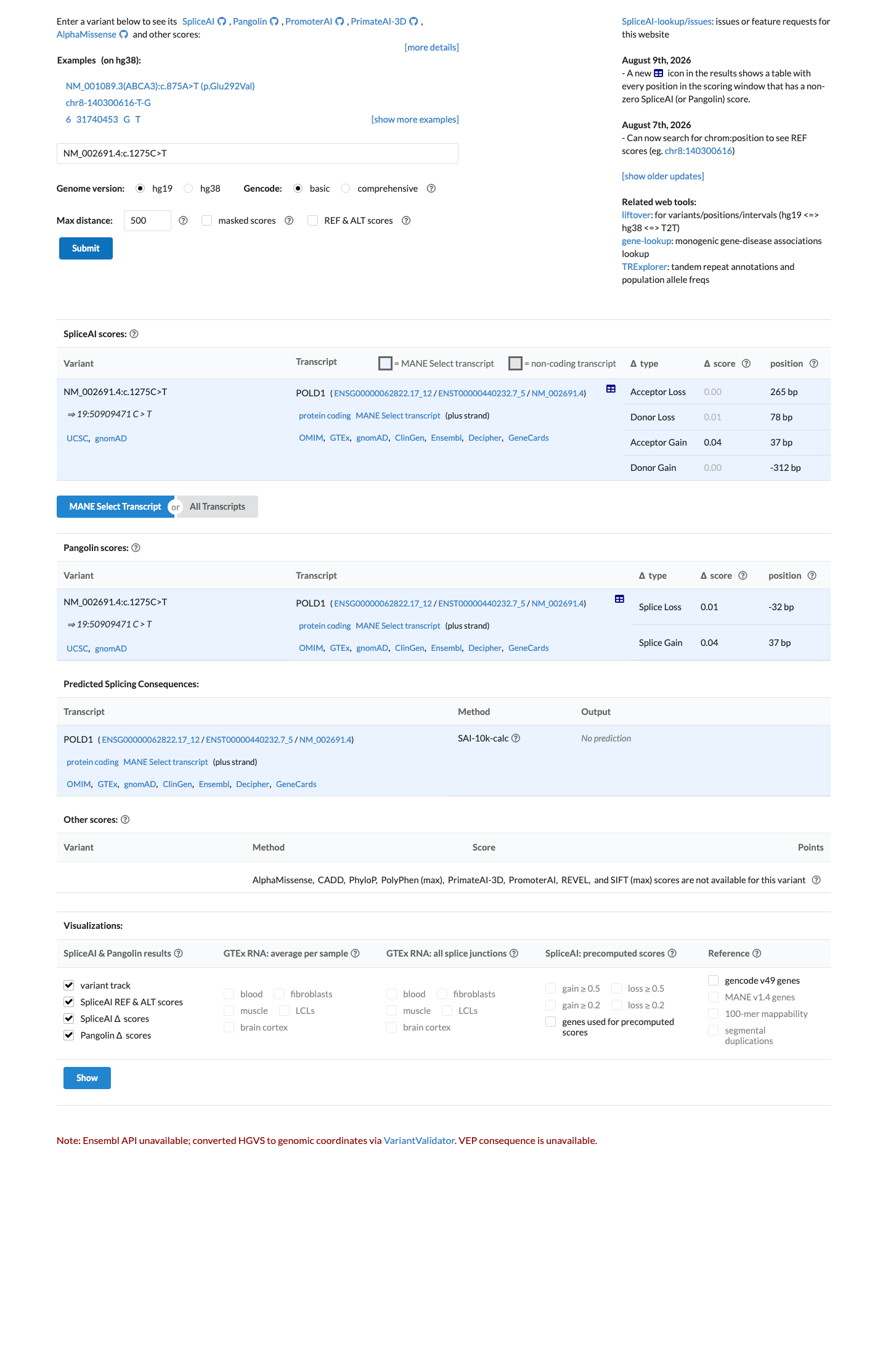
Met (supporting): SpliceAI max delta 0.035 is well below the ~0.1 threshold for no predicted splicing consequence.
SpliceAI max delta score = 0.035 (DS_AG=0.035, DS_AL=0.001, DS_DG=0.001, DS_DL=0.005) for NM_002691.4:c.1275C>T, well below thresholds associated with splice-altering variants.SpliceAI delta-score interpretation thresholds (0.2 high recall / 0.5 recommended / 0.8 high precision) are from Jaganathan et al. 2019 (Cell), PMID 30661751; the observed score of 0.035 is well below even the lowest of these thresholds, supporting no predicted splicing impact.
Met (supporting): SpliceAI max delta 0.035 predicts no splice-site creation or disruption for this synonymous change. Flagged for human review: no nucleotide-level conservation score was available to confirm.
gnomAD VEP annotation: most_severe_consequence = synonymous_variant for this variant, confirming p.(Ala425=) is a silent change.SpliceAI max delta score = 0.035, indicating no predicted disruption of splice donor/acceptor sites or creation of a new splice site.
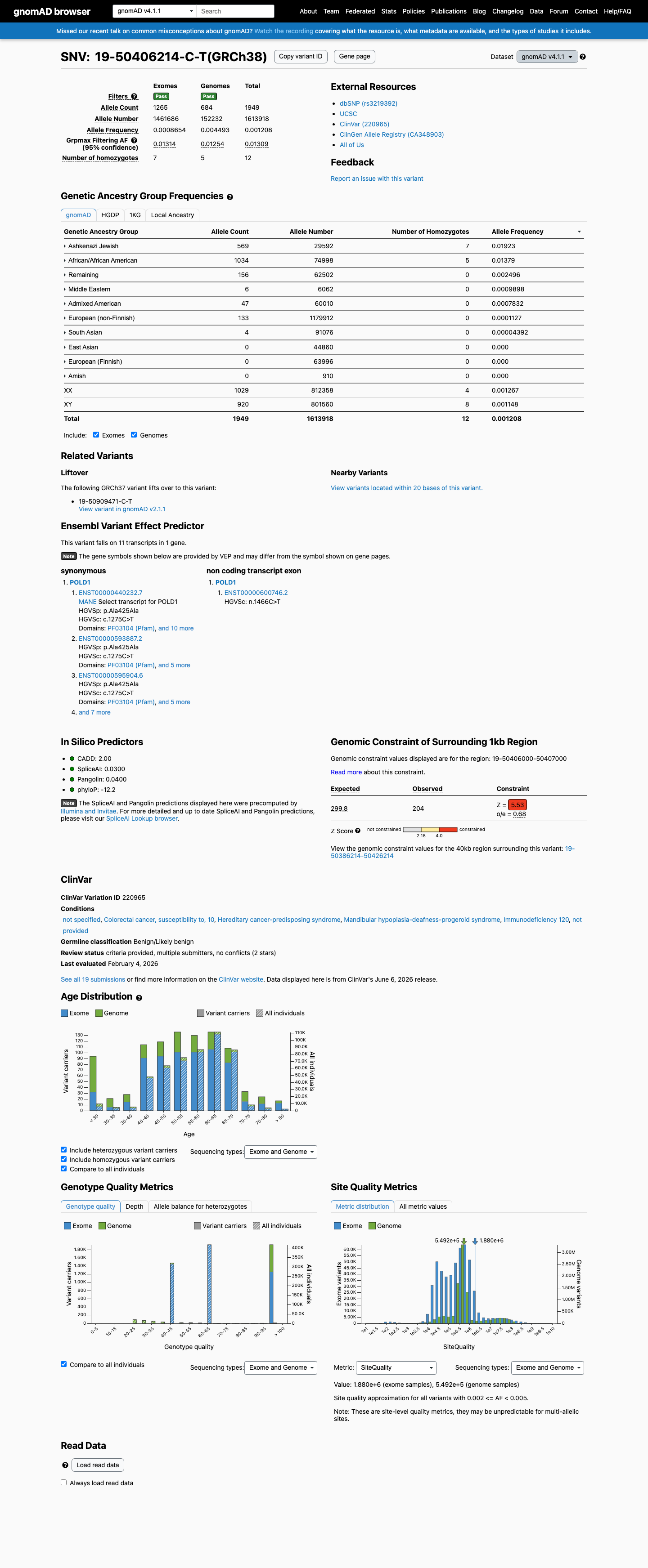
This variant is present in gnomAD v4.1 (AF= 0.00120762; MAF= 0.12076%, 1949/1613918 alleles, homozygotes = 12) and has highest observed frequency in the Ashkenazi Jewish population (AF= 0.0192282; MAF= 1.92282%, 569/29592 alleles, homozygotes = 7); grpmax FAF= 0.0130893.
v2.1
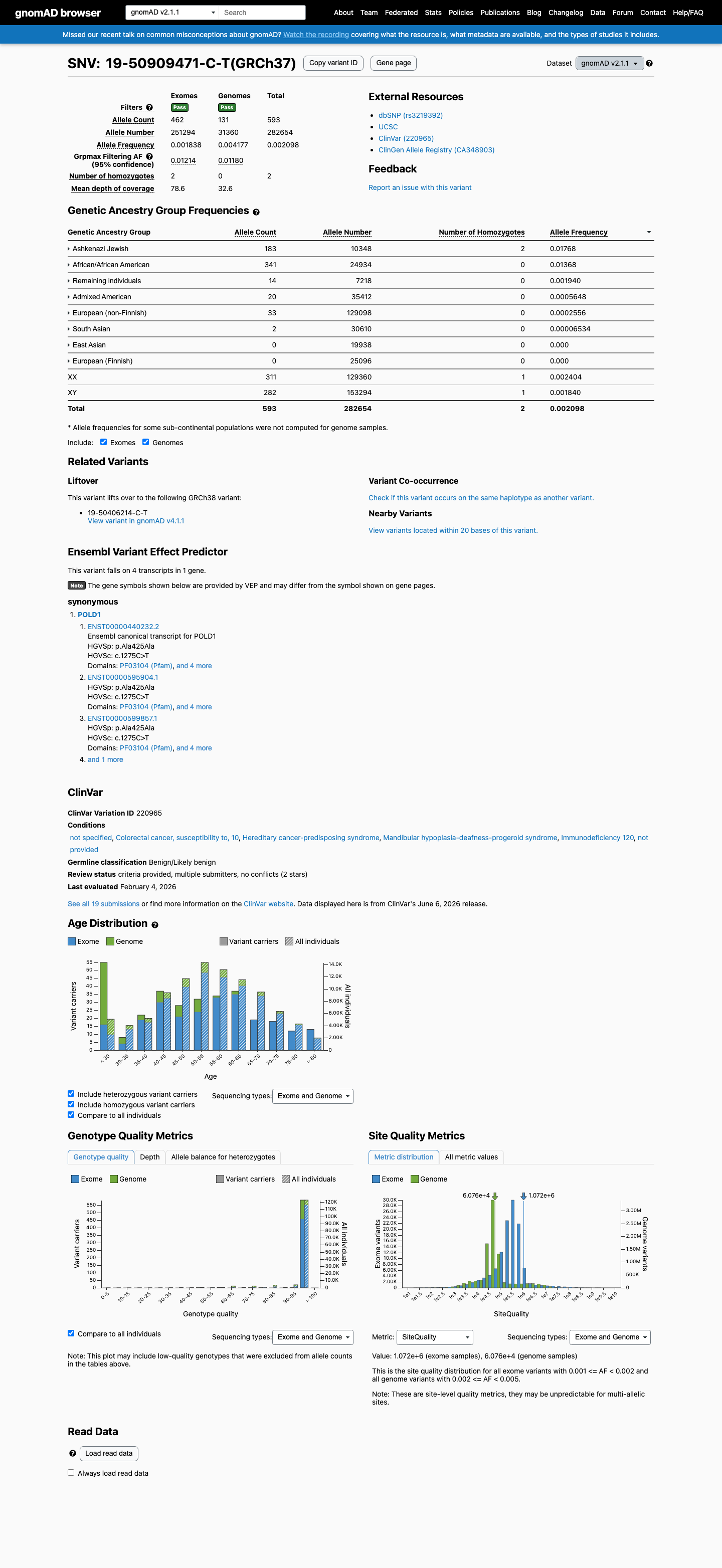
This variant is present in gnomAD v2.1 (AF= 0.00209797; MAF= 0.20980%, 593/282654 alleles, homozygotes = 2) and has highest observed frequency in the Ashkenazi Jewish population (AF= 0.0176846; MAF= 1.76846%, 183/10348 alleles, homozygotes = 2); grpmax FAF= 0.0121365.
🇨🇦 CA
This variant is present in gnomAD-Canada v1.0 (AF= 0.001738752445120626, 32/18404 alleles, homozygotes = 1).
Allele frequency by ancestry
three datasets · side by side
gnomAD v4.1
0.12%
· 1949 / 1,613,918
12 hom · FAF 1.3%
Ashkenazi Jewish
569 / 29,592
1.9%
7 hom
African/African American
1034 / 74,998
1.4%
5 hom
Remaining individuals
156 / 62,502
0.25%
Middle Eastern
6 / 6,062
0.099%
Admixed American
47 / 60,010
0.078%
European (non-Finnish)
133 / 1,179,912
0.011%
South Asian
4 / 91,076
0.0044%
+ 3 not observed (European (Finnish), Amish, East Asian)
gnomAD v2.1
0.21%
· 593 / 282,654
2 hom · FAF 1.2%
Ashkenazi Jewish
183 / 10,348
1.8%
2 hom
African/African American
341 / 24,934
1.4%
Remaining individuals
14 / 7,218
0.19%
Admixed American
20 / 35,412
0.056%
European (non-Finnish)
33 / 129,098
0.026%
South Asian
2 / 30,610
0.0065%
+ 2 not observed (East Asian, European (Finnish))
gnomAD Canada 🇨🇦
0.17%
· 32 / 18,404
1 hom · FAF 0.99%
African/African American
16 / 1,018
1.6%
1 hom
Ashkenazi Jewish
7 / 832
0.84%
Remaining individuals
3 / 1,138
0.26%
Latino/Admixed American
2 / 838
0.24%
European (non-Finnish)
4 / 11,726
0.034%
+ 4 not observed (East Asian, European (Finnish), Middle Eastern, South Asian)
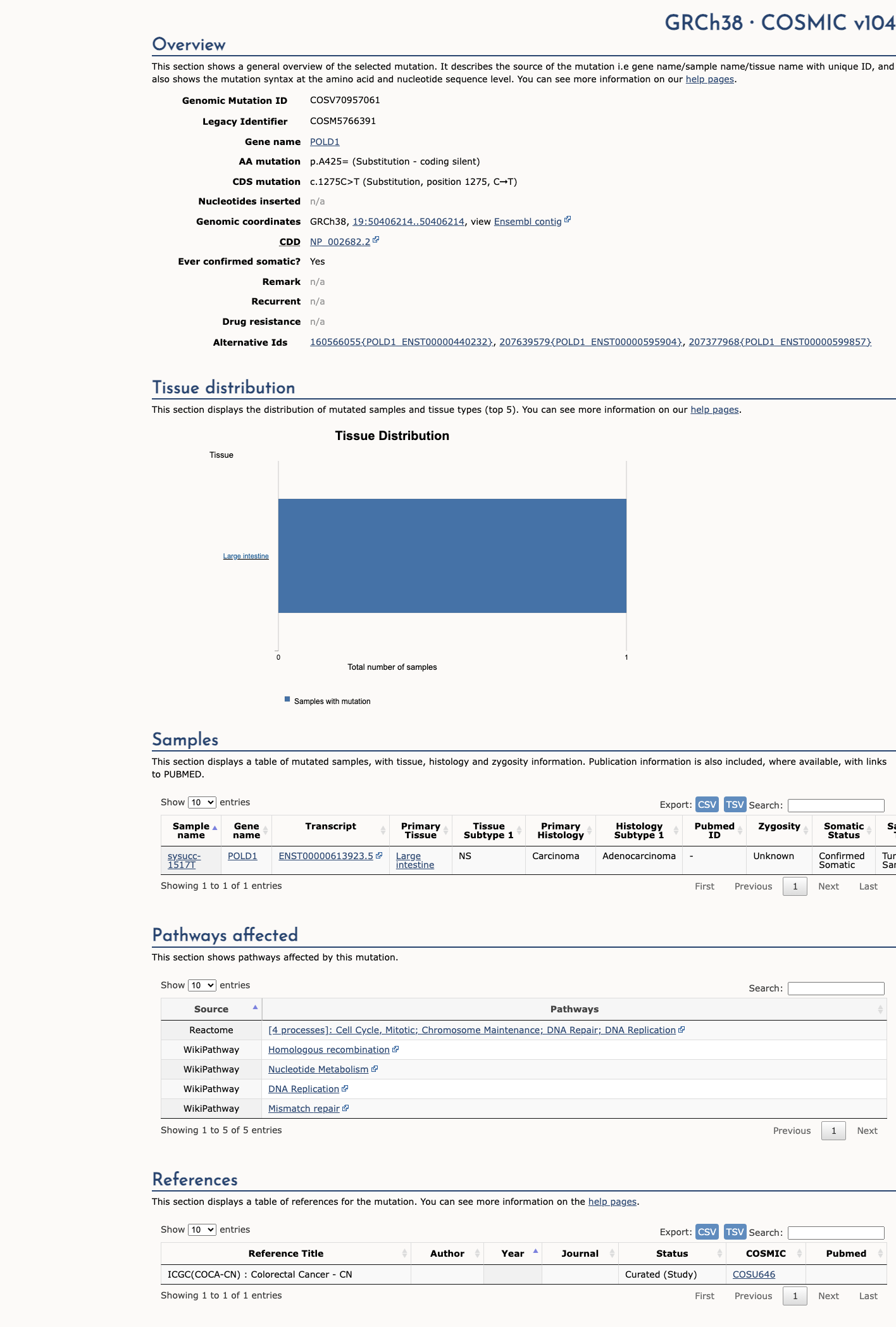
This variant does not lie in a statistically significant hotspot. This variant has previously been reported in somatic cancers (COSMIC; COSV70957061, n = 1 times).
Hotspots
This variant does not lie in a statistically significant hotspot.
Triaged references · 4 PMIDs not cited in assessment
25741868 ↗Standards and guidelines for the interpretation of sequence variants: a joint consensus recommendation of the American College of Medical Genetics and Genomics and the Association for Molecular Pathology.CLINVAR
26467025 ↗A Standardized DNA Variant Scoring System for Pathogenicity Assessments in Mendelian Disorders.CLINVAR
25394175 ↗A practice guideline from the American College of Medical Genetics and Genomics and the National Society of Genetic Counselors: referral indications for cancer predisposition assessment.CLINVAR
28492532 ↗Sherloc: a comprehensive refinement of the ACMG-AMP variant classification criteria.CLINVAR