Analysis in progress
Initialising…
0%
complete
This report is still being assembled — sections appear as each stage finishes. It isn't final yet.
TSC2
Final classification
Likely Benign
BS2BS3BS4
TSC2
c.2476C>A
p.Leu826Met
missense · exon 22

TSC2 is a tumor suppressor gene that encodes tuberin, a growth-inhibitory protein. Tuberin teams up with hamartin to form the TSC protein complex, which keeps cell growth in check by dampening mTORC1 signaling. Mutations in TSC2 cause tuberous sclerosis, a disorder featuring benign and occasionally malignant tumors, and are also linked to lymphangioleiomyomatosis. Loss-of-function changes in TSC2 are seen in some cancers, such as liver and endometrial cancers, and can make tumors sensitive to mTOR-inhibiting drugs.

This variant

TSC2 is a tumor suppressor whose loss of function causes tuberous sclerosis, but this missense change (p.Leu826Met) is classified Likely Benign: functional assays show it does not disrupt tuberin's growth-inhibitory activity, and population databases carry it at measurable frequency. The variant is therefore not expected to impair TSC2 function or contribute to tuberous sclerosis.

Transcript
NM_000548.5
HGVS · transcript:coding
NM_000548.5:c.2476C>A
GRCh38
chr16:2074320 C>A
GRCh37
chr16:2124321 C>A
Basis Likely Benign: no TSC2-specific framework was available, so generic ACMG/AMP 2015 rules were applied; BS2, BS3 (moderate), and BS4 were met, with no pathogenic criteria.
Likely Benign: no TSC2-specific framework was available, so generic ACMG/AMP 2015 rules were applied; BS2, BS3 (moderate), and BS4 were met, with no pathogenic criteria.
Classification rationale
BS2BS3BS4 Likely Benign
TSC2 c.2476C>A missense · exon 22

BS2 (Supporting): variant reported as a polymorphism inherited from an unaffected father with no effect on TSC2 protein function. BS3 (Moderate): direct functional assays showed p.Leu826Met behaves like wild-type tuberin across multiple readouts, with no damaging effect. BS4 (Supporting): the variant non-segregates with disease, inherited by both children from an unaffected father. Overall: Likely Benign under generic ACMG/AMP 2015 combination rules — BS2, BS3, and BS4 met, no pathogenic criteria applied.

BS2 + BS3 + BS4 Likely Benign
Gene diagram · NM_000548.5 · variants mapped to exon structure
TSC2 NM_000548.5
Fetching transcript structure from UCSC…
Applied criteria · 3 applied · 20 assessed
MetEvidence satisfies this criterion.
Not metEvaluated against available evidence; threshold not reached.
Not assessedApplies in principle, but no evidence was found to evaluate it.
N/ADoesn't apply to this variant type.
Applied · 3
Strength Supporting Moderate Strong Very strong
BS2 supporting Benign
Met (Supporting): the variant was reported as a polymorphism inherited from an unaffected father, with no effect on TSC2 protein function.
PMID:17120248 reports: "In Family B, both children also inherited a TSC2 L826M polymorphism from their unaffected father. This polymorphism has no effect on the TSC2 protein function.29 No other polymorphisms or variants were detected in TSC1 or TSC2." The location is Results, Additional Families.PMID:15483652 studied the exact TSC2 L826M substitution, identified in an unaffected relative of a TSC patient, and concluded there was no evidence that L826M disrupted tuberin function and that it was a nonpathogenic change. The relevant evidence is in the Results and Table 1.The observation is used only as healthy-individual evidence for BS2 in this group; the cited papers are not being used here for any other ACMG criterion.
BS3 moderate review Benign
Met (Moderate): direct functional assays showed p.Leu826Met behaved like wild-type tuberin across multiple concordant readouts, with no damaging effect.
PMID:15483652 directly assayed TSC2 p.L826M: coimmunoprecipitation showed L826M did not disrupt the tuberin-hamartin complex; S6K T389 phosphorylation and S6 phosphorylation (in Tsc2-/- MEFs) were inhibited normally; L826M stimulated rheb GTPase activity in vitro comparably to wild-type. Authors concluded no evidence of disrupted tuberin function and classified L826M as nonpathogenic.Direct quote (PMID:15483652): 'The R367Q, A607T and L826M substitutions did not adversely affect the tuberin-hamartin interaction, the stimulation of rheb GTPase activity or the inhibition of S6K and S6 phosphorylation. There was no evidence that the R367Q, A607T and L826M substitutions disrupted tuberin function and we concluded that they are nonpathogenic changes.'PMID:17120248 independently states the TSC2 L826M polymorphism 'has no effect on the TSC2 protein function,' citing the same underlying functional work, corroborating the benign-direction functional conclusion in a second publication.
BS4 supporting review Benign
Met (Supporting): both children inherited the variant from their unaffected father, demonstrating non-segregation with disease.
PMID:17120248 directly states: "In Family B, both children also inherited a TSC2 L826M polymorphism from their unaffected father."The same extraction identifies the source as family-based clinical and molecular analysis and states that L826M had no effect on TSC2 protein function; only the inheritance from an unaffected father is used here for BS4.
Assessed · not applied · 10 not met · 10 not assessed
Pathogenic
PS1 Not assessed: no differently-coded variant producing the same p.Leu826Met substitution with an established pathogenic classification was identified.
PS2 Not assessed: no evidence that the variant arose de novo in an affected proband with confirmed maternity and paternity was available.
PS3 Not met: direct functional assays showed p.Leu826Met behaved like wild-type tuberin, with no damaging effect across any readout.
PS4 Not assessed: no case-control or enrichment evidence for this variant among individuals with tuberous sclerosis was available.
PM1 Not met: residue 826 lies in a broad ~900-residue N-terminal region rather than a small curated hotspot, and direct functional data show the substitution is nonpathogenic.
PM2 Not met: gnomAD v4.1 overall allele frequency is 0.135%, above the <0.1% PM2 rare-variant cutoff.
PM5 Not assessed: no same-residue missense change with an established pathogenic classification was identified; the only alternate, p.Leu826Pro, comes from a somatic functional panel.
PM6 Not assessed: no evidence of presumed de novo occurrence without confirmed parentage was available.
PP1 Not assessed: no supportive segregation series exists; the variant was inherited from an unaffected father, which is non-segregating.
PP2 Not assessed: no TSC2 missense constraint metric, such as a gnomAD missense Z-score, was available to evaluate this criterion.
PP3 Not met: REVEL score 0.638 is below the ≥0.644 PP3 supporting threshold, in the inconclusive zone.
PP4 Not assessed: no phenotype-specificity information for the tested individual was provided.
PP5 Not met: ClinVar has no expert-panel Pathogenic or Likely Pathogenic assertion for this exact variant.
Benign
BA1 Not met: the highest gnomAD v4.1 subpopulation frequency is 0.17%, far below the >1% BA1 threshold.
BS1 Not met: the highest gnomAD v4.1 subpopulation frequency is 0.17%, below the >0.3% BS1 threshold.
BP1 Not met: missense variants are an established cause of TSC2 disease, so the truncation-only premise does not hold.
BP2 Not assessed: no pathogenic variant in the same individuals was documented, so phase with such a variant could not be established.
BP4 Not met: REVEL score 0.638 is above the ≤0.290 BP4 supporting threshold, in the inconclusive zone.
BP5 Not assessed: no data linking the tested individual to an alternate phenotype-causing molecular diagnosis were available.
BP6 Not met: ClinVar has no expert-panel Benign or Likely Benign assertion for this exact variant.
N/A · 5 PVS1 · PM3 · PM4 · BP3 · BP7
Research & evidence
Population frequency · supports benign
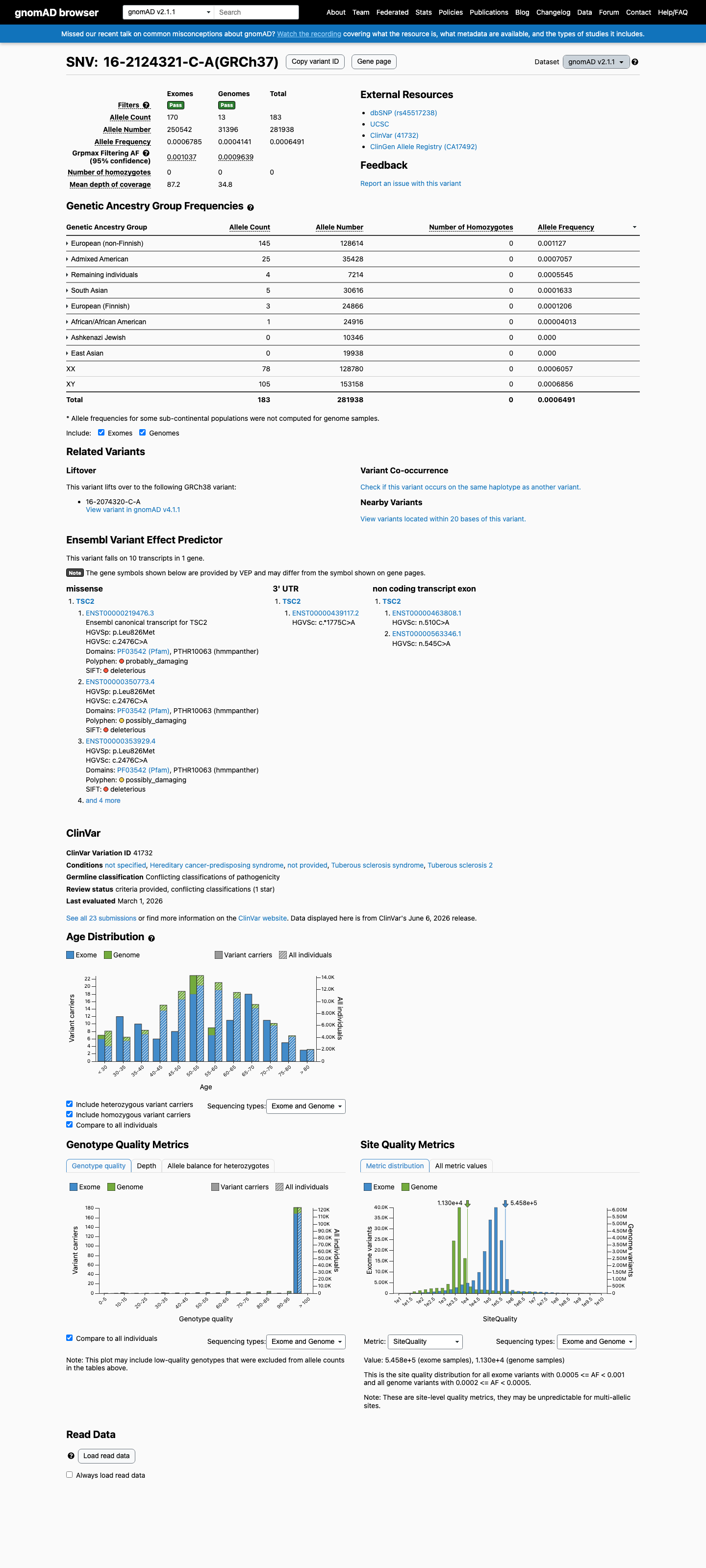
gnomAD v4.1 screenshot
gnomAD v4.1
gnomAD v2.1 screenshot
gnomAD v2.1
v4.1
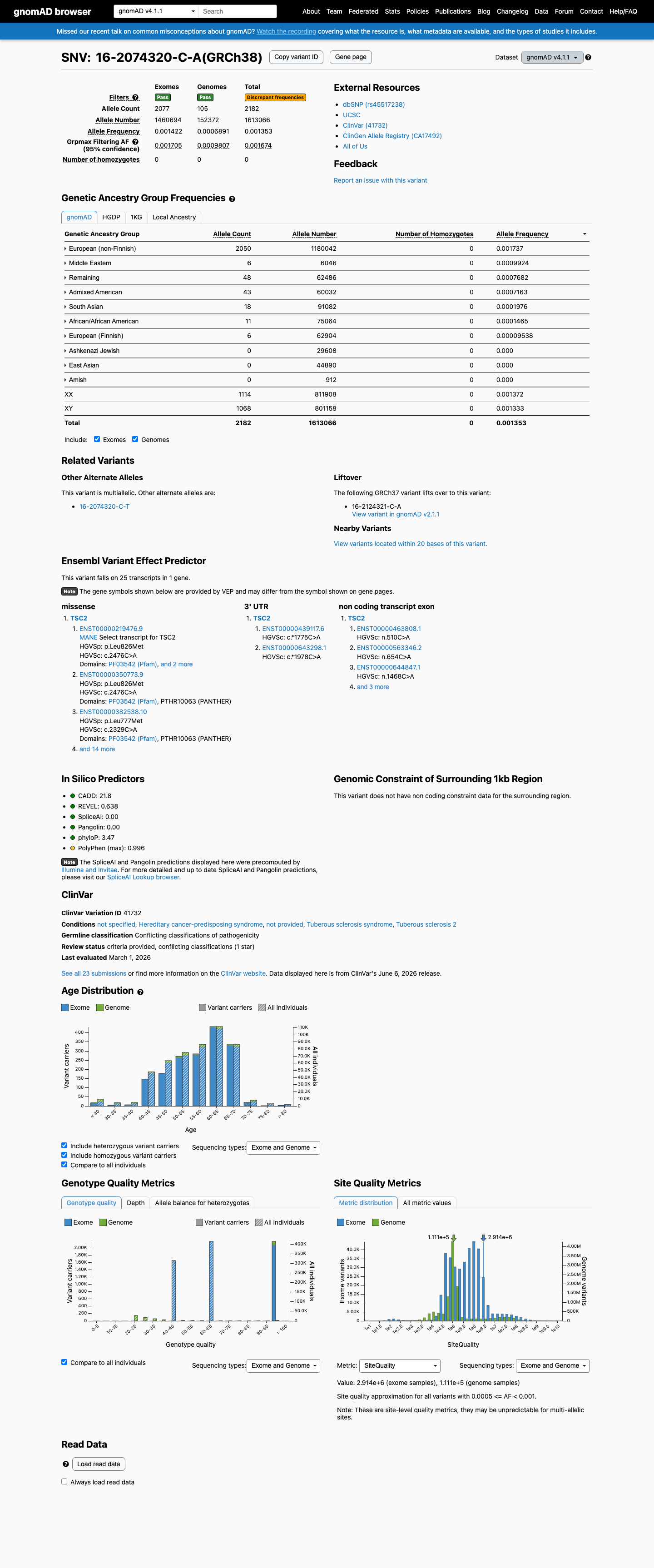
This variant is present in gnomAD v4.1 (AF= 0.0013527; MAF= 0.13527%, 2182/1613066 alleles, homozygotes = 0) and has highest observed frequency in the European (non-Finnish) population (AF= 0.00173723; MAF= 0.17372%, 2050/1180042 alleles, homozygotes = 0); grpmax FAF= 0.00167402.
v2.1
This variant is present in gnomAD v2.1 (AF= 0.000649079; MAF= 0.06491%, 183/281938 alleles, homozygotes = 0) and has highest observed frequency in the European (non-Finnish) population (AF= 0.0011274; MAF= 0.11274%, 145/128614 alleles, homozygotes = 0); grpmax FAF= 0.00103684.
🇨🇦 CA
This variant is present in gnomAD-Canada v1.0 (AF= 0.0002714146129627619, 5/18422 alleles, homozygotes = 0).
Allele frequency by ancestry
three datasets · side by side
gnomAD v4.1
0.14% · 2182 / 1,613,066
0 hom · FAF 0.17%
European (non-Finnish)
2050 / 1,180,042
0.17%
Middle Eastern
6 / 6,046
0.099%
Remaining individuals
48 / 62,486
0.077%
Admixed American
43 / 60,032
0.072%
South Asian
18 / 91,082
0.02%
African/African American
11 / 75,064
0.015%
European (Finnish)
6 / 62,904
0.0095%
+ 3 not observed (Amish, East Asian, Ashkenazi Jewish)
gnomAD v2.1
0.065% · 183 / 281,938
0 hom · FAF 0.1%
European (non-Finnish)
145 / 128,614
0.11%
Admixed American
25 / 35,428
0.071%
Remaining individuals
4 / 7,214
0.055%
South Asian
5 / 30,616
0.016%
European (Finnish)
3 / 24,866
0.012%
African/African American
1 / 24,916
0.004%
+ 2 not observed (Ashkenazi Jewish, East Asian)
gnomAD Canada 🇨🇦
0.027% · 5 / 18,422
0 hom
Latino/Admixed American
1 / 838
0.12%
European (non-Finnish)
4 / 11,742
0.034%
+ 7 not observed (African/African American, Ashkenazi Jewish, East Asian, European (Finnish), Middle Eastern, Remaining individuals, South Asian)
ClinVar screenshot
ClinVar
This variant has been reported in ClinVar as Likely benign (10 clinical laboratories) and as Benign (8 clinical laboratories) and as Uncertain significance (1 clinical laboratory). (ClinVarID = 41732)
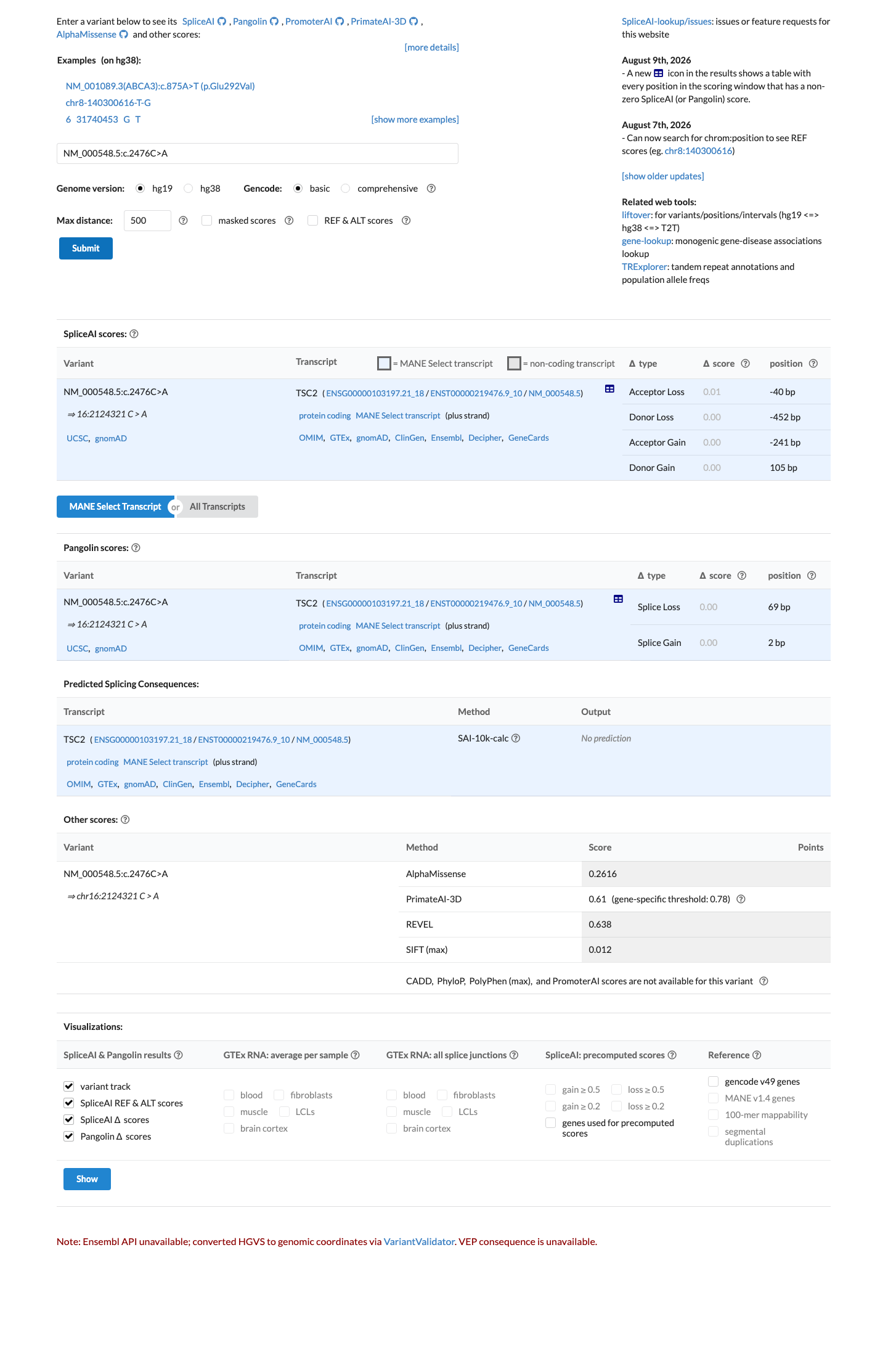
SpliceAI screenshot
In silico
SpliceAI predicts no significant splice impact for this variant (max delta score = 0.01). REVEL score = 0.638. BayesDel score = 0.0342033.
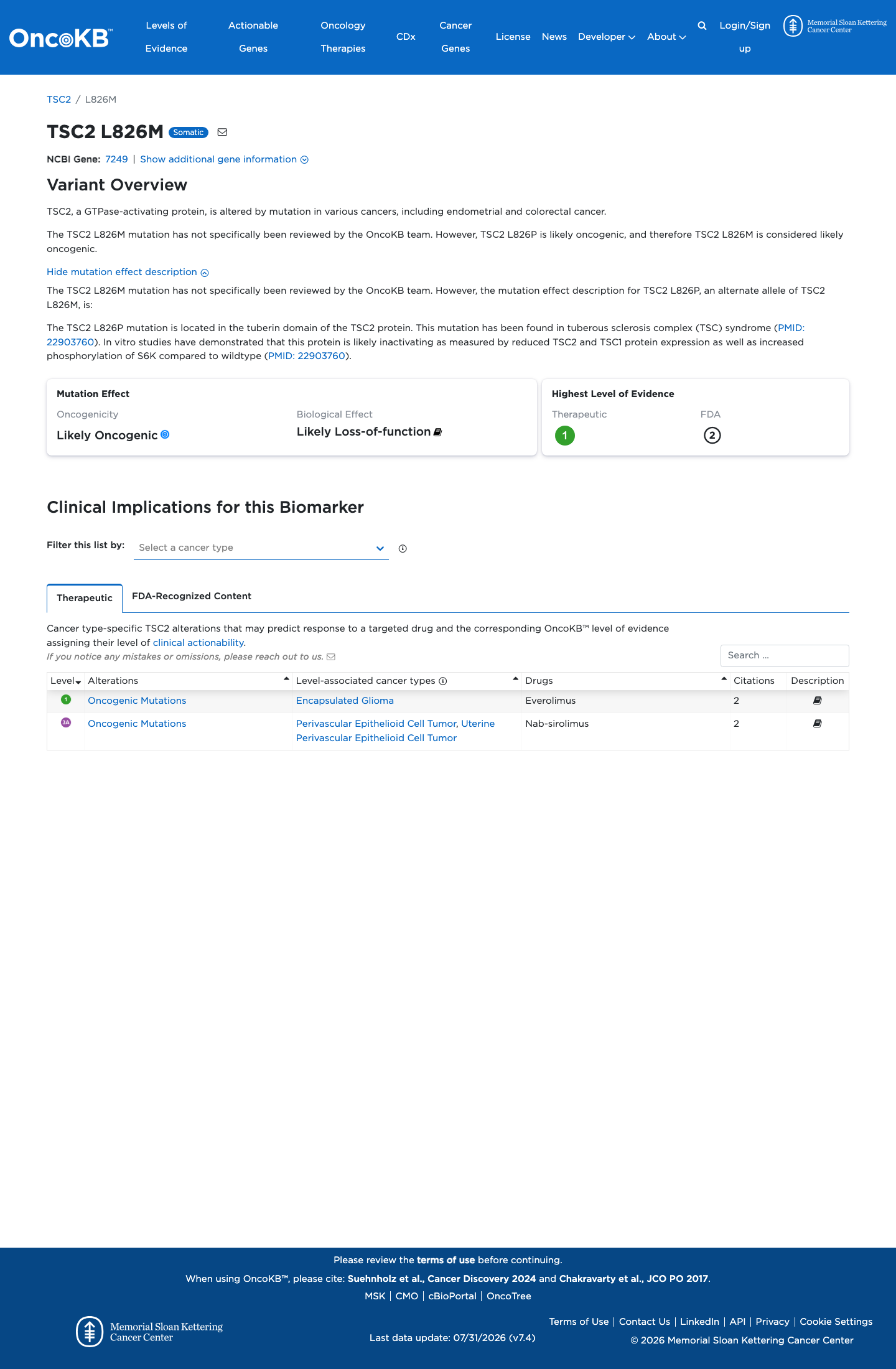
Functional / OncoKB screenshot
Functional Likely Oncogenic
OncoKB did not identify variant-specific reviewed functional evidence for this variant; gene-level curated context is available for reviewer follow-up. TSC2, a GTPase-activating protein, is altered by mutation in various cancers, including endometrial and colorectal cancer.
OncoKB ↗
COSMIC screenshot
COSMIC
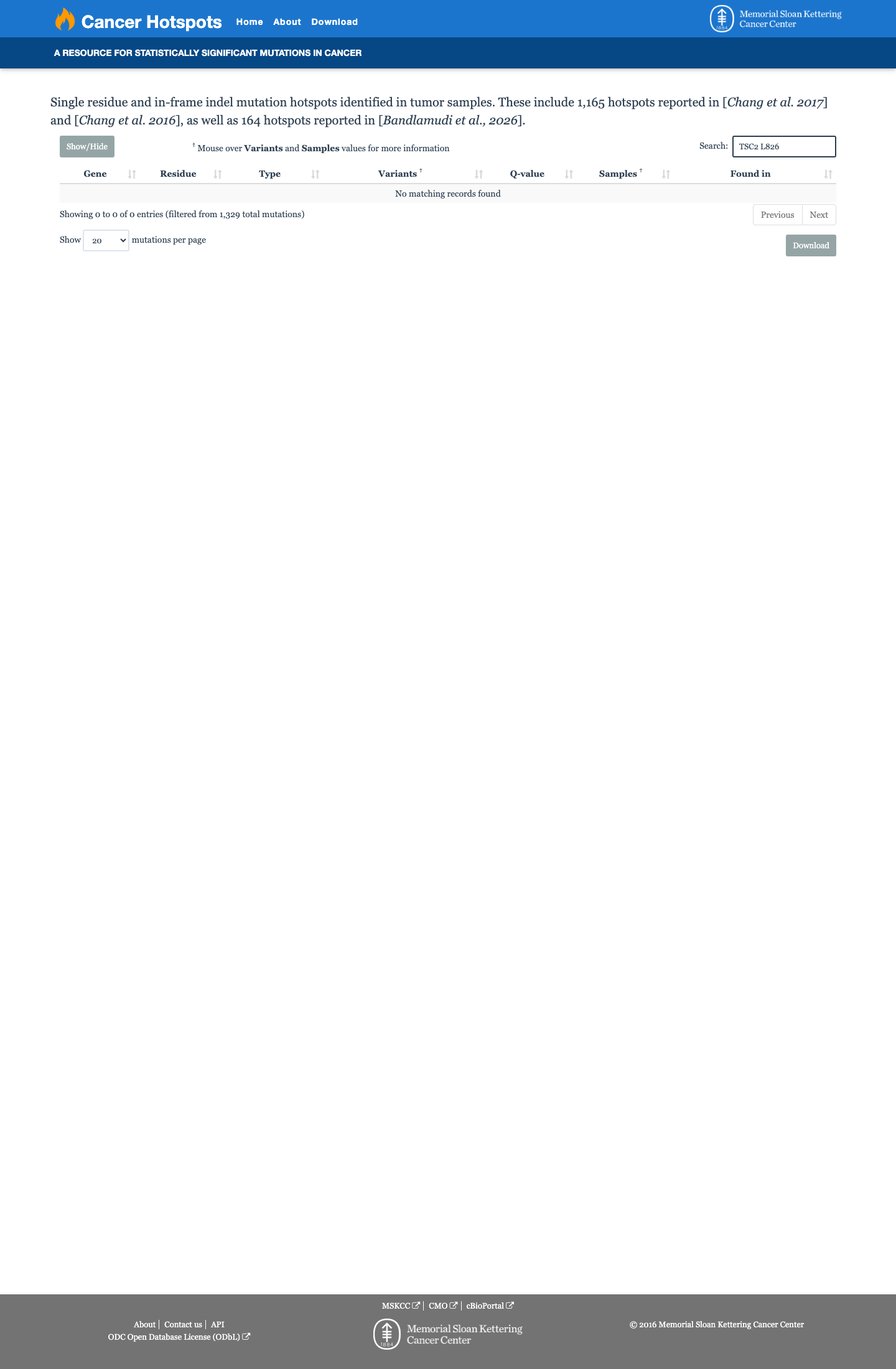
Cancer hotspots screenshot
Cancer hotspots
Somatic evidence Not in COSMIC / hotspots
COSMIC
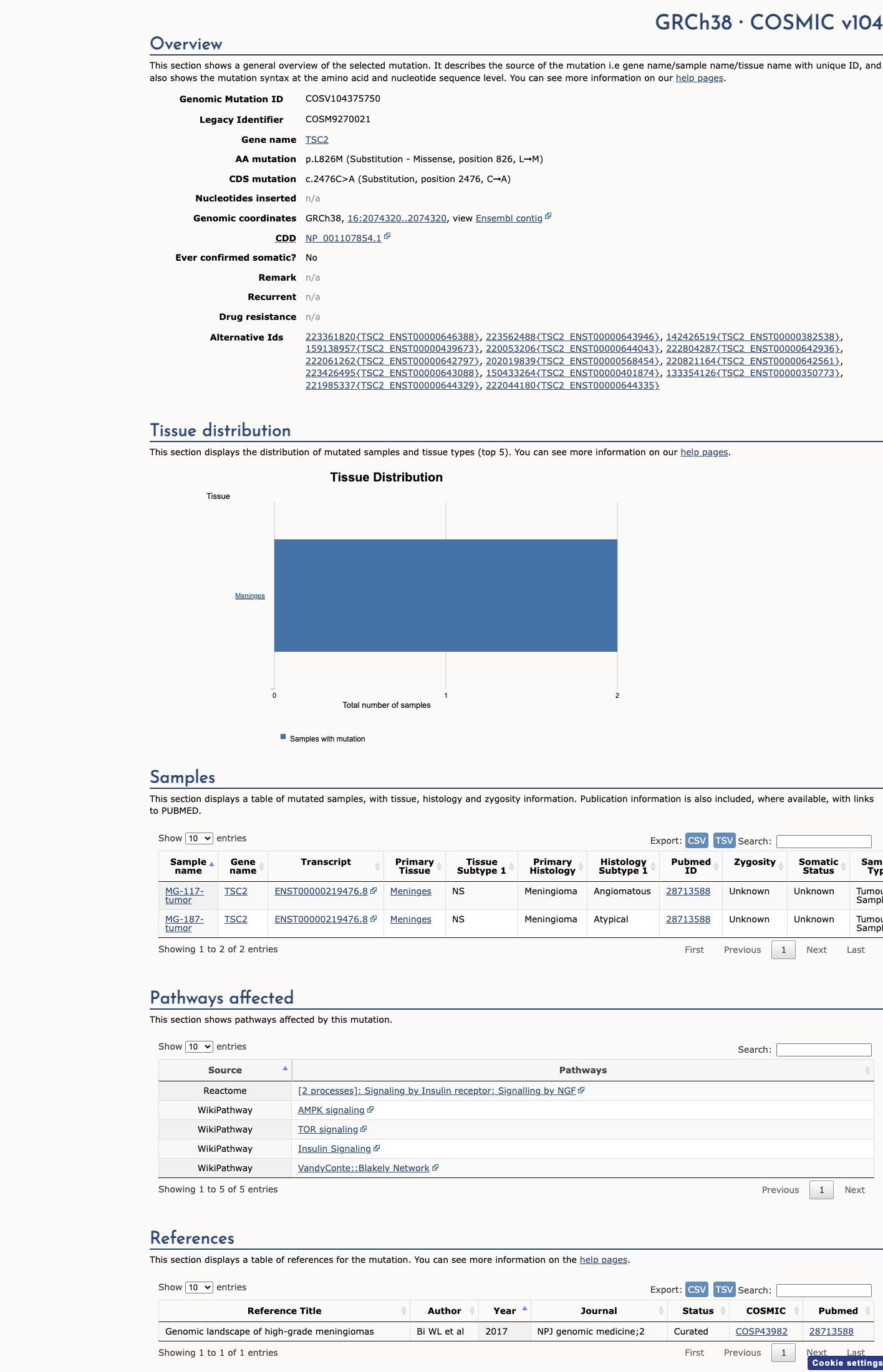
This variant does not lie in a statistically significant hotspot. This variant has previously been reported in somatic cancers (COSMIC; COSV104375750, n = 2 times).
Hotspots
This variant does not lie in a statistically significant hotspot.
Literature · how each cited paper was used
5papers cited
Each card is an audit: what was searched, what was found, whether it names the variant, which criteria it fed, and why. 5 further PMIDs triaged but not cited — see Sources & references.
Distinct effects of single amino-acid changes to tuberin on the function of the tuberin-hamartin complex.
Searched
TSC2 c.2476C>ANP_000539.2:p.(L826M)L826M
Found
This paper explicitly studied the TSC2 p.L826M tuberin substitution. L826M did not affect formation of the tuberin-hamartin complex, did not impair inhibition of S6K T389 phosphorylation, did not impair inhibition of S6 phosphorylation in Tsc2-/- mouse embryo fibroblasts, and did not impair stimulation of rheb GTPase activity in vitro. The authors reported no evidence that L826M disrupted tuberin function and classified it as a nonpathogenic change.
Variant
✓ Names this variant — characterised directly
Applied to
BS2 supporting
The exact L826M variant was identified in an unaffected relative, contributing healthy-individual evidence.
BS3 moderate
Direct, variant-specific multi-assay functional data showing no damaging effect of L826M on tuberin function.
The R367Q, A607T and L826M substitutions did not adversely affect the tuberin–hamartin interaction, the stimulation of rheb GTPase activity or the inhibition of S6K and S6 phosphorylation. There was no evidence that the R367Q, A607T and L826M substitutions disrupted tuberin function and we concluded that they are nonpathogenic changes.
Location Results, paragraphs discussing the tuberin–hamartin interaction and overall functional analysis; Table 1  ·  Context Site-directed mutagenesis and expression of TSC2 variants; coimmunoprecipitation of tuberin-hamartin complexes; S6K T389 phosphorylation assay in transfected HEK293 cells; S6 phosphorylation assay in serum-starved Tsc2-/- mouse embryo fibroblasts; in vitro rheb GTPase assay. L826M was identified in an unaffected relative of a TSC patient.  ·  full text
Unusually mild tuberous sclerosis phenotype is associated with TSC2 R905Q mutation.
Searched
TSC2 c.2476C>Ac.2476C>ANP_000539.2:p.(L826M)p.(L826M)L826M
Found
The paper explicitly mentions TSC2 L826M in Family B, where both children inherited this polymorphism from their unaffected father, with no effect on TSC2 protein function reported. The paper's primary subject is TSC2 R905Q, an unrelated pathogenic missense mutation at a different codon causing a mild but definite tuberous sclerosis phenotype in a large kindred.
Variant
✓ Names this variant — characterised directly
Applied to
BS2 supporting
The exact L826M variant was inherited from an unaffected father in Family B, providing healthy-individual evidence.
BS3 moderate
Corroborates the benign functional conclusion for L826M by independently citing it as having no effect on TSC2 protein function.
BS4 supporting
The report of L826M in an unaffected father who transmitted it to both children is direct non-segregation evidence relevant to BS4.
In Family B, both children also inherited a TSC2 L826M polymorphism from their unaffected father. This polymorphism has no effect on the TSC2 protein function.29 No other polymorphisms or variants were detected in TSC1 or TSC2.
Location Results, Additional Families  ·  Context Family-based clinical and molecular analysis of TSC kindreds; L826M cited via prior functional literature rather than a new assay in this study; R905Q pathogenicity was separately established with clinical and functional data in this paper's main cohort.  ·  full text
Rule & framework references · cited for criterion definitions, not variant evidence
15798777 ↗ Mutational analysis of the TSC1 and TSC2 genes in a diagnostic setting: genotype--phenotype correlations and comparison of diagnostic DNA techniques in Tuberous Sclerosis Complex.
21309039 ↗ Functional assessment of variants in the TSC1 and TSC2 genes identified in individuals with Tuberous Sclerosis Complex.
22903760 ↗ Functional assessment of TSC2 variants identified in individuals with tuberous sclerosis complex.
Sources & reference links
8Sources
ClinVar
gnomAD v2.1
gnomAD v4.1
gnomAD-Canada
SpliceAI
OncoKB
COSMIC
Cancer hotspots
Triaged references · 5 PMIDs not cited in assessment
24033266 ↗ A systematic approach to assessing the clinical significance of genetic variants. CLINVAR
25741868 ↗ Standards and guidelines for the interpretation of sequence variants: a joint consensus recommendation of the American College of Medical Genetics and Genomics and the Association for Molecular Pathology. CLINVAR
26489027 ↗ Prioritization and burden analysis of rare variants in 208 candidate genes suggest they do not play a major role in CAKUT. CLINVAR
24055113 ↗ Actionable, pathogenic incidental findings in 1,000 participants' exomes. CLINVAR
28492532 ↗ Sherloc: a comprehensive refinement of the ACMG-AMP variant classification criteria. CLINVAR