Analysis in progress
Initialising…
0%
complete
This report is still being assembled — sections appear as each stage finishes. It isn't final yet.
TP53
Final classification
VUS
PM2PP3
TP53
c.797G>T
p.Gly266Val
missense · exon 8

TP53 encodes the p53 protein, a critical tumor suppressor that acts as a transcription factor to protect cells from damage. When activated by cellular stress such as DNA damage, p53 triggers responses including DNA repair, cell cycle arrest, and programmed cell death (apoptosis) to prevent the propagation of damaged cells. TP53 is the most frequently mutated gene in human cancers, and loss of its function contributes to tumor development, invasion, drug resistance, and genomic instability. Inherited mutations in TP53 cause Li-Fraumeni syndrome, a rare hereditary condition that greatly increases the risk of developing multiple types of cancer at a young age.

This variant

TP53 encodes the p53 tumor suppressor, whose loss of function drives cancer development and whose inherited mutations cause Li-Fraumeni syndrome. This p.Gly266Val variant is classified as a Variant of Uncertain Significance: it is absent from population databases and predicted damaging by Align-GVGD and BayesDel, but without variant-specific functional or familial evidence its impact on p53 tumor-suppressor function cannot yet be determined.

Transcript
NM_000546.6
HGVS · transcript:coding
NM_000546.6:c.797G>T
GRCh38
chr17:7673823 C>A
GRCh37
chr17:7577141 C>A
Basis 3 points under the TP53 VCEP v2.4 framework (PM2_Supporting +1, PP3_Moderate +2) map to Uncertain Significance (Rule3: -1 to 5).
3 points under the TP53 VCEP v2.4 framework (PM2_Supporting +1, PP3_Moderate +2) map to Uncertain Significance (Rule3: -1 to 5).
Classification rationale
PM2PP3 VUS
TP53 c.797G>T missense · exon 8

PM2 (Supporting): allele frequency 0 in gnomAD v2.1 (0/248,882 alleles), absent from gnomAD v4.1 and gnomAD-Canada, meeting the <0.003% threshold. PP3 (Moderate): Align-GVGD Class C65 and BayesDel score 0.599005 meet the VCEP PP3_Moderate threshold (BayesDel >= 0.16). Final classification: Uncertain Significance (VUS) under the TP53 VCEP v2.4 point framework (3 points, Rule3: -1 to 5).

PM2 + PP3 VUS
Gene diagram · NM_000546.6 · variants mapped to exon structure
TP53 NM_000546.6
Fetching transcript structure from UCSC…
Applied criteria · 2 applied · 16 assessed
MetEvidence satisfies this criterion.
Not metEvaluated against available evidence; threshold not reached.
Not assessedApplies in principle, but no evidence was found to evaluate it.
N/ADoesn't apply to this variant type.
Applied · 2
Strength Supporting Moderate Strong Very strong
PM2 supporting Pathogenic
Met (Supporting): allele frequency is 0 in gnomAD v2.1 (0/248,882 alleles) and the variant is absent from gnomAD v4.1, below the 0.003% PM2 threshold.
TP53 VCEP v2.4 specifies PM2_Supporting for AF <0.00003 (0.003%) in gnomAD or another large sequenced population; if multiple alleles occur within an ancestry group, that group's AF must be <0.00004, and founder-effect groups are ignored.gnomAD v2.1 reports AC=0, AN=248,882, AF=0, and homozygotes=0; every reported ancestry group also has AC=0 and AF=0.gnomAD v4.1 and gnomAD-Canada report the variant as absent, providing concordant population rarity evidence.
PP3 moderate Pathogenic
Met (Moderate): Align-GVGD Class C65 and BayesDel score 0.599005 meet the VCEP PP3_Moderate threshold (BayesDel >= 0.16).
TP53 VCEP PP3-BP4-codes.xlsx (Supplementary Table S2) row for c.797G>T / p.Gly266Val: Align-GVGD Class C65, BayesDel 0.599005, preliminary bioinformatic code = PP3_moderate, maximum SpliceAI delta score (10kb window) = 0.17 (below 0.2 splice-impact threshold, so code is not altered).TP53 VCEP cspec v2.4 PP3 rule (moderate): 'Missense variants: aGVGD Class C65 and BayesDel score >= 0.16' -> PP3_Moderate satisfied.Local BayesDel predictor lookup (BayesDel_170824_noAF, chr17) score = 0.599005 at 17-7577141-C-A, matching the VCEP spreadsheet value.
Assessed · not applied · 5 not met · 11 not assessed
Pathogenic
PS1 Not assessed: no alternative nucleotide change producing p.Gly266Val with an established pathogenic classification was available as a comparator.
PS2 Not assessed: no parental testing or de novo occurrence data were available for the proband.
PS3 Not assessed: no functional assay result specific to p.Gly266Val was available; the only VCEP worksheet row covers a different substitution (p.Gly266Ala).
PS4 Not assessed: no eligible proband observations or case-control enrichment data for p.Gly266Val were available.
PM1 Not assessed: codon 266 is not among the TP53 VCEP hotspot codons (175, 245, 248, 249, 273, 282).
PM5 Not assessed: no other codon 266 missense variant with an established pathogenic classification was available as a comparator.
PP1 Not assessed: no affected relatives or cosegregation data were available.
PP4 Not assessed: no blood-test variant allele fraction or testing-context data were available for this low-VAF rule.
PP5 Not met: the ClinVar record has no expert-panel submissions; the lone pathogenic assertion comes from a single laboratory.
Benign
BA1 Not met: the variant is absent from population databases (0/248,882 gnomAD v2.1 alleles), far below the 0.1% BA1 threshold.
BS1 Not met: allele frequency is 0 in gnomAD, below the 0.03% BS1 frequency threshold.
BS2 Not assessed: no data on unrelated cancer-free carriers aged 60 or older were available.
BS3 Not assessed: no functional assay result specific to p.Gly266Val was available to assess a benign effect.
BS4 Not assessed: no family members tested and found not to carry the variant.
BP4 Not met: BayesDel 0.599005 is far above the benign threshold, and BP4 is mutually exclusive with the assigned PP3_Moderate code.
BP6 Not met: the ClinVar record has no expert-panel benign or likely benign classification.
N/A · 10 PVS1 · PM3 · PM4 · PM6 · PP2 · BP1 · BP2 · BP3 · BP5 · BP7
Research & evidence
Population frequency
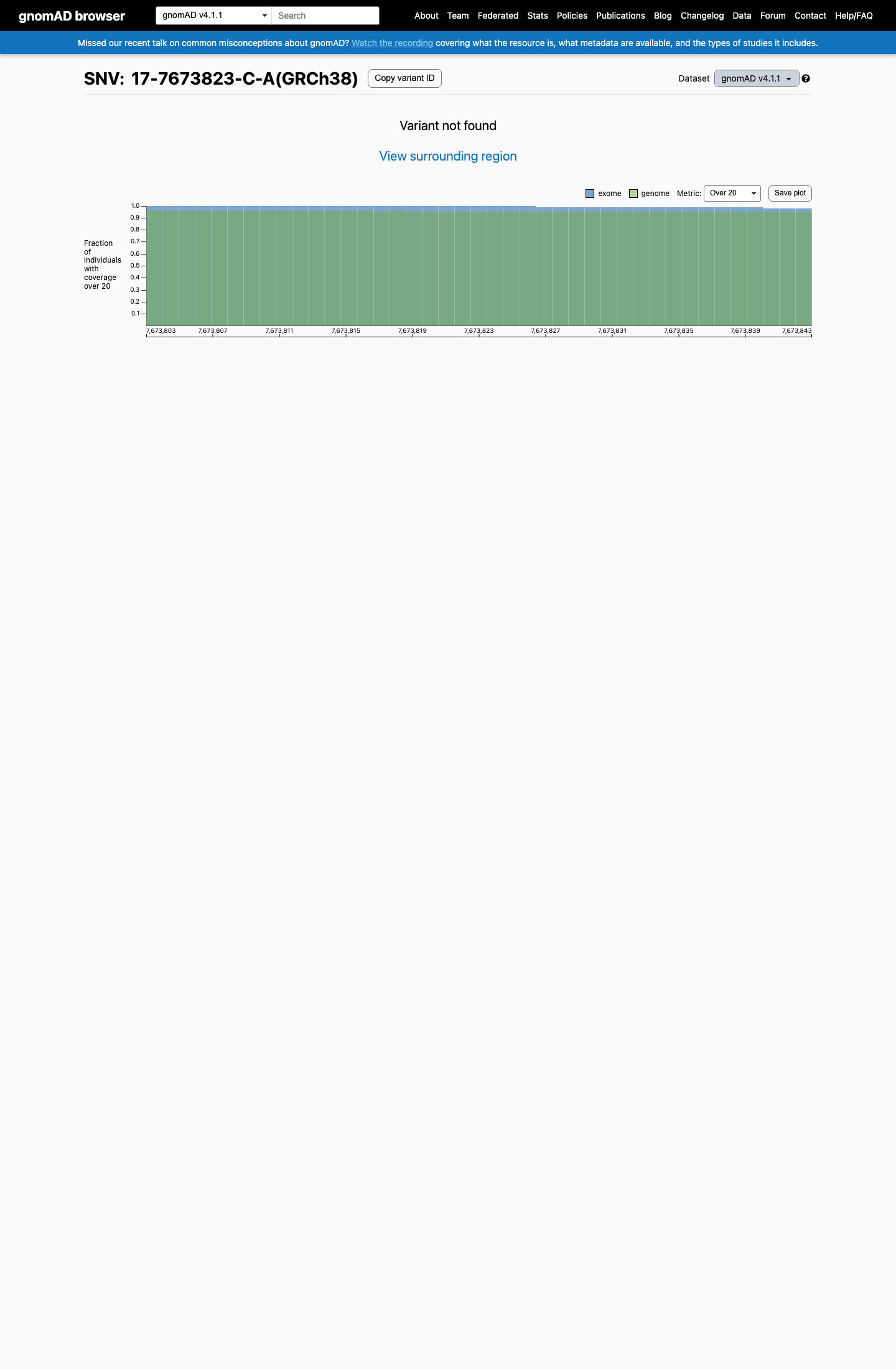
gnomAD v4.1 screenshot
gnomAD v4.1
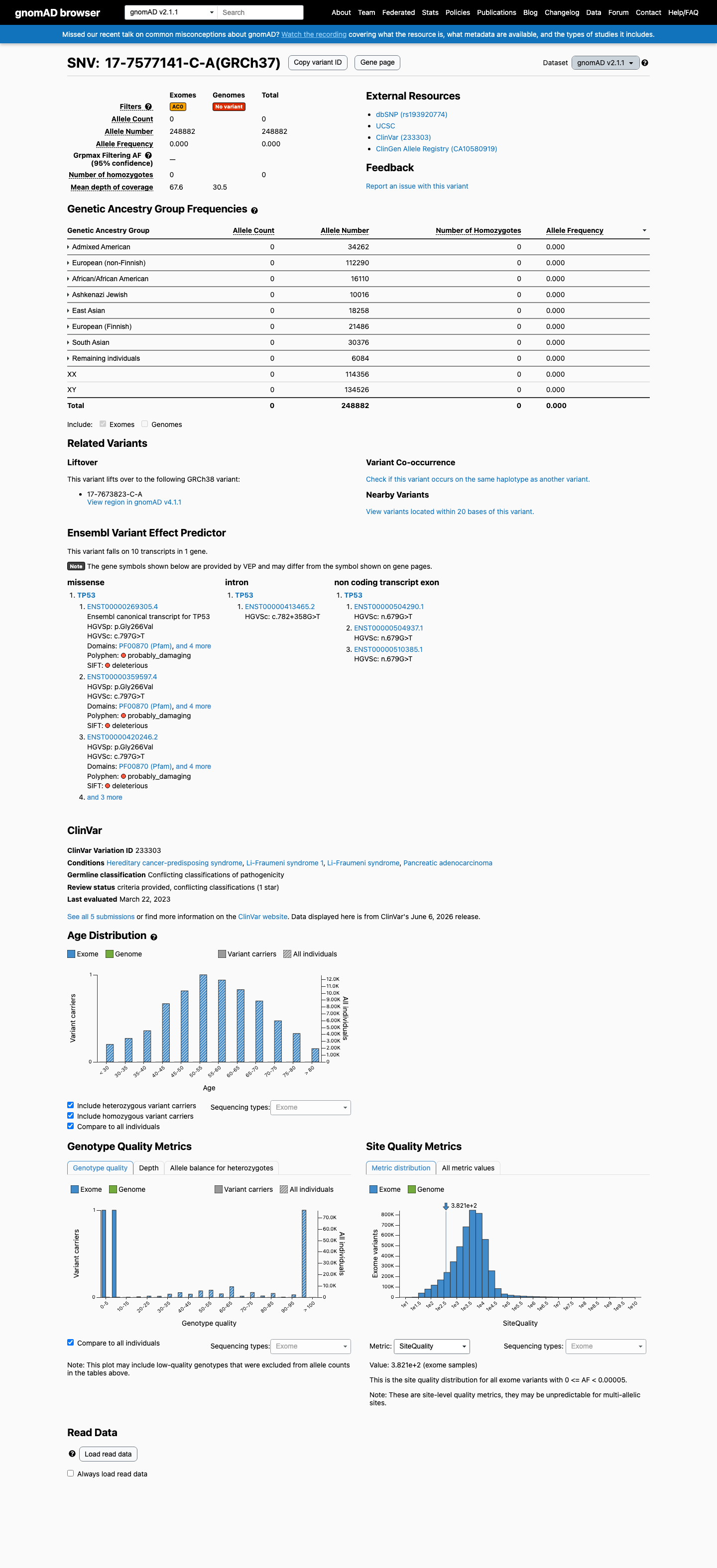
gnomAD v2.1 screenshot
gnomAD v2.1
v4.1
Absent from gnomAD v4.1.
v2.1
This variant is present in gnomAD v2.1 (AF= 0; MAF= 0.00000%, 0/248882 alleles, homozygotes = 0) and has highest observed frequency in the African/African American population (AF= 0; MAF= 0.00000%, 0/16110 alleles, homozygotes = 0).
🇨🇦 CA
Absent from gnomAD-Canada v1.0.
Allele frequency by ancestry
three datasets · side by side
gnomAD v4.1
Absent · 0 / ?
0 hom
Not observed in any ancestry group.
gnomAD v2.1
Absent · 0 / 248,882
0 hom
Not observed in any ancestry group.
+ 8 not observed (African/African American, Admixed American, Ashkenazi Jewish, East Asian, European (Finnish), European (non-Finnish), Remaining individuals, South Asian)
gnomAD Canada 🇨🇦
Absent · 0 / ?
0 hom
Not observed in any ancestry group.
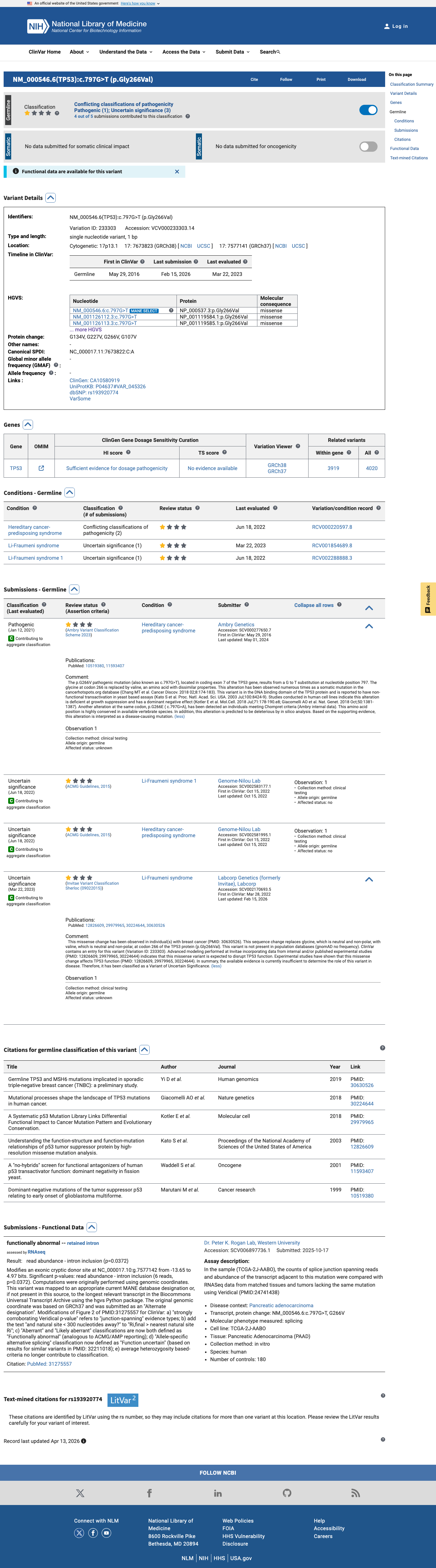
ClinVar screenshot
ClinVar
This variant has been reported in ClinVar as Uncertain significance (3 clinical laboratories) and as Pathogenic (1 clinical laboratory). (ClinVarID = 233303)
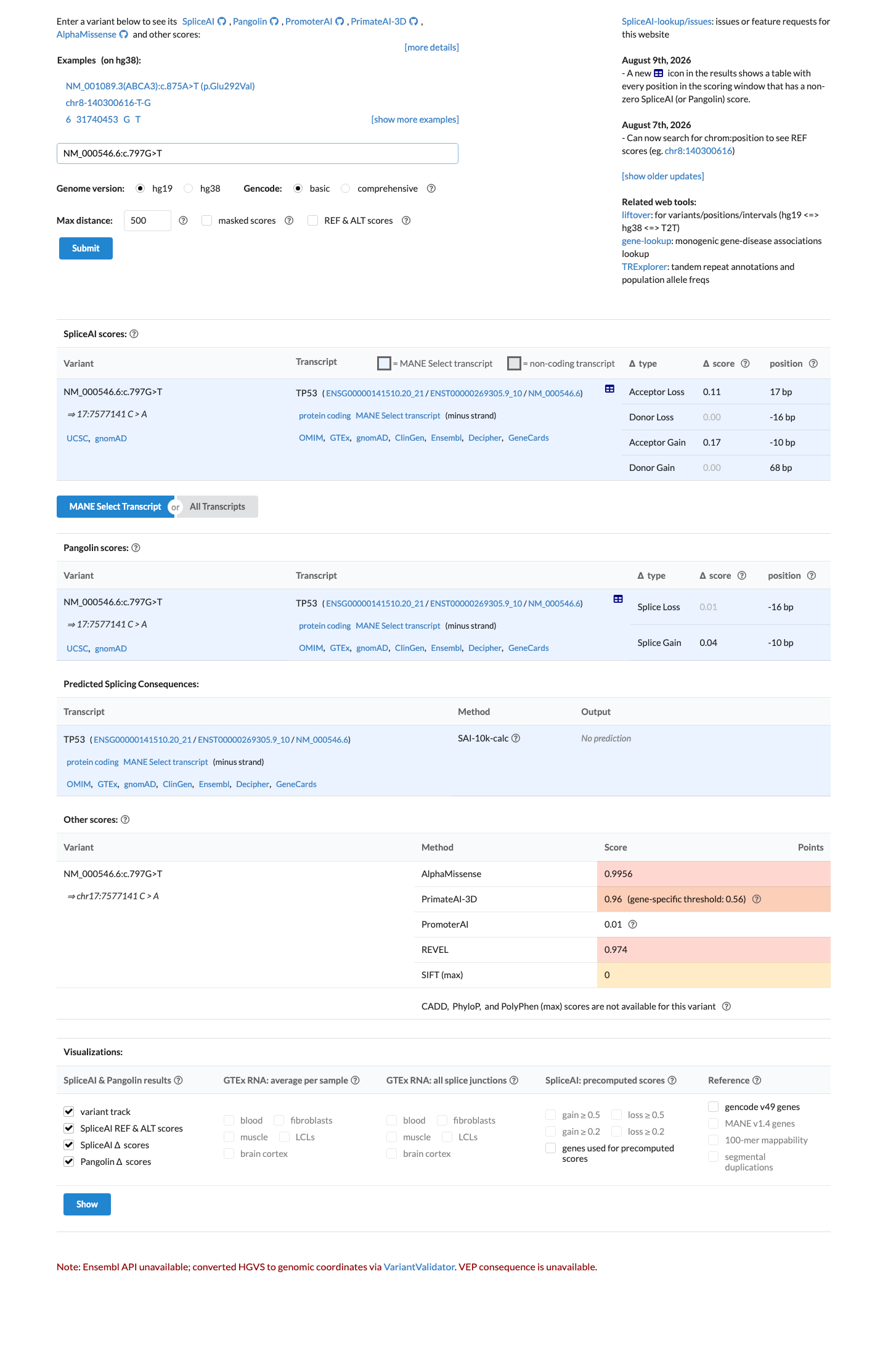
SpliceAI screenshot
In silico
SpliceAI predicts no significant splice impact for this variant (max delta score = 0.00). REVEL score = 0.974. BayesDel score = 0.599005.
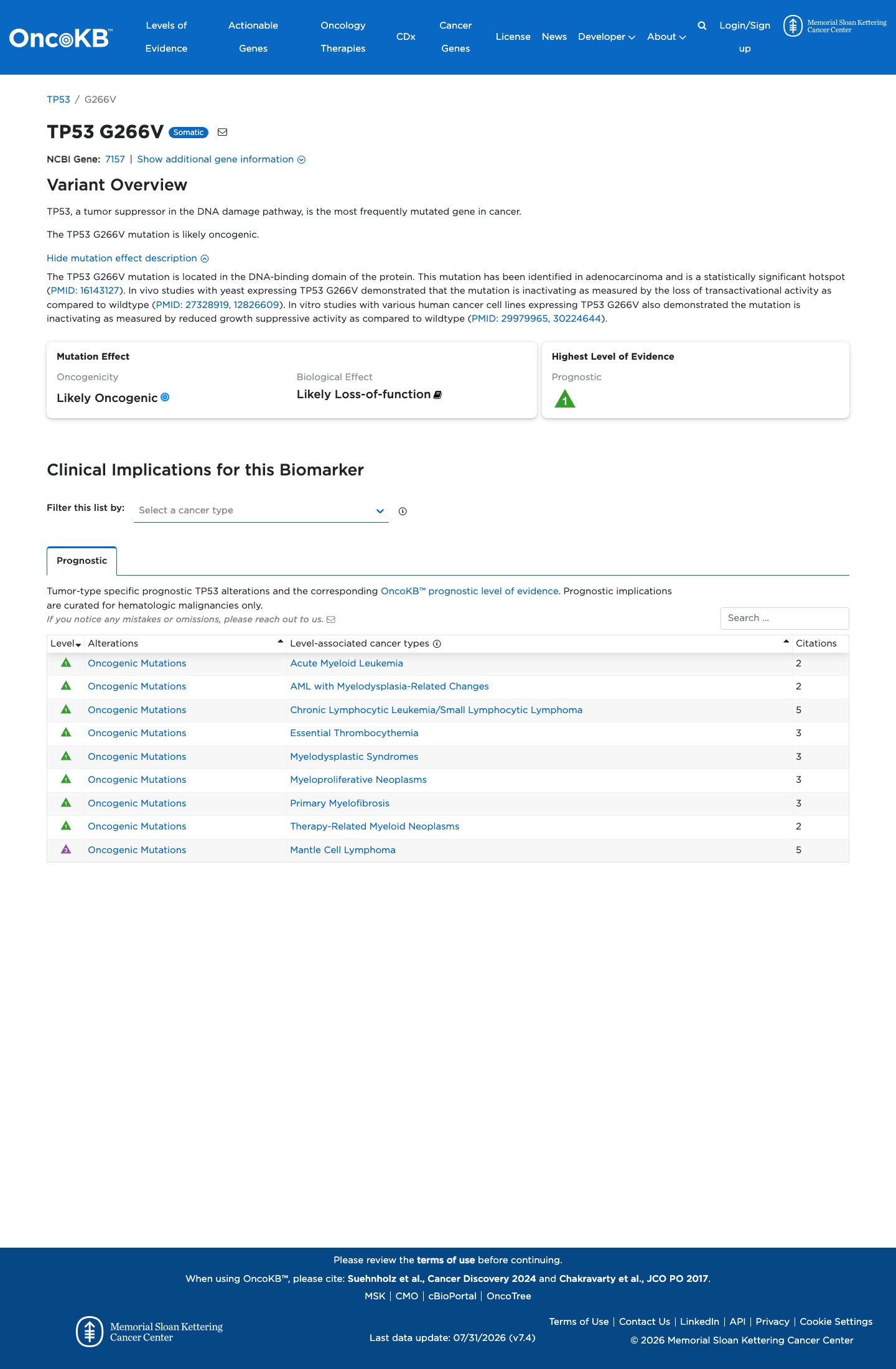
Functional / OncoKB screenshot
Functional Likely Oncogenic
OncoKB identified variant-specific curated literature and context relevant to functional review; biological-effect context: Likely Loss-of-function; curated oncogenicity label: Likely Oncogenic.
OncoKB ↗
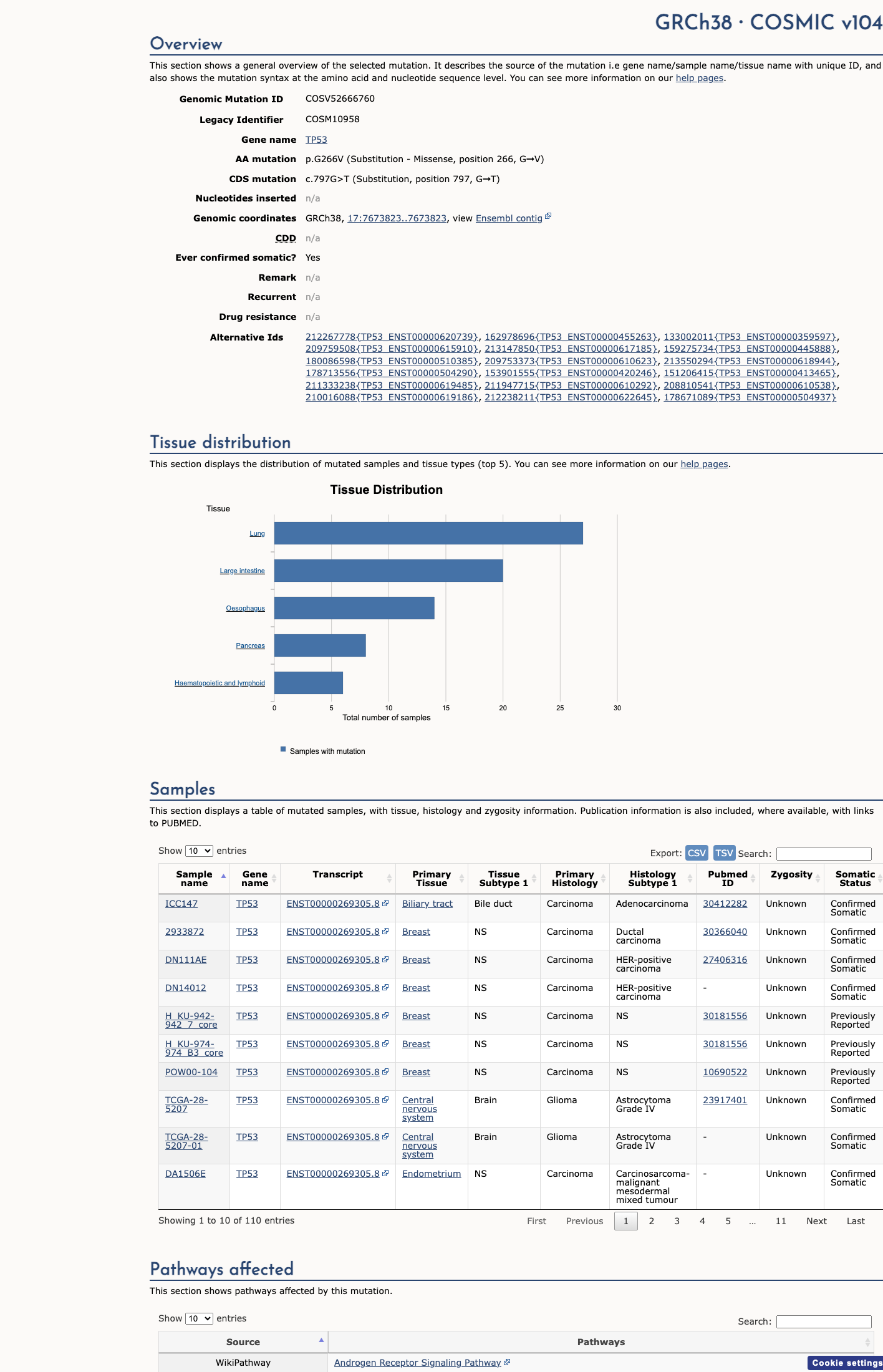
COSMIC screenshot
COSMIC
Cancer hotspots screenshot
Cancer hotspots
Somatic evidence Hotspot
COSMIC
This variant lies in a statistically significant hotspot. This variant has previously been reported in somatic cancers (COSMIC; COSV52666760, n = 110 times).
Hotspots
This variant lies in a statistically significant hotspot.
Sources & reference links
9Sources
CSpec VCEP
ClinVar
gnomAD v2.1
gnomAD v4.1
gnomAD-Canada
SpliceAI
OncoKB
COSMIC
Cancer hotspots
Triaged references · 5 PMIDs not cited in assessment
12826609 ↗ Understanding the function-structure and function-mutation relationships of p53 tumor suppressor protein by high-resolution missense mutation analysis. ONCOKB
29979965 ↗ A Systematic p53 Mutation Library Links Differential Functional Impact to Cancer Mutation Pattern and Evolutionary Conservation. ONCOKB
30224644 ↗ Mutational processes shape the landscape of TP53 mutations in human cancer. ONCOKB
16143127 ↗ Gene-expression profiling predicts recurrence in Dukes' C colorectal cancer. ONCOKB
27328919 ↗ TP53 Variations in Human Cancers: New Lessons from the IARC TP53 Database and Genomics Data. ONCOKB