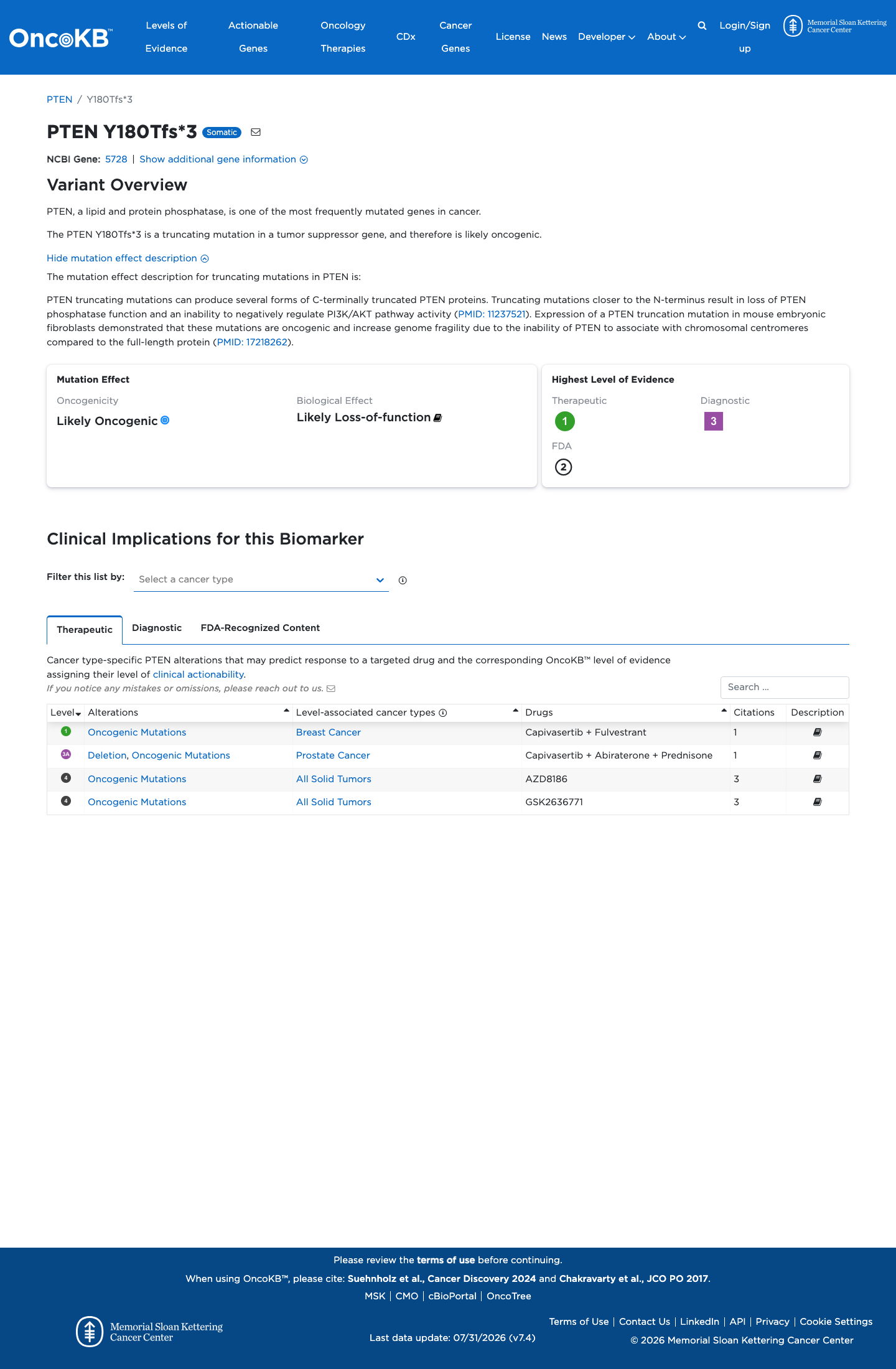
PTEN is a tumor suppressor gene that encodes a phosphatase converting the lipid messenger PIP3 back to PIP2 at the cell membrane, thereby restraining the AKT/mTOR signaling pathway that drives cell growth, proliferation, and survival. It is one of the most frequently mutated genes across many types of human cancer, and its loss promotes unchecked cell growth, survival, and genomic instability, partly through impaired DNA repair. Germline loss-of-function variants in PTEN cause Cowden syndrome, an inherited cancer predisposition disorder associated with elevated risk of breast and thyroid cancer.
This variant
Germline loss-of-function variants in PTEN cause Cowden syndrome, an inherited cancer predisposition disorder with elevated breast and thyroid cancer risk. This frameshift, predicted to eliminate PTEN function through nonsense-mediated decay, is classified Likely Pathogenic, directly matching the loss-of-function mechanism by which this tumor suppressor drives disease.
Transcript
NM_000314.8
HGVS · transcript:coding
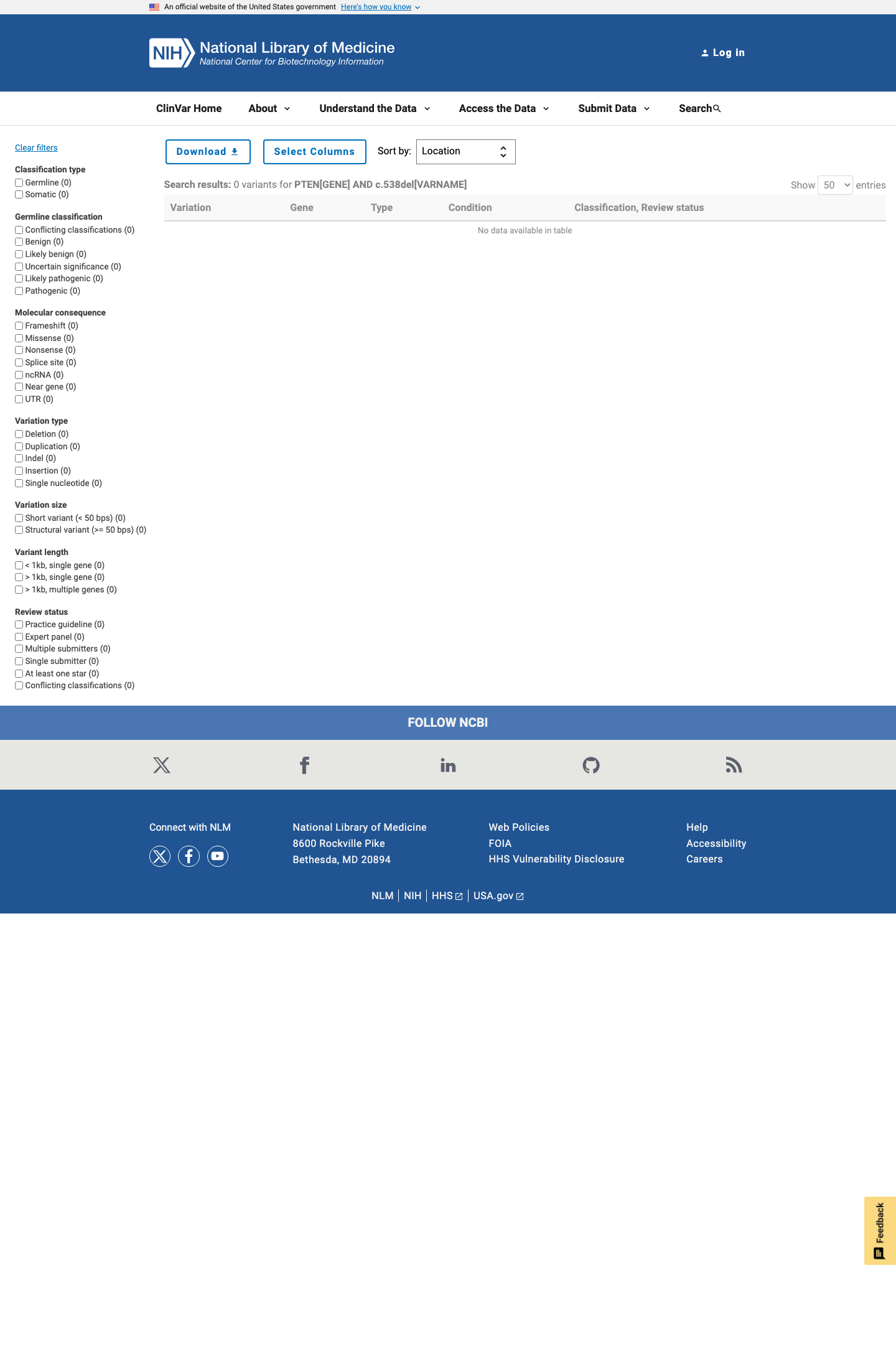
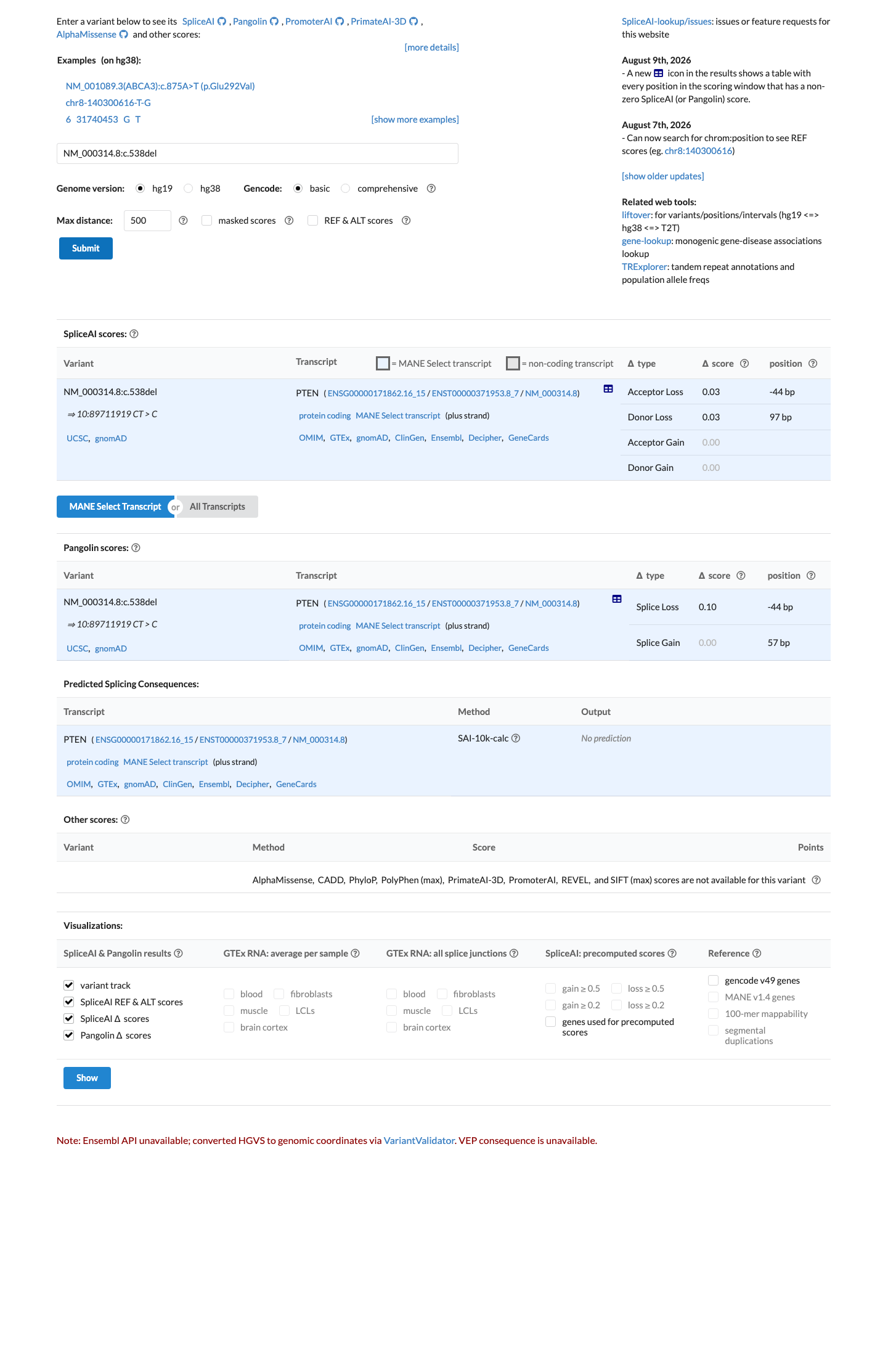
NM_000314.8:c.538del
GRCh38
chr10:87952162 CT>C
GRCh37
chr10:89711919 CT>C
BasisLikely Pathogenic: PVS1 (Very Strong) plus PM2 (Supporting) satisfies PTEN VCEP Rule20, requiring one Pathogenic.Very Strong and one Pathogenic.Supporting criterion.▾
Likely Pathogenic: PVS1 (Very Strong) plus PM2 (Supporting) satisfies PTEN VCEP Rule20, requiring one Pathogenic.Very Strong and one Pathogenic.Supporting criterion.
Classification rationale
PVS1PM2Likely Pathogenic
PTEN c.538delframeshift · exon 6
PVS1 (Very Strong): frameshift p.(Tyr180ThrfsTer3) introduces a premature stop at residue 182, upstream of the PTEN p.Asp375 threshold and predicted to trigger nonsense-mediated decay. PM2 (Supporting): variant is absent from gnomAD v2.1, v4.1, and gnomAD-Canada, meeting the PTEN <0.001% population rarity requirement. Overall: Likely Pathogenic by PTEN VCEP Rule20, combining one Very Strong (PVS1) and one Supporting (PM2) pathogenic criterion.
PVS1 + PM2→Likely Pathogenic
Gene diagram
· NM_000314.8 · variants mapped to exon structure
PTENNM_000314.8
Fetching transcript structure from UCSC…
Exons
—
Transcript span
—
Strand
—
Variants mapped
—
Source
UCSC ncbiRefSeqCurated
All variants in PTEN—click a row to locate it on the plot · use the link column to open its page
Variant ↕
Protein
Location
Classification
Link
Applied criteria · 2 applied · 16 assessed
MetEvidence satisfies this criterion.
Not metEvaluated against available evidence; threshold not reached.
Not assessedApplies in principle, but no evidence was found to evaluate it.
N/ADoesn't apply to this variant type.
Applied · 2
Strength Supporting Moderate Strong Very strong
✓
PVS1very strongPathogenic
Met (Very Strong): frameshift p.(Tyr180ThrfsTer3) stops translation at residue 182, upstream of the PTEN p.Asp375 threshold, with nonsense-mediated decay predicted.
Normalization on the PTEN Expert Panel's biologically relevant transcript NM_000314.8 gives p.(Tyr180ThrfsTer3) for c.538del and places the variant in exon 6.The PTEN Expert Panel PVS1 decision tree assigns PVS1 to frameshift or nonsense variants at or 5′ to p.Asp375 (c.1121) in NM_000314.8; c.538del is 5′ to this threshold.The premature stop at residue 182 occurs before downstream exon junctions, consistent with nonsense-mediated decay rather than a distal NMD-escaping truncation.
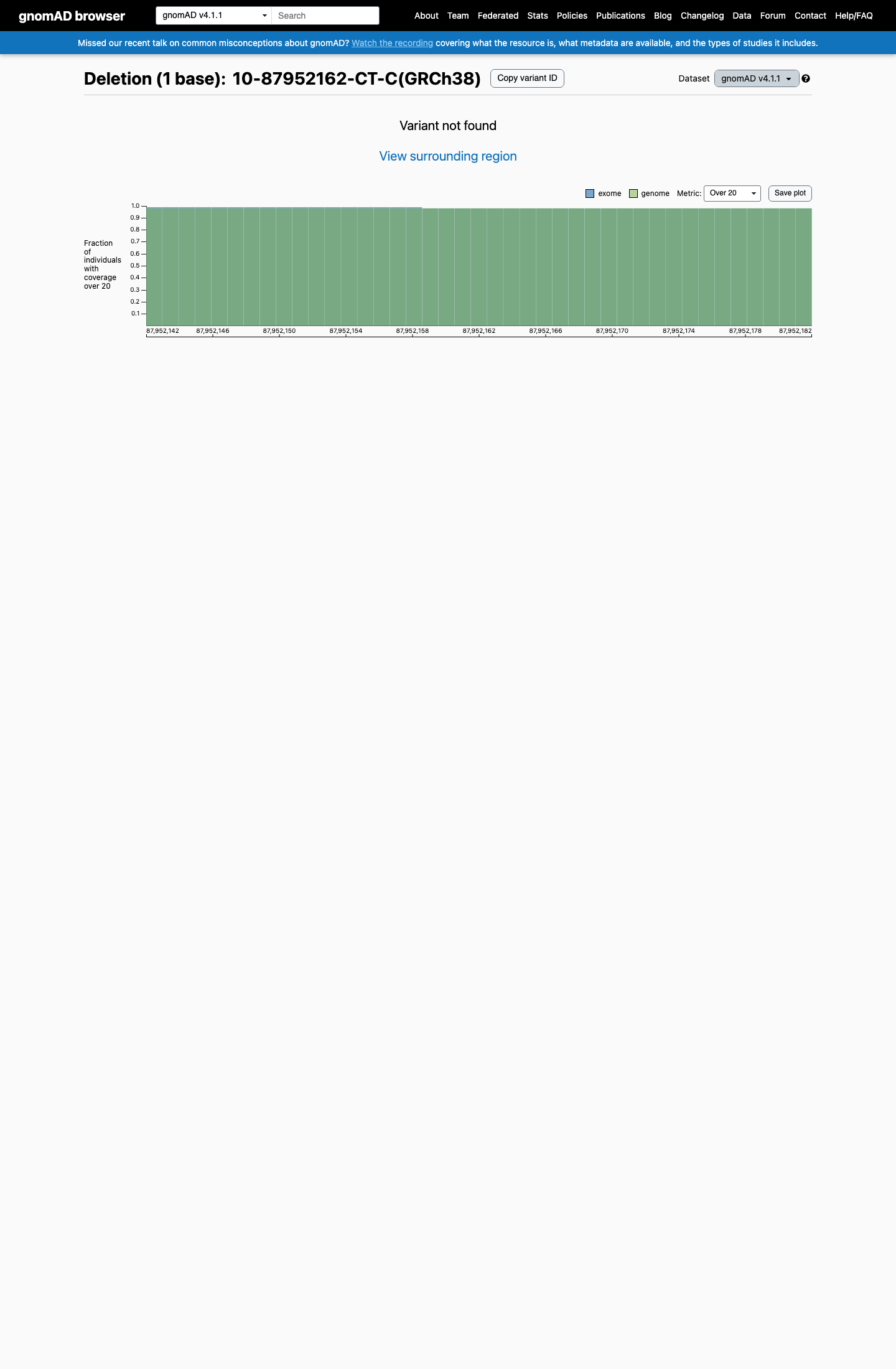
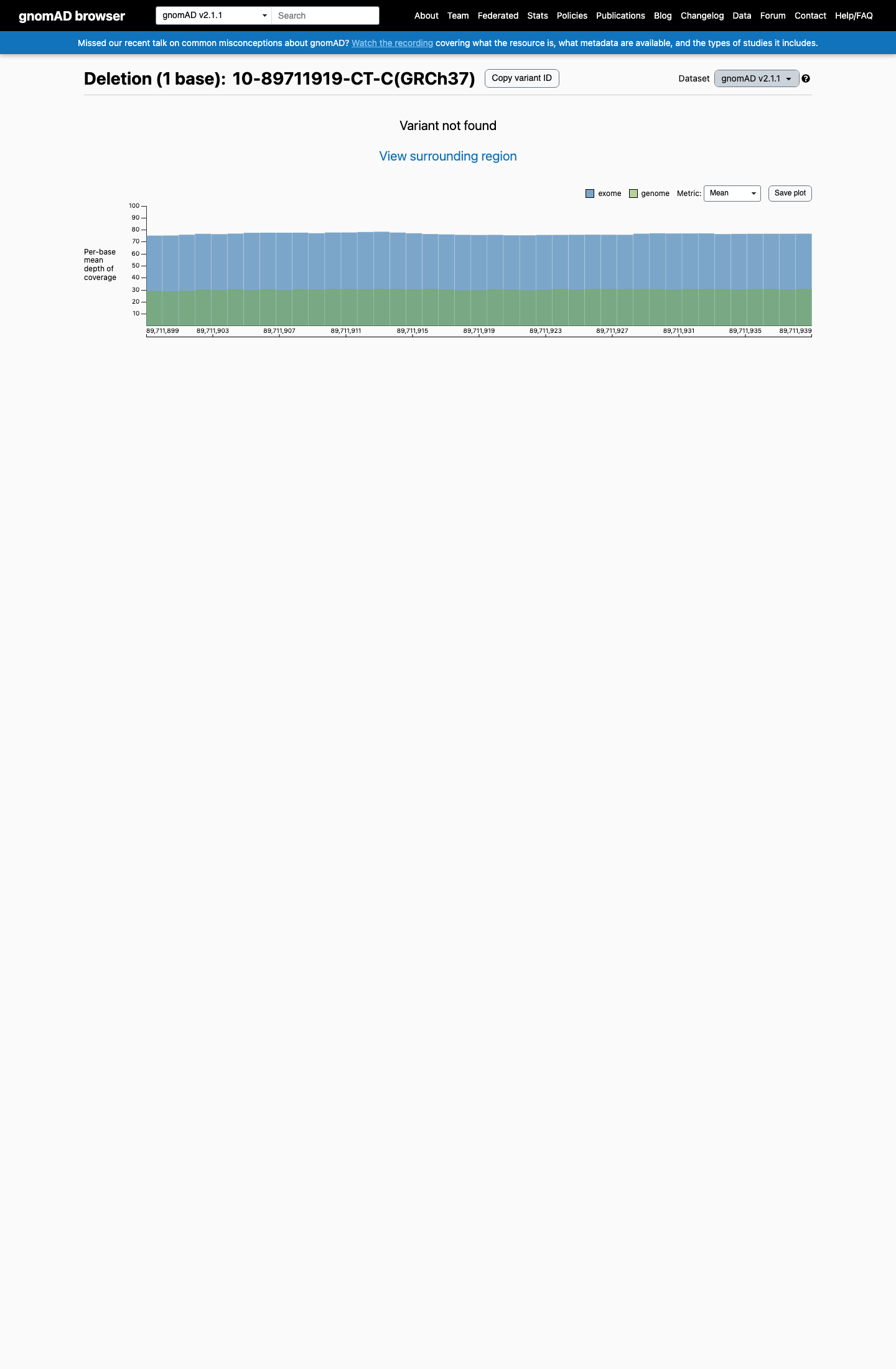
Met (Supporting): absent from gnomAD v2.1, v4.1, and gnomAD-Canada, meeting the PTEN <0.001% population frequency requirement.
ClinGen PTEN Expert Panel Specification version 3.2 defines PM2 Supporting as allele frequency <0.00001 (0.001%) in gnomAD or another large sequenced population; if multiple alleles are present in a subpopulation, that subpopulation frequency must be <0.00002 (0.002%).The normalized variant NM_000314.8:c.538del, corresponding to NC_000010.10:g.89711920del and NC_000010.11:g.87952163del, was reported absent from gnomAD v2.1, gnomAD v4.1, and gnomAD-Canada v1.0.Because the variant is absent rather than observed at a measurable frequency, no ancestry-specific frequency exceeds the VCEP PM2 limit in the available queried datasets.