DICER1 encodes an enzyme that processes RNA into small silencing RNAs and microRNAs, which regulate gene expression after transcription. Germline mutations in DICER1 cause DICER1-related disorders, a familial tumor susceptibility syndrome that increases the risk of pleuropulmonary blastoma, cystic nephroma, rhabdomyosarcoma, multinodular goiter, and ovarian Sertoli-Leydig cell tumors. DICER1 acts as a tumor suppressor, and loss or reduced activity of the protein is linked to cancer development and poorer outcomes in several cancer types, including lung, breast, and ovarian cancers.
This variant
DICER1 germline mutations cause a familial tumor susceptibility syndrome, yet this intronic variant is present in 35.2% of gnomAD alleles, far too common to be a disease-causing predisposition allele. Consistent with a benign change, it does not alter the DICER1 protein or its RNA-processing function, so it should not be considered a contributor to DICER1-related cancer risk.
Transcript
NM_177438.3
HGVS · transcript:coding
NM_177438.3:c.4206+9del
GRCh38
chr14:95099770 AC>A
GRCh37
chr14:95566107 AC>A
ClinGen DICER1 VCEP v1.4 point framework: BA1 stand-alone benign (-8) + BS1 strong (-4) + BS2 supporting (-1) = -13 points, which maps to Benign.
Classification rationale
BA1BS1BS2Benign
DICER1 c.4206+9delunknown · exon 22i
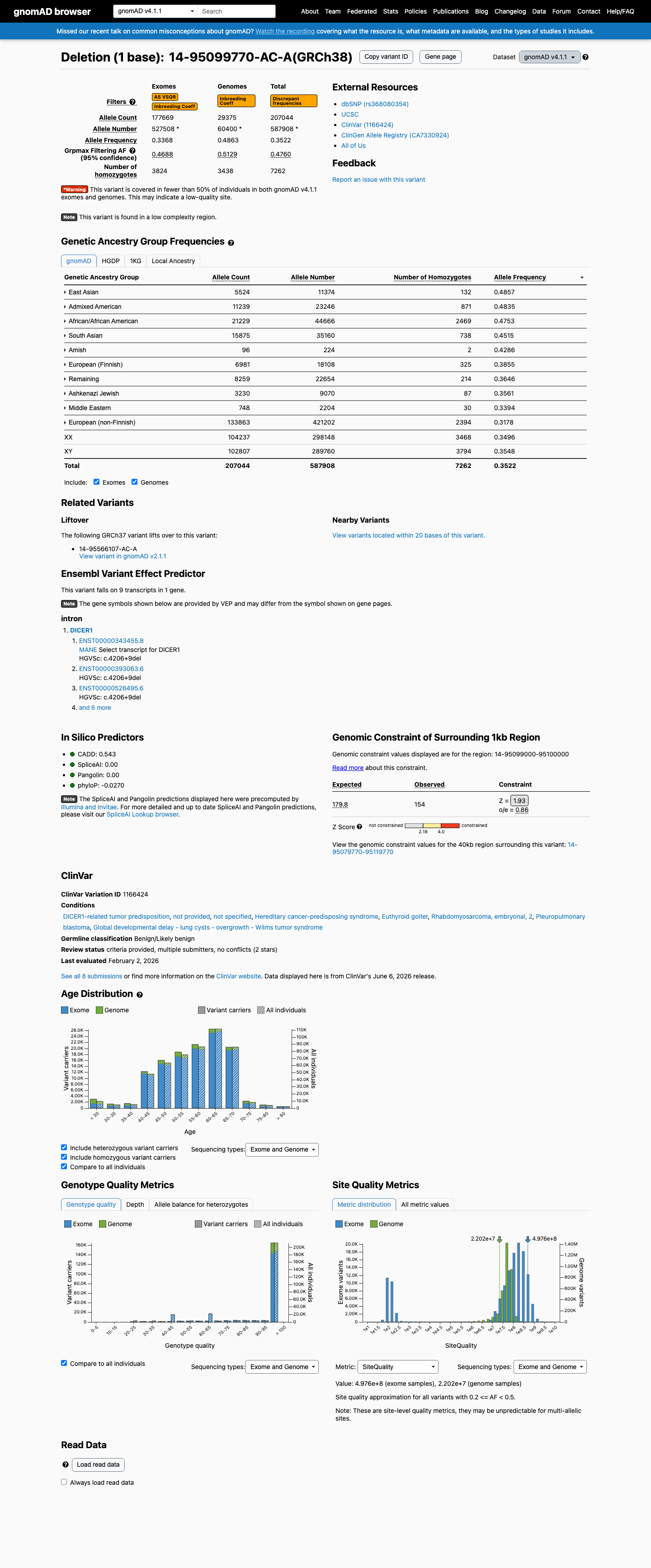
BA1 (stand-alone benign): gnomAD v4.1 allele frequency 35.2% overall and 48.6% in East Asians far exceeds the >0.3% BA1 threshold. BS1 (strong): the same gnomAD frequency far exceeds the >0.03% BS1 threshold, incompatible with a rare tumor-predisposition allele. BS2 (supporting): 7,262 homozygous carriers in gnomAD far exceed the two-observation BS2 threshold. Combined, BA1 (-8) + BS1 (-4) + BS2 (-1) = -13 points, classifying this variant as Benign under the DICER1 VCEP framework.
BA1 + BS1 + BS2→Benign
Gene diagram
· NM_177438.3 · variants mapped to exon structure
DICER1NM_177438.3
Fetching transcript structure from UCSC…
Exons
—
Transcript span
—
Strand
—
Variants mapped
—
Source
UCSC ncbiRefSeqCurated
All variants in DICER1—click a row to locate it on the plot · use the link column to open its page
Protein
Location
Classification
Link
Applied criteria · 3 applied · 15 assessed
MetEvidence satisfies this criterion.
Not metEvaluated against available evidence; threshold not reached.
Not assessedApplies in principle, but no evidence was found to evaluate it.
N/ADoesn't apply to this variant type.
Applied · 3
Strength Supporting Moderate Strong Very strong
✓
BA1stand-aloneBenign
Met (stand-alone benign): gnomAD v4.1 allele frequency 35.2% overall and 48.6% in East Asians far exceeds the >0.3% BA1 threshold.
The DICER1 VCEP Version 1.4 rule states: frequency >0.003 (0.3%) in gnomAD subpopulations; subpopulations must have >2,000 alleles tested and a minimum of 5 alleles present.The VCEP clarification states that, in general, the most recent/most comprehensive gnomAD version should be used.gnomAD v4.1 reports AF 0.352171 overall from 207,044/587,908 alleles, 7,262 homozygotes, and East Asian AF 0.485669 from 5,524/11,374 alleles with 132 homozygotes.
Met (strong): gnomAD allele frequency 35.2% far exceeds the >0.03% BS1 threshold, incompatible with a rare disease-causing allele.
The DICER1 VCEP Version 1.4 rule states: frequency >0.0003 (0.03%) in gnomAD subpopulations; subpopulations must have >2,000 alleles tested and a minimum of 5 alleles present.gnomAD v4.1 reports overall AF 0.352171 (207,044/587,908 alleles) and East Asian AF 0.485669 (5,524/11,374 alleles), with 7,262 overall homozygotes and 132 East Asian homozygotes.
Met (supporting): 7,262 homozygous carriers in gnomAD far exceed the two-observation BS2 threshold.
The DICER1 VCEP Version 1.4 BS2 Supporting rule permits 2 or more observations of homozygosity in individuals lacking clinical information.gnomAD v4.1 reports 7,262 homozygotes overall and 132 homozygotes in the East Asian subpopulation; these population records do not provide individual-level phenotype or parental-testing information in the case bundle.
This variant is present in gnomAD v4.1 (AF= 0.352171; MAF= 35.21707%, 207044/587908 alleles, homozygotes = 7262) and has highest observed frequency in the East Asian population (AF= 0.485669; MAF= 48.56691%, 5524/11374 alleles, homozygotes = 132); grpmax FAF= 0.476004.
v2.1
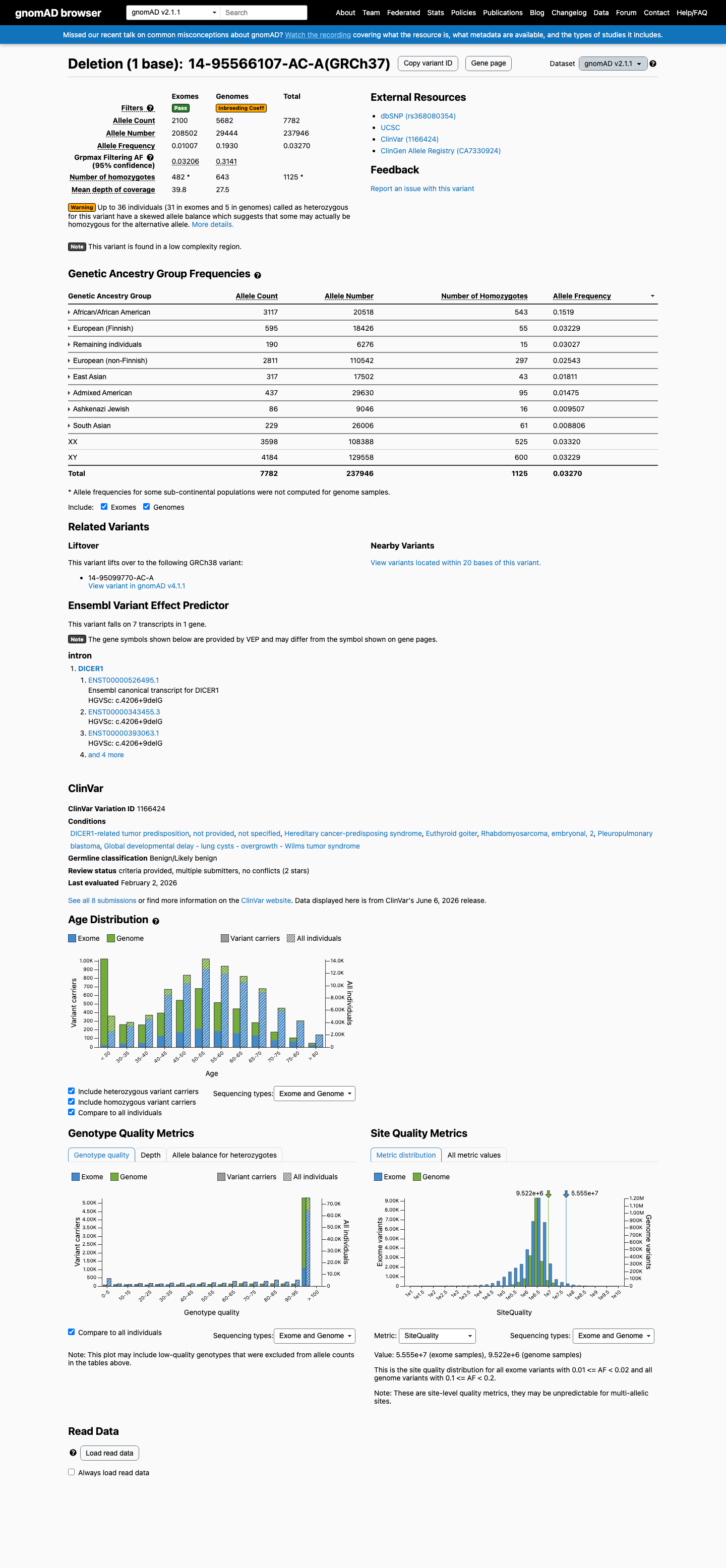
This variant is present in gnomAD v2.1 (AF= 0.0327049; MAF= 3.27049%, 7782/237946 alleles, homozygotes = 1125) and has highest observed frequency in the African/African American population (AF= 0.151915; MAF= 15.19154%, 3117/20518 alleles, homozygotes = 543); grpmax FAF= 0.314123.
🇨🇦 CA
This variant is present in gnomAD-Canada v1.0 (AF= 0.46475563909774437, 2967/6384 alleles, homozygotes = 279).
Triaged references · 5 PMIDs not cited in assessment
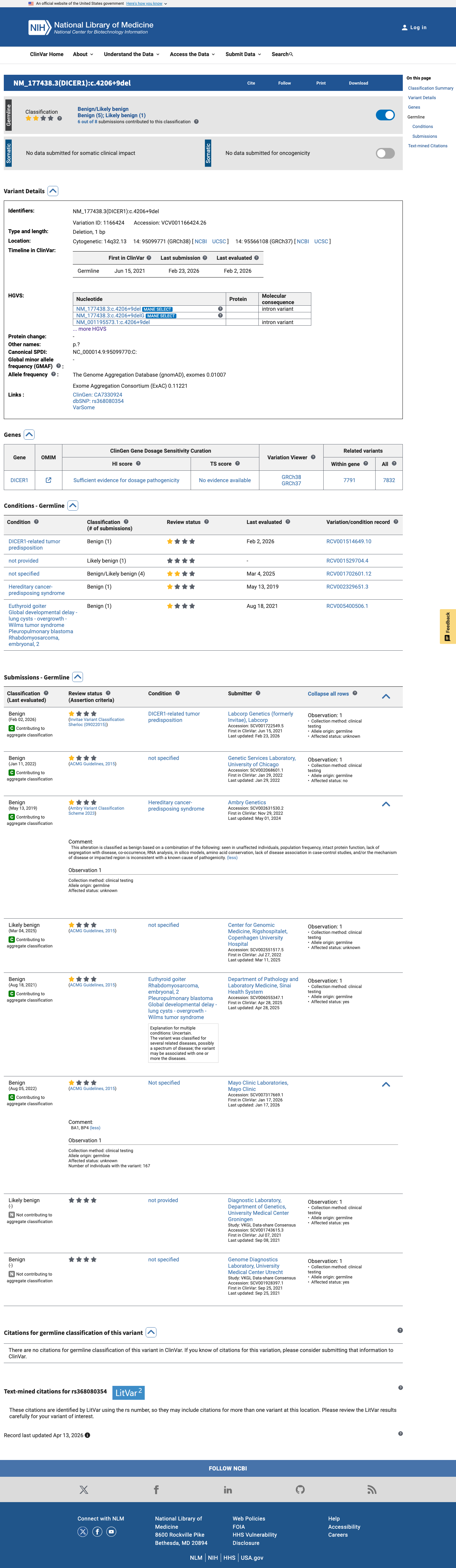
25741868 ↗Standards and guidelines for the interpretation of sequence variants: a joint consensus recommendation of the American College of Medical Genetics and Genomics and the Association for Molecular Pathology.CLINVAR
24493721 ↗American Society of Clinical Oncology Expert Statement: collection and use of a cancer family history for oncology providers.CLINVAR
25394175 ↗A practice guideline from the American College of Medical Genetics and Genomics and the National Society of Genetic Counselors: referral indications for cancer predisposition assessment.CLINVAR
28492532 ↗Sherloc: a comprehensive refinement of the ACMG-AMP variant classification criteria.CLINVAR