0%
complete
Final classification
Likely Pathogenic
PVS1PM2
PTCH1
c.2588G>A
p.Trp863Ter
nonsense · exon 16

PTCH1 encodes a transmembrane receptor for hedgehog signaling proteins such as sonic hedgehog, a pathway that guides embryonic development. The protein normally keeps hedgehog signaling in check by inhibiting the Smoothened protein, so when PTCH1 is inactivated the pathway becomes overactive. Inherited changes in PTCH1 cause Gorlin syndrome (nevoid basal cell carcinoma syndrome), which predisposes to basal cell carcinoma and medulloblastoma, and can also contribute to holoprosencephaly. As a tumor suppressor, its loss drives basal cell carcinoma and medulloblastoma.

This variant

This PTCH1 loss-of-function variant is relevant to Gorlin syndrome, in which disruption of the tumor-suppressor receptor can cause constitutive Hedgehog-pathway activation.

Transcript
NM_000264.4
HGVS · transcript:coding
NM_000264.4:c.2588G>A
GRCh38
chr9:95461971 C>T
GRCh37
chr9:98224253 C>T
Likely Pathogenic: PVS1 (very strong) for the NMD-eligible PTCH1 truncation plus PM2 (supporting) for absence from gnomAD drove the call.
Classification rationale
PVS1PM2 Likely Pathogenic
PTCH1 c.2588G>A nonsense · exon 16

PVS1 very strong: the exon 16 nonsense variant truncates PTCH1 at residue 863 of 1,448 and is expected to undergo nonsense-mediated decay. PM2 supporting: the variant is absent from gnomAD v2.1 and v4.1, supporting rarity in reference populations.

PVS1 + PM2 Likely Pathogenic
Gene diagram · NM_000264.4 · variants mapped to exon structure
PTCH1 NM_000264.4
Fetching transcript structure from UCSC…
Applied criteria · 2 applied · 15 assessed
MetEvidence satisfies this criterion.
Not metEvaluated against available evidence; threshold not reached.
Not assessedApplies in principle, but no evidence was found to evaluate it.
N/ADoesn't apply to this variant type.
Applied · 2
Strength Supporting Moderate Strong Very strong
PVS1 very strong Pathogenic
Met at very strong: the exon 16 nonsense variant truncates PTCH1 at residue 863 of 1,448 and is expected to undergo nonsense-mediated decay.
The normalized consequence is NM_000264.4:c.2588G>A, NP_000255.2:p.(Trp863Ter), a nonsense change that truncates PTCH1 from 1,448 amino acids to 862 residues before the premature stop.VariantValidator assigns the variant to exon 16; the transcript annotation shows multiple downstream coding exons, supporting a premature termination codon sufficiently upstream of the terminal exon-exon junction for expected nonsense-mediated decay.NM_000264.4 is the RefSeq-selected PTCH1 transcript, and the transcript-level annotation is concordant with the normalized p.(Trp863Ter) consequence.
PM2 supporting Pathogenic
Met at supporting strength: the variant is absent from gnomAD v2.1 and v4.1, supporting rarity in reference populations.
The default all-comers gnomAD v2.1 record reports the variant as absent.The default all-comers gnomAD v4.1 record reports the variant as absent.The generic ACMG/AMP framework publication (Richards et al., PMID:25741868) supports PM2 when a variant is absent or extremely rare in appropriate population databases; this variant is absent from both default datasets.
Assessed · not applied · 4 not met · 11 not assessed
Pathogenic
PS2 Not assessed: no proband-specific parental genotypes or maternity and paternity confirmation are documented for this variant.
PS3 Not assessed: no validated assay directly tested PTCH1 p.(Trp863Ter) with variant-specific quantitative results and appropriate controls.
PS4 Not assessed: no exact-variant case-control counts or validated enrichment statistic were available for PS4.
PM6 Not assessed: no family-history or parental-testing evidence supports presumed de novo occurrence of this variant.
PP1 Not assessed: no informative affected-relative genotypes or meioses are reported for segregation analysis.
PP4 Not assessed: no patient-level phenotype or family history was provided to establish a highly specific Gorlin syndrome presentation.
PP5 Not met: the exact variant is Pathogenic in ClinVar, but the record has zero expert-panel submissions.
Benign
BA1 Not met: the variant is absent from gnomAD v2.1 and v4.1, far below the generic BA1 population-frequency threshold of >5%.
BS1 Not met: gnomAD v2.1 and v4.1 show no observed allele frequency, so the variant does not exceed a disease-specific BS1 threshold.
BS2 Not assessed: gnomAD reports no carriers or homozygotes, so the required healthy-adult observation for BS2 is unavailable.
BS3 Not assessed: no validated assay showed preserved PTCH1 function for p.(Trp863Ter) using quantitative results and appropriate controls.
BS4 Not assessed: no genotyped affected relatives with reliable phenotype information are available to demonstrate non-segregation.
BP2 Not assessed: no second pathogenic variant or molecular phase result establishes c.2588G>A in trans or cis with another disease-causing allele.
BP5 Not assessed: no confirmed alternative molecular diagnosis or applicable BP5-specific likelihood-ratio evidence was available.
BP6 Not met: the exact variant has no expert-panel Benign or Likely benign ClinVar classification.
N/A · 11 PS1 · PM1 · PM3 · PM4 · PM5 · PP2 · PP3 · BP1 · BP3 · BP4 · BP7
Research & evidence
Population frequency · supports pathogenic
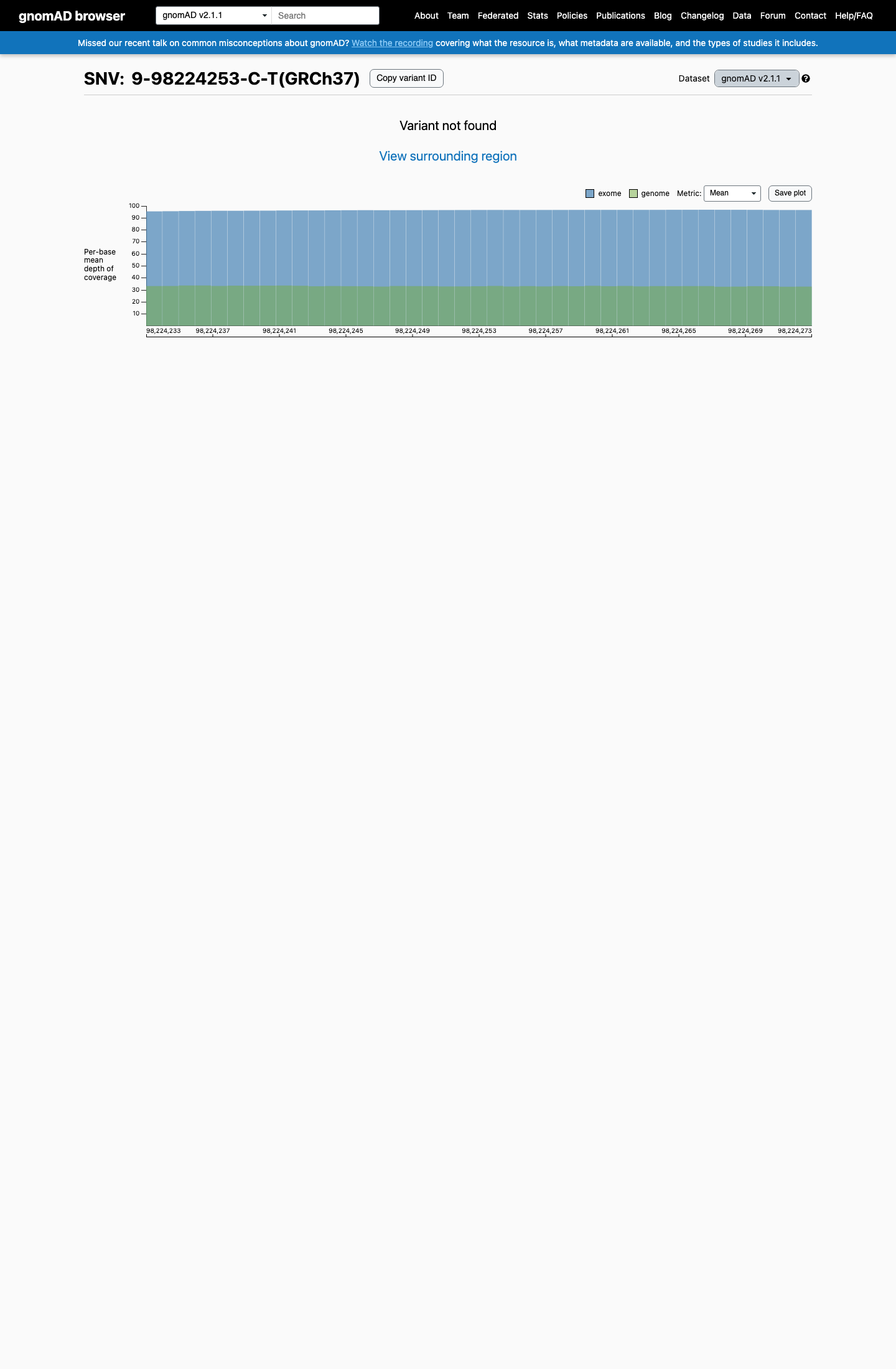
gnomAD v4.1 screenshot
gnomAD v4.1
gnomAD v2.1 screenshot
gnomAD v2.1
v4.1
Absent from gnomAD v4.1.
v2.1
Absent from gnomAD v2.1.
🇨🇦 CA
Absent from gnomAD-Canada v1.0.
Allele frequency by ancestry
three datasets · side by side
gnomAD v4.1
Absent · 0 / ?
0 hom
Not observed in any ancestry group.
gnomAD v2.1
Absent · 0 / ?
0 hom
Not observed in any ancestry group.
gnomAD Canada 🇨🇦
Absent · 0 / ?
0 hom
Not observed in any ancestry group.
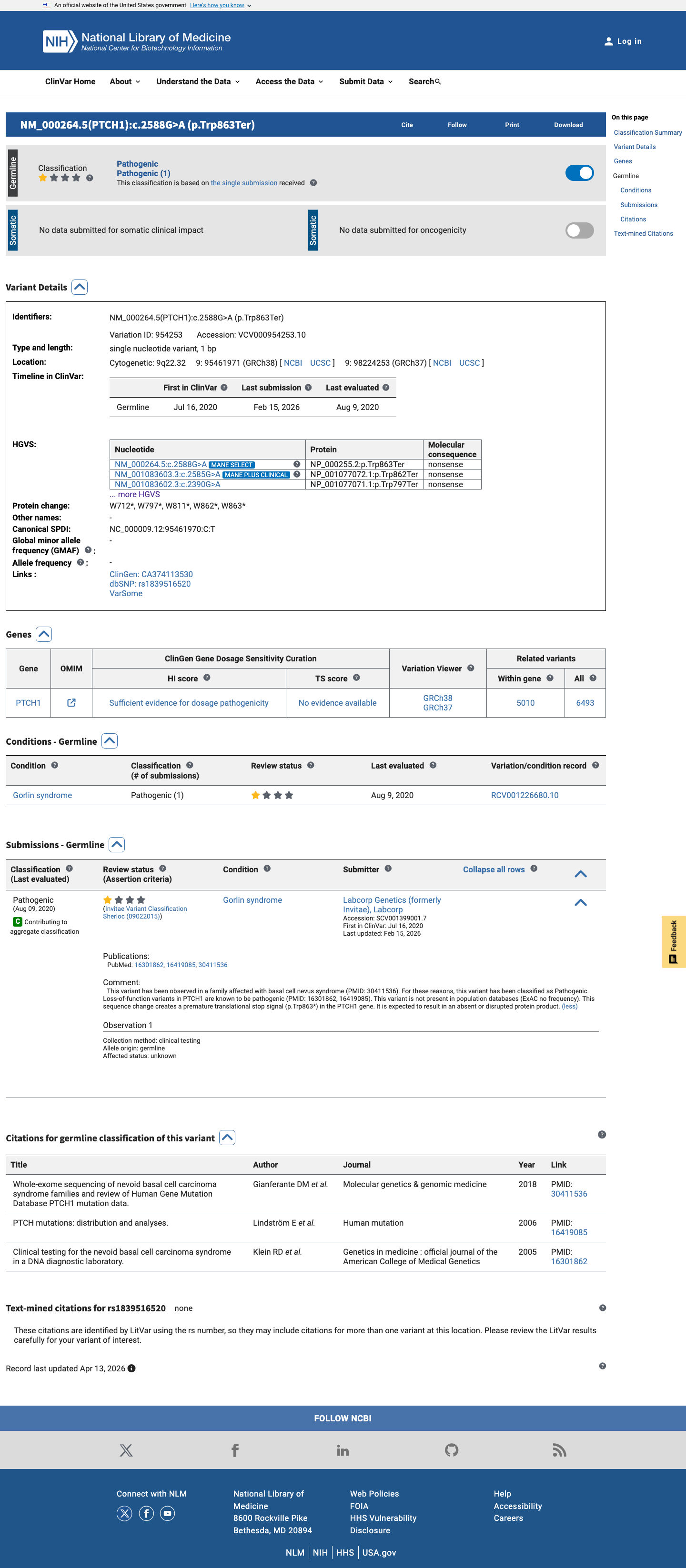
ClinVar screenshot
ClinVar
This variant has been reported in ClinVar as Pathogenic (1 clinical laboratory). (ClinVarID = 954253)
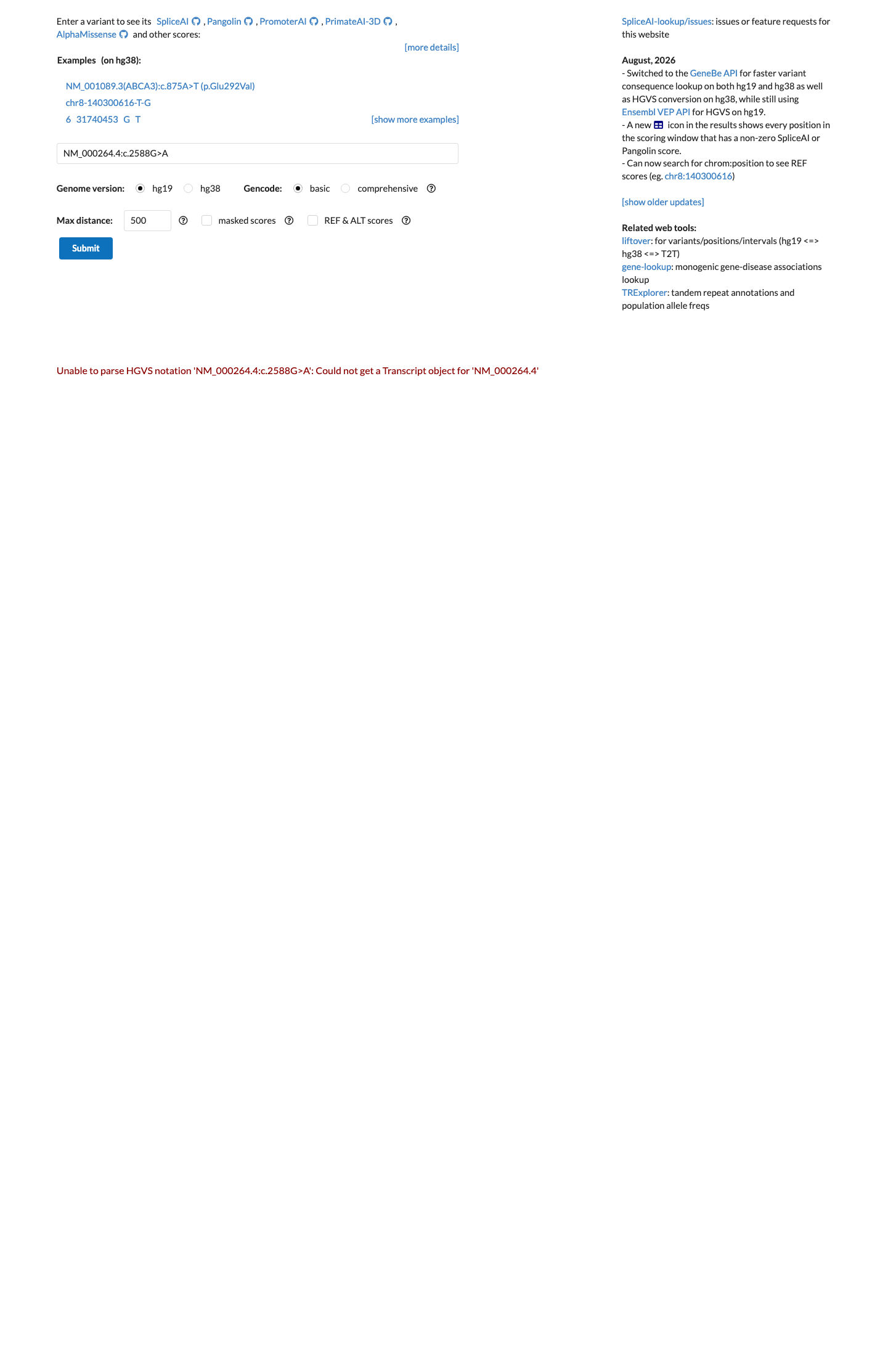
SpliceAI screenshot
In silico
SpliceAI predicts no significant splice impact for this variant (max delta score = 0.03).
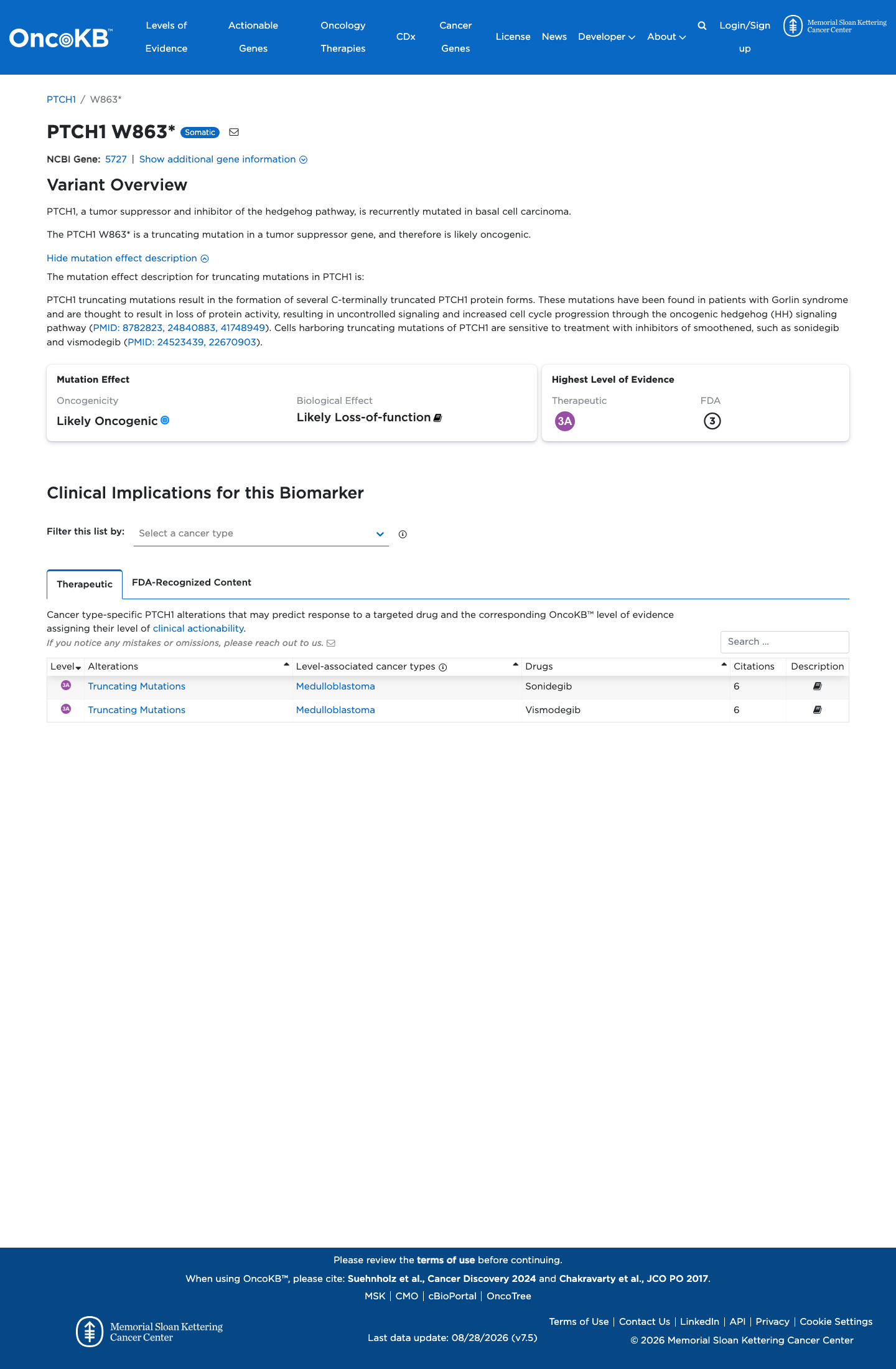
Functional / OncoKB screenshot
Functional Likely Oncogenic
OncoKB identified variant-specific curated literature and context relevant to functional review; biological-effect context: Likely Loss-of-function; curated oncogenicity label: Likely Oncogenic.
OncoKB ↗
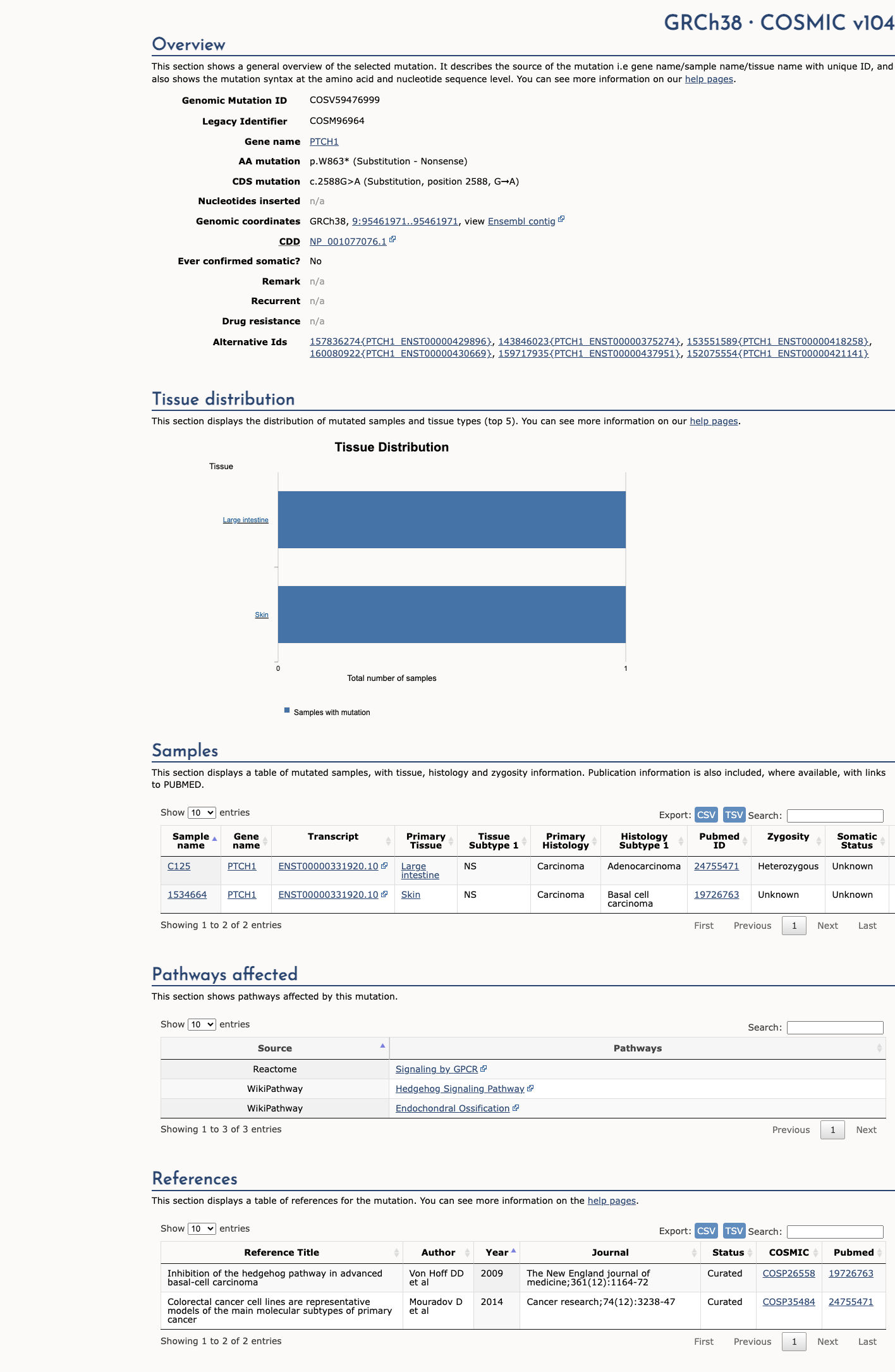
COSMIC screenshot
COSMIC
Cancer hotspots screenshot
Cancer hotspots
Somatic evidence Not in COSMIC / hotspots
COSMIC
This variant does not lie in a statistically significant hotspot. This variant has previously been reported in somatic cancers (COSMIC; COSV59476999, n = 2 times).
Hotspots
This variant does not lie in a statistically significant hotspot.
Literature · how each cited paper was used
2papers cited
Each card is an audit: what was searched, what was found, whether it names the variant, which criteria it fed, and why. 6 further PMIDs triaged but not cited — see Sources & references.
Rule & framework references · cited for criterion definitions, not variant evidence
16301862 ↗ Clinical testing for the nevoid basal cell carcinoma syndrome in a DNA diagnostic laboratory.
16419085 ↗ PTCH mutations: distribution and analyses.
Sources & reference links
8Sources
ClinVar
gnomAD v2.1
gnomAD v4.1
gnomAD-Canada
SpliceAI
OncoKB
COSMIC
Cancer hotspots
Triaged references · 6 PMIDs not cited in assessment
22670903 ↗ Efficacy and safety of vismodegib in advanced basal-cell carcinoma. ONCOKB
24523439 ↗ A phase I, multicenter, open-label, first-in-human, dose-escalation study of the ONCOKB
24840883 ↗ The large intracellular loop of ptch1 mediates the non-canonical Hedgehog pathwa ONCOKB
41748949 ↗ Partial truncation of the C-terminal domain of PTCH1 in cancer promotes tumourig ONCOKB
8782823 ↗ The role of the human homologue of Drosophila patched in sporadic basal cell car ONCOKB
20301330 ↗ Nevoid Basal Cell Carcinoma Syndrome. CLINVAR